<?xml version="1.0" encoding="utf-8"?><feed xmlns="http://www.w3.org/2005/Atom" ><generator uri="https://jekyllrb.com/" version="4.2.2">Jekyll</generator><link href="https://nodebe4.github.io/oped2/feed.xml" rel="self" type="application/atom+xml" /><link href="https://nodebe4.github.io/oped2/" rel="alternate" type="text/html" /><updated>2026-04-16T06:43:40-05:00</updated><id>https://nodebe4.github.io/oped2/feed.xml</id><title type="html">觀點2</title><subtitle>高頻版 git.io/JUJZT</subtitle><entry><title type="html">不會日文去考 JLPT 日檢 N2 可以得幾分？</title><link href="https://nodebe4.github.io/oped2/2025-02-15/%E4%B8%8D%E6%9C%83%E6%97%A5%E6%96%87%E5%8E%BB%E8%80%83-JLPT-%E6%97%A5%E6%AA%A2-N2-%E5%8F%AF%E4%BB%A5%E5%BE%97%E5%B9%BE%E5%88%86/" rel="alternate" type="text/html" title="不會日文去考 JLPT 日檢 N2 可以得幾分？" /><published>2025-02-15T05:06:41-06:00</published><updated>2025-02-15T05:06:41-06:00</updated><id>https://nodebe4.github.io/oped2/2025-02-15/%E4%B8%8D%E6%9C%83%E6%97%A5%E6%96%87%E5%8E%BB%E8%80%83%20JLPT%20%E6%97%A5%E6%AA%A2%20N2%20%E5%8F%AF%E4%BB%A5%E5%BE%97%E5%B9%BE%E5%88%86%3F</id><content type="html" xml:base="https://nodebe4.github.io/oped2/2025-02-15/%E4%B8%8D%E6%9C%83%E6%97%A5%E6%96%87%E5%8E%BB%E8%80%83-JLPT-%E6%97%A5%E6%AA%A2-N2-%E5%8F%AF%E4%BB%A5%E5%BE%97%E5%B9%BE%E5%88%86/"><![CDATA[<!--1739617601000-->
<p><a href="https://hulitw.medium.com/jlpt-n2-c2bbc55ca183?source=rss-f1fb3e40dc37------2">不會日文去考 JLPT 日檢 N2 可以得幾分？</a>
——</p>

<div>
  <figure>
<img alt="" src="https://cdn-images-1.medium.com/max/1024/0*QFyI5aK2e1DnN8EV.jpg" />
  </figure>
  <p>來日本生活九個月以後，在 2024 年七月考了日檢，由於考日檢的目的是高度人才加分，因此 N2 以下都不考慮，所以在不會什麼日文的狀況下直接報了個 N2，想說碰碰運氣，順便想實測一下能猜到多少分。</p>
  <p>大概講一下我的日文程度大概到哪邊：</p>
  <ol>
    <li>五十音看得懂，但有些很像的還是要想一下</li>
    <li>很常分不清楚有沒有濁音</li>
    <li>日常生活會用到的日文只有買東西的時候一直說：「大丈夫です」（不用塑膠袋、不用會員卡等等）以及「レシート大丈夫です」，不用收據。</li>
    <li>基本上不會文法也不會什麼單字，「我住在日本」不會說，因為我不知道「住」怎麼講，連接詞也不知道用什麼，更別提什麼動詞變化了，那是什麼？</li>
    <li>聽力的部分，只有與漢字相似的音可以猜一猜，否則聽不懂</li>
  </ol>
  <p>換句話說，我的日文程度跟沒學過日文但常來日本玩的人差不多，搞不好還更爛一些。</p>
  <p>但畢竟都花錢考試了嘛，所以想說還是來準備一下，因此就買了文章開頭的那些書籍，但最後全部都沒看。</p>
  <p>很多人以為我在自我介紹裡面寫的「生活上是重度拖延症患者，有很多想做的事，卻幾乎都沒有執行」只是隨便寫寫的，沒有，那是千真萬確的，真的全部都沒看，有些書我連打開都沒打開來過。我也曾經想透過其他管道例如說 YouTube 學習，覺得 Yuta 老師的日本語教室還滿不錯的，但看到第三課就沒看了，第三課教的大概是這些：</p>
  <figure>
<img alt="" src="https://cdn-images-1.medium.com/max/1024/0*sAER8pBmmGsnd0U_.png" />
  </figure>
  <p>介紹完背景之後，先直接公佈成績好了：</p>
  <ul>
    <li>言語知識 25 / 60</li>
    <li>讀解 23 / 60</li>
    <li>聽力 19 / 60</li>
    <li>總分 67 / 180</li>
  </ul>
  <figure>
<img alt="" src="https://cdn-images-1.medium.com/max/1024/0*WO3D7ybhNW7HuwtB.png" />
  </figure>
  <p>及格線是 90 分，所以還差得很遠。</p>
  <p>前面閱讀的部分因為有漢字，還可以大概猜一下意思，我還是有認真考的，試著透過漢字去猜題目在寫什麼，不過只看得懂漢字顯然是不太夠的。而聽力的部分我原本想說應該聽得懂一點吧，結果發現全部都聽不懂，因此最後是直接用猜的，比想像中還慘不忍睹。</p>
  <p>大概就是這樣，然後今天（2024/08/29）也剛報完了年底的日檢，希望這段時間我會乖乖唸書。</p>
  <p>結果半年後還是沒有認真唸書，再挑戰了一次不會日文裸考 N2，這次有進步了，變成 80 分：</p>
  <figure>
<img alt="" src="https://cdn-images-1.medium.com/max/1024/0*Lbh1Nx7PtRSr7VFw" />
  </figure>
  <p>不過運氣成份比較重，看起來沒唸書的話要猜到及格還是滿難的XD</p>
<img src="https://medium.com/_/stat?event=post.clientViewed&amp;referrerSource=full_rss&amp;postId=c2bbc55ca183" width="1" height="1" alt="" />
</div>]]></content><author><name>Huli</name></author><category term="medium" /><category term="medium" /><summary type="html"><![CDATA[不會日文去考 JLPT 日檢 N2 可以得幾分？ ——]]></summary></entry><entry><title type="html">愛沙尼亞數位居民申請心得</title><link href="https://nodebe4.github.io/oped2/2024-09-23/%E6%84%9B%E6%B2%99%E5%B0%BC%E4%BA%9E%E6%95%B8%E4%BD%8D%E5%B1%85%E6%B0%91%E7%94%B3%E8%AB%8B%E5%BF%83%E5%BE%97/" rel="alternate" type="text/html" title="愛沙尼亞數位居民申請心得" /><published>2024-09-23T18:31:41-05:00</published><updated>2024-09-23T18:31:41-05:00</updated><id>https://nodebe4.github.io/oped2/2024-09-23/%E6%84%9B%E6%B2%99%E5%B0%BC%E4%BA%9E%E6%95%B8%E4%BD%8D%E5%B1%85%E6%B0%91%E7%94%B3%E8%AB%8B%E5%BF%83%E5%BE%97</id><content type="html" xml:base="https://nodebe4.github.io/oped2/2024-09-23/%E6%84%9B%E6%B2%99%E5%B0%BC%E4%BA%9E%E6%95%B8%E4%BD%8D%E5%B1%85%E6%B0%91%E7%94%B3%E8%AB%8B%E5%BF%83%E5%BE%97/"><![CDATA[<!--1727134301000-->
<p><a href="https://hulitw.medium.com/estonia-e-resident-1614efd60895?source=rss-f1fb3e40dc37------2">愛沙尼亞數位居民申請心得</a>
——</p>

<div>
  <figure>
<img alt="" src="https://cdn-images-1.medium.com/max/874/0*zQwROdOqcTP0kJHQ.png" />    <figcaption>
愛沙尼亞數位居民官網
    </figcaption>
  </figure>
  <p>大約半年前左右，跟朋友聊天時無意間得知有「愛沙尼亞數位居民」這個酷東西，正式名稱為「e-Residency of Estonia」，任何人都可以申請，通過之後可以拿到一個讀卡機跟數位身分證，接著就可以直接在網路上在愛沙尼亞開公司以及開戶。</p>
  <p>但數位居民終究只存在於數位，這並不是合法的愛沙尼亞公民，也沒有什麼永久居留權，連簽證都算不上，在實體的世界中，有沒有 e-Residency 應該是沒有差別的。</p>
  <p>那為什麼我想申請這個？申請這個又能幹嘛呢？</p>
  <h3 id="section">辦這個可以幹嘛？</h3>
  <p>聽到這個酷東西之後，先上網稍微研究了一下，網路上的中文參考資源不多，基本上就那幾個：</p>
  <ol>
    <li><a href="https://medium.com/%E7%88%B1%E6%B2%99%E5%B0%BC%E4%BA%9A%E7%94%B5%E5%AD%90%E5%85%AC%E6%B0%91%E4%B8%8D%E5%AE%8C%E5%85%A8%E6%8C%87%E5%8D%97/%E7%88%B1%E6%B2%99%E5%B0%BC%E4%BA%9A%E7%94%B5%E5%AD%90%E5%85%AC%E6%B0%91%E8%AE%A1%E5%88%92%E4%B8%8D%E5%AE%8C%E5%85%A8%E6%8C%87%E5%8D%97-%E9%9B%B6-8b0eba8b2b96">爱沙尼亚电子公民计划不完全指南·零</a> (2018)</li>
    <li><a href="https://yichuncheng.medium.com/%E5%8D%81%E5%88%86%E9%90%98%E6%88%90%E7%82%BA%E6%84%9B%E6%B2%99%E5%B0%BC%E4%BA%9E%E6%95%B8%E4%BD%8D%E5%85%AC%E6%B0%91-9fb3f194a194">十分鐘成為愛沙尼亞數位公民</a> (2019)</li>
    <li><a href="https://theinitium.com/article/20230112-international-chinese-estonia-e-id">愛沙尼亞的中國「數字居民」：通往新身份之路</a> (2023)</li>
  </ol>
  <p>不過我在寫這篇之前還有找到一個資源超豐富的網站：<a href="https://rososa.com/">爱沙尼亚电子居民社区</a>，裡面很多資源，滿推薦這個的。話說這網站有特別寫一篇<a href="https://rososa.com/e-residency-faq/">电子居民常见问题汇总</a>，裡面有提到：</p>
  <blockquote>
<em>虽然有时候你会在网络上看到“电子公民”这个词，但是答案是：没有“电子公民”这个东西，它其实是“电子居民”。从词语的具体含义和法律含义来说，“公民”与“居民”虽一字之隔，但是有着巨大的差别，过去在互联网上有很多网站和博主使用过“电子公民”一词，在不严谨的情形下，很多网友将“电子居民”与“电子公民”混用。本站(rososa.com)也与爱沙尼亚电子居民办公室做过沟通和确认，中文应为“电子居民”。所以也推荐大家本着避免误会，和传达准确意义的角度，统一使用正确的称呼：“电子居民”</em>  </blockquote>
  <p>聽起來滿有道理的，因此這篇標題才會是「數位居民」而非「數位公民」。</p>
  <p>總之呢，研究完一輪之後，發現跟我理解的差不多，成為數位公民之後，在網路以外的世界是沒有任何差異的，你入境愛沙尼亞也不會走特別通道，原本需要簽證的話現在還是需要。</p>
  <p>因此，所謂的愛沙尼亞數位居民，說穿了就是「住在愛沙尼亞數位世界的人」。</p>
  <h3 id="section-1">愛沙尼亞數位世界</h3>
  <p>如果你說在台灣有個台灣版的數位公民，發給你一個自然人憑證然後可以使用網路上的服務，這可能沒什麼大不了的，因為大多數服務可能還是需要你跑一趟實體的據點，或者是蓋章之類的。如果想要開公司的話，一樣要去跑大地遊戲。</p>
  <p>但愛沙尼亞就不同了，他們什麼都可以在線上辦，甚至連投票也可以。</p>
  <p>國家發展委員會資訊管理處的<a href="https://ws.ndc.gov.tw/Download.ashx?u=LzAwMS9hZG1pbmlzdHJhdG9yLzEwL3JlbGZpbGUvMC8xMTM5Mi9iY2JiYzk5NC02NTA3LTQzMDAtODViYy0yMTkwM2JhMTM5NDgucGRm&amp;n=5pW45L2N5rK75ZyL55qE5oSb5rKZ5bC85Lqe77yM5pW45L2N5YWs5rCR542o5q2l5YWo55CDLnBkZg==&amp;icon=..pdf">數位治國的愛沙尼亞，數位公民獨步全球</a>一文中有提到：</p>
  <blockquote>
<em>根據愛沙尼亞官方統計，在愛沙尼亞有 99%的銀行轉帳通過數位平臺進行，95%的納稅人在網上申報所得，98%的藥物以數位方式提供處方，66%的人口曾參加線上人口普查，98%的愛沙尼亞人皆使用數位身份證，由此可知，愛沙尼亞民眾數位化程度也相當高，幾乎所有大小事都能在線上完成。根據世界銀行 2016 年的報告統計，愛沙尼亞已經有超過 3 千多個政府和銀行的服務可以透過網路提供：透過網路，可以在 20 分鐘內成立 1 間公司；不需要透過會計師，在 5 分鐘內即可申報收入</em>  </blockquote>
  <p>還真的什麼都可以在網路上搞定，非常方便。</p>
  <p>想知道更多的話可以參考 2021 年報導者的文章：<a href="https://www.twreporter.org/a/e-id-in-estonia">連「政府」都備份好了！愛沙尼亞如何打造世界最成功的數位社會？</a>。</p>
  <p>有不少人想成為愛沙尼亞數位居民，都是因為透過這個身份，可以在愛沙尼亞，也就是歐盟裡面開一間公司，如果想做那邊的生意的話，是一個非常方便的管道。而這也是數位居民的主要目的，官方網站的標題已經告訴你了：</p>
  <blockquote>
<em>e-Residency of Estonia | Apply &amp; start an EU company online</em>  </blockquote>
  <figure>
<img alt="" src="https://cdn-images-1.medium.com/max/624/0*SxAMJui7UYgvBTjI.png" />
  </figure>
  <p>那如果不需要開公司的話，申請這個數位居民可以幹嘛？</p>
  <p>似乎還真的不能幹嘛，因為開戶的話如果是以個人的身份，應該還是開不了（或是很困難，這部分我沒有深入研究），但我的話覺得倒是沒什麼關係，更多是出自於有趣，覺得「哇，愛沙尼亞數位居民欸，這聽起來就超酷的啦」。</p>
  <h3 id="section-2">申請歷程</h3>
  <p>更多介紹以及申請連結都在官網上面：<a href="https://www.e-resident.gov.ee/">https://www.e-resident.gov.ee/</a></p>
  <p>基本上整個流程就是：</p>
  <ol>
    <li>填資料申請</li>
    <li>等待結果</li>
    <li>通過</li>
    <li>等待寄送 ID card，只能去愛沙尼亞大使館領（我選東京的）</li>
    <li>去大使館領取 ID card</li>
    <li>完成</li>
  </ol>
  <p>申請的部分，反正就資料填一填，但要填的東西還不少，包括：</p>
  <ol>
    <li>申請理由</li>
    <li>個人聯絡資訊</li>
    <li>護照</li>
    <li>證件照</li>
    <li>社群媒體帳號</li>
    <li>履歷（來看你的學歷跟經歷）</li>
    <li>（還有一些但我懶得寫）</li>
  </ol>
  <p>我不確定是不是每樣都是必須的（例如說社群媒體帳號），但我是都有給就是了。另外，最後送出申請時需要支付 120 歐元的手續費，折合台幣約 4300 塊。</p>
  <p>送出之後，就會收到一封 email 說已經成功送出申請，接著就是等結果了。</p>
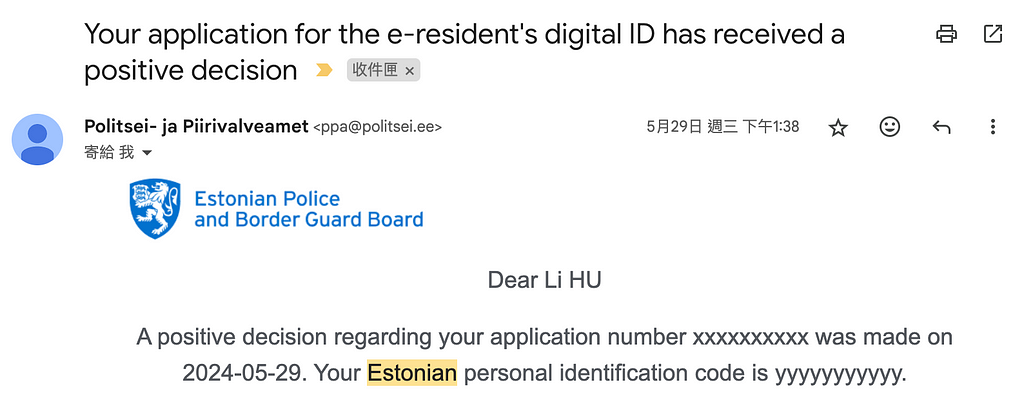
  <p>我是 5/19 的時候送出申請的，5/29 收到通過的信件，話說信件上面寫的是「Your application for the e-resident’s digital ID has received a positive decision」，「positive decision」，學到了新的用法。</p>
  <figure>
<img alt="" src="https://cdn-images-1.medium.com/max/1024/0*vf9sxif1Zn5JT0_c.png" />    <figcaption>
申請通過的信件
    </figcaption>
  </figure>
  <p>通過之後就會開始製作我的 ID card 然後寄到我選的東京大使館，要等寄到之後才能去領。等了一個多月，終於在 6/27 收到信件，通知說我的 ID card 寄到了。</p>
  <p>信裡會有一個預約連結，點左上角的國旗可以選語言：</p>
  <figure>
<img alt="" src="https://cdn-images-1.medium.com/max/1024/0*B5cGWsC9ZVYLL9Ut.png" />    <figcaption>
預約系統
    </figcaption>
  </figure>
  <p>如果人在台灣的話，來東京玩的時候可以順便約時間去拿，但並不是每個時段都可以，目前（2024 年 8 月）只有每週一跟三的早上可以預約而已，其他時間是不行的。</p>
  <h3 id="section-3">領取證件</h3>
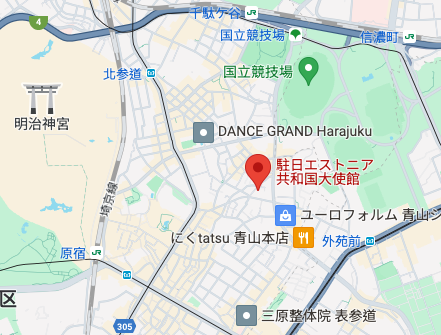
  <p>愛沙尼亞駐東京大使館在一個滿尷尬的位置，離周遭的每一個地鐵站都不算近：</p>
  <figure>
<img alt="" src="https://cdn-images-1.medium.com/max/441/0*y30tBPuzQHEULIKg.png" />    <figcaption>
地圖
    </figcaption>
  </figure>
  <p>我是搭到北參道之後走過去的，路程大約是 15 分鐘。強烈建議不要在夏天做這種事，你大概有 80% 的機率會後悔，因為超級熱，而且沿途沒什麼遮蔽物，就沿路曬曬曬一直曬到大使館。比較好的做法可能是找個更近的地鐵站（外苑前）、搭公車或是搭計程車，否則太陽真的太可怕。</p>
  <p>不確定那邊能不能拍照，但是 <a href="https://maps.app.goo.gl/1WJKqP6xXytrYbwJA">Google Maps</a> 上面有一些照片可以看，就是一個小小的建築物，到門口之後需要按對講機告知身份才能進去。</p>
  <p>進去之後確實如我朋友所說，還滿漂亮的，第一次看到大使館，原來是這種感覺。</p>
  <p>然後就會有人來處理一些手續，會簽一份文件跟按指紋，整個流程大約 15 分鐘，大部分時間都在等，中間也沒聊什麼。總之呢，最後就會拿到證件外加讀卡機，還有一份使用說明（讀卡機在裡面）：</p>
  <figure>
<img alt="" src="https://cdn-images-1.medium.com/max/1024/0*5gmtNKGQ9LxII6nV.jpg" />
  </figure>
  <h3 id="section-4">進入愛沙尼亞數位世界</h3>
  <p>在開始之前，需要做一些前置準備。</p>
  <p>在電腦上要安裝一個叫 DigiDoc 的軟體，接上讀卡機以後可以用這個軟體簽署電子文件，也能看到自己的個人資料：</p>
  <figure>
<img alt="" src="https://cdn-images-1.medium.com/max/1024/0*WwLPfn_PeVBWcNzm.png" />
  </figure>
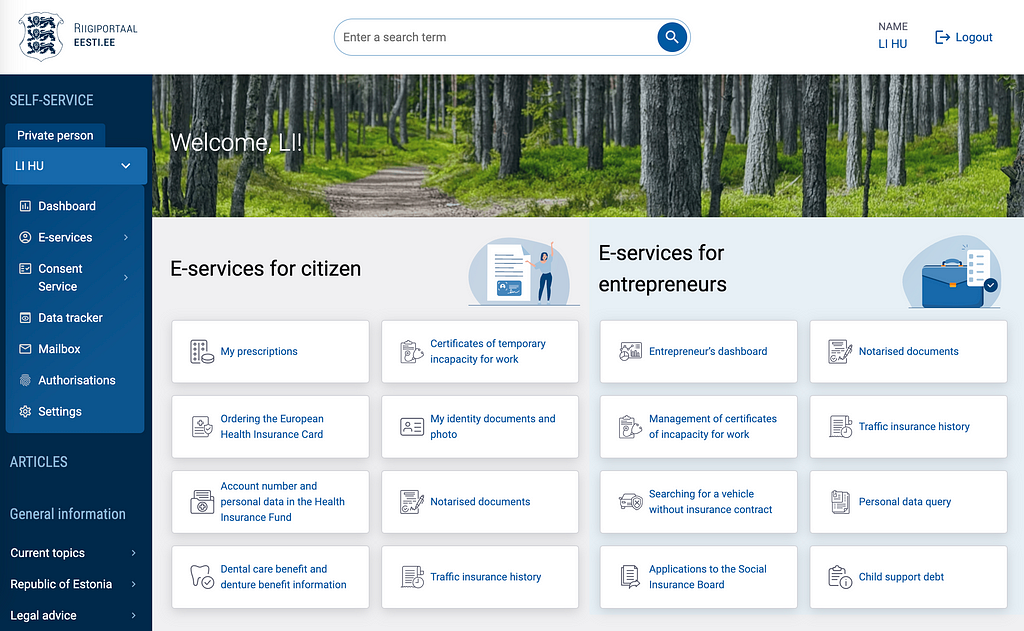
  <p>再來的話還要裝瀏覽器的擴充套件，裝完之後就可以登入愛沙尼亞的網站，查看有哪些服務可以使用：</p>
  <figure>
<img alt="" src="https://cdn-images-1.medium.com/max/1024/1*_g8pljFaQoFGinfs433vTw.png" />
  </figure>
  <p>跟之前查得差不多，基本上什麼都可以在上面完成，全部都整合在同一個入口裡面，滿方便的。而且剛剛提到的 DigiDoc 跟這個網站，應該都是他們自己的公民就會使用的服務，是同一套系統，而不是只為了數位居民而建的。</p>
  <p>話說我拿到證件之後才發現原來這個數位居民不是永久的，效期是五年，快到五年的時候需要更新，更新的時候要再付 120 歐元左右的更新費用，底下是 dashboard 的截圖：</p>
  <figure>
<img alt="" src="https://cdn-images-1.medium.com/max/784/0*DWg24JP2c0mRGsw0.png" />
  </figure>
  <p>還有另一件事情是官方的文件有提到成為數位居民之後，會拿到一個 @eesti.ee 的 email 地址，所有官方的通知都會寄到這個地址去，但因為它並沒有一個真的 email client 讓你登入，所以需要去網站上設定 email forwarding，轉到自己在用的其他信箱去。</p>
  <p>我試了一下，這句話讓我以為我會有一個「<a href="mailto:xxx@eesti.ee">xxx@eesti.ee</a>」的 email 可以用，所有寄到這邊來的，都會轉到我設定好的信箱去。</p>
  <p>不過我在哪都找不到這個 xxx 是什麼，最後好不容易才搜尋到這個公告：<a href="https://www.eesti.ee/en/news/email-addresses-using-names-and-ending-in-eestiee-are-closed-as-of-today">Email addresses using names and ending in @eesti.ee are closed as of today</a>，看起來那個 xxx 是 personal identification code，類似身分證字號的東西。</p>
  <p>嘗試寄到我的地址之後，直接噴了一個錯誤訊息是不允許某個 IP 發送到這個位置，看來就只能收來自官方的信件而已，沒辦法做為私人用途。</p>
  <p>這樣講起來根本也不用知道什麼 @eesti.ee，從頭到尾就只是能設定一個 email address，讓官方把通知信件寄給你，僅此而已，否則多一個 @eesti.ee 的信箱感覺挺帥的。</p>
  <h3 id="section-5">結語</h3>
  <p>以上就是我申請愛沙尼亞數位居民的歷程，目前得到的結論是：「如果沒有想在愛沙尼亞開公司，申請這個沒有其他實際用途」。</p>
  <p>因此，下一步我就要來研究怎麼在那邊開個公司了。</p>
  <p>原本其實是想寫在同一篇的，但我想得太天真了，因為有不少東西需要研究。最簡單的方案就是找個一條龍的線上服務，從開公司到提供會計服務全部搞定，類似於台灣的 <a href="https://simpany.co/">Simpany</a>，但一個月需要 60 歐元（大部分都是會計用途），一年就是 25,000 台幣左右，如果我這個公司也是沒什麼在運作的（整年搞不好三四筆紀錄而已），那成本有點太高了。</p>
  <p>這些開發票、申報以及記帳的東西，如果不複雜的話其實可以考慮自己來（法規允許的話），也可以分開找不同的線上服務花錢處理，看有沒有更簡單的方式。</p>
  <p>綜合以上所述，開公司以及事前研究的部分還在進行中，因此之後會再寫一篇，只是不知道要多久就是了（正大光明的拖稿預告）。</p>
<img src="https://medium.com/_/stat?event=post.clientViewed&amp;referrerSource=full_rss&amp;postId=1614efd60895" width="1" height="1" alt="" />
</div>]]></content><author><name>Huli</name></author><category term="medium" /><category term="medium" /><summary type="html"><![CDATA[愛沙尼亞數位居民申請心得 ——]]></summary></entry><entry><title type="html">1.5 本書的誕生 — — 《Beyond XSS：探索網頁前端資安宇宙》的幕後故事</title><link href="https://nodebe4.github.io/oped2/2024-07-11/1.5-%E6%9C%AC%E6%9B%B8%E7%9A%84%E8%AA%95%E7%94%9F-Beyond-XSS-%E6%8E%A2%E7%B4%A2%E7%B6%B2%E9%A0%81%E5%89%8D%E7%AB%AF%E8%B3%87%E5%AE%89%E5%AE%87%E5%AE%99-%E7%9A%84%E5%B9%95%E5%BE%8C%E6%95%85%E4%BA%8B/" rel="alternate" type="text/html" title="1.5 本書的誕生 — — 《Beyond XSS：探索網頁前端資安宇宙》的幕後故事" /><published>2024-07-11T17:15:06-05:00</published><updated>2024-07-11T17:15:06-05:00</updated><id>https://nodebe4.github.io/oped2/2024-07-11/1.5%20%E6%9C%AC%E6%9B%B8%E7%9A%84%E8%AA%95%E7%94%9F%20%E2%80%94%20%E2%80%94%20%E3%80%8ABeyond%20XSS:%E6%8E%A2%E7%B4%A2%E7%B6%B2%E9%A0%81%E5%89%8D%E7%AB%AF%E8%B3%87%E5%AE%89%E5%AE%87%E5%AE%99%E3%80%8B%E7%9A%84%E5%B9%95%E5%BE%8C%E6%95%85%E4%BA%8B</id><content type="html" xml:base="https://nodebe4.github.io/oped2/2024-07-11/1.5-%E6%9C%AC%E6%9B%B8%E7%9A%84%E8%AA%95%E7%94%9F-Beyond-XSS-%E6%8E%A2%E7%B4%A2%E7%B6%B2%E9%A0%81%E5%89%8D%E7%AB%AF%E8%B3%87%E5%AE%89%E5%AE%87%E5%AE%99-%E7%9A%84%E5%B9%95%E5%BE%8C%E6%95%85%E4%BA%8B/"><![CDATA[<!--1720736106000-->
<p><a href="https://hulitw.medium.com/story-behind-beyond-xss-12c2179ae7dc?source=rss-f1fb3e40dc37------2">1.5 本書的誕生 — — 《Beyond XSS：探索網頁前端資安宇宙》的幕後故事</a>
——</p>

<div>
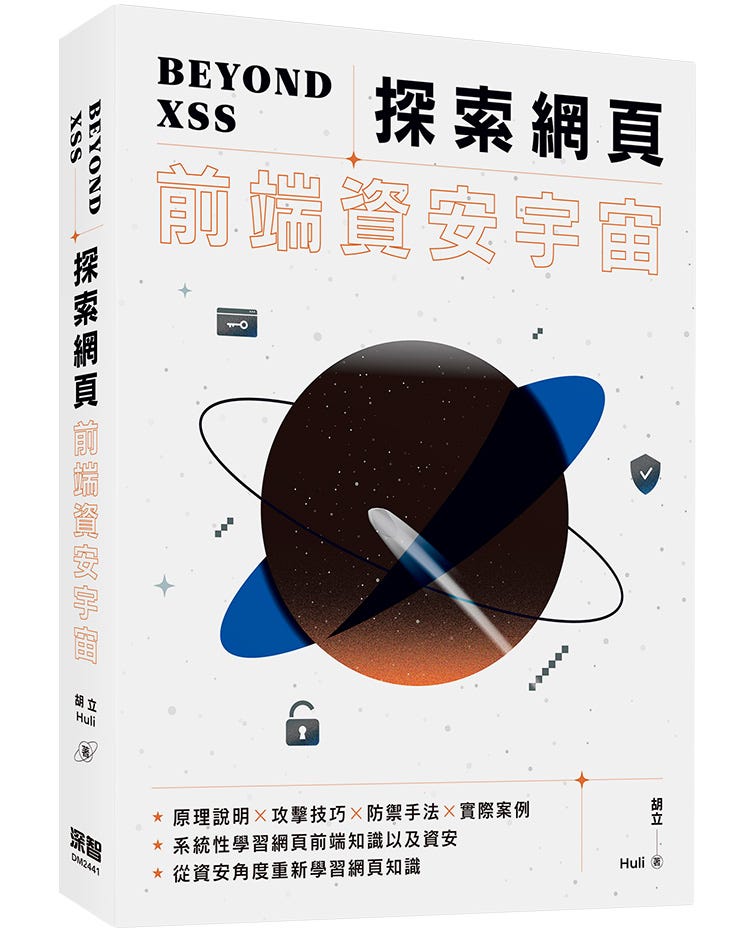
  <h3 id="beyond-xss">1.5 本書的誕生 — — 《Beyond XSS：探索網頁前端資安宇宙》的幕後故事</h3>
  <figure>
<img alt="" src="https://cdn-images-1.medium.com/max/750/0*yvdTskmpZj1PNi_E.jpg" />    <figcaption>
書的封面
    </figcaption>
  </figure>
  <p><a href="https://www.tenlong.com.tw/products/9786267383803?list_name=r-zh_tw">Beyond XSS：探索網頁前端資安宇宙</a>是一本即將於 7 月 19 日正式發售的書籍，其內容源自於我在 2023 年 9 月時參加的 iThome 鐵人賽同名系列文章，基本上整本書是改寫自那個系列文，但有修正了一些錯誤，並且加上了全新的章節。</p>
  <p>這篇文章就來寫一下這本書背後的故事，包括我為什麼寫、怎麼寫，以及到底花了多久，又為什麼是 1.5 本書。前面會有一段時間聽我在講古，如果只對出書的部分有興趣，可以快速略過。</p>
  <h3 id="section">17 年前的夢想</h3>
  <p>從小時候開始，就一直覺得能寫一本電腦書的話，那真是太好了。畢竟書並不是每個人都可以寫的，要有出版社的認可，才能寫上一本；而需要得到認可，無論是在技術還是在寫作，都必須具備一定的能力。因此，出書這件事情的目的，對我來說並不在於書要賣得多好，而是「能出書」這件事情的價值。</p>
  <p>大概就像金曲獎一樣，入圍就是肯定，不管得不得獎，只要能入圍就已經很厲害了。</p>
  <p>之前在寫我自己的<a href="https://life.huli.tw/2017/10/05/the-programming-journey-1-b9b19c0ef05b/">故事</a>時就有提過我小時候的經歷，這邊再詳細寫一次。想寫書不是只有說說而已，早在 2007 年的時候，我就寫信到專門出電腦書的松崗出版社，提說我想寫一本 Visual Basic 2005 的入門書。</p>
  <p>而那時出版社回覆由於 Visual Basic 2005 即將改版，因此他們目前並沒有出版入門書籍的計畫，而當時的我也沒有其他能寫的主題，所以就只好放棄。</p>
  <p>2007 年，距今 17 年前，那時我 13 歲，國中二年級。</p>
  <p>當時的提案內容已經不見了，但如果我沒記錯的話，我應該是覺得那些入門書雖然嘴上說著入門，但其實對一般人（或是對我這個國中生）來說門檻還是太高，入不了門。因此我希望由我的角度來寫一本入門書，目標是讓國中生也能看得懂，也能學習寫程式。看來這種「我能講得比其他人清楚」的自信，是從小就有了。</p>
  <p>既然沒辦法寫書，那就只好試試看其他管道了。</p>
  <p>在同年年底，我寫信給雜誌《電腦王》，現在看起來那封信件很沒禮貌，沒頭沒尾的：</p>
  <blockquote>
<em>請問對這個主題有興趣嗎?<br />用VB2005寫一個檔案監視程式</em>  </blockquote>
  <p>但以一個沒什麼在用 email 的國中生來說，或許也就這樣了？</p>
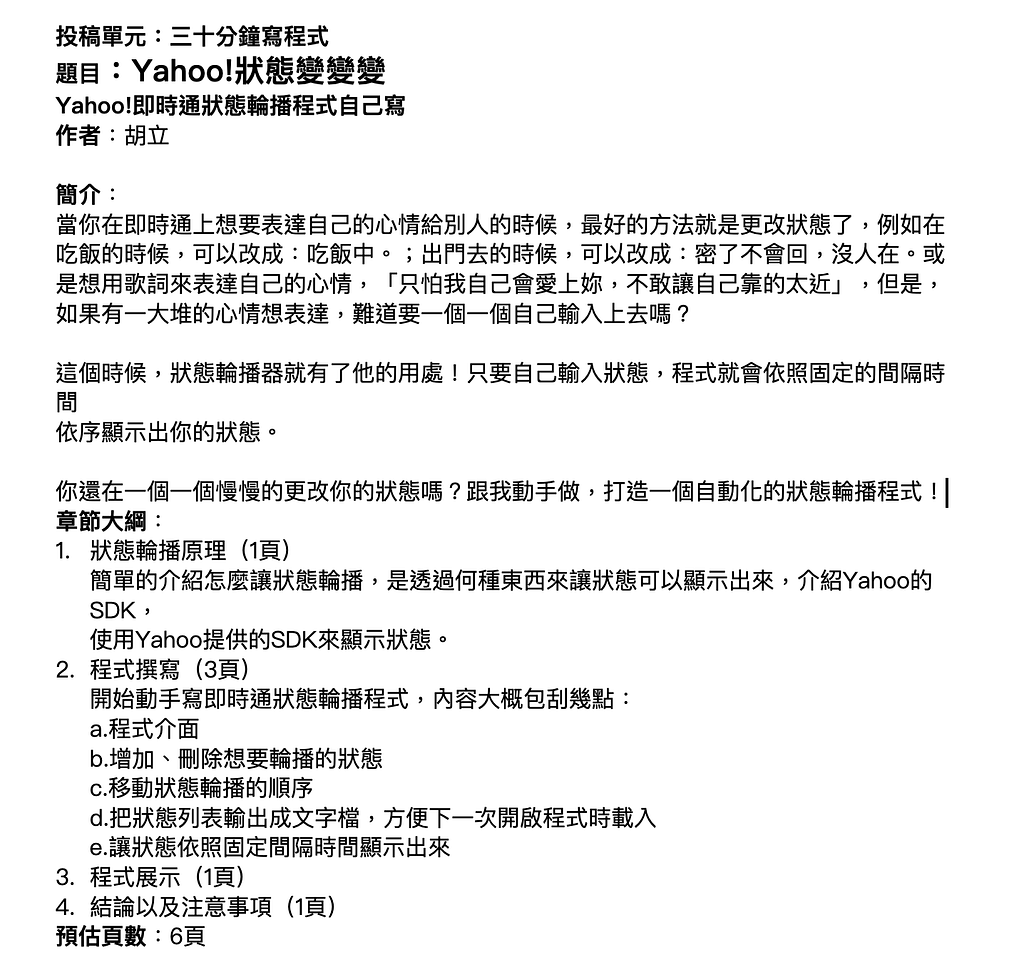
  <p>而電腦王的編輯則是很認真回覆了我的信，並且附上提案的範例，跟我說可以給他們一個比較完整的說明，他們才比較好評估是否錄用。而在那之後我給出了這樣一份提案：</p>
  <figure>
<img alt="" src="https://cdn-images-1.medium.com/max/1024/0*HXlnRHBMtzRAbeOq.png" />    <figcaption>
提案初體驗
    </figcaption>
  </figure>
  <p>接著，編輯回覆說提案沒有問題，於是我就開始寫了，大概花了一週的時間寫完，然後收到編輯修改過的稿子，看到文章裡面有好多虛線以及註解還有修改建議，那時我才知道：「原來 Word 應該是要這樣用」。</p>
  <p>於是呢，在 2008 年 2 月，我寫的稿子被登上了電腦王雜誌，我那時候超級無敵興奮。</p>
  <figure>
<img alt="" src="https://cdn-images-1.medium.com/max/800/0*4QARxTZSdfT0KpHo.png" />    <figcaption>
電腦王雜誌翻拍
    </figcaption>
  </figure>
  <p>除了我寫的文章被刊出來很開心以外，拿到稿費也很開心。稿費是一字一塊，而且不知道為什麼，我記得連程式碼也算在內（但我沒有偷灌水啦），最後拿到了 3000 多塊錢。</p>
  <p>對一個國中生來說，3000 塊是很大一筆錢。</p>
  <p>然後有個插曲滿好笑的，因為要申請稿費的緣故，需要提供我的身份證影本，結果我回他說：「沒有身分證怎麼辦？」，不過後來因為我剛好滿 14 歲，所以就為了這個去申請了身份證。</p>
  <p>隔了一年，2009 年的 2 月，我又投稿了一篇新的文章，題目為：「Keylogger鍵盤記錄自己寫」，被刊登在 2009 年 6 月出版的雜誌上面。</p>
  <p>後來升上高中之後，就沒有再繼續投稿了。之所以會特別寫這一段，是因為這大概是我開始寫作的開端吧，比部落格還要早。</p>
  <h3 id="section-1">為什麼一定要是書？</h3>
  <p>讓我們把時間快轉到 2009 年的 5 年後，也就是 2014 年，我大二的時候。因為開始工作的關係，又開始寫起了部落格。只所以會說又，是因為高中的時候也曾經寫過，但只寫了三四個月就停更放棄了。</p>
  <p>從那之後就養成了固定寫部落格文章的習慣，從 2014 一直到現在 2024，這十年間都沒停過。而這段期間也累積了不少讀者，寫過不少文章，也收到許多讚賞的留言，稱讚說某篇文章寫得真好之類的。</p>
  <p>既然寫文章收到這些讚賞已經很開心了，而且部落格也在特定的圈子中小有名氣，那為什麼非得寫書不可呢？</p>
  <p>答案或許跟開頭講的一樣吧，出書有種被認可的感覺，並不是每個人都可以出書的。雖然說寫文章得到稱讚一樣會覺得被認可，但或許是我覺得這樣還不夠吧？或許對大眾（還有我）來說，「我寫了一篇超讚的技術文章」跟「我寫了一本書」，後者還是更厲害一點。</p>
  <p>再者，技術文章通常只是一篇，但要寫書的話，需要更完整的規劃，才能撐起一本書的篇幅。雖然說也有一些書寫得不怎麼樣，但對我來說，我對寫書有一種迷思，認為能出書就是強者。</p>
  <p>一直到 2021 年 7 月的時候，我還在社群媒體上發文，講說小時候的目標之一是寫電腦書，而現在想寫書，最快的管道應該就是 iThome 鐵人賽了，不過我很懶得再參加一次，還是作罷吧。</p>
  <p>但你知道的，後來我還是參加了。</p>
  <h3 id="section-2">寫書的捷徑與心態的轉變</h3>
  <p>iThome 鐵人賽是一個由 iThome 所舉辦的活動，固定在每年的八九月左右，參賽者必須連續 30 天發文，才算完成比賽，而比賽會根據主題分成不同組別，例如說 Web 組、資安組或是 DevOps 組等等。</p>
  <p>在 2017 年的時候我有寫了一個 <a href="https://ithelp.ithome.com.tw/users/20091346/ironman/1150">Half-Stack Developer 養成計畫</a>系列，拿到了優選。</p>
  <p>而應該是從 2020 年開始，出版社博碩文化開始與 iThome 鐵人賽合作，得獎的書籍都有機會可以出書，至今這個系列已經累積了上百本的書籍。</p>
  <p>這就是為什麼我當時會說想寫書的話，最快的管道就是透過這個比賽，因為只要能得獎，幾乎就是出書的保證。但其實透過鐵人賽得獎來出書，跟我原本想出書的初衷，是有點不太一樣的。</p>
  <p>我為什麼想出書？因為想得到出版社的肯定，我的理想情節是有天出版社主動寄信給我，跟我說他們看我文章寫得不錯，想要邀請我出書，這就是我所謂的「得到出版社的認可」。</p>
  <p>但如果透過鐵人賽就不同了，雖然說我同樣是得到了鐵人賽評審的認可，但之所以能出書，並不是因為「出版社主動看到了我的文章，覺得我的文章有潛力」，而是「我鐵人賽得了獎」，對我來說還是不太一樣的。</p>
  <p>這大概就像是我想要在 YouTube 上面一直發表翻唱 cover，直到某天有唱片公司聯絡我說：「你唱得不錯，有沒有興趣簽約？」，而不是自己去報名歌唱比賽，拿了冠軍之後被合作的唱片公司簽走。</p>
  <p>或許是一種主動跟被動的差別吧？我認為「被動地被發現」比「主動讓別人看見我」，來得更加厲害，更加特別。</p>
  <p>可能很多人會覺得這有些幼稚，覺得這是莫名其妙的堅持，但無論如何，我就是那樣想的。</p>
  <p>在近期探索自我的過程中，我才漸漸明白原來「想要變得特別」是我做很多事情的原因（我以前沒發現這件事）。如果透過鐵人賽得獎出書，我就變得跟許多人一樣，就不特別了。</p>
  <p>然而，在 2023 年的時候，我還是報名了鐵人賽，並且不諱言自己就是為了出書而來。</p>
  <p>之所以會下這個決定，是因為我仔細思考了一番，最後認為無論管道是什麼，途徑是什麼，只要能出書的話，都是值得嘗試的，畢竟出書對我來說還是有其意義在。</p>
  <p>因此，那次報名鐵人賽，在寫的時候就是抱持著我要寫一本書的心態跟架構下去寫的。既然都報名了，那就要認真寫；既然都認真寫了，那就一定要得獎。</p>
  <h3 id="section-3">出書 222：2 本書、2 家出版社、2 次延遲交稿</h3>
  <p>2023 年 9 月 30 號，我的第 15 屆 iThome 鐵人賽畫下了句點，順利達成了連續 30 天發文的目標，而文章的品質也在我預期之中。預期之中的意思是，有些文章我寫完的時候，會打從心底覺得自己似乎有點厲害，並且給出自己的文章「這切入點真是特別」或是「這個講解方式太強了吧」這些評語。</p>
  <p>而 10 月中的時候，鐵人賽都還沒公布得獎名單，深智數位出版社就透過 email 聯繫了我，說看到我的文章後覺得豐富的經歷讓人印象深刻，問我有沒有出書的意願。</p>
  <p>而後來也跟他們開了簡短的線上會議，大致討論了一下。</p>
  <p>雖然說他們一開始想出的是鐵人賽那個系列，但我認為鐵人賽的合作出版社是另一間博碩文化，在參賽的規章中也有寫說在相同條件下，博碩文化應該優於其他出版社。因此鐵人賽的文章我想先留給博碩文化，至少先談過之後再來決定後續規劃（儘管當時還沒公布得獎名單，但我就覺得一定會有我，至少拿個優選不為過吧）。</p>
  <p>但同時我一直有個很想寫的系列，那就是被我放置很久的：<a href="https://github.com/aszx87410/blog/discussions/93">JavaScript 隨意聊聊</a>，因此與深智討論過後，他們同意用這本書繼續推進，用這本書來簽合約。</p>
  <p>在 11 月初的時候，我們就完成了簽約，當初我自己訂的交稿日期是隔年的 3 月。</p>
  <p>於是呢，從那之後我就過著寫書、拖延、拖稿、寫書、拖延、拖稿的無窮迴圈。</p>
  <p>而 11 月底的時候，鐵人賽公佈了得獎名單，我的系列文是資安組的冠軍，順利拿到了出書的機會。</p>
  <p>接著在 12 月 4 日，收到了博碩文化的通知信，依照裡面的指示與編輯加了 LINE，等待後續的通知。</p>
  <p>而到了隔年（也就是今年，2024 年）的 1 月 31 日，收到博碩的後續通知，要我們整理鐵人賽系列文的全文 Word 檔案、基本資料以及新書規劃，內容是市場上同類型的作品有哪些，自己的作品又有哪些優勢等等。</p>
  <p>而差不多在同一天，我的 JavaScript 書籍進度只有 170 頁（預計要寫 400 頁），進度落後，我自己評估沒辦法在約定好的 3 月完成，因此先通知編輯會延期，至於延到什麼時候，等 2 月底再確定。</p>
  <p>到了 2 月底的時候，進度是 210 頁，大概是一半左右，因此我跟編輯說需要延到五月底。</p>
  <p>然後在 3 月初的時候，博碩那邊有了後續進展，開始到了下一個階段，需要安排線上會議。由於我平日上班時間都沒有辦法，比較難請假，因此只能詢問日本的假日（只有特定幾天）或是平日晚上有沒有空。</p>
  <p>到了 4 月 10 日，收到博碩的通知，給了交稿格式範本讓我們參考，並希望我們提供想要問的問題，之後會安排時間與作者們線上會議。</p>
  <p>而這個時候，我對出書這件事情有了一些別的想法。</p>
  <p>從時程中其實可以看出博碩這邊由於是一次跟所有鐵人賽得獎者聯繫，所以進度會更緩慢一點，但這對我來說反倒是個優點，因為我才有時間能先把 JavaScript 的書完成。</p>
  <p>雖然說原本我是很期待同時跟兩間出版社合作，想說可以比較一下彼此的差異順便寫一篇心得文，但真的合作之後發現自己有點太天真了，蠟燭兩頭燒是真的忙不太過來，就算進度比較緩慢也一樣。</p>
  <p>而且除了寫書，也有其他很多生活上與工作上的事情要忙，開始漸漸覺得要同時顧到兩邊確實是有點累。</p>
  <p>除此之外，4 月中的時候我的 JavaScript 書籍進度在 320 頁，雖然已經完成了 80%，但剩下的那 20% 是很花時間的一個章節（scope、closure 與 this），我並不覺得在一個半月內可以寫完，因此有很高的機率必須往後再延。</p>
  <p>總之呢，我覺得當時再繼續這樣下去的話，我可能會先 burn out，於是再三思考過後，決定把 JavaScript 那本書籍先暫停，並且把鐵人賽的系列文簽給深智，博碩的話就不接著跑後續流程了。</p>
  <p>做這個決定背後的理由是基於：</p>
  <ol>
    <li>為了避免太累，只能選擇一間合作</li>
    <li>JavaScript 書籍需要先暫停寫作。因為一來沒辦法如期交稿，再繼續延我不太好意思，二來我對這個系列有其他想法，例如說其實可以先開個 workshop 再根據學生 feedback 改善，才出成書籍等等。</li>
    <li>只出鐵人賽那本的話，我希望速度盡可能快一點</li>
  </ol>
  <p>因為已經與深智先簽了約，所以把出書的計畫停了也不太對，所以就需要拿鐵人賽那本來補，改成簽那本，而且交稿日維持不變。至於博碩的話還在偏早期的階段，還沒正式開過會也還沒簽約，還來得及中止。</p>
  <p>總之呢，跟兩邊都告知了這個狀況以後，就朝這個方向走了。</p>
  <p>這也是為什麼標題會說是 1.5 本書，因為那 0.5 本是未完成的 JavaScript 書籍，那個章節我依舊還沒動筆。</p>
  <p>因為鐵人賽那本 XSS 的書，原本就是照著寫書的架構去規劃，所以要改的東西並不多，改起來滿快的，因此也在五月底的時候順利交稿。</p>
  <p>5/29 交稿之後，隔了一週深智就給了第一章節排版過的範例讓我確認，與此同時跟我要了書的作者介紹以及封面封底的文字，封面的設計我也自己用 AI 產生了幾張圖，讓他們作為範例參考：</p>
  <figure>
<img alt="" src="https://cdn-images-1.medium.com/max/1024/0*LT1b29RCq0dYVFk9.png" />    <figcaption>
Bing 幫我產生的封面圖
    </figcaption>
  </figure>
  <p>6/17 的時候排版完成，進行第一次校對，6/20 二校，6/26 最後校對，接著 7/2 就被通知書籍已經開始預購了。</p>
  <p>進入校對之後，文字上就沒有什麼動了，基本上都是改善一些排版而已。</p>
  <h3 id="section-4">書跟原本的系列文差在哪裡？</h3>
  <p>前面一再提到當初寫鐵人賽系列文的時候，就已經是用寫書的規劃去寫的，所以原本就規劃 30 篇隸屬於五個章節，從賽後我自己用 Docusaurus 架的網站可以看出來這件事情：<a href="https://aszx87410.github.io/beyond-xss/">https://aszx87410.github.io/beyond-xss/</a></p>
  <p>因此，大約有八成的內容其實都是直接照搬文章。</p>
  <p>剩下的兩成是一些小細節，除了修錯字以及比較不通順的地方以外，我還做了底下這些事情。</p>
  <h3 id="section-5">去除連結</h3>
  <p>當我在寫文章的時候有兩個習慣：</p>
  <ol>
    <li>附上一堆參考連結</li>
    <li>自己還沒這麼熟的地方，就先放個連結連到補充資訊，讓讀者自己參考</li>
  </ol>
  <p>但這兩點對於實體書籍來講，閱讀體驗其實是不太好的。因為你在看書的時候，不會拿出手機或電腦來訪問這些連結，所以這些連結對於在看實體書籍的人來說，是沒什麼幫助的，甚至閱讀起來會有些干擾。</p>
  <p>因此，有些地方如果參考連結太多，我會把那些內容拿掉或是縮減，盡可能讓它不要太干擾閱讀的體驗。</p>
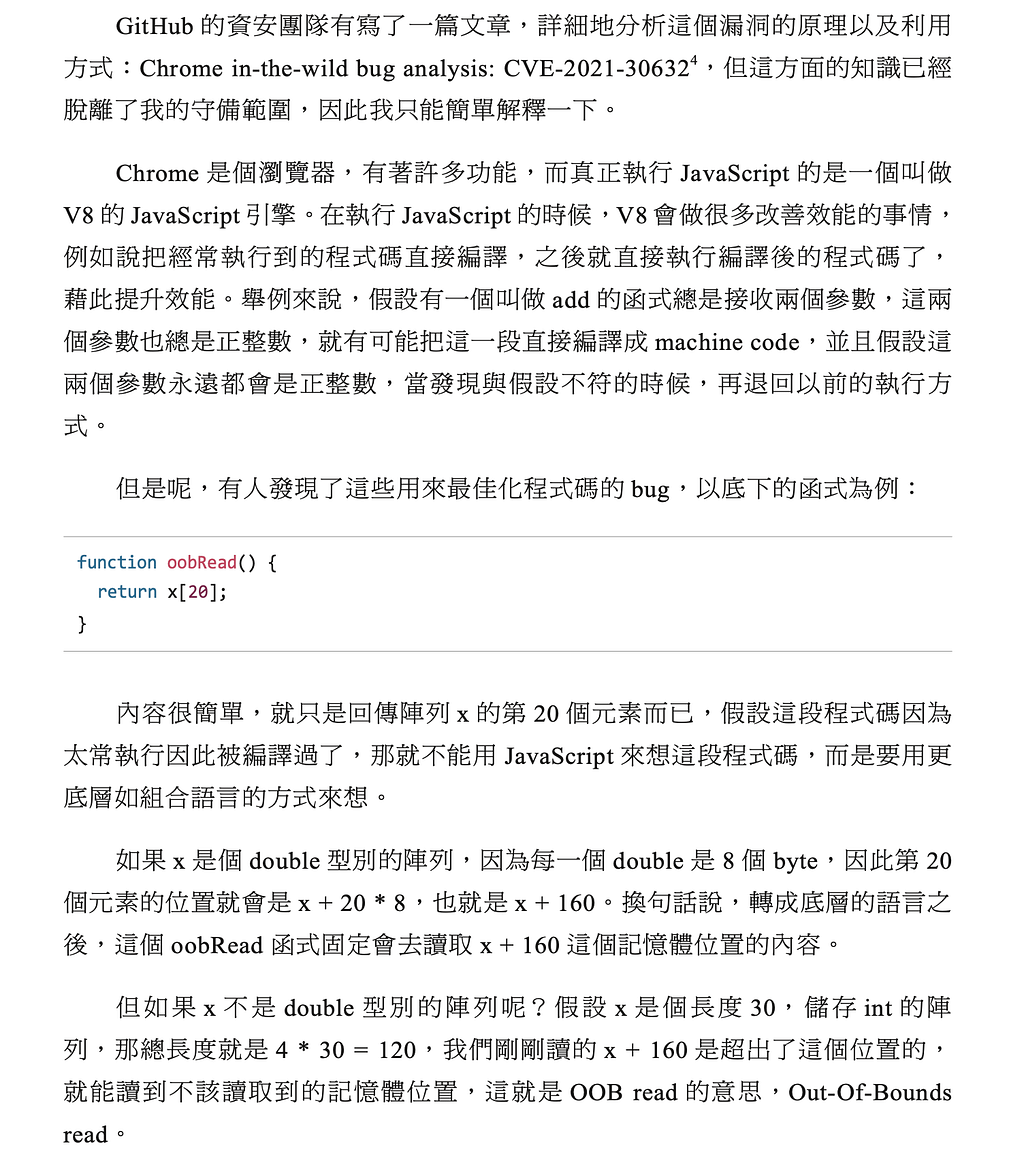
  <p>再者，有些「有興趣的話可以看 XXX」的地方我拿掉了，直接把參考內容的大意寫在書籍裡面，讀者就不需要自己去看。舉例來講，在第一章我有談到 Chromium 的 RCE 漏洞 CVE-2021–30632，但並沒有解釋原因，而是讓讀者自己去看：</p>
  <figure>
<img alt="" src="https://cdn-images-1.medium.com/max/750/0*Pp3EdAkY_noZg4vP.png" />    <figcaption>
原本鐵人的文章
    </figcaption>
  </figure>
  <p>說穿了其實就是覺得發生原因太複雜需要更多時間研究，但因為沒時間或因為懶所以沒有仔細看，因此至少留個連結給有興趣的人自己看。</p>
  <p>但這樣其實閱讀體驗也不太好，因此在書籍版我就直接補上了相關內容，大概講了一下漏洞發生的原因：</p>
  <figure>
<img alt="" src="https://cdn-images-1.medium.com/max/1024/0*H9qQpH5dPqV1DWhy.png" />    <figcaption>
出書修改後的內容
    </figcaption>
  </figure>
  <p>這只是其中一處而已，還有其他地方也做了類似的事情。</p>
  <h3 id="section-6">補充內容</h3>
  <p>XSS 系列文完成的日期是 2023 年 9 月底，其實已經是半年前了，在這半年當中我也有學到一些新知識，就順勢補充進去書裡面。</p>
  <p>例如說原本有一個章節在談 MIME sniffing，是有關 content-type 的知識，我就把今年 4 月份看到的 Flatt Security 的研究 <a href="https://speakerdeck.com/flatt_security/xss-using-dirty-content-type-in-cloud-era">XSS using dirty Content Type in cloud era</a> 也一起補充了進去。</p>
  <p>只要是我有想到可以補充的地方，都會順便補充一下。</p>
  <h3 id="section-7">新增章節</h3>
  <p>上面的這些改變頂多只是「改進原有的內容」，實際上的主軸還是與原本的文章相同。而我自己認為既然都出書了，那在書籍裡面就應該提供額外的附加價值，一定要有更多本來的文章沒有的東西。</p>
  <p>因此，特地為書籍寫了一個全新的章節：「Case study — 有趣的攻擊案例分享」，寫了 5 個我覺得非常值得一提的例子，這部分大約有 30 頁左右。</p>
  <p>話說寫完之後我才發現怎麼 5 個案例全部都是 XSS，說好的「Beyond XSS」呢。</p>
  <h3 id="section-8">寫書以及與出版社合作的心得</h3>
  <p>同時與兩間出版社合作的過程中，自然也有感受到兩間出版社的不同。</p>
  <p>博碩文化有許多與鐵人賽作者的合作經驗，因此有一套完整的規劃，就有點像大公司會有那種完整的新人教育訓練一樣，他們會主動提供各種的範例讓你參考，而你自己也必須做出回應，去研究市場上的同類書籍，並且繳交書籍規劃等等。</p>
  <p>不過由於鐵人賽的作者有很多人，所以前置作業的時間會拉的比較長一點。如果對博碩出版的完整流程有興趣，可以參考 Taiming 寫的：<a href="https://just-taiming.medium.com/ithome-%E9%90%B5%E4%BA%BA%E8%B3%BD%E7%B3%BB%E5%88%97%E6%9B%B8%E7%B1%8D-%E5%AE%8C%E6%95%B4%E5%87%BA%E7%89%88%E6%94%BB%E7%95%A5-ea4a3d124341">iThome 鐵人賽系列書籍-完整出版攻略</a>。</p>
  <p>而相對來說，深智數位就比較沒有這麼完整的規劃，主動提供的資源較少一些，但也因為少了許多前置作業，所以可以縮短整體的時程。</p>
  <p>總之呢，我自己與這兩間出版社合作過後，並沒有特別推薦或是不推薦哪一間，兩間合作起來都沒什麼問題，主要還是根據自己的需求以及偏好而定，我自己的話就與深智的風格滿契合的，合作的滿順利的。</p>
  <p>至於有關寫書的心得，儘管大部分內容都有了，但還是覺得滿累的，畢竟對寫書的標準跟寫部落格的標準還是不同的，前者應該要更嚴格一點。另外，實體書本這個載體也是非常特殊，一旦印出了，就沒有辦法更改，因此需要嚴格要求內容的正確性以及盡可能去除錯字以及排版錯誤等等。</p>
  <p>還有我之前提過的，同樣是附一個連結，説「想知道更多可以看這裡」，在網頁上可能 10 個人還會有一兩個點進去，但是在書上，可能 10 個人裡面沒有一個會拿起手機輸入網址。因此，需要盡可能把想補充的都直接補充在書上。</p>
  <p>話說回來，前面有提到寫書曾經是我的夢想之一，參加鐵人賽也是為了寫書，那現在夢想達成了，感覺如何？</p>
  <p>達成了一個里程碑，會開心一下是難免，但總覺得沒有想像中這麼…興奮嗎？比起書籍出版這件事情，在文章寫完的當下，或是看到有人推薦系列文的時候，其實更為開心。</p>
  <p>仔細想想，或許追求目標的過程，比達成目標更為有趣吧。</p>
  <p>以上就是這次寫書的心得以及背後的故事，如果對書有興趣的話，可以至書局購買：<a href="https://www.tenlong.com.tw/products/9786267383803?list_name=r-zh_tw">Beyond XSS：探索網頁前端資安宇宙</a></p>
  <p>最後附上出書跟與出版社聯絡的完整時間軸，供有興趣的人參考：</p>
  <p>2023/09/01 iThome 鐵人賽開賽<br />2023/09/30 iThome 鐵人賽完賽<br />2023/10/13 深智數位出版社聯繫，詢問出書意願<br />2023/10/20 初次線上會議<br />2023/10/22 我提了兩個想法，一個是 JavaScript 隨意聊聊，另一個冷知識大全<br />2023/10/25 決定出 JavaScript 的書，收到合約<br />2023/11/01 簽完合約回傳<br />2023/11/09 收到簽好的合約，約定交稿日為 2024/03/01<br />2023/11/28 鐵人賽公布得獎名單<br />2023/12/04 [博碩] 收到博碩文化的通知信，詢問出版意願並且加 LINE<br />2023/12/08 [博碩] 收到訊息說要填寫基本資料，之後會主動聯繫</p>
  <p>2024/01/23 [博碩] 收到訊息說因為編輯有點狀況，會於月底發放詳細資訊<br />2024/01/31 進度 170 頁，評估無法完成，延後交稿日<br />2024/01/31 [博碩] 收到博碩文化後續通知，要整理全文 word、基本資料以及新書規劃<br />2024/02/13 [博碩] 回傳需要的檔案<br />2024/02/29 進度 210 頁，預計需要延期到五月底<br />2024/03/08 [博碩] 安排博碩會議時間，我說 3/20 跟平日晚上可以<br />2024/04/10 [博碩] 提供交稿格式範本、出版提問清單以及會議時程<br />2024/04/15 [博碩] 告知博碩不繼續之後的流程<br />2024/04/15 與深智重新簽了新的合約，拿 XSS 換<br />2024/05/29 初稿完成<br />2024/06/04 確認書籍排版<br />2024/06/17 排版完成，一次校對<br />2024/06/20 二次校對<br />2024/06/26 最後校對<br />2024/07/02 通知書籍已經開始預購<br />2024/07/19 書籍發售</p>
<img src="https://medium.com/_/stat?event=post.clientViewed&amp;referrerSource=full_rss&amp;postId=12c2179ae7dc" width="1" height="1" alt="" />
</div>]]></content><author><name>Huli</name></author><category term="medium" /><category term="medium" /><summary type="html"><![CDATA[1.5 本書的誕生 — — 《Beyond XSS：探索網頁前端資安宇宙》的幕後故事 ——]]></summary></entry><entry><title type="html">到日本工作怎麼繳稅？稅有多重？跟台灣比呢？</title><link href="https://nodebe4.github.io/oped2/2024-06-28/%E5%88%B0%E6%97%A5%E6%9C%AC%E5%B7%A5%E4%BD%9C%E6%80%8E%E9%BA%BC%E7%B9%B3%E7%A8%85-%E7%A8%85%E6%9C%89%E5%A4%9A%E9%87%8D-%E8%B7%9F%E5%8F%B0%E7%81%A3%E6%AF%94%E5%91%A2/" rel="alternate" type="text/html" title="到日本工作怎麼繳稅？稅有多重？跟台灣比呢？" /><published>2024-06-28T20:35:50-05:00</published><updated>2024-06-28T20:35:50-05:00</updated><id>https://nodebe4.github.io/oped2/2024-06-28/%E5%88%B0%E6%97%A5%E6%9C%AC%E5%B7%A5%E4%BD%9C%E6%80%8E%E9%BA%BC%E7%B9%B3%E7%A8%85%3F%E7%A8%85%E6%9C%89%E5%A4%9A%E9%87%8D%3F%E8%B7%9F%E5%8F%B0%E7%81%A3%E6%AF%94%E5%91%A2%3F</id><content type="html" xml:base="https://nodebe4.github.io/oped2/2024-06-28/%E5%88%B0%E6%97%A5%E6%9C%AC%E5%B7%A5%E4%BD%9C%E6%80%8E%E9%BA%BC%E7%B9%B3%E7%A8%85-%E7%A8%85%E6%9C%89%E5%A4%9A%E9%87%8D-%E8%B7%9F%E5%8F%B0%E7%81%A3%E6%AF%94%E5%91%A2/"><![CDATA[<!--1719624950000-->
<p><a href="https://hulitw.medium.com/compare-japan-tax-and-taiwan-tax-9b8608b878ff?source=rss-f1fb3e40dc37------2">到日本工作怎麼繳稅？稅有多重？跟台灣比呢？</a>
——</p>

<div>
  <p>其實我想寫一篇關於繳稅的文章已經很久了，就算沒有來日本工作，也會寫一篇台灣的繳稅文章。我在 20 歲的時候進入職場工作，但卻有很長一段時間沒有自己報過稅，都直接當媽寶靠我媽幫我報，也沒什麼留意過薪資單上的健保跟勞保還有預扣的稅，完全都不管。</p>
  <p>那時的我甚至認為「所得稅 20%」代表的就是薪水的 20%，例如說收入 5 萬，繳的稅就是 1 萬塊，對扣除額還有累進稅率完全沒有概念。可能對有些人來說會覺得不可思議，想說怎麼連這個都不知道，但對當時的我來說可能也沒必要知道吧，反正到了報稅的時候上網按個按鈕就好，我也懶得去看細項有哪些。</p>
  <p>是一直到最近兩三年，因為興趣的緣故，突然好奇稅金的組成是什麼，我才開始比較認真研究稅金到底包含哪些東西，又是怎麼計算的，話說我的繳稅入門影片應該是這支影片：<a href="https://www.youtube.com/watch?v=8UYn6sj8PAw&amp;ab_channel=%E6%9F%B4%E9%BC%A0%E5%85%84%E5%BC%9FZRBros">報稅起跑！2023綜合所得稅扣除額&amp;級距全圖解 上班族存股ETF配息節稅攻略 | 夯翻鼠FQ76</a>，看了之後對所得稅的概念清楚很多。</p>
  <p>來日本工作之後，覺得對於外國人來說有很多新的概念要學習，例如說厚生年金、源泉徵收、確定申告以及住民稅等等，要不要自己申請？該怎麼申請？什麼時候繳？要繳多少？有什麼方法可以節稅？因此打算寫一篇整理一下，給未來的自己看。</p>
  <p>雖然這篇主要想談的是在日本工作的繳稅，但因為稅金的組成在台灣與日本有很多類似之處，因此我會先從台灣開始談起，會對繳稅這件事情有更深的理解。如果你沒興趣的話，可以直接跳到日本的段落。</p>
  <p>這篇想解決的問題有：</p>
  <ol>
    <li>台灣稅金與保險構成</li>
    <li>日本稅金與保險構成</li>
    <li>台灣與日本的稅金比較</li>
    <li>日本工作該怎麼報稅、繳稅？</li>
    <li>日本的所得稅該怎麼計算？</li>
    <li>是不是申請永住之後海外收入就會被課稅？</li>
    <li>該怎麼合法節稅？</li>
    <li>故鄉納稅什麼時候要開始準備？</li>
    <li>要離開日本時，有哪些錢可以拿回來？</li>
  </ol>
  <p>由於我研究過後，發現有些東西跟之前聽說的不太一樣，所以我會盡可能附上官方的資料來源，讓想查證的人自行查證。</p>
  <h3 id="section">台灣的稅與保險</h3>
  <p>台灣是在每年的 5/1~5/31，申報去年一整年的收入。依照法規，如果月薪高於 8.8 萬的話，公司每個月就會先預扣 5% 起來，報稅的時候就會多退少補。</p>
  <p>另外，雖然我們平常都習慣說繳稅繳稅，但其實除了所得稅以外，還有另一個大部分人都一定會繳的，那就是勞保（勞工保險）與健保（健康保險），這兩種嚴格來講似乎不算稅金，但因為通常也是個固定支出，所以我會把這兩個加在一起談。</p>
  <h3 id="section-1">台灣的勞保與健保</h3>
  <p>我們先從勞保跟健保開始談起好了，健保的話大家應該滿熟悉的了，全名為「全民健康保險」，那健保費又是怎麼算的呢？這邊有衛福部提供的<a href="https://www.nhi.gov.tw/ch/cp-13134-43e43-2569-1.html">投保金額分級表</a>，總共分了 50 級，最低的是月收入 27,470 以下，最高的是 212,001 以上。</p>
  <p>假設小明年薪是 201.5 萬，薪資組成為每個月的收入 155,000 元再加上一個月的年終獎金。那根據投保金額分級表，會被分到第 41 級，月投保金額為 156,400 元。</p>
  <p>而目前健保的費率為 5.17%，其中 30% 員工自己付，60% 公司付，10% 政府付。所以自己每個月要繳的錢就是 156400 * 5.17% * 30% = 2425 元，公司的話則是 4851 元。</p>
  <p>接著我們來看勞保，勞保一樣有分級，最高級是月薪 43,901 元以上，投保金額為 45,800 元。而勞保的費率為 12%，其中 20% 自己付，70% 公司付，10% 政府付。</p>
  <p>所以每個月要繳的錢是 1099 元，而公司則是 3847 元。</p>
  <p>因此呢，以每個月薪水 15.5 萬來講，健保要繳 2425 元，勞保則是 1099 元，健保佔了薪水的 1.56%，勞保佔了 0.7%，都是滿小的數字。</p>
  <p>公司的話則是繳了將近 8700 元，差不多是 5.5% 的薪資。</p>
  <p>不過公司還要額外繳一筆費用，叫做勞工退休金，也就是俗稱的勞退，是 6% 的薪水，因此加起來除了你的月薪以外，公司還要額外付出 11.5% 的隱藏成本。</p>
  <p>而員工自己也可以提撥最多 6% 的薪水到勞退的帳戶，叫做勞退自提，好處是這部分不列入所得稅的計算，因此可以作為一個節稅的手段，但缺點就是放到勞退帳戶裡面的錢要 60 歲之後才能領。</p>
  <h3 id="section-2">台灣的所得稅計算方式</h3>
  <p>接著我們來看看所得稅，所得稅的全名為「個人綜合所得稅」，白話文就是你的收入當中，有一定比例的錢要繳給政府。而這個收入除了每個月的薪水之外，年終獎金也算是收入。</p>
  <p>不過如果你有看過薪資單，會發現裡面通常有個項目叫做「伙食津貼」，2024 年的免稅額是每個月 3000，因此假設我談好的月薪是 50,000 塊，通常實際的項目會是薪水 47,000 加上伙食津貼 3000，需要繳稅的只有 47,000 元。不過這就屬於比較細節的部分了，這邊就先不列入計算。</p>
  <p>同樣是剛剛的例子，年薪 201.5 萬的小明，所得稅該怎麼計算呢？</p>
  <p>在計算稅金之前，有幾項可以扣除：</p>
  <ol>
    <li>薪資所得特別扣除額（每人為 207,000 元）</li>
    <li>免稅額（每人 92,000 元）</li>
    <li>標準扣除額跟列舉扣除額擇一，通常是用標準扣除額 124,000 元</li>
    <li>特別扣除額（幼兒以及長照相關，我沒扣過）</li>
  </ol>
  <p>除此之外其實還有一個「基本生活費差額」，意思就是基本生活會用的錢是不會扣稅的，每個人的基本生活費是 202,000 元，如果前面那堆扣完之後（不含薪資所得特別扣除額）還有剩，就可以再拿來扣除。</p>
  <p>不過以單身人士來說，免稅額加上標準扣除額就超過 20 萬了，因此是沒辦法扣的。話說所得稅的部分，台灣的<a href="https://www.gov.tw/News_Content_26_534742">官方懶人包</a>寫得很清楚，十分推薦閱讀。</p>
  <p>總之呢，扣一扣之後，可以得到一個綜合所得稅淨額：</p>
  <figure>
<img alt="" src="https://cdn-images-1.medium.com/max/1024/1*Jzg7FWwaqByJGo6r-joWFQ.png" />    <figcaption>
綜合所得稅淨額
    </figcaption>
  </figure>
  <p>200 萬的薪水，東扣西扣之後，真正要拿來計算所得稅的總額是 159 萬元，而這些錢該繳多少稅，可以參考底下的表格：</p>
  <figure>
<img alt="" src="https://cdn-images-1.medium.com/max/1024/1*7RC0bEiR9AIqIhJdy8C_Tw.png" />    <figcaption>
所得稅淨額與稅率
    </figcaption>
  </figure>
  <p>由於所得稅是採累進稅率，並不是說我到那個級距就直接乘以稅率，而是 56 萬元以下的部分，稅率就是 5%，而 56 萬 ~ 126 萬的部分，稅率是 12%。</p>
  <p>假設收入是 70 萬，那就是 56 萬 * 5% 再加上 14 萬 * 12%，總共就是 44,800 元。不過要這樣加加減減的話很麻煩，因此表格旁邊有一個「累積差額」可以使用。</p>
  <p>我們直接把 70 萬 * 12%，再扣掉 39,200 元，一樣會得到 44,800 元。簡單來講就是先把所有錢都用 12% 來算，再扣掉 56 萬的 7% 啦，換個方式算而已，但容易很多。</p>
  <p>因此呢，159 萬元要繳的稅就是 1,592,000 * 20% 再扣掉 14 萬，也就是 178,400 元。</p>
  <h3 id="section-3">台灣稅收結論</h3>
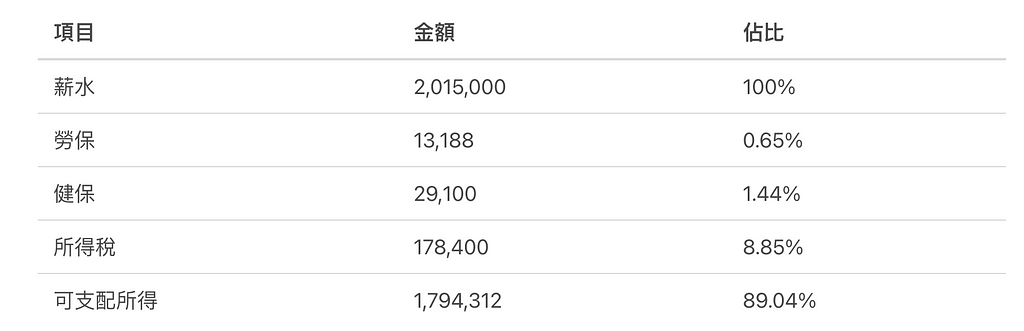
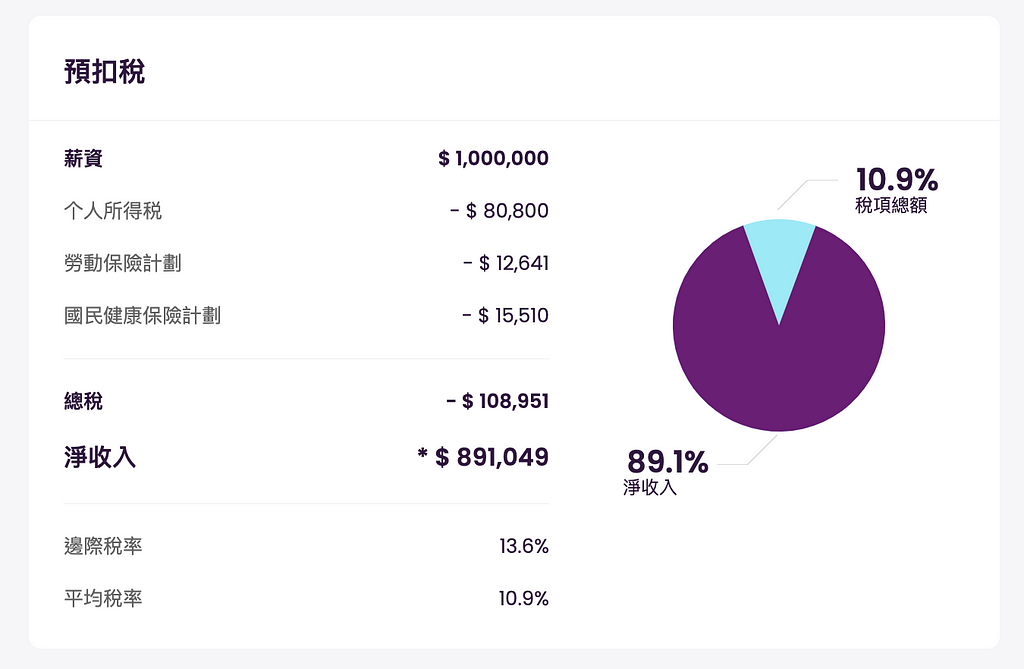
  <p>根據上面的計算，我們可以得出底下的表格：</p>
  <figure>
<img alt="" src="https://cdn-images-1.medium.com/max/1024/1*fmqu7E-XV6YrfbH-1_7M2w.png" />    <figcaption>
台灣年收 200 萬的可支配所得
    </figcaption>
  </figure>
  <p>年收入 200 萬，扣完稅金、健保跟勞保以後，最後實拿為 179 萬，大約是原本的九成。</p>
  <p>比對一下我之前寫過的文章，拿了 <a href="https://tw.talent.com/tax-calculator?salary=2015000&amp;from=year&amp;region=Taiwan">talent</a> 的薪資計算器，算出來實拿為 170 萬而已，要嘛是我上面算錯，要嘛就是 talent 算錯，上面我驗算過兩三遍了，因此應該是它算錯了。</p>
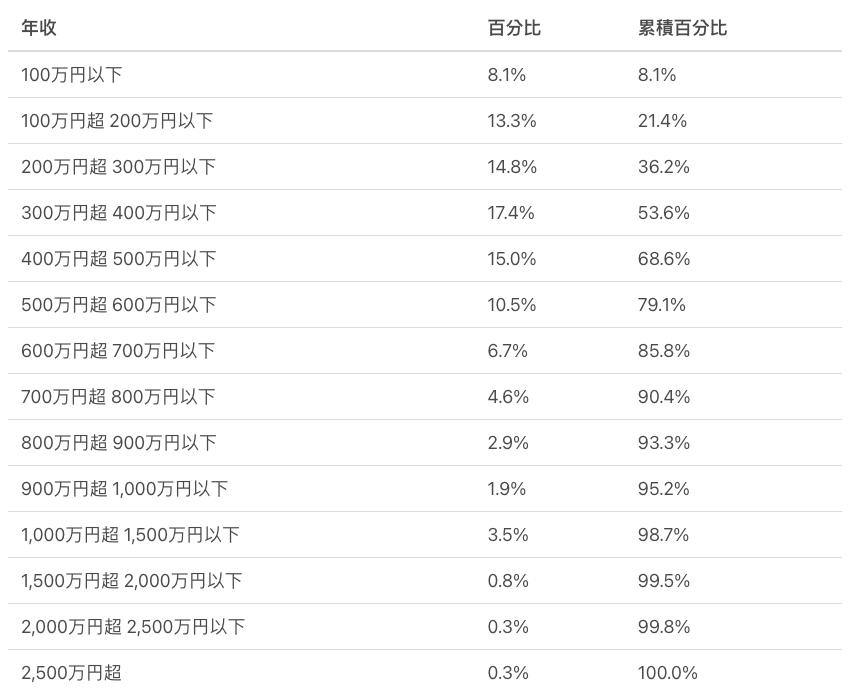
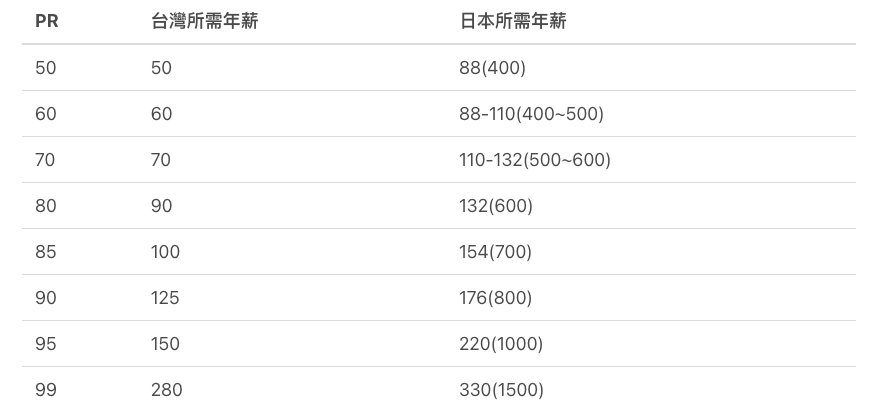
  <p>這樣一看，台灣的勞健保跟所得稅確實滿低的，年薪 200 萬在台灣已經是薪資收入的 PR98 左右了，稅跟健保勞保扣完只要 10%。</p>
  <p>話說為了方便計算，都是先用單身來計算，如果是夫妻申報或是要報撫養的話，計算公式就會不太一樣了，因此先不考慮這個，也不考慮勞退自提。</p>
  <h3 id="section-4">日本的稅與保險</h3>
  <p>跟台灣有所得稅以及勞健保類似，在日本工作也有分幾種要繳納的項目，包含：</p>
  <ol>
    <li>所得稅</li>
    <li>住民稅</li>
    <li>健保</li>
    <li>厚生年金（類似於台灣的國民年金）</li>
  </ol>
  <p>不過與台灣不管怎樣都要自己報稅不同，日本的話有分兩種方式，如果是一般上班族的話，大多數人都是全部交給公司就好，每個月會直接從薪水預扣，稱為「源泉徵收」，而到年底的時候則會進行「年末調整」，看一看這一整年的稅有沒有多或少，一樣是多退少補。</p>
  <p>另外一種叫做「確定申告」，在每年的 2/16 ~ 3/15，一樣是報去年一整年的稅，如果有副業或是年收超過 2000 萬日幣的話，就要選擇這個。</p>
  <p>這兩個選一種就好，以源泉徵收居多。</p>
  <p>接著我們一樣從保險開始，來看看日本的各種細項。</p>
  <h3 id="section-5">日本的健保與厚生年金</h3>
  <p>日本的健康保險分兩種，一種是跟台灣健保類似的國民健康保險，而另外一種則是給上班族的社會保險，兩者能享受到的權益差不多，都可以拿到健保卡，但是保費不太一樣。</p>
  <p>而厚生年金就與台灣的勞保類似，基本上是給我們這種上班族保的，如果沒有上班或者是自由工作者的話，保的就會是國民年金。</p>
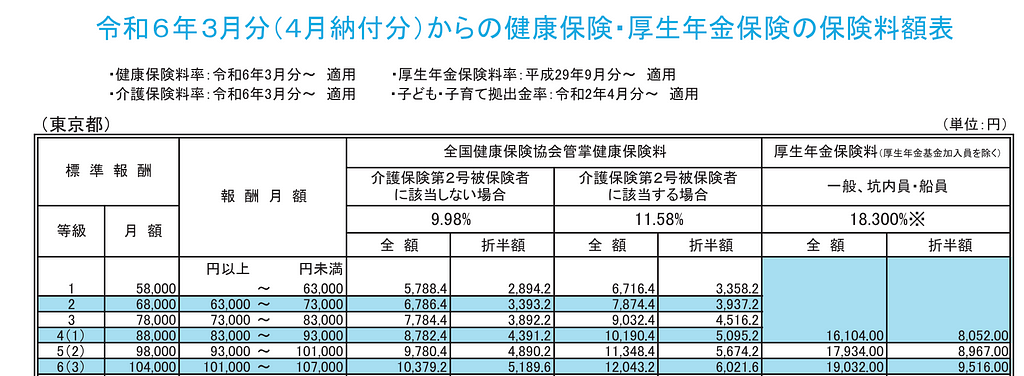
  <p>日本的健保與厚生年金跟台灣類似，一樣有分成不同級距，但不同的是還會根據所在區域有所不同，可以在官網上查到詳細資訊：<a href="https://www.kyoukaikenpo.or.jp/g3/cat330/sb3150/">都道府県毎の保険料額表</a>，底下是東京都的表格：</p>
  <figure>
<img alt="" src="https://cdn-images-1.medium.com/max/1024/0*euGVrMbmpM5GtSZH.png" />
  </figure>
  <p>在這個表格中，所謂的「介護保險第 2 號被保險者」指的是 40 歲 ~ 65 歲的人，因此我們該看的是左邊那一欄 9.98% 的。為了跟台灣比較，這次我們用年薪 1000 萬日幣，月薪 83.3 萬來做計算。</p>
  <p>月薪 83.3 萬的話，健保會落在第 40 級，保費全額是 82,834 元，公司跟個人分別負擔一半，因此每月就是 41,417 元。</p>
  <p>厚生年金的話直接到了上限，每月大約 12 萬日幣，一樣對半分，每個月是 59,475 元。</p>
  <p>再來還有一個雇用保險，是失業的時候可以得到補償用的，每個月是 0.5%，也就是 4615 元。</p>
  <p>總結下來，每年要繳的保險費用是：</p>
  <figure>
<img alt="" src="https://cdn-images-1.medium.com/max/1024/1*-9maFoJsEIcYjMsuLEenUQ.png" />    <figcaption>
日本保險費用
    </figcaption>
  </figure>
  <h3 id="section-6">日本的所得稅與住民稅</h3>
  <p>在計算所得稅以前，要先知道自己是什麼身份，有分成底下三種：</p>
  <ol>
    <li>永久居民</li>
    <li>非永久居民</li>
    <li>非居民</li>
  </ol>
  <p>第一種永久居民的話無論是日本收入還是海外收入，都會課稅。之前聽人講過申請永住通過之後，海外的收入也會被課稅，因此對有些人來說會是一個考量是否申請的點，不過我查了一下，這應該是錯誤的說法。</p>
  <p>因為這裡的永久居民定義是稅務上的，並不是身份上的，<a href="https://www.nta.go.jp/taxes/shiraberu/taxanswer/shotoku/2010.htm">國稅廳</a>官網給了這個表格：</p>
  <figure>
<img alt="" src="https://cdn-images-1.medium.com/max/718/0*UZwIwHAoRQ1bhY8h.png" />
  </figure>
  <p>如果你不是日本人，而且過去 10 年內待在日本的時間是 5 年以內，那就會被歸類在非永久居民。由於永久居留許可並不是歸化，所以不會有日本國籍。因此，不管有沒有去申請永住，只要 10 年內待滿 5 年，你的海外收入就是要被課稅，中文版的說明可以參考：<a href="https://www.jetro.go.jp/tc/invest/setting_up/section3/page7.html">3.7 自然人的稅收制度的概要</a></p>
  <p>總之呢，剛去日本工作的人都會是第二種非永久居民，只有在日本的收入會被課稅（除非你把海外收入也匯到日本）。</p>
  <p>然後所得稅的計算方法跟台灣類似，先扣東扣西之後，再按照累進稅率來計算。</p>
  <p>假設年薪是 1000 萬日幣，會先扣掉所謂的<a href="https://www.nta.go.jp/taxes/shiraberu/taxanswer/shotoku/1410.htm">給与所得控除</a>，超過 850 萬以上都是扣 195 萬，這是上限了。</p>
  <p>接著再扣掉各種項目，包括：</p>
  <ol>
    <li>社會保險（包含健保跟厚生年金還有雇用保險）</li>
    <li>扶養</li>
    <li>配偶</li>
    <li>基礎扣除（年收入 2400 萬以下的話，固定 48 萬）</li>
  </ol>
  <p>一樣以單身來算的話，這邊會扣掉社會保險的 126 萬外加基礎扣除 48 萬：</p>
  <figure>
<img alt="" src="https://cdn-images-1.medium.com/max/1024/1*sXeY6X8cTI-q67UyGDeyVQ.png" />    <figcaption>
日本年收千萬的扣除結果
    </figcaption>
  </figure>
  <p>接著再搭配這個累進稅率的表格：</p>
  <figure>
<img alt="" src="https://cdn-images-1.medium.com/max/1024/1*wjE36QBPiMdBurmc3_yBKQ.png" />    <figcaption>
日本所得税累進稅率表格
    </figcaption>
  </figure>
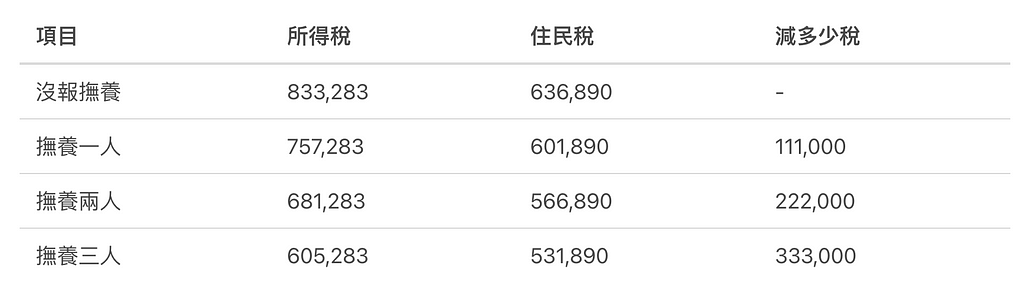
  <p>630 萬所對應到的是第三個範圍，所以是 6303916 * 20% — 427500 = 833,283，這就是所得稅的部分。</p>
  <p>除了要繳給日本政府的所得稅（國稅）以外，還有另外一個要繳給地方的住民稅（地方稅），這兩個是分開的，可以視為完全不同的東西。</p>
  <p>住民稅有分兩種繳納方式：</p>
  <ol>
    <li>特別徵收（從薪水裡面直接扣）</li>
    <li>普通徵收（每年 6 月自己繳）</li>
  </ol>
  <p>而住民稅跟所得稅類似，課稅的金額都跟前一年一整年（1/1~12/31）的收入有關。話說之前我有聽過「第二年開始要繳住民稅」或是「來日本第一年不用繳住民稅」之類的說法，但這種說法非常不精確而且容易誤導，怎樣算是一年？是完整的一年還是以年度來計算？</p>
  <p>我猜測之所以會有這種說法，是因為假設你三月來日本，要一直到隔年的六月才需要繳住民稅，所以才會說：「第一年不用繳」。但如果你是十月來日本，那一樣是隔年六月要繳住民稅。</p>
  <p>只是就像所得稅一樣，課的是前一年整年的收入，但該年只有十月到十二月這幾個月的收入，很有可能達到免稅的門檻。</p>
  <p>總之呢，住民稅就跟所得稅沒兩樣，課稅的金額都是去年一整年的收入，只要這樣想就好。</p>
  <p>除此之外，住民稅的計算方式也比所得稅再更複雜一些，住民稅底下其實包含兩種：</p>
  <ol>
    <li>都民稅（都道府県民税）</li>
    <li>區民稅（区市町村民税）</li>
  </ol>
  <p>簡單來講就是第一種繳給新北市，第二種繳給中和區。</p>
  <p>而住民稅的計算方式是兩個細項加起來，一個叫做均等割，意思就是每個人都繳一樣的錢，東京都的均等割是 1000 日幣，區民稅的均等割則是 3000日幣。</p>
  <p>另一個則叫做所得割，就是按照所得的比例去計算，東京的都民稅是 4%，區民稅是 6%。</p>
  <p>而這邊的所得就跟所得稅一樣，是扣掉各種扣除額之後剩餘的數字，唯一的差別是基礎控除的部分，所得稅是 48 萬，而住民稅只有 43 萬，兩者的比較可以參考<a href="https://www.tax.metro.tokyo.lg.jp/kazei/kojin_ju.html">東京都主稅局的說明</a>，寫得很詳細。</p>
  <p>因此，可以直接拿剛剛的數字來用，加上 5 萬之後變成 6,353,916，底下是詳細表格：</p>
  <figure>
<img alt="" src="https://cdn-images-1.medium.com/max/1024/1*oGY8301KJqyliLMX3yIrdg.png" />    <figcaption>
日本住民稅試算
    </figcaption>
  </figure>
  <p>其實還有一個「稅額控除額」可以扣，但那個比較複雜，而且以這個年收來說似乎只有 2500 日圓而已，所以先不仔細算了，有興趣可以參考：<a href="https://www.city.musashino.lg.jp.c.ad.hp.transer.com/kurashi_tetsuzuki/zeikin/kojinjuminzei/keisan/zeigakukoujo/1032619.html">调整扣除</a></p>
  <p>總之呢，最後算出來的住民稅是 636,890 元。</p>
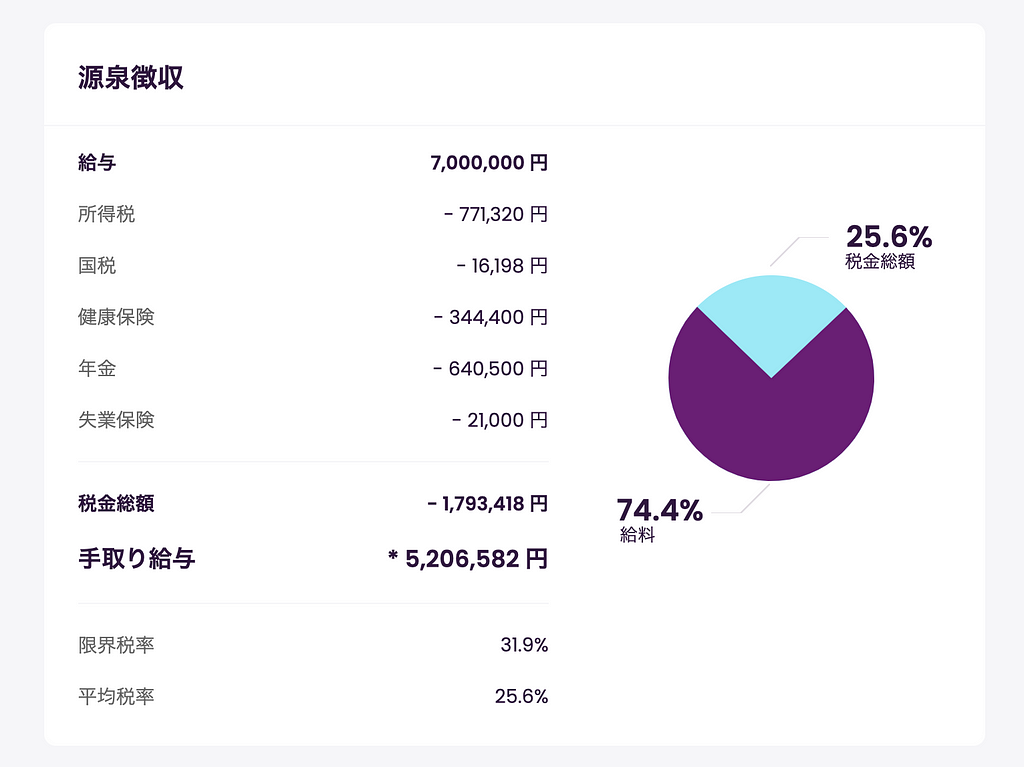
  <h3 id="section-7">日本稅收結論</h3>
  <figure>
<img alt="" src="https://cdn-images-1.medium.com/max/1024/1*IHWwC7B7q7ExS8n8XUNSdA.png" />    <figcaption>
日本稅收結論
    </figcaption>
  </figure>
  <p>保險加年金總共佔了 12.66%，比所得稅還要高，而住民稅也不可小覷，如果把所得稅跟住民稅加起來，也有 14.7%。</p>
  <p>這裡的數字跟我在<a href="https://life.huli.tw/2024/02/12/japan-software-engineer-salary/">日本軟體工程師的薪水如何？到底值不值得去？</a>一文中，得到的數字差不多，稅跟保險佔了 27% 左右，最後實拿只有 73%。不過當時我一直以為所謂的「日本工作稅很重」，是所得稅重，但這篇算下來以後，發現所得稅本身根本不重，甚至比台灣還要低一點。</p>
  <p>算完日本跟台灣以後，就可以來比較一下了：</p>
  <figure>
<img alt="" src="https://cdn-images-1.medium.com/max/1024/1*mNrtgpeT6t75FUcKGzenww.png" />    <figcaption>
台灣與日本繳稅比較
    </figcaption>
  </figure>
  <p>其實在我寫上一篇日本薪水的文章時，我只注意到會少三成，但沒注意到這三成的比例是如何分配的，但現在這樣列下來就很清楚了。</p>
  <p>事實上，日本的所得稅跟台灣差不多，就算年收 200 萬，都只有不到 10% 而已，但在保險這塊要繳的比台灣多很多，台灣加起來大概是 2%，日本則是 12%，是台灣的六倍。</p>
  <p>除此之外，住民稅佔了總收入的 6%，也是一筆不小的負擔。</p>
  <p>因此，同樣收入底下，日本之所以拿得比台灣少，並不是因為所得稅很重，而是因為保險貴很多，外加日本還多一個住民稅。</p>
  <h3 id="section-8">日本工作的節稅手段</h3>
  <h3 id="section-9">報撫養</h3>
  <p>其實這跟台灣一樣，是最常見的節稅手段之一，在日本要報海外撫養的話要滿足幾個資格，包括：</p>
  <ol>
    <li>六等親以內</li>
    <li>被撫養人的年收不能超過 48 萬日幣</li>
    <li>需要有匯款 38 萬日幣以上的證明</li>
  </ol>
  <p>扣除額的話會根據撫養對象的年齡而有所不同，最常見的 23–70 歲區間的話，報一個人所得稅的扣除額可以多 38 萬，住民稅則是 33 萬。</p>
  <p>我們來計算一下報撫養之後，稅金會差多少：</p>
  <figure>
<img alt="" src="https://cdn-images-1.medium.com/max/1024/1*8UF9ZXpK8Ie4y6ot5p9alA.png" />    <figcaption>
報撫養的差別
    </figcaption>
  </figure>
  <p>算出來之後得出撫養一個人，可以少 11 萬日幣的稅金，也就是薪水的 1.1%，其實還滿多的。</p>
  <p>不過要注意的是如果撫養太多人的話，可能會影響到永住的申請。畢竟永住審查時會需要你有一定的謀生能力，你的薪水必須能夠支撐你自己以及撫養人的生活，不過如果薪水夠高的話，影響似乎沒這麼大。</p>
  <h3 id="section-10">故鄉納稅（ふるさと納税制度）</h3>
  <p>住民稅是一種地方稅，繳給地方政府的，不過除了繳給居住地以外，其實你也可以選擇繳給其他地方（其實是捐款的一種），例如說北海道或是沖繩之類的，算是一種宣傳地方特色以及平均城鄉差距的手段。</p>
  <p>如果選擇繳給其他地方的話，還會拿到價值大約是稅金 30% 的禮品，不過由於這個故鄉納稅制度並沒有減少你繳的稅，所以有些人不覺得這是一種節稅手段。</p>
  <p>但重點是有那個禮品，如果沒有用故鄉納稅的話，你就是什麼也拿不到，用了之後還可以換一些有價值的禮品回來，所以我認為這就是一種節稅沒錯，有賺到禮品。</p>
  <p>而故鄉納稅是有額度限制的，想知道大約的限制，可以到各個故鄉納稅的專門網站去計算：</p>
  <ol>
    <li><a href="https://furunavi.jp/deduction.aspx">https://furunavi.jp/deduction.aspx</a></li>
    <li><a href="https://furusato-nouzei.event.rakuten.co.jp/mypage/deductions/">https://furusato-nouzei.event.rakuten.co.jp/mypage/deductions/</a></li>
    <li><a href="https://mogufull.jp/info/003/#DEDUCTIBLELIST">https://mogufull.jp/info/003/#DEDUCTIBLELIST</a></li>
  </ol>
  <p>以小明單身年薪一千萬日幣來說，最多的扣除額大約是 18 萬日幣左右，以 30% 的價值來說，就是 5.4 萬日幣的禮品，不無小補。</p>
  <p>詳細的流程可以參考這兩篇：</p>
  <ol>
    <li><a href="https://mogufull.jp/info/002/">从申请到确定申告的流程</a></li>
    <li><a href="http://www.jpchinapress.com/static/content/QW/2022-12-12/1051822022071959552.html">众说纷纭的故乡纳税到底是什么？图图是道，详解一站式特例制度故乡纳税全流程</a></li>
  </ol>
  <p>基本上就是上網選擇要捐款給誰，接著付錢，然後就會收到禮品跟一個申請書，把申請書填完寄回去就好了，滿方便的。至於時間點的話，要看收入，有可能來的第一年就可以開始準備了。</p>
  <p>舉例來說，如果是 9 月才來日本工作，四個月的薪資算 300 萬日幣好了，隔年六月要繳住民稅的時候，就會用這 300 萬來算。而 300 萬收入的故鄉稅最大金額大約是 28,000 日幣，30% 是 8400 日幣，也是不無小補。</p>
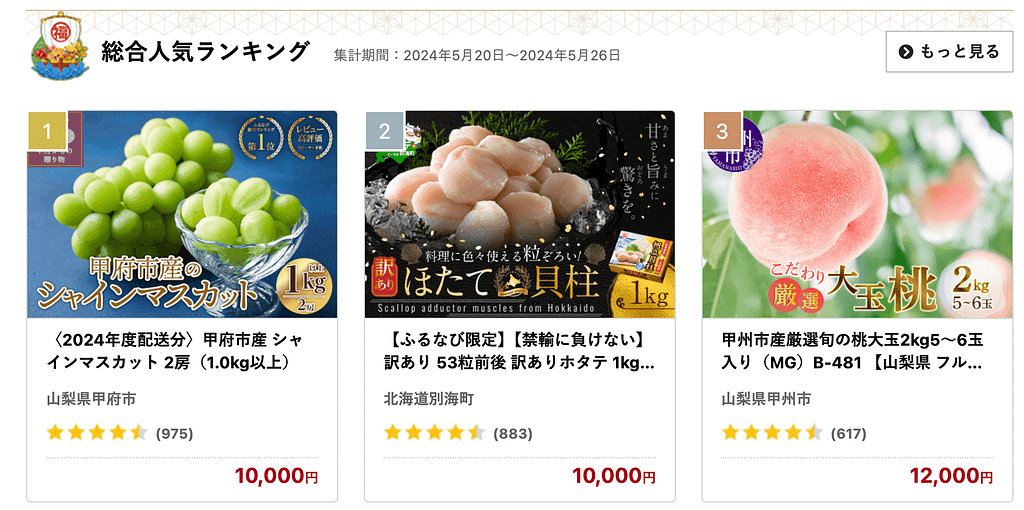
  <p>總之呢，不管你什麼時候來日本，只要該年度的年收會大於 300 萬，就可以在該年開始準備買禮品了，你看看這些禮品多誘人：</p>
  <figure>
<img alt="" src="https://cdn-images-1.medium.com/max/1024/0*9FZ11u3IAp38GnE6.png" />
  </figure>
  <h3 id="nisa">NISA（少額投資非課税制度）</h3>
  <p>這個節稅手段跟前面講的不同，前面都是基於所得稅或是住民稅的節稅手段，對所有人都適用，但現在要講的這個不太一樣。</p>
  <p>在日本如果你有在做投資，例如說買賣股票的話，賺到的錢會直接被扣 20% 的稅金！例如說我賺個 10 萬，最後拿到手的只剩下 8 萬塊而已。</p>
  <p>而日本政府為了鼓勵大家投資，因此就有了 NISA 這個制度，NISA 的全名為 Nippon Individual Saving Account，可以去開立一個 NISA 的戶頭，在這個戶頭下的投資賺了錢也不用課稅。</p>
  <p>NISA 戶頭底下還有分兩種，一種是積立（定期定額）投資，另外一種是成長投資，前者一年有 120 萬日元的免稅額，後者則是 240 萬日元，這兩者可以買的股票不太一樣。</p>
  <p>這裡的免稅指的是成本而非獲利，意思就是如果我今年花 120 萬買了某個股票，半年後漲到 500 萬，中間賺的 380 萬是不需要扣稅的。</p>
  <p>總之呢，如果本來就有在投資的，記得利用 NISA 戶頭降低資本利得稅，在一定額度內可以直接少掉 20%。</p>
  <p>更詳細的資訊可以參考：</p>
  <ol>
    <li><a href="https://mssinsin.com/biztrend2/">《懶人投資+節稅的好方法：日本 NISA 制度》</a></li>
    <li><a href="https://tubakiinjapan.com/new-nisa/">【投資】還是不了解 新NISA 嗎？使用舊NISA的各位看過來～</a></li>
    <li><a href="https://www.fsa.go.jp/policy/nisa2/know/">日本金融廳官方說明</a></li>
  </ol>
  <h3 id="section-11">離開日本時的注意事項 — 脱退一時金</h3>
  <p>之前在計算的時候有說到保險佔了滿大一部分，其中厚生年金更是佔了薪資的 7% 左右。由於繳交的年金其實是給未來老了的自己用的，因此如果沒有打算長期待在日本，在離開日本時可以申請所謂的「脱退一時金」，把之前繳的厚生年金拿回來。</p>
  <p>這是日本年金機構的官方說明，我覺得寫得滿清楚的：<a href="https://www.nenkin.go.jp/service/jukyu/sonota-kyufu/dattai-ichiji/20150406.html">https://www.nenkin.go.jp/service/jukyu/sonota-kyufu/dattai-ichiji/20150406.html</a></p>
  <p>要注意的是年金最多只能拿五年份的回來，超過了就不列入計算了，例如說在日本待了七年要離開，也只能拿最近五年的。</p>
  <p>假設來日本工作三年的小明要退出厚生年金，可以拿到的錢會是 650,000（厚生年金的標準報酬上限） * 3.3 = 2,145,000，我算了一下，這跟小明這三年自己繳的厚生年金其實差不多，因此是可以全數拿回來的。</p>
  <p>因此，如果沒有想要長期待在日本的話，在離開時可以拿 7% 的錢回來，其實還滿不錯的。之前算的在日本的實拿薪水大概 72.6%，若是一開始就沒有打算長期待著，就可以把脫退一時金加上，就會變成大概 80%。</p>
  <h3 id="section-12">結語</h3>
  <p>這篇的主要目的其實是紀錄外加研究一下日本的稅務，因為自己也很快就會用到，有研究過的話會心安不少，日後有朋友問起也可以有憑有據的跟他說明。</p>
  <p>有很多東西都是點到為止，沒有講得很詳細，但關鍵字應該給的很足，有興趣的朋友們可以自己照著關鍵字去找，反正都脫離不了節稅三天王：撫養、故鄉納稅還有 NISA。</p>
  <p>話說還有另一個叫做 <a href="https://tubakiinjapan.com/ideco-index/">iDeCo</a> 的東西，有點類似台灣的勞退自提那種感覺，都是把薪水的一部分提到固定帳戶，而且老了才能領出來，但因為我應該不會用這個，所以就沒有研究了。</p>
  <p>參考資料：</p>
  <ol>
    <li><a href="https://www.gov.tw/News_Content_26_534742">申報112年度個人綜合所得稅懶人包，幫您搞懂怎麼報！</a></li>
    <li><a href="https://www.swingvy.com/blog-tw/salary-slip-example">符合勞基法的薪資單格式怎麼做？跟著範本放上這幾個薪資明細就搞定！</a></li>
    <li><a href="https://www.swingvy.com/blog-tw/labor-insurance-and-nhi">2024年（113年）勞健保、勞退級距三合一對照表 + 勞健保負擔費用等常見問題一次看</a></li>
    <li><a href="https://www.swingvy.com/blog-tw/monthly-insurance-salary">投保薪資是什麼？只用本薪投保勞健保可以嗎？一次搞懂月投保薪資眉角！</a></li>
    <li><a href="https://www.yourator.co/articles/356">勞健保扣多少？2024 勞健保費用與勞工退休金試算總整理！</a></li>
    <li><a href="https://thetravellernotes.com/income-tax-in-japan/">日本工作稅金知多少？萬萬稅後的實領薪水</a></li>
    <li><a href="https://www.nta.go.jp/taxes/shiraberu/taxanswer/shotoku/1199.htm">№1199 基礎控除</a></li>
    <li><a href="https://www.cr.mufg.jp/mycard/beginner/23091/index.html">社会保険料控除とは？年末調整と確定申告での手続きを解説</a></li>
    <li><a href="https://www.jetro.go.jp/tc/invest/setting_up/section4/page9.html">4.9 日本的社會保障制度</a></li>
    <li><a href="https://www.cr.mufg.jp/mycard/beginner/23081/index.html">所得税の計算方法は？税率や控除などをわかりやすく解説</a></li>
    <li><a href="https://www.nta.go.jp/taxes/shiraberu/taxanswer/shotoku/1410.htm">№1410 給与所得控除</a></li>
    <li><a href="https://www.zeikin5.com/info/">所得税・住民税の計算方法</a></li>
    <li><a href="https://www.freee.co.jp/kb/kb-payroll/the-deduction-for-employment-income/">給与所得控除とは？給与所得の計算方法や所得控除との違いついてわかりやすく解説</a></li>
    <li><a href="https://www.city.taito.lg.jp/kurashi/zeikin/zeikin/shurui/093722836.html">1.所得控除</a></li>
    <li><a href="https://www.freee.co.jp/kb/kb-kakuteishinkoku/resident_tax_deduction/">住民税の控除とは？ 種類と控除金額を解説</a></li>
    <li><a href="https://www.nenkin.go.jp/service/jukyu/sonota-kyufu/dattai-ichiji/20150406.html">脱退一時金の制度</a></li>
    <li><a href="https://tubakiinjapan.com/taxdeduction-dependents/">【稅金】日本工作一定要報的 海外扶養 ～幫你省下來回機票錢～（2023年最新）</a></li>
  </ol>
<img src="https://medium.com/_/stat?event=post.clientViewed&amp;referrerSource=full_rss&amp;postId=9b8608b878ff" width="1" height="1" alt="" />
</div>]]></content><author><name>Huli</name></author><category term="medium" /><category term="medium" /><summary type="html"><![CDATA[到日本工作怎麼繳稅？稅有多重？跟台灣比呢？ ——]]></summary></entry><entry><title type="html">2024 年日本家族滯在簽證申請心得</title><link href="https://nodebe4.github.io/oped2/2024-06-10/2024-%E5%B9%B4%E6%97%A5%E6%9C%AC%E5%AE%B6%E6%97%8F%E6%BB%AF%E5%9C%A8%E7%B0%BD%E8%AD%89%E7%94%B3%E8%AB%8B%E5%BF%83%E5%BE%97/" rel="alternate" type="text/html" title="2024 年日本家族滯在簽證申請心得" /><published>2024-06-10T18:22:12-05:00</published><updated>2024-06-10T18:22:12-05:00</updated><id>https://nodebe4.github.io/oped2/2024-06-10/2024%20%E5%B9%B4%E6%97%A5%E6%9C%AC%E5%AE%B6%E6%97%8F%E6%BB%AF%E5%9C%A8%E7%B0%BD%E8%AD%89%E7%94%B3%E8%AB%8B%E5%BF%83%E5%BE%97</id><content type="html" xml:base="https://nodebe4.github.io/oped2/2024-06-10/2024-%E5%B9%B4%E6%97%A5%E6%9C%AC%E5%AE%B6%E6%97%8F%E6%BB%AF%E5%9C%A8%E7%B0%BD%E8%AD%89%E7%94%B3%E8%AB%8B%E5%BF%83%E5%BE%97/"><![CDATA[<!--1718061732000-->
<p><a href="https://hulitw.medium.com/depndant-visa-in-japan-how-to-apply-4462919c3038?source=rss-f1fb3e40dc37------2">2024 年日本家族滯在簽證申請心得</a>
——</p>

<div>
  <p>去年（2023）十月，我來到日本工作，因為各種原因，我們需要自己申辦我太太的家族滯在簽證（但也不是我去辦的，是我太太自己搞定的，太神啦），這篇記錄一下過程以及心得。</p>
  <p>我太太是去年十月就跟著我一起過來，先拿觀光簽證念三個月的短期語言學校，因為預計待的時間較長（快要待滿 90 天），入境日本的時候有被問，所有有出示語言學校的入學通知，之後也順利入境了。</p>
  <p>接著先來講一下辦理家族滯在簽證之前要準備什麼文件。</p>
  <h3 id="section">家族滯在簽證事前準備</h3>
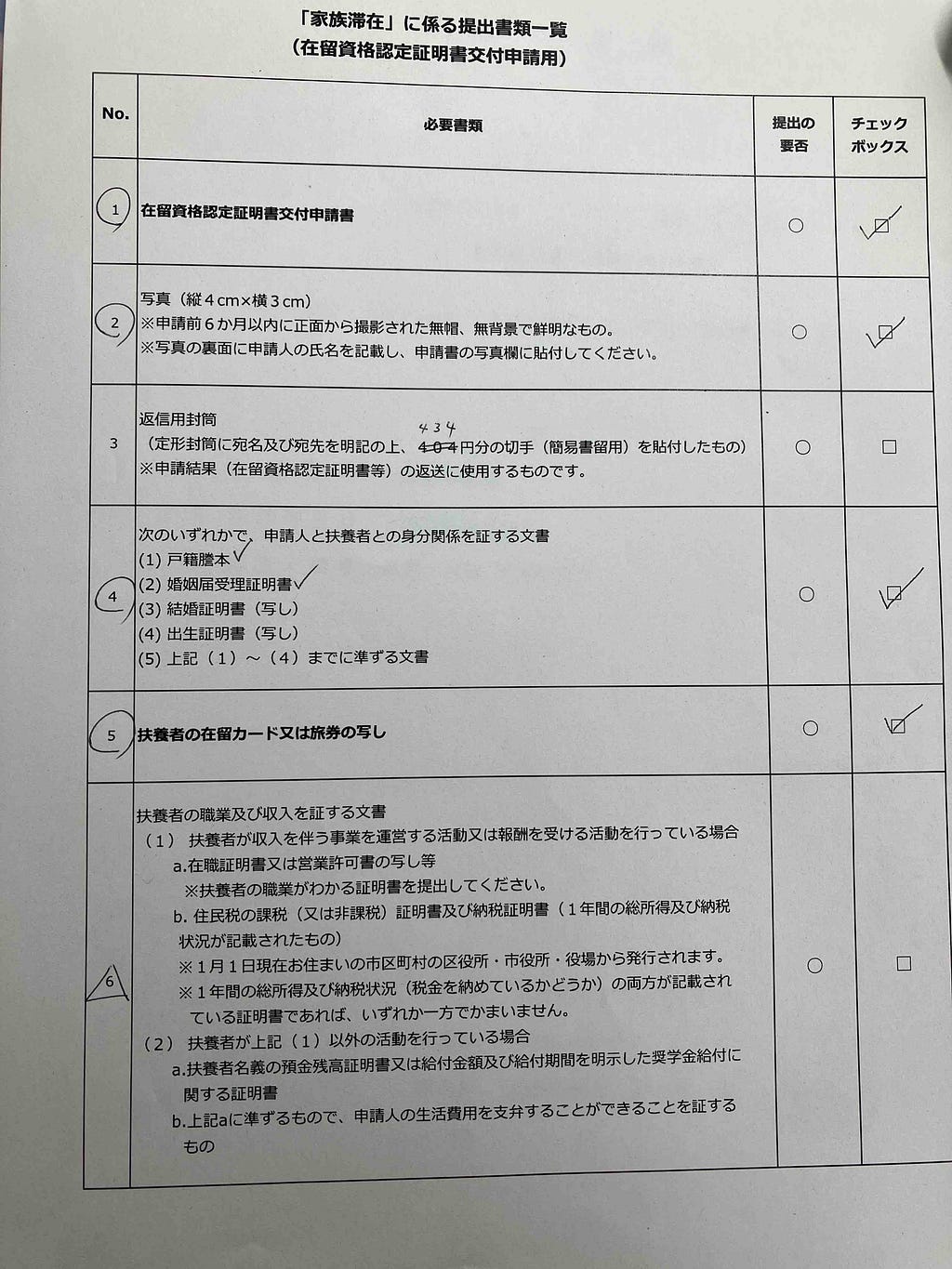
  <p>底下條列式需要準備的資料，可以參考入管局的家族滞在在留資格官方資料：<br /><a href="https://www.moj.go.jp/isa/applications/status/dependent.html">https://www.moj.go.jp/isa/applications/status/dependent.html</a></p>
  <ol>
    <li>在留資格認定證明書交付申請書（入管局網站下載，請整份列印）</li>
    <li>大頭照片（4cm * 3cm，在背後寫名字，可以先不貼，給櫃檯貼）</li>
    <li>返信用信封跟郵票（便利商店或郵局都可以買到，交付當時郵費是 434，定形郵便物（25gまで）84 + 簡易書留 350 = 434，請依當下郵局公告料金為主）</li>
    <li>戶籍謄本 + 結婚證明書（正本 + 複印 + 翻譯都有帶上，翻譯是自己翻的）</li>
    <li>扶養者在留卡 + 護照影印</li>
    <li>在職證明書、雇用契約書，需請公司開立，需繳交正本。</li>
    <li>納稅證明書，如扶養者剛到日本不久，這個文件生不出來，會開一個單子請你到就勞審查部門走一趟</li>
    <li>申請者本人護照正本</li>
  </ol>
  <p>填寫申請書的時候有幾個地方可以注意一下：</p>
  <ol>
    <li>查証申請予定地：台北/高雄 (拿到 COE（在留許可）後預計在哪裡的日本在台協會換成簽證)</li>
    <li>看清楚是「申請人署名」還是「扶養者署名」</li>
    <li>所有中文文件都需要附上翻譯，翻譯部分都可以自己翻，請善用網路跟 AI，翻譯完之後要不要簽名好像都可以，但我太太有自己簽名</li>
    <li>所有文件都用文件夾收好，不要用釘書機，也不要用迴紋針</li>
  </ol>
  <p>準備完上面這些資料之後，就可以跑一趟東京品川入管局了（全名為東京出入国在留管理局）。</p>
  <h3 id="section-1">家族滯在簽證入管局申請過程</h3>
  <p>2023/10/17 的時候我太太跑了一趟入管局，新申辦在留資格認定證明書無法預約，建議開門前半小時到入管局等候，有時候似乎會提早一點點開，底下是詳細時程：</p>
  <ul>
    <li>08:30 抵達入管局</li>
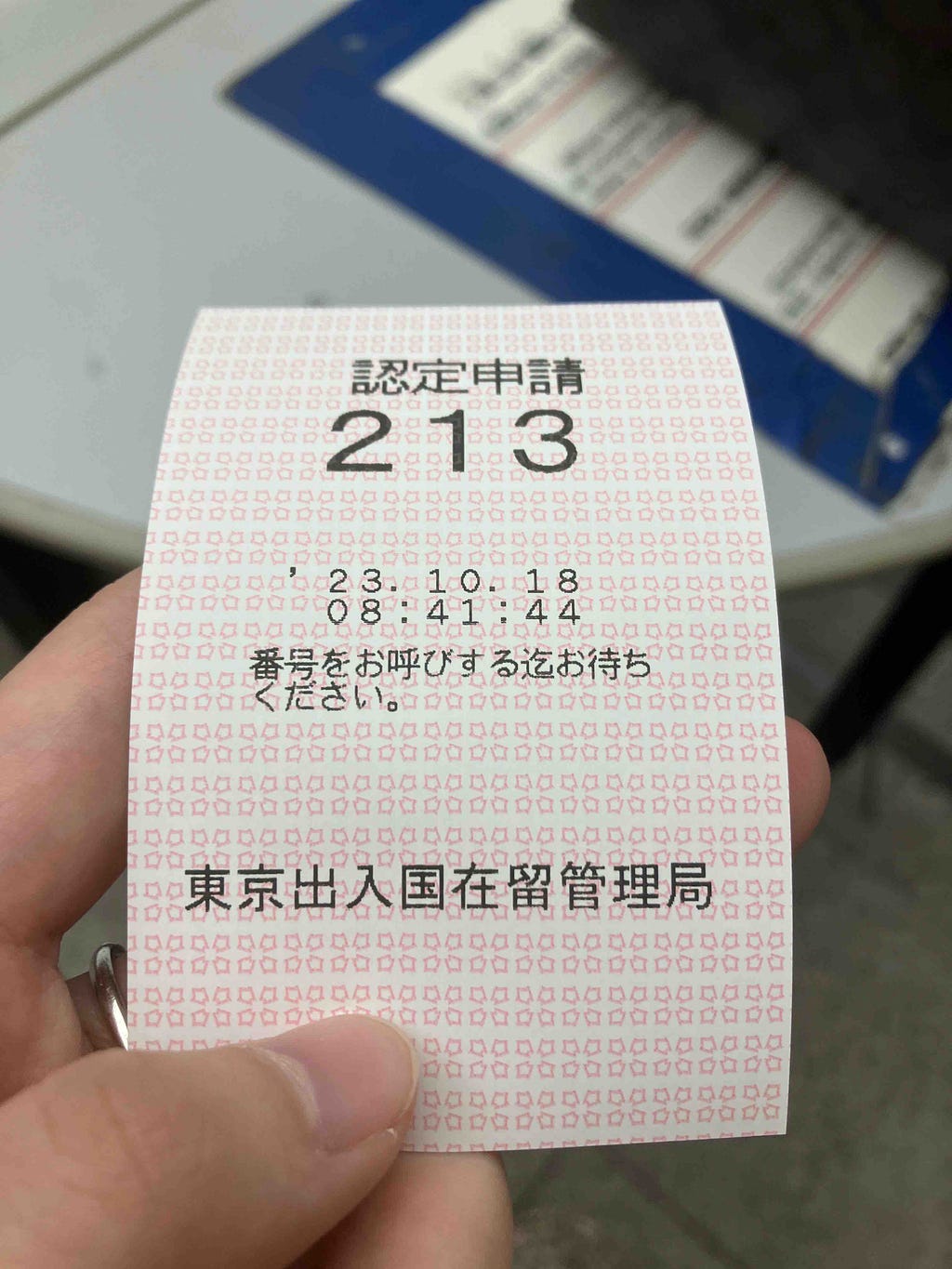
    <li>08:44 認定申請櫃檯抽 213 號號碼牌（話說如果是高度人才的話有專門櫃檯）</li>
    <li>09:43 因為沒有納稅證明書所以要去就勞審查櫃檯走一趟</li>
    <li>10:21 重新回到認定申請櫃檯抽 233 號號碼牌</li>
    <li>10:38 提交文件，但申請書裡面有個地方是要扶養者簽名，但我們弄錯了，因此決定明天再來一趟</li>
  </ul>
  <figure>
<img alt="" src="https://cdn-images-1.medium.com/max/1024/0*hcY_CSnrySWWuux3.jpg" />
  </figure>
  <figure>
<img alt="" src="https://cdn-images-1.medium.com/max/1024/0*eKwPgTKrDu8k-gXN.jpg" />
  </figure>
  <p>隔天差不多時間到達入管局，08:42 抽號碼牌，結果又抽到同一個號碼：</p>
  <figure>
<img alt="" src="https://cdn-images-1.medium.com/max/1024/0*xKn83--yZOXh0eaz.jpg" />
  </figure>
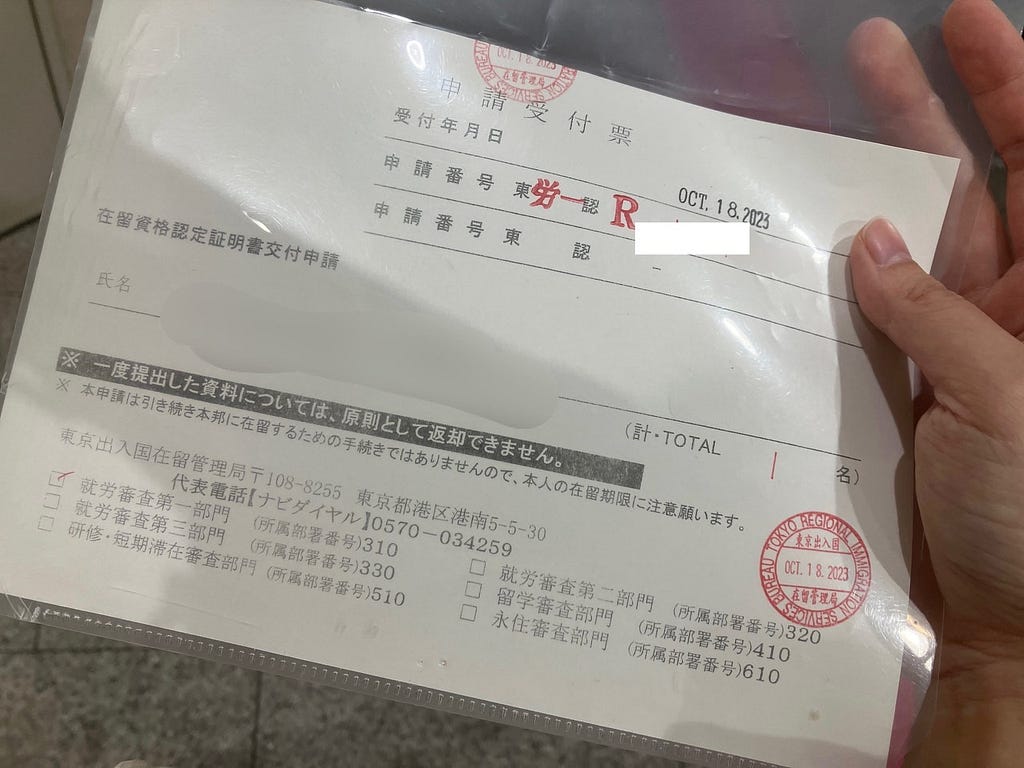
  <p>一直到 09:26 把準備好的資料全都交出去，完成申請！（話說我太太不只兩天抽一樣號碼的號碼牌，還兩天在同一個時間點看到同一個行政書士出現，還以為是電影情節發生回到前一天了）</p>
  <p>申請完之後會拿到一個「申請受付票」，請好好保存：</p>
  <figure>
<img alt="" src="https://cdn-images-1.medium.com/max/1024/0*SYtz_Yve-YPBPAVw.jpg" />
  </figure>
  <h3 id="section-2">等了又等</h3>
  <p>10/18 辦的家族滯在，原本預計最晚應該是 3 個月後，也就是 1 月中左右會拿到，但殊不知等了更久。</p>
  <p>雖然說可以打去入管局問進度，但基本上也沒什麼用，而且電話超難打，建議不用打了，我們農曆過年的時候有成功打通兩次，給完編號之後說要查一下，結果一查就是個二三十分鐘，然後電話就斷線了。</p>
  <p>這裡有官方提供的在留資格審查時間參考表格，可以看到家族滯在都滿久的，最近一次的要等到 86 天：<a href="https://www.moj.go.jp/isa/applications/resources/nyuukokukanri07_00140.html">https://www.moj.go.jp/isa/applications/resources/nyuukokukanri07_00140.html</a></p>
  <p>在等待家族滯在的時候，一樣可以用觀光簽證入境日本（申請受付票等資料入境時建議帶在身邊），像我太太就是 10 月跟我一起來，1 月初回台灣，然後 2 月過完年再用觀光簽入境日本，但這一次就只待個兩三週左右。</p>
  <p>那我們什麼時候收到通知的呢？</p>
  <p>是一直到 2/16 號入管局才來電（但我沒接到），而 2/21 收到了在留許可，因此足足等了 4 個月。收到之後的流程就不詳述了，基本上就是回台灣跑一趟台日交流協會辦簽證，後續跟我之前辦工作簽的流程都一樣。</p>
  <h3 id="section-3">結語</h3>
  <p>這篇簡單分享一下我們自己辦理家族滯在簽證的過程，跑完一次之後覺得好像確實不一定要找行政書士去辦，畢竟準備資料相對來講比較簡單一點，而且辦完之後就是一直等等等，中間也沒有任何來來回回。原本其實是想找行政書士的，但查一下價錢差不多要 10 萬日幣，也就是 2 萬台幣，下不了手，所以最後還是選擇自己辦了。</p>
  <p>辦之前我太太有跑去一個外国人在留総合インフォメーションセンター，但如果你看得懂入管局網站說明，不需要前往該機構，此處似乎是外包單位，他們也只會按照入管局網站跟你說，你問以外的問題他們也不知道。</p>
<img src="https://medium.com/_/stat?event=post.clientViewed&amp;referrerSource=full_rss&amp;postId=4462919c3038" width="1" height="1" alt="" />
</div>]]></content><author><name>Huli</name></author><category term="medium" /><category term="medium" /><summary type="html"><![CDATA[2024 年日本家族滯在簽證申請心得 ——]]></summary></entry><entry><title type="html">The Future According to Xi and Putin</title><link href="https://nodebe4.github.io/oped2/2024-05-28/The-Future-According-to-Xi-and-Putin/" rel="alternate" type="text/html" title="The Future According to Xi and Putin" /><published>2024-05-28T11:47:00-05:00</published><updated>2024-05-28T11:47:00-05:00</updated><id>https://nodebe4.github.io/oped2/2024-05-28/The%20Future%20According%20to%20Xi%20and%20Putin</id><content type="html" xml:base="https://nodebe4.github.io/oped2/2024-05-28/The-Future-According-to-Xi-and-Putin/"><![CDATA[<!--1716914820000-->
<p><a href="https://www.chinafile.com/conversation/future-according-xi-and-putin">The Future According to Xi and Putin</a>
——</p>

<div>
  <div class="view view-featured-photo view-id-featured_photo view-display-id-panel_pane_1 visual-box view-dom-id-0ffe490cb6b37bf9214769d885e9ac97">
    <div class="content view-content">
      <div class="views-row views-row-1">
        <div class="views-field views-field-field-common-featured-photo">
          <div class="field-content">
&lt;a href="https://www.chinafile.com/sites/default/files/assets/images/article/featured/55396_sm.jpg" title="The Future According to Xi and Putin" class="colorbox" data-colorbox-gallery="gallery-node-55396-2fUXmxP-SPc" data-cbox-img-attrs="{"title": "", "alt": ""}"&gt;<img src="https://www.chinafile.com/sites/default/files/styles/large/public/assets/images/article/featured/55396_sm.jpg?itok=trjPH8ez" width="1500" height="999" alt="" title="" referrerpolicy="no-referrer" />&lt;/a&gt;
          </div>
        </div>
        <div>
          <div class="photo-credit">
Sergei Bobylyov—AFP/Getty Images
          </div>
        </div>
        <div>
          <div class="photo-caption">
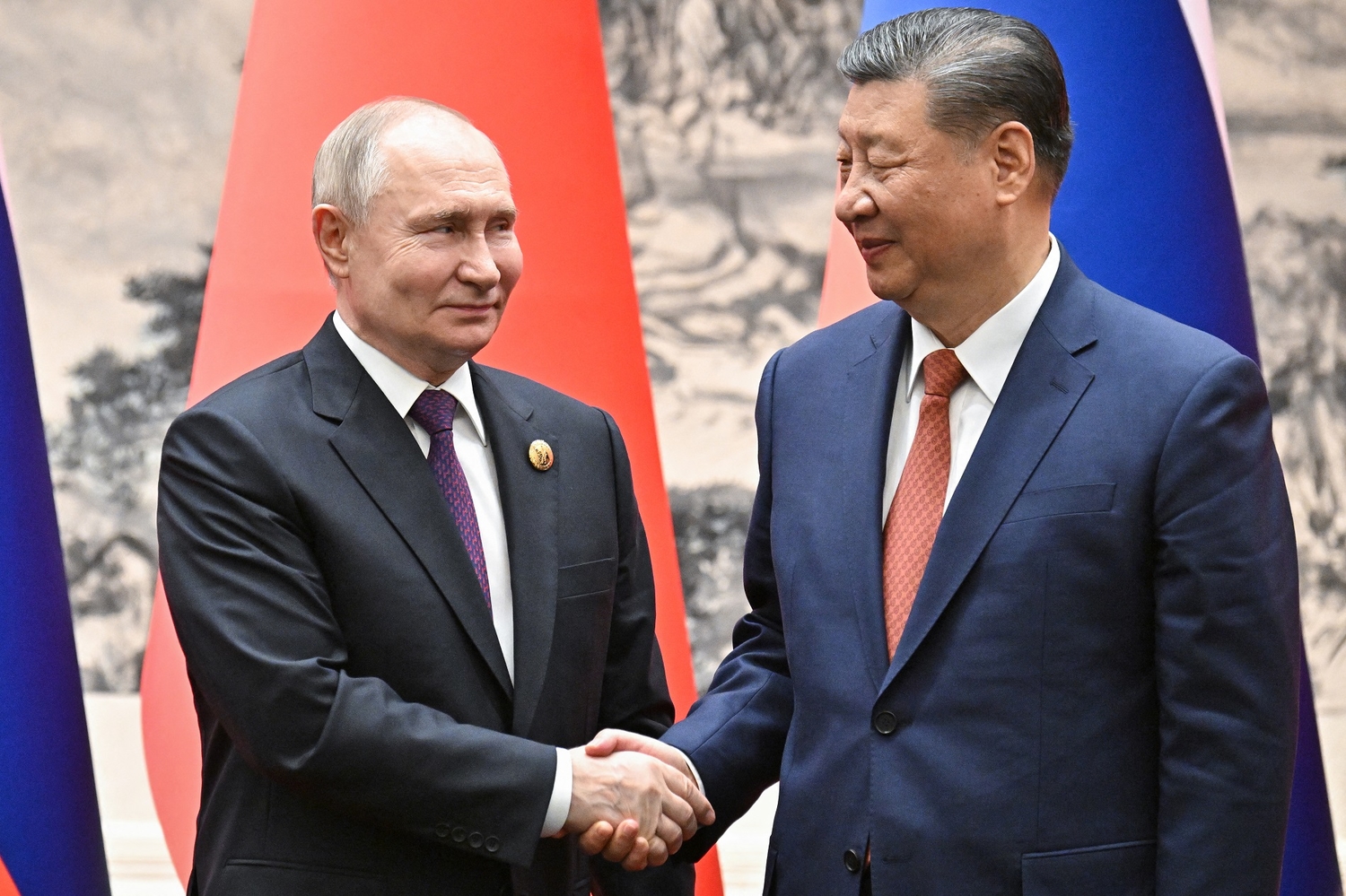
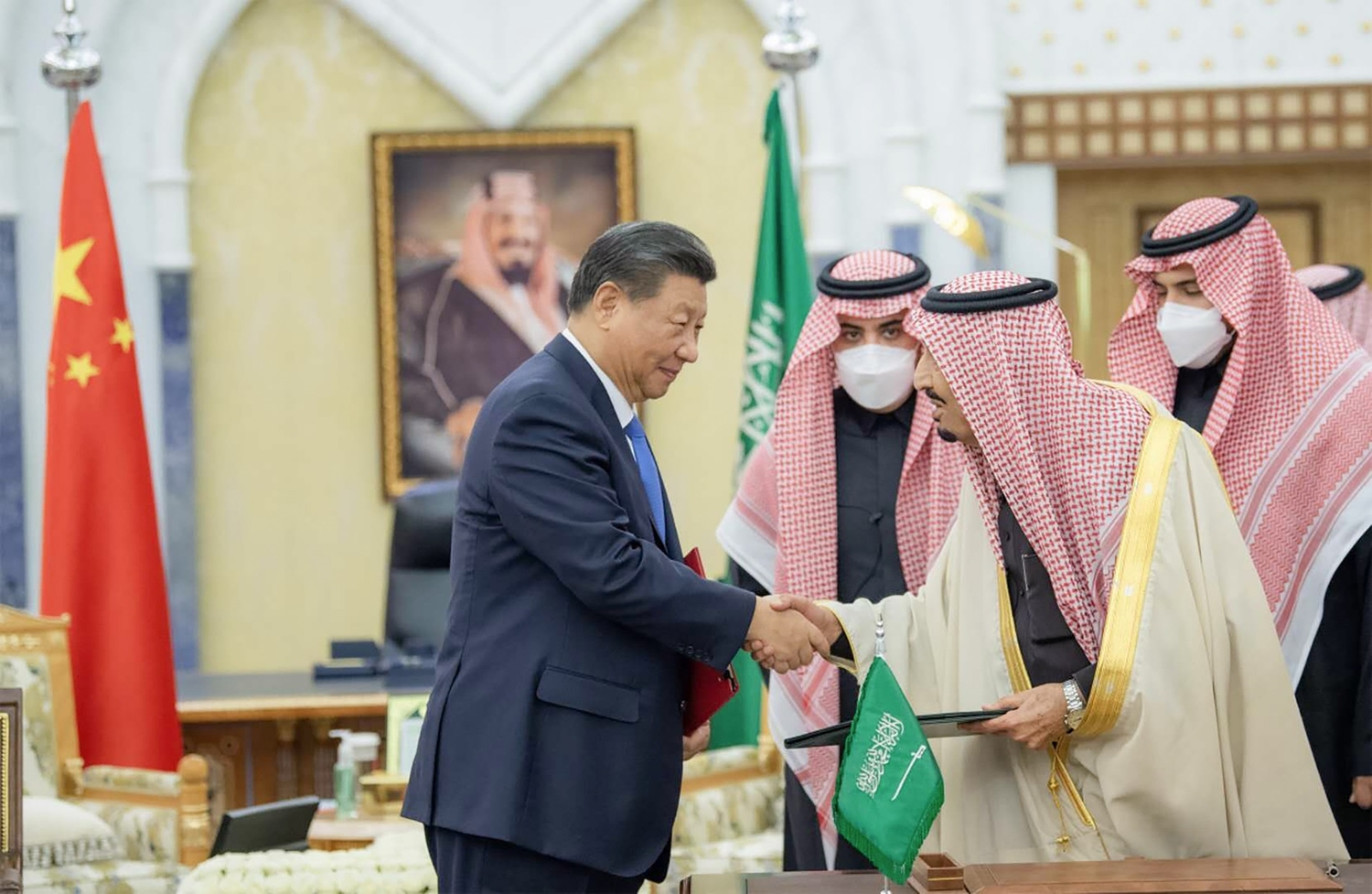
            <p>Russia’s President Vladimir Putin and China’s leader Xi Jinping shake hands during a signing ceremony following their talks in Beijing on May 16, 2024. (Photograph distributed by the Russian state agency Sputnik.)</p>
          </div>
        </div>
      </div>
    </div>
  </div>
  <div class="content">
    <div class="field field-name-body field-type-text-with-summary field-label-hidden">
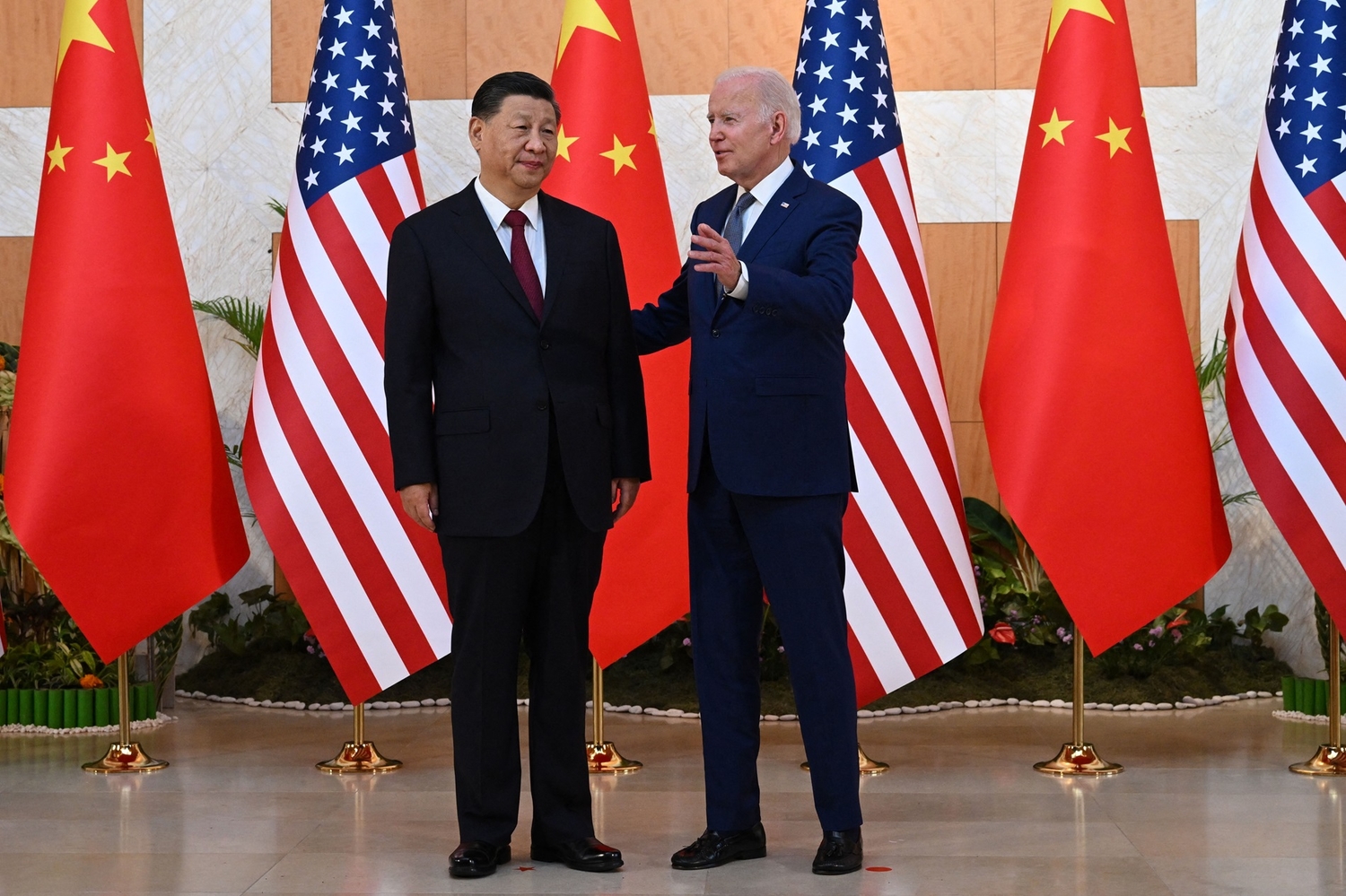
      <p class="dropcap">On May 16 and 17, Russian President Vladimir Putin made a state visit to China, where he met with Chinese leader Xi Jinping.</p>
      <p>On the opening day of the 2022 Winter Olympics, just 20 days before the Russian invasion of Ukraine, the two leaders had met in Beijing and <a href="https://www.reuters.com/world/europe/russia-china-tell-nato-stop-expansion-moscow-backs-beijing-taiwan-2022-02-04/" target="_blank" rel="nofollow">declared</a> a “no limits” partnership. On March 22, 2023, at the end of a state visit to Russia, as Xi left the Kremlin he <a href="https://www.aljazeera.com/news/2023/3/22/xi-tells-putin-of-changes-not-seen-for-100" target="_blank" rel="nofollow">told</a> Putin, “There are changes—the likes of which we haven’t seen for 100 years—and we are the ones driving these changes together.” The remarks were filmed and broadcast around the world.</p>
      <p>China has not condemned the Russian invasion of Ukraine, and China’s rhetorical and economic support for Russia has been rock solid. Bilateral trade <a href="https://www.reuters.com/world/putin-visit-china-may-16-17-kremlin-says-2024-05-14/" target="_blank" rel="nofollow">rose</a> 26.3 percent between 2022 and 2023, hitting a record $240.1 billion, with China <a href="https://energyandcleanair.org/december-2023-monthly-analysis-on-russian-fossil-fuel-exports-and-sanctions/" target="_blank" rel="nofollow">buying</a> enormous qualities of Russian fossil fuels, and <a href="https://www.atlanticcouncil.org/blogs/econographics/chinese-exports-have-replaced-the-eu-as-the-lifeline-of-russias-economy/" target="_blank" rel="nofollow">selling</a> products and commodities that Russia needs.</p>
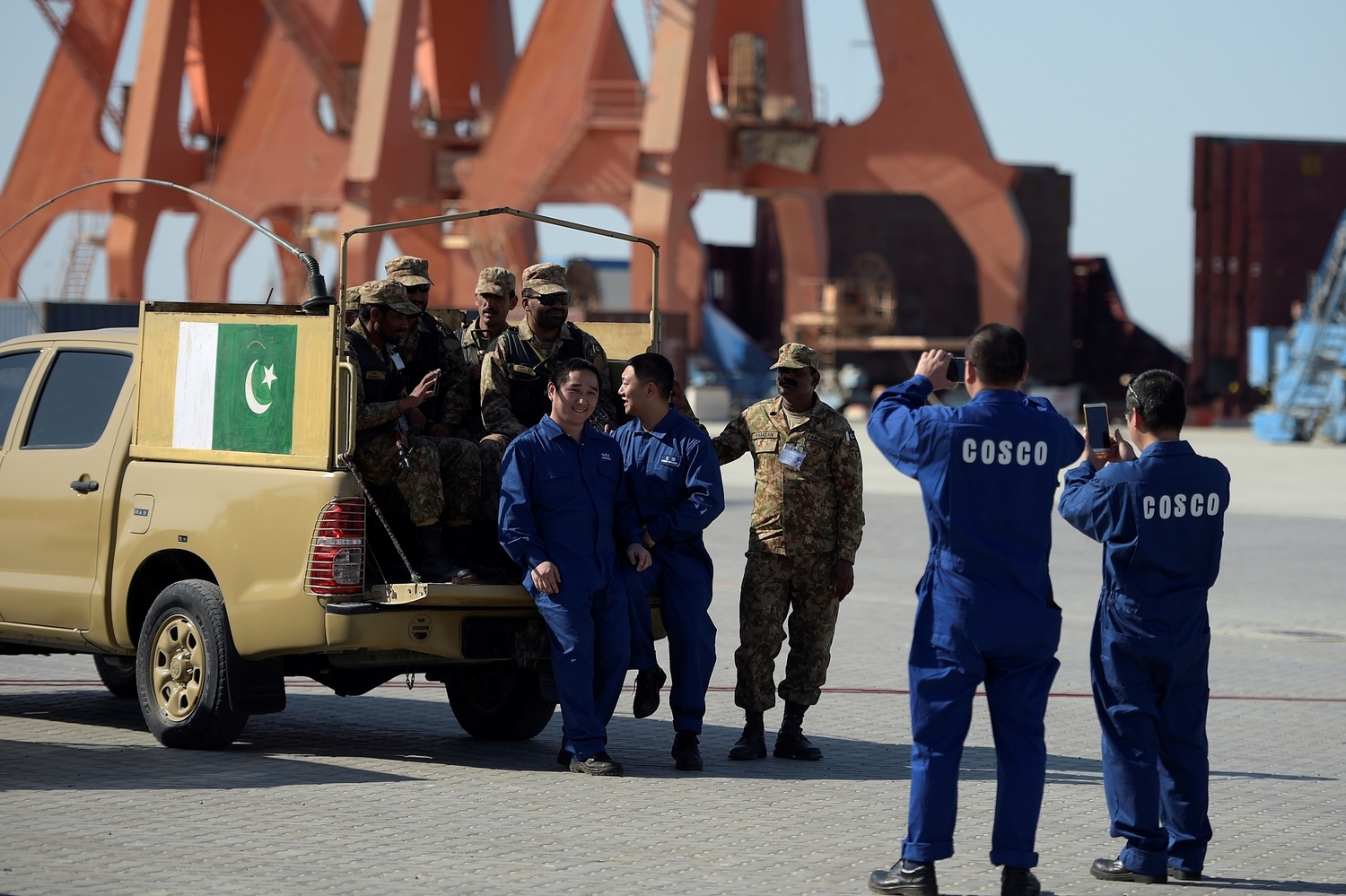
      <p>Putin came to Beijing this month with an <a href="https://www.reuters.com/world/putin-visit-china-may-16-17-kremlin-says-2024-05-14/" target="_blank" rel="nofollow">entourage</a> of senior officials, including the new Defense Minister Andrei Belousov and the man he replaced, Sergei Shoigu, as well as a host of other officials who have a long history of working with Chinese counterparts.</p>
      <p>In 2023, Beijing issued a 12-point “<a href="https://www.fmprc.gov.cn/mfa_eng/zxxx_662805/202302/t20230224_11030713.html" target="_blank" rel="nofollow">Position on the Political Settlement of the Ukraine Crisis”</a> that state media <a href="https://www.chinadaily.com.cn/a/202302/28/WS63fd5426a31057c47ebb12f8.html" target="_blank" rel="nofollow">called</a> a “peace proposal.” Before this month’s trip, China’s official Xinhua News Agency <a href="https://english.news.cn/20240515/bd1fc008f0a642c5bc71baf7720421c5/c.html" target="_blank" rel="nofollow">quoted</a> Putin as saying, “We are open to a dialogue on Ukraine, but such negotiations must take into account the interests of all countries involved in the conflict, including ours.”</p>
      <p>The Kremlin <a href="http://en.kremlin.ru/catalog/persons/351/events/74025" target="_blank" rel="nofollow">released a statement</a> about the visit saying that the “leaders of Russia and China will have an extensive discussion of the entire scope of issues pertaining to the Russia-China overarching partnership and strategic cooperation,” and that they “will outline priorities for further practical cooperation between the two states and have an in-depth exchange of opinions on the most pressing international and regional issues.”</p>
      <p>Xi has stood closely by Putin’s side since their announcement of the “no limits” partnership, and this does not look likely to change. But what has been the outcome of Putin’s trip? Did the two leaders make a serious attempt to negotiate on Ukraine, or were the optics of bilateral friendship the main aim? How should we expect the two countries’ trade relationship to change after this visit? What else came out of this trip?</p>
      <p align="right">—<em>The Editors</em></p>
    </div>
  </div>
  <div id="comments" class="comment-wrapper">
    <h2 class="title" id="comments">Comments</h2>
 <a id="comment-10706" href="https://www.chinafile.com/conversation/undefined"></a>    <article class="comment comment-by-node-author">
      <div class="node node-profile cboxes contributor grid-2 img-no logo-no">
        <div class="inner-content">
          <div class="field field-name-field-profile-photo field-type-image field-label-hidden">
<a href="https://www.chinafile.com/contributors/maria-repnikova"><img src="https://www.chinafile.com/sites/default/files/styles/epsacrop_220x220/public/assets/images/profile/maria_repnikova.jpg?itok=whWAGgu6" width="220" height="220" alt="" referrerpolicy="no-referrer" /></a>
          </div>
        </div>
        <h3 id="maria-repnikova"><a href="https://www.chinafile.com/contributors/maria-repnikova" title="Maria Repnikova">Maria Repnikova</a></h3>
      </div>
      <div class="field field-name-comment-body field-type-text-long field-label-hidden">
        <p class="dropcap">Vladimir Putin’s trip to China concluded with high symbolism but limited transformation in the relationship. Choosing China as the first foreign visit after the inauguration already signaled to domestic and international audiences the enduring importance of the China-Russia partnership. Russian media <a href="https://vz.ru/politics/2024/5/16/1268478.html" target="_blank" rel="nofollow">reported</a> in detail about the red carpet and festive treatment of Russia’s leader, comparing it to China’s more subdued reception toward European leaders. Xi Jinping even <a href="https://www.reuters.com/world/hugs-not-full-socialist-era-kiss-putin-xi-beijing-2024-05-17/" target="_blank" rel="nofollow">graced</a> Putin with a farewell hug—an unusual gesture, enthusiastically discussed on social media.</p>
        <p>The joint statement <a href="http://kremlin.ru/supplement/6132" target="_blank" rel="nofollow">published</a> by the Kremlin is loaded with gripping declarations, yet limited on specifics. It reads as a long but relatively general, aspirational account of shared values and visions, as well as areas for further bilateral collaboration. The two sides, predictably, use this platform to extol multipolarity and critique U.S. hegemony. Their appeal towards a more equitable world order may be met with cynicism in the West but it could still resonate in the Global South, where many developing countries perceive the United States as duplicitous.</p>
        <p>The promotion of shared geopolitical narratives was further solidified in new agreements about cooperation between Russian and Chinese media. During the latest visit, Russia Today and Xinhua News Agency <a href="http://kremlin.ru/supplement/6131" target="_blank" rel="nofollow">signed</a> a memorandum to hold an expert forum representing BRICS countries. The Russian News Agency TASS and Xinhua also <a href="http://kremlin.ru/supplement/6131" target="_blank" rel="nofollow">signed</a> an agreement to share information. This collaboration in the media and communications realm is not new. It builds on the past 20 years of growing media partnerships, forums, and increasingly positive mutual media coverage. I have <a href="https://www.wilsoncenter.org/publication/china-russia-convergence-communication-sphere-exploring-growing-information-nexus" target="_blank" rel="nofollow">written</a> about this in detail in a recent publication for the Wilson Center.</p>
        <p>Beyond the symbolic realm, the two nations professed to expand collaboration across a range of economic, geopolitical, educational, and military spheres, without providing too much detail. The big pronouncements also obfuscate the core missing items from the meeting. The Power of Siberia 2 gas pipeline deal, long anticipated on the Russian side, was not signed. When asked about this at a Russian press conference, Putin <a href="http://www.kremlin.ru/events/president/transcripts/74065" target="_blank" rel="nofollow">responded</a> in broad strokes about the interest on both sides to expand this partnership and the importance of Russia for China’s energy needs. He ignored the question on timelines for the construction of the pipeline.</p>
        <p>Negotiation over Russia’s war in Ukraine has also witnessed little progress. As in the past, Putin praised China’s efforts at peaceful solutions to the conflict and blamed Ukraine for abandoning peace negotiations. Putin publicly acknowledges China’s initiative as a peacemaker, but in practice continues to wage the war in Ukraine.</p>
        <p>Even without these breakthroughs, however, Putin’s visit to China holds a lot of significance. It reaffirms, at least publicly, the growing affinities between the two leaders and their determination to continue to challenge the Western-led order. Resisting the efforts by the United States to drift China and Russia apart, Putin and Xi declared that the show would go on.</p>
      </div>
      <nav class="links">
        <ul class="links inline">
          <li class="comment_forbidden first last"></li>
        </ul>
      </nav>
    </article>
<a id="comment-10711" href="https://www.chinafile.com/conversation/undefined"></a>    <article class="comment comment-by-node-author">
      <div class="node node-profile cboxes contributor grid-2 img-no logo-no">
        <div class="inner-content">
          <div class="field field-name-field-profile-photo field-type-image field-label-hidden">
<a href="https://www.chinafile.com/contributors/evan-medeiros"><img src="https://www.chinafile.com/sites/default/files/styles/epsacrop_220x220/public/assets/images/profile/medeiros_sm.jpg?itok=mLCfoKVr" width="220" height="220" alt="" referrerpolicy="no-referrer" /></a>
          </div>
        </div>
        <h3 id="evan-medeiros"><a href="https://www.chinafile.com/contributors/evan-medeiros" title="Evan Medeiros">Evan Medeiros</a></h3>
      </div>
      <div class="field field-name-comment-body field-type-text-long field-label-hidden">
        <p class="dropcap">Xi Jinping’s hosting of Vladimir Putin’s May 16-17 visit was a diplomatic spectacle. It signaled that Xi’s “<a href="https://www.prcleader.org/post/china-s-strategic-straddle-beijing-s-diplomatic-response-to-the-russian-invasion-of-ukraine" target="_blank" rel="nofollow">strategic straddle</a>”—his conviction that he can balance relations with the United States, Europe, and Russia—has moved into high gear. Xi gave Putin some of what he needed but not all that he wanted. Beijing’s ties with Washington remain stable but structurally fraught. Europe is divided both with Washington and with itself about how precisely to confront China over Russia. China is threading the seams of today’s geopolitics, and Putin’s visit was the latest evidence of this.</p>
        <p>The visit was a bookend, not the beginning, of a Chinese diplomatic gambit. It began with Xi’s hosting the leaders of both the <a href="https://www.scmp.com/news/china/diplomacy/article/3256667/tech-war-xi-jinping-li-qiang-meet-visiting-dutch-pm-mark-rutte-chip-tensions-surge" target="_blank" rel="nofollow">Netherlands</a> and <a href="http://dk.china-embassy.gov.cn/eng/ztbd/xjpfo/201406/t20140612_3157917.htm" target="_blank" rel="nofollow">Germany</a> in Beijing. China effectively framed those visits as “bilateral” not European affairs, and Xi focused on “common economic interests” (i.e., their reliance on China). Ukraine barely featured. Following that, Xi’s Beijing meetings with U.S. Secretaries of Treasury and State validated his leadership at home. Both cabinet officials <a href="https://www.reuters.com/world/blinken-meet-chinese-counterpart-wang-yi-beijing-2024-04-26/#:~:text=BEIJING%2C%20April%2026%20(Reuters),between%20the%20world's%20biggest%20economies." target="_blank" rel="nofollow">complained</a> about China’s military <a href="https://www.cnn.com/2024/04/08/business/janet-yellen-china-visit-takeaways-hnk-intl/index.html#:~:text=The%20visit%2C%20her%20second%20to,leader%20Xi%20Jinping%20last%20November." target="_blank" rel="nofollow">aid</a> to Russia, but the U.S. has not implemented new financial sanctions. Beijing is well prepared for this, anyway. Next, Xi visited Europe (France, Serbia, and Hungary) in early May and used the trip to highlight China’s economic largesse and to <a href="https://www.nytimes.com/2024/05/10/world/europe/xi-europe-diplomacy.html" target="_blank" rel="nofollow">encourage</a> divisions within both NATO and the European Union. Hosting Putin completed this sequence, and it validated Xi’s entire strategy.</p>
        <p>Putin’s sojourn was long on symbolism and short on material gains. Xi’s embrace helped him appear less isolated after his sham election. The visit provided a high profile <a href="http://kremlin.ru/supplement/6132" target="_blank" rel="nofollow">opportunity</a> for both leaders to criticize the United States and to reject Western liberal rules and norms, while offering their authoritarian alternatives. There was much talk of deepening cultural ties, another symbolic gift from China to Russia. The meeting itself was largely the message.</p>
        <p>Of course, Putin wanted more. He brought a big delegation of Russian finance and defense experts to circumvent sanctions and expand military industrial cooperation. He capped off the trip with a <a href="http://en.kremlin.ru/events/president/news/74064" target="_blank" rel="nofollow">visit</a> to one of China’s top defense S&amp;T universities. Yet, <a href="http://kremlin.ru/supplement/6131" target="_blank" rel="nofollow">no major</a> new deals were announced, civilian or military. But they did release a lengthy <a href="https://www.mfa.gov.cn/zyxw/202405/t20240516_11305860.shtml" target="_blank" rel="nofollow">joint statement</a>, underscoring their common visions and values. The Chinese are masters of using ceremony and symbolism to substitute for material progress. Notably, Xi again failed to approve the Power of Siberia 2 gas project, which Putin has been pushing for years. China wants to avoid dependence on Russia for natural gas, implying there are indeed some limits.</p>
        <p>While Xi may not have given Putin much, according to official communications about the visit he also didn’t raise sensitive issues. He didn’t pressure Russia on Ukraine. Indeed, he linked Chinese support on Ukraine to Russian support for Taiwan. Publicly, Xi did not mention Putin’s recent <a href="https://www.reuters.com/world/asia-pacific/north-koreas-kim-expresses-support-putin-victory-day-message-kcna-says-2024-05-08/" target="_blank" rel="nofollow">dalliances</a> with North Korea, which concern Chinese policymakers. Finally, to the chagrin of Western policymakers, there was no hint of a discussion of nuclear weapons, including their usage in Ukraine.</p>
        <p>Thus, the “no limits relationship” is as real and pernicious as ever. Chinese assistance to reconstituting both the civilian economy and the defense industrial base may ultimately reshape European security. Russia is rapidly becoming not just dependent on China but reorienting its society and culture around its ties to China. Xi’s “strategic straddle” is not just working well, but Xi may be perfecting it. This raises the question of whether the West is going to let China get away with perhaps the great geopolitical crime of the 21st century.</p>
      </div>
      <nav class="links">
        <ul class="links inline">
          <li class="comment_forbidden first last"></li>
        </ul>
      </nav>
    </article>
<a id="comment-10716" href="https://www.chinafile.com/conversation/undefined"></a>    <article class="comment comment-by-node-author">
      <div class="node node-profile cboxes contributor grid-2 img-no logo-no">
        <div class="inner-content">
          <div class="field field-name-field-profile-photo field-type-image field-label-hidden">
<a href="https://www.chinafile.com/contributors/una-aleksandra-berzina-cerenkova"><img src="https://www.chinafile.com/sites/default/files/styles/epsacrop_220x220/public/assets/images/profile/berzina-cerenkova_sm.jpg?itok=Tp4PQfWE" width="220" height="220" alt="" referrerpolicy="no-referrer" /></a>
          </div>
        </div>
        <h3 id="una-aleksandra-brzia-erenkova"><a href="https://www.chinafile.com/contributors/una-aleksandra-berzina-cerenkova" title="Una Aleksandra Bērziņa-Čerenkova">Una Aleksandra Bērziņa-Čerenkova</a></h3>
      </div>
      <div class="field field-name-comment-body field-type-text-long field-label-hidden">
        <p class="dropcap">The visit had two main foci: bilateral cooperation, and Russia’s chiming in on the Chinese vision for a global order—the “multipolar world.”</p>
        <p>In terms of bilateral cooperation, promises were made and documents signed. These <a href="https://apnews.com/article/putin-visit-china-xi-907134e5d2ec2cc62376caca5d8df79b" target="_blank" rel="nofollow">covered</a> economic relations, cultural links (Putin spent the second day of his trip in <a href="https://apnews.com/article/putin-visit-china-xi-907134e5d2ec2cc62376caca5d8df79b" target="_blank" rel="nofollow">Harbin</a>), media (Xinhua <a href="http://kremlin.ru/supplement/6131" target="_blank" rel="nofollow">partnered</a> up with several Russian media agencies), and softening the border by <a href="https://www.rgo.ru/en/article/russia-and-china-created-worlds-first-cross-border-reserve-leopard-and-tiger" target="_blank" rel="nofollow">establishing</a> a cross-border reserve for big cats and <a href="https://www.axios.com/2024/05/16/russia-putin-china-xi-condemn-us" target="_blank" rel="nofollow">jointly developing</a> Bolshoy Ussuriysky Island (Heixiazi Dao).</p>
        <p>The last point is particularly curious, as there was <a href="https://www.rbc.ru/politics/29/08/2023/64edffd29a794770db9f07e6" target="_blank" rel="nofollow">public outrage</a> in Russia last year over official People’s Republic of China maps’ demarcation of the island as fully Chinese despite a 2008 <a href="https://carnegieendowment.org/posts/2016/05/signs-and-symbols-on-the-sino-russian-border?lang=en&amp;center=middle-east" target="_blank" rel="nofollow">agreement</a> to divide the disputed island between the two countries.</p>
        <p>In terms of the vision for a global order, Putin provided a full endorsement of China’s global and regional initiatives. He <a href="http://www.xinhuanet.com/20240515/c73e9ed0eef7477aa54c80ad4cd7f4d7/c.html" target="_blank" rel="nofollow">argued</a> that the BRICS consortium is “attractive” to countries in the “Global South” and “Global East” because it makes “their voices heard and valued.” Clearly, Western <a href="https://jamestown.org/program/russia-struggles-for-hearts-and-minds-in-global-south-part-one/" target="_blank" rel="nofollow">concerns</a> over the real fight being for the hearts and minds of the Global South are being heard in Russia and China.</p>
        <p>Ukraine was a topic for conversation, but not really for negotiation between Xi and Putin. Both sides are framing Russia’s attack on Ukraine in terms of promoting a multipolar world order and pushing back against U.S. hegemony. The <a href="http://kremlin.ru/supplement/6132" target="_blank" rel="nofollow">joint statement</a> argues for “removing the root causes” of the war—which, according to the Russian and Chinese positions <a href="https://tass.com/world/1781039" target="_blank" rel="nofollow">previously expressed</a>, is NATO’s eastward expansion. Both parties <a href="http://kremlin.ru/supplement/6132" target="_blank" rel="nofollow">called for</a> “adhering to the principle of indivisibility of security, taking into account the legitimate security interests and concerns of all countries”—a pro-Russian statement if there ever was one. Against that backdrop, the Russian side probably gave optimistic accounts of its military advances, hinting that just a little more help can go a long way.</p>
        <p>Whether or not Beijing will find such help to be in its interest remains to be seen.</p>
      </div>
      <nav class="links">
        <ul class="links inline">
          <li class="comment_forbidden first last"></li>
        </ul>
      </nav>
    </article>
<a id="comment-10721" href="https://www.chinafile.com/conversation/undefined"></a>    <article class="comment comment-by-node-author">
      <div class="node node-profile cboxes contributor grid-2 img-no logo-no">
        <div class="inner-content">
          <div class="field field-name-field-profile-photo field-type-image field-label-hidden">
<a href="https://www.chinafile.com/contributors/vita-golod"><img src="https://www.chinafile.com/sites/default/files/styles/epsacrop_220x220/public/assets/images/profile/golod_sm.jpg?itok=ak1ySfNE" width="220" height="220" alt="" referrerpolicy="no-referrer" /></a>
          </div>
        </div>
        <h3 id="vita-golod"><a href="https://www.chinafile.com/contributors/vita-golod" title="Vita Golod">Vita Golod</a></h3>
      </div>
      <div class="field field-name-comment-body field-type-text-long field-label-hidden">
        <p class="dropcap">The Xi-Putin meeting elicited a strong negative reaction in Ukraine, even causing a sense of panic. The meeting included <a href="https://www.reuters.com/world/putin-visit-chinas-xi-deepen-strategic-partnership-2024-05-15/" target="_blank" rel="nofollow">discussion</a> of military cooperation between Russia and China, which the U.S. is “<a href="https://news.usni.org/2024/05/19/chinas-support-of-russias-war-in-ukraine-major-concern-for-u-s-says-official" target="_blank" rel="nofollow">profoundly concerned</a>” about, and which has exacerbated the already negative perception of China in Ukraine.</p>
        <p>Furthermore, many in Ukraine believe that China is <a href="https://cepa.org/article/china-russia-axis-heralds-an-ominous-future/" target="_blank" rel="nofollow">establishing</a> a dominant-subordinate <a href="https://carnegieendowment.org/russia-eurasia/politika/2023/07/is-russia-really-becoming-chinas-vassal?lang=en" target="_blank" rel="nofollow">relationship</a> with Russia, leveraging this situation to penetrate various sectors of the Russian economy. The <a href="https://www.reuters.com/world/putin-push-growing-moscow-beijing-trade-chinas-northeast-2024-05-17/" target="_blank" rel="nofollow">presence</a> of Russian bank representatives in Putin’s Beijing delegation indeed underscores Russia’s efforts to develop an alternative financial system that circumvents the dollar. This development is particularly concerning for Ukraine, as it suggests the increasing support from amoral Chinese businesses for the Russian war effort, without the fear of facing sanctions.</p>
        <p>The worst imaginable outcome of the Russian invasion of Ukraine is the potential use of nuclear weapons, which Putin has <a href="https://foreignpolicy.com/2024/05/15/nuclear-weapons-mind-game-deterrence-escalation-putin-russia-threats-ukraine-war-biden/" target="_blank" rel="nofollow">signaled</a>. This is a global threat that could provoke a third world war. Ukraine has repeatedly requested China to provide a nuclear security guarantee, a plea that has been consistently ignored. As the situation approaches a critical juncture, the question looms: Did Xi Jinping leverage his meeting with Putin in Beijing on May 16 to prevent a catastrophic outcome? We may never know the details of their private discussions, but such efforts would contribute significantly to building a community with a shared future for mankind.</p>
      </div>
      <nav class="links">
        <ul class="links inline">
          <li class="comment_forbidden first last"></li>
        </ul>
      </nav>
    </article>
  </div>
</div>]]></content><author><name>Maria Repnikova, Evan Medeiros &amp;#38; more</name></author><category term="中参馆" /><category term="中参馆" /><summary type="html"><![CDATA[The Future According to Xi and Putin ——]]></summary></entry><entry><title type="html">Beijing’s Culinary Crusade: Erasing Uyghur Identity through Food</title><link href="https://nodebe4.github.io/oped2/2024-05-13/Beijing-s-Culinary-Crusade-Erasing-Uyghur-Identit/" rel="alternate" type="text/html" title="Beijing’s Culinary Crusade: Erasing Uyghur Identity through Food" /><published>2024-05-13T09:38:00-05:00</published><updated>2024-05-13T09:38:00-05:00</updated><id>https://nodebe4.github.io/oped2/2024-05-13/Beijing%E2%80%99s%20Culinary%20Crusade:%20Erasing%20Uyghur%20Identit</id><content type="html" xml:base="https://nodebe4.github.io/oped2/2024-05-13/Beijing-s-Culinary-Crusade-Erasing-Uyghur-Identit/"><![CDATA[<!--1715611080000-->
<p><a href="https://www.chinafile.com/reporting-opinion/viewpoint/beijings-culinary-crusade-erasing-uyghur-identity-through-food">Beijing’s Culinary Crusade: Erasing Uyghur Identity through Food</a>
——</p>

<div>
  <div class="view view-featured-photo view-id-featured_photo view-display-id-panel_pane_1 visual-box view-dom-id-087df33a6001b80825ab492e43e61750">
    <div class="content view-content">
      <div class="views-row views-row-1">
        <div class="views-field views-field-field-common-featured-photo">
          <div class="field-content">
&lt;a href="https://www.chinafile.com/sites/default/files/assets/images/article/featured/55371_sm.jpg" title="Beijing’s Culinary Crusade: Erasing Uyghur Identity through Food" class="colorbox" data-colorbox-gallery="gallery-node-55371-g4gG2wVxse4" data-cbox-img-attrs="{"title": "", "alt": ""}"&gt;<img src="https://www.chinafile.com/sites/default/files/styles/large/public/assets/images/article/featured/55371_sm.jpg?itok=UbGsv99M" width="1500" height="1008" alt="" title="" referrerpolicy="no-referrer" />&lt;/a&gt;
          </div>
        </div>
        <div>
          <div class="photo-credit">
Kevin Frayer—Getty Images
          </div>
        </div>
        <div>
          <div class="photo-caption">
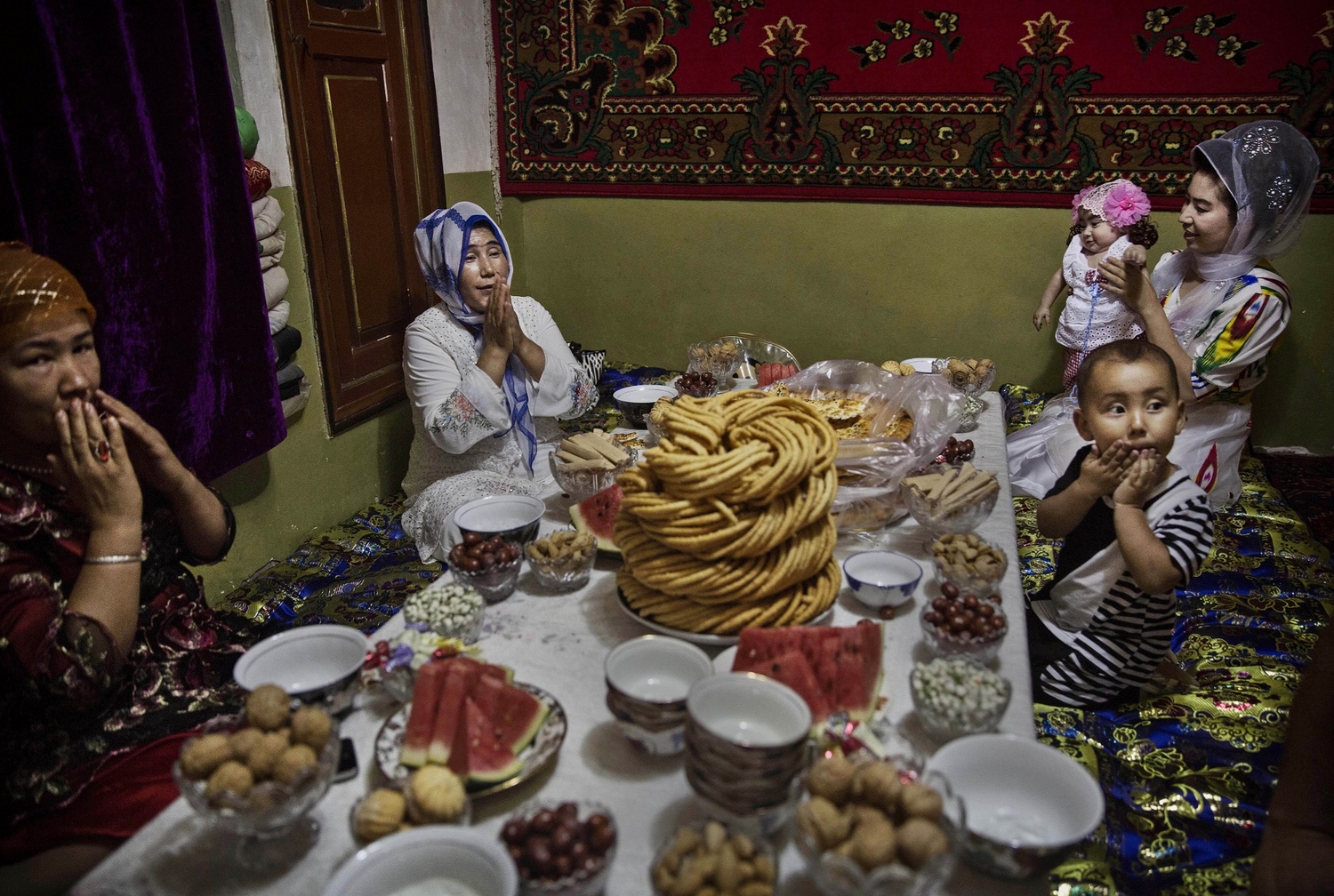
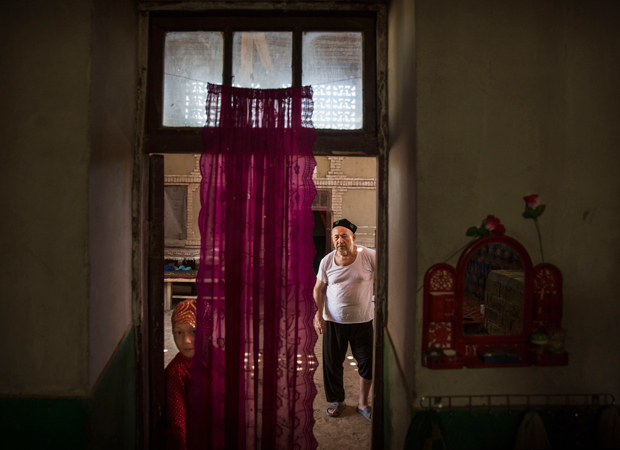
            <p>A Uyghur family prays before a meal on Eid, in Kashgar, Xinjiang Uyghur Autonomous Region, July 29, 2014.</p>
          </div>
        </div>
      </div>
    </div>
  </div>
  <div class="content">
    <div class="field field-name-body field-type-text-with-summary field-label-hidden">
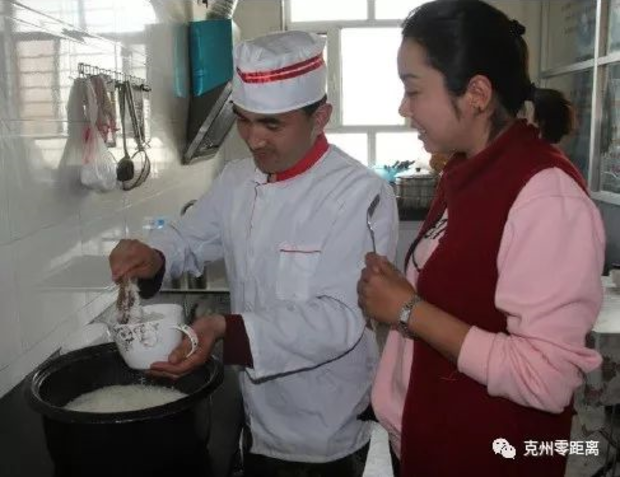
      <p class="dropcap">Instruction began early on a November 2018 morning. This lesson was not taught in a classroom, but in a makeshift kitchen as part of Xinjiang’s “household school” program. There, a teacher stood before her class of adult women and <a href="https://web.archive.org/web/20231127163715/https:/mp.weixin.qq.com/s?src=11&amp;timestamp=1701102874&amp;ver=4922&amp;signature=AJy45cOPgirdkxqwYDig5w%2ALw4BGSn-GvJ5sBouCyTtbOS7mstK4kmzMbPNS3xz1Z5uEfBIr%2AXxKWDoao5wdDp7bGS7UBXk%2AxID1hZahEjPBIPSj7AZu%2AE3g5Xjp4tr3&amp;new=1" target="_blank" rel="nofollow">asked</a>: “What do you like to eat for breakfast?”</p>
      <p>The students responded in unison, “nan and milk” or “nan and tea.”</p>
      <p>“You don’t eat a bowl of hot congee?” the teacher interjected. This question sparked additional discussion and “even more curiosity” among the women in attendance.</p>
      <p>As described in the official government social media account Xinjiang Women’s Voices, the teacher, affiliated with the Xinjiang branch of the All-China Women’s Federation, then offered hands-on tutorials for preparing fried dough sticks (<em>youtiao</em>), congee, onion pancakes, and steamed buns, among other side dishes. At the end of the workshop, one attendee <a href="https://web.archive.org/web/20231127163715/https:/mp.weixin.qq.com/s?src=11&amp;timestamp=1701102874&amp;ver=4922&amp;signature=AJy45cOPgirdkxqwYDig5w%2ALw4BGSn-GvJ5sBouCyTtbOS7mstK4kmzMbPNS3xz1Z5uEfBIr%2AXxKWDoao5wdDp7bGS7UBXk%2AxID1hZahEjPBIPSj7AZu%2AE3g5Xjp4tr3&amp;new=1" target="_blank" rel="nofollow">remarked</a>, “In the past, I only knew how to prepare nan and milk tea each morning; now, I am able to make scallion pancakes, fried dough sticks, and even rose buns. My family’s breakfast will now have more nutrition, vegetables, and congee as a staple, which children love to eat!”</p>
      <p>This report—which implies that Uyghurs’ culinary traditions compare unfavorably to those of certain Han communities—exemplifies the Chinese Communist Party’s (CCP’s) approach to Uyghur culture generally. The CCP <a href="https://www.documentcloud.org/documents/22040744-orangebookfinalocrtoc?responsive=1&amp;title=1" target="_blank" rel="nofollow">views</a> many facets of Uyghur life as “backward,” so it seeks to refashion Uyghur cultural expression in a way it finds both intelligible and non-threatening, promoting a set of officially sanctioned “Han” tastes and habits as the standard for <a href="https://web.archive.org/web/20190726023846/http:/item.xjmsw.cn/xxzl/20181127/2018112752722.html" target="_blank" rel="nofollow">hygiene</a>, <a href="https://blog.westminster.ac.uk/contemporarychina/beautifying-uyghur-bodies-fashion-modernity-and-state-power-in-the-tarim-basin-2/" target="_blank" rel="nofollow">modernity</a>, and <a href="https://www.chinafile.com/reporting-opinion/viewpoint/why-china-banning-islamic-veils" target="_blank" rel="nofollow">normalcy</a>. In the case of food, Beijing often works to impose this standard through direct interventions with local women. Even when authorities <a href="https://web.archive.org/web/20240423213532/https:/www.chinadaily.com.cn/culture/2016-02/14/content_23478222.htm" target="_blank" rel="nofollow">extol the virtues</a> of the cuisine of the region, they often speak not specifically of “Uyghur food” but of “Xinjiang food,” as though the dishes so many Han tourists enjoy have their origins in geography rather than the practices and culture of the Uyghur people. At the same time, officials consider ethno-cultural diets of Uyghurs—especially if they are shaped by Islamic law—as obstacles to ethnic unity at best and a gateway to extremism at worst. <a href="https://web.archive.org/web/20231031173359/https:/mp.weixin.qq.com/s?src=11&amp;timestamp=1698772790&amp;ver=4868&amp;signature=EyxaiDauupYZ9%2ARHtpbDd1nvCsjdae%2ANFAGzSaMZR5XbXv7R6oCWLvgzP12JM20TZTVMzSH5epUn6q1at9WndYNx4FrcWOz61HCKqRhVAizS3-E8P7PVfhIqPOvEGeDk&amp;new=1" target="_blank" rel="nofollow">According to</a> Mijit Qadir, a Public Security Bureau official in Kashgar, “Muslim halal customs create an unbridgeable gap between Uyghur and Han people and widen the distance between them as would an invisible wall.” He adds:</p>
      <blockquote>
        <p>During my work in the PSB third division, some ethnic minority [Uyghur] police and auxiliary police have had persistent vices/outmoded habits [生活陋习, <em>shenghuo luoxi</em>]. They do not eat pork because they are not used to it; they do not use modern products because they are not used to them; and they are afraid if they do some things a religious dogma they did not choose for themselves will punish them. This outlook must change.</p>
      </blockquote>
      <p>Qadir, himself Uyghur, connects “ethnic minority” culinary traditions with “dogma” and pits them against modernity, as represented by Han people. For the CCP, the wrong diet can obstruct modernization, which must be embodied in a unitary “modern” culture. Thus, in order to cast off the vestiges of their supposed cultural backwardness not only must Uyghur women <a href="https://blog.westminster.ac.uk/contemporarychina/beautifying-uyghur-bodies-fashion-modernity-and-state-power-in-the-tarim-basin-2/" target="_blank" rel="nofollow">replace</a> their jilbab with pencil skirts, they must also now feed themselves as Han people do.</p>
      <p></p>
      <div class="node node-article cboxes article align-left grid-4 img-yes logo-no">
        <div class="cboxes-inner">
          <div class="cb-head">
            <h3 id="postcard"> <a href="https://www.chinafile.com/reporting-opinion/postcard">Postcard</a></h3>
 <span class="date">10.24.18</span> <span class="type-icon"></span>
          </div>
          <div class="cb-link">
<a href="https://www.chinafile.com/reporting-opinion/postcard/million-citizens-occupy-uighur-homes-xinjiang"></a>
          </div>
          <div class="cb-img">
<img src="https://www.chinafile.com/sites/default/files/styles/system/public/assets/images/article/system/uighur-home-sys.jpg?itok=h1t3BxDM" width="620" height="450" alt="" referrerpolicy="no-referrer" />
          </div>
          <div class="cb-cont">
            <h2 id="chinas-government-has-ordered-a-million-citizens-to-occupy-uighur-homes-heres-what-they-think-theyre-doing"><a href="https://www.chinafile.com/reporting-opinion/postcard/million-citizens-occupy-uighur-homes-xinjiang" title="China’s Government Has Ordered a Million Citizens to Occupy Uighur Homes. Here’s What They Think They’re Doing.">China’s Government Has Ordered a Million Citizens to Occupy Uighur Homes. Here’s What They Think They’re Doing.</a></h2>
 <span class="authors"> <span>Darren Byler</span> </span>             <div class="inner-content">
              <div class="field field-name-body field-type-text-with-summary field-label-hidden">
The village children spotted the outsiders quickly. They heard their attempted greetings in the local language, saw the gleaming Chinese flags and round face of Mao Zedong pinned to their chests, and knew just how to respond. “I love China,” the...
              </div>
            </div>
          </div>
        </div>
      </div>
      <p>Although some officials believe that Uyghur cuisine is insipid, reflecting the simple and religious mindsets of those who consume it, the food prepared and served in Uyghur homes and restaurants is as diverse as the communities that inhabit the oases of the Tarim and Junggar Basins. Dough-covered stews called <a href="https://asianmarketsphilly.com/2019/02/20/dough-covered-meals-of-the-uyghurs-kazakhs-and-mongols/" target="_blank" rel="nofollow"><em>mori yapmisi</em></a> provide warming meals during Qumul’s short but frigid winters while <em>toxurmiyen</em>, a tomato-broth längmän noodle with beans, peppers, and a poached egg, is a hearty dish distinct to Yäkän. Despite regional diversity, <a href="https://apjcn.nhri.org.tw/server/APJCN/26/5/764.pdf" target="_blank" rel="nofollow">common ingredients</a> that help plate a “Uyghur cuisine” include wheat, rice, maize, sorghum, halal meat, and fruits and vegetables tolerant of arid climates, which are seasoned with various peppers, onion, and cumin. These ingredients combine in varieties of flatbread (in Uyghur, <em>nan</em>), pilaf (Uy. <em>polu</em>), steamed dumplings (<em>manta</em>), roasted dumplings (<em>samsa</em>), hand-pulled noodles (<em>längmän</em>), kebab (<em>kawab</em>), and many soups (such as <em>shorpa</em>, <em>suyuq’ash</em>, and <em>chöchürä</em>). The <a href="https://www.ewlad.biz/uyghurkitap/325-kitap/%d8%a6%db%87%d9%8a%d8%ba%db%87%d8%b1%20%d8%aa%d8%a7%d8%a6%d8%a7%d9%85%d9%84%d9%89%d8%b1%d9%89%20%d9%82%d8%a7%d9%85%db%87%d8%b3%d9%89.pdf" target="_blank" rel="nofollow"><em>Uyghur Food Encyclopedia</em></a>, published in the Xinjiang Uyghur Autonomous Region’s capital, Ürümchi, provides recipes for more than 1,800 different dishes. The volume’s introduction reads: “Uyghur cuisine is valued domestically and abroad for its many varieties, complicated and meticulous [<em>inchiklik</em>] preparations techniques, high quality, and nutritional and medicinal benefits.”</p>
      <p>But the political climate in the Xinjiang has changed vastly since 2007, when the <em>Uyghur Food Encyclopedia</em> was first published. Beijing no longer lauds the nutritional or medicinal benefits of Uyghur cuisine. Instead, the introduction of “Chinese cuisine” into Uyghur communities is a key part of the Party-state’s comprehensive “stability work.” In addition to the repressive and often violent mechanisms of control imposed on the region in recent years—including <a href="https://www.haujournal.org/index.php/hau/article/view/1695" target="_blank" rel="nofollow">mass incarceration</a>, <a href="https://archive.vn/SPFT1" target="_blank" rel="nofollow">invasive birth control</a>, and <a href="https://madeinchinajournal.com/2020/08/24/the-spatial-cleansing-of-xinjiang-mazar-desecration-in-context/" target="_blank" rel="nofollow">religious repression</a>—Beijing is attempting to remold Uyghur culture itself, combining intensive human surveillance with paternalistic “educational” efforts. For example, the “<a href="https://www.chinafile.com/reporting-opinion/postcard/million-citizens-occupy-uighur-homes-xinjiang" target="_blank" rel="nofollow">Visit the People, Benefit the People, and Bring Together the Hearts of the People</a>” (<em>fanghuiju</em>), sometimes referred to as the “<a href="https://xinjiang.sppga.ubc.ca/chinese-sources/cadre-materials/cadre-handbooks/" target="_blank" rel="nofollow">Becoming Family</a>” campaign, dispatches government workers, many of whom are Han, to “<a href="https://archive.fo/qNhkI" target="_blank" rel="nofollow">live, study, and work</a>” with Uyghurs throughout Xinjiang. According to <a href="https://web.archive.org/web/20231127165413/https:/www.gjxfj.gov.cn/gjxfj/zw/webinfo/2020/09/1601762465048283.htm" target="_blank" rel="nofollow">2018 figures</a>, 56,000 work teams visited over 380 million people in the first four years of the campaign. Now in its <a href="https://books.google.com/books/about/%E8%AE%BF%E6%83%A0%E8%81%9A_%E6%94%BF%E7%AD%96%E5%AF%B9%E5%8D%97%E7%96%86%E4%B9%A1%E6%9D%91%E5%A6%87%E5%A5%B3%E8%A7%92.html?id=obhj0AEACAAJ" target="_blank" rel="nofollow">third phase</a> (2021-present), these workers not only serve as the eyes and ears of the government, reporting any “extremist” tendencies among the population, but also as transmitters of “healthy” culture.</p>
      <p></p>
      <div class="view view-photo-embed view-id-photo_embed view-display-id-panel_pane_3 visual-box view-dom-id-4b4ead405880e024bf90630876c248c6 grid-4 photo-object">
        <div class="views-field views-field-field-common-system-photo">
          <div class="field-content">
&lt;a href="https://www.chinafile.com/sites/default/files/assets/images/photo/system/cooking_class_sm.png" title="Household School Cooking Class" class="colorbox" data-colorbox-gallery="gallery-node-55381-g4gG2wVxse4" data-cbox-img-attrs="{"title": "", "alt": ""}"&gt;<img src="https://www.chinafile.com/sites/default/files/styles/medium/public/assets/images/photo/system/cooking_class_sm.png?itok=yz6Aqs2W" width="620" height="428" alt="" title="" referrerpolicy="no-referrer" />&lt;/a&gt;
          </div>
        </div>
        <div class="views-field views-field-field-common-system-credit">
          <div class="field-content photo-credit img-credit">
Xinjiang Women’s Voices via Sina Weibo
          </div>
        </div>
        <div>
          <div class="photo-caption img-caption">
            <p>Women take part in a “household school” cooking class, in Xinjiang, November 2018.</p>
          </div>
        </div>
      </div>
      <p>From organizing fashion shows to delivering lectures on illegal religious activities, the Party-led All-China Women’s Federation helps to carry out <em>fanghuiju</em> work. The central role the All-China Women’s Federation plays reflects the CCP’s logic: a stable Xinjiang requires “liberated” women, rescued from what Beijing <a href="https://web.archive.org/web/20240321132127/https:/www.sohu.com/a/50792427_119586" target="_blank" rel="nofollow">describes</a> as a backwards, overly religious, and sometimes “extremist” local culture. Understood from this perspective, a woman’s place in the home makes her a key vector for the spread of healthy, or unhealthy, influences. According to the chairwoman of Kashgar’s Women’s Federation, <a href="https://www.meipian.cn/c/11596039" target="_blank" rel="nofollow">Dilbär Imam</a>, “Uyghur women must eliminate the environment in which religious extremist forces disseminate [their teachings] and propagate the ‘real’ Xinjiang . . . [and] as Uyghur mothers, we must remember that when the mother is good, the child will be good; when the child is good, the <em>ethnic group</em> will be good; and when the ethnic group is good, the fatherland will be good.”</p>
      <p>In its ongoing efforts to rescue Uyghur women from “extremism” and propel them towards modern society, the Women’s Federation of Xinjiang also holds periodic “household school” (家庭学校, <em>jiating xuexiao</em>) intensive workshops as crash courses in “civilized” living. According to the Federation’s <a href="https://web.archive.org/web/20231128152957/https:/mp.weixin.qq.com/s?src=11&amp;timestamp=1701185361&amp;ver=4924&amp;signature=hGPHjS-WIlAqeUjlZmzmrEBU451HPkeOxdR30cVgS8rL8tPFLcEBCmtH9gcy061SU5NIAJpv1eiK7RssD2IgLX3A5J0EoaYI74OcXBXXJxlQaxRIY2xJ6Lej6zcHLzJW&amp;new=1" target="_blank" rel="nofollow">official website</a>, household schools “advocate new-era women to change customs and improve the modern civilized qualities of rural women.” More specifically, the Women’s Federation <a href="https://web.archive.org/web/20231128152957/https:/mp.weixin.qq.com/s?src=11&amp;timestamp=1701185361&amp;ver=4924&amp;signature=hGPHjS-WIlAqeUjlZmzmrEBU451HPkeOxdR30cVgS8rL8tPFLcEBCmtH9gcy061SU5NIAJpv1eiK7RssD2IgLX3A5J0EoaYI74OcXBXXJxlQaxRIY2xJ6Lej6zcHLzJW&amp;new=1" target="_blank" rel="nofollow">tasks itself</a> with training “a group of modern civilized messengers who, by demonstration, will lead [other] rural women to abandon ‘bad habits’ . . . and educate women to love the Party, love their country, and love their families.”</p>
      <p>Household school events generally entail technical training during the day and policy lectures in the evening. Cooking classes are a focal point of household school workshops. Since “diets in southern Xinjiang are monotonous,” <a href="https://web.archive.org/web/20231128153841/https:/www.fx361.com/page/2020/1130/7275193.shtml" target="_blank" rel="nofollow">according to</a> one Han Party cadre affiliated with the program, they provide hands-on instruction on meal preparation and guidance to cultivate “scientific and healthy” dietary habits. At a household school event in Konasheher county, members of the Xinjiang Women’s Federation <a href="https://web.archive.org/web/20231128155434/https:/mp.weixin.qq.com/s?src=11&amp;timestamp=1701186832&amp;ver=4924&amp;signature=4aF2sDC1eWoST7hG7nLkle83WAtGWcF0WgcjOKg6kSpJXlUYqgbZPcrC9fa76atluqWsr%2AhDj-Vgv84VQzFVykW-V8Oc1yCg7GQzOYJGkXakuyITWwIbiruFy0LAogxE&amp;new=1" target="_blank" rel="nofollow">led</a> women towards “healthy eating habits,” which begin with breakfast foods such as scallion pancakes, fried dough sticks, dumplings, steamed rolls, cold dishes, and a variety of soups—dishes that, while maybe not all actually healthful, are more typically found at breakfast stands throughout cities in central and eastern China. Meanwhile in Maralbeshi county (Bachu), the more than 260 women <a href="https://web.archive.org/web/20231128155813/https:/mp.weixin.qq.com/s/eIHQhFU7AugKYKsa08QMmg" target="_blank" rel="nofollow">attending</a> the local household school training held the same month as in Konasheher learned how to prepare 13 breakfast foods, four entrees/staples, and eight other side dishes. In addition, participants practiced washing, cutting, stir-frying, pan-frying, deep frying, and braising, among other techniques.</p>
      <p>For some work, changes in diet must start with breakfast. Villages in <a href="https://archive.vn/gRaR4" rel="nofollow">Yeken</a> (Ch. <em>Shache</em>) and <a href="https://archive.vn/qxQ2F" target="_blank" rel="nofollow">Khotan</a> hosted household school trainings that provided instruction on preparing morning meals. Dishes included scallion pancakes, fried dough sticks, cold cucumber, fried eggs, congee, porridge, and milk tea. The goal: transform the monotonous “traditional” (i.e., Uyghur) breakfast of nan and tea.</p>
      <p>But cooking classes aren’t only meant to teach Uyghurs how to better nourish their bodies. As is the case elsewhere, food and the manner in which it is consumed in China are important vehicles through which social and cultural identities are <a href="https://www.ucpress.edu/book/9780520293526/bitter-and-sweet" target="_blank" rel="nofollow">created and maintained</a>. During the Qin dynasty, adopting rice and wine <a href="https://link.springer.com/chapter/10.1057/9781403979278_3" target="_blank" rel="nofollow">symbolized</a> “barbarian” submission to Chinese rule. Meanwhile, popular lore has it that regional cuisines determine personalities: the spicy food of Sichuan makes its people fiery; the simple ingredients used in Shandong province <a href="https://www.scmp.com/lifestyle/food-drink/article/2157843/chinese-regional-cuisine-shandong-food-defiantly-humble-and?campaign=2157843&amp;module=perpetual_scroll_0&amp;pgtype=article" target="_blank" rel="nofollow">explain</a> residents’ humility.</p>
      <p>Training Uyghurs to prepare “Chinese” cuisine also serves to create a more comfortable environment for the Han minders sent to “live, study, and work” in the region—who, despite wanting Uyghurs to alter their eating habits, have no intention of changing their own. A <a href="https://web.archive.org/web/20231031185041/https:/mp.weixin.qq.com/s?src=11&amp;timestamp=1698777442&amp;ver=4868&amp;signature=6yeXLUBHYKo9WUgJ0qQIaIRy976T5f1-XcwDRap-Bd1rhT8l8*G7m8He-nOmbFvWsFH27*0XBdwsjoAc5za8oPRSGf7SmCW*XOd0SYypC8bZjsb-6gzV7w2VyC0tqT20&amp;new=1" target="_blank" rel="nofollow">post</a> on Mekit County’s official “Becoming Family” or <em>fanghuiju</em> site complained:</p>
      <blockquote>
        <p>For someone who is not used to lamb like me, each meal [here] is “torture” [煎熬, <em>jian’ao</em>]. What’s more, most of the time we eat things I dislike such as carrots and cabbage. I also can’t tolerate using hands to eat to get [food] straight from bowls. I’m also not used to eating vegetables and rice from the same bowl. Even more, I am not accustomed to eating the same noodle or soup dish each evening and afternoon.</p>
      </blockquote>
      <p>For this reason, the state has often provided many Han law enforcement personnel stationed in Xinjiang with a <a href="https://archive.vn/jDJv0" target="_blank" rel="nofollow">Han</a> restaurant. In Shayar county, authorities opened a Chongqing-style cafeteria in one of the local prisons a mere 10 days after the idea was proposed. During the cafeteria’s opening ceremony, a provincial official celebrated the “<a href="https://archive.vn/GuDN7#selection-971.0-971.1" target="_blank" rel="nofollow">bridge of friendship</a>” the restaurant symbolized. The officers themselves reportedly embraced the cafeteria with open arms and heaped plates: an officer surnamed Lü <a href="https://archive.vn/jDJv0#selection-643.6-643.7" target="_blank" rel="nofollow">said</a> the opportunity to eat “delicious” Chongqing cuisine in distant Xinjiang allowed him to dedicate himself more fully to his job.</p>
      <p>To ensure there are local chefs able to produce food for the Han workers stationed in Xinjiang, county- and township-level governments have <a href="https://web.archive.org/web/20231101190922/https:/mp.weixin.qq.com/s?src=11&amp;timestamp=1698865104&amp;ver=4870&amp;signature=yJum2eGtsSwWHsPO03n6TmfTFUcCtaXQ9Vz0Iv9aNU4ILgtg1ZhnKiSnuHx6lbWlTtD-V-YWreBL38q6n6ye8y7mr09xdywbTDgFj*U1c8LuIZzkOQtExgFBn3J1UpLs&amp;new=1" target="_blank" rel="nofollow">subsidized</a> vocational programs to train local Uyghurs in “Chinese” (中式, <em>Zhongshi</em>) cuisine—an ironic use of the term since the CCP claims Uyghurs to also be “Chinese.” Some newly trained Uyghur chefs are even placed in the service of <em>fanghuiju</em> work teams. This frees Han government minders from having to cook their own food and gives them more time for their intended tasks. In Aqchi county, Qizilsul prefecture, for example, the “Warming Stomach Project” (暖胃工程, <em>nuan wei gongcheng</em>) prepares locals to cook for for Han cadres stationed there. As one cadre <a href="https://web.archive.org/web/20231101190922/https:/mp.weixin.qq.com/s?src=11&amp;timestamp=1698865104&amp;ver=4870&amp;signature=yJum2eGtsSwWHsPO03n6TmfTFUcCtaXQ9Vz0Iv9aNU4ILgtg1ZhnKiSnuHx6lbWlTtD-V-YWreBL38q6n6ye8y7mr09xdywbTDgFj*U1c8LuIZzkOQtExgFBn3J1UpLs&amp;new=1" target="_blank" rel="nofollow">explained</a>, “In the past, work teams did not have a full-time chef, so every day one or two members who knew how to cook had to stay behind to prepare meals, which inevitably affected the village work. Now, Aqchi county provides chefs [from the Warming Stomach Project], which has easily solved this problem.” Once certified in “Chinese cooking”—a <a href="https://mp.weixin.qq.com/s?src=11&amp;timestamp=1698865104&amp;ver=4870&amp;signature=yJum2eGtsSwWHsPO03n6TmfTFUcCtaXQ9Vz0Iv9aNU4ILgtg1ZhnKiSnuHx6lbWlTtD-V-YWreBL38q6n6ye8y7mr09xdywbTDgFj*U1c8LuIZzkOQtExgFBn3J1UpLs&amp;new=1" target="_blank" rel="nofollow">process</a> that demands aptitude in creating Han-inspired dishes and passing a comprehensive examination—chefs can earn between 1,500 and 2,000 renminbi per month.</p>
      <p></p>
      <div class="view view-photo-embed view-id-photo_embed view-display-id-panel_pane_3 visual-box view-dom-id-52fd4137c4cf0f4893af7ca345dde853 grid-4 photo-object">
        <div class="views-field views-field-field-common-system-photo">
          <div class="field-content">
&lt;a href="https://www.chinafile.com/sites/default/files/assets/images/photo/system/chef.png" title="Warming Stomach Project Chef" class="colorbox" data-colorbox-gallery="gallery-node-55391-g4gG2wVxse4" data-cbox-img-attrs="{"title": "", "alt": ""}"&gt;<img src="https://www.chinafile.com/sites/default/files/styles/medium/public/assets/images/photo/system/chef.png?itok=Iz0KNT_l" width="620" height="477" alt="" title="" referrerpolicy="no-referrer" />&lt;/a&gt;
          </div>
        </div>
        <div class="views-field views-field-field-common-system-credit">
          <div class="field-content photo-credit img-credit">
Kezhou Zero Distance via Sina Weibo
          </div>
        </div>
        <div>
          <div class="photo-caption img-caption">
            <p>A chef cooks in a kitchen as part of the “Warming Stomach Project,” in Aheqi village, Halaqi Township, Aheqi county, Xinjiang, 2018.</p>
          </div>
        </div>
      </div>
      <p>Han officials’ distaste for Uyghur dishes is a typical reaction in places where food becomes a <a href="https://press.uchicago.edu/ucp/books/book/chicago/M/bo3752854.html" target="_blank" rel="nofollow">site</a> of colonial <a href="https://foodispower.org/our-food-choices/colonization-food-and-the-practice-of-eating/" target="_blank" rel="nofollow">contact</a>: the colonizer’s aversion to local cuisine reifies ethnic divisions. A Han civil servant sent to “live, study, and work” in Xinjiang can have friendly interactions with a Uyghur who lives in the village where he’s stationed. And yet, the Han cadre’s distaste for Uyghur food will always prevent him from viewing Uyghurs in the village as equals.</p>
      <p>Introducing and encouraging the preparation of “Chinese” dishes devalues Uyghur food systems. According to Sam Grey and Raj Patel’s work on <a href="https://rajpatel.org/wp-content/uploads/2009/11/Grey-Patel-2015-Food-Sovereignty-as-Decolonization.pdf" target="_blank" rel="nofollow">food sovereignty</a>, teaching the cooking techniques of colonizers weakens and eliminates an important channel of indigenous knowledge. Applying this theory to Xinjiang, Party officials are telling Uyghurs their diets are bland, monotonous, and even unhealthy while they are teaching women how to prepare “healthy” and “modern” “Chinese style” food. These recipes not only require new ingredients, they demand different preparation techniques and etiquette for sharing meals.</p>
      <p>Even as government work teams admonish Uyghur families for eating bland, unhealthy food and for adhering to Islamic dietary restrictions that can lead to “extremism,” the CCP seems to have no problem with tourists consuming it. Indeed, Han sightseers have arrived in Xinjiang in droves and devoured local cuisine. A November 1, 2023 <a href="https://english.news.cn/20231101/df70a0a89a6c4b2985c5052ce6ae5b46/c.html" target="_blank" rel="nofollow">Xinhua report</a> indicates that over 7 million tourists visited the region in 2023 alone. Liu Quan, deputy director of the Xinjiang Department of Culture and tourism, notes the “<a href="http://www.china.org.cn/travel/2023-07/11/content_91883379.htm" target="_blank" rel="nofollow">famous local cuisine</a>” as one of the main driving forces behind these high numbers.</p>
      <p>How to explain this apparent contradiction in the government’s view of Uyghur cuisine? Simply put, the Party-state deems Uyghur food acceptable as long as it has been appropriated and re-branded as generic “Xinjiang” food. The Qing dynasty formally christened the region “Xinjiang,” which means “new territory,” in 1884. Under the auspices of this vague title, the modern Chinese state has sought to subsume distinct local cultures, including not only Uyghur but also Kazakh and Uzbek, into a broader “Xinjiang” identity, which is itself a part of what the CCP calls the “Chinese nation,” or <em>Zhonghua minzu</em>, a collective identity that recognizes China’s diverse populations but insists on their unity. Thus official media <a href="https://news.cgtn.com/news/2020-09-08/Mo-s-delicacy-directory-Xinjiang-cuisine--TC5IXlvVYs/index.html" target="_blank" rel="nofollow">describe</a> nan, the staple food of Uyghurs, as sharing a long history with people of all ethnicities in Xinjiang, implying it is fundamentally part of a broader Chinese culture and not a Turkic or Central Asian. The Party-state is simultaneously removing indigenous foods from Uyghur homes while serving up those same dishes as de-ethnicized “Xinjiang food” for hungry Han tourists.<span class="cube"></span></p>
    </div>
  </div>
</div>]]></content><author><name>Timothy Grose</name></author><category term="中参馆" /><category term="中参馆" /><summary type="html"><![CDATA[Beijing’s Culinary Crusade: Erasing Uyghur Identity through Food ——]]></summary></entry><entry><title type="html">2024 年 5 月首爾四天三夜旅遊心得</title><link href="https://nodebe4.github.io/oped2/2024-05-11/2024-%E5%B9%B4-5-%E6%9C%88%E9%A6%96%E7%88%BE%E5%9B%9B%E5%A4%A9%E4%B8%89%E5%A4%9C%E6%97%85%E9%81%8A%E5%BF%83%E5%BE%97/" rel="alternate" type="text/html" title="2024 年 5 月首爾四天三夜旅遊心得" /><published>2024-05-11T18:42:38-05:00</published><updated>2024-05-11T18:42:38-05:00</updated><id>https://nodebe4.github.io/oped2/2024-05-11/2024%20%E5%B9%B4%205%20%E6%9C%88%E9%A6%96%E7%88%BE%E5%9B%9B%E5%A4%A9%E4%B8%89%E5%A4%9C%E6%97%85%E9%81%8A%E5%BF%83%E5%BE%97</id><content type="html" xml:base="https://nodebe4.github.io/oped2/2024-05-11/2024-%E5%B9%B4-5-%E6%9C%88%E9%A6%96%E7%88%BE%E5%9B%9B%E5%A4%A9%E4%B8%89%E5%A4%9C%E6%97%85%E9%81%8A%E5%BF%83%E5%BE%97/"><![CDATA[<!--1715470958000-->
<p><a href="https://hulitw.medium.com/korea-travel-2024-seoul-eac8f0314eb4?source=rss-f1fb3e40dc37------2">2024 年 5 月首爾四天三夜旅遊心得</a>
——</p>

<div>
  <p>來日本工作半年之後，迎來了日本的黃金週，只要請三天假就可以放滿十天，不過老實說這麼長的假期也不知道要到哪裡玩，於是我在請假之前先查了一下機票，看看從東京出發可以去哪裡。</p>
  <p>由於不想去太遠的地方，因此選擇其實滿少的，最近的就是韓國，再來應該是台灣，就沒了。其他地方像是夏威夷也要 9 個小時，東南亞的話如泰國也要 6 個半小時，中國的話因為台胞證過期很久了，就沒有列入旅遊清單中。</p>
  <p>本來想說那就在日本玩就好，或乾脆就待在家吧，但在查機票的時候突然發現在黃金週中段（需要請假那幾天）有便宜的商務艙機票，猶豫一天之後就刷下去了，才有了這次的旅遊心得。</p>
  <p>那到底多便宜呢？</p>
  <p>韓亞航空商務艙，東京首爾來回，一個人才 16000 台幣而已，雖然說只是兩個多小時的短程航班，但這個價格我還是覺得滿值得的。底下一樣分天流水帳記錄一下去了哪裡，又吃了什麼。</p>
  <h3 id="day1-bhc">Day1：弘大住宿以及 BHC 炸雞</h3>
  <p>這次是搭 OZ101，下午一點半的飛機，大約四點到仁川機場，話說成田機場真的是頗遠，從我家出發至少要一個半小時才能到，所以儘管是一點半的飛機，也是大約九點十點就要出門了（我不喜歡太趕）。</p>
  <p>到機場之後發現人潮比預期中的還少，可能是在黃金週中段（4/30）才出國的人不多吧？更多應該是早就出國了，或是還沒出國，也看到新聞說這次黃金週似乎請假的人不多。</p>
  <p>出境之後第一件事情就是去貴賓室，由於韓亞航空是星空聯盟的，所以去的是成田一航廈的 ANA 貴賓室，人也是不多，雖然貴賓室很大但是食物只開了一區，另外一區是空的。熟食的部分就炸雞跟咖哩飯，以及可以單點的烏龍麵或是蕎麥麵等等。</p>
  <p>不過我還是覺得選擇有點太少，因此稍微吃了一點之後就先離開了（話說炸雞味道不錯，但也就只有炸雞）。</p>
  <p>離開之後去哪呢？去另外一個也在成田一航廈的聯合航空 UA 貴賓室，一進去之後就覺得很寬敞很大，雖然人也不多，但熟食還是開了兩區，而且選擇更多，最重要的是有水果區！去過這兩個貴賓室之後，覺得 UA 更勝一籌，之後再來的話去 ANA 吃個炸雞以後就可以到 UA 吃飯休息了。</p>
  <p>這次飛首爾的機型是 A380–800，在買機票的時候我有先查過機型，後來想想覺得這確實滿重要的，雖然說都是商務艙，但是機型差很多。</p>
  <p>例如說這次搭的 A380–800 是雙層的飛機，商務艙空間滿大的，就會覺得這錢花的值得，這次沒拍座位，底下借<a href="https://m.flyasiana.com/C/HK/ZH/contents/a380-800">韓亞航空</a>網站的照片來用：</p>
  <figure>
<img alt="" src="https://cdn-images-1.medium.com/max/960/0*nwoV10EAlBInJ8uS.jpg" />    <figcaption>
A380 商務艙
    </figcaption>
  </figure>
  <p>而回程是 A330–300，同樣是商務艙但就差很多：</p>
  <figure>
<img alt="" src="https://cdn-images-1.medium.com/max/960/0*wJIBzGu-1wPF0XmG.jpg" />    <figcaption>
A330 商務艙
    </figcaption>
  </figure>
  <p>餐點的話有兩種可以選，西式跟韓式，西式的話長這樣，主餐是雞肉，我滿喜歡的：</p>
  <figure>
<img alt="" src="https://cdn-images-1.medium.com/max/1024/0*iI3xxX9maB5swyLx.jpg" />    <figcaption>
真的滿好吃的
    </figcaption>
  </figure>
  <p>韓式的話是拌飯，我覺得味道也滿不錯的，只是醬汁有點辣而已（可以自己決定要拌多少就是了）：</p>
  <figure>
<img alt="" src="https://cdn-images-1.medium.com/max/1024/0*pvoqNo8oVzX-58BH.jpg" />    <figcaption>
味道不錯但有點辣
    </figcaption>
  </figure>
  <p>抵達機場之後入境沒有排太久，大概十五分鐘左右而已，拿完行李之後就直接去搭機場快線 AREX 了。在搭之前從車站旁的販賣機買了韓國交通卡 Tmoney，一張 5000 韓幣，話說這邊買會比去便利商店買還貴，但因為懶惰省時間，就直接在販賣機買了。</p>
  <p>從機場到弘大大約也要將近一個小時，到車站之後再走個 10 分鐘左右前往飯店，到的時候差不多晚上 6 點。這次的住宿是 <a href="https://maps.app.goo.gl/k8udQW5FosCiPWpb8">Amanti Seoul Hotel</a>，三個晚上合計約 16000 台幣，一個晚上要 5000 多。</p>
  <p>話說我訂完機票之後查住宿感覺選擇滿多，但那時候拖延症發作懶得訂，隔了幾週之後再查發現幾乎沒什麼選擇了，而且價格貴了不少，看來這種事情真的不能拖，趕快下訂比較實在。</p>
  <p>住宿的話我覺得就普普通通吧，雖然說 Google Maps 上面寫四星級，但我自己是感受不到，而且房間燈光滿昏暗的，真的不像有這個等級。但地點的話是滿方便的，離弘大商圈走路大約五分鐘左右而已。附近其實有幾間更方便的，但我查過價錢也更貴，三個晚上要 22000 以上，下不了手。</p>
  <p>在房間裡面短暫休息之後，就前往第一站：BHC 炸雞。</p>
  <p>這間是看 <a href="https://youtu.be/lN70r3a32Q0?si=SjTCrtWTyf-Bk_Vd&amp;t=683">YouTuber</a> 推薦的，也點了他推薦的口味，先來上個圖：</p>
  <figure>
<img alt="" src="https://cdn-images-1.medium.com/max/1024/0*ci-JccKumFJmSMw0.jpg" />    <figcaption>
真香
    </figcaption>
  </figure>
  <p>味道確實是不錯，不過吃完的心得是兩個人吃還是有點太多了，而且吃到最後面有點膩。價格的話炸雞搭配兩罐飲料是 30000 韓元，台幣 715 塊，滿能接受的。</p>
  <p>吃完炸雞之後就到弘大商圈逛逛，逛完就回去睡覺了。</p>
  <h3 id="day2">Day2：樂天世界塔以及寶可夢</h3>
  <p>我太太一直以來都對韓國沒什麼興趣，這次的首爾之旅也是一樣，但很剛好地在去之前幾天，公佈了寶可夢要在首爾開快閃店的消息：<a href="https://holiday.presslogic.com/article/418701/pokemon%E5%B0%8F%E9%8E%AE-%E9%A6%96%E7%88%BE%E6%A8%82%E5%A4%A9-%E6%AF%94%E5%8D%A1%E8%B6%85%E3%80%81%E8%83%8C%E8%83%8C%E9%BE%8D%E3%80%81%E6%B4%BB%E5%8B%95%E8%A9%B3%E6%83%85">「Pokémon小鎮」登陸韓國首爾樂天！打卡巨型背背龍、必買比卡超樂天塔超萌公仔！</a>，於是她突然變得很期待首爾之旅。</p>
  <p>這次去首爾的最主要目的其實是我想搭便宜的商務艙以及來韓國吃吃東西，所以本來就沒有安排什麼景點，行程很隨意，因此第二天就來樂天世界塔看寶可夢。商店跟戶外的園區都是十點半才開，我們差不多將近 11 點到，戶外園區已經排了一圈了。</p>
  <p>看到這個人潮我才想到那天是 5/1 勞動節，韓國放假，難怪人這麼多。</p>
  <p>排了大概半小時左右順利進去，不過很多活動都是下午才開始，因此早上就只是進去拍拍照而已：</p>
  <figure>
<img alt="" src="https://cdn-images-1.medium.com/max/960/0*aHuwjXUcNuzrv-Zs.jpg" />
  </figure>
  <figure>
<img alt="" src="https://cdn-images-1.medium.com/max/1024/0*xjH-KxhAc3mfLuK1.jpg" />
  </figure>
  <p>晃了一圈之後就進去室內，排隊方式的話是放了兩台平板，在上面輸入電話就會拿到號碼，而像我們這種沒有韓國電話的外國人就要直接跟工作人員說，就會拿到別的卡片，上面寫著入場時間。我們是 12 點左右排到的，拿到的入場時間是下午 3 點。</p>
  <p>後來就隨便找個地方吃飯，點了豆腐鍋跟全州拌飯，花了 32000 韓幣，折合台幣 760 塊。吃完飯之後繼續在百貨公司內晃來晃去，一直晃到 3 點進場。</p>
  <p>不知道是主辦單位太小看寶可夢的威力，還是租不到更大的場地，整個空間我覺得都有點太小：</p>
  <figure>
<img alt="" src="https://cdn-images-1.medium.com/max/960/0*uhjUzgqakXzMm64h.jpg" />
  </figure>
  <p>照片拍到的差不多就是全部了，上半部人很多那邊是結帳區，然後左邊那個卡比獸後面還有一小區可以逛，整體空間不大，而且人超級多，動線規劃的也不是很好。更可惜的是樂天世界塔限定的那幾隻還沒開賣，然後先開賣的一些商品似乎也賣完了，因此其實沒什麼可以買。</p>
  <p>我買了一隻這個我覺得很可愛：</p>
  <figure>
<img alt="" src="https://cdn-images-1.medium.com/max/1024/0*oyChjjSBh7B6ELU_.jpg" />
  </figure>
  <p>逛完之後就回飯店休息一下，晚上出來吃飯，本來想吃之前看好的一間烤肉，到了店門口發現要排隊，於是就隨便吃了附近的另一間韓式烤肉的餐廳，點了兩份肉外加兩碗白飯，吃了 71000 韓幣，約台幣 1700 塊，肉不錯但價格似乎小貴。</p>
  <p>吃完之後繼續去弘大找尋街頭表演，話說這次會住弘大是因為我第一次來首爾的時候就被弘大吸引住了，跳舞的街頭表演很有活力，以前都是在家看 YouTube 上的舞蹈 cover 或是 random dance 之類的，但在現場看感受完全不同，很讚。</p>
  <figure>
<img alt="" src="https://cdn-images-1.medium.com/max/1024/0*XVulpqS3EMq8cXwY.jpg" />
  </figure>
  <h3 id="day3--t1--">Day3：弘大申美京辣炒雞排 + T1 網咖 + 汝矣島現代百貨</h3>
  <p>這天中午去吃了有名的<a href="https://maps.app.goo.gl/sDnT5fNcUsJ2igko6">弘大申美京辣炒雞排</a>，十一點多到的，店裡空無一人。除了主菜之外還點了一碗白飯來分，因為主菜真的是滿下飯的。</p>
  <p>吃完之後的感想是味道不錯但似乎有點太重口味，有點承受不住，另一個感想是我跟太太一致認同店員很帥。價格是 33000 韓幣，折合台幣 785 元。</p>
  <p>接著下一個行程是就在弘大的 T1 網咖，一進門就可以看到五個人的立牌：</p>
  <figure>
<img alt="" src="https://cdn-images-1.medium.com/max/1024/0*nAuCnCg9nIU_snWo.jpg" />
  </figure>
  <p>還可以跟巨大版的 Faker 公仔合照：</p>
  <figure>
<img alt="" src="https://cdn-images-1.medium.com/max/1024/0*zm4WFNPwIZf38B9_.jpg" />
  </figure>
  <p>網咖的部分我就沒嘗試了，只是來這邊逛逛拍拍照而已：</p>
  <figure>
<img alt="" src="https://cdn-images-1.medium.com/max/1024/0*kXNavOEOb1nQg7Si.jpg" />
  </figure>
  <p>朝聖完 T1 網咖以後，就前往汝矣島現代百貨。來這邊純粹只是因為不知道要幹嘛，所以找個地方晃晃而已。在那邊其實也沒特別做什麼，就走著走著休息坐下來看漫畫，喝個藍瓶咖啡邊看漫畫，回家的時候也是邊搭車邊看漫畫。最近剛好迷上韓國漫畫，用 LINE WEBTOON 看著正版的漫畫（有些免費有些要課金，通常是看到後面要課金，我課了大概一千多），很多其實滿好看的，停不下來。</p>
  <p>在那邊晃到下午四點就搭車回飯店了，回去之後開始繼續看漫畫，看到晚上快八點才出門覓食。話說韓國的天超晚才黑，在日本我七點下班天一定是黑的，但是在韓國就算七點半了都還沒黑。</p>
  <p>因為我太太說想吃韓國版的松屋（平價連鎖餐廳），因此這天吃的是平價美食 ssada gimbab，點了一個紫菜飯捲跟泡麵還有一罐飲料，才 12500 韓幣而已，300 塊台幣，確實是滿平價的，味道也不錯，但就是泡麵有點太辣了。</p>
  <p>吃完之後依照慣例去弘大晃晃，跟前幾天都是至少兩人或更多人的表演者不同，這次是一個人獨挑大樑：</p>
  <figure>
<img alt="" src="https://cdn-images-1.medium.com/max/1024/0*kTWFDDE59uTJLCIg.jpg" />
  </figure>
  <p>查了一下 IG 跟 YouTube，發現 YouTube 上面有 40 萬的訂閱，真的厲害，是一個日本女生但是在韓國發展，當天的表演還有直播紀錄：<a href="https://www.youtube.com/watch?v=VbXTixTyP-Q&amp;ab_channel=YuKagawa%EC%B9%B4%EA%B0%80%EC%99%80%EC%9C%A0">https://www.youtube.com/watch?v=VbXTixTyP-Q&amp;ab_channel=YuKagawa%EC%B9%B4%EA%B0%80%EC%99%80%EC%9C%A0</a></p>
  <h3 id="day4">Day4：幸運壓線再訪寶可夢</h3>
  <p>這天要回東京的飛機是下午 3 點半飛，因此下午 1 點半要到機場，等於 12 點左右要出發。原本想說在飯店待到差不多的時間退房然後去機場，但是在前一天晚上接到了一個新消息。</p>
  <p>那就是之前說還沒開賣的世界塔限定娃娃要開賣啦！算一算時間覺得應該來得及，於是事先規劃了一番。</p>
  <p>我太太早上先去排隊，如果人很多就放棄回飯店，人不多就繼續排隊，而我繼續在飯店睡覺，睡到 9 點多再帶著行李搭車過去會合（商店 10:30 才開）。</p>
  <p>寶可夢狂粉如我太太，早上 6 點就出門去排隊了，大概 7 點到，拿到 16 號，順利搶到第一批進去，而我也按照原定計畫退房之後帶著行李過去會合，順利在 10:30 左右進入商店。</p>
  <p>話說在日本這種限定商品一定都有限購，每人限購一隻之類的，但是在韓國場卻發現完全沒有類似的公告，拿著翻譯去問工作人員，他跟我說：no limit，還真的沒有限購，傻眼。於是我只能幫後面進場的人默哀，可能所有娃娃都在前三批就被拿光了，後面的人完全看不到。</p>
  <p>雖然不知道會不會補貨就是了，但根據前兩天去的情形，很有可能不會補。不過活動會到五月底左右，真的不補的話好像有點誇張？之後再繼續觀望一下。</p>
  <figure>
<img alt="" src="https://cdn-images-1.medium.com/max/1024/0*OcMZeJIlz1S8h5CF.jpg" />
  </figure>
  <p>總之呢，照著計畫買了一些東西就跑去附近等機場巴士了，剛好附近有可以直達機場的巴士，而且可以用信用卡在車上付款，很方便，到機場的時候才 12:30 而已，時間還綽綽有餘。因為買太多東西行李箱裝不下，於是就在機場尋找裝箱服務，最左邊跟最右邊都有，買了一個中的箱子是 8000 韓幣，差不多 190 元台幣。</p>
  <p>出境之後發現仁川機場一航廈有夠大，光是從最左邊走到最右邊大概就要個十分鐘了，東西很多，還有看到 riot 的特別專區，可以體驗玩遊戲也可以看到很多裝飾：</p>
  <figure>
<img alt="" src="https://cdn-images-1.medium.com/max/1024/0*De8oOQjs_59coUbj.jpg" />
  </figure>
  <p>貴賓室的話普普通通，東西沒有很多，而且也沒辦法點餐，就不特別寫了。</p>
  <p>如同開頭講過，這次回日本是搭 A330–300，而且飛機是肉眼可見的舊，座位的螢幕是超級舊的那一種，餐點的部分一樣有西式跟韓式，味道一樣都很不錯：</p>
  <figure>
<img alt="" src="https://cdn-images-1.medium.com/max/1024/0*zDHEHGKi77BTRcsV.jpg" />
  </figure>
  <figure>
<img alt="" src="https://cdn-images-1.medium.com/max/1024/0*mi_RAg9jvt_fAawE.jpg" />
  </figure>
  <p>話說之前好像沒來過成田一航廈，比想像中小滿多的，但入境還是要排隊，這時候就發揮出在日本工作的優點了，憑著再入國許可直接越過重重人潮，花不到兩分鐘就入境了，感覺真好。</p>
  <h3 id="section">總結</h3>
  <p>先來算一下花費。</p>
  <p>機票的話是 32000 台幣，住宿是 16000 台幣，光這兩樣就花了 48000 台幣。</p>
  <p>吃的話是 4260 台幣，吃了五餐而已，平均一餐 850 塊，一個人是 425 元，似乎有點偏高，畢竟我也沒有覺得吃得特別好。</p>
  <p>交通的話一個人大約是 32000 韓幣，折合台幣 760，兩個人就是 1520 元。</p>
  <p>因此這整趟算下來的花費約 54000 元左右，一天 13500 元，一人天 6750 台幣，比起之前我統計過的<a href="https://life.huli.tw/2023/07/27/2023-july-korea-trip-seoul-92ba2d0608ff/#%E8%8A%B1%E8%B2%BB%E7%B8%BD%E7%B5%90">平均數字</a>一人天 4000~5000 來說貴上不少，主要還是住宿太貴的緣故。</p>
  <p>這是我第四次去首爾了，感覺還是不錯的，不過開始漸漸意識到儘管有兩個人，有些東西分食還是不太夠，比較適合人多一點再來，不然吃東西會有點綁手綁腳的，因為份量都太多了。下次如果再去韓國，可能會選首爾釜山以外的地方，例如說大邱（雖然我也已經去過一次就是了），想吃吃看有名的巨松排骨。</p>
<img src="https://medium.com/_/stat?event=post.clientViewed&amp;referrerSource=full_rss&amp;postId=eac8f0314eb4" width="1" height="1" alt="" />
</div>]]></content><author><name>Huli</name></author><category term="medium" /><category term="medium" /><summary type="html"><![CDATA[2024 年 5 月首爾四天三夜旅遊心得 ——]]></summary></entry><entry><title type="html">Why the African Union Stopped the Donkey Hide Trade with China</title><link href="https://nodebe4.github.io/oped2/2024-05-10/Why-the-African-Union-Stopped-the-Donkey-Hide-Trad/" rel="alternate" type="text/html" title="Why the African Union Stopped the Donkey Hide Trade with China" /><published>2024-05-10T11:26:00-05:00</published><updated>2024-05-10T11:26:00-05:00</updated><id>https://nodebe4.github.io/oped2/2024-05-10/Why%20the%20African%20Union%20Stopped%20the%20Donkey%20Hide%20Trad</id><content type="html" xml:base="https://nodebe4.github.io/oped2/2024-05-10/Why-the-African-Union-Stopped-the-Donkey-Hide-Trad/"><![CDATA[<!--1715358360000-->
<p><a href="https://www.chinafile.com/reporting-opinion/viewpoint/why-african-union-stopped-donkey-hide-trade-china">Why the African Union Stopped the Donkey Hide Trade with China</a>
——</p>

<div>
  <div class="view view-featured-photo view-id-featured_photo view-display-id-panel_pane_1 visual-box view-dom-id-24df29ed83d3242194260b3c38887d5b">
    <div class="content view-content">
      <div class="views-row views-row-1">
        <div class="views-field views-field-field-common-featured-photo">
          <div class="field-content">
&lt;a href="https://www.chinafile.com/sites/default/files/assets/images/article/featured/sudan_donkey_sm.jpg" title="Why the African Union Stopped the Donkey Hide Trade with China" class="colorbox" data-colorbox-gallery="gallery-node-55386-GHtzc_tEx1c" data-cbox-img-attrs="{"title": "", "alt": ""}"&gt;<img src="https://www.chinafile.com/sites/default/files/styles/large/public/assets/images/article/featured/sudan_donkey_sm.jpg?itok=UI6wVEpQ" width="1500" height="1007" alt="" title="" referrerpolicy="no-referrer" />&lt;/a&gt;
          </div>
        </div>
        <div>
          <div class="photo-credit">
Ashraf Shazly—Getty Images
          </div>
        </div>
        <div>
          <div class="photo-caption">
            <p>A South Sudanese youth rides a donkey cart transporting water in a dry area at a refugee camp that was flooded by the White Nile, near al-Qanaa in southern Sudan, September 14, 2021.</p>
          </div>
        </div>
      </div>
    </div>
  </div>
  <div class="content">
    <div class="field field-name-body field-type-text-with-summary field-label-hidden">
      <p class="dropcap">In February 2024, African heads of state <a href="https://www.bbc.com/news/science-environment-68335851" target="_blank" rel="nofollow">agreed to ban</a> the trade of donkey skin, at the 37th African Union (AU) Summit in Addis Ababa, Ethiopia. The killing of donkeys for their hides is now illegal across the continent. Africa <a href="http://data.un.org/Data.aspx?d=FAO&amp;f=itemCode%3A1107" target="_blank" rel="nofollow">has</a> around 33 million donkeys, about two-thirds of the world’s estimated 53 million.</p>
      <p>The unprecedented decision ended a hitherto fast-evolving China-Africa business. It also is the result of an unusual agreement between the 55 African Union member countries on a matter that affects rural development, women’s rights, and poverty alleviation. Perhaps most unusually, the ban arose from an implicit unified pushback against a profitable business with China, Africa’s largest trade partner and one of its major investors and financiers.</p>
      <p>On a research visit in 2017 to Ethiopia—the country home to the world’s most numerous donkey population at more than 11 million—I was shocked to hear voice after voice in small towns and rural areas express dismay at the slaughter of donkeys for their skins.</p>
      <p>The donkey trade story begins around 5,000 BC in East Africa when <em>equus asinus</em>, the donkey, was first domesticated. The donkey would go on to help build the pyramids in Egypt, and to carry Jesus into Jerusalem on Palm Sunday, millions of low-income children around the developing world to school, and the sick to hospitals amid war and drought. The donkey’s domestication transformed not only trade and access to water, but also alleviated humans, women especially, from immense physical drudgery.</p>
      <p>In China, other uses for the donkey evolved too. For example, as a <a href="https://www.smithsonianmag.com/smart-news/after-lifetime-donkey-polo-chinese-noblewoman-asked-be-buried-her-steeds-180974437/" target="_blank" rel="nofollow">substitute</a> for horses in Tang dynasty polo matches for some female riders. During the <a href="https://www.aimc.edu/2022/10/02/a-look-at-the-history-of-ejiao-donkey-hide-glue-and-its-vegan-substitutes/" target="_blank" rel="nofollow">Tang dynasty</a>, <a href="https://www.zjxhzy.com/xuehuibencao/2024/0116/892.html" target="_blank" rel="nofollow">donkey hides</a> became a <a href="https://pubmed.ncbi.nlm.nih.gov/32495607/" target="_blank" rel="nofollow">key ingredient</a> of a Chinese medicinal treatment known as <em>ejiao</em> (阿胶), made by extracting collagen from donkey hides and mixing it with herbs, mineral-rich water, and other ingredients to <a href="https://www.sohu.com/a/386506462_120054977" target="_blank" rel="nofollow">create</a> gelatin pastes, tablets, and pulp. Today, <em>ejiao</em> is sold as both a stand-alone medicine and infused into liquids and gels and added to snacks such as bars or sesame balls.</p>
      <p>Used as an elixir of feminine vitality, as well as to <a href="https://www.chinadaily.com.cn/a/201803/28/WS5abaeaf8a3105cdcf6514ba9.html" target="_blank" rel="nofollow">treat</a> ailments <a href="https://www.npr.org/sections/goatsandsoda/2019/04/30/716732762/donkeys-are-dying-because-china-wants-their-hides-for-a-traditional-remedy" target="_blank" rel="nofollow">ranging</a> from infertility to anemia to insomnia, <em>ejiao</em> was produced in small quantities until the late 20th century, in the winter months and under intensive and arduous labor conditions. Modernization and elevated prosperity meant that in recent decades companies began to produce a wider range of <em>ejiao</em>-containing concoctions in greater quantities. But it was a <a href="https://k.sina.cn/article_6575789868_187f2972c00100u9xf.html?from=finance" target="_blank" rel="nofollow">product placement</a> in the 2011 television series <a href="https://drpress.org/ojs/index.php/EHSS/article/view/17141" target="_blank" rel="nofollow"><em>Empresses in the Palace</em></a> that really brought <em>ejiao</em> into widespread consumption in China, particularly among women.</p>
      <p>As a result, the price of donkey hides, and donkeys, have increased substantially over the last decade or so, though identification of <a href="https://www.mdpi.com/2076-2615/10/4/718" target="_blank" rel="nofollow">reliable price data</a> can be a challenge. Beijing-based business and finance consulting firm Newsijie reported that by 2023 the <em>ejiao</em> industry’s market size had exceeded <a href="http://www.newsijie.com/chanye/yiyao/jujiao/2023/0718/11332569.html" target="_blank" rel="nofollow">58 billion renminbi</a> (U.S.$8 billion).</p>
      <p>But the industry faces a supply problem: Donkeys are troublesome to breed. Unlike chickens or pigs, which start breeding much earlier and more frequently, and give birth to multiple offspring at a time, a jenny (a female donkey) typically starts breeding only around the age of two or three, is pregnant for about <a href="https://www.cabidigitallibrary.org/doi/pdf/10.5555/20043144220" target="_blank" rel="nofollow">12 months</a>, and then nurtures typically just one foal for four to six months.</p>
      <p>According to <a href="https://data.un.org/Data.aspx?d=FAO&amp;f=itemCode%3A1107" target="_blank" rel="nofollow">statistics</a> from the United Nations Food and Agriculture Organization, China’s donkey population has declined dramatically since 1990, specifically from more than 8 million in 2004 to under 2 million in 2021. By 2014, when China’s donkey stock fell to just above 4 million, the <em>ejiao</em> industry began to experience hide shortages. Officials in Liaochang prefecture, the heart of Shandong province’s <em>ejiao</em> industry, <a href="https://www.gov.cn/xinwen/2016-12/12/content_5146729.htm" target="_blank" rel="nofollow">responded</a> by issuing the “Opinions on the Development of Donkey Farming in Liaocheng City (2015-2019),” <a href="http://www.zgxwzk.chinanews.com.cn/finance/2019-08-19/6721.shtml" target="_blank" rel="nofollow">outlining</a> plans to develop the city’s donkey stock capacity and related financial support measures. In 2018, Shandong provincial authorities also began <a href="http://rmfp.people.com.cn/n1/2018/0329/c406725-29895829.html" target="_blank" rel="nofollow">formulating measures</a> to increase the donkey population, to little avail.</p>
      <p>By 2021, the growth of the industry meant that it <a href="https://saiia.org.za/research/china-africa-and-the-market-for-donkeys-keeping-the-cart-behind-the-donkey/" target="_blank" rel="nofollow">needed</a> some 5 million hides per year, but domestic sources could <a href="https://zhuanlan.zhihu.com/p/687180120" target="_blank" rel="nofollow">provide</a> only an estimated third to half of that requirement. The result is the relatively recent and sudden emergence of a global trade in donkey skins, primarily from Africa but also Mongolia, Pakistan, Brazil, and other countries. Roughly half of China’s imported donkey hides <a href="https://zhuanlan.zhihu.com/p/687180120" target="_blank" rel="nofollow">come from</a> Africa, at 12 percent of the cost of Chinese hides.</p>
      <p>It is hard to piece together the full picture of the legal (and illegal) donkey hide trade over the last decade. Since donkeys are mostly found in remote areas among the poorest, data on donkeys is limited. Data on the donkey trade is also incomplete. While the United Nations’ Standard International Trade Classification (SITC) data series lists categories related to the donkey hide trade, many of the related data lines do not actually contain any data.</p>
      <p>Sina Finance <a href="https://finance.sina.cn/2024-02-29/detail-inaktftc1215150.d.html?vt=4&amp;cid=76524&amp;node_id=76524" target="_blank" rel="nofollow">reports</a>, however, that 1,339,730 “unsplit whole equid skins” (<a href="https://dominileather.com/what-is-split-leather/" target="_blank" rel="nofollow">raw or pre-processed</a> skins) were imported by China in 2023, of which 784,221, or around 59 percent, were imported from African Union member states. There is also, however, an illicit donkey skin trade of unknown dimensions, <a href="https://www.thedonkeysanctuary.org.uk/sites/default/files/2019-12/under-the-skin-report-english-revised-2019.pdf" target="_blank" rel="nofollow">linked</a> to which are cases of donkey theft and illegal slaughter.</p>
      <p>Both the legal and illegal trades have multidimensional and mostly adverse effects in the source countries. For example, the loss of a donkey often means that female household members are forced to <a href="https://pubmed.ncbi.nlm.nih.gov/34827884/" target="_blank" rel="nofollow">do more</a> household and physical farming labor. This includes carrying water and goods on their backs over what are often long distances. That in turn leaves less time for work outside the home, reducing total household income and female contribution to it. Not only does this reduce gender equality, but it also leaves children having to walk to school, and girls sometimes being forced to drop out of school altogether to support their mothers. Not having a donkey can <a href="https://kalro.org/sites/default/files/donkey-kalro-report-final-trade-crisis.pdf" target="_blank" rel="nofollow">lead to</a> diminished access to clean water, as well as create added costs for transportation. Households that continue to own donkeys now must contend with the added expense of new security measures against theft. <em>Ejiao</em>-linked demand has contributed to increased trade, theft, and inflated prices, meaning that donkeys can be <a href="https://www.donkeysforafrica.org/Resources/ADWthesis.pdf" target="_blank" rel="nofollow">hard to replace</a>.</p>
      <p>For donkeys, the skins trade is often inhumane. Not only are donkeys typically killed without appropriate standards or systems, but they may also be transported across borders over long distances in cramped vehicles. It is animal welfare activists, primarily in Africa and the United Kingdom, who have led the charge to try to bring about a ban on donkey slaughter for their skins.</p>
      <p>These impacts have made the donkey skin trade <a href="https://www.essra.org.cn/view-1000-5864.aspx" target="_blank" rel="nofollow">unpopular</a> in some communities in rural Africa as well as among some <a href="https://panafricandonkeyconference.org/" target="_blank" rel="nofollow">government officials</a>. But countries that sought to regulate or ban the trade and contain its adverse impact on the rural poor mostly failed because of implementation challenges at home and the cross-border donkey smuggling supplying burgeoning illicit trade.</p>
      <p>A conference in December 2022 paved the way for continent-wide action. The inaugural <a href="https://panafricandonkeyconference.org/" target="_blank" rel="nofollow">Pan-African Donkey Conference</a> in Dar es Salaam, Tanzania, convened to discuss the <a href="https://panafricandonkeyconference.org/storage/2023/11/Communique_PANAFRICAN-DONKEY-CONFERENCE-2022-1.pdf" target="_blank" rel="nofollow">theme</a> of “Donkeys in Africa Now and in the Future.” Organized by the African Union’s Inter-African Bureau for Animal Resources (AU-IBAR), the government of Tanzania, and donkey charities within and outside of Africa, conference participants called for a continent-wide 15-year ban on the donkey skin trade. It is this call that the African Union historically opted to heed in February.</p>
      <p>The AU’s historic February 2024 decision was widely reported by Chinese media and discussed online. That coverage generally had a <a href="https://xueqiu.com/9604763311/279719324" target="_blank" rel="nofollow">pragmatic focus</a> on the fact that Africa needs its own donkeys, and that losing them leads to substantive socioeconomic costs. On Chinese social media platforms, some users expressed disappointment that China’s trade had ever reached a point that necessitated such an AU undertaking, although others <a href="https://weibo.com/1660925262/O1SyXoXK1" target="_blank" rel="nofollow">expressed</a> shock and called the AU’s ban “Western.”</p>
      <p>First Finance Media <a href="https://finance.eastmoney.com/a/202402292998590151.html" target="_blank" rel="nofollow">suggests</a> that the future of China’s donkey supply lies mainly in Pakistan. Other reporters have <a href="https://sd.china.com/shangye/20000940/20240227/25848545_all.html#page_2" target="_blank" rel="nofollow">questioned</a> the fundamental efficacy of <em>ejiao</em>. Meanwhile, in April Shandong province <a href="http://gxt.shandong.gov.cn/art/2024/4/1/art_15207_10341484.html" target="_blank" rel="nofollow">called for</a> public comment on a host of suggested measures for advancing the quality and direction of the <em>ejiao</em> industry.</p>
      <p>Neither the Ejiao Industry Association nor its dominant member, Dong’e Ejiao (a multibillion dollar business and subsidiary of CR Pharmaceutical Group, a division of China Resources, a large state-controlled conglomerate), has formally responded to the ban. Since Dong’e Ejiao is the only <em>ejiao</em> producer with its <a href="https://www.163.com/dy/article/IT0VPEC10543KNZ2.html" target="_blank" rel="nofollow">own supply</a> of donkeys, the ban may consolidate the industry around this nearly monopolistic supplier even further.</p>
      <p>The triennial Forum on China and Africa Cooperation (FOCAC) summit, which Beijing will host later this year, is an opportunity for Beijing to take steps to support the ban. Chinese support in enforcing the ban will help to ensure that African donkeys can first serve the needs of rural African communities. Moreover, that support can simply be embedded into China’s established <a href="http://za.china-embassy.gov.cn/eng/zngx_1/202401/t20240104_11218215.htm" target="_blank" rel="nofollow">push</a> to foster not only China-Africa people-to-people ties, but also to <a href="https://www.mfa.gov.cn/eng/topics_665678/xjpcxBRICSbdnfjxgsfw/202308/t20230825_11132535.html" target="_blank" rel="nofollow">promote</a> elevated agricultural productivity in, and agricultural trade with, Africa. Indeed, fostering a sustainable donkey supply for Africa and eventually the possibility of a well-regulated trade would appear to be an obvious area for deepening China-Africa collaboration.</p>
      <p>Significantly, the African Union’s ban was not about China or China-Africa ties, but about Africa and the role of donkeys on the continent. At the Pan-African Donkey Conference of 2022, Representing the South African Institute of International Affairs, I was the only speaker to directly raise China’s links to the donkey skin trade, and to discuss the <em>ejiao</em> industry and China-Africa relations at the event, at all. Other speakers took great effort to ensure their campaign was not mistaken as a campaign against China, the continent’s largest trade partner and a leading financier, and instead about preserving African resources and rural communities. This feat of a pro-donkey rather than anti-China narrative may have helped win the African Union’s support, but also still awaits durable and lasting implementation.</p>
      <p>What is also not yet clear is whether the coming together of the 55 African Union member countries to save the donkey, in the implicit face of Africa’s largest trade partner and major investor and financier, will come to mark a turning point in Africa’s agency in its relations with China and with the world. Perhaps this year’s FOCAC will give some indication. In the meantime, recent moves by Kenya to better regulate its livestock industry and South Africa’s <a href="https://www.downtoearth.org.in/news/africa/-blood-lions-no-more-as-south-africa-to-stop-captive-breeding-of-big-cats-for-trophy-hunting-traditional-medicine-95377" target="_blank" rel="nofollow">decision</a> this month to end the breeding of lions in captivity for trophy hunting or export of body parts for medicine suggest further animal protection measures are already taking place. Those who benefit from donkeys, as well as activists in Africa and beyond, are focused on supporting implementation of the ban and continuing to celebrate.<span class="cube"></span></p>
    </div>
  </div>
</div>]]></content><author><name>Lauren Johnston</name></author><category term="中参馆" /><category term="中参馆" /><summary type="html"><![CDATA[Why the African Union Stopped the Donkey Hide Trade with China ——]]></summary></entry><entry><title type="html">Traces in the Land</title><link href="https://nodebe4.github.io/oped2/2024-05-06/Traces-in-the-Land/" rel="alternate" type="text/html" title="Traces in the Land" /><published>2024-05-06T07:15:00-05:00</published><updated>2024-05-06T07:15:00-05:00</updated><id>https://nodebe4.github.io/oped2/2024-05-06/Traces%20in%20the%20Land</id><content type="html" xml:base="https://nodebe4.github.io/oped2/2024-05-06/Traces-in-the-Land/"><![CDATA[<!--1714997700000-->
<p><a href="https://www.chinafile.com/multimedia/photo-gallery/traces-land">Traces in the Land</a>
——</p>

<div>
Traces in the Land
</div>]]></content><author><name>Sim Chi Yin &amp;#38; Ian Johnson</name></author><category term="中参馆" /><category term="中参馆" /><summary type="html"><![CDATA[Traces in the Land ——]]></summary></entry><entry><title type="html">Updates to Our Database of Arrests under the Hong Kong National Security Law</title><link href="https://nodebe4.github.io/oped2/2024-04-30/Updates-to-Our-Database-of-Arrests-under-the-Hong/" rel="alternate" type="text/html" title="Updates to Our Database of Arrests under the Hong Kong National Security Law" /><published>2024-04-30T10:50:00-05:00</published><updated>2024-04-30T10:50:00-05:00</updated><id>https://nodebe4.github.io/oped2/2024-04-30/Updates%20to%20Our%20Database%20of%20Arrests%20under%20the%20Hong</id><content type="html" xml:base="https://nodebe4.github.io/oped2/2024-04-30/Updates-to-Our-Database-of-Arrests-under-the-Hong/"><![CDATA[<!--1714492200000-->
<p><a href="https://www.chinafile.com/reporting-opinion/notes-chinafile/updates-our-database-of-arrests-under-hong-kong-national-0">Updates to Our Database of Arrests under the Hong Kong National Security Law</a>
——</p>

<div>
  <div class="view view-featured-photo view-id-featured_photo view-display-id-panel_pane_1 visual-box view-dom-id-edb25be711a841fc36a37d4a4f28a7f7">
    <div class="content view-content">
      <div class="views-row views-row-1">
        <div class="views-field views-field-field-common-featured-photo">
          <div class="field-content">
&lt;a href="https://www.chinafile.com/sites/default/files/assets/images/article/featured/55351_sm.jpg" title="Tracking the Hong Kong National Security Law" class="colorbox" data-colorbox-gallery="gallery-node-55351-PkcC3NhuoIs" data-cbox-img-attrs="{"title": "", "alt": ""}"&gt;<img src="https://www.chinafile.com/sites/default/files/styles/large/public/assets/images/article/featured/55351_sm.jpg?itok=j8KKjx-A" width="1500" height="999" alt="" title="" referrerpolicy="no-referrer" />&lt;/a&gt;
          </div>
        </div>
        <div>
          <div class="photo-credit">
Peter Parks—AFP/Getty Images
          </div>
        </div>
        <div>
          <div class="photo-caption">
            <p>Policemen stop activist Alexandra Wong (center), also known as Grandma Wong, as she carries Britain’s Union Jack flag outside the West Kowloon court ahead of the trial of pro-democracy media tycoon Jimmy Lai in Hong Kong, December 22, 2023.</p>
          </div>
        </div>
      </div>
    </div>
  </div>
  <div class="content">
    <div class="field field-name-body field-type-text-with-summary field-label-hidden">
      <p>We updated our suite of graphics <a href="https://www.chinafile.com/tracking-impact-of-hong-kongs-national-security-law" target="_blank">tracking the impact of Hong Kong’s National Security Law</a>. The law, which went into effect on June 30, 2020, and the allegation of “sedition,” have been used to arrest 292 individuals, charge 159, and convict 71 as of January 31, 2024.</p>
      <p>Among arrests under the law in recent months, four individuals were arrested for signing up for paid subscriptions to Patreon accounts for Nathan Law and Ted Hui, Hong Kong politicians now living in the UK and Australia, respectively. Reasons cited for other recent arrests include posting on social media criticizing officials, as well as calling for protests and threatening the families of government officials, leading to charges of sedition.</p>
      <p>In March, legislators passed a new security law in Hong Kong. Enacting a mandate in Article 23 of Hong Kong’s Basic Law, the territory’s constitution, the new legislation expands on the 2020 National Security Law to cover sedition (and <a href="https://www.hrw.org/news/2024/03/19/hong-kong-new-security-law-full-scale-assault-rights" target="_blank">increases</a> the maximum sentence for this offense), <a href="https://www.bbc.com/news/world-asia-china-68508694" target="_blank">collaboration</a> with “external forces,” treason and insurrection, and other acts. We will be looking into how this new legislation will affect national security cases going forward.</p>
      <p>You can see our full dataset and graphics <a href="https://www.chinafile.com/node/53636" target="_blank">here</a>.</p>
      <p> </p>
      <p align="center">        <iframe style="overflow: hidden;" src="https://jessicachinafile.github.io/viz/NSL/top_level_stats.html" frameborder="0" width="370" height="250"></iframe>
</p>
    </div>
  </div>
</div>]]></content><author><name>中参馆</name></author><category term="中参馆" /><category term="中参馆" /><summary type="html"><![CDATA[Updates to Our Database of Arrests under the Hong Kong National Security Law ——]]></summary></entry><entry><title type="html">Lessons from Tiananmen for Today’s University Presidents</title><link href="https://nodebe4.github.io/oped2/2024-04-29/Lessons-from-Tiananmen-for-Today-s-University-Pres/" rel="alternate" type="text/html" title="Lessons from Tiananmen for Today’s University Presidents" /><published>2024-04-29T08:06:00-05:00</published><updated>2024-04-29T08:06:00-05:00</updated><id>https://nodebe4.github.io/oped2/2024-04-29/Lessons%20from%20Tiananmen%20for%20Today%E2%80%99s%20University%20Pres</id><content type="html" xml:base="https://nodebe4.github.io/oped2/2024-04-29/Lessons-from-Tiananmen-for-Today-s-University-Pres/"><![CDATA[<!--1714395960000-->
<p><a href="https://www.chinafile.com/reporting-opinion/notes-chinafile/lessons-tiananmen-todays-university-presidents">Lessons from Tiananmen for Today’s University Presidents</a>
——</p>

<div>
  <div class="view view-featured-photo view-id-featured_photo view-display-id-panel_pane_1 visual-box view-dom-id-d2e97e31be843e2042ea64cc1e98ab87">
    <div class="content view-content">
      <div class="views-row views-row-1">
        <div class="views-field views-field-field-common-featured-photo">
          <div class="field-content">
&lt;a href="https://www.chinafile.com/sites/default/files/assets/images/article/featured/55346_sm.jpg" title="Lessons from Tiananmen for Today’s University Presidents" class="colorbox" data-colorbox-gallery="gallery-node-55346-_vR1kL_Rxcs" data-cbox-img-attrs="{"title": "", "alt": ""}"&gt;<img src="https://www.chinafile.com/sites/default/files/styles/large/public/assets/images/article/featured/55346_sm.jpg?itok=za9V6gK3" width="1500" height="999" alt="" title="" referrerpolicy="no-referrer" />&lt;/a&gt;
          </div>
        </div>
        <div>
          <div class="photo-credit">
Stephanie Keith—Getty Images
          </div>
        </div>
        <div>
          <div class="photo-caption">
            <p>Columbia University students participate in an ongoing pro-Palestinian encampment on their campus, in New York City, April 23, 2024.</p>
          </div>
        </div>
      </div>
    </div>
  </div>
  <div class="content">
    <div class="field field-name-body field-type-text-with-summary field-label-hidden">
      <p class="dropcap">Thirty-five years ago, in April 1989, Chinese students from Beijing’s elite universities began their occupation of Tiananmen Square. Their issues were different from those of American students today. Chinese demonstrators voiced concerns about corruption, inflation, the effects of on-going market reforms, and lack of free press and participatory governance. Today’s students at Columbia, NYU, Harvard, Yale, University of Minnesota, University of Texas, Brown, USC, and other campuses are mounting an antiwar movement, calling on their institutions to divest from Israel in light of the unprecedented levels of civilian death in Gaza, and for the U.S. government to stop supplying Israel’s offensive war machine. Another big difference: as it turned out, Chinese students faced far more serious and long-lasting repercussions than seem likely for American students, even those violently arrested by police. At least so far.</p>
      <p>Despite the evident distinctions, however, there are thought-provoking similarities between the springtime student movements of China in 1989 and those in the U.S. in 2024—in particular, in the excessive rhetoric about and reactions to both movements. In 1989 as now, the students ask for a lot, right away. To many in powerful positions, they seem impetuous, unruly, irresponsible, and unrealistic. But the issues they raise are weighty and can’t easily be denied. And the students speak with moral certainty borne of youth and the very fact that they are students: They have done everything we asked of them to gain admission to the most elite universities in the land. They have read the books we assigned them. And what they have learned leads them to conclude, with great clarity, that bad things are happening, and that these bad things must stop. But the students are persistently denied access to channels of influence; their organizations are suspended; their calls for justice are dismissed, censored, or declared impractical or illegal. So they camp out in the Square, on the Common, or in the Yard, where their voices, chants, and signs cannot be ignored.</p>
      <p>To many, these student encampments are not just inconvenient, but amount to <em>lèse majesté</em>, a challenge to rightful authority. Though the students are managing their new al fresco communities pretty well, under the circumstances, many outsiders don’t see in them hope for a democratic, inclusive future, don’t see Jews and Muslims and people of all faiths praying and holding a Seder together. Rather, through narrowed eyes, such critics perceive only chaos. Efforts to discredit, intimidate, and disperse the students through the usual accusatory labeling (Black Hands! Tools of hostile foreign forces! Terrorist sympathizers! Anti-Semites!) aren’t working. Suspending or threatening to expel the students isn’t stopping them either—they aren’t the pliant, careeristic drones you thought they were, but put principle higher than pragmatism, some even above their personal safety (parents are panicking about this). Still worse, the students’ outcry is opening rifts within the power structure itself. Professors turn out in support of their students. Administrations and political parties split over how to deal with the kids, revealing deeper fissures across the system. A growing faction clamors for violence to “restore order,” using the students for their own political purposes.</p>
      <p>It was when things had come to this point that Deng Xiaoping declared martial law and sent troops to clear Tiananmen Square with lethal force. University presidents, do not imitate Deng Xiaoping’s example! (Some in New York, Minnesota, Texas, California, and elsewhere already have, unleashing police on peaceful protesters in public spaces on the campuses they pay tuition to attend. How do those videos look to you?)</p>
      <p>Universities should ignore the callous and disingenuous <a href="https://www.politico.com/news/2024/04/24/mike-johnson-columbia-national-guard-00154199" target="_blank" rel="nofollow">calls</a> of pundits and right-wing <a href="https://www.theatlantic.com/ideas/archive/2024/04/columbia-national-guard-tom-cotton/678163/" target="_blank" rel="nofollow">senators and congressmen</a> to deploy the military (which is what the National Guard is) against non-violent student antiwar protesters in their sleeping bags. That kind of “<a href="https://www.nytimes.com/2024/04/24/business/robert-kraft-donation-columbia-protests.html" target="_blank" rel="nofollow">corrective action</a>” will only make things worse. If nothing else, think of the lawsuits from these students’ parents when a bunch of them get hurt or killed. Deng was willing to shoot students and crush them under tanks to clear them away. Are you?</p>
      <p>So what is to be done? Here is a solution. It requires compromise, but also offers benefits to both university administrations and student protesters: Form a committee.</p>
      <p>Include elected representatives of activist student groups on that committee. This will require lifting those suspensions and campus bans you ineffectually imposed on some students before—but they are not ill-behaved children: They are the thought leaders you need to be talking to. Also include representatives of alumni, faculty, staff, administration, and trustees on this committee. Bring in the development officers and university lawyers, too. And let this committee, in transparent and deliberative fashion, consider ways in which you can reduce your institution’s contribution to the on-going lethality.</p>
      <p>As you go through the portfolio, activist students and faculty will learn the many constraints under which a university functions. They will learn that divestiture can’t be done overnight, nor can it easily be complete. But you will find some low-hanging fruit: investments in firms directly connected to things you’d rather not be responsible for or see splashed across the front page of the campus paper. Start the process of reinvesting in a manner that better reflects your values and kills fewer people. (You could even think about climate change at the same time.) Would such divesting from war stocks really cost the university more than the cost of lawsuits, extra security, and bad PR?</p>
      <p>Meanwhile, don’t worry about the campers on your lawn. In fact, help them out: Stop flying police helicopters over their heads all night, in return for negotiated quiet times with fewer songs and chants and a clear camp perimeter. Maybe bring in porta-potties and help out with trash pick-up. Make sure that no one harasses anyone on either side. Final papers are coming due; exams aren’t far off. If students feel there’s a process underway in which they are involved, they will start to strike camp on their own.</p>
      <p>This may seem like giving into pressure—but you truckle to rich donors and grandstanding politicians all the time, so why not work with actual members of your own community, whom large majorities of your student body agree with? They, not cynical provocateurs and performative politicians, comprise your future alumni donor base, and they will be more inclined to give later if you refrain from cracking their heads now. By inviting passionate students into substantive discussions, you will drop the control rods into a reaction that’s getting too hot. It is a truth as old as bureaucracy itself that there’s no better way to slow things down than to commend it to a committee.</p>
      <p>Students, you don’t want to slow things down, and may fear being co-opted by such a process. That is a valid fear, and you should resist committee stalling. Had Chinese leaders not panicked in 1989 that the Communist Party itself would split, they might have coopted Beijing students into the system, just as past emperors sometimes granted rebel leaders official posts to bring them into the fold. After 1989, the People’s Republic of China party-state essentially did that, by offering economic growth to garner the enthusiastic support of China’s intellectuals and middle class for nearly three decades without political liberalization (though that liberalization was needed, and China is now suffering from that delay).</p>
      <p>But, students, the main impact of divestiture, at least from your one institution, will be at first symbolic, not economic. Just starting a process to consider how your university can divest from the most egregious war stocks will send a powerful message and encourage similar processes on other campuses and in other institutions around the U.S. and the world.</p>
      <p>University presidents, confrontation may be your first impulse amidst all the outsiders goading you to violence, but no good will come of it. Compromise—and a committee—will serve everyone better than a bloodbath in the quad.<span class="cube"></span></p>
    </div>
  </div>
</div>]]></content><author><name>James A. Millward</name></author><category term="中参馆" /><category term="中参馆" /><summary type="html"><![CDATA[Lessons from Tiananmen for Today’s University Presidents ——]]></summary></entry><entry><title type="html">A New Round of Restrictions Further Constrains Religious Practice in Xinjiang</title><link href="https://nodebe4.github.io/oped2/2024-04-19/A-New-Round-of-Restrictions-Further-Constrains-Rel/" rel="alternate" type="text/html" title="A New Round of Restrictions Further Constrains Religious Practice in Xinjiang" /><published>2024-04-19T04:06:00-05:00</published><updated>2024-04-19T04:06:00-05:00</updated><id>https://nodebe4.github.io/oped2/2024-04-19/A%20New%20Round%20of%20Restrictions%20Further%20Constrains%20Rel</id><content type="html" xml:base="https://nodebe4.github.io/oped2/2024-04-19/A-New-Round-of-Restrictions-Further-Constrains-Rel/"><![CDATA[<!--1713517560000-->
<p><a href="https://www.chinafile.com/reporting-opinion/viewpoint/new-round-of-restrictions-further-constrains-religious-practice-xinjiang">A New Round of Restrictions Further Constrains Religious Practice in Xinjiang</a>
——</p>

<div>
  <div class="view view-featured-photo view-id-featured_photo view-display-id-panel_pane_1 visual-box view-dom-id-13b080a3449e5015fceab20cb040fa73">
    <div class="content view-content">
      <div class="views-row views-row-1">
        <div class="views-field views-field-field-common-featured-photo">
          <div class="field-content">
&lt;a href="https://www.chinafile.com/sites/default/files/assets/images/article/featured/55286_sm.jpg" title="A New Round of Restrictions Further Constrains Religious Practice in Xinjiang" class="colorbox" data-colorbox-gallery="gallery-node-55286-iWSDuNCMU3c" data-cbox-img-attrs="{"title": "", "alt": ""}"&gt;<img src="https://www.chinafile.com/sites/default/files/styles/large/public/assets/images/article/featured/55286_sm.jpg?itok=pv_tanU1" width="1500" height="998" alt="" title="" referrerpolicy="no-referrer" />&lt;/a&gt;
          </div>
        </div>
        <div>
          <div class="photo-credit">
Hector Retamal—AFP/Getty Images
          </div>
        </div>
        <div>
          <div class="photo-caption">
            <p>People walk and drive past a mosque in Ürümqi, the regional capital of Xinjiang, September 11, 2019.</p>
          </div>
        </div>
      </div>
    </div>
  </div>
  <div class="content">
    <div class="field field-name-body field-type-text-with-summary field-label-hidden">
      <p class="dropcap">Authorities in the Xinjiang Uyghur Autonomous Region rang in 2024 by <a href="https://www.scmp.com/news/china/politics/article/3247467/chinas-xinjiang-region-says-all-new-religious-buildings-must-reflect-chinese-characteristics" target="_blank" rel="nofollow">announcing</a> an update to the region’s strictures on religious practice. Changes include new rules to ensure that sites of religious worship, like mosques, look adequately “Chinese,” and to mandate the cultivation of “patriotic” religious leaders.</p>
      <p>Officials have long levied restrictions on religious belief and practice in the Xinjiang Uyghur Autonomous Region (XUAR), but the new provisions still represent a significant change. The XUAR enacted the first iteration of the <a href="http://www.law-lib.com/law/law_view.asp?id=494736" target="_blank" rel="nofollow">Xinjiang Regulations on Religious Affairs</a> in 1994 and amended it in 2015. Beijing has also been <a href="https://www.chinafile.com/reporting-opinion/notes-chinafile/planting-flag-mosques-and-monasteries" target="_blank" rel="nofollow">pushing</a> for the “Sinicization” of Muslim religious buildings for the last several years. Therefore, the <a href="https://bitterwinter.org/coming-in-february-harsher-religious-regulations-just-for-xinjiang" target="_blank" rel="nofollow">newest amendments</a> to the religious regulations, which came into effect on February 1, 2024, do not represent a wholesale change in the government’s approach to the region, but rather the further codification of constraints on religious practice and the assurance of even harsher punishments for those who violate them. Despite enshrining religious freedom in its constitution and official pronouncements, China has seen a continued decline in the space available for religious practice.</p>
      <p>While the Party-state’s restrictive approach to religious affairs has indeed intensified under the leadership of Xi Jinping, China’s leaders have not changed their general attitude towards religion since the early 1980s. Viewed from today’s perspective, the 1980s looks like a golden age of religious revival in China, especially in comparison to the denigration of religious practice during the Cultural Revolution. Nevertheless, the 1982 Party directive known as <a href="https://www.globaleast.org/wp-content/uploads/2020/02/Document_no._19_1982.pdf" target="_blank" rel="nofollow">Document 19</a> clearly states that religion is a vestige of history, an instrument of oppression by feudalists, reactionaries, and capitalists, and that eradicating religion in China would be a lengthy endeavor. It appears that Xi’s administration hopes to expedite this process.</p>
      <p>When the regional government first issued the Xinjiang Regulations on Religious Affairs in 1994, Beijing was increasingly <a href="https://webarchive.archive.unhcr.org/20230521020251/https:/www.refworld.org/docid/469f387ac.html" target="_blank" rel="nofollow">concerned</a> about rising anti-government sentiment among Uyghurs as well as the perceived threat of <a href="https://journals.openedition.org/chinaperspectives/648" target="_blank" rel="nofollow">“radical” Islam</a> flowing into China via Pakistan, particularly after the bombings in Ürümqi and Kashgar in 1992. The State Council issued the first <a href="https://www.cecc.gov/resources/legal-provisions/regulations-on-religious-affairs" target="_blank" rel="nofollow">Religious Affairs Regulations</a> directed at the national level a decade later in 2004. However, the promulgation of distinct religious affairs regulations for the XUAR underscores the region’s significance to the central government; no other province or autonomous region in the People’s Republic of China has comparable regulations. Although the regulations apply to a specific geographical region, and not Islam per se, a quick glance at Xinjiang’s demographics shows that they predominantly impact Muslims. According to the <a href="http://www.news.cn/2021-12/10/c_1128152696.htm" target="_blank" rel="nofollow">2020 census</a>, Xinjiang’s total population of 25.9 million comprises a Han population of 10.9 million Han Chinese and 14.9 million “minorities,” most of whom are Uyghur and predominantly Muslim. (In 1994, these proportions would have been tilted even more towards Uyghurs.) However, it is worth noting that Articles 33 and 38 of the Regulations also explicitly address the inheritance and succession of living Buddhas, which might be surprising considering that Buddhism is not particularly prominent in the region.</p>
      <p>Officials enacted an updated version of these regulations in 2015, almost certainly in response to violent incidents that occurred in Beijing and Kunming in the years prior. In both cases, what appeared to be isolated groups of Uyghurs attacked civilians in crowded, and in the case of Beijing, highly symbolic locations. The government <a href="http://politics.people.com.cn/n/2014/0303/c70731-24513553.html" target="_blank" rel="nofollow">labeled</a> these attacks terrorism and attributed them to Muslim Uyghur separatists. Accordingly, the 2015 regulations contained numerous references to the so-called “<a href="https://www.cecc.gov/publications/commission-analysis/xinjiang-government-intensifies-campaign-against-the-three-forces" target="_blank" rel="nofollow">three evil forces</a>” of terrorism, separatism, and religious extremism.</p>
      <p></p>
      <div class="node node-article cboxes article align-left grid-4 img-yes logo-no">
        <div class="cboxes-inner">
          <div class="cb-head">
            <h3 id="notes-from-chinafile"> <a href="https://www.chinafile.com/notes-chinafile">Notes from ChinaFile</a></h3>
 <span class="date">12.13.22</span> <span class="type-icon"></span>
          </div>
          <div class="cb-link">
<a href="https://www.chinafile.com/reporting-opinion/notes-chinafile/planting-flag-mosques-and-monasteries"></a>
          </div>
          <div class="cb-img">
<img src="https://www.chinafile.com/sites/default/files/styles/system/public/assets/images/article/system/54471_sm.jpg?itok=J3SNSfDS" width="620" height="450" alt="" referrerpolicy="no-referrer" />
          </div>
          <div class="cb-cont">
            <h2 id="planting-the-flag-in-mosques-and-monasteries"><a href="https://www.chinafile.com/reporting-opinion/notes-chinafile/planting-flag-mosques-and-monasteries" title="Planting the Flag in Mosques and Monasteries">Planting the Flag in Mosques and Monasteries</a></h2>
 <span class="authors"> <span>Jessica Batke</span> </span>             <div class="inner-content">
              <div class="field field-name-body field-type-text-with-summary field-label-hidden">
Over the last few years, the Chinese Communist Party has physically remade places of religious worship in western China to its liking. This includes not only the Xinjiang Uyghur Autonomous Region, but also other areas with mosques or Tibetan...
              </div>
            </div>
          </div>
        </div>
      </div>
      <p>This year’s amendments to the Regulations place a heavy emphasis on the Sinicization of religion. Xi initially <a href="http://www.xinhuanet.com/politics/2016-04/23/c_1118716540.htm" target="_blank" rel="nofollow">proposed</a> this framing at the National Religious Work Conference in 2016, where he highlighted the need for China’s religions to “adhere to the path of Sinicization” and embody the nation’s unity, patriotism, and “excellent traditional culture.” The Party has since incorporated these ideas into its own doctrine: the State Administration for Religious Affairs (SARA), previously a government institution but formally <a href="https://jamestown.org/program/reorganizing-the-united-front-work-department-new-structures-for-a-new-era-of-diaspora-and-religious-affairs-work/" target="_blank" rel="nofollow">folded into</a> the Chinese Communist Party (CCP) in 2018, has <a href="https://www.sara.gov.cn/web/bmgz/index.html" target="_blank" rel="nofollow">issued</a> seven distinct management measures (管理办法, <em>guanli banfa</em>) addressing various aspects of religious affairs, nationally. These include measures related to religious groups (2020), the Hajj pilgrimage (2020), religious clergy (2021), religious educational institutions (2021), online religious information services (2022), and venues for religious activity (2022, 2023). Given this context, it is hardly surprising that some provisions from these measures appear in the 2024 Xinjiang Religious Affairs Regulations. Article 5 of the amended Regulations explicitly calls for religious institutions and individual adherents to “practice core socialist values” and “adhere to the Sinicization of religion in China.”</p>
      <p></p>
      <div class="node node-article cboxes article align-left grid-4 img-yes logo-no">
        <div class="cboxes-inner">
          <div class="cb-head">
            <h3 id="viewpoint"> <a href="https://www.chinafile.com/reporting-opinion/viewpoint">Viewpoint</a></h3>
 <span class="date">12.28.18</span> <span class="type-icon"></span>
          </div>
          <div class="cb-link">
<a href="https://www.chinafile.com/reporting-opinion/viewpoint/now-we-dont-talk-anymore"></a>
          </div>
          <div class="cb-img">
<img src="https://www.chinafile.com/sites/default/files/styles/system/public/assets/images/article/system/horrorxj-sys.jpg?itok=QSqxfAEJ" width="620" height="450" alt="" referrerpolicy="no-referrer" />
          </div>
          <div class="cb-cont">
            <h2 id="now-we-dont-talk-anymore"><a href="https://www.chinafile.com/reporting-opinion/viewpoint/now-we-dont-talk-anymore" title="‘Now We Don’t Talk Anymore’">‘Now We Don’t Talk Anymore’</a></h2>
 <span class="authors"> <span>Joanne Smith Finley</span> </span>             <div class="inner-content">
              <div class="field field-name-body field-type-text-with-summary field-label-hidden">
In an old Silk Road oasis town on China’s western border, these days a thirsty traveller can knock back a cold beer in a local mosque. The former place of worship is now a bar for tourists. And it is with the customers’ views in mind—and, perhaps,...
              </div>
            </div>
          </div>
        </div>
      </div>
      <p>Article 26, one of the most extreme additions to the 2024 amendment, stipulates that “Religious activity sites that are newly built, renovated, expanded, or rebuilt should reflect Chinese characteristics and style in terms of architecture, sculptures, paintings, decorations, etc.” Its appearance follows <a href="https://ig.ft.com/china-mosques/" target="_blank" rel="nofollow">years</a> of <a href="https://www.npr.org/2021/10/24/1047054983/china-muslims-sinicization" target="_blank" rel="nofollow">reporting</a> from across China documenting the Party-state’s removal of distinctive architectural features of mosques, such as domes, minarets, and even crescent symbols, which the Party-state views as reflecting foreign or even “radical” influence over domestic religious adherents. And it bears a striking resemblance to Article 50 of the 2023 SARA Administrative Measures for the <a href="https://www.gov.cn/gongbao/2023/issue_10666/202308/content_6900867.html" target="_blank" rel="nofollow">Management of Religious Activity Venues</a>, which states: “Religious activity venues should integrate Chinese culture and reflect Chinese style in terms of architecture, sculpture, painting, decoration, etc.” In this way, Article 26 of the new amendments illustrates a larger trend of the Party issuing its objectives in the form of “measures” which then make their way into state laws and regulations.</p>
      <p>However, the 2024 XUAR regulations may not represent the culmination of this codification process. Xinjiang is often used as a <a href="https://www.thechinastory.org/chinas-guinea-pig-xinjiang-as-a-testing-ground-for-religious-policies/" target="_blank" rel="nofollow">testing ground</a> for religious policies, which may eventually be incorporated into national-level regulations. The 2017 revision of the national-level <a href="https://www.chinalawtranslate.com/en/religious-affairs-regulations-2017/" target="_blank" rel="nofollow">Religious Affairs Regulations</a>, for example, incorporated wording similar to that found in Article 5 of the 2015 XUAR regulations. In the newest national-level Regulations, Article 63 prohibits “advocating, supporting, or funding religious extremism, or using religion to harm national security or public safety, undermine ethnic unity, divide the nation, or conduct terrorist activities and separatism.” Prior to 2017, these Regulations did not explicitly mention separatism or terrorism.</p>
      <p>This practice of ex-post codification of pre-existing practices is not a novel phenomenon in China. Authorities took similar action in 2018, when they <a href="https://ishr.ch/latest-updates/china-un-experts-call-repeal-de-extremification-regulations-xinjiang/" target="_blank" rel="nofollow">amended</a> Article 33 of the Xinjiang <a href="https://flk.npc.gov.cn/detail2.html?MmM5MGU1YmE2NWM2OGNmNzAxNjdjNTlmZDYxZTMxNzE%3D" target="_blank" rel="nofollow">Regulations on De-extremification</a> to <a href="https://www.chinalawtranslate.com/en/decision-to-revise-the-xinjiang-uighur-autonomous-region-regulation-on-de-extremification/" target="_blank" rel="nofollow">refer</a> to the so-called “vocational education and training centers,” a euphemism used by the Chinese government for the incarceration camps that began <a href="https://www.chinafile.com/reporting-opinion/features/where-did-one-million-figure-detentions-xinjiangs-camps-come" target="_blank" rel="nofollow">operating</a> in the region in 2016.</p>
      <p>The recent amendment to the Xinjiang Regulations on Religious Affairs introduces a new chapter dedicated to institutions providing religious education. Such schools must “reflect Chinese characteristics” and are tasked with nurturing “patriotic religious talents” who can reliably interpret religious doctrines. Comparable provisions can be found in the <a href="https://www.gov.cn/gongbao/content/2021/content_5623053.htm" target="_blank" rel="nofollow">2021 SARA Management Measures for Religious Education Institutions</a>. Through these rules, the Party-state seeks to utilize religious education for its own goals, aiming to influence a substantial segment of China’s populace that might otherwise acknowledge the presence of an authority higher than the Communist Party of China: According to the 2019 State Council Information Office white paper “<a href="http://www.scio.gov.cn/zfbps/ndhf/2019n/202207/t20220704_130632.html" target="_blank" rel="nofollow">Seeking Happiness for People: 70 Years of Progress on Human Rights in China</a>,” there are nearly 200 million religious believers in the country. In the same year, <a href="https://www.statista.com/statistics/281378/number-of-chinese-communist-party-ccp-members-in-china/" target="_blank" rel="nofollow">CCP membership</a> was approximately 92 million.</p>
      <p>The 2024 amendment also introduces new articles (Articles 51-52) specifically regulating “Internet religious information services.” These articles mirror provisions outlined in the <a href="https://www.gov.cn/gongbao/content/2022/content_5678093.htm" target="_blank" rel="nofollow">2022 SARA Measures for the Administration of Internet Religious Information Services</a>, calling for religious affairs government departments to increase oversight over religious information services, prohibiting online proselytizing, and mandating that providers of online religious services register and verify the identities of their users.</p>
      <p>The updated Regulations also exemplify the ways in which “national security” concerns have colored how the Party-state regulates all aspects of citizens’ lives. The Regulations represent an escalation in administrative oversight over religious affairs and threaten more severe penalties for non-compliance. For example, penalties for breaches of specific provisions, such as conducting large-scale religious activities without prior authorization, can lead to fines as high as 300,000 renminbi (U.S.$41,670), along with personal repercussions for the individuals involved.</p>
      <p>The latest amendments to Xinjiang’s religious regulations take place in the context of the Party-state’s larger project to use the “rule of law” to validate and consolidate the leadership of the CCP. In the CCP’s telling, the Party itself is the guarantor of <a href="https://www.gov.cn/zhengce/2020-12/07/content_5567791.htm" target="_blank" rel="nofollow">rule of law</a>, or, more specifically, “socialist rule of law with Chinese characteristics.” At heart, this project seeks to protect the dominance of the CCP’s ideology and prevent any challenges to its control, both internally and from external influences—including religion. Thus establishing a “rule of law” system involves enacting new laws and regulations that govern the conduct of religious activities within the country, functionally secularizing religion and restructuring religious groups’ organizational frameworks to reflect the Party-state’s own administration, while enumerating clearly defined tasks, responsibilities, and punitive measures. An illustrative example in the 2021 SARA Management Measures for Religious Education Institutions is the requirement for these institutions to “provide necessary conditions for Chinese Communist Party members among faculty and staff to establish grassroots Party organizations and carry out activities” and for these institutions to provide education on Xi Jinping Thought on Socialism with Chinese Characteristics for the New Era, socialist core values, and “rule of law.”</p>
      <p>By incorporating these non-religious elements into religions, stripping them of their remaining spirituality, and implementing management control systems within religious institutions, the CCP is intentionally trying to create an antithesis of religion. It aligns with Xi’s 2016 call at the National Religious Work Conference to develop a “Socialist Religious Theory with Chinese Characteristics.” This term echoes other concepts like “rule of law with Chinese characteristics” or “human rights with Chinese characteristics,” highlighting a pattern of significantly altering established terms by weakening their original meaning and challenging their universality.</p>
      <p>The <a href="http://www.npc.gov.cn/npc/c191/c505/201905/t20190521_263492.html" target="_blank" rel="nofollow">Constitution of the People’s Republic of China</a> explicitly prohibits discrimination and oppression against any nationality, and guarantees all its citizens the freedom of religious belief. Despite these constitutional protections, a significant number of observers, including <a href="https://news.un.org/en/story/2022/08/1125932" target="_blank" rel="nofollow">United Nations bodies</a>, <a href="https://www.amnesty.org/en/latest/news/2021/06/china-draconian-repression-of-muslims-in-xinjiang-amounts-to-crimes-against-humanity/" target="_blank" rel="nofollow">international NGOs</a>, and <a href="https://www.aspi.org.au/index.php/report/architecture-repression" target="_blank" rel="nofollow">think tanks</a> have consistently highlighted a more troubling reality that Xinjiang’s new religious rules make official policy. Moreover, with each amendment to the religious regulations, the space for religious practice appears to shrink further. This raises concerns that China is gradually approaching its ultimate goal, set a few decades ago: to become an atheistic country with the CCP as the only authority.<span class="cube"></span></p>
    </div>
  </div>
</div>]]></content><author><name>Martin Lavička</name></author><category term="中参馆" /><category term="中参馆" /><summary type="html"><![CDATA[A New Round of Restrictions Further Constrains Religious Practice in Xinjiang ——]]></summary></entry><entry><title type="html">哩程新手入門：為什麼要刷卡累積哩程？真的有比較划算嗎？</title><link href="https://nodebe4.github.io/oped2/2024-04-09/%E5%93%A9%E7%A8%8B%E6%96%B0%E6%89%8B%E5%85%A5%E9%96%80-%E7%82%BA%E4%BB%80%E9%BA%BC%E8%A6%81%E5%88%B7%E5%8D%A1%E7%B4%AF%E7%A9%8D%E5%93%A9%E7%A8%8B-%E7%9C%9F%E7%9A%84%E6%9C%89%E6%AF%94%E8%BC%83%E5%88%92%E7%AE%97%E5%97%8E/" rel="alternate" type="text/html" title="哩程新手入門：為什麼要刷卡累積哩程？真的有比較划算嗎？" /><published>2024-04-09T09:02:46-05:00</published><updated>2024-04-09T09:02:46-05:00</updated><id>https://nodebe4.github.io/oped2/2024-04-09/%E5%93%A9%E7%A8%8B%E6%96%B0%E6%89%8B%E5%85%A5%E9%96%80:%E7%82%BA%E4%BB%80%E9%BA%BC%E8%A6%81%E5%88%B7%E5%8D%A1%E7%B4%AF%E7%A9%8D%E5%93%A9%E7%A8%8B%3F%E7%9C%9F%E7%9A%84%E6%9C%89%E6%AF%94%E8%BC%83%E5%88%92%E7%AE%97%E5%97%8E%3F</id><content type="html" xml:base="https://nodebe4.github.io/oped2/2024-04-09/%E5%93%A9%E7%A8%8B%E6%96%B0%E6%89%8B%E5%85%A5%E9%96%80-%E7%82%BA%E4%BB%80%E9%BA%BC%E8%A6%81%E5%88%B7%E5%8D%A1%E7%B4%AF%E7%A9%8D%E5%93%A9%E7%A8%8B-%E7%9C%9F%E7%9A%84%E6%9C%89%E6%AF%94%E8%BC%83%E5%88%92%E7%AE%97%E5%97%8E/"><![CDATA[<!--1712671366000-->
<p><a href="https://hulitw.medium.com/why-credit-card-and-miles-5ab65df648b8?source=rss-f1fb3e40dc37------2">哩程新手入門：為什麼要刷卡累積哩程？真的有比較划算嗎？</a>
——</p>

<div>
  <p>身為一個哩程界的新手，程度大概就只到看了一些網路文章並找了資料之後，覺得可以用哩程來換商務艙機票很划算，僅此而已。就算自己目前有累積了一些哩程，其實還沒有太多開過票的經驗。</p>
  <p>至於原因的話，就是懶吧，每一間航空公司的規則都不一樣，而且有許多東西是規則上不會寫的，例如說票放得多不多，什麼時候的票比較好換之類的，太多東西要研究，就先擱著了。</p>
  <p>但前陣子剛好有些時間，就趁機從源頭開始想一件事情：「累積哩程真的有比較划算嗎？」，研究出來的答案是：「看狀況」，但只講這一句就跟沒講一樣，因此這篇來記錄一下，怎樣的狀況有比較划算，怎樣又沒有。</p>
  <p>這篇適合的對象會是對哩程完全不懂的超級新手，因為我目前的程度大概也只比這個好一點。</p>
  <h3 id="section">累積哩程的管道以及基礎知識</h3>
  <p>想要累積航空公司的哩程，通常就兩個管道最常見：</p>
  <ol>
    <li>搭飛機</li>
    <li>刷卡</li>
  </ol>
  <p>雖然這篇的重點在於第二個管道，但先來講一下第一個，畢竟搭飛機累積哩程本來就是最普遍的手段。</p>
  <p>能靠著第一個管道累積大量哩程的通常都是一些商務客，需要經常出差，所以可以一直飛，一直累積。或是如果經常要飛一些長途航班，可能也會累積到還不錯的哩程，例如說三個月飛一次台灣美國之類的，也會有不少哩程。</p>
  <p>儘管每個人搭飛機都可以辦個會員累積哩程，但是如果沒有經常飛的話，累積到的哩程真的不多。</p>
  <p>舉個例子，從桃園機場到日本成田機場，想知道距離的話可以用這個網站算出來：<a href="http://www.gcmap.com/dist?P=TPE-NRT">http://www.gcmap.com/dist?P=TPE-NRT</a></p>
  <figure>
<img alt="" src="https://cdn-images-1.medium.com/max/1024/0*qKwXMGIHZydMIihD.png" />
  </figure>
  <p>距離是 1356 哩，那這樣是不是就代表可以累積 1356 的哩程呢？並不是這樣的。</p>
  <p>累積哩程的時候要注意兩個東西，第一個是會員計劃，第二個是艙等。</p>
  <p>先講會員計劃的部分，例如說我搭的可能是日本航空的飛機好了，但其實這趟航班的哩程，不一定只能累積在日航的會員，通常都可以累積到其他有合作的航空公司，例如說國泰航空或是阿拉斯加航空。</p>
  <p>這個合作關係最簡單的方式通常都是看聯盟，目前有三大聯盟，規模由大到小排序如下：</p>
  <ol>
    <li>星空聯盟 Star Alliance</li>
    <li>天合聯盟 Skyteam</li>
    <li>寰宇一家 oneworld</li>
  </ol>
  <p>以台灣人可能比較常搭的航空公司來說，其所屬的聯盟如下：</p>
  <ol>
    <li>星空聯盟：長榮、全日空、聯合航空、新加坡航空</li>
    <li>天合聯盟：華航、大韓、達美</li>
    <li>寰宇一家：國泰、日航、美國航空、英國航空</li>
  </ol>
  <p>並不是每一間航空公司都有加入聯盟，例如說星宇航空目前就沒有。</p>
  <p>聯盟之間的航空基本上都有合作關係，因此你在等待長榮的班機登機時，可能會聽到：「目前邀請星空聯盟金卡夥伴以及商務艙的旅客登機」之類的。</p>
  <p>但其實並不是星空聯盟本身有發行一張「星空聯盟金卡」，而是星空聯盟底下每一間航空公司都有自己的會員計劃，到了某個等級之後，效力就等同於是星空聯盟的金卡。</p>
  <p>舉例來說，底下是長榮的會員表格，分成四種等級：</p>
  <figure>
<img alt="" src="https://cdn-images-1.medium.com/max/1024/0*SMYG5tF-5p7AEOUw.png" />
  </figure>
  <p>而這四種等級中，長榮的銀卡就對應著星空聯盟的銀卡，再上去的金卡跟鑽石卡就都是金卡：</p>
  <figure>
<img alt="" src="https://cdn-images-1.medium.com/max/872/0*TneMQdvicMcar8nE.png" />
  </figure>
  <p>所以當我拿到長榮航空的金卡以後，搭乘同個聯盟的全日空，報到時可以跟商務艙用同一個櫃檯，可以進貴賓室，行李也可以變成優先行李。</p>
  <p>讓我們再講回累積哩程這件事情，同理，當我搭乘長榮航空的班機後，我的哩程可以累積在其他夥伴航空公司，不一定要累積在長榮。每間公司都會有不同的表格，去計算說其他航空公司來累積的話，可以累積到多少。</p>
  <p>而這個表格裡面就會有剛剛提到的第二個變因：艙等。</p>
  <p>這個艙等並不只是指經濟艙、商務艙那種，而是會區分得更詳細。下面這是長榮會員計劃，搭乘長榮航班的<a href="https://www.evaair.com/zh-tw/infinity-mileagelands/mileage-award-program/earning-mileage/eva-air-and-uni-air/mileage-accrual-ratio-rule/">表格</a>：</p>
  <figure>
<img alt="" src="https://cdn-images-1.medium.com/max/904/0*-iPviXXHgvlk4osJ.png" />
  </figure>
  <p>可以看到就算是經濟艙，也分了三種類型，這是為什麼呢？</p>
  <p>這其實就跟買機票的時候有關啦，通常買機票的時候，就算買了經濟艙，不是也有其他的票價可以選嗎？例如說再貴一點可以優先選位，更貴一點的話取消機票不用錢之類的。</p>
  <p>更好的福利通常都伴隨著更高的價格，因此就算都是經濟艙，細節的艙等也還是不同。我們在講的艙等其實就是上表中的「訂位代碼」，例如說最底下的 S 艙只能累積 50% 的哩程，最上面的 C 艙可以累積 175%。</p>
  <p>底下是長榮航空的購票頁面，可以清楚看到越貴的票福利越好，可以累積的哩程也越多：</p>
  <figure>
<img alt="" src="https://cdn-images-1.medium.com/max/971/0*ULWNT7zFmXE6rBqX.png" />
  </figure>
  <p>講完了上面這些背景知識以後，終於可以來回答「台灣飛日本單程的距離是 1356 哩，那到底可以累積多少哩程」這個問題了。</p>
  <p>如果是搭乘長榮航空最便宜的經濟艙 S 艙，那只能累積 50%，也就是 1356 * 50% = 678 哩，來回的話就是 1356 哩。若搭乘的是商務艙 J 艙，來回就是 1356 * 2 * 150% = 4068 哩。</p>
  <p>那如果累積在其他航空公司的話，會有多少呢？這時候可以用另外一個好用的網站：<a href="https://www.wheretocredit.com/calculator#TPE-NRT-BR-J/NRT-TPE-BR-J">https://www.wheretocredit.com/calculator#TPE-NRT-BR-J/NRT-TPE-BR-J</a></p>
  <figure>
<img alt="" src="https://cdn-images-1.medium.com/max/1024/0*lKSkljCY5AzNpGZk.png" />
  </figure>
  <p>根據上面的資料，如果累積到中國航空的會員，會有 5672 哩，比長榮還多了 1600 多。不過哩程這東西也不一定是多就好，還需要搭配其他各種因素來看，單看哩程數量是不準的，例如說別的航空公司有可能票比較難換，或是需要的哩程比較多等等。</p>
  <p>除此之外，許多會員計劃內的哩程是會過期的，像長榮是三年，這也是在累積哩程時需要考慮的東西。</p>
  <h3 id="section-1">刷卡累積哩程</h3>
  <p>剛剛把第一種管道，搭飛機累積哩程談完了，接著來談談刷卡。</p>
  <p>通常刷卡可以累積到的哩程也有兩種，一種是直接累積，另一種是先累積成信用卡點數，再把點數轉到航空公司去，由於後者通常都可以轉多個航空公司，所以會更彈性一點。</p>
  <p>再次以長榮為例，長榮航空的聯名卡就屬於第一種，買長榮機票的話是 10 塊錢一哩，其他一般消費就是 20 塊一哩。</p>
  <p>而滙豐旅人卡則是第二種，以滙豐旅人無限卡來說，海外消費是 10 塊錢一點，國內消費則是 18 塊一點。而這些點數可以用 1:1 的比例轉到華航、長榮、日航等等的航空公司：</p>
  <figure>
<img alt="" src="https://cdn-images-1.medium.com/max/736/0*l-tCW1yVhpn8Y_z8.png" />
  </figure>
  <p>有另外一種的信用卡，刷了之後是直接現金回饋的，例如說聯邦 LINE Bank 聯名卡，國內消費回饋 2%（雖然說對很多信用卡來說指定管道消費活動帶來的回饋更多，可以到 5%、10% 或更高，但這塊我不熟，就先不談了），而滙豐現金回饋御璽卡，則是國外 2.2%。</p>
  <p>以這種沒有指定通路，只要刷了就會回饋的信用卡來說，能到 3% 就已經算很高了。不過對那些熟悉信用卡的人來說，針對各種管道拿不同的卡刷，我看應該可以到 5%、8% 甚至再更高，例如說這篇就列了一大堆優惠：<a href="https://www.ptt.cc/bbs/creditcard/M.1704126609.A.04E.html">[心得] 2024上半年用卡整理</a>。</p>
  <p>那如果是用累積哩程的信用卡，換算下來的價值有沒有比現金回饋高呢？話又說回來，哩程的價值應該怎麼計算？</p>
  <h3 id="section-2">哩程的價值</h3>
  <p>哩程其實是可以交易的。</p>
  <p>像是這篇 PTT 點數版的文章：<a href="https://www.ptt.cc/bbs/points/M.1708851533.A.194.html">[ 售 ] 長榮哩程35000</a>，賣 35000 哩程，一點 0.513，總價 18000 台幣。</p>
  <p>這邊的交易其實也有很多種，有一種是付錢之後把哩程轉到你的帳戶，需要注意的是很多航空公司，自己的跟轉入的不能一起用，所以我原本有 5000，別人轉給我 35000，能換到的機票還是只有 35000 的，不會變成 40000。</p>
  <p>再來有些的交易是「我直接幫你開機票」，而不是用點數轉帳的方式（有些會員系統根本沒這功能）。</p>
  <p>總之呢，以長榮航空為例，一哩的價值大約是 0.5~0.52 左右，就算 0.5 好了。</p>
  <p>那以剛剛講到的信用卡為例，如果 20 元一哩，就代表是 20 元回饋 0.5 元，回饋率是 2.5%，如果是 10 元一哩，那回饋率就是 5%。</p>
  <p>聽起來好像很不錯？</p>
  <p>不過還有很多細節要考慮，就如同剛提到的，自己的哩程跟別人轉的不能共用，所以通常都會累積到一個量才會有人買，而且並不是每個數目都有人買。</p>
  <p>舉例來說，日航換一張單程的台灣到日本經濟艙機票，最低是 2 萬哩，因此就算你有 23000 哩，那 3000 可能也不會有人買，因為他只需要 2 萬。必須存到下一個數量，才能一起賣掉。</p>
  <p>換句話說，哩程要賣得掉，是有一個最低門檻跟級距的。</p>
  <p>我們先假設這個最低門檻是 20000 哩好了，如果信用卡是 20 元一哩，那就必須要刷 40 萬台幣，才能集到 20000 哩。</p>
  <p>這就是在考慮該用現金回饋卡還是哩程卡時，可以先思考的一個角度。如果你的刷卡消費一年才 10 萬，那三年 30 萬，可以換的哩程只有 15000 哩，很可能會賣不掉，此時用現金回饋卡或許會是更好的選擇。</p>
  <p>再者，賣哩程還要找買家，也需要承擔網路交易會有的風險，如果回饋率沒有到這麼高，那不如就別自找麻煩，無腦刷現金回饋卡就好了。</p>
  <p>但如果你的消費滿高，一年可以刷個 3、40 萬台幣，用的卡又比較高階，是那種 10 塊錢 1 哩的，就代表一年可以累積至少 30000 點，拿去賣的話直接變成 5% 現金回饋，或許就可以考慮累積哩程。</p>
  <p>等等，還沒結束，這還不是結論。</p>
  <p>剛剛都只有討論「哩程交易」的情形，並沒有談到「拿哩程去換機票」這件事情，那如果拿哩程換機票，回饋率又有多少？</p>
  <h3 id="section-3">用哩程換機票，帶來的價值有多少？</h3>
  <p>為了之後方便計算，我先假設信用卡是 10 塊錢 1 哩的卡片（如滙豐旅人無限卡，我就是用這張而且覺得滿好用的）。</p>
  <p>滙豐旅人無限卡可以轉點的夥伴很多，底下我用長榮跟日航當作範例。</p>
  <p>長榮航空的話，兌換表格如下：</p>
  <figure>
<img alt="" src="https://cdn-images-1.medium.com/max/1024/0*qd-sepITpCChjpSd.png" />
  </figure>
  <p>以台灣人最喜歡去的日本為例，兌換一張經濟艙來回機票是 35000 哩，商務艙則是 50000 哩。</p>
  <p>飛紐約的話，經濟艙是 110000 哩，商務艙是 160000 哩。</p>
  <p>其實從這個兌換表格就可以知道為什麼有很多人說：「哩程換商務艙比較划算」，因為用現金買機票的話，商務艙通常會是經濟艙的兩倍起跳，但哩程卻不是。</p>
  <p>接著我們隨意來找個機票：</p>
  <figure>
<img alt="" src="https://cdn-images-1.medium.com/max/319/0*cEknwNflYwAv8pCh.png" />
  </figure>
  <p>台灣飛東京經濟艙，來回 14400 台幣。</p>
  <p>用 35000 哩程去換的話，等於說一哩的價值就是 14400/35000 = 0.4 台幣，比拿去交易還不划算。</p>
  <p>那如果是商務艙呢？</p>
  <figure>
<img alt="" src="https://cdn-images-1.medium.com/max/328/0*BZb3yyRieH8XO-__.png" />
  </figure>
  <p>商務艙的話是 35000 台幣，一哩的價值是 35000/50000，一哩是 0.7 台幣！換算下來就是 7% 的回饋，遠大於現金卡的 3%。</p>
  <p>不過這算法其實有個問題，那就是沒有考慮到稅金跟其他費用。一張機票的價格除了機票本身，也包含了其他各種費用，用其他更專業的網站（如 <a href="https://matrix.itasoftware.com/search">ITA</a>）來查，就可以看到細節：</p>
  <figure>
<img alt="" src="https://cdn-images-1.medium.com/max/813/0*UnHw8AXC5C-Z1mGh.png" />
  </figure>
  <p>像這張 39748 元的票，機票本身的價格是 36500 塊，剩下的 3248 元包含：</p>
  <ol>
    <li>台灣機場服務費 500 元</li>
    <li>燃油附加費（Carrier-imposed surcharge） 1899 元</li>
    <li>日本機場服務費 637 元</li>
    <li>日本遊客稅 212 元</li>
  </ol>
  <p>當你用哩程開票時，能夠避開的只有機票本身的價格，上面這些其他的是避不開的。</p>
  <p>因此，當我們用 50000 哩去換價值 35000 的商務艙機票時，要考慮到這些額外費用，一哩的價值變成 ((35000–3248)/50000) = 0.63 元台幣。</p>
  <p>接著我們來看長程線，台灣飛紐約：</p>
  <figure>
<img alt="" src="https://cdn-images-1.medium.com/max/323/0*JAS1zvMwnqL_D_MI.png" />
  </figure>
  <p>經濟艙是 56672 元。</p>
  <figure>
<img alt="" src="https://cdn-images-1.medium.com/max/324/0*y8kziLBkZUe37R7U.png" />
  </figure>
  <p>商務艙是 204791 元，哇。</p>
  <p>其他那些稅什麼的我幫大家算好了，是 6717 元。</p>
  <p>結合前面講的經濟艙是 110000 哩，商務艙是 160000 哩，換算的結果如下。</p>
  <p>經濟艙一哩是 (56672–6717) / 110000 = 0.45 元，不如賣掉。</p>
  <p>商務艙一哩是 (204791–6717) / 160000 = 1.23 元！</p>
  <p>刷 10 塊錢一哩，一哩 1.23 元，就等於是 12.3% 的回饋了！這就是為什麼許多人喜歡用哩程來換長途商務艙，因為從這個角度來看的話，根本超級划算。</p>
  <p>不過要注意之前講的前提，你要累積到 16 萬的哩程，得先刷到 160 萬台幣，分三年一年也要刷 50 萬，很多人可能沒辦法刷到這個金額。</p>
  <h3 id="section-4">日航的兌換標準</h3>
  <p>看完了長榮，我們來看看另外一間日本航空。</p>
  <p>這邊幫大家節省時間，就不附圖了。</p>
  <p>一樣以 5/17 ~ 5/24 桃園東京來回航班為例，現金買經濟艙是 13773 元，商務艙是 25000 元（剛好特價），用哩程兌換的話，經濟艙是 20000 哩，商務艙是 48000 哩，但稅費很可怕，是 6263 元。</p>
  <p>經濟艙一哩是 (13773–6263) / 20000 = 0.37 元，不如賣掉。</p>
  <p>商務艙一哩是 (25000–6263) / 48000 = 0.39 元，也不如賣掉。</p>
  <p>不過這是因為剛好碰到商務艙在特價的緣故，因此才這麼不划算，如果是沒有特價的時候，商務艙大概要個 35000，換算下來一哩就是 0.49，跟賣掉其實也差不多，但至少比 0.39 好。</p>
  <p>像是這種現金票在特價的時候，用哩程換就沒這麼划算。</p>
  <p>再來一樣是看長途線，東京飛舊金山，經濟艙是 65000 元，商務艙是 16 萬，用哩程的話經濟艙「表定最低」是 5 萬哩，商務艙是 10 萬哩，而稅金是 2 萬台幣。</p>
  <p>經濟艙一哩是 (65000–20000) / 50000 = 0.9 元。</p>
  <p>商務艙一哩是 (160000–20000) / 100000 = 1.4 元。</p>
  <p>看起來兩個都相當划算，一個是 9% 回饋，另一個是 14%。</p>
  <h3 id="section-5">用哩程換機票真的這麼划算嗎？</h3>
  <p>剛剛我們已經用長榮跟日航的現金票價以及哩程兌換的換算來驗證過了，短程商務艙可以帶來 6% 以上的回饋價值，長程更是可以帶來 10% 以上，看起來非常不錯。</p>
  <p>不過，剛剛的換算其實建立在兩個前提之上：</p>
  <ol>
    <li>哩程兌換標準不變</li>
    <li>換得到機票</li>
  </ol>
  <p>先講第一點，剛剛在聊日航時有特別強調「表定最低」，會這樣講是因為現在許多航空公司的哩程兌換改成浮動制，需求多的話，需要的哩程也會變多，因此實際要換的日子可能不一定是這個價格。</p>
  <p>舉例來說，我剛查的一張 10 月的機票，一樣是日本到舊金山來回，需要的是 376000 哩加上 2 萬台幣，一哩的價值就變成 (160000–20000) / 376000 = 0.37，非常不划算。</p>
  <p>除此之外，哩程本身也有可能貶值，意思是航空公司改了兌換表格，通常都是越改越差，需要的哩程會變得更多，此時價值就又掉下來了。</p>
  <p>而第二點更為重要，對航空公司來說還是現金票最賺錢，所以一個航班一定是現金票佔大多數，哩程票可以兌換的位子少很多，尤其是商務艙，可能一個航班才一個或兩個位子。</p>
  <p>意思是你不一定能換到理想中的日子的機票。</p>
  <p>因此，哩程票的玩法就比較適合旅遊日期彈性的人，否則有可能換不到機票，那哩程就沒什麼用了。</p>
  <p>另外，如果你願意多花一些時間研究，有可能利用轉機、中停或是外站等等的方式讓哩程票的價值更大，不知道什麼是外站的話可以參考我之前簡單寫過的：<a href="https://life.huli.tw/2022/12/28/cheap-eva-air-ticket-taipei-to-japan-116cc1d68804/">長榮外站出發日本便宜機票購買心得</a>。</p>
  <p>最後是一個我覺得另外一個很適合用哩程票的方式，那就是買單程機票。</p>
  <p>用哩程換機票時很簡單，來回通常就是單程 * 2，但是自己用現金買機票的時候通常都不是，很有可能來回只要 12000，但單程卻要 8000 元，這時候用哩程票就會比較划算一點。</p>
  <h3 id="section-6">我自己用哩程換票的經驗</h3>
  <p>我自己到目前為止只有兩次經驗而已。</p>
  <p>第一次是 2018 年的時候從新加坡工作回台灣，在 PTT 上面徵了新航哩程，27500 哩換一張新加坡往台北的單程商務艙機票，一哩 0.4 元，花了 11000 台幣。</p>
  <p>那時候的交易就是用前面講的開票的形式，賣哩程的人會先把帳號借你用，你自己開完票以後還他。</p>
  <p>如果是用現金買這張票的話，我記得少說也要個兩萬以上，直接省了一半。</p>
  <p>第二次剛好是在最近，用以前累積的阿拉斯加航空哩程換了星宇航空的台北飛日本單程商務艙，超級划算。</p>
  <p>只要 15000 哩程加上 30 塊美金而已。</p>
  <p>阿拉斯加航空本身大概每一兩個月會有一次哩程特賣，最低都可以拿到 40% 的加成，換算下來一哩 0.66 元，因此這張機票的取得成本大約也是 11000 台幣，現金買的話一樣至少 2 萬，賺！</p>
  <h3 id="section-7">總結</h3>
  <p>有一點要先讓大家知道，這篇文章的前提是：「不需要花太多心力研究的狀況下，刷卡累積哩程的價值到底是多少？」</p>
  <p>這是什麼意思呢？</p>
  <p>如同前面所講過的，無論是信用卡還是哩程，想要發揮最大的價值，一定都是要花許多的心力去研究。有研究跟沒研究，最後的結果可能會差到兩倍以上。</p>
  <p>舉例來說，方才有提到現金回饋卡，不看活動跟指定管道的話，3% 就已經算滿多的了。但真的懂玩的人就會說：「欸不是，刷卡的重點本來就是那個活動」，針對各種管道刷不同的卡，登錄不同的活動，有可能光是刷這種現金回饋的卡，就已經能拿到 8% 或更高的優惠了。</p>
  <p>而哩程卡也類似，有很多 base 在美國的人光是開卡禮什麼的就可以拿幾萬哩了，而使用哩程開出來的票，運用各種轉機、中停與外站各種規則，也可以發揮比原本更多的價值。</p>
  <p>但我的程度還不到那邊，所以這篇是給像我這種沒做功課的人看的，先不考慮這些活動。</p>
  <p>從文章中實際查出來的各種數字，我們可以得知：</p>
  <ol>
    <li>無腦刷現金回饋卡，3% 回饋就很多了</li>
    <li>假設刷的是 10 塊錢累積一哩程的信用卡，回饋至少 5%</li>
    <li>短程經濟艙 3% — 4%</li>
    <li>短程商務艙 5% — 7%</li>
    <li>長程經濟艙 5% — 10%</li>
    <li>長程商務艙 12% — 14%</li>
  </ol>
  <p>就這個結論看起來，刷哩程卡是會比較划算的。</p>
  <p>但再次強調幾個重點：</p>
  <p>第一，哩程卡重點在於累積，你要累積到一定數字（至少 20000 哩）以上才有意義。</p>
  <p>第二，用哩程換商務艙以價錢來說是划算的，但會不會是一種不存在的需求？</p>
  <p>舉例來說，你搭經濟艙就可以滿足了，根本不需要搭到商務艙，所以就算回饋高，其實整體看來還是虧的，你寧願把哩程拿去賣掉，也不想換商務艙。此時哩程的價值上限大概就是 5% 了。</p>
  <p>第三，我前面在講刷卡累積哩程時，都是用 10 塊錢一哩來舉例，但這個數字在台灣基本上已經是最好的了，以滙豐旅人為例，要辦到年費 8000 台幣的無限卡才有這個回饋比例，而且這是海外消費才有。</p>
  <p>那如果你的資格辦不到無限卡，或是都是國內消費居多，有可能就不是這個比例，而是 20 塊錢一哩，那這樣的話剛剛寫的回饋比例全都打對折，賣哩程的回饋變成 2.5%，跟現金卡差不了多少。</p>
  <p>總而言之呢，如果你消費夠多（一年至少 20 萬台幣），也辦得到一張哩程回饋不錯的卡，又願意花一點時間去研究該怎麼開票，行程也比較彈性，想搭商務艙，那我覺得滿適合哩程卡的。</p>
  <p>懶得研究哩程，消費又沒這麼多的話，無腦刷現金回饋卡會更有感覺，或是把時間拿去投資在信用卡的研究，CP 值也可能會更高。</p>
  <p>如果看完這篇想要深入研究哩程的東西，台灣的話首選應該是這個：<a href="https://www.tripplus.cc/home">https://www.tripplus.cc/home</a> ，裡面的文章跟知識多到我看不完…</p>
  <p>也可以用哩程當作關鍵字去搜一些人多的臉書社團，裡面會有各種開票的心得分享文。</p>
  <p>最後的最後來講講我自己，之所以會想累積哩程，最大的原因是用現金買商務艙下不了手，所以才改用哩程的方式換，會讓我覺得划算了不少。</p>
<img src="https://medium.com/_/stat?event=post.clientViewed&amp;referrerSource=full_rss&amp;postId=5ab65df648b8" width="1" height="1" alt="" />
</div>]]></content><author><name>Huli</name></author><category term="medium" /><category term="medium" /><summary type="html"><![CDATA[哩程新手入門：為什麼要刷卡累積哩程？真的有比較划算嗎？ ——]]></summary></entry><entry><title type="html">Time up for TikTok?</title><link href="https://nodebe4.github.io/oped2/2024-03-15/Time-up-for-TikTok/" rel="alternate" type="text/html" title="Time up for TikTok?" /><published>2024-03-15T12:42:00-05:00</published><updated>2024-03-15T12:42:00-05:00</updated><id>https://nodebe4.github.io/oped2/2024-03-15/Time%20up%20for%20TikTok</id><content type="html" xml:base="https://nodebe4.github.io/oped2/2024-03-15/Time-up-for-TikTok/"><![CDATA[<!--1710524520000-->
<p><a href="https://www.chinafile.com/conversation/time-tiktok">Time up for TikTok?</a>
——</p>

<div>
  <div class="view view-featured-photo view-id-featured_photo view-display-id-panel_pane_1 visual-box view-dom-id-78ad646f6804b19ae62a32f2baa4e975">
    <div class="content view-content">
      <div class="views-row views-row-1">
        <div class="views-field views-field-field-common-featured-photo">
          <div class="field-content">
&lt;a href="https://www.chinafile.com/sites/default/files/assets/images/article/featured/55261_sm.jpg" title="Time up for TikTok?" class="colorbox" data-colorbox-gallery="gallery-node-55261-eZc8A3HhyU8" data-cbox-img-attrs="{"title": "", "alt": ""}"&gt;<img src="https://www.chinafile.com/sites/default/files/styles/large/public/assets/images/article/featured/55261_sm.jpg?itok=HFW1z-Kv" width="1500" height="1000" alt="" title="" referrerpolicy="no-referrer" />&lt;/a&gt;
          </div>
        </div>
        <div>
          <div class="photo-credit">
Gonzalo Marroquin—Getty Images
          </div>
        </div>
        <div>
          <div class="photo-caption">
            <p>A sign at the TikTok Oscars Viewing Party at Bar Lis in Los Angeles, California, March 10, 2024.</p>
          </div>
        </div>
      </div>
    </div>
  </div>
  <div class="content">
    <div class="field field-name-body field-type-text-with-summary field-label-hidden">
      <p class="dropcap">On March 13, in a rare moment of bipartisanship, the House of Representatives overwhelmingly <a href="https://www.reuters.com/technology/us-house-vote-force-bytedance-divest-tiktok-or-face-ban-2024-03-13/" target="_blank" rel="nofollow">passed</a> a bill that could result in TikTok’s being unable to do business in the U.S.</p>
      <p>The bill is called the <a href="https://www.congress.gov/bill/118th-congress/house-bill/7521/text" target="_blank" rel="nofollow">Protecting Americans from Foreign Adversary Controlled Applications Act</a>. Its proponents <a href="https://lamalfa.house.gov/media-center/press-releases/congressman-lamalfa-votes-protect-americans-data-foreign-adversaries#:~:text=This%20bill%20addresses%20the%20immediate,or%20other%20adversaries%20do%20not" target="_blank" rel="nofollow">say</a> that it’s <a href="https://x.com/repjeffduncan/status/1768002769313530069?s=46&amp;t=o97I1VQRWdCDqRAIXhBjYQ" target="_blank" rel="nofollow">not a ban</a>, it just requires divestiture by ByteDance and the sale of TikTok within six months to a company that isn’t subject to the control of the Chinese Communist Party, Russia, Iran, or North Korea. But if the Senate passes the bill and it becomes law, TikTok and its parent company ByteDance will be in a very uncomfortable situation. Beijing may not allow ByteDance to sell China’s most successful international Internet service, and six months may not be enough time for a sale.</p>
      <p>Although President Joe Biden has said he plans to sign the bill, it could very well get bogged down at the Senate, and Donald Trump this week <a href="https://www.cnbc.com/2024/03/11/trump-says-a-tiktok-ban-would-empower-meta-slams-facebook-as-enemy-of-the-people.html" target="_blank" rel="nofollow">said</a> he would not support a TikTok ban (shortly after <a href="https://www.businessinsider.com/trump-tiktok-comments-meeting-with-billionaire-investor-jeff-yass-2024-3" target="_blank" rel="nofollow">meeting with</a> one of the major American investors in ByteDance).</p>
      <p>What does the rapid passage of the bill in the House say about the state of Washington’s attitude to China? How would a potential sale work? How is Beijing likely to react? Is TikTok really a threat to the U.S.? What does the Act tell us about the state of the world and the global Internet in 2024? —<em>The Editors</em></p>
    </div>
  </div>
  <div id="comments" class="comment-wrapper">
    <h2 class="title" id="comments">Comments</h2>
 <a id="comment-10651" href="https://www.chinafile.com/conversation/undefined"></a>    <article class="comment comment-by-node-author">
      <div class="node node-profile cboxes contributor grid-2 img-no logo-no">
        <div class="inner-content">
          <div class="field field-name-field-profile-photo field-type-image field-label-hidden">
<a href="https://www.chinafile.com/contributors/aynne-kokas"><img src="https://www.chinafile.com/sites/default/files/styles/epsacrop_220x220/public/assets/images/profile/kokas.jpg?itok=IRZDoaWo" width="220" height="220" alt="" referrerpolicy="no-referrer" /></a>
          </div>
        </div>
        <h3 id="aynne-kokas"><a href="https://www.chinafile.com/contributors/aynne-kokas" title="Aynne Kokas">Aynne Kokas</a></h3>
      </div>
      <div class="field field-name-comment-body field-type-text-long field-label-hidden">
        <p class="dropcap">TikTok presents significant challenges to the U.S. as I discuss in my book, <a href="https://www.amazon.com/Trafficking-Data-Winning-Digital-Sovereignty/dp/0197620507" target="_blank" rel="nofollow"><em>Trafficking Data: How China Is Winning the Battle for Digital Sovereignty</em></a>. The challenge individual users most commonly cite is personal surveillance. While the most seemingly creepy, it is actually the least directly risky for the majority of everyday users (although it remains a serious concern for individuals in sensitive political categories, such as activists who focus on issues like Taiwan, Tibet, and Xinjiang, as well as others with access to sensitive information).</p>
        <p>Collective risks, or capabilities generated by gathering and aggregating large amounts of user data, are more difficult to conceptualize and respond to, and thus easier to ignore. However, TikTok’s gathering of large troves of data can improve consumer targeting, making apps more appealing to users, increasing data traffic, and allowing TikTok to outcompete other apps. Such a practice presents an economic competition concern for U.S. firms unable to gather user data in China to refine their apps, and an economic security concern because of the variety of legal mechanisms the Chinese government has to pressure TikTok’s parent company, ByteDance. Despite the app’s claims of autonomy, the Chinese government has come out loudest against forced divestment of the app.</p>
        <p>Other collective risks include the possibility that a hostile actor could precisely target mis- and disinformation campaigns based on population-level knowledge gleaned from social data. Perhaps the most prominent of these tactics is to use existing concerns to sow further social discord on issues that already are of great sensitivity in the U.S. population. TikTok obviously is not the only place this happens. Young democratic activists have also <a href="https://www.politico.com/news/2024/03/14/tiktok-ban-biden-young-voters-00147014" target="_blank" rel="nofollow">cautioned</a> the Biden Administration against signing this law into effect because of the app’s powerful ability to target key voting blocs. However, TikTok is the only current major U.S. social media app whose algorithm is subject to export approval by the Chinese government and whose parent company is subject to Chinese national security data audits.</p>
        <p>The Protecting Americans from Foreign Adversary Controlled Applications Act offers ByteDance divestment of its TikTok U.S. operations as an alternative to banning the app in the United States. Realistically, selling TikTok during a six-month period would be challenging. It took a year to find a suitable buyer following CFIUS’ <a href="https://www.reuters.com/article/us-grindr-m-a-sanvincente-idUSKBN2352PR/#:~:text=China's%20Kunlun%20says%20U.S%20approves%20sale%20of%20Grindr%20to%20investor%20group,-By%20Echo%20Wang&amp;text=(Reuters)%20%2D%20Chinese%20gaming%20company,called%20San%20Vicente%20Acquisition%20LLC." target="_blank" rel="nofollow">decision</a> to force Beijing Kunlun Tech’s divestment of Grindr in 2019. Even if ByteDance found a suitable buyer, it would also have to pass a Federal Trade Commission <a href="https://www.ftc.gov/news-events/topics/competition-enforcement/merger-review" target="_blank" rel="nofollow">antitrust review</a>.</p>
        <p>In the unlikely event of a successful ByteDance divestment in the U.S., it is equally unlikely that the Chinese government would allow it. China requires a technology export license for the export of the key technologies that allow TikTok to function. Beyond blocking a technology export license, Beijing could potentially respond with a range of different approaches, from ramping up nationalist discourse on social media to asymmetrical trade retaliation to other types of cyber attacks or other flexes of strength not related to the tech sector. The degree and direction of China’s response is unpredictable.</p>
        <p>Ultimately, what this bill tells us is that the U.S. is still not willing to work toward powerful nationwide data protection regulations that could protect users not just from data exploitation by TikTok, but from data gathering by other firms with ties to China such as <a href="https://www.chinafile.com/library/excerpts/appliances-are-listening" target="_blank" rel="nofollow">appliance companies</a> and health tech firms, to say nothing of the predatory practices of U.S.-based tech firms.</p>
      </div>
      <nav class="links">
        <ul class="links inline">
          <li class="comment_forbidden first last"></li>
        </ul>
      </nav>
    </article>
<a id="comment-10661" href="https://www.chinafile.com/conversation/undefined"></a>    <article class="comment comment-by-node-author">
      <div class="node node-profile cboxes contributor grid-2 img-no logo-no">
        <div class="inner-content">
          <div class="field field-name-field-profile-photo field-type-image field-label-hidden">
<a href="https://www.chinafile.com/contributors/julian-g-ku"><img src="https://www.chinafile.com/sites/default/files/styles/epsacrop_220x220/public/assets/images/profile/julian-ku-highres.jpg?itok=uzYnyrGB" width="220" height="220" alt="" referrerpolicy="no-referrer" /></a>
          </div>
        </div>
        <h3 id="julian-g-ku"><a href="https://www.chinafile.com/contributors/julian-g-ku" title="Julian G. Ku">Julian G. Ku</a></h3>
      </div>
      <div class="field field-name-comment-body field-type-text-long field-label-hidden">
        <p class="dropcap">Opponents of the Protecting Americans from Foreign Adversary Controlled Applications Act (the “Protect Act”) have argued that the proposed law represents an unprecedented expansion of U.S. government power to censor speech. As one congressional opponent <a href="https://twitter.com/jahimes/status/1767920202304356696?ref_src=twsrc%5Etfw" target="_blank" rel="nofollow">argued</a>, “one of the key differences between us and those adversaries is the fact that they shut down newspapers, broadcast stations, and social media platforms. We do not.” This argument, while superficially appealing, is wrong. For well over one hundred years, U.S. law has blocked foreign (not just Chinese) control of certain crucial U.S. electronic media. The Protect Act fits comfortably within this long tradition.</p>
        <p>From the dawn of the electronic communications era, the U.S. government has sought to limit foreign ownership of electronic media. The 1912 Radio Act, the first comprehensive effort to regulate electronic communications in U.S. history, imposed foreign ownership limits on holders of radio licenses. Congress passed new legislation in 1927 for radio licenses, and eventually created the modern regulatory system of broadcast and telecommunications regulations with the Federal Communications Act of 1934. Each of these new laws maintained strict limits on foreign ownership of broadcast licenses begun in the 1912 Radio Act, eventually <a href="https://www.fcc.gov/general/foreign-ownership-rules-and-policies-common-carrier-aeronautical-en-route-and-aeronautical#:~:text=Section%20310(b)(3,or%20aeronautical%20radio%20station%20licensee." target="_blank" rel="nofollow">imposing</a> a 20 percent limit on foreign ownership (25 percent for holding companies) that is still in place today. In a famous example of this law’s impact, media mogul Rupert Murdoch <a href="https://www.theguardian.com/media/2003/aug/24/rupertmurdoch.business" target="_blank" rel="nofollow">gave up</a> his Australian citizenship in order to be able to purchase television broadcaster 20th Century Fox.</p>
        <p>The Protect Act is a continuation of this tradition. It <a href="https://deadline.com/2024/03/tiktok-ban-passes-house-1235857133/" target="_blank" rel="nofollow">addresses</a> the immediate national security risks posed by TikTok and establishes a framework for the Executive Branch to protect Americans from future foreign adversary controlled applications by limiting foreign adversary ownership to the same 20 percent cap imposed on broadcasters. Seen in this historical context, the Protect Act is not a ban, but just another measure to ensure that important U.S. electronic media is no longer controlled by a foreign entity, especially one that has become increasingly hostile. Put another way, current U.S. law would prevent any foreign company from buying ABC, CBS, or Fox. That is not a “ban,” but it is a condition on the operation of those businesses within the U.S. The Protect Act simply extends this approach to social media, which makes sense given that <a href="https://www.cjr.org/the_media_today/democrats_tiktok_news_ban_biden.php" target="_blank" rel="nofollow">studies</a> show an increasingly large percentage of Americans use social media to get news.</p>
        <p>This long American tradition of limiting foreign ownership over domestic electronic media will also strengthen the Protect Act against First Amendment challenges. Courts will be more likely to recognize a good faith U.S. national security interest in limiting foreign media ownership if it is one that has been part of U.S. law for over a hundred years.</p>
      </div>
      <nav class="links">
        <ul class="links inline">
          <li class="comment_forbidden first last"></li>
        </ul>
      </nav>
    </article>
<a id="comment-10666" href="https://www.chinafile.com/conversation/undefined"></a>    <article class="comment comment-by-node-author">
      <div class="node node-profile cboxes contributor grid-2 img-no logo-no">
        <div class="inner-content">
          <div class="field field-name-field-profile-photo field-type-image field-label-hidden">
<a href="https://www.chinafile.com/contributors/jeremy-daum"><img src="https://www.chinafile.com/sites/default/files/styles/epsacrop_220x220/public/assets/images/profile/daum_sm.png?itok=LEJOtZ1M" width="220" height="220" alt="" referrerpolicy="no-referrer" /></a>
          </div>
        </div>
        <h3 id="jeremy-daum"><a href="https://www.chinafile.com/contributors/jeremy-daum" title="Jeremy Daum">Jeremy Daum</a></h3>
      </div>
      <div class="field field-name-comment-body field-type-text-long field-label-hidden">
        <p class="dropcap">There are a lot of reasons people worry about TikTok, so it’s no surprise a bill targeting it would generate so much political support. There are security concerns surrounding the millions of U.S. users’ data that may flow to China. There are concerns about the harmful impact of the app on younger users, and that it may encourage imitation of high-risk behavior, addiction, or suicidal ideation. And there are concerns that the app is a powerful tool for Chinese propaganda, able to censor messages that China’s leaders dislike and boost narratives they prefer.</p>
        <p>Some of these problems are unique to a company with strong ties to China, others are common to all large social media platforms. Yet in discussing TikTok, these diverse issues are often lumped together as a more amorphous threat inherent to a popular “foreign adversary controlled app,” as Congress’ <a href="https://www.congress.gov/bill/118th-congress/house-bill/7521/text" target="_blank" rel="nofollow">bill</a> describes it. It matters, however, which of these concerns are asserted as the purpose of the law. When the government seeks to limit speech, we need to evaluate the legitimacy of its interests, and how well tailored the law is toward serving those interests.</p>
        <p>And yes, forcing a sale or banning TikTok limits speech. The app’s curation and arrangement of content is itself a form of protected speech. This is the core of TikTok’s functionality and what makes it unique and popular. It’s not only about TikTok’s or ByteDance’s speech rights, however, but about the rights of the U.S. citizen users to access global content, and have their own content presented through Tiktok’s curation. Users of “X” (Twitter) might be familiar with how much a change in ownership can impact the content one sees.</p>
        <p>There hasn’t been a clear and unified articulation of the need for this law; moreover, most of the concerns don’t ring true. If the concern is China’s access to data, we should be adopting comprehensive protections for such data, or at least restricting China’s access to it. If the concern is protecting minors, we should keep drafting and better enforcing laws to protect minors on all social media platforms. If the concern is propaganda, well, citizens <a href="https://supreme.justia.com/cases/federal/us/381/301/" target="_blank" rel="nofollow">can decide</a> if they want to read propaganda themselves without the government’s help.</p>
        <p>The failure to more fully address these problems beyond Tiktok doesn’t just mean that the Protecting Americans from Foreign Adversary Controlled Applications Act will be less effective, it raises the question of whether these motives are the government’s real reasons for embracing the Act at all. I suspect that they are not, which is why seemingly viable solutions to data security concerns, like <a href="https://mashable.com/article/project-texas-tiktok" target="_blank" rel="nofollow">Project Texas</a>, never gained much traction. The real purpose is “to counter China”—that magical “Open Sesame” for bridging the gap across the aisle in U.S. politics.</p>
        <p>There are of course a lot of things we might wish to change about China. Among these are Chinese law’s censorship requirements, punishment of speech that is deemed illegal, and <a href="https://zh.greatfire.org/search/all/chinalawtranslate.com" target="_blank" rel="nofollow">blocking access</a> to foreign websites and apps. Our consideration of this proposed law, however, is not really a China issue at all, but a question of U.S. law and Constitutional values. Still, our decision will have international consequences. Should we start banning apps based on their foreign ownership, rather than addressing specific provable misconduct, it will be seen by other nations as legitimizing the practice, and by China as confirming that our commitment to freedom of speech only applies when we hold the microphone.</p>
      </div>
      <nav class="links">
        <ul class="links inline">
          <li class="comment_forbidden first last"></li>
        </ul>
      </nav>
    </article>
<a id="comment-10676" href="https://www.chinafile.com/conversation/undefined"></a>    <article class="comment comment-by-node-author">
      <div class="node node-profile cboxes contributor grid-2 img-no logo-no">
        <div class="inner-content">
          <div class="field field-name-field-profile-photo field-type-image field-label-hidden">
<a href="https://www.chinafile.com/contributors/rui-zhong"><img src="https://www.chinafile.com/sites/default/files/styles/epsacrop_220x220/public/assets/images/profile/profilephoto.jpg?itok=ZVZ-BK-n" width="220" height="220" alt="" referrerpolicy="no-referrer" /></a>
          </div>
        </div>
        <h3 id="rui-zhong"><a href="https://www.chinafile.com/contributors/rui-zhong" title="Rui Zhong">Rui Zhong</a></h3>
      </div>
      <div class="field field-name-comment-body field-type-text-long field-label-hidden">
        <p class="dropcap">Bytedance is a Chinese company. American policymakers believe that this implies, first and foremost, that it competes with American companies, and also that it acts as a de facto propaganda arm of the Chinese government. To Chinese officials, however, Bytedance is more adversary than ally: However much technology firms may comply with laws and official direction, the Chinese state views <a href="https://www.cambridge.org/core/journals/china-quarterly/article/who-not-what-the-logic-of-chinas-information-control-strategy/4DC69883679770CBCDB1F1B87A34F09E" target="_blank" rel="nofollow">influential forces</a> in civil society, such as social media and civic groups, as entities to be monitored. Even entertainment and content creation can host “thought leaders” that distract or dissatisfy state cultural norms and desires.</p>
        <p>Chinese technology firms operate in a space where government authority over their products is absolute, albeit overly centralized and slow. Douyin and Toutiao, two of the apps that Bytedance operates in the Chinese market, do not have the same lobbying tools that TikTok can use. Compliance with political censorship trends and directives is the default.</p>
        <p>But that does not mean, as is sometimes argued in U.S. discussions of TikTok, that Douyin is purposefully made to be a “cleaner” platform of moral education than TikTok because it is made for the Chinese market, while ByteDance is happy to miseducate American teenagers. In fact, low-brow comedy, fashion, food, and popular culture are major reasons why Chinese users continue to flock to social media. Rural content creators in particular, long neglected by Chinese social media communities, have found success by <a href="https://www.sixthtone.com/news/1014233" target="_blank" rel="nofollow">video blogging</a> their work and selling products, which has led to controversial business practices and <a href="https://jingdaily.com/posts/douyins-e-commerce-clampdown-platform-cancels-controversial-sales-star-xinba" target="_blank" rel="nofollow">exploitation</a> by and of influencers.</p>
        <p>As the Senate debates the TikTok sale bill, American pundits insist that Douyin <a href="https://nypost.com/2023/02/25/china-is-hurting-us-kids-with-tiktok-but-protecting-its-own/" target="_blank" rel="nofollow">protects youth</a> and instills good values while TikTok does not. However, Chinese censorship itself disputes the present existence of Douyin as “clean” social media. State censors have deleted content that is subversive, sexual, or otherwise deemed inappropriate. For instance, the app <a href="https://www.theguardian.com/world/2022/jun/06/chinese-star-taken-offline-after-showing-tank-cake-on-tiananmen-anniversary" target="_blank" rel="nofollow">censored</a> one influencer who showed a cake shaped like a tank ahead of June 4. While the censorship of Tiananmen-related historical images is unique to Chinese interests, the Chinese state still prioritizes shaping youth culture and stopping the spread of “unclean” or morally subversive content on social media.</p>
        <p>China’s goal for a more moral domestic Internet remains a work in progress, even within the great firewall. Young Internet users, however censored they are, will opt to waste time on their phones. Rather than slinging “digital opium” monikers that <a href="https://www.bloomberg.com/view/articles/2020-08-09/tiktok-is-the-superweapon-in-china-s-cultural-warfare?sref=ojq9DljU" target="_blank" rel="nofollow">emerged</a> during prior attempts to ban TikTok, current policy debates have an opportunity to think inclusively and internationally about Bytedance’s portfolio.</p>
      </div>
      <nav class="links">
        <ul class="links inline">
          <li class="comment_forbidden first last"></li>
        </ul>
      </nav>
    </article>
<a id="comment-10681" href="https://www.chinafile.com/conversation/undefined"></a>    <article class="comment comment-by-node-author">
      <div class="node node-profile cboxes contributor grid-2 img-no logo-no">
        <div class="inner-content">
          <div class="field field-name-field-profile-photo field-type-image field-label-hidden">
<a href="https://www.chinafile.com/contributors/kaiser-kuo"><img src="https://www.chinafile.com/sites/default/files/styles/epsacrop_220x220/public/assets/images/profile/kuo_sm.jpg?itok=HZsqPGHB" width="220" height="220" alt="" referrerpolicy="no-referrer" /></a>
          </div>
        </div>
        <h3 id="kaiser-kuo"><a href="https://www.chinafile.com/contributors/kaiser-kuo" title="Kaiser Kuo">Kaiser Kuo</a></h3>
      </div>
      <div class="field field-name-comment-body field-type-text-long field-label-hidden">
        <p class="dropcap">The bill that got through Congress on Wednesday to effectively ban TikTok—let’s not pretend either that this bill isn’t specifically about TikTok, or that a forced divestiture isn’t tantamount to a ban—is the latest example of a classic pattern of American behavior: In a panicked attempt to preserve the American way of life, we undermine that very way of life. This time, we seem to be falling over one another to sacrifice our openness, a cornerstone of American strength, out of exaggerated fear that a social media app owned by a Chinese company could be our undoing. As usual, this whole episode says much more about us than it does about China. We have a terrible track record of making bad decisions while in the throes of a moral panic, from Prohibition to the Patriot Act. A closer analogy can be found in the Trump administration’s moves to <a href="https://www.nytimes.com/2020/05/28/us/politics/china-hong-kong-trump-student-visas.html" target="_blank" rel="nofollow">restrict</a> Chinese STEM students and researchers from coming and working in the U.S., and the subsequent <a href="https://www.npr.org/2022/02/23/1082593735/justice-department-china-initiative" target="_blank" rel="nofollow">China Initiative</a>. Out of a fear that Chinese industrial espionage would confer an advantage on Beijing, we somehow decided that we were better off if all that prodigious Chinese STEM talent went back to China or just stayed there.</p>
        <p>If we accept that we ought to take preemptive action against threats to national security, even if they are only latent and potential, any actions should address those potential threats in good faith. In this case, the threats are data harvested by social media falling into the hands of the Chinese, and social media being used by China to advance a hostile agenda. The bill now making its way to the Senate does not address either of these threats. Instead, it takes aim only at one relatively minor potential vector. Not only is the preponderance of valuable data on TikTok out in the open—the content itself, not the metadata—and would be there just the same irrespective of who owned the company, but Beijing can easily either buy valuable data from brokers, vacuum it up from other social media properties, or just acquire it the old fashioned way, through hacking.</p>
        <p>That the motive behind this bill is not, in fact, data security is driven home by the refusal of legislators to accept ByteDance’s own proposal, Project Texas, which was devised in consultation with the Austin-based tech company Oracle and The Committee on Foreign Investment in the United States (CFIUS) and would see data localized and housed entirely on servers controlled by Oracle with oversight entirely by U.S. citizens vetted and approved by Oracle. Project Texas would make TikTok the most locked-down, secure social media property in the U.S., if not in the world. The notion that even under that plan, Beijing would still decide to squeeze ByteDance just to acquire data it could obtain far more easily, and in ways that wouldn’t seriously imperil the only Chinese social media company to have enjoyed any global success, is just risible.</p>
        <p>And influence? If TikTok is a potent vector for Chinese propagandists, one has to ask: How’s that working out for you, Beijing? Across its years of popularity, American attitudes toward China have plummeted, not improved. If we’re looking for causation, it is clear enough that, if anything, it’s our low national opinion of China driving D.C.’s animus toward TikTok. In a sense, the threat of TikTok is real: In this crisis of confidence, and in a state of moral panic that we’ll look back on red-faced a decade out, TikTok is causing us to inflict grievous self-harm.</p>
      </div>
      <nav class="links">
        <ul class="links inline">
          <li class="comment_forbidden first last"></li>
        </ul>
      </nav>
    </article>
<a id="comment-10686" href="https://www.chinafile.com/conversation/undefined"></a>    <article class="comment comment-by-node-author">
      <div class="node node-profile cboxes contributor grid-2 img-no logo-no">
        <div class="inner-content">
          <div class="field field-name-field-profile-photo field-type-image field-label-hidden">
<a href="https://www.chinafile.com/contributors/louise-matsakis"><img src="https://www.chinafile.com/sites/default/files/styles/epsacrop_220x220/public/assets/images/profile/matsakis_sm.jpg?itok=Z4nHQBS3" width="220" height="220" alt="" referrerpolicy="no-referrer" /></a>
          </div>
        </div>
        <h3 id="louise-matsakis"><a href="https://www.chinafile.com/contributors/louise-matsakis" title="Louise Matsakis">Louise Matsakis</a></h3>
      </div>
      <div class="field field-name-comment-body field-type-text-long field-label-hidden">
        <p class="dropcap">TikTok has become a symbol of two things in Washington that both Democrats and Republicans have come to agree are urgent issues. The first is ensuring China is prevented from controlling critical Internet infrastructure and certain advanced technologies, especially those deemed vital for national security. Banning TikTok, in other words, is part of the same broader policy logic that led to the <a href="https://www.cfr.org/backgrounder/chinas-huawei-threat-us-national-security" target="_blank" rel="nofollow">exclusion</a> of Huawei from 5G networks and <a href="https://www.cnbc.com/2023/10/17/us-bans-export-of-more-ai-chips-including-nvidia-h800-to-china.html" target="_blank" rel="nofollow">bans</a> on Nvidia selling cutting-edge semiconductors to Chinese firms.</p>
        <p>The second issue could actually be the bigger driver of the proposed ban of TikTok, at least for some lawmakers: Over the last several years, a bipartisan consensus has emerged that unrestricted access to social media is harming children. Both times that TikTok CEO Shou Zi Chew testified before Congress, elected officials asked him more questions about what his company was doing to protect minors than about TikTok’s connections to its Chinese parent company ByteDance. That’s likely a reflection of the fact that voters generally care more about things impacting their kids than about geopolitical competition.</p>
        <p>If this bill passes, only a very small group of private equity firms and multinational companies could afford to buy TikTok’s U.S. business, which may be <a href="https://www.bloomberg.com/news/articles/2023-03-14/tiktok-considers-divesting-from-bytedance-if-deal-with-us-fails" target="_blank" rel="nofollow">valued</a> at $50 billion. Beijing will likely try to block the sale, citing export restrictions it introduced a few years ago. When former President Donald Trump first tried to ban TikTok in 2020, the Chinese government <a href="https://www.nytimes.com/2020/08/29/technology/china-tiktok-export-controls.html" target="_blank" rel="nofollow">passed</a> rules requiring firms to get permission before they can sell technology like TikTok’s recommendation algorithm to foreign investors.</p>
        <p>But at the same time, it’s not clear Beijing cares all that much about protecting TikTok. The video app’s user base is starting to age and growth is flatlining, all while it continues to <a href="https://www.theinformation.com/articles/tiktok-ban-bill-spotlights-open-secret-app-loses-money" target="_blank" rel="nofollow">lose billions of dollars</a> annually, according to The Information. Even if TikTok does end up being sold, China has arguably already won. The years-long panic over the app in Washington helped legitimize the Chinese Communist Party’s model for governing the global Internet. Other countries may now try to block American social media platforms the same way China did in the past, and they can cite the U.S. government’s treatment of TikTok as justification.</p>
      </div>
      <nav class="links">
        <ul class="links inline">
          <li class="comment_forbidden first last"></li>
        </ul>
      </nav>
    </article>
<a id="comment-10696" href="https://www.chinafile.com/conversation/undefined"></a>    <article class="comment comment-by-node-author">
      <div class="node node-profile cboxes contributor grid-2 img-no logo-no">
        <div class="inner-content">
          <div class="field field-name-field-profile-photo field-type-image field-label-hidden">
<a href="https://www.chinafile.com/contributors/Graham-Webster"><img src="https://www.chinafile.com/sites/default/files/styles/epsacrop_220x220/public/assets/images/profile/webster.graham.headshot.jpeg?itok=PW6p15Tf" width="220" height="220" alt="" referrerpolicy="no-referrer" /></a>
          </div>
        </div>
        <h3 id="graham-webster"><a href="https://www.chinafile.com/contributors/Graham-Webster" title="Graham Webster">Graham Webster</a></h3>
      </div>
      <div class="field field-name-comment-body field-type-text-long field-label-hidden">
        <p class="dropcap">No one should be confident about what will happen to TikTok in the United States. The recently-passed House bill may or may not pass the Senate. If it does, and President Biden signs it into law, a torrent of litigation will almost certainly result, likely offering procedural and First Amendment free speech challenges. Should the law withstand judicial scrutiny long enough for 180 days to elapse—the time allotted for TikTok to sever its ties with ByteDance or face a ban—the company <a href="https://nz.news.yahoo.com/tiktok-plans-full-legal-fight-183013031.html" target="_blank" rel="nofollow">reportedly</a> would pursue divestment only as a last resort. Even if it tries to, it may not get the deal done in time. If divestment is not completed, the Executive Branch will likely order Apple and Google to remove TikTok from their app stores, which will almost certainly result in further high-stakes lawsuits, during which a court may or may not suspend the ban. If it’s not suspended, TikTok will effectively be at least temporarily banned from normal use. If so, U.S. users might become more adept with VPNs or side-loading apps. If, if, if, if.</p>
        <p>The only thing that is certain, if the bill becomes law, is that millions of dollars will go to expensive law firms, and the issue will remain alive for many months.</p>
        <p>Any assessment that takes seriously the potential downsides of Chinese intelligence services targeting individuals for recruitment or retaliation, or of pushing a particular message to more than 100 million users, must conclude TikTok poses a non-zero national security risk. This is especially true in some of the darker potential futures of U.S.-China relations. But the size of that risk, how unique it is to TikTok or other China-linked companies, and how best to handle it are difficult questions.</p>
        <p>There are other approaches. At the most sanguine, one could conclude that U.S. society is transparent enough that TikTok doesn’t offer anything special to Chinese spies, and the public sphere is robust enough to withstand a propaganda play in a crisis. A more cautious stance might require that TikTok verifiably store U.S. user data outside of China and restrict data access and content functions such that relevant control is denied to those that can be pressured by China’s government. This is precisely the point of <a href="https://www.lawfaremedia.org/article/project-texas-the-details-of-tiktok-s-plan-to-remain-operational-in-the-united-states" target="_blank" rel="nofollow">Project Texas</a>, the proposal the company and U.S. officials developed to mitigate risks through operational silos and a system of audits. Rejecting this focused effort to mitigate specific risks, the present bill’s stance is that ownership—specifically 20 percent or more—is tantamount to control, and that changing ownership will remove the risks.</p>
        <p>Whether you estimate the risks to be dire or mundane, it is a sign of dysfunction that the House and the Biden administration find this ownership proxy appealing, rather than developing legislation or other means to focus on the risks themselves. A company can operate free of the relevant forms of control while investors in a rival country profit. A company can also be domestically owned and compromised. Policymakers are losing focus.</p>
      </div>
      <nav class="links">
        <ul class="links inline">
          <li class="comment_forbidden first last"></li>
        </ul>
      </nav>
    </article>
<a id="comment-10701" href="https://www.chinafile.com/conversation/undefined"></a>    <article class="comment comment-by-node-author">
      <div class="node node-profile cboxes contributor grid-2 img-no logo-no">
        <div class="inner-content">
          <div class="field field-name-field-profile-photo field-type-image field-label-hidden">
<a href="https://www.chinafile.com/contributors/yaqiu-wang"><img src="https://www.chinafile.com/sites/default/files/styles/epsacrop_220x220/public/assets/images/profile/wangyaqiu.jpeg?itok=b9qqIj2m" width="220" height="220" alt="" referrerpolicy="no-referrer" /></a>
          </div>
        </div>
        <h3 id="yaqiu-wang"><a href="https://www.chinafile.com/contributors/yaqiu-wang" title="Yaqiu Wang">Yaqiu Wang</a></h3>
      </div>
      <div class="field field-name-comment-body field-type-text-long field-label-hidden">
        <p class="dropcap">America is struggling to agree on what to do about TikTok. A ban will have free speech implications, but maintaining the status quo poses real national security risks. That TikTok represents a conundrum at all, though, is a sign of how difficult it is for Washington to proactively resolve debates about data, freedom, and security.</p>
        <p>While the United States is a leader in tech innovation, we lag behind some of our democratic peers in rights-respecting regulation. Unfortunately, we still lack a comprehensive set of laws to address how tech companies process user data and moderate content. These laws could have helped us limit the kind of data TikTok could share with the Chinese Communist Party (CCP), including through third-party data brokers. Laws on platform transparency could have provided more insight about how large platforms like TikTok may have censored, suppressed, or promoted content at the request of the CCP, a subject that is increasingly on the minds of observers and elected officials.</p>
        <p>These laws could have created opportunities for evidence-based policymaking and increased scrutiny from legislators and civil society. And if TikTok failed to fully comply, Washington could have fined the company millions or billions, which could then have been invested in safeguarding digital and national security.</p>
        <p>Unfortunately, that’s not currently the case.</p>
        <p>TikTok presents unique national security and human rights concerns. This is because the platform’s parent company, ByteDance, is effectively beholden to the CCP, one of the worst human rights abusers in the world with a record of leveraging Chinese companies to undermine democracy and human rights globally. The risks of TikTok being exploited by the CCP for malign purposes—for instance, to shape the information environment in the United States in the event of a national crisis or a seismic international event—are very real and need to be taken seriously.</p>
        <p>In recent years, the CCP has ramped up its effort to undermine American security and democracy, by spreading <a href="https://apnews.com/article/disinformation-china-us-xinjiang-global-opinion-c9e033f22622841935a2b1bc1060c01b" target="_blank" rel="nofollow">disinformation</a>, attempting to <a href="https://www.nytimes.com/2024/02/15/business/media/chinese-influence-campaign-division-elections.html" target="_blank" rel="nofollow">influence</a> elections, and initiating <a href="https://apnews.com/article/fbi-china-espionage-hacking-db23dd96cfd825e4988852a34a99d4ea" target="_blank" rel="nofollow">cyberattacks</a> on critical infrastructure, among other things. TikTok could be an effective tool for the CCP to spread disinformation and affect political mobilization in the United States.</p>
        <p>That being said, we can’t forget that the same TikTok, with 170 million users in the United States, is an important platform for people across the country to express themselves, access information, and connect with loved ones. And America has always prided itself, rightly, on being a champion of free speech and the free flow of information across borders.</p>
        <p>TikTok is a hard problem to solve, but solving it requires a balance to be struck between legitimate national security needs, human rights, and free expression.</p>
      </div>
      <nav class="links">
        <ul class="links inline">
          <li class="comment_forbidden first last"></li>
        </ul>
      </nav>
    </article>
  </div>
</div>]]></content><author><name>Aynne Kokas, Julian G. Ku &amp;#38; more</name></author><category term="中参馆" /><category term="中参馆" /><summary type="html"><![CDATA[Time up for TikTok? ——]]></summary></entry><entry><title type="html">Xinjiang Authorities Are Retroactively Applying Laws to Prosecute Religious Leaders as Criminals</title><link href="https://nodebe4.github.io/oped2/2024-03-08/Xinjiang-Authorities-Are-Retroactively-Applying-La/" rel="alternate" type="text/html" title="Xinjiang Authorities Are Retroactively Applying Laws to Prosecute Religious Leaders as Criminals" /><published>2024-03-08T05:00:00-06:00</published><updated>2024-03-08T05:00:00-06:00</updated><id>https://nodebe4.github.io/oped2/2024-03-08/Xinjiang%20Authorities%20Are%20Retroactively%20Applying%20La</id><content type="html" xml:base="https://nodebe4.github.io/oped2/2024-03-08/Xinjiang-Authorities-Are-Retroactively-Applying-La/"><![CDATA[<!--1709895600000-->
<p><a href="https://www.chinafile.com/reporting-opinion/features/xinjiang-authorities-are-retroactively-applying-laws-prosecute-religious">Xinjiang Authorities Are Retroactively Applying Laws to Prosecute Religious Leaders as Criminals</a>
——</p>

<div>
  <div class="view view-featured-photo view-id-featured_photo view-display-id-panel_pane_1 visual-box view-dom-id-1e761a1bc759483f1a104f10db169b40">
    <div class="content view-content">
      <div class="views-row views-row-1">
        <div class="views-field views-field-field-common-featured-photo">
          <div class="field-content">
&lt;a href="https://www.chinafile.com/sites/default/files/assets/images/article/featured/55121_sm.jpg" title="Xinjiang Authorities Are Retroactively Applying Laws to Prosecute Religious Leaders as Criminals" class="colorbox" data-colorbox-gallery="gallery-node-55121-RGh3KukQaQY" data-cbox-img-attrs="{"title": "", "alt": ""}"&gt;<img src="https://www.chinafile.com/sites/default/files/styles/large/public/assets/images/article/featured/55121_sm.jpg?itok=msbxFZdX" width="1500" height="999" alt="" title="" referrerpolicy="no-referrer" />&lt;/a&gt;
          </div>
        </div>
        <div>
          <div class="photo-credit">
Pedro Pardo—AFP/Getty Images
          </div>
        </div>
        <div>
          <div class="photo-caption">
            <p>A man runs through a park with the statue of late Chinese leader Mao Zedong in the background, in Kashgar city, Xinjiang Uyghur Autonomous Region, July 14, 2023.</p>
          </div>
        </div>
      </div>
    </div>
  </div>
  <div class="content">
    <div class="field field-name-body field-type-text-with-summary field-label-hidden">
      <p class="dropcap">Sholpan Amirkhan and her aunt gasped when the guards carried her brother-in-law Nurlan Pioner into the Jimunai County People’s Court, on the border with Kazakhstan in China’s western region of Xinjiang. He was gaunt, and a fetid smell followed him. When she shouted his name, she did not see any recognition on his face. He trembled, barely able to maintain a sitting posture as the guards settled him into the seat in the defendant’s cage.</p>
      <p>Here was a man that everyone in Amirkhan’s community adored and admired, a vital and eloquent religious leader wrecked by 14 months in detention. He was a kind of living Quran, giving voice to the sacred Arabic words that most in his Kazakh community couldn’t read. He was a <em>molla</em>, a religious scholar and cleric, who had studied how to recite Islamic texts in Arabic and how to conduct religious rituals in an official Chinese state-run Islamic training center. He conducted marriages, funerals, and circumcisions, pulling families together, the elderly into the afterlife, the young into the world. Their relationships to each other and to their ancestors flowed through him. And now, his limbs paralyzed, he sat in his own urine in the courtroom.</p>
      <p>Pioner had just turned 50. Before public security officials took him into custody on June 10, 2017, as part of China’s ongoing crackdown on ethnic minorities in Xinjiang, he had been perfectly healthy, an active village representative of the Jimunai County People’s Congress. His status as a state-appointed community leader, however, did not stop the three judges, all ethnic Kazakhs, from describing him as a criminal who had led members of the Kazakh community into extremism. When the proceedings were over, Amirkhan and her aunt leaned on each other as they walked out of the courthouse. Amirkhan said she whispered to her aunt, “it would be better if they just killed him.”</p>
      <p>On August 31, 2018, almost a month after Amirkhan had seen Pioner at his bail hearing, the court sentenced him to 17 years in prison on three separate counts: gathering a crowd to disturb social order, “using extremism to undermine law enforcement,” and “illegal possession of items propagating extremism and terrorism.” The court gave Pioner’s family a written copy of the official verdict soon after his sentencing. Amirkhan smuggled it across the Kazakhstan-China border when she managed to flee the region in 2018. It provides a rare glimpse into the mechanisms of power guiding the now years-long campaign of repression in Xinjiang. Since the crackdown began in 2017, court authorities have deemed verdicts and other case documents related to social stability “<a href="https://livingotherwise.com/wp-content/uploads/2021/04/Elephant-in-the-XUAR-III.-Gene-A.-Bunin.pdf" target="_blank">not appropriate</a>” to make publicly available.</p>
      <p>Pioner’s verdict is one of the most detailed official government accounts available of the way routine Islamic practice has been criminalized across Xinjiang. His case shows how prosecutors and judges reimagine the past activities of Muslim communities, once accepted by the state, as the behavior of “evil gangs.” The verdict presents evidence against Pioner and a Uyghur bookseller named Tokhti Silam, who the prosecutors say together led dozens of people in the community to practice extremism. It describes in granular detail activities labeled instances of extremism, books that foster extremist thought, how homes and devices were searched for extremist content, even who drove in which cars to religious events and the student status of young people who <a href="https://www.amnesty.org/en/latest/campaigns/2019/05/forgive-my-children-ramadan-in-xinjiang/" target="_blank">illegally fasted</a> during Ramadan.</p>
      <p>Most importantly, it shows in explicit detail how “crimes” committed before they were deemed illegal have been retroactively prosecuted. As the legal state-appointed defenders for Silam state in the verdict, “Judging from the year and a month of the criminal charges, all the crimes committed by the defendant occurred between 1994 and 1995 and between 2011 and 2015. At that time, the relevant laws and regulations had not yet been promulgated, and legal publicity work had not yet been implemented. Therefore, during this period there was a widespread lack of awareness of legal responsibilities in society. Every legal provision related to this case was announced and implemented after 2015.”</p>
      <p align="center">* * *</p>
      <p class="dropcap">Since the start of the reeducation campaign in 2017, approximately a <a href="https://www.jpolrisk.com/wash-brains-cleanse-hearts/" target="_blank">tenth</a> of all adult Uyghurs and Kazakhs in Xinjiang have been sent to various forms of detention. This began with internment camps and pre-trial detention, but since 2018 has increasingly <a href="https://livingotherwise.com/wp-content/uploads/2021/04/Elephant-in-the-XUAR-III.-Gene-A.-Bunin.pdf" target="_blank">shifted toward</a> mass imprisonment.</p>
      <p>According to data released by the national and Xinjiang prosecutors’ offices, or “procuratorates,” more than 615,000 people have been formally prosecuted in Xinjiang since 2017, the year the reeducation campaign began. From 2014 through 2016, total prosecutions in Xinjiang averaged about 41,700 per year. In 2017, Xinjiang authorities prosecuted 220,000 individuals, representing a 437 percent jump over the year before. (Though sentencing figures are not readily available, historically, <a href="https://thechinacollection.org/chinas-low-acquittal-rates-interesting-statistics/" target="_blank">more than</a> 99 percent of individuals prosecuted in China are convicted.) That same year, China prosecuted a total of 1,450,000 people nationally—meaning that Xinjiang, a region with merely 1.8 percent of the national population, comprised 15 percent of all prosecutions in the country. Prosecutions declined in subsequent years (almost certainly due to the large number of people already detained and the corresponding chill cast over the rest of society, rather than an easing of prosecutorial zeal). But even so, from 2017 to the end of 2022, 6 percent of all prosecutions in China took place in Xinjiang.</p>
      <p>        <iframe style="overflow: hidden;" align="left" src="https://jessicachinafile.github.io/XJ_prosecutions.html" frameborder="0" width="400" height="550"></iframe>
</p>
      <p>The shift in the role of the Xinjiang court system is apparent in statements from state procuratorates, that began to appear in 2017. A judge named Hasyati Muhetas from Jimunai, Pioner’s home county, <a href="https://archive.fo/jZfVe#selection-179.166-179.235" target="_blank">wrote</a>, “While punishing a very small number, we must unite to educate and strive to save the majority, while maximally protecting the basic rights of citizens from terrorism and religious extremism.” In order to do this, the judge added, the court must be firm in normalizing “prevention,” the “<a href="https://www.tandfonline.com/doi/full/10.1080/02634937.2019.1586348" target="_blank">de-radicalization</a>” measures which central Party leadership had mandated.</p>
      <p>Prosecutors in Pioner’s home county also noted their embrace of the political campaign that targeted “<a href="https://archive.fo/YpRd7" target="_blank">gangs of evil</a>.” In the region, they <a href="https://archive.fo/YpRd7#selection-431.12-431.59" target="_blank">trained</a> government employees to “walk into the village and enter homes” without warning in order to unearth evidence of “criminal” activity. In 2017, this campaign led to a mass confiscation of “<a href="https://archive.fo/mvD7u" target="_blank">illegal propaganda materials</a>” from the homes of villagers who had been influenced by the “<a href="https://archive.fo/t0t33" target="_blank">three Illegals</a>” of “illegal religious activities, illegal religious materials, and spreading illegal religious networks.”</p>
      <p>Prosecutors portrayed what had once been routine cultural and religious activity as an Islamist plot bent on the destruction of Chinese society.</p>
      <p>In 2020, one prosecutor <a href="https://archive.fo/FKa7c" target="_blank">wrote</a> that the “<a href="https://www.cecc.gov/publications/commission-analysis/xinjiang-government-intensifies-campaign-against-the-three-forces" target="_blank">three forces</a>” of extremism, separatism, and terrorism had infiltrated the community by “tampering with religious doctrines.” This in turn had resulted in a “fanaticization of their beliefs,” such that people no longer “practice religion itself, but instead perpetrate the serious crimes of violence and terror.”</p>
      <p align="center">* * *</p>
      <p class="dropcap">In 2015, I witnessed what was then a routine social event: a Muslim wedding conducted according to Uyghur tradition. Young men from villages in southern Xinjiang were crowded shoulder to shoulder in the carpeted room of a banquet hall. They had their best shirts on; some had bought suits for the occasion. As an ethnographer living in Ürümchi, I was the only non-Uyghur in the room. A molla addressed the young men around me, speaking of the way Islam revealed truth about the world and banished ignorance and superstition. The molla then conducted a <em>nikah</em> ceremony for the couple who had legally applied for a state-issued marriage license, offering a Quranic blessing in Arabic on their future life together. Grins appeared on the faces of the young men around me; it was time for the food, the music, the dancing.</p>
      <p>By 2017, such an event would likely be deemed an instance of “gathering a crowd to disturb social order.” I, and all of the young men around me, were, according to the coming prosecutorial campaign, guilty of having received illegal religious knowledge. Simply attending the event would have been enough for us to later be deemed untrustworthy and in need of reeducation. For the molla, a state-appointed religious figure, that 20-minute sermon and Quranic recitation could result in a five year prison sentence.</p>
      <p>In his <a href="https://www.academia.edu/40438739/Uyghur_Marriage_in_Kashgar" target="_blank">research</a> on nikah ceremonies in Kashgar in 2013, before the mass detention campaign began, the anthropologist Rune Steenberg showed that messages from state-appointed mollas and imams as part of weddings were a common phenomenon in Uyghur society. During the summer months in particular—the “marriage season”—many Uyghurs attended a wedding in the home of a local community member every weekend. Since the Maoist period, and centuries before the establishment of the People’s Republic of China, these semi-public events outside of the mosque have been important spaces for the transmission of Islamic tradition.</p>
      <p>Prior to 2014, in some areas, Uyghurs and Kazakhs who had become more pious in their Islamic practice sometimes omitted the music and dancing that accompanied most weddings, instead emphasizing the nikah marriage ceremony and admonition from the molla himself. In some cases, people attended particular weddings because of the renown of the molla who had been invited to speak. These more charismatic mollas are the people state police documents would later refer to as “<a href="https://www.ft.com/content/e0224416-4e77-11ea-95a0-43d18ec715f5" target="_blank">wild imams</a>” and, at times, as ringleaders of extremist gangs.</p>
      <p>In 2015, these ceremonies were normal, or at worst, in the gray zone of activities in China that were officially disapproved of but still routine. The United Front of the Xinjiang Communist Party Committee published a list of “<a href="https://xinjiang.sppga.ubc.ca/chinese-sources/online-sources/identifying-religious-extremism/" target="_blank">75 Signs of Extremism</a>” in 2014 that included traveling across counties to attend religious events and weddings without music and dancing, but no one I met at the time considered attending or conducting such an event to be a criminal offense. People generally believed that these events might result in an imam or molla being given a warning, yet already some were being detained.</p>
      <p>In 2017, thousands upon thousands of Uyghurs and Kazakhs were detained for having participated in past ceremonies. In a 2021 survey of available data, the researcher Peter Irwin <a href="https://uhrp.org/report/islam-dispossessed-chinas-persecution-of-uyghur-imams-and-religious-figures/" target="_blank">showed</a> that a minimum of approximately 1,000 imams and mollas had been detained since 2014. In a dataset of internal police documents from Ürümchi that I have examined as part of an <a href="https://theintercept.com/2021/01/29/china-uyghur-muslim-surveillance-police/" target="_blank"><em>Intercept</em> investigation</a>, hundreds more religious figures are listed as detained. Having attended such gatherings is also cited as a primary reason for detention among non-leaders. Out of a sample of more than <a href="https://shahit.biz/eng/stats.php" target="_blank">45,000 detentions</a> assessed by researcher Gene Bunin, state documents explicitly list religious activity, or other euphemisms for religious activity such as “disturbing social order” or “extremism,” as the reason for detention more than 50 percent of the time.</p>
      <p>One of the key charges against Pioner was that he had led nikah ceremonies for at least 39 couples. In 13 cases, the verdict declares, the couples underwent the religious ceremony before receiving their state marriage license. In one case, a couple was first married and then divorced by Pioner, without state approval. All of this, the prosecution argued, was clear proof that Pioner was guilty of “obstructing law enforcement by means of extremism.”</p>
      <p>In addition, because he had provided religious instruction on 17 different occasions, the prosecutors argued that he was guilty of disturbing social order. He was also accused of teaching students and women to recite parts of the Quran and to <a href="https://www.amnesty.org/en/latest/campaigns/2019/05/forgive-my-children-ramadan-in-xinjiang/" target="_blank">fast during Ramadan</a>. For instance, in 2013 and 2014 during the Night of Power, or Night of Qadr, one of the most important evenings during the Ramadan fast, he allegedly led women in prayer. Amirkhan said he did this because, as in most Kazakh and Uyghur communities, women were excluded from formally attending the mosque due to gender prohibitions. “This is why they asked him to do this,” she said, “and he agreed because he believed that women should also be able to practice our traditions.”</p>
      <p>As the ethnomusicologist Rachel Harris <a href="https://iupress.org/9780253050205/soundscapes-of-uyghur-islam/" target="_blank">shows</a>, in some communities women are led by female religious leaders known as <em>büwi</em>, but in their absence male community leaders are sometimes asked to take on this role.</p>
      <p>Leading women in the Night of Power, Pioner would have helped them remain in a constant state of prayerful attention throughout the night, reading the Quran, making prayers of invocation on their behalf, repeating prayers according to strings of prayer beads, on a night when it is believed prayers are amplified a thousand-fold.</p>
      <p></p>
      <div class="view view-photo-embed view-id-photo_embed view-display-id-panel_pane_2 visual-box view-dom-id-cbf2ecd38eafadaff0cb5dd8983dd3db grid-8 photo-object">
        <div class="views-field views-field-field-common-system-photo">
          <div class="field-content">
&lt;a href="https://www.chinafile.com/sites/default/files/assets/images/photo/system/empty_bookshelves_xj_byler.jpg" title="Empty Bookshelves" class="colorbox" data-colorbox-gallery="gallery-node-55126-RGh3KukQaQY" data-cbox-img-attrs="{"title": "", "alt": ""}"&gt;<img src="https://www.chinafile.com/sites/default/files/assets/images/photo/system/empty_bookshelves_xj_byler.jpg" width="2977" height="2040" alt="" title="" referrerpolicy="no-referrer" />&lt;/a&gt;
          </div>
        </div>
        <div class="views-field views-field-field-common-system-credit">
          <div class="field-content photo-credit img-credit">
Darren Byler
          </div>
        </div>
        <div>
          <div class="photo-caption img-caption">
            <p>Empty book shelves at the Xinhua bookstore in Ürümchi, April 2018.</p>
          </div>
        </div>
      </div>
      <p></p>
      <p align="center">* * *</p>
      <p class="dropcap">In 2017, as judges and prosecutors began to work with the Public Security Bureau and Ministry of Civil Affairs to seize “illegal propaganda” from people’s homes, they confiscated 112 books in Nurlan Pioner’s possession, which he had previously stored in a neighbor’s home. Among these books, they deemed 55 to be illegal texts.<sup id="fnr1"><a href="https://www.chinafile.com/reporting-opinion/features/xinjiang-authorities-are-retroactively-applying-laws-prosecute-religious#fn1">1</a></sup></p>
      <p>In 2015, the second floor of the Xinhua Bookstore on Yan’an Road in downtown Ürümchi was nearly always full of young people perched on the lowest level book shelves poring over the latest Uyghur historical novel or travelogue, such as <a href="https://elkitab.org/ozluk_we_kimlik_eset_sulayman_-_suzuk_sikan_nusxisi/" target="_blank">Eset Sulayman</a>’s travels to Europe in the 1990s. Many of these young people, the children of migrants to the city or farmers in the countryside, could not afford the three or four dollars the books cost, and so they treated the bookstore as a library, browsing without buying. In the big state-run store, the clerks left them alone, letting them read for hours at a time under the dingy fluorescent lights.</p>
      <p>Many Uyghurs I spoke with while doing fieldwork in Xinjiang in 2015 said that they liked to read because it filled their imagination with other times and places. They often did not fully understand what life was like in 1960s Egypt or 1990s Europe, but it gave them something to talk about and, for some, offered a promise of a life that was different from the one they knew. None of them supposed that nearly all of the books they were reading—those explicitly about religion and those that touched on aspects of Uyghur culture or foreign history—would later be deemed illegal.</p>
      <p>As the historian Rian Thum <a href="https://www.hup.harvard.edu/catalog.php?isbn=9780674598553&amp;content=reviews" target="_blank">has shown</a>, Uyghur-authored non-Chinese texts and oral storytelling are how Uyghurs have made sense of themselves and their own history for centuries. Historical tales of the bringers of Islam and the shrines where they are buried form a sacred landscape throughout the region. Novels about more recent history that present Uyghurs as heroic figures in fighting off the Manchus and driving the Chinese Nationalist Party to Taiwan, building the second East Turkestan Republic with the help of the Soviets, and then joining the People’s Republic of China have been read by millions of Uyghurs. For many Uyghurs, books themselves have a sacred quality. They feel as though destroying a book, particularly a book about religion, is an act of desecration. Having books gave one status, but also carried responsibility. The texts needed to be preserved and respected.</p>
      <p>As Uyghurs became more interested in their place in the broader Muslim world, they also began to translate texts from the Middle East and Turkey that Hui scholars in Eastern China and Taiwan had translated into Chinese. By the late 1990s and early 2000s, these books, some of which were published by private presses, outside of the state Ministry of Culture publishing houses, were in wide circulation in Uyghur and Kazakh society, particularly in the personal libraries of religious scholars.</p>
      <p>Books once held sacred have become dangerous. Sholpan Amirkhan, Pioner’s sister-in-law, told me that after Pioner was taken along with his books, people in her community began purging their households of all objects that could possibly be construed as Islamic. “We did not know which books were considered bad, so we just burned all of our Uyghur and Kazakh books page by page in the stove in our house,” she said. “We were too afraid to throw them away because we worried they could be traced back to us.” Contacts from Southern Xinjiang told me that irrigation canals were clogged with masses of soggy books that villagers threw away in the middle of the night. In his <a href="https://www.theatlantic.com/the-uyghur-chronicles/" target="_blank">memoir</a>, the Uyghur poet Tahir Hamut Izgil describes the way his panicked neighbors <a href="https://www.theatlantic.com/the-uyghur-chronicles/" target="_blank">dumped religious articles</a> into the sewer in their Ürümchi apartment complex in the middle of the night. They did not trust the local authorities to protect them, so they avoided handing them in in person.</p>
      <p>One of the books Pioner possessed that was mentioned in his case was <a href="https://elkitab.org/yaxshilarning_baghchisi_hedisler_toplimi/" target="_blank"><em>Garden of the Righteous</em></a>, a collection of <em>hadiths</em>, or sayings of the Prophet Mohammad, translated from Arabic to Uyghur by the Uyghur scholar <a href="https://shahit.biz/eng/viewentry.php?entryno=256" target="_blank">Muhemmed Salih Hajim</a> and his daughter, <a href="https://shahit.biz/eng/viewentry.php?entryno=1911" target="_blank">Nezire Muhemmed Salih</a>, who had studied Arabic as an international student in Qatar. After it was published through the Xinjiang People’s Publishing House in 2005, for the next decade this collection of <em>hadiths</em> was the standard edition used by nearly all state-sponsored imams and mollas throughout the region. Because the Uyghur translation was censored by the Ministry of Culture and excluded numerous passages the government read as problematic, it was much shorter than the original Arabic. Until Salih Hajim and Nezire Muhemmed Salih were arrested in 2017, likely on charges of “propagating terrorism and extremism, and inciting terrorist activities,” Uyghurs generally did not view this text as politically dangerous. It was only when Salih Hajim, who was 82 at the time of his detention, died less than 40 days after his arrest—one of the first known casualties of the mass internment campaign—that it became widely known that possession of his translation could result in arrest.</p>
      <p>Many of the other titles deemed illegal were books that were translated from Chinese into Uyghur. For instance, <em>Quotations from Indian Imams</em> was a very widely known and commonly read book of religious scholarly opinions on family issues, composed of excerpts drawn from leading scholars of <a href="https://jamaateislamihind.org/eng/about-jamaat/" target="_blank">Jamaat-e-Islami Hind</a>, a large Islamic association in India that explicitly denounces terrorism and political violence as anti-Islamic. Another book titled <em>Islamic Education</em> instructed readers how to pray, perform ablutions, and practice their faith.</p>
      <p>According to the verdict against Pioner, <em>Islamic Education</em> was deemed extremist by the Xinjiang Press and Publications Review Department in 2005, but according to my interviewees this was not widely known until 2017. Likewise, it was only after the authorities seized Pioner’s Kazakh translation of <em>Quotations from Indian Imams</em> that the Jimunai County Religious Affairs Special Review Committee determined it to be extremist. Hui Muslim contacts elsewhere in China confirmed that they still have the Chinese translations of these books on their bookshelves.</p>
      <p>The verdict makes the largest claim regarding a memoir that Pioner translated into Kazakh. It’s not clear exactly which text this is. According to the verdict, the text, which the verdict refers to as Memoir No. 27, makes statements regarding the need to “liberate Israel from the Jewish people,” dictates that women wear modest clothes, and describes when children should begin their Islamic education. One theory put forward by Uyghur contacts who are currently outside of China is that the memoir could be a translation of the <a href="https://books.apple.com/us/book/return-of-the-pharaoh/id1027225816" target="_blank">prison diaries</a> of the Muslim feminist organizer Zaynab Al-Ghazali, who was imprisoned in Egypt in 1965 for organizing Muslim women to participate in democratic change.</p>
      <p>The verdict deemed Pioner’s possession and translation of these texts to constitute the crime of promoting extremism—a crime that carried a five-year sentence. Taken together with the other crimes of disturbing social order and obstructing the function of law through extremism by conducting marriage ceremonies, his resulting sentence was 17 years. The dozens of witnesses named in the verdict have likely also been charged with prison terms or terms in the camps.</p>
      <p>As Pioner’s own broken body and dozens of <a href="https://xinjiang.amnesty.org/" target="_blank">reports</a> from other former detainees make clear, the evidence prosecutors presented at his trial was likely collected at a tremendous cost. While some witnesses may have openly confessed and named others as a way of protecting themselves, many were likely subjected to torture. Many people who have been held in pre-trial detention centers before being transferred to camps were also forced to wear heavy shackles. <a href="https://livingotherwise.com/2021/04/19/the-elephant-in-the-xuar-iii-in-accordance-with-the-law/" target="_blank">Bagdat Akin</a>, a Kazakh exchange student, was detained after returning to Xinjiang after studying in Egypt. In his handwritten sentencing appeal, given to me by his relative, he describes interrogators beating detainees, depriving them of sleep, bringing their relatives to nearby cells and torturing them, and forcing detainees to listen to their screams. The screams of people in interrogation is something that former detainees I have interviewed mention over and over. Either they themselves were subject to such torture or they heard others scream.</p>
      <p>Pioner’s verdict shows that in the rhetoric of the court, the “evil” of “criminal gangs” or religious Kazakhs and Uyghurs has been hiding in plain sight in the books, <a href="https://thechinaproject.com/2023/10/05/long-prison-sentence-for-book-loving-uyghur-who-tried-to-preserve-history-culture-for-kids/" target="_blank">published</a> by state presses, that had been on the shelves across the region for decades.</p>
      <p>As the campaign in Xinjiang shifts from detention camps to formal imprisonment, Xinjiang society appears to be shifting to a new kind of normalcy. In some locations, obvious forms of surveillance are disappearing, though mosque entrances are still equipped with border control technologies that scan people’s faces and phones. Although a diminishment of state terror as new detention numbers fall is undoubtedly a positive sign, the new normal is not the same as what existed before. While Uyghur- and Kazakh-language books are reappearing on bookshelves at the Xinhua Bookstore, the new books are nearly all simply translations of Chinese texts. Community leaders have not been restored to their old positions of authority. Weddings and funerals are now <a href="https://www.chinafile.com/reporting-opinion/viewpoint/how-ccp-took-over-most-sacred-of-uighur-rituals" target="_blank">conducted</a> by Party officials.<span class="cube"></span></p>
      <hr />
      <p></p>
      <ol id="footnotes">
        <li id="fn1">In the Criminal Verdict of the People’s Court of Jimunai County, Xinjiang Uyghur Autonomous Region, the number of publications deemed illegal is listed as both 55 and 93. ChinaFile was unable to determine what accounts for this discrepancy.<a title="Jump back to footnote 1 in the text" href="https://www.chinafile.com/reporting-opinion/features/xinjiang-authorities-are-retroactively-applying-laws-prosecute-religious#fnr1">↩</a></li>
      </ol>
      <p></p>
    </div>
  </div>
</div>]]></content><author><name>Darren Byler</name></author><category term="中参馆" /><category term="中参馆" /><summary type="html"><![CDATA[Xinjiang Authorities Are Retroactively Applying Laws to Prosecute Religious Leaders as Criminals ——]]></summary></entry><entry><title type="html">ChinaFile Presents: A Wild Ride through China’s Economy with Author Anne Stevenson-Yang</title><link href="https://nodebe4.github.io/oped2/2024-03-07/ChinaFile-Presents-A-Wild-Ride-through-China-s-Ec/" rel="alternate" type="text/html" title="ChinaFile Presents: A Wild Ride through China’s Economy with Author Anne Stevenson-Yang" /><published>2024-03-07T04:54:00-06:00</published><updated>2024-03-07T04:54:00-06:00</updated><id>https://nodebe4.github.io/oped2/2024-03-07/ChinaFile%20Presents:%20A%20Wild%20Ride%20through%20China%E2%80%99s%20Ec</id><content type="html" xml:base="https://nodebe4.github.io/oped2/2024-03-07/ChinaFile-Presents-A-Wild-Ride-through-China-s-Ec/"><![CDATA[<!--1709808840000-->
<p><a href="https://www.chinafile.com/reporting-opinion/media/chinafile-presents-wild-ride-through-chinas-economy-author-anne-stevenson">ChinaFile Presents: A Wild Ride through China’s Economy with Author Anne Stevenson-Yang</a>
——</p>

<div>
  <div class="content">
    <div class="field field-name-field-video-embed field-type-video-embed-field field-label-hidden">
      <div class="embedded-video video-above-fold">
        <div class="player">
          <iframe class="" width="500" height="281" src="//www.youtube.com/embed/NmXN_VKoHPU?width=500&amp;height=281&amp;theme=light&amp;autoplay=0&amp;vq=large&amp;rel=0&amp;showinfo=1&amp;modestbranding=0&amp;iv_load_policy=1&amp;controls=1&amp;autohide=2&amp;wmode=opaque" frameborder="0" allowfullscreen=""></iframe>
        </div>
      </div>
    </div>
    <div class="field field-name-body field-type-text-with-summary field-label-hidden">
      <p> </p>
      <p class="dropcap">The 1980s were an extraordinary time of hope in China, both for its citizens and for foreign visitors. Anne Stevenson-Yang first went to China in 1985, where she was enchanted by the lively cultural scene and what seemed to be the growing openness of the country’s political system. But there’s very little of that optimism left.</p>
      <p>Stevenson-Yang worked in China as an entrepreneur, lobbyist for U.S. business, publisher, tech startup founder, business commentator, and financial analyst for about three decades, and she had a front-row seat to the events she describes in her new book: <a href="https://buijones.com/wild-ride" target="_blank" rel="nofollow"><em>Wild Ride: A Short History of the Opening and Closing of the Chinese Economy</em></a>. She has also just published a collection of short fiction set in China titled <a href="https://www.roughtrade.com/en-gb/product/anne-stevenson-yang/hello-kitty-and-other-stories" target="_blank" rel="nofollow"><em>Hello, Kitty and Other Stories</em></a>.</p>
      <p>Stevenson-Yang discusses both books with ChinaFile Editorial Fellow Jeremy Goldkorn in this interview recorded in late February.<span class="cube"></span></p>
    </div>
  </div>
</div>]]></content><author><name>Anne Stevenson-Yang &amp;#38; Jeremy Goldkorn</name></author><category term="中参馆" /><category term="中参馆" /><summary type="html"><![CDATA[ChinaFile Presents: A Wild Ride through China’s Economy with Author Anne Stevenson-Yang ——]]></summary></entry><entry><title type="html">Studying in China May Have Gotten Harder for Americans, But We Shouldn’t Stop Trying</title><link href="https://nodebe4.github.io/oped2/2024-03-05/Studying-in-China-May-Have-Gotten-Harder-for-Ameri/" rel="alternate" type="text/html" title="Studying in China May Have Gotten Harder for Americans, But We Shouldn’t Stop Trying" /><published>2024-03-05T06:03:00-06:00</published><updated>2024-03-05T06:03:00-06:00</updated><id>https://nodebe4.github.io/oped2/2024-03-05/Studying%20in%20China%20May%20Have%20Gotten%20Harder%20for%20Ameri</id><content type="html" xml:base="https://nodebe4.github.io/oped2/2024-03-05/Studying-in-China-May-Have-Gotten-Harder-for-Ameri/"><![CDATA[<!--1709640180000-->
<p><a href="https://www.chinafile.com/reporting-opinion/viewpoint/studying-china-may-have-gotten-harder-americans-we-shouldnt-stop-trying">Studying in China May Have Gotten Harder for Americans, But We Shouldn’t Stop Trying</a>
——</p>

<div>
  <div class="view view-featured-photo view-id-featured_photo view-display-id-panel_pane_1 visual-box view-dom-id-1018bf36162144818daf74a16e209bba">
    <div class="content view-content">
      <div class="views-row views-row-1">
        <div class="views-field views-field-field-common-featured-photo">
          <div class="field-content">
&lt;a href="https://www.chinafile.com/sites/default/files/assets/images/article/featured/55231_sm.jpg" title="Studying in China May Have Gotten Harder for Americans, But We Shouldn’t Stop Trying" class="colorbox" data-colorbox-gallery="gallery-node-55231-qDVR0apnTvw" data-cbox-img-attrs="{"title": "", "alt": ""}"&gt;<img src="https://www.chinafile.com/sites/default/files/styles/large/public/assets/images/article/featured/55231_sm.jpg?itok=Hw5SEx6k" width="1500" height="999" alt="" title="" referrerpolicy="no-referrer" />&lt;/a&gt;
          </div>
        </div>
        <div>
          <div class="photo-credit">
(Getty Images)
          </div>
        </div>
        <div>
          <div class="photo-caption">
            <p>Readers sit at a distance from one other at the Hubei Provincial Library in Wuhan, Hubei province, June 14, 2020.</p>
          </div>
        </div>
      </div>
    </div>
  </div>
  <div class="content">
    <div class="field field-name-body field-type-text-with-summary field-label-hidden">
      <p class="dropcap">The U.S.-China relationship is the most important bilateral relationship in the world, but it is at its worst point since President Richard Nixon visited in 1972—more than 50 years ago. Getting the relationship right is not easy, but getting it wrong is not an option. Universities have an opportunity and a responsibility to help, but they face headwinds. COVID closed the borders for three years, with only a trickle of American university students finding a way to study in China between 2020 and 2023. But deteriorating U.S.-China tensions, which began well before the pandemic and are ongoing, are causing students, faculty, and administrators to think twice about engagement since the borders reopened last spring. Universities have a chance now to lead the way on re-engagement, but we have to get on a plane and demonstrate that it is both feasible and advantageous for faculty and students to return.</p>
      <p>I have made scores of trips to China. I first went as a 17-year-old high school student in the spring of 1990. My career—as a Ph.D. student, NGO employee, U.S. State Department China specialist, and now as a senior administrator and adjunct professor at the University of Pennsylvania—has sent me back close to 100 times over more than 30 years. When China <a href="https://www.reuters.com/world/china/china-reopens-borders-final-farewell-zero-covid-2023-01-08/" target="_blank" rel="nofollow">lifted</a> its “dynamic zero-COVID policy” last winter, I was determined to return.</p>
      <p>Immediately, doubts were raised. “Is it safe to go to China? Are you going to be detained at the border or put in a quarantine facility if you have a cough?” my Penn colleagues asked. “How should we factor rising tensions in the region into our student travel policy?” our university’s risk manager queried. “How can foreigners pay for things, now that China has shifted its economy to fully digital payment?” was another common question.</p>
      <p>Walking up to immigration at Beijing Capital Airport in July 2023 made me nervous. Several scholars had been <a href="https://www.nbcnews.com/news/world/china-exit-bans-detentions-travelers-businesses-xi-jinping-covid-rcna95264" target="_blank" rel="nofollow">detained</a> and even deported since the country reopened post-COVID, and I feared that I too would face questions from the authorities. My <a href="https://cscc.sas.upenn.edu/podcasts/2022/04/08/ep-26-us-human-rights-policy-towards-china-amy-gadsden" target="_blank" rel="nofollow">work</a> has focused on human rights and democracy in China, and I have been <a href="https://fpif.org/chinas-zero-covid-policy-is-a-big-liability-for-xi-jinping/" target="_blank" rel="nofollow">critical</a> of China’s pandemic management, which harkened back to the authoritarian social control reminiscent of the 1950s and ’60s and which many Chinese found <a href="https://www.nytimes.com/2020/05/15/books/review-wuhan-diary-fang-fang.html" target="_blank" rel="nofollow">distressing</a>, even <a href="https://www.chinafile.com/reporting-opinion/viewpoint/tibet-officials-pursuit-of-zero-covid-sent-tens-of-thousands-mass" target="_blank" rel="nofollow">traumatizing</a>. But after scrutinizing my 10-year visa that had been issued in 2015, the agent motioned me into the country with a stamp in my passport and a brusque nod of her head.</p>
      <p>Beijing was bustling, but there were few foreign faces on the streets. Expats have been <a href="https://www.nationalreview.com/corner/china-expats-and-millionaires-are-leaving/#:~:text=From%202010%20to%202020%2C%20Shanghai's,their%20futures%20in%20the%20country." target="_blank" rel="nofollow">leaving</a> the country by the thousands. Taking their place, it appeared, were hundreds of yellow-vested moped drivers making deliveries at all hours to contactless lockers sitting outside office and apartment buildings. Cash was obsolete, replaced by QR code readers for every transaction big or small. I looked for the swabbing stations and health code checkers that had been everywhere during the pandemic but found none.</p>
      <p>China was deeply impacted by the COVID pandemic, with <a href="https://www.aljazeera.com/news/2023/12/21/china-tries-to-bury-the-memory-and-trauma-of-zero-covid-era" target="_blank" rel="nofollow">many</a> in the country traumatized by their lockdown experience, but foreigners are now able to return. They haven’t. Foreign tourism in China has <a href="https://www.cnn.com/travel/china-foreign-visitor-number-2023-intl-hnk/index.html" target="_blank" rel="nofollow">plunged</a> 60 percent since 2019. The drop in the number of American students studying in China has been even more calamitous. In 2022-2023, the United States sent only about <a href="https://www.nbcnews.com/news/world/americans-study-china-university-tensions-rcna87203" target="_blank" rel="nofollow">350 students</a> to China, down from a <a href="https://www.nbcnews.com/news/world/americans-study-china-university-tensions-rcna87203" target="_blank" rel="nofollow">high-water mark</a> of almost <a href="https://pinyin.info/news/2018/china-attracting-fewer-and-fewer-u-s-study-abroad-students/" target="_blank" rel="nofollow">15,000</a> in 2011-2012. The numbers are up slightly this year to about 800, according to the U.S. Embassy in Beijing, but reversing the trend requires more than hand-wringing. We must take steps to send faculty and students back, to show not tell, as it were, that we are committed to resuming in-person research and teaching in China.</p>
      <p>In January 2024, I led a Penn delegation of more than 30 deans, staff, faculty, researchers, and students to China to re-engage in scholarly discussions and classroom activities and meet with academic leaders across the country. The delegation included undergraduates studying traditional Chinese medicine as part of Penn’s China Education Initiative, which is aimed at giving students first-hand experience in China across a wide range of subjects. It also included four Penn deans, who were able to meet with their counterparts at leading institutions, and five Penn faculty, who were able to reconnect with scholars they had not met in person in at least four years. And it included a dozen China policy scholars, participating in a first-of-its-kind post-pandemic track two type discussion about the thorniest issues in the U.S.-China relationship, including nuclear policy and grand strategy, cyber and technology competition, human rights and democracy, economics and trade, and climate. The trip culminated in a 200-person daylong event discussing the importance of resuming Sino-U.S. connections in higher education and the challenges to that resumption.</p>
      <p>It was a remarkable week. I was able, for example, to discuss with colleagues what a policy defined by competition means for America’s human rights policy in China. It is the kind of conversation that simply does not happen on Zoom.</p>
      <p>Going to China is harder now than it was before the pandemic. There are fewer flights, it costs more, and visa policies are stricter. Study abroad programs are fewer now and the opportunities to intern, string, or get an English teaching gig have all but disappeared. Multinational companies are <a href="https://apnews.com/article/china-foreign-companies-investment-trade-a47887e2c89050d291ebd169b0989cc4" target="_blank" rel="nofollow">pulling out</a> of China, meaning that China experience is less valuable for college graduates eager to get corporate jobs. American students interested in careers at the nexus of China and national security express concern that studying there will prevent them from getting security clearance down the road. In 2020, the United States <a href="https://www.scmp.com/news/china/article/3218645/want-improve-us-china-relations-bring-back-fulbright-programme-advocates-say" target="_blank" rel="nofollow">shut down</a> both the Peace Corps and Fulbright programs in China, committing what can only be considered an “own-goal” with regard to fostering the next generation of America’s China specialists.</p>
      <p>On the Chinese side, the ongoing campaigns against “Western values” raise fundamental questions about how welcoming Chinese universities can be to continued academic engagement. To bolster their rhetorical efforts, the PRC has implemented strict <a href="https://www.chinalawtranslate.com/en/Personal-Information-Protection-Law/" target="_blank" rel="nofollow">data protection</a> laws, closed or <a href="https://www.universityworldnews.com/post.php?story=20230329194656185" target="_blank" rel="nofollow">restricted</a> access to archives, and erected more barriers to scholars doing research. Moreover, the decade-long backsliding on reform and opening up—as evidenced by the crackdown on civil society, rights lawyers, the media—not to mention the ongoing genocide in Xinjiang, repression of rights in Hong Kong and Tibet, and sabre-rattling against Taiwan, constitute hostile soil for academic collaboration to flourish.</p>
      <p>There are many barriers to boosting the number of faculty and students engaging China. Still, we must try. In a December 2023 speech in Washington, D.C., U.S. Ambassador to China Nicholas Burns <a href="https://china.usembassy-china.org.cn/ambassador-burns-remarks-at-qa-at-the-brookings-institution/" target="_blank" rel="nofollow">called for</a> more American students to study and return to China, warning that a next generation of leaders “that is cut off from China, that hasn’t had an experience there, that doesn’t speak Mandarin” is not in the national interest. At a summit with U.S. President Joe Biden one month earlier, Chinese President Xi Jinping <a href="https://www.cnn.com/2023/11/16/business/china-us-xi-dinner-ceo-intl-hnk/index.html" target="_blank" rel="nofollow">set a goal</a> to bring 50,000 American students to China in the next five years. But given the anemic uptake of President Barack Obama’s 100,000 Strong Initiative in the mid-aughts, reversing the downward trend in Americans studying in China will take more than government pledges.</p>
      <p>American universities have a chance to play an important role in reestablishing frayed academic ties at this critical juncture, but they need to keep a few things in mind when doing so. One, they should create their own classes and programs with curriculum developed by their faculty, perhaps in partnership with Chinese colleagues, but not wholly outsourced to Chinese organizations. Two, they can be sensitive to the thorny issues that are raised regarding China, but they should never censor course content because the Chinese government may consider it sensitive. Three, they need to work with the federal government to clarify boundaries for research collaboration so that their faculty members can resume conversations with Chinese counterparts without fear of finding themselves on the wrong side of national security boundaries.</p>
      <p>There are many <a href="https://www.cnbc.com/2023/11/14/us-china-relations-are-now-more-about-crisis-prevention.html" target="_blank" rel="nofollow">predictions</a> of an inevitable crisis (or even clash) between the United States and China. It would be naive to argue that academic collaboration is by itself going to significantly alter whatever course history may take. But academic collaboration, which includes student exchanges, faculty interactions, and the development of courses that center China-related content, are key to compiling as thorough and comprehensive an assessment as possible of what China is today and what its goals might be in the future. Increasingly, we are dependent on digital tools to do this, <a href="https://www.thetimes.co.uk/article/social-media-post-giraffes-focus-dissent-china-8c9wscvwn" target="_blank" rel="nofollow">parsing</a> Chinese social media for clues about where the country is headed. This is not bad, but it is incomplete. A reviewer of U.S. Ambassador to Japan Joseph Grew’s memoir about Japan in the 1930s <a href="https://www.jstor.org/stable/2048987" target="_blank" rel="nofollow">concluded</a> that one of the reasons the United States failed to anticipate the attack on Pearl Harbor was lack of access to people beyond the Embassy’s circle of interlocutors:</p>
      <blockquote>
        <p>as the years passed and as the tension increased, the Japanese Government more and more closed in around the Embassy until the time came when the Ambassador was compelled to inform the Department of State that he was able to report little more than what met the eye. The persons who actually shaped the policy became obscure and in the last two or three years it would appear that the Department was not adequately informed as to Japanese affairs.</p>
      </blockquote>
      <p>Going to China now is just as important—if not more important—than it was when China’s booming economy generated interest on our campuses. Universities did not shy away from studying the Soviet Union during the Cold War, and we should not shy away from studying China now.<span class="cube"></span></p>
    </div>
  </div>
</div>]]></content><author><name>Amy E. Gadsden</name></author><category term="中参馆" /><category term="中参馆" /><summary type="html"><![CDATA[Studying in China May Have Gotten Harder for Americans, But We Shouldn’t Stop Trying ——]]></summary></entry><entry><title type="html">日本軟體工程師的薪水如何？到底值不值得去？</title><link href="https://nodebe4.github.io/oped2/2024-03-03/%E6%97%A5%E6%9C%AC%E8%BB%9F%E9%AB%94%E5%B7%A5%E7%A8%8B%E5%B8%AB%E7%9A%84%E8%96%AA%E6%B0%B4%E5%A6%82%E4%BD%95-%E5%88%B0%E5%BA%95%E5%80%BC%E4%B8%8D%E5%80%BC%E5%BE%97%E5%8E%BB/" rel="alternate" type="text/html" title="日本軟體工程師的薪水如何？到底值不值得去？" /><published>2024-03-03T00:23:41-06:00</published><updated>2024-03-03T00:23:41-06:00</updated><id>https://nodebe4.github.io/oped2/2024-03-03/%E6%97%A5%E6%9C%AC%E8%BB%9F%E9%AB%94%E5%B7%A5%E7%A8%8B%E5%B8%AB%E7%9A%84%E8%96%AA%E6%B0%B4%E5%A6%82%E4%BD%95%3F%E5%88%B0%E5%BA%95%E5%80%BC%E4%B8%8D%E5%80%BC%E5%BE%97%E5%8E%BB%3F</id><content type="html" xml:base="https://nodebe4.github.io/oped2/2024-03-03/%E6%97%A5%E6%9C%AC%E8%BB%9F%E9%AB%94%E5%B7%A5%E7%A8%8B%E5%B8%AB%E7%9A%84%E8%96%AA%E6%B0%B4%E5%A6%82%E4%BD%95-%E5%88%B0%E5%BA%95%E5%80%BC%E4%B8%8D%E5%80%BC%E5%BE%97%E5%8E%BB/"><![CDATA[<!--1709447021000-->
<p><a href="https://hulitw.medium.com/japan-taiwan-software-engineer-salary-2f228f192650?source=rss-f1fb3e40dc37------2">日本軟體工程師的薪水如何？到底值不值得去？</a>
——</p>

<div>
  <p>前陣子被邀請去一個讀書會分享自己在日本的心得感想，以及日本軟體工程師產業的現況，就有順便整理了不少資料，想說那不如就寫一篇來分享。</p>
  <p>在開始之前，要先跟各位讀者分享我覺得在讀這類型的文章前非常重要的事情。首先，只有經驗分享是沒有用的，沒有搭配上背景跟條件，就沒什麼參考價值。</p>
  <p>舉個例子，如果有個人說：「到日本隨便都千萬日幣年薪啦，上次我隨便面面就兩千萬起跳，沒有年薪千萬千萬不要去」，背後的真實情況可能是怎麼樣？或許這個人台清交資工碩畢又是書卷獎，原本在台灣工作個兩三年以後年薪就 300 萬台幣以上了，以這個背景來說，他講的確實有道理，但也僅有相似背景的人適用。</p>
  <p>但問題在於看到這個評論的人，不一定每個都是這個背景，更精確地說，其實絕大部分人都不是。那以其他背景的人來看，這則評論就顯得相當不合理。問題是或許有些人根本不知道，或沒意識到這件事，就會以為日本還真的隨隨便便就可以年薪千萬日幣。許多的評論都不會順勢揭露自己的背景，這就是我前面所講的，在不知道背景的狀況下，個人經驗的參考價值就變得偏低的理由。</p>
  <p>其實也不光是國外，光台灣本身的狀況也是類似的，而且有時候類似背景的境遇也可能不同，畢竟背景只是決定薪水的一環，其他像是經驗、能力以及軟實力等等，都很難在一言兩語之內說明完畢。同樣是三年工作經驗，有的人可以領到百萬年薪，有的人可能只拿一半。</p>
  <p>在談論薪水時，最理想的目標是：「不要高估，但也不要低估自己」。該如何定位自己，本身就不是件容易的事情，而該如何找到與自己背景類似的參考資料，這點就更難了。</p>
  <p>就算是統計資料，根據背景不同或是國家差異，也可能會有誤差，而且正確的統計資料搭配錯誤的詮釋方式，也會得出不同的結果。不過，至少它的立論基礎會更穩固。</p>
  <p>寫了這麼多，我想強調的只有三點：</p>
  <ol>
    <li>沒有提到個人背景的經驗分享，參考價值不高，可以先忽略</li>
    <li>就算有提到，也只是僅供參考，還需要衡量到自己的狀況</li>
    <li>統計數字相對來說應該會更有參考價值</li>
  </ol>
  <p>這篇會嘗試以統計資料以及可支配的所得的角度下手，並且附上一堆參考資料，讓有興趣的讀者們可以自己研究。</p>
  <h3 id="section">台灣與日本的薪資所得比較</h3>
  <p>根據<a href="https://twitter.com/eason9487/status/1699615935597085005">台灣行政院主計處的資料</a>，年薪與 PR 的對應表如下：</p>
  <figure>
<img alt="" src="https://cdn-images-1.medium.com/max/862/1*IsHTiOCPTvyzN48Cpv4vMQ.png" />    <figcaption>
台灣年薪與 PR 對照表
    </figcaption>
  </figure>
  <p>如果以 PR 來換算的話，想達到各個 PR 需要的薪水如下：</p>
  <figure>
<img alt="" src="https://cdn-images-1.medium.com/max/577/1*dJmSNa8J-x6qhPt5Xn1stA.png" />    <figcaption>
想達成 PR 所需薪水
    </figcaption>
  </figure>
  <p>年收破百萬，PR 就 85 了，破 150 萬的話可以到 PR 95，想要成為全台薪資所得的前 1%，年薪需要 280 萬台幣。</p>
  <p>話說這個統計資料只包含薪資所得，不包含投資等等，不過因為這篇只談薪資，所以應該沒什麼大礙。</p>
  <p>日本的部分，根據<a href="https://www.cr.mufg.jp/mycard/beginner/23054/index.html">日本國稅廳 2021 年的統計資料</a>，可以得出以下表格：</p>
  <figure>
<img alt="" src="https://cdn-images-1.medium.com/max/858/1*YK5_lMTPmL5qEObz-n5gkA.png" />    <figcaption>
日本年收與百分比表格
    </figcaption>
  </figure>
  <p>我們可以跟剛剛台灣的對比一下，匯率以 0.22 做計算，括弧為日幣：</p>
  <figure>
<img alt="" src="https://cdn-images-1.medium.com/max/872/1*G7OFar1HGES2QKAb_oAhSA.png" />    <figcaption>
台灣與日本年薪 PR 比較
    </figcaption>
  </figure>
  <p>如果你想要到日本工作，又想維持同樣的「收入水準」，那可以參考上表。</p>
  <p>從上表來看，同樣的 PR，日本的收入大概是台灣的 1.4–1.5 倍左右（PR 99 則是例外，只有 1.2 倍左右），但需要注意的是上表考慮的僅僅是收入本身，並不是可支配所得，沒有扣掉稅金跟保險等等。</p>
  <h3 id="section-1">可支配所得的比較</h3>
  <p>接著我們挑兩組比較常見的薪水，來比較一下相同 PR 底下的可支配所得，也就是收入扣掉各種稅金以及保險之後的費用。</p>
  <p>第一組是台灣的 100 萬 vs 日本的 700 萬，直接用這個好用的網站幫我們計算：<a href="https://tw.talent.com/tax-calculator?salary=1000000&amp;from=year&amp;region=Taiwan">https://tw.talent.com/tax-calculator?salary=1000000&amp;from=year&amp;region=Taiwan</a></p>
  <p>台灣的部分如下圖，已經有扣掉所得稅以及勞健保：</p>
  <figure>
<img alt="" src="https://cdn-images-1.medium.com/max/1024/0*kU891vLJc6PEoe5A.png" />
  </figure>
  <p>日本的部分一樣使用相同的<a href="https://jp.talent.com/tax-calculator?salary=7000000&amp;from=year&amp;region=Japan">網站</a>，結果如下圖：</p>
  <figure>
<img alt="" src="https://cdn-images-1.medium.com/max/1024/0*BEk42ujSgk6zeQkW.png" />
  </figure>
  <p>可以看到日本扣除的項目更多，700 萬日幣最後拿到的只有 520 萬，扣掉的項目包含：</p>
  <ol>
    <li>所得稅</li>
    <li>國稅</li>
    <li>健康保險</li>
    <li>年金</li>
    <li>失業保險</li>
  </ol>
  <p>不過這個網站的細項並沒有列得很精準，還有一個住民税沒有在細項裡面，但比對其他資料來源過後，發現應該是包含在所得稅的項目中。</p>
  <p>我參考的其他網站如下，都有把住民稅算進去：</p>
  <ol>
    <li><a href="https://doda.jp/guide/oubo/tedori/">月給・年収の手取り計算の方法【早見表つき】</a>，寫到 700 萬實拿 525–595 萬</li>
    <li><a href="https://studyfire.jp/?c=simulation/income_table">年収別 手取り金額一覧（年収100万円～年収1億円まで）</a>，寫到 700 萬實拿 524 萬</li>
    <li><a href="https://www.musashi-corporation.com/wealthhack/annual-income-net-income">【早見表付】年収200万円～1億円の手取り｜計算式と簡易計算方法も解説</a>，寫到 700 萬實拿 530 萬，裡面有附上詳細的計算表格，大推</li>
  </ol>
  <p>這幾個資料來源跟剛剛使用的網站得出來的結果差不多，因此推測住民稅也是有算的，只是包含在所得稅裡面了，沒有獨立出來。</p>
  <p>為了方便閱讀，我直接將幣值轉換為台幣了，數字也稍微做了一點處理，所以會有些許偏差。</p>
  <figure>
<img alt="" src="https://cdn-images-1.medium.com/max/865/1*tyFxOXrw2KfMhrgG1HM4mA.png" />    <figcaption>
台幣 100 萬 vs 日幣 700 萬扣稅後比較
    </figcaption>
  </figure>
  <p>結論就是扣除稅金後，台灣是 89 萬台幣，日本則是 114.6 萬台幣。日本約為台灣的 1.28 倍。</p>
  <p>接著再來看台灣的 150 萬 vs 日本的 1000 萬：</p>
  <figure>
<img alt="" src="https://cdn-images-1.medium.com/max/854/1*q9s2i5aCaR8PsXAP984gww.png" />    <figcaption>
台幣 150 萬 vs 日幣 1000 萬扣稅後比較
    </figcaption>
  </figure>
  <p>台灣扣稅後剩下 130.5 萬，日本是 161.7 萬，日本約為台灣的 1.23 倍。</p>
  <p>結論是如果收入的 PR 相同，雖然日本的薪水是台灣的 1.4–1.5 倍，但是扣稅後日本的可支配所得約為台灣的 1.25 倍左右（取個中間值）。</p>
  <h3 id="section-2">生活所需開銷</h3>
  <p>因為每個人生活型態不一樣，我只算最大筆的房租加吃飯，吃飯全部都以外食計算，不考慮自己煮。生活型態都以一個人為例，不考慮家庭。租金的話也是憑自己體感居多，不一定準確（而且我沒在台北租過房，確實不知道行情）。水電網路等等的我也先排除了。</p>
  <p>台灣的話在台北市租個 7、8 坪小套房，抓個 13k 好了，東京 23 區的話根據<a href="https://suumo.jp/chintai/soba/tokyo/">租房網站的資料</a>，1K 的租金可以抓個 9 萬日幣，房間大小也差不多，換算成台幣是 19.8k 左右。</p>
  <p>吃飯的話每個人生活型態都不太一樣，而且根據公司地點也會有不同價位，我就憑我自己感覺大概抓一下，以自己的經驗為準。台灣的話我都吃某間健康便當，主菜雞胸肉加三樣配菜，120 元，日本的話其實飲食的選擇滿固定的，不像台灣有自助餐那種可以夾自己喜歡的，而且一般餐廳跟速食店的價差滿大，我比較常吃的是松屋、吉野家等等的平價速食店，下圖這樣漢堡排加青菜再加一碗湯，830 日幣，點牛丼的話會更便宜一點：</p>
  <figure>
<img alt="" src="https://cdn-images-1.medium.com/max/1024/0*GZUO3E6Jt0N5V9wM.jpeg" />
  </figure>
  <p>因此台灣抓早餐 60 塊 + 午餐 120 + 晚餐 120，一天是 300 塊，一個月就是 9k。日本抓早餐 400 日幣 + 午餐 800 日幣 + 晚餐 800 日幣，一天是 2000 日幣，台幣約 440 塊，一個月是 13k。</p>
  <p>因此只看租房跟吃飯，台北的生活費一個月是 22k，而東京是 32.8k，換算下來東京約為台北的 1.49 倍。</p>
  <p>拿剛剛台灣的 100 萬跟日本的 700 萬來算，可以得到底下的表格：</p>
  <figure>
<img alt="" src="https://cdn-images-1.medium.com/max/865/1*Sk8xCZmx0Xv3wisoWvhjFw.png" />    <figcaption>
扣掉基本花費後比較
    </figcaption>
  </figure>
  <p>這個計算結果告訴我們，不包含其他娛樂費用的話，在台灣拿 100 萬收入的人如果去日本拿 700 萬日幣，每年可以多存個 12 萬左右。</p>
  <p>若是拿 600 萬日幣的話，收入 132 萬，稅後 99.5 萬，扣掉基本花費 39.3 萬，剩下 60.2 萬，與台灣收入 100 萬可以存的錢是類似的。</p>
  <p>這個結論與之前在 PTT 有一篇 alihue 大大寫的文章：<a href="https://www.ptt.cc/bbs/Soft_Job/M.1640353090.A.3A1.html">[心得] 日本薪水要除以十? 日本薪資換算分享</a>類似，文中的結論是：「在台北領 113 萬，跟在東京領 600~650 萬，可以存的錢是差不多的」，這篇在計算生活費的時候算得比較精準，還有包含飲食習慣以及雜費。</p>
  <p>綜合稍早寫到的 PR 表以及 PTT 上的文章，可以得出底下表格（想要相同 PR 薪水的部分是比較隨意抓的，沒這麼精確）：</p>
  <figure>
<img alt="" src="https://cdn-images-1.medium.com/max/860/1*KFCTQ2US9amxnDUiKyFEYQ.png" />    <figcaption>
想存同樣錢的比較表格
    </figcaption>
  </figure>
  <p>可以看出如果想要相同 PR 的話，是需要拿到更高的。</p>
  <p>這個表格可以給想去日本工作的人一個參考，例如說你在台灣年薪 110 左右，如果你不想比台灣存的少，那去日本工作薪水至少要 600 萬日幣。若是想要有相同的收入 PR，那就至少需要 700 萬日幣，因此 600–800 萬日幣算是比較合理的範圍。</p>
  <p>不過再次強調，上面的數字有著不少的前提以及限制，如果想要抓個更精確的數字，需要配合自身背景調整，細節也可以參考 leafwind 大大的：<a href="https://leafwind.tw/2020/10/15/jp-living-01/">日本工作篇：與台灣比較可支配收入</a>。</p>
  <h3 id="section-3">從日本的角度看薪水</h3>
  <p>剛剛講的其實都像是從台灣的角度出發，去看說如果自己到日本工作，該拿到怎樣的待遇，才不會比台灣存的少。但其實我們還需要注意在日本當地，到底薪水分佈是如何，畢竟我們想要的待遇是一回事，日本開的薪水又是另外一回事。</p>
  <p>我自己會把日本軟體工程師依照薪水分成四大類，底下的薪水區間都是工作三五年以上的薪水，不考慮社會新鮮人（但 range 其實抓得滿寬，所以有些新鮮人也可能會拿到區間內的薪水）：</p>
  <figure>
<img alt="" src="https://cdn-images-1.medium.com/max/868/1*38wgZcv4ySY0F_M5InzOHw.png" />    <figcaption>
日本公司分類（僅供參考）
    </figcaption>
  </figure>
  <p>這邊的區間是參考底下幾個資料來源得出的：</p>
  <ol>
    <li><a href="https://project-comp.com/detail/j100">Project comp</a></li>
    <li><a href="https://opensalary.jp/en/roles/software-engineer">Open Salary</a></li>
    <li><a href="https://japan-dev.com/">https://japan-dev.com/</a></li>
    <li><a href="https://www.tokyodev.com/jobs/salary-data">https://www.tokyodev.com/jobs/salary-data</a></li>
    <li><a href="https://japan-dev.com/blog/jp-software-developer-salaries-in-japan-the-ultimate-guide">日本で働くソフトウェアエンジニアの給与：東京で働く外国人エンジニアによる究極のガイド</a></li>
  </ol>
  <p>如果想要知道社會新鮮人的薪水範圍，可以參考 @tigercosmos 的這篇：<a href="https://tigercosmos.xyz/post/2022/06/japan/new-grad-find-swe-job-in-japan/">2022 海外新卒找日本東京軟體工程師工作經驗分享</a>。</p>
  <p>第一個分類就是那些頂級外商公司，在這個區間的人就是開頭提到的「隨便都千萬日幣年薪」。</p>
  <p>第二個分類是我周遭朋友最多人在的區間，畢竟列舉的那幾間公司有不少間在台灣找過人。這些公司基本上以英語溝通為主，不需要會日文，是不少台灣人選擇去日本工作的目標。有少數以英語為主的日本新創也會落在這個區間，新創的話可以去上面有貼的 japan dev 看，很多都會把薪水寫出來。</p>
  <p>第三個分類我不太熟，但根據資料一些日本本土的公司大概是這個價碼，例如說 DeNA 以及 Yahoo! 等等。這些日本本土公司通常需要有日語能力，還有一些日本新創也在這區間內，可以用英文，但數量不多。</p>
  <p>第四個分類我最不熟，但根據網路上的心得，應該是不太推薦去的一個區間，詳情可以參考底下幾篇：</p>
  <ol>
    <li><a href="https://kakuyomu.jp/works/1177354054890089747/episodes/1177354054890770261">台灣工程師看見的日本IT派遣黑暗面</a></li>
    <li><a href="https://home.gamer.com.tw/artwork.php?sn=5593173">主題 日本IT業派遣及生活開銷分享</a></li>
    <li><a href="https://forum.gamer.com.tw/C.php?bsn=60561&amp;snA=23321">【心得】在日本工作6年的經驗分享</a></li>
    <li><a href="https://www.ptt.cc/bbs/Tech_Job/M.1686918043.A.4D3.html">[心得] 在日本工作受不了，想回台灣</a></li>
  </ol>
  <p>把區間分出來以後，就很自然可以得知為什麼許多地方對於日本薪水的討論，會出現很兩極的現象，因為前兩個區間跟最後的區間，差異本來就很大，同樣是工作三五年，有些背景的人真的隨便找就千萬日幣，有些人卻領著 400 萬日幣。</p>
  <p>在沒有揭露自身背景的前提之下，就會把四種區間混在一起聊，這就是我開頭所說的沒什麼參考價值的原因。</p>
  <p>接著我們再回來看一下之前的這個表格：</p>
  <figure>
<img alt="" src="https://cdn-images-1.medium.com/max/871/1*QlKCAT3n9_OLlIvUpj8bHw.png" />    <figcaption>
台日薪水比較表格
    </figcaption>
  </figure>
  <p>可以發現這張表格上的薪水，基本上就是剛剛聊的第二個區間。以一個完全不會日文的人來說，選擇最多的其實就是這個區間了。而這個區間也是我最熟的區間，我有許多朋友都在前面提到的那幾間公司裡面。</p>
  <h3 id="section-4">自身經驗分享</h3>
  <p>我的背景在剛剛已經揭露完畢了，我自己跟我大多數的朋友，都在以英文為主的這個區間，公司大概都是 Mercari、PayPay、LINE、Rakuten 這幾間，網路上寫的薪水範圍大約是 700 萬 — 1500 萬。</p>
  <p>如果你的求職目標也是這個區間，那我自身的經驗談或許可以讓你作為參考。</p>
  <p>以我自己的經驗而言，在日本能拿到的薪水，大約是剛剛那個表格的第一欄，也就是「想存相同的錢需要的薪水」，再附一次表格比較好看：</p>
  <figure>
<img alt="" src="https://cdn-images-1.medium.com/max/854/1*fxEpDSGIit3rYqgq3kn_9w.png" />    <figcaption>
台日薪水比較表格
    </figcaption>
  </figure>
  <p>如果在台灣的能力拿個 120 萬年薪，在日本可以談到的大約會是 600–700 萬日幣。如果可以拿到 150 萬，大約是 800–900 萬日幣左右。</p>
  <p>換句話說，你很有可能沒辦法維持相同的 PR 收入水準，你在台灣年收是 PR 85，來這邊可能掉到 PR 80。而且這畢竟只是參考，實際狀況因人而異，有些人或許台灣拿 150 萬，來日本卻只拿到 700 萬日幣，光看基本花費能存得就比台灣還少。</p>
  <p>還不僅如此，雖然說這一欄叫做「想存相同的錢需要的薪水」，但前面有講說這只是粗估，實際上有更多因素需要考量，例如說家庭，有不少人都是帶著另一半來的，在日本的開銷就會更多，在物價較高的情形之下，差異就更大。或是稅收，台灣有些人可以報一堆撫養節稅，但在日本可能就不會報這麼多（考量到未來要申請永住之類的），還有交通啦以及娛樂等等的費用，這些剛剛都沒算。</p>
  <p>結論是，我自己跟我身邊大部分的工程師朋友，來日本東京工作，可以存的錢都比以前少。是的，你沒有看錯，就是比較少。</p>
  <p>很多人看到這裡，會想問的下一個問題就是…</p>
  <h3 id="section-5">為什麼要來日本？</h3>
  <p>我自己聽過的理由有幾個：</p>
  <ol>
    <li>想換個生活環境看看</li>
    <li>想出國體驗</li>
    <li>未來想移民日本</li>
    <li>想要第一線接觸日本文化（如動漫畫、偶像明星等等）</li>
  </ol>
  <p>通常會選擇來日本的人，都是對日本有愛，這個愛可能會體現在不同的領域。例如說有些人為了追星，所以想來日本；有些人則是為了生活，為了交通安全，因此選擇來一個<a href="https://tw.news.yahoo.com/%E6%97%A5%E5%AA%92%E7%9B%B4%E6%93%8A%E5%8F%B0%E7%81%A3%E8%A1%8C%E4%BA%BA%E5%9C%B0%E7%8D%84-%E7%9B%AE%E7%9D%B9%E8%BB%8A%E5%BE%9E%E8%A1%8C%E4%BA%BA%E9%96%93%E9%91%BD%E9%81%8E-%E4%BA%A4%E9%80%9A%E6%AD%BB%E4%BA%A1%E4%BA%BA%E5%9D%87%E9%AB%98%E6%97%A5%E6%9C%AC6%E5%80%8D-010507344.html">交通事故死亡率只有台灣的 20%</a> 的地方。</p>
  <p>當然，日本也會有自己的缺點，並不是說日本生活就一定比台灣好。總之，我自己跟大多數的朋友，來日本的主因都不是薪水，因此就算在日本存得比台灣少，也會選擇來這裡。</p>
  <p>雖然說很多人出國工作是為了薪水，但每個人看重的東西都不同。如果你只是為了錢，想要在日本賺得比台灣更多，存得也更多，那根據我前面一再提到的數據，日本很有可能不適合你。</p>
  <p>比起日本，你或許可以考慮<a href="https://www.explainthis.io/zh-hant/career/software-engineer-salary-in-singapore">新加坡</a>，薪水比日本更高，税也比日本低，可以存到更多的錢。</p>
  <p>但我覺得讀者們也可以從另外一個角度去想這件事，那就是存錢的目的是什麼？通常是為了更好的生活，那如果是為了生活，能存到的錢或許就只是其中一個點而已，還需要考慮更多長遠的事情，如買房等等，但因為這塊我不熟，所以就沒辦法談了。</p>
  <h3 id="section-6">結語</h3>
  <p>這篇利用官方的統計數字搭配非官方的薪水資訊以及個人的經驗，得出了一些數字，讓日後想來日本工作的讀者們參考。同時也附上了我比較熟悉的區間以及背景，讓讀者們參考時能夠有個依據。</p>
  <p>再次強調，文章中的數字有些人是憑個人經驗或是四捨五入隨意抓的，沒有非常精確；再者，文中的日幣匯率是用 0.22 來算的，但現在已經掉到 0.21，差了 5%，所以如果你只是為了存錢回台灣花，那日本不適合你的理由又多了一個。</p>
  <p>根據上面那些資料，這篇比較適合的讀者在台灣的年收大概是 100 萬 ~ 200 萬左右，比這個區間低或高都不太適合，比較適合去閱讀其他類似背景的文章。</p>
  <p>最後回到標題，到底值不值得來日本工作？</p>
  <p>如果只在意錢，出國工作是想要存更多錢，那日本很可能不適合你。但如果你有其他誘因，又沒這麼在意收入的話，日本或許會是不錯的選擇。</p>
  <p>（原文發佈於：<a href="https://life.huli.tw/2024/02/12/japan-software-engineer-salary/">日本軟體工程師的薪水如何？到底值不值得去？</a>）</p>
<img src="https://medium.com/_/stat?event=post.clientViewed&amp;referrerSource=full_rss&amp;postId=2f228f192650" width="1" height="1" alt="" />
</div>]]></content><author><name>Huli</name></author><category term="medium" /><category term="medium" /><summary type="html"><![CDATA[日本軟體工程師的薪水如何？到底值不值得去？ ——]]></summary></entry><entry><title type="html">“There Is No CPEC in Gwadar, Except Security Check Posts”</title><link href="https://nodebe4.github.io/oped2/2024-03-01/There-Is-No-CPEC-in-Gwadar,-Except-Security-Check/" rel="alternate" type="text/html" title="“There Is No CPEC in Gwadar, Except Security Check Posts”" /><published>2024-03-01T04:16:00-06:00</published><updated>2024-03-01T04:16:00-06:00</updated><id>https://nodebe4.github.io/oped2/2024-03-01/%E2%80%9CThere%20Is%20No%20CPEC%20in%20Gwadar,%20Except%20Security%20Check</id><content type="html" xml:base="https://nodebe4.github.io/oped2/2024-03-01/There-Is-No-CPEC-in-Gwadar,-Except-Security-Check/"><![CDATA[<!--1709288160000-->
<p><a href="https://www.chinafile.com/reporting-opinion/features/there-no-cpec-gwadar-except-security-check-posts">“There Is No CPEC in Gwadar, Except Security Check Posts”</a>
——</p>

<div>
  <div class="view view-featured-photo view-id-featured_photo view-display-id-panel_pane_1 visual-box view-dom-id-1f394e6df96944ffc27860de1e453e78">
    <div class="content view-content">
      <div class="views-row views-row-1">
        <div class="views-field views-field-field-common-featured-photo">
          <div class="field-content">
&lt;a href="https://www.chinafile.com/sites/default/files/assets/images/article/featured/55221_sm.jpg" title="“There Is No CPEC in Gwadar, Except Security Check Posts”" class="colorbox" data-colorbox-gallery="gallery-node-55221-u8K_2PC-wA0" data-cbox-img-attrs="{"title": "", "alt": ""}"&gt;<img src="https://www.chinafile.com/sites/default/files/styles/large/public/assets/images/article/featured/55221_sm.jpg?itok=sir2XVls" width="1500" height="999" alt="" title="" referrerpolicy="no-referrer" />&lt;/a&gt;
          </div>
        </div>
        <div>
          <div class="photo-credit">
Aamir Qureshi—AFP/Getty Images
          </div>
        </div>
        <div>
          <div class="photo-caption">
            <p>Chinese workers pose for a picture with Pakistani soldiers at a ceremony to open a pilot trade project in Gwadar port, November 13, 2016.</p>
          </div>
        </div>
      </div>
    </div>
  </div>
  <div class="content">
    <div class="field field-name-body field-type-text-with-summary field-label-hidden">
      <p class="dropcap">The China-Pakistan Economic Corridor (CPEC) is one of the major spokes of Beijing’s multi-trillion dollar Belt and Road Initiative (BRI), an ambitious attempt to remake global trade and transport infrastructure. CPEC’s terminus is Gwadar, a port city in Pakistan’s Balochistan province, near the Iranian border. The plan for CPEC is to <a href="https://multimedia.scmp.com/news/china/article/One-Belt-One-Road/pakistan.html" target="_blank" rel="nofollow">connect</a> Gwadar with Xinjiang, the enormous “Uyghur Autonomous Region,” through a network of highways, railways, and pipelines. CPEC would boost trade between Pakistan and China, and give China access to the Indian Ocean for exports as well as a shorter route for imports of Middle Eastern oil.</p>
      <p>Despite growing local discontent and an insurgency that targets Chinese interests, Pakistani and Chinese officials continue to talk up Gwadar’s potential. During a press junket last year in Beijing that included journalists from Pakistan, Assistant Foreign Minister Nong Rong called Gwadar “the second Shenzhen,” likening it to the onetime southern Chinese fishing village that has become a symbol of China’s economic and technological success.</p>
      <p align="center">* * *</p>
      <p></p>
      <div class="pullquote">
“There is no CPEC in Gwadar, except security check posts that exist in the name of CPEC in Gwadar. So, if you ask me, CPEC projects in Gwadar are the name of security check posts.”         <div class="pullquote-share">
<span class="st_facebook_large" st_title="“There is no CPEC in Gwadar, except security check posts that exist in the name of CPEC in Gwadar. So, if you ask me, CPEC projects in Gwadar are the name of security check posts.”" displaytext="Facebook"></span><span class="st_twitter_large" st_title="“There is no CPEC in Gwadar, except security check posts that exist in the name of CPEC in Gwadar. So, if you ask me, CPEC projects in Gwadar are the name of security check posts.”" st_via="chinafile" displaytext="Tweet"></span><span class="st_email_large" st_title="“There is no CPEC in Gwadar, except security check posts that exist in the name of CPEC in Gwadar. So, if you ask me, CPEC projects in Gwadar are the name of security check posts.”" displaytext="Email"></span>
        </div>
      </div>
      <p class="dropcap">Next to the village of Gwadar is a developing port complex. China first <a href="http://www.sasac.gov.cn/n2588025/n2588124/c4023232/content.html" target="_blank" rel="nofollow">began investing</a> in its development in 2002 with an initial commitment of $248 million. More than 20 years have passed, but Chinese officials continue to evince optimism about its future: “Gwadar is the future, which has the potential to change the fate of the region with the help of CPEC,” said China’s Ambassador to Pakistan Jiang Zaidong in an interview in Islamabad. “It will take some time to develop Gwadar. However, we have already set up a vocational center so that the people of Gwadar may get some training and skills. Moreover, we have asked the local Chinese companies to hire the locals, as we want to help them through the CPEC projects, which is meant, among other things, to help the locals.”</p>
      <p>But the locals themselves don’t all share the enthusiasm. Over the last two years, there have been <a href="https://thechinaproject.com/2022/12/22/an-ongoing-protest-at-chinese-funded-projects-in-pakistan/" target="_blank" rel="nofollow">frequent</a> <a href="https://thediplomat.com/2023/01/pakistans-port-city-gwadar-in-chaos/" target="_blank" rel="nofollow">protests</a> in <a href="https://asia.nikkei.com/Spotlight/Belt-and-Road/Pakistan-s-Belt-and-Road-hub-Gwadar-hit-by-protest-clampdown" target="_blank" rel="nofollow">Gwadar</a> by local residents who feel their needs and rights are being neglected. A previously little-known politician named <a href="https://www.dawn.com/news/1661224" target="_blank" rel="nofollow">Maulana Hidayat-ur-Rehman</a> has attracted national and <a href="https://www.nytimes.com/2022/05/04/world/asia/pakistan-baluchistan-violence.html" target="_blank" rel="nofollow">international</a> media attention by organizing protests by Baloch people in Gwadar. (The Baloch people live mostly in Pakistan, Iran, and Afghanistan and speak their own language.)</p>
      <p>“Instead of resolving our woes, the CPEC projects and the arrival of Chinese in Gwadar have further doubled up our issues,” said Maulana Hidayat-ur-Rehman in an interview in Gwadar. One issue that is causing particular resentment is the security infrastructure that has been built up together with the port development: There are a number of security checkpoints that locals have to go through when moving around Gwadar port and the surrounding district. These checkpoints have had more impact on people’s daily lives than anything else. “There is no CPEC in Gwadar, except security check posts that exist in the name of CPEC in Gwadar. So, if you ask me, CPEC projects in Gwadar are the name of security check posts.”</p>
      <p>Maulana Hidayat-ur-Rehman grew up in Surbandan, a small coastal town with a population in the thousands in Gwadar district, about 15 miles from the main port town. In 2021, five Chinese trawlers were <a href="https://thechinaproject.com/2023/04/27/is-china-going-to-eat-pakistans-fish/" target="_blank" rel="nofollow">spotted</a> off of Gwadar, prompting local fishermen to take to the streets to defend their waters. Maulana Hidayat-ur-Rehman led a 32-day-long protest, and he would go on to lead more demonstrations throughout Gwadar in the months afterwards.</p>
      <p>He does not, however, see himself as anti-Chinese: “I am not opposed to the CPEC projects,” he says. “I have always read about and admired China and the developments taking place in their own country. But I protest in Gwadar for the rights of fishermen, traders, and common people, among others, who are not included in CPEC and the development of Gwadar. So people follow me and come to my protests because I talk about the issues that confront them.”</p>
      <p>Maulana Hidayat-ur-Rehman is a member of the Jamaat-e-Islami (JI) party, an Islamist political party that is not particularly popular in Gwadar, so he has gathered Baloch protestors under the banner of Gwadar Ko Huqooq Do Tehreek (Give Rights to Gwadar Movement). During his first protest in 2021, tens of thousands of Baloch people joined him to demand rights for Gwadar.</p>
      <p>One of them was Maasi Zainab, 65, who has become the female face of the protests in Gwadar. She says she joined Maulana Hidayat-ur-Rehman because he had removed the “fear” from their hearts and minds to speak up for their rights, including the hardships many women faced after their husbands were prevented from fishing in the name of security.</p>
      <p>According to Zainab, when important Chinese visitors arrive at the port town, Pakistani military personnel stop local fishermen from going out to sea. Those who have already set sail are not allowed to dock until the VIP movement ends, and they sometimes end up waiting as long as 12 hours. While waiting in their boats offshore near the town, they are unable to deliver their catch to market.</p>
      <p>“Under these circumstances, how can we earn a livelihood for our children?” Zainab says.</p>
      <p>The protests continued to take place, even after Maulana Hidayat-ur-Rehman himself was arrested along with some supporters in January 2023 following two months of protests in front of Gwadar port that stopped road traffic in and out of the port. Pakistan’s Supreme Court ordered Maulana Hidayat-ur-Rehman’s <a href="https://tribune.com.pk/story/2417390/sc-orders-release-of-gwadar-tehreeks-maulana-hidayat-on-bail" target="_blank" rel="nofollow">release</a> in May 2023. In early February, he was <a href="https://asia.nikkei.com/Politics/Pakistan-elections/Pakistan-vote-elevates-Belt-and-Road-critic-in-key-port-of-Gwadar#:~:text=Rehman%2C%20commonly%20known%20simply%20as,had%20gone%20undefeated%20since%202008" target="_blank" rel="nofollow">elected</a> to the provincial assembly of Balochistan, representing Gwadar.</p>
      <p>Chinese officials have taken notice. “Yes, we are concerned about the protests in Gwadar,” says Li Bijian, former Consul General of the Chinese Consulate in Karachi.</p>
      <p align="center">* * *</p>
      <p class="dropcap">Associate Professor of Political Science at the University of Balochistan Abdul Zahir Mengal says that aside from the protests in Gwadar, “the political uncertainty in Pakistan has made the Chinese unhappy about their increasing investments under CPEC.”</p>
      <p>In October 2023, China held its Third Belt and Road Forum for International Cooperation in Beijing, hosting leaders from all over the world. One of them was Pakistan’s interim Prime Minister Anwaar-ul-Haq Kakar, who visited Beijing and Xinjiang. Kakar was welcomed warmly in Beijing, where he met Xi Jinping and his wife Peng Liyuan.</p>
      <p>Kakar held several meetings and signed several agreements and <a href="http://www.beltandroadforum.org/english/n101/2023/1020/c127-1273.html" rel="nofollow">memorandums of understanding</a> (MOUs) with his Chinese counterparts. But Kakar is an interim prime minister who will hold the position only until the new leader takes office after the February 8, 2024 elections, and a new leader might revisit and re-negotiate these agreements. (On February 20, two of Pakistan’s political parties said they had reached an <a href="https://www.aljazeera.com/news/2024/2/20/pakistan-government-deal-agreed-despite-opposition-from-imran-khans-pti" target="_blank" rel="nofollow">agreement</a> to form a coalition government, after uncertainty in the wake of the elections.)</p>
      <p>“When former Prime Minister Imran Khan assumed office in 2018 after the general elections, he too wanted to revisit the terms and conditions of CPEC with his Chinese counterparts,” Mengal says. “Khan was a rival of former Prime Minister Nawaz Sharif, who had <a href="https://www.mfa.gov.cn/eng/topics_665678/2015zt/xjpdbjstjxgsfwbfydnxycxyfldrhyhwlhy60znjnhd/201504/t20150422_704879.html" target="_blank" rel="nofollow">welcomed</a> President Xi Jinping in 2015 when he had to come to Pakistan” to formally <a href="https://www.reuters.com/article/idUSKBN0NA12T/" target="_blank" rel="nofollow">announce</a> the formation of CPEC.</p>
      <p>CPEC was <a href="https://web.archive.org/web/20150419174640/http:/gzdaily.dayoo.com/html/2015-04/19/content_2906931.htm" target="_blank" rel="nofollow">first mooted</a> by the Chinese government in 2013, and Xi was originally supposed to visit Pakistan in 2014. But Xi’s trip was <a href="https://www.aljazeera.com/news/2014/9/6/chinese-president-postpones-pakistan-trip" target="_blank" rel="nofollow">delayed</a> until 2015 because of on-going protests in Islamabad led by Khan. Khan sought to overthrow Sharif’s government that year, alleging that Sharif had come to power through rigged elections.</p>
      <p>Over the last several years, from one crisis to the other, political problems have taken priority over economic development.</p>
      <p align="center">* * *</p>
      <p class="dropcap">Along with growing political uncertainty is growing political violence. In July 2023, China’s Vice Premier He Lifeng arrived in Pakistan to kick off a 10 year anniversary <a href="https://www.dawn.com/news/1763530" target="_blank" rel="nofollow">celebration</a> for CPEC. He was greeted in Islamabad by Pakistan’s ministers for planning and the interior. But just a few hours before his arrival, a <a href="https://apnews.com/article/pakistan-bomb-bajur-maulana-fazlur-rehman-b655861c854ff086f118f18b69861ca1" target="_blank" rel="nofollow">suicide bomber</a> killed himself and 44 others at a political rally in northwestern Pakistan’s Khyber Pakhtunkhwa province, about 100 miles north of Islamabad on the border of Afghanistan. A <a href="https://cpecinfo.com/pm-approves-inclusion-of-peshawar-torkham-section-in-main-line-1ml-1-under-cpec/" target="_blank" rel="nofollow">planned</a> CPEC route will <a href="https://www.cpicglobal.com/cpec-map/" target="_blank" rel="nofollow">pass through</a> the province’s capital of Peshawar.</p>
      <p>“Besides the Baloch separatists targeting China, in Afghanistan, the Pakistan Taliban and their allies have also started regrouping in the Afghan region bordering Khyber Pakhtunkhwa province. That has raised the threat level for CPEC,” Muhammad Safdar, an Islamabad-based researcher, says.</p>
      <p>Perhaps of more concern to CPEC is that Chinese nationals and CPEC projects in Pakistan, particularly in Balochistan, have been increasingly targeted by militants.</p>
      <p>“We have made a lot of effort to address the security issue for the Chinese and for CPEC projects,” says Pakistan’s former Ambassador to China Moin ul Haque, during an interview. “For instance, we established a force of 3,000, comprising two army divisions, for the purpose of protecting the CPEC projects. . . There are external forces that want to spoil the relations between Pakistan and China.”</p>
      <p>“Terrorism has, of course, affected Pakistan’s national economy and other projects such as CPEC,” says Muhammad Feyyaz, a professor who researches violent behavior at the University of Management and Technology in Lahore, and who has taught counterterrorism studies at China National Defense University.</p>
      <p>At a recent media briefing in Beijing, China’s Assistant Minister of Foreign Affairs Nong Rong admitted that terrorists do not want to see CPEC and other cooperative projects succeed.</p>
      <p align="center">* * *</p>
      <p></p>
      <div class="pullquote">
“The business is yet to come to Gwadar. . . CPEC projects have not benefited local businessmen and traders, and there is hardly any business in Gwadar these days, even though CPEC was launched back in 2013.”         <div class="pullquote-share">
<span class="st_facebook_large" st_title="“The business is yet to come to Gwadar. . . CPEC projects have not benefited local businessmen and traders, and there is hardly any business in Gwadar these days, even though CPEC was launched back in 2013.”" displaytext="Facebook"></span><span class="st_twitter_large" st_title="“The business is yet to come to Gwadar. . . CPEC projects have not benefited local businessmen and traders, and there is hardly any business in Gwadar these days, even though CPEC was launched back in 2013.”" st_via="chinafile" displaytext="Tweet"></span><span class="st_email_large" st_title="“The business is yet to come to Gwadar. . . CPEC projects have not benefited local businessmen and traders, and there is hardly any business in Gwadar these days, even though CPEC was launched back in 2013.”" displaytext="Email"></span>
        </div>
      </div>
      <p class="dropcap">All of this political turmoil has affected CPEC projects, and there is growing doubt about China’s commitment. Recent Pakistan <a href="https://tribune.com.pk/story/2425529/cpec-projects-garnered-25b-direct-investment" target="_blank" rel="nofollow">media reports</a> suggest that only around $25 billion has actually been spent.</p>
      <p>CPEC was <a href="http://finance.people.com.cn/n/2015/0529/c1004-27074268.html" target="_blank" rel="nofollow">valued</a> at $46 billion when Xi first announced it in 2015. In 2017, then Governor of Sindh province Mohammad Zubair <a href="https://tribune.com.pk/story/1381733/cpec-investment-pushed-55b-62b" target="_blank" rel="nofollow">said</a> the planned investment had increased to $62 billion, a figure that is frequently cited in English-language reports about CPEC in the last few years. But Chinese officials have never confirmed that number—one of the very few mentions of the new number in <a href="https://www.yidaiyilu.gov.cn/p/92936.html" target="_blank" rel="nofollow">official Chinese documents</a> cites Pakistani media. The Pakistani news organization Balochistan Voices <a href="https://www.balochistanvoices.com/2020/01/total-value-of-cpec-is-50-billion-not-62-billion/" target="_blank" rel="nofollow">reported</a> that the total planned investment is $50 billion, not $62 billion, and backed up the claim with <a href="https://drive.google.com/drive/folders/1kwWp3Iz-2mRRdbnS-m8ogKesYlj2dcdE" target="_blank" rel="nofollow">scans of documents</a> from Pakistan’s Ministry of Planning, Development, and Special Initiatives.</p>
      <p>Whatever the official and actual investment amounts are, local businesspeople have been disappointed. Shams ul-Haq Kalmati, president of the Gwadar Chamber of Commerce and Industry, says he had thought Gwadar would become the epicenter of Chinese business activities in Pakistan, as the port was supposed to be a major node of CPEC. But, he says, “The business is yet to come to Gwadar. . . CPEC projects have not benefited local businessmen and traders, and there is hardly any business in Gwadar these days, even though CPEC was launched back in 2013.”</p>
      <p>Not everyone blames China for CPEC’s failure to meet expectations. “The problem lies on our side,” says Islamabad-based economist Sajid Amin Javed, who works as deputy executive director of research at the Sustainable Development Policy Institute, an Islamabad-based think tank. “We have political, economic, and security issues. At the same time, China’s industries and priorities are shifting toward Vietnam, while we have not been able to increase our trade exports with China, despite the close relations between the two countries.”</p>
      <p>There is also almost certainly a reassessment of CPEC happening in Beijing. Hasan H. Karrar, an associate professor at Lahore University of Management Sciences, one of Pakistan’s top universities, who has a Ph.D. in East Asian Studies from McGill University in Canada, says that after two decades of investing in developing countries, China is starting to reassess its strategy: “There is a reassessment in China happening as to whether these investments are successful or not. To my mind, Chinese investments are going to look quite different from now on, compared to the last 10 to 20 years.”</p>
      <p>Even Chinese officials seem to be more willing to voice frustration with how CPEC is panning out. One Chinese diplomat said, under the condition of anonymity, that “in China decisions are taken once and for all by the central government, while in Pakistan it is not the case. There are federal and provincial governments who develop differences over matters related to CPEC projects.”</p>
      <p>And there certainly is a limit to how much China is willing to invest if there are no returns. China’s ambassador to Pakistan Jiang Zaidong says that China knows Pakistan is going through economic challenges, and that “China is there to help their brother country Pakistan in any way possible.” But he quoted Mao Zedong and said: “Success requires you to stand on your own feet.”<span class="cube"></span></p>
    </div>
  </div>
</div>]]></content><author><name>Akbar Notezai</name></author><category term="中参馆" /><category term="中参馆" /><summary type="html"><![CDATA[“There Is No CPEC in Gwadar, Except Security Check Posts” ——]]></summary></entry><entry><title type="html">“When It All Comes down to It, China Has No Real ‘New Year’”</title><link href="https://nodebe4.github.io/oped2/2024-02-21/When-It-All-Comes-down-to-It,-China-Has-No-Real/" rel="alternate" type="text/html" title="“When It All Comes down to It, China Has No Real ‘New Year’”" /><published>2024-02-21T07:40:00-06:00</published><updated>2024-02-21T07:40:00-06:00</updated><id>https://nodebe4.github.io/oped2/2024-02-21/%E2%80%9CWhen%20It%20All%20Comes%20down%20to%20It,%20China%20Has%20No%20Real%20%E2%80%98</id><content type="html" xml:base="https://nodebe4.github.io/oped2/2024-02-21/When-It-All-Comes-down-to-It,-China-Has-No-Real/"><![CDATA[<!--1708522800000-->
<p><a href="https://www.chinafile.com/reporting-opinion/viewpoint/when-it-all-comes-down-it-china-has-no-real-new-year">“When It All Comes down to It, China Has No Real ‘New Year’”</a>
——</p>

<div>
  <div class="view view-featured-photo view-id-featured_photo view-display-id-panel_pane_1 visual-box view-dom-id-67b54cd5ddef15720057ceb3b8e784f3">
    <div class="content view-content">
      <div class="views-row views-row-1">
        <div class="views-field views-field-field-common-featured-photo">
          <div class="field-content">
&lt;a href="https://www.chinafile.com/sites/default/files/assets/images/article/featured/55201_sm.jpg" title="“When It All Comes down to It, China Has No Real ‘New Year’”" class="colorbox" data-colorbox-gallery="gallery-node-55201-PEo0b9wjlBY" data-cbox-img-attrs="{"title": "", "alt": ""}"&gt;<img src="https://www.chinafile.com/sites/default/files/styles/large/public/assets/images/article/featured/55201_sm.jpg?itok=MpEdDc4H" width="1500" height="999" alt="" title="" referrerpolicy="no-referrer" />&lt;/a&gt;
          </div>
        </div>
        <div>
          <div class="photo-credit">
Wang Zhao—AFP/Getty Images
          </div>
        </div>
        <div>
          <div class="photo-caption">
            <p>People burn incense sticks and offer prayers at Yonghe Temple, also known as Lama Temple, on the first day of the new year, in Beijing, January 1, 2024.</p>
          </div>
        </div>
      </div>
    </div>
  </div>
  <div class="content">
    <div class="field field-name-body field-type-text-with-summary field-label-hidden">
      <h3 id="translators-introduction">Translator’s Introduction</h3>
      <p class="dropcap">Li Chengpeng (李承鹏, born in 1968), also known as “Big-eyed Li,” had a successful career as a popular sports reporter in Beijing. He enjoyed early notoriety for his reporting on corruption in soccer, which is a national obsession, and <a href="https://thediplomat.com/2011/06/who-is-li-chengpeng/" target="_blank" rel="nofollow">his political ambitions</a>. In recent years, Li has come to be known for social commentary and his scathing essays on current affairs. For the most part, his work circulates in China unofficially and he also publishes a <a href="https://yibaochina.com/?cat=484" target="_blank" rel="nofollow">column</a> in <a href="https://www.yibao.net/about-us/" target="_blank" rel="nofollow">Yibao</a>, an independent media site operating outside the People’s Republic of China.</p>
      <p>In late 2022, Li <a href="https://www.wenxuecity.com/news/2022/12/31/12053576.html" target="_blank" rel="nofollow">published</a> “Take it from me, we are losing the war because we can salute too well,” a letter addressed to the year 2022. The title is a quotation from <em>All Quiet on the Western Front</em>, a famous anti-war novel by Erich Maria Remarque. In the <a href="https://chinaheritage.net/journal/chinese-time-the-struggle-of-memory-against-forgetting/" rel="nofollow">letter</a>, Li observes that:</p>
      <blockquote>
        <p>In retrospect, a lot of the things that happened during 2022 seem ridiculous, even absurd. Upon closer inspection, however, they still reflect the irrefutable logic of power. When an organisation [like the Chinese Communist Party] is not constrained in any way and is under no pressure to respond to public opinion, it can easily claim to enjoy unquestioned moral authority. It can then go about brainwashing society and mobilizing people to go about doing evil with a sense of holy purpose, even when that evil is directed at oppressing themselves . . . [T]he upshot is to further entrench unrestrained power and enhance the belief among the power-holders that they are possessed of some kind of moral superiority. The cycle is self-perpetuating and it reinforces itself.”</p>
      </blockquote>
      <p>The Xi Jinping era has variously been described as an “<a href="https://www.foreignaffairs.com/china/xi-jinping-age-stagnation" target="_blank" rel="nofollow">age of stagnation</a>,” an “<a href="https://www.newyorker.com/magazine/2023/10/30/chinas-age-of-malaise" target="_blank" rel="nofollow">age of malaise</a>,” and an “<a href="https://thechinaproject.com/2022/04/08/ugh-here-we-are-qa-with-geremie-barme/" target="_blank" rel="nofollow">empire of tedium</a>.” Likewise, Li Chengpeng’s abiding attitude is summed up in the letter: “when I think of 2022 I feel that even if we don’t deserve the kind of ‘red dignity’ [that the Communist Party bestows upon itself], at least we can hold on to our black humor.”</p>
      <p>Similarly, the tenor of the letter that Li <a href="https://yibaochina.com/?p=252143" target="_blank" rel="nofollow">addresses to</a> the year 2023, translated below, is suffused with black humor. The style is lapidary and Li punctuates his prose with references both to current affairs and to historical figures and incidents. Where necessary, explanatory material has been added in square brackets, although some references have required notes.</p>
      <p>Li <a href="https://twitter.com/dayangelcp/status/1742230168431919295" target="_blank" rel="nofollow">posted</a> the essay online on January 2, 2024. It was widely reposted and, although scrubbed by China’s censors, PDF and other versions are still in circulation.</p>
      <p align="right">—<em>Geremie Barmé</em></p>
      <h2 align="center" id="year-202x-the-devilish-details-in-the-big-story">Year 202X: The Devilish Details in the Big Story</h2>
      <p class="dropcap">According to the traditional Chinese calendar, 2023 was a “Water Rabbit” year. People who read auguries predicted that the country would be prone to flooding.<sup id="fnr1"><a href="https://www.chinafile.com/reporting-opinion/viewpoint/when-it-all-comes-down-it-china-has-no-real-new-year#fn1" rel="nofollow">1</a></sup></p>
      <p>A video shot during the <a href="https://www.nytimes.com/2023/08/04/world/asia/china-flood-beijing-rain.html" target="_blank" rel="nofollow">Zhuozhou floods</a> [in July-August] showed a man screaming as he desperately held onto a pillar, struggling not to be sucked into a whirlpool: “Where’s emergency rescue?” he screams. “Why aren’t they here yet. . ?” After a moment, the shouting stops as he’s swept away, and then you see him floating by a car that’s also caught in the rising floodwaters, along with tables and chairs from a restaurant. Then, he simply disappears.</p>
      <p>Another video recorded a woman wading through the surging waters with her mother on her back. Turns out she’d been driving to the local hospital when the rising waters stalled her engine. She found shelter in a roadside shop just in time to see her car being swept away. The floodwater reaches her waist and you see her struggling to find higher ground. When the waters took the pair, her expression seemed to reflect a lifetime of indomitable struggle.</p>
      <p>We’ll never know how many people drowned during the floods of 2023, although I’m sure no statistics would have dampened the buoyant message of the propagandists: “The will of the people is as solid as the Great Wall, love is everywhere,” was one line that they came up with. Another went: “The Heavens have opened up and the floodwaters may be a vicious beast, but the heroes fighting in Zhuozhou remain undaunted.”</p>
      <p>They still think that by emphasizing the Big Picture, the “Grand Narrative,” they are feeding us the kind of aphrodisiac that will uplift the spirits of the suffering masses.</p>
      <p>During the Tang dynasty, the commander Zhang Xun, in his efforts to feed the troops under his command who were protecting the capital Chang’an from a rebellion, sacrificed his beloved concubine. The wrenching decision was praised as a demonstration of loyalty to the court. This time around, so that the <a href="https://www.cnn.com/2023/08/17/china/china-floods-xiongan-hebei-xi-jinping-intl-hnk/index.html" target="_blank" rel="nofollow">Xiong’an New Area</a> could be kept safe, it didn’t matter that a few ants ended up being drowned.<sup id="fnr2"><a href="https://www.chinafile.com/reporting-opinion/viewpoint/when-it-all-comes-down-it-china-has-no-real-new-year#fn2" rel="nofollow">2</a></sup></p>
      <p>The newspaper <em>Southern Weekly</em> used to be classy like Lin Dayu [a melancholic yet thoughtful female character in the Qing novel <em>Dream of the Red Chamber</em>], but over time it turned into Pan Jinlian [a notoriously lascivious and opportunistic figure in the Ming novel <em>The Plum in the Golden Vase</em>]. That was bad enough, but today that paper is little better than Yu Dan [the author of soppy interpretations of traditional Chinese thought]. Its New Year’s Message this year went: “May the first rays of the new year’s sun well up in your depths, protect your inner well being, vouchsafe your lifestyle, and ensure you maintain your unwavering bottom lines. Even if the way ahead appears unclear, you should still choose to be the best you. You should be proactive in what you think and do and be open to what comes your way.”</p>
      <p>It’s all pretty grubby.<sup id="fnr3"><a href="https://www.chinafile.com/reporting-opinion/viewpoint/when-it-all-comes-down-it-china-has-no-real-new-year#fn3" rel="nofollow">3</a></sup></p>
      <p>Given the fact that so many people had died [during the year] I thought that it was ill-judged for <em>Southern Weekly</em> to issue a call for its readers to “protect their inner well being.” It was also pretty rich to enjoin people to “vouchsafe your lifestyle and ensure you maintain your unwavering bottom lines,” as the economy was tanking. Other end-of-year retrospectives and essays that talked about the upcoming year were even more thoroughly <em>Chicken Soup for the Soul</em> in tone. They [the state media] talk about the [emotional and economic] scars that we’re covered in as though they are nothing more than decorative tattoos; they celebrate the trials and tribulations that people have experienced as though they are medals that we are supposed to wear with pride.</p>
      <p>If you really want to put a positive spin on all of this, the best you could say is that it’s a kind of “spiritual massage therapy.” Unfortunately, a far more distasteful style of propaganda prose has reared its ugly head once more. It’s the kind of thing we saw back in the early 1990s and it was known as “embracing the positivity of the sun.” According to such boosterism, no matter how beaten down you were by hard work, you were always supposed to hold on tight to “the beam of sunlight” in your core being. The propagandists are like the eunuch scribes of dynastic China who, even before the emperor had an orgasm, were groaning in anticipation.</p>
      <p>Since the zero-COVID restrictions were <a href="https://www.chinafile.com/conversation/beginning-of-end-zero-covid" target="_blank" rel="nofollow">lifted</a> [in late 2022], things haven’t really improved that much. The grim reality of our everyday lives has been laid bare and COVID can no longer be used as an excuse to cover it up. People see no reason to be hopeful. What’s even worse is that they have given up on the idea of hope itself. Confronted by all of the lies, they cooperate, collaborate, and even participate in planning for the next stage of [our national] wreckage. Even though everyone has a countdown clock ticking away in their heads, the only part that can be said out loud is summed up in that trite slogan “May the Fatherland Prosper, the Nation be Peaceful, and the People Content.” On the surface, friend groups are all harmonious and ideal. Whether it be in the corridors of power, in the theaters, or in the bars, it’s impossible to gauge just who is fooling whom.</p>
      <p>But there I go giving in to my own “meta narrative.” Forgive me.</p>
      <p>When it comes down to it, 2023 was also a year made for the dead.</p>
      <p>Suddenly,<a href="https://www.nytimes.com/2023/03/14/world/asia/jiang-yanyong-dead.html" target="_blank" rel="nofollow">Jiang Yanyong</a> [the physician who exposed the official coverup of the 2003 SARS crisis] passed away. It never occurred to me that he might leave us; he was a permanent fixture at the 301 Hospital. He might not have been able to shine in his own right, but after a major snowfall, that lump you saw in the bland landscape reminded you that he was still there. At the end of 2020, before the pandemic was over, a nephew of his told me over a meal in Hangzhou that: “My uncle is doing okay. . .” After that big snow, people raised a glass to West Lake and also expressed their respects for that honorable man, a solitary hero like Wu Liuqi [of the Qing dynasty who is celebrated in literature].</p>
      <p>It’s been so long now that not many people know about Jiang Yanyong anymore. They don’t know that 20 years ago he withstood tremendous official pressure and revealed the truth about SARS <a href="https://www.npr.org/sections/goatsandsoda/2023/03/18/1163657374/military-surgeon-jiang-yanyong-the-doctor-who-spoke-the-truth-about-sars" target="_blank" rel="nofollow">to the international media</a>. His actions taken in the face of all of the official lies helped prevent that epidemic from spreading out of control. It also resulted in his spending his remaining years condemned to a form of “locked-in syndrome.”</p>
      <p>Then, just as suddenly, <a href="https://www.washingtonpost.com/world/2023/12/11/gao-yaojie-china-aids-obituary/" target="_blank" rel="nofollow">Gao Yaojie</a> [a gynecologist and AIDS activist who had called out provincial Party authorities for repressing information about the spread of AIDS through tainted blood supplies] also left us. For all intents and purposes, she’d been forced into exile and people were grieved to learn that she’d died in a dingy apartment in the suburbs of New York. They didn’t need to feel sorry about her denouement since, back in the day, Gao had suffered far worse in China. After all, back in the day the authorities had made her live in a mortuary for eight months. Then, her 13-year-old son had also been <a href="https://www.buzzfeed.com/kathleenmclaughlin/the-aids-granny-in-exile" target="_blank" rel="nofollow">implicated</a> [in her early work] and although he was too young to be put on trial, the authorities, ever mindful of legal niceties, devised an ingenious workaround: they added three years to his statutory age. As a 16-year-old, he was deemed to be legally culpable for his actions and so they meted out the punishment that he so richly deserved.</p>
      <p>There’s often a dark elegance in the way they resolve things.</p>
      <p>There were similar examples of such dark elegance in 2023, particularly in the way that the authorities dealt with other deaths and legal cases. Their mopping-up operations were finely wrought, akin to the craftsmanship of a traditional artisan, or the mastery of a chocolatier. To avoid the taboo of talking directly about the dead, let me just say that their machinations were as seamless as something produced by a cyborg.</p>
      <p>Officially, no one paid any attention to Jiang Yanyong, a man of monumental stature, nor did they care about Gao Yaojie, even though she shone like a star. Instead, with their heads bowed, people continued to scrounge in the muck. Looking up at those exemplars might have proved to be far too costly.</p>
      <p>So those deaths passed by in silence, and in China silent deaths don’t really count at all. Other deaths didn’t register either. There was <a href="https://www.bbc.com/news/world-asia-china-67813199" target="_blank" rel="nofollow">Zhu Ling</a>, the student at Tsinghua University, who didn’t really die from thallium poisoning, nor was that high-school student <a href="https://www.whatsonweibo.com/what-happened-to-hu-xinyu-disappearance-and-death-of-15-year-old-student-attracts-widespread-attention-in-china/" target="_blank" rel="nofollow">Hu Xinyu</a> strangled with a shoelace. Nor, for that matter, was that other <a href="https://bitterwinter.org/china-another-schoolboy-dies-mysteriously-thousands-protest/#:~:text=Now%2C%20another%20national%20scandal%20has,front%20of%20the%20dormitory%20building" target="_blank" rel="nofollow">student</a> at Shangqiu in Ningling county—they didn’t have their hands and feet broken, nor was their body punctured by numerous holes before they “fell” from a rooftop. As for the 11 members of the volleyball team buried alive when that gymnasium in that northeastern city <a href="https://www.bbc.com/news/world-asia-china-66286576" target="_blank" rel="nofollow">collapsed</a> on them, well, they didn’t count either. . .</p>
      <p>I’ve always gotten Qiqihar and Jiamusi [two cities in Heilongjiang province] mixed up, and now I’m even more confused. Speaking of which, I’m also damned befuddled by the details of all of those “dead ants,” A-B-C-D, one-two-three-four—the list goes on. This year, the statistics included people at the pinnacle of the system [a reference to the death of former premier <a href="https://chinaheritage.net/journal/li-keqiang-the-empty-boat-of-the-xi-jinping-era/" target="_blank" rel="nofollow">Li Keqiang</a>] as well as those mired in the dust below. . . Then again, there’s really no need to work out who’s who. We’re all just digits, the carbohydrate underbelly of their digital currency.</p>
      <p>By 2023, it really didn’t seem as though things could get any more absurd. But then, gradually, I got the feeling I was actually living in an AI-generated virtual world. Take this, for example: In May, a <a href="https://www.163.com/dy/article/I68QTC0N0532NAJ7.html" target="_blank" rel="nofollow">student</a> in Wuhan was run over and killed by a teacher. When the grief-stricken mother went to the school demanding to know what had happened, the overwhelming tenor of online comments focused on the bereft woman’s appearance: she was criticized for wearing a Burberry heritage trench coat which “cost over 10,000 yuan,” for one thing, and people wrote things like “You’ve really gotta wonder how she makes her money, and how come she’s caked her face in so much makeup?” Then there was this line of attack: “She’s probably trying to extort money [out of the school].” Overwhelmed by the online abuse, the grieving mother killed herself by jumping off a building.</p>
      <p>Human nature, human beings. . . Daresay every vile individual in Sodom also found a way to justify their appalling behavior. And appalling behavior is so commonplace these days that, ultimately, there’s simply no room for basic decency, no standard by which to judge moral behavior. The last shreds of humanity have been stripped away by the phony high dudgeon [of the official media]. That’s why so many people fled our Sodom during 2023. They “<a href="https://www.eth.mpg.de/molab-inventory/reproduction-migration/run-part-one-why-is-Chinas-urban-youth-searching-for-a-way-out" target="_blank" rel="nofollow">rùn</a>” overseas without looking back, afraid that if they do [like the wife of Lot] they might turn into a pillar of salt.<sup id="fnr4"><a href="https://www.chinafile.com/reporting-opinion/viewpoint/when-it-all-comes-down-it-china-has-no-real-new-year#fn4" rel="nofollow">4</a></sup></p>
      <p>I’ll never forget that old aunty who chose to “walk the line,” and that determined expression on her face as she cast her luggage into the river before jumping in herself. She swam so desperately that it looked as though something or someone was chasing her. I couldn’t tell if the river was in Ecuador or Chile.<sup id="fnr5"><a href="https://www.chinafile.com/reporting-opinion/viewpoint/when-it-all-comes-down-it-china-has-no-real-new-year#fn5" rel="nofollow">5</a></sup> Either way, I guess there weren’t any crocodiles in it, though I do know why she was so desperate to escape: She was fleeing her old life in China.</p>
      <p>When she finally made it to the other shore, lots of people who saw the <a href="https://youtu.be/X9_uz1OxfBo?si=jspfvh8cF-8e_nRZ" target="_blank" rel="nofollow">video</a> on their phones let out a roar of celebration. She was no longer a desperate refugee, and that’s because she’d realized a dream that so many people secretly harbor, one that in the context of the Official Big China Story is a totemic representation of our piddling existence. There was an epic quality about it.</p>
      <p>2023 really was a year marked by death in other ways. Apart from the ant-like commoners that I touched on in the above, there were also people like that premier [Li Keqiang] who’d <a href="https://asia.nikkei.com/Editor-s-Picks/China-up-close/Analysis-In-cryptic-lingo-Premier-Li-says-rivers-only-flow-forward" target="_blank" rel="nofollow">famously said</a> that the Yangtze and Yellow Rivers would never flow backward [that is, China’s economic reforms were unstoppable]. It’s hard to know just how the waters are flowing these days, though one thing is certain: that premier has been swept away.</p>
      <p>His death made me think of some of China’s other famous historian premiers like Li Si [a brilliant courtier who served the First Emperor and was executed by his successor], Wang Anshi [the failed reformer of the Song dynasty], as well as Yu Qian and Zhang Juzheng [both of the Ming dynasty]. In my mind’s eye, it was as though I could see Zhang Juzheng [the famous reformist of the Wanli reign of the late-Ming] in a palanquin born aloft by 32 bearers [for which he was accused of hypocrisy, since he had imposed harsh austerity measures on the court] and I wondered if he ever wondered how things might turn out for him. [After his death, Zhang’s reforms were undone and his family fortune was confiscated.] The Empire remains unchanged, and today the rules of the game are just as they were. What’s different is that it’s all being done in the name of a different cause.</p>
      <p>During the year, any perceived atmospheric change [in the nation’s political life] inspired revolutionary dreamers to imagine that perhaps this or that incident might have some significant impact on the future. All I have to say to those fantasists is no way and not a chance. The [party-state’s] fundamentals are solid and people are keeping their heads down and going about their business without concerning themselves with when the next deluge may hit.</p>
      <p>To die in silence and unknown barely even counts as a death these days. But there’s another kind of death; it’s called “living death.”</p>
      <p>I’m thinking of that video that circulated online that showed a group of ride-hailing drivers in Shanghai who, exhausted after having worked 16 hours straight, <a href="https://www.youtube.com/watch?v=WIJFFeQicn8" target="_blank" rel="nofollow">came up with</a> a novel solution. They realized that going home after the last fare would not only be a waste of gas, it also ate into the limited time they had to sleep. If, say, their last fare was in Hongqiao, in the far west of the city, and they lived in Pudong, over in the east, the driver calculated that just to make it back home was the equivalent of two full fares. So, this one driver prepared his overnight gear—quilt, water kettle, and so on—and when he clocked out he found a parking lot so he could sleep in his car. . . Some drivers worked out that they were better off doing food delivery since it allowed them more free time. When you hit your middle years, to have more time to do what you want really matters. The focus on freedom was really unsettling. There’s been a 120 percent increase in the number of ride-hailing drivers. Before, they mostly had factory jobs and a middle-class income of a few hundred thousand; now, they’re little more than modern-day <a href="https://thechinaproject.com/2023/11/02/lao-shes-greatest-work-rickshaw-boy/" target="_blank" rel="nofollow">Rickshaw Boys</a>. In reality, they’d always been like coolies, the only difference is that instead of running a computer with a keyboard, they find themselves behind a steering wheel.</p>
      <p>Elon Musk claims that with advances in AI, human evolution will soon result in silicon-based life forms. In my opinion, that’s a fairly simplistic view. Here in China we have Marx, so we don’t need Musk; we’re already a highly evolved carbon-based AI life form—China has 1.4 billion obedient robots that follow orders, work 24/7, and dutifully pay their taxes. Because we take care of ourselves and don’t require maintenance, we are superior in every way to Musk’s silicon robots. We are also self-replicating and autonomously bring up the future generations that will replace us.</p>
      <p>I have some good news, too. After his gym business went under, Hank, a buddy from my home town in Chengdu, lived off his wife for a while. He was a talented physicist and, back in the day, he’d even come second place in a bodybuilding competition at college. Now, overnight, he was unemployed. I told him not to take it to heart because he could always teach physics and tell his wife what E=mc2 really meant, that is to say: no matter how hard you try to outstrip the speed of light matter remains a constant, and no matter how hard the average shit-kicker works they can’t outstrip their lowly social status.</p>
      <p>My knowledge of economics doesn’t extend beyond memorizing my bank card number and even then I can’t always remember it. In 2023, you could ask [the reformist economist] Wu Jinglian what he thought about China’s macro economic environment. There was also Zhang Weiying and Xu Xiaonian [both of whom were liberal economists with a public profile]. Or you could check out the statistics produced by <a href="https://twitter.com/laomanpindao" target="_blank" rel="nofollow">Lao Man</a>.<a href="https://twitter.com/Jiabang1" target="_blank" rel="nofollow">He Jiangbing</a> wasn’t too bad, either.</p>
      <p>In retrospect, 2023 really was a year of trivial odds and ends, the devilish details in the Big Story that is China:</p>
      <p>Three years ago, I repeatedly urged my buddy Haotao to sell off the property he has in Tongzhou [east of Beijing], but he wanted to hang on until he was sure he could make an extra 500,000 yuan profit. In 2023, even though he’d dropped his asking price by a million yuan, no one was interested. When he came running to me full of complaints, all I could say was that he’d been an “utter shit-head.” That hurt. “Hey, Peng,” he said, “when did you literary types start bad-mouthing people like me?” Weird, since although I’d been right all along he somehow thought that the onus was on me to “act in a civilized and uplifting manner” just like the propagandists tell us. But I’ll leave that kind of good behavior to the people in commercial real estate. Anyway, I’ve decided that from now on I’m not going to tell it like it is. Instead, I’ll applaud and support friends like Haotao at every turn and reassure them that every decision they make is correct.</p>
      <p>Another friend, Tuode, is from Shenyang. He said his barber told him that people used to get their haircut around 10 times a year but now they’re letting go and getting it cut six or maybe seven times a year tops. Dye jobs and perms are even less popular. Having your hair cut is a necessity. Hair is just like<a href="https://chinaheritage.net/journal/xi-jinpings-harvest-from-reaping-garlic-chives-to-exploiting-huminerals/" target="_blank" rel="nofollow">garlic chives</a>, it grows back after each harvest. . . If people really want to cut back on expenses, there are lots of things they can do. After all, if you let your hair grow out for say three to five years, you’ll have it long enough to braid into a queue, just like in the Qing dynasty [when men were required to grow queues as a sign of submission to the emperor].</p>
      <p>One online post says that fortune tellers suffered a major loss in income during 2023. People just weren’t interested in having someone foretell their fate because they’d decided simply to give in to fate. Having said that, fortune-telling has been enjoying a wave of popularity among younger people. Apart from a new fad for reading Tarot cards, the thing youngsters do is “seek the advice of one’s Spirit Guide.” According to this belief, we all have a Spirit Guide who follows us through life. When you can’t find a job or earn a living it’s because you’ve lost your Spirit Guide, but if you seek out an adept, they can help invite them back into your life—whether it be the Huang Daxian, the Green or White Dragon Sages, or a Great Fox Spirit. Business is booming among spiritualists and you have to make a booking even to get a reading. It’s about as popular as going to the hospital to deal with minor ailments.</p>
      <p>It would appear that when you’ve lost faith in the state, you seek solace in the realm of spirits. That’s how the Way of the Five Pecks of Rice school of Taoism appeared in the first place [during the Three Kingdoms period of the 2nd century CE].</p>
      <p>Of course, the state still has some big tricks up its own sleeve. When the Hebei district government in Tianjin ran out of money to pay its civil servants, it <a href="https://www.bannedbook.org/en/bnews/headline/20230929/1940328.html" target="_blank" rel="nofollow">approached</a> the Chan Temple of Great Compassion for a large loan. Although it kept the city going until July, they had to go back for more. This time the abbot complained: “Over the centuries, I’ve never heard of the government begging for alms from a temple.” That abbot had better watch his tongue, if you ask me. I’m pretty sure that it’s only a matter of time before the state decides to re-nationalize the finances of all the temples. When <a href="https://whc.unesco.org/en/news/523" target="_blank" rel="nofollow">Wutai Shan</a> [a sacred Buddhist site that includes one of the most holy Buddhist temple complexes in China and is also a major tourist attraction] is forced to hand over their offering box, the national budget will probably get a 440 percent shot in the arm.</p>
      <p>Ultimately, it’s all in the planning: We live in a society where life is planned, as is death; we have a planned economy and planned beliefs. If you really want me to say what I think about the prospects for the year 2024, I’d venture the following:</p>
      <p>In the old days, when they made a statue of the Buddha, they placed various propitious objects inside it, like the five grains or silver and gold ingots. In the future, I think they’ll put a Party membership card in the Buddha’s belly, so that devotees can both avoid making political errors and be confident that the Enlightened One will lead them on the correct path to salvation.</p>
      <p></p>
      <div class="pullquote">
Anyway, I don’t see that there was all that much difference between 1949 and 1979, nor for that matter can I detect how 1962 and 2022 were different.         <div class="pullquote-share">
<span class="st_facebook_large" st_title="Anyway, I don’t see that there was all that much difference between 1949 and 1979, nor for that matter can I detect how 1962 and 2022 were different." displaytext="Facebook"></span><span class="st_twitter_large" st_title="Anyway, I don’t see that there was all that much difference between 1949 and 1979, nor for that matter can I detect how 1962 and 2022 were different." st_via="chinafile" displaytext="Tweet"></span><span class="st_email_large" st_title="Anyway, I don’t see that there was all that much difference between 1949 and 1979, nor for that matter can I detect how 1962 and 2022 were different." displaytext="Email"></span>
        </div>
      </div>
      <p>I’ve written all of this because friends urged me to offer some reflections on the year gone by and jot down a few thoughts for the upcoming year. But I didn’t want to waste my time looking up data points. Anyway, I don’t see that there was all that much difference between 1949 and 1979, nor for that matter can I detect how 1962 and 2022 were different.</p>
      <p>My advice as this new year begins is, don’t just stand out on your balcony chanting “Embrace the New Year, a New Year and New Beginning.” And don’t be fooled into thinking that just because it’s a new year you’ll be paying off your mortgage any time soon, or you’ll be elevated to some new social status. You’re not passing the new year as much as the new year is already passing you by. It’s speeding along as if it were a runner in a relay race and, as the baton is passed on, you’re going to find yourself struggling between the pumping legs of the racers. What you have to do is “remember your mission and hold true to your original intentions” [the Party’s <a href="http://www.xinhuanet.com/english/2019-08/11/c_138301309.htm" target="_blank" rel="nofollow">slogan</a> for a national education campaign in 2019]—regardless of the year, people like you and me are <a href="https://chinaheritage.net/journal/xi-jinpings-harvest-from-reaping-garlic-chives-to-exploiting-huminerals/" target="_blank" rel="nofollow">just like</a> a bunch of garlic chives; we are all “huminerals”! And, I know that no matter what university my kids end up studying at, in the end it is just another “mining college” [for the training of exploitable “huminerals”].<sup id="fnr6"><a href="https://www.chinafile.com/reporting-opinion/viewpoint/when-it-all-comes-down-it-china-has-no-real-new-year#fn6" rel="nofollow">6</a></sup></p>
      <p>My buddy Brother Hai has this architectural firm that employed a particularly energetic and ambitious young architect. A few years after graduating, he went on to establish his own business, which got to work on quite a few big projects with the support of the Evergrande property developers. It was all going gangbusters until Evergrande <a href="https://www.businessinsider.com/china-evergrande-property-real-estate-crisis-debts-collapse-what-happens-2024-2" target="_blank" rel="nofollow">imploded</a>, leaving them with a pile of debts. Now, this young fellow’s company was little more than a holding operation. To keep the show on the road he took out some high-interest loans, but before long he found himself in a vicious cycle of debt that landed him on the list of untrustworthy investments. Now he’s working in security down in Shenzhen.</p>
      <p>Speaking of Evergrande, people seem to be obsessed with stories about <a href="https://www.163.com/dy/article/IICBRG0V0553UFY5.html" target="_blank" rel="nofollow">Bai Shanshan</a>, the lissome impresario in charge of Evergrande’s controversial performing arts troupe. She’s a celebrated beauty who is also noted for her acrobatic talent.<sup id="fnr7"><a href="https://www.chinafile.com/reporting-opinion/viewpoint/when-it-all-comes-down-it-china-has-no-real-new-year#fn7" rel="nofollow">7</a></sup> You could say that she is a femme fatale in the mode of other traditional beauties. Remember, after all, the Ming dynasty was brought low by the concubine Chen Yuanyuan, and that beautiful women always seem to be involved in the end of empires.<sup id="fnr8"><a href="https://www.chinafile.com/reporting-opinion/viewpoint/when-it-all-comes-down-it-china-has-no-real-new-year#fn8" rel="nofollow">8</a></sup> Nowadays, no one dares take on the state banks that gave Hui Ka Yan, the director of Evergrande, to task. Instead, they focus their smutty gossip on a woman who can do the splits. It’s really pathetic.</p>
      <p>So many people crowded into commercial plazas in Shenzhen to watch the New Year’s shows on the massive LED screens that a few operators shut it all down [because they feared large gatherings might spark a mass disturbance]. Everyone was left to celebrate in the dark, and still no one wanted to go home. They chanted the countdown to midnight while making their New Year’s resolutions. Maybe they believed that under the cloak of darkness they had a better chance of attracting good fortune. Some people in the crowds prayed that real estate prices would rebound to pre-COVID levels; others prayed equally fervently for them to drop even further. Despite everyone’s wildly different hopes, they all gathered in front of the massive blank LED screens, all living in the same world but with vastly disparate dreams. I wonder if the failed young architect who now works in security in Shenzhen was in the crowd.</p>
      <p>The year 2023 started out with a Grand Narrative [about economic recovery], but it ended up mired in trivial details—and the devil is in just such details. They say that back when the feel-good film “<em><a href="https://thechinaproject.com/2018/03/16/amazing-china-a-documentary-extolling-xi-jinping/" target="_blank" rel="nofollow">Amazing China</a></em>” was all the rage [in 2018 when people felt that China had finally “made it” as a preeminent economic power], in aggregate the tech companies Alibaba, Tencent, Baidu, and Meituan had a market valuation in excess of Apple’s 50 billion USD. Today, however, if you combine the total value of the top 100 or so Chinese tech companies, you’ll realize that the figure doesn’t even match <a href="https://companiesmarketcap.com/apple/marketcap/" target="_blank" rel="nofollow">Apple</a>. That’s the kind of devilish detail that I’m talking about.</p>
      <p>Well may people ask: So what’s gone on over these last few years that’s landed us all here?</p>
      <p>Forgive me if I quote that clichéd line from [the tragic character] Cheng Dieyi in the 1993 film <em>Farewell My Concubine</em>: “You just think that those vile types have brought disaster raining down on us? That’s not it, no. No way! We’ve done it to ourselves, bit by bit, step by step.”</p>
      <p>It’s stagnation, or worse, rigor mortis. People are no longer confident that things can be resuscitated. Even worse, they don’t particularly care if it really is “game over.” It’s like when a skydiver jumps out of a plane only to discover that instead of carrying a parachute on their back, all they’ve got is a school satchel. That’s the way it is. So don’t go imagining that there’s going to be some “historical inflection point.” The inflection point came back in 1949, that’s when they wrote the final script for this particular production.</p>
      <p>I just watched the <a href="https://www.mfa.gov.cn/eng/zxxx_662805/202312/t20231231_11215608.html" target="_blank" rel="nofollow">New Year message</a> [by Xi Jinping in which he admitted, among other things, that “Along the way, we are bound to encounter headwinds”]. When I did an online search, I found that this key message was a reworking of a <a href="https://www.163.com/dy/article/IJBDVFNL055652K8.html" target="_blank" rel="nofollow">famous line</a> by Mo Yan, the Nobel Laureate:</p>
      <p>“In life, storms are the normal state of affairs. A positive mental attitude will allow you to weather them with equanimity. The way you should approach things is to advance regardless of the conditions.”</p>
      <p>I accept that winds and rain are the norm, but my advice and my wish is that things might be better if they don’t actually go around seeding the clouds.</p>
      <p>Maybe we can gauge the direction the winds are blowing in China from those <a href="https://asia.nikkei.com/Politics/Chinese-mark-Mao-s-birthday-with-Cultural-Revolution-era-chants" target="_blank" rel="nofollow">young people</a> in Hunan [in Shaoshan, the birthplace of Mao Zedong]. On the night of Christmas Day [the eve of Mao’s birthday on 26 December] they marched with banners held high, chanting slogans like “Down with the Capitalists!” and “We Want to Return to the Mao Era!” I’d advise you to face the fact that they are by no means a small minority. They are giving voice to the sentiments of a large swathe of enthusiastic young people in China today. Back in the day, their parents celebrated the new year by marching around with red flags. And I get the feeling that these young people today want to fulfill the unfinished mission of their parent’s generation.</p>
      <p>So, when it all comes down to it, China has no real “new year.” Every new year now passes by just like all the old years that have come before. As such, there’s never been any real “renewal of life,” and that’s why what I have written here is not really a summation of the year 2023, nor a prospectus for the year 2024. Moreover, I believe that from here on in, many new years in China’s future will be pretty much a repetition of the same old year. That’s why I’ve titled this essay “202X,” meaning “the year 202-whatever.”</p>
      <p>In a New Year’s <a href="https://www.thepaper.cn/newsDetail_forward_25865032" target="_blank" rel="nofollow">essay</a> that [the celebrated novelist and essayist] Wang Xiaobo wrote in 1997, he said: “I hope in the new year all manner of odd things will pass us by and that everyone will be able to realize the full extent of their humanity.” Wang surprised everyone with this statement, but he wrote it because he was himself a fully realized human being. We, however, long ago became an integral part of all of the oddities of our age, and the most we can hope for is to be a little kinder to our families, even if only a little bit. The previous generation, our present generation, and the next generation might all have been born into the Grand Narrative, but ultimately we’ll end up mired in the myriad devilish details behind the Big Story.</p>
      <p>Or, maybe we’ll all be like that old auntie in the all-weather jacket who cast her luggage into the river before diving in to swim “over the line,” desperate for another life. Her situation was completely different from that of the guy who was swept away by the flood waters of Zhuozhou, along with all of the tables and chairs of that restaurant. Poor bastard, he didn’t even count as a statistic.</p>
      <p align="right"><em>—Li Chengpeng, January 2, 202X</em></p>
      <hr />
      <ol id="footnotes">
        <li id="fn1">An old adage says that “If the coming year is the Water Rabbit, you won’t see the sky from spring to autumn” 明年迎水兔，春秋不见天.<a title="Jump back to footnote 1 in the text" href="https://www.chinafile.com/reporting-opinion/viewpoint/when-it-all-comes-down-it-china-has-no-real-new-year#fnr1" rel="nofollow">↩</a></li>
        <li id="fn2">Xiong’an was created in 2017 as a “city of the future.” It is a hi-tech government town southwest of Beijing. Built on reclaimed marshlands, the area is <a href="https://www.cnn.com/2023/08/17/china/china-floods-xiongan-hebei-xi-jinping-intl-hnk/index.html" target="_blank" rel="nofollow">prone</a> to flooding. In the summer of 2023, a coordinated government effort to <a href="https://www.washingtonpost.com/world/2023/08/31/china-floods-beijing-rain/" target="_blank" rel="nofollow">protect</a> the Area only exacerbated the disastrous flooding in rural Hebei province. “Ants” (<em>蝼蚁</em>, lóu yǐ) is a widely used unofficial term for workers and average people.<a title="Jump back to footnote 2 in the text" href="https://www.chinafile.com/reporting-opinion/viewpoint/when-it-all-comes-down-it-china-has-no-real-new-year#fnr2" rel="nofollow">↩</a></li>
        <li id="fn3">Founded in the 1980s, <em>Southern Weekly</em> was once the most liberal newspaper in China and its annual New Year’s Message was regarded as being something of a political bellwether. It was also one of the first victims of the Xi Jinping era. In 2013, the paper’s Message <a href="https://www.chinafile.com/reporting-opinion/media/media-censorship-and-its-future" target="_blank" rel="nofollow">addressed</a> Xi Jinping’s keynote theme of “The China Dream” by controversially declaring that the nation was actually dreaming of constitutional rule, first promoted by the Republic of China in 1912 and realized in Taiwan starting in 1996. Reflecting the aspirations of liberal activists and professionals, this was a direct challenge to the Communist Party and Xi Jinping. At the last minute, the paper’s New Year’s Message was replaced by a bland editorial composed by the local propaganda authorities. This in turn led to many of the journalists going on strike. After the controversy died down, most members of the rebellious editorial staff of the newspaper were fired.<a title="Jump back to footnote 3 in the text" href="https://www.chinafile.com/reporting-opinion/viewpoint/when-it-all-comes-down-it-china-has-no-real-new-year#fnr3" rel="nofollow">↩</a></li>
        <li id="fn4">The term “<a href="https://www.eth.mpg.de/molab-inventory/reproduction-migration/run-part-one-why-is-Chinas-urban-youth-searching-for-a-way-out" target="_blank" rel="nofollow">rùn</a>” (润) is a homophone for “run,” or to flee, a common term used to describe people who feel that they have no prospects in China and have relocated overseas.<a title="Jump back to footnote 4 in the text" href="https://www.chinafile.com/reporting-opinion/viewpoint/when-it-all-comes-down-it-china-has-no-real-new-year#fnr4" rel="nofollow">↩</a></li>
        <li id="fn5">Many immigrants to the U.S. <a href="https://www.nytimes.com/2023/12/03/business/darien-gap-china-immigration.html" target="_blank" rel="nofollow">pass through</a> the Darién Gap in Panama. In Chinese, the journey is known as “zǒu xiàn” (走线), or “walking the line.” Most of these illegal immigrants come from a lower middle-class background.<a title="Jump back to footnote 5 in the text" href="https://www.chinafile.com/reporting-opinion/viewpoint/when-it-all-comes-down-it-china-has-no-real-new-year#fnr5" rel="nofollow">↩</a></li>
        <li id="fn6">“<a href="https://chinadigitaltimes.net/2018/09/word-of-the-week-cut-chives/" target="_blank" rel="nofollow">Garlic chives</a>” (韭菜, <em>jiǔcài</em>) is a vegetable that continues growing after each harvest. It is a popular term used to <a href="https://chinaheritage.net/journal/xi-jinpings-harvest-from-reaping-garlic-chives-to-exploiting-huminerals/" target="_blank" rel="nofollow">describe</a> the boundlessly renewable resource of young men and women of working age. In 2022, another old sardonic term for “The People” enjoyed renewed currency. <a href="https://chinaheritage.net/journal/xi-jinpings-harvest-an-anthem-for-chinas-disaffected-huminerals/" rel="nofollow"><em>Rén kuàng</em></a> (人矿), literally “human mine”—also Huminerals, Renmine, Humine, and Humore—first coined in the early 1980s, was widely used to describe the expendable nature of working people.<a title="Jump back to footnote 6 in the text" href="https://www.chinafile.com/reporting-opinion/viewpoint/when-it-all-comes-down-it-china-has-no-real-new-year#fnr6" rel="nofollow">↩</a></li>
        <li id="fn7">The troupe is controversial, as is Bai Shanshan, because its creation was unrelated to the core real estate business of Evergrande and it was seen as an “influence operation” used by the company to curry favor with local Party bureaucrats.<a title="Jump back to footnote 7 in the text" href="https://www.chinafile.com/reporting-opinion/viewpoint/when-it-all-comes-down-it-china-has-no-real-new-year#fnr7" rel="nofollow">↩</a></li>
        <li id="fn8">Chen Yuanyuan was the concubine of the late-Ming-dynasty general Wu Sangui, who was in charge of the defenses at the Great Wall. Wu’s obsession with Chen led him to allow the invading Manchu troops through the Great Wall after which they occupied the Ming capital, Beijing.<a title="Jump back to footnote 8 in the text" href="https://www.chinafile.com/reporting-opinion/viewpoint/when-it-all-comes-down-it-china-has-no-real-new-year#fnr8" rel="nofollow">↩</a></li>
      </ol>
    </div>
  </div>
</div>]]></content><author><name>Li Chengpeng &amp;#38; Geremie R. Barmé</name></author><category term="中参馆" /><category term="中参馆" /><summary type="html"><![CDATA[“When It All Comes down to It, China Has No Real ‘New Year’” ——]]></summary></entry><entry><title type="html">It’s Grim out There: China’s Economy in the Year of the Dragon</title><link href="https://nodebe4.github.io/oped2/2024-02-16/It-s-Grim-out-There-China-s-Economy-in-the-Year-o/" rel="alternate" type="text/html" title="It’s Grim out There: China’s Economy in the Year of the Dragon" /><published>2024-02-16T10:35:00-06:00</published><updated>2024-02-16T10:35:00-06:00</updated><id>https://nodebe4.github.io/oped2/2024-02-16/It%E2%80%99s%20Grim%20out%20There:%20China%E2%80%99s%20Economy%20in%20the%20Year%20o</id><content type="html" xml:base="https://nodebe4.github.io/oped2/2024-02-16/It-s-Grim-out-There-China-s-Economy-in-the-Year-o/"><![CDATA[<!--1708101300000-->
<p><a href="https://www.chinafile.com/conversation/its-grim-out-there-chinas-economy-year-of-dragon">It’s Grim out There: China’s Economy in the Year of the Dragon</a>
——</p>

<div>
  <div class="view view-featured-photo view-id-featured_photo view-display-id-panel_pane_1 visual-box view-dom-id-c738fc49dc1cb26d8cfa2d43844f0b6d">
    <div class="content view-content">
      <div class="views-row views-row-1">
        <div class="views-field views-field-field-common-featured-photo">
          <div class="field-content">
&lt;a href="https://www.chinafile.com/sites/default/files/assets/images/article/featured/55196_sm.jpg" title="It’s Grim out There: China’s Economy in the Year of the Dragon" class="colorbox" data-colorbox-gallery="gallery-node-55196-j3J2mfRkD0o" data-cbox-img-attrs="{"title": "", "alt": ""}"&gt;<img src="https://www.chinafile.com/sites/default/files/styles/large/public/assets/images/article/featured/55196_sm.jpg?itok=ZTbsTwPk" width="1500" height="999" alt="" title="" referrerpolicy="no-referrer" />&lt;/a&gt;
          </div>
        </div>
        <div>
          <div class="photo-credit">
(AFP/Getty Images)
          </div>
        </div>
        <div>
          <div class="photo-caption">
            <p>An employee works on engines at a factory in Qingzhou, in eastern Shandong province, November 30, 2023.</p>
          </div>
        </div>
      </div>
    </div>
  </div>
  <div class="content">
    <div class="field field-name-body field-type-text-with-summary field-label-hidden">
      <p class="dropcap">At the end of January, a Hong Kong judge <a href="https://www.reuters.com/business/embattled-china-evergrande-back-court-liquidation-hearing-2024-01-28/#:~:text=Justice%20Linda%20Chan%20decided%20to,and%20following%20several%20court%20hearings." target="_blank" rel="nofollow">ordered</a> the liquidation of the heavily-indebted Chinese real estate giant Evergrande. It was just the latest piece of bad news for China’s economy, after a year of disappointing growth, high youth unemployment, and various surveys and media reports that show a lack of confidence amongst China’s entrepreneurs and consumers.</p>
      <p>Some observers have been predicting an economic collapse in China for decades. Others have long predicted that China would be stuck in a middle-income trap or some other type of economic stagnation. Might some of these predictions come true this time? What does the Year of the Dragon have in store for consumers, companies, and markets? What should we look out for this year to understand both China’s real economy and its financial sector? —<em>The Editors</em></p>
    </div>
  </div>
  <div id="comments" class="comment-wrapper">
    <h2 class="title" id="comments">Comments</h2>
 <a id="comment-10616" href="https://www.chinafile.com/conversation/undefined"></a>    <article class="comment comment-by-node-author">
      <div class="node node-profile cboxes contributor grid-2 img-no logo-no">
        <div class="inner-content">
          <div class="field field-name-field-profile-photo field-type-image field-label-hidden">
<a href="https://www.chinafile.com/contributors/anne-stevenson-yang"><img src="https://www.chinafile.com/sites/default/files/styles/epsacrop_220x220/public/assets/images/profile/annestevensonyang.png?itok=G4zVhjGd" width="220" height="220" alt="" referrerpolicy="no-referrer" /></a>
          </div>
        </div>
        <h3 id="anne-stevenson-yang"><a href="https://www.chinafile.com/contributors/anne-stevenson-yang" title="Anne Stevenson-Yang">Anne Stevenson-Yang</a></h3>
      </div>
      <div class="field field-name-comment-body field-type-text-long field-label-hidden">
        <p class="dropcap">I think we can all agree that China has followed an investment-driven growth model for over 40 years. It is never easy for a country to wean itself off this model, but instead of trying to do that, a few years back, China doubled down.</p>
        <p>After the 2008 Global Financial Crisis, fearing a bank contagion and declining exports, leaders put the investment model on steroids. Under instruction from Beijing, banks threw caution to the winds. In five short years, Chinese banks added loans worth the entire value of the U.S. banking system—which had taken 150 years to create, in a country with a much larger economy. Those loans went to industrial schemes and much more infrastructure than the country actually could justify, but very largely, to real estate.</p>
        <p>The property mania that followed, with years of rising prices that helped encourage consumers to keep buying, created Ozymandian blights on the landscape: replica cities including at least three “Little Manhattans,” three “Little Hong Kongs,” a mini-Paris, an “English village” complete with little red phone booths, replicas of Red Square, and many, many other toy cities, almost entirely unoccupied, as if re-creating the physical structures might magically bring to life the real thing, and Chinese people would find themselves living not in the dusty streets of Anhui or Hubei or Henan but among palm trees and burbling fountains in wealthy, leisured communities.</p>
        <p>Not only did the construction fail to create wealthy communities, but the money invested in these projects has trickled away. Loans created deposits, and the stimulus generated cash. That cash, coursing through the economy, surged to crazy levels after 2009. People who had been farming barley or tending cows and seeing $10,000 a year in cash income suddenly had money to spend on cars and casinos and investment products.</p>
        <p>But underneath the sudden wealth, basic incomes were not rising much, and investment in the intangibles that strengthen a population was neglected. China’s population, particularly in rural areas, has not benefited from the improvements in health and education that would have prepared them for a modernizing economy.</p>
        <p>The illusion of property values that would rise forever was burst in 2021, and since then, China’s economy has weakened. What to do? The whole Chinese economy has kited atop property speculation, and no official dared allow it to stop. Now, banks say that 70 percent of assets are invested in the property sector. Bloomberg Economics <a href="https://www.bloomberg.com/news/articles/2023-12-17/china-s-shrinking-household-wealth-families-strive-to-save-nest-eggs" target="_blank" rel="nofollow">calculates</a> that a 5 percent fall in housing prices would equate a loss of 19 trillion renminbi (U.S.$2.7 trillion) in wealth.</p>
        <p>Already, dozens of property developers have defaulted. Bank deposit rates have been pushed down, and the investment schemes that once offered better returns were swept away by regulators who want cash to return to the banks. Chinese consumers are becoming poorer.</p>
        <p>To revive the old model and save the defaulting assets, the government would need to hose trillions on the economy. But all that cash would break the renminbi’s peg to the U.S. dollar, and that is a consequence the Chinese Communist Party cannot accept: It would mean massive capital flight, an angry populace, and the end of the dream of great wealth.</p>
        <p>So, China’s leaders pace like caged tigers, lunging at half measures like new bond issues and a “stock market stabilization fund,” as if these efforts might bring back the glory days. But half measures will not work.</p>
        <p>China has a huge economy, much of which is functional. Debt can be spread around for some time, and it is hard to say when the banks will demand massive cash injections to survive. But once that happens, the currency will deflate like an old party balloon, and the government will do its best to suppress dissent and close the borders. Those processes have already begun, and they foretell nothing good for 2024.</p>
      </div>
      <nav class="links">
        <ul class="links inline">
          <li class="comment_forbidden first last"></li>
        </ul>
      </nav>
    </article>
<a id="comment-10621" href="https://www.chinafile.com/conversation/undefined"></a>    <article class="comment comment-by-node-author">
      <div class="node node-profile cboxes contributor grid-2 img-no logo-no">
        <div class="inner-content">
          <div class="field field-name-field-profile-photo field-type-image field-label-hidden">
<a href="https://www.chinafile.com/contributors/zongyuan-zoe-liu"><img src="https://www.chinafile.com/sites/default/files/styles/epsacrop_220x220/public/assets/images/profile/liu_sm.jpg?itok=PUGQYhsp" width="220" height="220" alt="" referrerpolicy="no-referrer" /></a>
          </div>
        </div>
        <h3 id="zongyuan-zoe-liu"><a href="https://www.chinafile.com/contributors/zongyuan-zoe-liu" title="Zongyuan Zoe Liu">Zongyuan Zoe Liu</a></h3>
      </div>
      <div class="field field-name-comment-body field-type-text-long field-label-hidden">
        <p class="dropcap">In the short run, China’s economic recovery in 2024 hinges upon four interrelated factors: property market stabilization, household consumption recovery, external environment improvement, and confidence in the economy restored.</p>
        <p>The <a href="https://english.www.gov.cn/news/202311/02/content_WS65430bb8c6d0868f4e8e0e33.html" target="_blank" rel="nofollow">Central Financial Work Conference in October 2023</a> and the <a href="https://english.www.gov.cn/news/202312/12/content_WS657860aec6d0868f4e8e21c2.html" target="_blank" rel="nofollow">Central Economic Work Conference in December</a> underscored the importance of risk prevention and resolution in three key areas: the property market, local government debt, and small- and medium-sized financial institutions. A necessary first step is stabilizing the property market by easing credit conditions to meet reasonable financing needs without fueling a new round of excessive borrowing.</p>
        <p>Property market stabilization directly contributes to strengthening household balance sheets, creating a favorable environment to boost household consumption and expand domestic aggregate demand, all necessary to lift the Chinese economy out of the deflationary trap. Moreover, the property sector intricately links with local government off-balance sheet financing and small- and medium-sized banks’ lending. While the fall of <a href="https://www.cfr.org/in-brief/does-evergrandes-collapse-threaten-chinas-economy" target="_blank" rel="nofollow">Evergrande</a> is not China’s Lehman moment and is unlikely to immediately spark a contagious wave of bank failures, its negative shock on the entire supply chain of the property sector, corporate creditors, and the small banks involved adds to the challenges facing China’s economic recovery.</p>
        <p>Tensions with the United States are the top external challenge for China’s economic recovery in 2024, but not the only one. Complex global supply chain disruptions pose risks to Chinese exporters that are already operating on thin profit margins. The Red Sea crisis has <a href="https://www.reuters.com/business/autos-transportation/impact-commodities-due-chaos-red-sea-2024-01-29/" target="_blank" rel="nofollow">disrupted</a> the main shipping route between Asia and Europe, causing delays and raising shipping costs, lowering the profitability of Chinese exporters. The Suez Canal is a primary route for China’s westward goods shipments, including around <a href="https://www.shs-conferences.org/articles/shsconf/pdf/2022/04/shsconf_eac-law2021_00135.pdf" target="_blank" rel="nofollow">60 percent</a> of its exports to Europe. A prolonged Red Sea shipping crisis would pile pressure on Chinese exporters and challenge the Chinese economy that is already battered by a looming property sector crisis, weak consumer demand, a shrinking population, and sluggish global growth.</p>
        <p>Additionally, over 70 countries and over 4.2 billion people worldwide will hold elections this year, including major economies such as the United States, Russia, and India. The election results may affect and change the global business environment and market landscape in which Chinese companies operate.</p>
        <p>In the long run, Chinese economic growth faces the challenges of the “<a href="https://foreignpolicy.com/2022/11/01/zero-covid-china-economic-problems-demographics/" target="_blank" rel="nofollow">4 Ds</a>”: debt, demand, demographics, and decoupling (which some prefer to call “<a href="https://www.chinafile.com/conversation/what-does-it-really-mean-europe-de-risk-its-relationship-china" target="_blank" rel="nofollow">de-risking</a>”). The first three Ds suggest that the Chinese economy is exposed to the risk of a Japan-style stagnation: Debt is soaring while growth is slowing down, and sluggish demand cannot catch up to overextended supply and adverse demographic trends. However, these risk factors do not necessarily suggest that the decline of the Chinese economy is inevitable. An improvement in the external environment combined with domestic structural reform can still boost the growth of the Chinese economy.</p>
        <p>However, structural reform takes more than fiscal and monetary stimulus; it requires political incentive alignment that is hard to obtain.</p>
      </div>
      <nav class="links">
        <ul class="links inline">
          <li class="comment_forbidden first last"></li>
        </ul>
      </nav>
    </article>
<a id="comment-10626" href="https://www.chinafile.com/conversation/undefined"></a>    <article class="comment comment-by-node-author">
      <div class="node node-profile cboxes contributor grid-2 img-no logo-no">
        <div class="inner-content">
          <div class="field field-name-field-profile-photo field-type-image field-label-hidden">
<a href="https://www.chinafile.com/contributors/arthur-r-kroeber"><img src="https://www.chinafile.com/sites/default/files/styles/epsacrop_220x220/public/assets/images/profile/arthur_kroeber_photo_0.jpg?itok=lwL8ZHxt" width="220" height="220" alt="" referrerpolicy="no-referrer" /></a>
          </div>
        </div>
        <h3 id="arthur-r-kroeber"><a href="https://www.chinafile.com/contributors/arthur-r-kroeber" title="Arthur R. Kroeber">Arthur R. Kroeber</a></h3>
      </div>
      <div class="field field-name-comment-body field-type-text-long field-label-hidden">
        <p class="dropcap">China’s economic malaise results from a combination of political decisions, structural factors, and policy mistakes. The central reason for it is that Xi Jinping has decided to make national security and technological upgrading—not economic growth—his <a href="https://merics.org/en/report/comprehensive-national-security-unleashed-how-xis-approach-shapes-chinas-policies-home-and" target="_blank" rel="nofollow">policy priorities</a>.</p>
        <p>The broadening definition of national security, and the increased influence of security interests in economic policy, have soured private investor confidence. The focus on technological upgrading has led to an economic strategy that relies almost exclusively on industrial policy. This means that the government devotes most of its attention to the supply side of the economy: boosting production of semiconductors, clean energy equipment, electric vehicles, industrial machinery, ships, and other products seen as needed to increase the country’s technological capability and self-sufficiency. Virtually no serious effort goes into figuring out how to unlock domestic demand—especially from households, which now <a href="https://www.bloomberg.com/opinion/articles/2023-01-11/chinese-consumers-where-will-they-splash-their-extra-827-billion" target="_blank" rel="nofollow">save</a> about a third of their income, one of the highest savings rates in the world.</p>
        <p>These policies mean that China’s economy will have two faces in the coming years. The chronic shortage of demand will mean disappointing GDP growth—probably 3-4 percent on average over the rest of the decade—and a constant struggle to shake off deflation. But at the same time, its technology-intensive sectors will thrive, thanks to both government support and China’s uniquely competitive manufacturing ecosystem. The result will be persistent high trade surpluses and, probably, a strong wave of protectionism from countries that want to preserve their own industrial capacity.</p>
        <p>This policy stance also makes it very hard for China to solve two of its biggest structural problems: the collapsing property market and the huge and growing debt burdens of local governments. The last time China faced a challenge of this scale was the late 1990s, when <a href="https://www.economist.com/sites/default/files/20160507_finance_china.pdf" target="_blank" rel="nofollow">nearly half</a> of all bank loans went bad. At that time, it responded with a combination of financial engineering to postpone the reckoning of bad debts, well-targeted infrastructure stimulus, and aggressive deregulation of manufacturing and housing which unlocked huge new sources of entrepreneurship and household demand. As a result, China grew out of its problems and by 2010 became the world’s second-biggest economy.</p>
        <p>A similar approach today would recognize that deregulation of services—which account for more than half the economy, and all net new employment—is the main path to boosting consumer demand and accelerating economic growth. Too much of the service economy is either in state hands, or burdened by stunting regulations. But such a policy would conflict directly with Xi’s desire to keep the state’s finger on all economic levers. So we need to brace for the consequences of the Xi model: slower growth in China, a big rise in Chinese technology exports, and more protectionism in the rest of the world.</p>
      </div>
      <nav class="links">
        <ul class="links inline">
          <li class="comment_forbidden first last"></li>
        </ul>
      </nav>
    </article>
<a id="comment-10631" href="https://www.chinafile.com/conversation/undefined"></a>    <article class="comment comment-by-node-author">
      <div class="node node-profile cboxes contributor grid-2 img-no logo-no">
        <div class="inner-content">
          <div class="field field-name-field-profile-photo field-type-image field-label-hidden">
<a href="https://www.chinafile.com/contributors/bill-bishop"><img src="https://www.chinafile.com/sites/default/files/styles/epsacrop_220x220/public/assets/images/profile/bill_bishop.2_0.jpg?itok=49RmOGfM" width="220" height="220" alt="" referrerpolicy="no-referrer" /></a>
          </div>
        </div>
        <h3 id="bill-bishop"><a href="https://www.chinafile.com/contributors/bill-bishop" title="Bill Bishop">Bill Bishop</a></h3>
      </div>
      <div class="field field-name-comment-body field-type-text-long field-label-hidden">
        <p class="dropcap">The zodiac animal may have changed, but the Year of the Dragon is likely to be another Year of the Grind for the PRC economy.</p>
        <p>In spite of the exhortation from the <a href="http://www.news.cn/politics/leaders/2023-12/12/c_1130022917.htm" target="_blank" rel="nofollow">December Central Economic Work Conference</a> (planning for 2024) to “strengthen economic propaganda and public opinion guidance, and promote a positive narrative about the bright prospects for the Chinese economy,” it is very hard to build a case that the economy is doing well or that 2024 is going to be a smooth year for the economy and consumers.</p>
        <p>Xi and the leadership are very serious about transitioning from the old growth model to the “<a href="https://merics.org/en/2-xis-policies-serve-strategic-national-goals-beyond-growth" target="_blank" rel="nofollow">New Development Concept</a>” with high-quality growth. That transition would be painful even in the best of times, but it is now more difficult in the wake of the pandemic hangover, the huge debt problems throughout the economy, employment challenges, the recent stock market meltdown, and a growing loss of confidence in the economy and the competence of policymakers.</p>
        <p>Those hoping for more robust “stimulus” and a return to more “pragmatic” policymaking will likely be disappointed again in 2024. There has been lots of targeted stimulus, but the goal has been to manage the debt crises and prevent a sharp decline in economic activity and employment, rather than massive, indiscriminate 2008-like stimulus. As for a return to “pragmatism,” Xi Jinping Economic Thought is the chart for navigating the rough economic seas to higher-quality growth, and so far we have no indication that the top leadership, or at least the top leader, believes there is any need to deviate from that.</p>
        <p>Other hopeful events for change we often hear about are the March National People’s Congress (NPC) and the oft-rumored but so far not convened Third Plenum. The hope is that Premier Li Qiang, in his work report to the NPC, will outline more stimulative policies and that the Plenum perhaps will shift back to a more “pragmatic” approach to economic policy. I am skeptical. The policies for 2024 were likely set at the Central Economic Work Conference in December, and other than the stock market decline over the last several weeks it is not clear anything else in the economy has materially worsened since then, so why would they suddenly shift policies so soon after?</p>
        <p>Both the Central Economic Work Conference and the <a href="https://english.www.gov.cn/news/202311/02/content_WS65430bb8c6d0868f4e8e0e33.html" target="_blank" rel="nofollow">October Central Financial Work Conference</a>, the first held in several years, raised <a href="https://www.fitchratings.com/research/banks/chinas-central-financial-work-conference-maintains-focus-on-systemic-risks-03-11-2023" target="_blank" rel="nofollow">hopes</a> of more comprehensive <a href="https://www.reuters.com/world/china/china-step-up-financial-supervision-cut-risks-2023-10-31/" target="_blank" rel="nofollow">measures</a> to resolve some of the massive debt problems. Meaningful and credible steps to materially resolve the real estate and local government debt crises would be very positive, and also very painful.</p>
        <p>It makes sense that so many inside and outside the People’s Republic of China want more robust stimulus. I believe the top leadership, however, is willing to endure much more pain than investors and citizens expect, and that it will continue to harden the system to be able to withstand significantly more difficult times.</p>
      </div>
      <nav class="links">
        <ul class="links inline">
          <li class="comment_forbidden first last"></li>
        </ul>
      </nav>
    </article>
<a id="comment-10641" href="https://www.chinafile.com/conversation/undefined"></a>    <article class="comment comment-by-node-author">
      <div class="node node-profile cboxes contributor grid-2 img-no logo-no">
        <div class="inner-content">
          <div class="field field-name-field-profile-photo field-type-image field-label-hidden">
<a href="https://www.chinafile.com/contributors/lizzi-c-lee"><img src="https://www.chinafile.com/sites/default/files/styles/epsacrop_220x220/public/assets/images/profile/lizzi_lee_sm.jpg?itok=Hs-23Lff" width="220" height="220" alt="" referrerpolicy="no-referrer" /></a>
          </div>
        </div>
        <h3 id="lizzi-c-lee"><a href="https://www.chinafile.com/contributors/lizzi-c-lee" title="Lizzi C. Lee">Lizzi C. Lee</a></h3>
      </div>
      <div class="field field-name-comment-body field-type-text-long field-label-hidden">
        <p class="dropcap">Two competing extreme views of China’s economy historically have vied for dominance. Not too long ago we witnessed a plethora of “<a href="https://www.foreignaffairs.com/china/end-china-economic-miracle-beijing-washington" target="_blank" rel="nofollow">China miracle</a>” theories. Now we find ourselves in the era of its antithesis: the narrative of <a href="https://www.heritage.org/asia/commentary/chinas-economic-collapse-carries-warning-about-our-own-future" target="_blank" rel="nofollow">China’s economic collapse</a>, which casts the country as “<a href="https://www.ft.com/content/88c027d2-bda6-4e52-97f3-127197aef1bd" target="_blank" rel="nofollow">uninvestable</a>.”</p>
        <p>Leading this story are the systemic issues plaguing the <a href="https://www.imf.org/en/News/Articles/2024/02/02/cf-chinas-real-estate-sector-managing-the-medium-term-slowdown" target="_blank" rel="nofollow">property market</a>, intricately intertwined with <a href="https://rhg.com/research/tapped-out/" target="_blank" rel="nofollow">local debt</a>. The immediate impact of the property sector’s decline is undeniably severe. Analysts highlight the looming specter of <a href="https://www.reuters.com/world/china/chinas-troubled-property-sector-face-more-debt-defaults-2023-10-20/" target="_blank" rel="nofollow">defaults</a> on property developer debt, the staggering sum of which threatens to unsettle economic actors from homeowners to local governments. But it’s crucial to differentiate between “policy failure” and “policy choice.” In the context of China’s real estate market, Beijing’s leadership <a href="https://www.wsj.com/articles/in-tackling-chinas-real-estate-bubble-xi-jinping-faces-resistance-to-property-tax-plan-11634650751" target="_blank" rel="nofollow">views</a> the market’s downturn not as an oversight but as the result of a deliberate decision to curb an <a href="https://www.bloomberg.com/news/articles/2022-12-28/-1-3-trillion-china-housing-crackdown-hasn-t-fixed-unaffordable-property-market" target="_blank" rel="nofollow">unsustainable surge</a> in property prices and overdevelopment. This <a href="https://www.wsj.com/articles/evergrande-china-crisis-real-estate-developers-11636552507" target="_blank" rel="nofollow">strategic pullback</a> aims to stabilize the market after decades of <a href="https://www.imf.org/en/Publications/fandd/issues/2023/12/China-bumpy-path-Eswar-Prasad" target="_blank" rel="nofollow">rampant growth</a>. However, several analysts and rating agencies <a href="https://www.cnbc.com/2023/12/07/chinas-big-property-market-problem-will-take-years-to-resolve.html" target="_blank" rel="nofollow">expect</a> that stabilizing the property market’s decline and restoring a new equilibrium will be a <a href="https://fortune.com/asia/2023/09/26/china-economist-hao-hong-real-estate-crisis-decade-to-fix-social-media-censorship/" target="_blank" rel="nofollow">lengthy process</a>, possibly stretching to the decade’s end. Any misstep in management threatens to transform this calculated choice into a considerable failure.</p>
        <p>Adding to the malaise of its property market, the dismal <a href="https://www.bloomberg.com/news/articles/2024-01-08/china-stocks-slump-to-5-year-low-as-2024-starts-on-a-dismal-note" target="_blank" rel="nofollow">performance</a> of China’s stock market and the alarming <a href="https://www.forbes.com/sites/miltonezrati/2023/11/23/more-money-is-leaving-china/?sh=6d64dcf03acf" target="_blank" rel="nofollow">outflow</a> of funds underscore investors’ waning confidence. Recently, Beijing has embarked on active measures, ranging from personnel <a href="https://www.wsj.com/finance/stocks/china-battling-a-stock-market-rout-replaces-its-top-securities-regulator-0c3abadc" target="_blank" rel="nofollow">reshuffles</a> to market-stabilizing <a href="https://www.bloomberg.com/news/articles/2024-02-04/china-vows-to-prevent-abnormal-market-fluctuations-csrc-says" target="_blank" rel="nofollow">interventions</a>, in a bid to avert further decline.</p>
        <p>In contrast to the <a href="https://www.afr.com/world/asia/why-we-ve-reached-peak-pessimism-on-china-20231001-p5e8yy" target="_blank" rel="nofollow">widespread pessimism</a>, an alternative narrative celebrates China’s burgeoning economy, spotlighting its prowess in <a href="https://www.scmp.com/economy/china-economy/article/3246040/china-targets-industries-future-2024-humanoid-robots-and-biomedicines-drive-high-quality-economic" target="_blank" rel="nofollow">advanced manufacturing</a> across sectors such as <a href="https://www.cnbc.com/2023/09/28/chinas-chip-firms-see-revenue-surge-as-beijing-seeks-self-reliance.html" target="_blank" rel="nofollow">domestic chip production</a>, <a href="https://www.theguardian.com/world/2024/jan/09/in-the-race-for-ai-supremacy-china-and-the-us-are-travelling-on-entirely-different-tracks" target="_blank" rel="nofollow">artificial intelligence</a>, <a href="https://hbr.org/2024/01/3-drivers-of-chinas-booming-electric-vehicle-market" target="_blank" rel="nofollow">electric vehicle manufacturing</a>, and the expansion of <a href="https://www.scmp.com/news/china/science/article/3243314/55g-china-rolling-out-next-big-thing-communications-technology" target="_blank" rel="nofollow">5.5G networks</a> and <a href="https://asia.nikkei.com/Politics/International-relations/China-deepens-ties-with-Global-South-to-counter-U.S.-led-order" target="_blank" rel="nofollow">infrastructure projects</a> in the Global South. These sectors are the pillars of Xi Jinping’s <a href="https://merics.org/en/report/made-china-2025" target="_blank" rel="nofollow">economic strategy</a>, designed to secure China’s position as a global economic juggernaut over the long term.</p>
        <p>Xi’s faith in this <a href="https://www.brookings.edu/articles/the-long-game-chinas-grand-strategy-to-displace-american-order/ame-chinas-grand-strategy-to-displace-american-order/" target="_blank" rel="nofollow">strategy</a> might stem from a conception that China has a unique capacity for <a href="https://www.brookings.edu/articles/the-long-game-chinas-grand-strategy-to-displace-american-order/" target="_blank" rel="nofollow">long-term planning</a> and is willing to invest heavily in <a href="http://english.scio.gov.cn/in-depth/2022-05/12/content_78213763.htm" target="_blank" rel="nofollow">future-oriented projects</a>. This approach positions itself in contrast to what Xi reportedly perceives as the <a href="https://www.wsj.com/articles/xi-jinping-aims-to-rein-in-chinese-capitalism-hew-to-maos-socialist-vision-11632150725" target="_blank" rel="nofollow">short-sightedness</a> of capitalist societies, where the focus often skews towards immediate gains rather than sustainable growth. Furthermore, Xi argues the cycle of elections in such societies tends to <a href="http://www.dangjian.com/shouye/sixianglilun/lilunqiangdang/202401/t20240129_6733318.shtml" target="_blank" rel="nofollow">prioritize</a> voters’ short-term desires at the expense of long-term strategic imperatives.</p>
        <p>Considering both viewpoints, what is my prediction for 2024? The answer largely depends on the ability of Beijing’s policymakers to precisely calibrate and modify their policy approaches.</p>
        <p>It’s imperative that Xi recognizes that the current <a href="https://www.bloomberg.com/news/articles/2024-02-05/china-stocks-languish-despite-renewed-vow-to-stabilize-markets" rel="nofollow">instability</a> in Chinese markets extends beyond transient fluctuations driven by capricious investor sentiment or alleged “<a href="https://china.caixin.com/m/2023-11-03/102124204.html" target="_blank" rel="nofollow">malicious external forces</a>” seeking to sow discord. The market unrest reflects more profound systemic challenges. The recent downturn is a vivid warning of the risks posed by <a href="https://www.cnbc.com/2024/01/10/is-chinas-consumption-story-over-heres-what-experts-are-saying.html#:~:text=Consumer%20confidence%20in%20China%20has,have%20weighed%20on%20consumer%20spending." target="_blank" rel="nofollow">declining</a> consumer confidence and <a href="https://www.bloomberg.com/news/articles/2024-02-08/quant-hedge-funds-trounce-rivals-amid-china-rout" target="_blank" rel="nofollow">eroding</a> investor trust, the consequences of Beijing’s overly aggressive <a href="https://www.foreignaffairs.com/united-states/xis-security-obsession#:~:text=He%20emphasized%20that%20%E2%80%9Cexternal%20suppression,of%20China.%E2%80%9D%20His%20remarks%20echoed" target="_blank" rel="nofollow">emphasis</a> on security, ambiguous <a href="https://www.reuters.com/technology/beijings-regulatory-crackdown-wipes-11-trln-off-chinese-big-tech-2023-07-12/" target="_blank" rel="nofollow">regulatory measures</a>, and the economic strain caused by stringent <a href="https://www.foreignaffairs.com/china/china-epidemic-mistrust-xi-jinping-covid-19" target="_blank" rel="nofollow">pandemic lockdowns</a>.</p>
        <p>Furthermore, the leadership in Beijing must recognize and address the intrinsic <a href="https://www.reuters.com/technology/china-launch-new-40-bln-state-fund-boost-chip-industry-sources-say-2023-09-05/" target="_blank" rel="nofollow">risks</a> in state-led investment initiatives. Ostensibly designed to catalyze economic vitality, these initiatives frequently precipitate <a href="https://www.bloomberg.com/news/articles/2022-08-09/china-corruption-probes-stem-from-anger-over-failed-chip-plans" target="_blank" rel="nofollow">inefficiencies and misallocate resources</a>, thereby intensifying <a href="https://www.scmp.com/economy/china-economy/article/3244959/chinas-involuted-new-energy-industry-awash-overcapacity-could-stall-new-economic-driver" target="_blank" rel="nofollow">predicaments</a> such as overcapacity and the erosion of profit margins. Additionally, these state-driven investments have proved unable to tackle one of China’s most urgent challenges: <a href="https://www.cfr.org/blog/root-chinas-growing-youth-unemployment-crisis" target="_blank" rel="nofollow">escalating unemployment</a>. Absent a recalibration toward solving these critical issues, the robustness and prospects of China’s economic framework remain uncertain.</p>
        <p>Investors are eagerly anticipating fiscal and structural <a href="https://www.reuters.com/world/china/chinas-economic-woes-embolden-calls-deeper-reforms-2023-09-21/" target="_blank" rel="nofollow">reforms</a> from Beijing, with a particular interest in measures that support households. They may be disappointed. Xi appears resolved not to “<a href="https://rmt.eol.cn/2023/07/13/9928783.html" target="_blank" rel="nofollow">hollow out</a>” the Chinese economy through excessive financial stimulus, a pitfall Beijing views as a fundamental flaw in the U.S. economic paradigm. Instead, the Chinese leadership is placing its faith in strengthening the economy’s foundations through non-financial means, <a href="https://www.wsj.com/articles/chinas-xi-stacks-government-with-science-and-tech-experts-amid-rivalry-with-u-s-11668772682" target="_blank" rel="nofollow">such as</a> advanced manufacturing and technological breakthroughs.</p>
        <p>The critical challenge for Xi in 2024 will be his capacity to manage the equilibrium among divergent perspectives and to <a href="https://www.wsj.com/world/china/xis-tight-control-hampers-stronger-response-to-chinas-slowdown-868ab454" target="_blank" rel="nofollow">incorporate</a> feedback promptly. Unfortunately, Xi does not have a good <a href="https://www.reuters.com/world/china/how-chinas-xi-accumulated-power-why-it-matters-third-term-2022-10-10/" target="_blank" rel="nofollow">track record</a> at this.</p>
      </div>
      <nav class="links">
        <ul class="links inline">
          <li class="comment_forbidden first last"></li>
        </ul>
      </nav>
    </article>
<a id="comment-10646" href="https://www.chinafile.com/conversation/undefined"></a>    <article class="comment comment-by-node-author">
      <div class="node node-profile cboxes contributor grid-2 img-no logo-no">
        <div class="inner-content">
          <div class="field field-name-field-profile-photo field-type-image field-label-hidden">
<a href="https://www.chinafile.com/contributors/diana-choyleva"><img src="https://www.chinafile.com/sites/default/files/styles/epsacrop_220x220/public/assets/images/profile/choyleva_sm.jpg?itok=Z7umCvgW" width="220" height="220" alt="" referrerpolicy="no-referrer" /></a>
          </div>
        </div>
        <h3 id="diana-choyleva"><a href="https://www.chinafile.com/contributors/diana-choyleva" title="Diana Choyleva">Diana Choyleva</a></h3>
      </div>
      <div class="field field-name-comment-body field-type-text-long field-label-hidden">
        <p class="dropcap">2024 is shaping up to be another challenging year for China as the economy stutters under the burden of mounting debt and deepening deflation. My firm, Enodo Economics, <a href="https://enodoeconomics.com/view_publication/vhT6FV/trial" target="_blank" rel="nofollow">estimates</a> that the likely overall credit losses amount to between 37 percent and 42 percent of GDP while deflation is the worst it has been since the 1997 Asian Financial Crisis.</p>
        <p>In the mid-to-late 1990s, China had to deal with a serious debt problem, much like now. But then it was on the cusp of entry into the World Trade Organization, and the subsequent exploding growth helped the debt shrink away rapidly. This time around, China is in the midst of the “<a href="https://foreignpolicy.com/2020/05/14/china-us-pandemic-economy-tensions-trump-coronavirus-covid-new-cold-war-economics-the-great-decoupling/" target="_blank" rel="nofollow">Great Decoupling</a>,” with foreign capital <a href="https://markets.businessinsider.com/news/stocks/china-economy-chinese-stock-market-foreign-investor-cash-flow-money-2023-12#:~:text=Foreign%20investors%20have%20pulled%20about,and%20slow%20growth%20post%2DCOVID." target="_blank" rel="nofollow">pulling out</a> of the country, U.S. tech restrictions <a href="https://www.theguardian.com/world/2023/aug/09/biden-executive-order-us-investment-chinese-technology" target="_blank" rel="nofollow">impeding</a> China’s technological development, and Chinese exports and capital less welcome in the West. Deflation is set to persist this year, and strong growth is unlikely to help shrink China’s bad debt away.</p>
        <p>Premier Li Qiang <a href="https://www.theguardian.com/world/2024/jan/23/chinese-markets-rally-on-report-beijing-considering-222bn-state-rescue-plan" target="_blank" rel="nofollow">praised</a> the government for not having sought “short-term growth while accumulating long-term risk.” True, just throwing money at the economy without structural change would not have been beneficial. Xi Jinping and his economic team are focused on pouring much more resources on “<a href="https://www.gov.cn/yaowen/liebiao/202402/content_6929446.htm" rel="nofollow">high-grade growth</a>,” a reference to technology-intensive industrial sectors dominated by state-owned enterprises. Xi said in a <a href="https://wb.beijing.gov.cn/home/index/rdgz/202402/t20240206_3557887.html" target="_blank" rel="nofollow">lecture</a> to the Politburo on January 31 that “we must keep in mind that high-quality development is the absolute principle of the new era, fully implement the new development concept, accelerate the construction of a modern economic system, [and] promote self-reliance and self-reliance in high-level science and technology.”</p>
        <p>But while China has been transforming the production side of its economy, it has neglected the demand side. The leadership seems incapable of instituting the structural changes that would help it fuel a consumer-led recovery. Instead, Beijing appears more amenable now to a credit-fueled stimulus, although this is unlikely to yield the results it hopes to achieve.</p>
        <p>Both fiscal and monetary support are in the cards, and with government debt at <a href="https://www.imf.org/external/datamapper/GG_DEBT_GDP@GDD/CHN/FRA/DEU/ITA/JPN/GBR/USA/FADGDWORLD" target="_blank" rel="nofollow">around 80 percent of GDP</a>, China has the scope to ramp up central government borrowing. But this model for growth only doubles down on the issues that have dogged the economy for years: overcapacity, low returns on investment, and ballooning debt.</p>
        <p>Meanwhile, Beijing has proven far less adept at stimulating more demand from its 1.4 billion people, the true engine of growth for the vast country, and remains committed to “<a href="https://www.chinafile.com/conversation/common-prosperity-China-wealth-redistribution" target="_blank" rel="nofollow">common prosperity</a>.” Xi’s redistribution drive and focus on frugality have <a href="https://asiasociety.org/policy-institute/end-experimentation-and-aspiration-xi-jinpings-china" target="_blank" rel="nofollow">depressed</a> consumer sentiment among the urban middle classes. It’s difficult to see consumption turning into a growth engine. Exports remain the only viable route to access genuine demand, but slowing global growth is set to be another headwind for China’s battered economy.</p>
        <p>So far, all these are China’s problems, or at least a problem for companies trying to sell into the China market. But deflation in China will soon become a problem for other key markets—which the U.S. will have to address multilaterally, or suffer a bruising race to the bottom that will damage America’s biggest corporations and American workers.</p>
      </div>
      <nav class="links">
        <ul class="links inline">
          <li class="comment_forbidden first last"></li>
        </ul>
      </nav>
    </article>
  </div>
</div>]]></content><author><name>Anne Stevenson-Yang, Zongyuan Zoe Liu &amp;#38; more</name></author><category term="中参馆" /><category term="中参馆" /><summary type="html"><![CDATA[It’s Grim out There: China’s Economy in the Year of the Dragon ——]]></summary></entry><entry><title type="html">What Will Newly Increased Party Control Mean for China’s Universities?</title><link href="https://nodebe4.github.io/oped2/2024-02-05/What-Will-Newly-Increased-Party-Control-Mean-for-C/" rel="alternate" type="text/html" title="What Will Newly Increased Party Control Mean for China’s Universities?" /><published>2024-02-05T10:45:00-06:00</published><updated>2024-02-05T10:45:00-06:00</updated><id>https://nodebe4.github.io/oped2/2024-02-05/What%20Will%20Newly%20Increased%20Party%20Control%20Mean%20for%20C</id><content type="html" xml:base="https://nodebe4.github.io/oped2/2024-02-05/What-Will-Newly-Increased-Party-Control-Mean-for-C/"><![CDATA[<!--1707151500000-->
<p><a href="https://www.chinafile.com/conversation/what-will-newly-increased-party-control-mean-chinas-universities">What Will Newly Increased Party Control Mean for China’s Universities?</a>
——</p>

<div>
  <div class="view view-featured-photo view-id-featured_photo view-display-id-panel_pane_1 visual-box view-dom-id-50ded547be9460a9f792cf00198829e9">
    <div class="content view-content">
      <div class="views-row views-row-1">
        <div class="views-field views-field-field-common-featured-photo">
          <div class="field-content">
&lt;a href="https://www.chinafile.com/sites/default/files/assets/images/article/featured/55186_sm.jpg" title="What Will Increased Party Control Mean for China’s Universities?" class="colorbox" data-colorbox-gallery="gallery-node-55186-OOI_jLW6k6A" data-cbox-img-attrs="{"title": "", "alt": ""}"&gt;<img src="https://www.chinafile.com/sites/default/files/styles/large/public/assets/images/article/featured/55186_sm.jpg?itok=0SxaSsbd" width="1500" height="1001" alt="" title="" referrerpolicy="no-referrer" />&lt;/a&gt;
          </div>
        </div>
        <div>
          <div class="photo-credit">
Wang Zhao—AFP/Getty Images
          </div>
        </div>
        <div>
          <div class="photo-caption">
            <p>A security guard walks behind people reading books at a national library in Beijing, May 30, 2013.</p>
          </div>
        </div>
      </div>
    </div>
  </div>
  <div class="content">
    <div class="field field-name-body field-type-text-with-summary field-label-hidden">
      <p class="dropcap">In January, Radio Free Asia <a href="https://www.rfa.org/english/news/china/china-universities-01182024160231.html" target="_blank" rel="nofollow">reported</a> that the Chinese Communist Party is “taking a direct role in the running of universities across the country” by merging the presidents’ offices with their Party committees.</p>
      <p>Ideological controls on universities have been tightening for more than a decade. In 2013, a leaked Party directive, <a href="https://www.chinafile.com/document-9-chinafile-translation" target="_blank" rel="nofollow">Document 9</a>, warned against threats to the Party’s rule from “mistaken views and ideas . . . public lectures, seminars, university classrooms, class discussion forums,” and in the media and on the Internet. Last year, the Party’s General Office <a href="https://www.chinafile.com/reporting-opinion/notes-chinafile/document-9-10-years-later" target="_blank" rel="nofollow">renewed the warning</a> with a notice ordering legal theorists and educators to “firmly oppose and resist erroneous Western views of ‘constitutional government,’ ‘separation of three powers,’ and ‘independence of the judiciary.’”</p>
      <p>This latest move may be even more dramatic: Although all universities have Party branches and committees, the Party has never directly controlled administrative offices.</p>
      <p>How are China’s universities going to change under the new system? Why is the Party doing this now? —<em>The Editors</em></p>
    </div>
  </div>
  <div id="comments" class="comment-wrapper">
    <h2 class="title" id="comments">Comments</h2>
 <a id="comment-10586" href="https://www.chinafile.com/conversation/undefined"></a>    <article class="comment comment-by-node-author">
      <div class="node node-profile cboxes contributor grid-2 img-no logo-no">
        <div class="inner-content">
          <div class="field field-name-field-profile-photo field-type-image field-label-hidden">
<a href="https://www.chinafile.com/contributors/sun-peidong"><img src="https://www.chinafile.com/sites/default/files/styles/epsacrop_220x220/public/assets/images/profile/sun_peidong_sm.jpg?itok=u6ZJM6rr" width="220" height="220" alt="" referrerpolicy="no-referrer" /></a>
          </div>
        </div>
        <h3 id="sun-peidong"><a href="https://www.chinafile.com/contributors/sun-peidong" title="Sun Peidong">Sun Peidong</a></h3>
      </div>
      <div class="field field-name-comment-body field-type-text-long field-label-hidden">
        <p class="dropcap">In recent years, the Chinese Communist Party (CCP) has intensified its grip on various sectors, including education. The recent integration of university presidents’ offices with Party committees in January marks a significant step in the CCP’s effort to exert direct control over universities. This move raises pressing questions about the future of higher education in China, and the broader implications for academic freedom and innovation.</p>
        <p>The CCP’s tightening control over universities isn’t a novel development: It is a continuation of a trend that has been evident for over a decade, from <a href="https://www.chinafile.com/document-9-chinafile-translation" target="_blank" rel="nofollow">Document 9</a> to the <a href="http://www.moe.gov.cn/jyb_xxgk/moe_1777/moe_1778/202302/t20230227_1047943.html" target="_blank" rel="nofollow">warning</a> from the Party’s General Office.</p>
        <p>Also in January, China’s Ministry of State Security for the first time <a href="https://www.scmp.com/news/china/politics/article/3250419/10-cups-tea-first-time-chinas-top-intelligence-agency-spells-out-reasons-questioning-authorities" target="_blank" rel="nofollow">explicitly outlined</a> 10 specific actions that may lead to an individual’s being questioned by authorities, colloquially referred to as an “invitation to tea.” Transitioning from 9 to 10 is merely a step, but it’s a leap backwards, not forwards. These actions include espionage and activities that jeopardize national security. Additionally, the ministry indicated that foreigners found guilty of violating the anti-espionage law may be required to leave the country. This announcement marks a significant move in terms of transparency regarding the criteria for state security investigations in China.</p>
        <p>The effectiveness of the policy as a deterrent has been significant. Some of my colleagues in the West are currently assisting their friends with recommendation letters, as they look to leave their current roles due to growing ideological constraints on their teaching and research. Similarly, some of their counterparts in China have opted for early retirement from academic positions for the same reason. Meanwhile, I have seen a number of Chinese millennials, who earned their Ph.D.s in Western nations and served as tenure-track assistant professors at top 50 Chinese universities for a few years, now applying to pursue Master’s programs at Cornell University, where I teach.</p>
        <p>So, what is driving the CCP to take such actions? Fundamentally, it’s about maintaining ideological purity and control. The Party believes that a firm grip on educational institutions is crucial to uphold its narrative and negate any Western influence that may challenge its authority. However, this approach is not without its costs.</p>
        <p>Regarding the 2023 notice from the General Offices, Tong Zhiwei, a respected legal scholar, highlighted in a WeChat communication with me on January 31 that while the focus on developing legal theories rooted in Chinese culture and conditions is acceptable, the complete dismissal of Western theories is problematic. Tong pointed out three critical issues that need further discussion: the existence and nature of “comprehensive governance by law,” the relationship between practices governed by law and those not, and whether theories should be derived solely from the concept of “socialist rule of law with Chinese Characteristics” or from a broader range of legal phenomena.</p>
        <p>Moreover, Tong recognizes the self-censorship practiced by experts, professors, and editors often exceeds official mandates, adding another layer of suppression in academic circles. This individual self-censorship, driven by opportunism and fear, significantly contributes to the erosion of academic integrity and freedom.</p>
        <p>Looking at the broader context, the case of Dai Yi (1926-2024), a historian who led the compilation of the “Qing History Project” at Renmin University for more than 20 years, illustrates how state influence can hinder academic projects. Dai’s death recently brought attention to the troubled Project, reflecting the challenges historians face in navigating political sensitivities and academic rigor. In November 2023, Professor Taisu Zhang of Yale University <a href="https://twitter.com/ZhangTaisu/status/1720433121428971934" target="_blank" rel="nofollow">revealed</a> via social media that the Qing History Project and the Chinese Academy of Social Sciences (CASS) had been suspended. This decision, influenced by the authorities’ view that the project was “overly influenced by the New Qing History” and failed to align with the required political perspective, marks a significant moment in Chinese academic censorship. Despite the investment of nearly 2 billion renminbi (U.S.$280 million) and decades of work, the project’s discontinuation underscores the current repressive standards of political correctness in Chinese academia.</p>
        <p>The CCP’s control over universities is not just about education; it’s part of a larger pattern of tightening control across various sectors. For instance, the recent <a href="https://www.cnn.com/2024/01/31/china/china-rocket-scientist-ousted-cppcc-intl-hnk/index.html" target="_blank" rel="nofollow">expulsion</a> of Wang Xiaojun, a leading rocket scientist, from the Party’s top political advisory body indicates a broader purge in the military and aerospace sectors.</p>
        <p>The CCP’s increasing control over universities is a regressive step for academic freedom and innovation. While the Party’s intentions might be to safeguard its rule and ideological purity, this approach is likely to stifle creativity, critical thinking, and intellectual advancement. In Asia Society’s recent report, “<a href="https://asiasociety.org/policy-institute/china-2024-what-watch" target="_blank" rel="nofollow">China 2024: What to Watch</a>,” economist Diana Choyleva finds Xi Jinping’s prioritization of “comprehensive national security” over economic growth, coupled with a revival of Marxist-Leninist ideology, is at odds with China’s development objectives. In essence, Xi’s regime prioritizes Communist Party control, even at the expense of economic progress and fundamental freedoms. As historian Antonia Finnane remarked in her book <em><a href="https://www.cambridge.org/core/books/how-to-make-a-mao-suit/EB9BDF66AD67DA6D50B03ED7024986F1#:~:text=Antonia%20Finnane%20brilliantly%20illuminates%20the,shaping%20twentieth%2Dcentury%20Chinese%20life" target="_blank" rel="nofollow">How to Make a Mao Suit: Clothing the People of Communist China, 1949–1976</a></em>, a nation cannot simultaneously encourage innovation in technology while restricting fundamental ideas in politics. This paradox within the communist system only tightens the noose around its own neck, ultimately suffocating the very vitality it seeks to protect.</p>
      </div>
      <nav class="links">
        <ul class="links inline">
          <li class="comment_forbidden first last"></li>
        </ul>
      </nav>
    </article>
<a id="comment-10591" href="https://www.chinafile.com/conversation/undefined"></a>    <article class="comment comment-by-node-author">
      <div class="node node-profile cboxes contributor grid-2 img-no logo-no">
        <div class="inner-content">
          <div class="field field-name-field-profile-photo field-type-image field-label-hidden">
<a href="https://www.chinafile.com/contributors/daniel-bell"><img src="https://www.chinafile.com/sites/default/files/styles/epsacrop_220x220/public/assets/images/profile/bell_sm.jpg?itok=r0LOLnQX" width="220" height="220" alt="" referrerpolicy="no-referrer" /></a>
          </div>
        </div>
        <h3 id="daniel-a-bell"><a href="https://www.chinafile.com/contributors/daniel-bell" title="Daniel A. Bell">Daniel A. Bell</a></h3>
      </div>
      <div class="field field-name-comment-body field-type-text-long field-label-hidden">
        <p class="dropcap">There won’t be much change. As it stands, all major decisions involving university life are decided by both Party secretaries and academic administrators such as university presidents and deans. At Peking University and Tsinghua University, the same person has served as both Party secretary and president, which suggests the person matters more than the post. At Shandong University, where I <a href="https://press.princeton.edu/books/hardcover/9780691247120/the-dean-of-shandong" target="_blank" rel="nofollow">served as dean</a> of the School of Political Science and Public Administration from 2017 to 2022, we had a form of collective leadership. Major decisions were taken following extensive deliberations at biweekly meetings involving three Party secretaries, four vice-deans, and myself. I had formal power as dean but could not make any major decisions without the support of the other leaders.</p>
        <p>That said, academic administrators and Party secretaries tend to do different things. In my faculty at Shandong University, academic decisions such as hiring and promotion were decided by an academic committee composed of 14 professors and the Party secretaries were rarely involved. The Party secretaries tended to focus on matters affecting the social life of the university. When COVID hit our campus, the Party secretaries were on the front line, living on the campus for weeks at a time. The Party secretaries also had the task of helping our students find employment after graduation. When students or professors had personal difficulties, the Party secretaries devoted time and effort to help them. It’s no wonder that some Party secretaries become therapists after they retire.</p>
        <p>Of course, academic censorship has worsened over the years, especially regarding Chinese language publications, although the teaching is still relatively free. It may not be the bulk of their work, but Party secretaries do enforce restrictions on academic freedom. I haven’t met a single academic, regardless of political orientation, who likes the current trend. Academics need freedom to develop their talents to the best of their ability.</p>
        <p>In principle, it’s not a bad idea to divide the labor between academic administrators in charge of academic matters and Party secretaries in charge of social matters. At the University of Hong Kong, where there is no system of Party secretaries, deans and university presidents sometimes find themselves dealing with social and political matters without the experience needed to smooth out conflicts. Not to mention that universities in the West tend to be “ivory towers” that are disconnected from real world social problems: In Hong Kong and the West, it may not be a bad idea for universities to hire the functional equivalent of Party secretaries tasked to ensure that universities contribute to the common good.</p>
        <p>In China, the challenge for the future is to secure academic freedom for scholars while Party secretaries do their best to smooth out social problems and increase the likelihood that universities “serve the people.” I write extensively on these themes in my book <em>The Dean of Shandong: Confessions of a Minor Bureaucrat at a Chinese University</em>, published by Princeton University Press in 2023.</p>
      </div>
      <nav class="links">
        <ul class="links inline">
          <li class="comment_forbidden first last"></li>
        </ul>
      </nav>
    </article>
<a id="comment-10596" href="https://www.chinafile.com/conversation/undefined"></a>    <article class="comment comment-by-node-author">
      <div class="node node-profile cboxes contributor grid-2 img-no logo-no">
        <div class="inner-content">
          <div class="field field-name-field-profile-photo field-type-image field-label-hidden">
<a href="https://www.chinafile.com/contributors/geremie-r-barme"><img src="https://www.chinafile.com/sites/default/files/styles/epsacrop_220x220/public/assets/images/profile/barme2_sm.jpg?itok=f1xlMmLq" width="220" height="220" alt="" referrerpolicy="no-referrer" /></a>
          </div>
        </div>
        <h3 id="geremie-r-barm"><a href="https://www.chinafile.com/contributors/geremie-r-barme" title="Geremie R. Barmé">Geremie R. Barmé</a></h3>
      </div>
      <div class="field field-name-comment-body field-type-text-long field-label-hidden">
        <p class="dropcap">When I studied at late-Mao-era universities from 1974 to 1977, we were ruled over not by academic administrators or Party cadres but by the military men of a Mao Zedong Thought Propaganda Team. The teams had <a href="https://www.marxists.org/subject/china/peking-review/1968/PR1968-43g.htm" target="_blank" rel="nofollow">occupied</a> universities over the summer months of 1968, dispatched by Mao to quell the Red Guard factional fighting that had turned campuses into bloody war zones. The leaders of the teams were drawn from factories, army units, and rural people’s communes, stalwarts who had proven their loyalty to Mao’s line. Their new ruling power structures combined young, mature, and older cadres into “revolutionary committees.” From 1967, the committees, the result of Mao’s autogolpe against the party-state he had founded, had replaced both Party and civilian structures. Their <a href="https://www.marxistphilosophy.org/Hongqi/68/196802-02.htm" target="_blank" rel="nofollow">mantra</a> was “The proletariat must rule over everything.”</p>
        <p>The head of the Mao Thought Propaganda Team at my university was a People’s Liberation Army general and he was not to be trifled with. I know because my fellow foreign students deputized me as a spokesperson to argue our case for closer ties with our Chinese classmates in lecture theaters, in the mess halls, and in our everyday lives. The team leader remained unmoved, and his underlings, fawning Party bureaucrats and tremulous academics alike, complied.</p>
        <p>So, while the Radio Free Asia report claims that although all universities have Party branches and committees, and the Party has never directly controlled administrative offices, the Party has long sought to dominate university life, as well as students’ minds. For much of its history, it has had a monopoly over every aspect of the nation’s life.</p>
        <p>A renewed determination to do this was apparent even before Xi Jinping took power in 2012-2013. Addressing an annual plenary session of the National People’s Congress in March 2011, Standing Committee Chairman Wu Bangguo <a href="https://china.usc.edu/wu-bangguo-2011-report-work-national-people%E2%80%99s-congress-march-10-2011" target="_blank" rel="nofollow">declared</a> a new war on corrosive ideas such as multiparty democracy and the separation of powers, and he affirmed that “the CPC is always the core of the leadership for the cause of socialism.”</p>
        <p>It was a full two years before Xi launched his own autogolpe by abrogating to himself control over both the civilian as well as the Party bureaucracy. As I have <a href="https://chinaheritage.net/journal/prelude-to-a-restoration-xi-jinping-deng-xiaoping-chen-yun-the-spectre-of-mao-zedong/" target="_blank" rel="nofollow">argued elsewhere</a>, Xi would continue the “counter-reform” movement that had been launched in response to the student rebellion of 1989. To do so, Party power, and his own authority, would be paramount. In <a href="http://news.xinhuanet.com/politics/2016-01/07/c_1117705534.htm" target="_blank" rel="nofollow">January 2016</a>, Xi unabashedly declared that “Everything in China is under the direction of the Communist Party: Party, state, army, civilian life, and education, as are all points of the compass.” It was an old Maoist slogan that had featured prominently during the Cultural Revolution when it was summed up as “<a href="https://www.marxists.org/chinese/maozedong/1968/5-376.htm" target="_blank" rel="nofollow">top-down integrated rule</a>.”</p>
        <p>Before 2016, I had called Xi the “Chairman of Everything.” Thereafter, I also referred to him as the “Chairman of Everyone and Everywhere.”</p>
        <p>In streamlining Party control over China’s campuses in 2024, Xi is indicating yet again that for him more power is never enough power. Mao used students in the form of Red Guard rebels to overthrow the bureaucratic order that he believed was stymying the revolution, but he swiftly crushed their anarchic potential and asserted monopolistic Party rule. Faced with a restive population of young people in a deliquescent economy, Xi also seems to be preparing for the worst.</p>
      </div>
      <nav class="links">
        <ul class="links inline">
          <li class="comment_forbidden first last"></li>
        </ul>
      </nav>
    </article>
<a id="comment-10606" href="https://www.chinafile.com/conversation/undefined"></a>    <article class="comment comment-by-node-author">
      <div class="node node-profile cboxes contributor grid-2 img-no logo-no">
        <div class="inner-content">
          <div class="field field-name-field-profile-photo field-type-image field-label-hidden">
<a href="https://www.chinafile.com/contributors/michael-szonyi"><img src="https://www.chinafile.com/sites/default/files/styles/epsacrop_220x220/public/assets/images/profile/szonyi_sm.jpg?itok=yaD8rZon" width="220" height="220" alt="" referrerpolicy="no-referrer" /></a>
          </div>
        </div>
        <h3 id="michael-szonyi"><a href="https://www.chinafile.com/contributors/michael-szonyi" title="Michael Szonyi">Michael Szonyi</a></h3>
      </div>
      <div class="field field-name-comment-body field-type-text-long field-label-hidden">
        <p class="dropcap">There’s a long tradition in China-watching, perhaps inherited from Kremlinology, of analyzing domestic politics through the lens of the party-state’s organizational structure. The tradition has yielded many insights, but not every revision to the Chinese Communist Party (CCP)-People’s Republic of China (PRC) org chart necessarily signals profound change. My understanding of China’s universities is drawn from practical experience dealing with them as the former director of a leading global center for Chinese studies, and more recently as a visitor at Xiamen University in the fall semester of 2023, rather than systematic study. But in my interpretation, the recent consolidation of the offices of University President and Party Secretary at some universities is largely symbolic, and reflects changes that have long been underway.</p>
        <p>It’s not always obvious to outsiders what the Party Secretary at a Chinese university actually does. Some hapless administrator at a U.S. school reportedly once saw the title in a visiting delegation name list and assumed it described a position akin to Dean of Student Life, responsible for ensuring that student hijinks in the dorm didn’t get out of hand. Some Chinese schools have chosen to translate the title with the English term "Provost," in order to indicate the importance of the role. (On first learning this, I proudly told Chinese colleagues that my running buddy was the “Party Secretary of Harvard.”)</p>
        <p>But terminology notwithstanding, it’s always been clear that in matters of importance it is the Party Secretary who ultimately calls the shots. This is actually reflected in the <em>old</em> org chart, where the President was typically concurrently Vice Party Secretary. Thus, the recent changes may be understood as a streamlining rather than a fundamental shift in governance. The corporate analogy would be the transfer of a VP role to the CEO’s office.</p>
        <p>In the context of greater CCP concerns about ideological discipline, and greater efforts to secure authority over society more broadly, the consolidation of these specific offices is likewise not surprising. What might it mean for intellectual enquiry? The space for intellectual debate in China has been shrinking for some years before this change. I’m confident China’s brightest scholars will still find ways to talk about the issues that matter. They may not be able to do so publicly, or in print. But they have plenty of experience in negotiating the system. At the margins, this may be good for U.S. higher education, encouraging some Chinese scholars to consider leaving. This would be an ironic outcome in light of America’s ongoing efforts to shoot itself in the foot in the war for global talent.</p>
        <p>Bill Kirby’s recent book <em><a href="https://www.hup.harvard.edu/books/9780674737716" target="_blank" rel="nofollow">Empires of Ideas</a></em> shows us that the structure of the modern global university is the product of history, not natural selection. There’s no reason to think the structure that prevails in U.S. universities is necessarily the universal ideal. We can be sure at least that many Chinese don’t think it is. But it’s hard to imagine how stricter ideological controls and limits can be good for China’s universities as centers of teaching and scholarship. I know I wouldn’t do my best work in an institution where the Party Secretary was the top authority. But making the assumption that adapting a global institutional template to incorporate “Chinese characteristics” is necessarily going to yield negative results has long been a losing bet.</p>
      </div>
      <nav class="links">
        <ul class="links inline">
          <li class="comment_forbidden first last"></li>
        </ul>
      </nav>
    </article>
<a id="comment-10611" href="https://www.chinafile.com/conversation/undefined"></a>    <article class="comment comment-by-node-author">
      <div class="node node-profile cboxes contributor grid-2 img-no logo-no">
        <div class="inner-content">
          <div class="field field-name-field-profile-photo field-type-image field-label-hidden">
<a href="https://www.chinafile.com/contributors/david-moser"><img src="https://www.chinafile.com/sites/default/files/styles/epsacrop_220x220/public/assets/images/profile/moser_sm.jpg?itok=hiAI4-tL" width="220" height="220" alt="" referrerpolicy="no-referrer" /></a>
          </div>
        </div>
        <h3 id="david-moser"><a href="https://www.chinafile.com/contributors/david-moser" title="David Moser">David Moser</a></h3>
      </div>
      <div class="field field-name-comment-body field-type-text-long field-label-hidden">
        <p class="dropcap">Though I have yet to witness these new developments firsthand, the recently announced mergers of campus Party committees and administrative functions seem to be just the latest move in a gradualist agenda that has continued for more than a decade. Just as Jiang Zemin’s “<a href="https://www.voanews.com/a/a-13-a-2002-07-22-4-china-s-67434552/384345.html" target="_blank" rel="nofollow">Three Represents</a>” policy facilitated a closer relationship between the Chinese Communist Party and corporate sectors, ensuring the Party’s relevance and control, the education sector has also encountered increasing Party influence. Scholars such as historian Zhang Lifan have <a href="https://ecfr.eu/publication/chinas_new_era_with_xi_jinping_characteristics7243/" target="_blank" rel="nofollow">warned</a> of an increasing “partyfication” of academia, and the public intellectual Zi Zhongyun has lamented that, due to increasing Party control, Tsinghua University, her alma mater, now “<a href="http://hx.cnd.org/2019/01/25/%E8%B5%84%E4%B8%AD%E7%AD%A0%EF%BC%9A%E6%B8%85%E5%8D%8E%E6%98%AF%E6%88%91%E6%AF%8D%E6%A0%A1%EF%BC%8C%E6%88%91%E5%BE%88%E7%88%B1%E4%BB%96%EF%BC%8C%E5%A6%82%E4%BB%8A%E5%8F%98%E6%88%90%E8%BF%99%E6%A0%B7/" target="_blank" rel="nofollow">values officials more than academics</a>.</p>
        <p>When I first started teaching on college campuses in China in the mid-1990s, Party offices were mostly manned with bureaucratic functionaries who cared little about the esoteric interests of scholars. Most academic projects were respected, or at least tolerated, and subject to relatively minimal scrutiny by today’s standards. The classroom was still a sacrosanct space, where professors and students could engage in a relatively free exchange of ideas. University administrators and professors, proud of their May 4th intellectual legacy, and sharing a tacit awareness that universities could not perform their nation-building function without free inquiry, allowed their institutions to function—within limits—as discourse “bubbles.”</p>
        <p>In the last two decades, the bubble has burst, as the Party has aggressively put its ideological requirements front and center in academia. The structural changes at Tsinghua and other institutions are just the next phase in the process. As usual, the Party continues to believe that the overlay of such imposed orthodoxies are not at odds with the goals and principles of a quality education system.</p>
        <p>Whether or not this assumption is tenable, the Party’s strategy is obviously counterproductive to China’s own aspirations of building world-class, soft-power-enhancing universities. Though certain elite Chinese universities have steadily risen in the world university rankings, over the long term top-notch universities cannot thrive without international cooperation. Despite the enticement of lucrative salaries, Chinese universities have failed to attract eminent foreign professors as prestigious fixtures of the faculty. The many study-abroad programs that were suspended during the COVID epidemic have not returned, partly due to the doubts about the usefulness of increasingly censored curricula. With enormous budgets and state funding, China will undoubtedly be able to attract academic talent and cooperation in areas such as AI and genomics, but the prospect of Chinese Harvards or Oxfords is still very much in doubt.</p>
        <p>The increasing presence of Party politics entangled in administrative and academic affairs will only make the university environment less attractive to foreign educational institutions. China, of course, has every right to structure its universities according to its own educational principles, even if they clash with the bedrock global principle: academic freedom.</p>
      </div>
      <nav class="links">
        <ul class="links inline">
          <li class="comment_forbidden first last"></li>
        </ul>
      </nav>
    </article>
  </div>
</div>]]></content><author><name>Sun Peidong, Daniel A. Bell &amp;#38; more</name></author><category term="中参馆" /><category term="中参馆" /><summary type="html"><![CDATA[What Will Newly Increased Party Control Mean for China’s Universities? ——]]></summary></entry><entry><title type="html">New Security Measure Curtailing the Study of China Alarm Educators</title><link href="https://nodebe4.github.io/oped2/2024-02-02/New-Security-Measure-Curtailing-the-Study-of-China/" rel="alternate" type="text/html" title="New Security Measure Curtailing the Study of China Alarm Educators" /><published>2024-02-02T06:15:00-06:00</published><updated>2024-02-02T06:15:00-06:00</updated><id>https://nodebe4.github.io/oped2/2024-02-02/New%20Security%20Measure%20Curtailing%20the%20Study%20of%20China</id><content type="html" xml:base="https://nodebe4.github.io/oped2/2024-02-02/New-Security-Measure-Curtailing-the-Study-of-China/"><![CDATA[<!--1706876100000-->
<p><a href="https://www.chinafile.com/reporting-opinion/viewpoint/new-security-measure-curtailing-study-of-china-alarm-educators">New Security Measure Curtailing the Study of China Alarm Educators</a>
——</p>

<div>
  <div class="view view-featured-photo view-id-featured_photo view-display-id-panel_pane_1 visual-box view-dom-id-7c224898e7e7fd0d6c387eab981a598c">
    <div class="content view-content">
      <div class="views-row views-row-1">
        <div class="views-field views-field-field-common-featured-photo">
          <div class="field-content">
&lt;a href="https://www.chinafile.com/sites/default/files/assets/images/article/featured/55176_2_sm.jpg" title="New Security Measure Curtailing the Study of China Alarm Educators" class="colorbox" data-colorbox-gallery="gallery-node-55176-Wl8JOS3QeRU" data-cbox-img-attrs="{"title": "", "alt": ""}"&gt;<img src="https://www.chinafile.com/sites/default/files/styles/large/public/assets/images/article/featured/55176_2_sm.jpg?itok=zeDvxbky" width="1500" height="1093" alt="" title="" referrerpolicy="no-referrer" />&lt;/a&gt;
          </div>
        </div>
        <div>
          <div class="photo-credit">
Mark Ralston—AFP/Getty Images
          </div>
        </div>
        <div>
          <div class="photo-caption">
            <p>Chinese exchange student Jason Chai stands next to a Chinese flag sitting amongst U.S. national flags that were erected by students and staff from Pepperdine University in honor of each victim of the September 11, 2001 attacks, in Malibu, California, September 9, 2014.</p>
          </div>
        </div>
      </div>
    </div>
  </div>
  <div class="content">
    <div class="field field-name-body field-type-text-with-summary field-label-hidden">
      <p class="dropcap">Late last year, <em>The New York Times</em> <a href="https://www.nytimes.com/2023/12/15/us/florida-law-chills-chinese-student-recruitment.html" target="_blank" rel="nofollow">reported</a> on a new state-level bill in Florida that was creating unintended consequences for prospective Chinese graduate students.</p>
      <p>The bill restricts universities from accepting grants from or participating in partnerships with seven “countries of concern,” including China. Now, it is creating confusion among Florida universities unsure where Chinese graduate students fall under the confines of that law. It may have already succeeded in scaring off talented students who could make important research contributions, and universities have refrained from making offers until the law is clarified, the <em>Times</em> reported.</p>
      <p>It’s not just Florida. Several states, including <a href="https://legiscan.com/TX/bill/HB4736/2023" target="_blank" rel="nofollow">Texas</a>, <a href="https://www.ropesgray.com/en/insights/alerts/2022/10/louisianas-higher-education-foreign-security-act-of-2022-signals-continued-scrutiny" target="_blank" rel="nofollow">Louisiana</a>, <a href="https://www.legislature.ohio.gov/download?key=20947&amp;format=pdf" target="_blank" rel="nofollow">Ohio</a>, and <a href="https://legiscan.com/MT/text/HB946/2023" target="_blank" rel="nofollow">Montana</a>, have pursued laws aiming to limit foreign influence, particularly from the Chinese Communist Party (CCP), by specifically targeting exchange and cooperation with students, researchers, and academic institutions.</p>
      <p>On the national level, House lawmakers in December also voted to pass the <a href="https://www.acenet.edu/News-Room/Pages/Groups-Oppose-DETERRENT-Act.aspx" target="_blank" rel="nofollow">DETERRENT Act</a>, a bill that would bar universities from entering into any contracts with “countries of concern” and lower the reporting threshold of gifts from individuals or entities from those countries to $0.</p>
      <p>These laws are contributing to what some academics describe as a “securitization” of China studies, a trend toward casting the study of China as a matter of national security. This can mean everything from a belief that the primary purpose of studying China is geostrategic to scrutinizing faculty, educational exchanges, and study abroad in order to thwart threats.</p>
      <p>“Of course it makes sense if national security concerns drive student interest in China these days,” says Neysun Mahboubi, director of the <a href="https://web.sas.upenn.edu/future-of-us-china-relations/" target="_blank" rel="nofollow">Penn Project on the Future of U.S.-China Relations</a>. “But it would be unfortunate and distortive if that is the only lens through which we are incentivizing our students to study China.”</p>
      <p>Laws like the DETERRENT Act are part of a wider trend of U.S.-imposed barriers on what are commonly referred to as “people-to-people” exchanges in China. Also playing a role is the heightened surveillance environment and further limits on academic freedom inside China, generally poor political relations between the two countries, and logistical issues like the low number and high cost of flights.</p>
      <p>Many scholars and observers <a href="https://www.washingtonpost.com/opinions/2024/01/03/us-shortage-china-experts/" target="_blank" rel="nofollow">say</a> that the decline in scholarship will only continue to damage the already fragile relationship between the U.S. and China at a time when more expertise is needed to deal with one of America’s most important relationships.</p>
      <p>“The United States is in desperate need to train the next generation of Sinologists [to] . . . advise government, business, and academia,” says Denis Simon, former executive vice chancellor of Duke Kunshan University who has been conducting business and academic exchanges with China since the early 1980s. “If we don’t have a cadre of young people who are going to China . . . then we’re going to be in a difficult spot because we won’t have people who can really, as they say, speak the Chinese language.”</p>
      <p>In 2011, nearly 15,000 American students were <a href="https://china.usc.edu/chinese-students-us-colleges#:~:text=Over%20the%20last%20decade%20the,11%2C639%20(2018%2D2019)." target="_blank" rel="nofollow">studying</a> in China. By the 2018-2019 academic year, the last full year before the outbreak of COVID-19, that number had already declined to 11,639.</p>
      <p>The State Department’s most recent <a href="https://opendoorsdata.org/fact_sheets/student-mobility/" target="_blank" rel="nofollow">statistics</a> show that 382 American students were in China in 2020-2021, dropping to just 211 students in 2021-2022. (The number of Americans in China in the 2022-2023 academic year is not yet available.)</p>
      <p>Enrollment of American higher education students in Chinese language courses was already on the decline before COVID-19, dropping by 21 percent between 2016 and 2020, while enrollment in <a href="https://www.mla.org/content/download/191129/file/Fall-2022-NL-snapshot.pdf" target="_blank" rel="nofollow">Korean</a> grew by 25 percent in the same period.</p>
      <p>Meanwhile, roughly 290,000 Chinese students were in the United States last school year, a notable <a href="https://www.brookings.edu/articles/how-america-lost-the-heart-of-chinas-top-talent/" target="_blank" rel="nofollow">decline</a> from the pre-COVID era (more than 372,000 in 2019-2020), yet still representing a significant deficit in exchange student numbers between both countries.</p>
      <p>Amid the dramatic decline in numbers, some key State Department-backed, on-the-ground opportunities in China have disappeared. The Critical Language Scholarship, a summer-long language intensive program, now only offers mainland China programs digitally; Fulbright, a fellowship supporting research abroad, terminated its China exchange in 2020. A majority of the Confucius Institutes, Chinese state-backed language institutes at international schools, many of which provided study abroad opportunities to participating students, have also <a href="https://thechinaproject.com/2021/08/24/with-confucius-institutes-dwindling-in-the-u-s-whats-next-for-chinese-language-education/" target="_blank" rel="nofollow">closed</a> across the U.S. following individual reviews or due to <a href="https://thechinaproject.com/2021/08/24/with-confucius-institutes-dwindling-in-the-u-s-whats-next-for-chinese-language-education/" target="_blank" rel="nofollow">new federal regulations</a> seeking to curb CCP influence at U.S. institutions.</p>
      <p>Montana recently passed a bill requiring universities to file detailed reports “on all existing collaborations, partnerships, contracts, donations, and contributions related to an entity or individual associated with a foreign country of concern.”</p>
      <p>The University of Montana (UMT) was the first university in the state to restore educational exchange with China after China’s borders reopened following pandemic border closures, according to Andrew Person, executive director of the Max S. Baucus Institute, which facilitates the university’s exchanges. He says staff there have been “diligent in complying” with the new rules and requirements imposed by the new law.</p>
      <p>Starting last summer, UMT began running short-term exchange programs in collaboration with the China-United States Exchange Foundation (CUSEF), a Hong Kong-based nonprofit, and with the Wanxiang Group, a Chinese car parts conglomerate with a Chicago-based subsidiary that co-runs a technical college with the city government in Hangzhou.</p>
      <p>In December, lawmakers <a href="https://dailyinterlake.com/news/2023/dec/07/zinke-rejects-um-partnership-with-china/" target="_blank" rel="nofollow">called on UMT</a> to cancel two CUSEF trips planned for next summer, citing the foundation’s connections with the CCP. CUSEF is “not a benign entity interested in the objective education of Montanans” the legislators wrote in a letter to UMT President Seth Bodnar. Rather, they wrote, it is “an organ of the [CCP’s] approach to influence operations, including those intended to shape Americans’ views toward the [CCP]-controlled People’s Republic of China government.”</p>
      <p></p>
      <div class="view view-photo-embed view-id-photo_embed view-display-id-panel_pane_3 visual-box view-dom-id-2ee793d0ee641b46d1058ab4f3e0a49c grid-4 photo-object">
        <div class="views-field views-field-field-common-system-photo">
          <div class="field-content">
&lt;a href="https://www.chinafile.com/sites/default/files/assets/images/photo/system/55176_sm.jpg" title="Columbia University students learn to write Chinese calligraphy in Chengdu" class="colorbox" data-colorbox-gallery="gallery-node-55191-Wl8JOS3QeRU" data-cbox-img-attrs="{"title": "", "alt": ""}"&gt;<img src="https://www.chinafile.com/sites/default/files/styles/medium/public/assets/images/photo/system/55176_sm.jpg?itok=qi3mV8sp" width="620" height="419" alt="" title="" referrerpolicy="no-referrer" />&lt;/a&gt;
          </div>
        </div>
        <div class="views-field views-field-field-common-system-credit">
          <div class="field-content photo-credit img-credit">
Wang Lei—China News Service/VCG via Getty Images
          </div>
        </div>
        <div>
          <div class="photo-caption img-caption">
            <p>Columbia University students learn to write Chinese calligraphy during a China-U.S. student exchange program in Chengdu, Sichuan province, January 7, 2024.</p>
          </div>
        </div>
      </div>
      <p>CUSEF’s founding chairman, Tung Chee-hwa, is a former Chief Executive of Hong Kong and vice chair of the Chinese People’s Political Consultative Conference, a People’s Republic of China (PRC) political advisory body and an organ of China’s United Front strategy. CUSEF is also registered in the United States as a foreign agent of China due to its financial backing by the Chinese government and ties to Tung, according to a <a href="https://efile.fara.gov/docs/5430-Exhibit-AB-20190301-72.pdf" target="_blank" rel="nofollow">Justice Department filing</a>.</p>
      <p>But Person says the Baucus Institute plans to continue its exchanges conducted through CUSEF and expand exchange opportunities with China despite the criticism.</p>
      <p>“We think it is important for students to travel to China to make up their own minds,” Person says. “We invite anyone concerned about this to meet with some of these Montanans who have traveled to China to learn. . . Many of our students have said these exchanges have been a highlight of their higher education. It’s one thing to read about a foreign country, but something entirely different to go see it, get to know its citizens, eat the food, etc. It’s so important.”</p>
      <p>Sara Newland, an assistant professor of government at Smith College, says that “a shared set of standards or a vetting process, akin to the <a href="https://home.treasury.gov/policy-issues/international/the-committee-on-foreign-investment-in-the-united-states-cfius" target="_blank" rel="nofollow">CFIUS</a> process for vetting foreign investment,” might be a better path forward when it comes to assessing partnerships with Chinese universities.</p>
      <p>“I think it’s appropriate to think carefully about the possible security risks associated with academic partnerships, but a patchwork of different state laws does not seem like the most effective way to do this, especially when many appear to be responding to political calculations (e.g. that being anti-China makes for good politics) and when different states are coming down in really different places in response to similar purported threats,” Newland said in an email.</p>
      <p>Besides state legislation, the State Department’s Level 3 travel warning in June for mainland China, which warns Americans to “reconsider travel,” has gotten in the way of some students’ study plans. According to the State Department, the travel warning <a href="https://travel.state.gov/content/travel/en/traveladvisories/traveladvisories/china-travel-advisory.html#:~:text=Mainland%20China%20%E2%80%93%20Level%203%3A%20Reconsider,the%20risk%20of%20wrongful%20detentions." target="_blank" rel="nofollow">was raised</a> “due to the arbitrary enforcement of local laws, including in relation to exit bans, and the risk of wrongful detentions.”</p>
      <p>Andrew Shea, a 22-year-old third-year student at the University of Iowa, eagerly looks forward to a future in academia and China-related research. But he’s still trying to figure out how he can study abroad in China before finishing his Bachelor’s degree.</p>
      <p>The program Shea had intended to pursue, the university’s “<a href="https://asian-slavic.uiowa.edu/areas/chinese/study-abroad#:~:text=The%20Iowa%20in%20Tianjin%20summer,course%20in%20Chinese%20folk%20art" target="_blank" rel="nofollow">Iowa in Tianjin</a>” program, shut down in 2020 amid the outbreak of COVID-19 and still hasn’t resumed operation. The travel warning is the primary reason, according to Russ Ganim, associate provost and dean of International Programs at the University of Iowa. In order to resume exchanges with China, “The U.S. Department of State travel advisory must be labeled Level 1 or Level 2, and our third-party providers must resume programming,” he said via email. “When programming is operating normally, i.e., the State Department Advisory is at Level 1 or Level 2, there are options in addition to Tianjin, but resumption of all programming is contingent on State Department advisories and third-party program providers.”</p>
      <p>Shea describes the process of trying to make it to China as “smashing your head up against a brick wall.” “Everybody collectively acknowledges the brick wall is there,” he says, “but they’re shrugging their shoulders like, ‘Oh well.’”</p>
      <p>Many American universities have also yet to revive their study abroad programs in China. At least one other, Ohio State University (OSU), explicitly invokes the travel alert as a reason for the suspension of their China study abroad programs, which included short- and long-term cultural and language exchange opportunities. According to Simon, the former Duke Kunshan University chancellor, the chill the State Department’s guidance has cast on similar programs is likely more widespread. He says it’s a big problem, particularly for public land-grant universities which “find it difficult to operate in a way that is not consistent with the State Department protocols.”</p>
      <p>Still, even if the State Department were to revise its travel alert, other obstacles might remain. Amy Gadsden, associate vice provost for Global Initiatives at the University of Pennsylvania, says interest in studying China among students remains high. “But the interest in spending a semester in China, that might take a while to recover.” Some are concerned that they will have trouble getting a security clearance in the U.S. if they engage in any travel or exchange with China, she says.</p>
      <p>The precariousness of China’s COVID-19 policies and risk of arbitrary detentions has cemented many students’ doubts about their comfort and security there, Gadsden says. For other students, logistical issues like the high cost of flights to China remained an issue.</p>
      <p>Those fears are not unfounded. In 2020, <em>The Wall Street Journal</em> <a href="https://www.wsj.com/articles/china-warns-u-s-it-may-detain-americans-in-response-to-prosecutions-of-chinese-scholars-11602960959" target="_blank" rel="nofollow">reported</a> that in private conversations, Chinese officials had warned their American counterparts they might detain U.S. citizens in China following the Justice Department’s prosecutions of Chinese scholars.</p>
      <p>In 2021, six American students at New York University’s Shanghai campus were detained by Chinese plainclothes police in two separate incidents for unclear reasons, <a href="https://www.washingtonpost.com/national-security/american-students-arrested-china/2021/03/16/1b284f6e-8690-11eb-8a67-f314e5fcf88d_story.html" target="_blank" rel="nofollow">according to</a> <em>The Washington Post</em>. Two of the students were physically assaulted by police, the <em>Post</em> reported. NBC News reports that the increased use of <a href="https://www.nbcnews.com/news/world/china-exit-bans-detentions-travelers-businesses-xi-jinping-covid-rcna95264" target="_blank" rel="nofollow">exit bans</a> has had a particularly chilling effect on Chinese diaspora with familial ties to China—including scholars—raising fears that they might not be able to return to the United States following a visit.</p>
      <p>Gadsden observes that the forces driving interest in China in recent years have changed: During the 2000s and early 2010s, Americans flocked to China in hopes of cashing in on its economy’s exponential growth. “Now, the driving force is, ‘China is our greatest competitor or greatest security threat,’” says Gadsden.</p>
      <p>The political climate also affects researchers. University of Pennsylvania faculty have been reluctant to resume research relationships with counterparts in China due to the uncertainty of the political environment or future legal and security changes both in China and the United States, Gadsden says.</p>
      <p>A <a href="https://www.acls.org/wp-content/uploads/2023/10/Luce_ACLS_China_Studies_in_an_Uncertain_Age_Oct-2023.pdf" target="_blank" rel="nofollow">recent study</a> from the American Council of Learned Societies found that many schools, mainly small liberal arts colleges and some research institutions, have seen institutional support for their China programs slashed in favor of Western and American Studies, even though interest in studying China remains strong among students.</p>
      <p>The study also found that many China scholars abandoned their research topics due to difficulty accessing research materials or concern about their or their research participants’ safety. Some are now conducting research from Taiwan, or have shifted their research focus to Taiwan itself; others have begun focusing on diasporic communities in other parts of the world.</p>
      <p>Emily Baum, an associate professor of modern Chinese history at the University of California, Irvine and co-author of the study, wrote in an email that laws aimed at further securitizing academic exchange likely have a stronger impact on scholars rather than students, especially in STEM fields.</p>
      <p>“Colleagues have noted their frustration at not being able to collaborate as freely with China-based colleagues as they were in the past and the difficulties involved in securing visas for PRC nationals to come to the United States,” she says.</p>
      <p>For Simon, the restrictions on exchanges with China were too much to bear. In 2023, he took up a position as a professor of business and technology at the University of North Carolina at Chapel Hill (UNC), where he taught courses on China and the global economy. He says for the first time in his career, he had to get university approval from five different offices to attend a speaking engagement in Beijing. In August, Simon invited Chinese embassy spokesperson Liu Pengyu to the university for a dialogue on U.S.-China relations. He says he received a phone call from the provost stating that he was not authorized to invite foreign government representatives to the university, “especially from China,” without explicit approval. He was also not allowed to bring students to China or Hong Kong as part of a business class due to the Level 3 travel alert.</p>
      <p>Simon stepped down from his position shortly after.</p>
      <p>“I’ve had a 40-year career with China,” Simon says. “All of these things just baffled me and I said, this university just doesn’t get it. It’s lagging behind in terms of a vision of what the world is going to look like in the next 25 years.”</p>
      <p>UNC did not respond to a request for comment on the matter.</p>
      <p>Miles Yu, director of the Hudson Institute’s China Center and former policy advisor to then U.S. Secretary of State Mike Pompeo, said the idea that the United States is contributing to the widening gap in intellectual exchanges between the U.S. and China is “totally wrong” and “intellectually dishonest.”</p>
      <p>“It is not the United States that politicized the process. The Chinese did that,” Yu said. He argued that new regulations in states like Montana and Florida, as well as the Level 3 travel warning, help American universities maintain transparency and academic integrity, abide by international standards, and keep students and researchers safe.</p>
      <p>The U.S. has the opportunity to play a leading role in ensuring academic freedom in China, at least for American students, Yu said. “One of the best ways is to ask each university or academic institution that wants to do academic exchange with China to sign some kind of pledge to the public and American law enforcement agencies that when you conduct academic exchange with China, you promise you will not cooperate with the Chinese national security authorities to harm American citizens.”</p>
      <p>Academic exchange with China of course has not completely disappeared. American scholars returning to China after the pandemic say their counterparts are eager to engage.</p>
      <p>And despite the additional paperwork, the Baucus Institute at UMT sent 22 students to China last summer and plans to send another group this summer. U.S. diplomats <a href="https://www.chinadaily.com.cn/a/202311/13/WS6552354da31090682a5edf24.html" target="_blank" rel="nofollow">have said</a> they expect the number of American students in China to increase following the loosening of COVID-19 restrictions.</p>
      <p>Pin Ni, president of the Wanxiang America Corporation, hosts high school and college students from the midwest on fully-funded exchange programs at the Wanxiang Polytechnic University campus, a vocational school run by the government of the city of Hangzhou and the Wanxiang Group. He says there are already set plans for exchanges with two universities next year, one of them UMT, but that partnerships with additional schools are still being finalized. “If you need to see China as your enemy, you still need to understand what the enemy is doing,” he said. “Isolating yourself from the world is very stupid.”</p>
      <p>Notably, Xi Jinping <a href="https://www.cnn.com/2023/11/16/business/china-us-xi-dinner-ceo-intl-hnk/index.html" target="_blank" rel="nofollow">announced</a> following his meeting with President Joe Biden in November that China intends to welcome 50,000 American students to China in the next five years. China has not offered further details about this, and the Chinese embassy in the United States did not respond to an information request sent by ChinaFile.</p>
      <p>Interviewees say this is a step in the right direction, but there will have to be significant change on both sides of the U.S.-China relationship for exchange to return to pre-COVID levels.</p>
      <p>“Xenophobic rhetoric from both sides will need to be toned down,” says UC Irvine’s Baum. “More flights between the two countries will need to be restored. And educators will need to take pains to explain to their students why knowledge of China is valuable and necessary, not just for becoming more globally informed but also for being competitive in the job market.” Until that happens, students like Shea may continue to wait around for an opportunity to visit China on the ground, or just decide to pursue other opportunities elsewhere. As Gadsden put it, America has already lost a generation of potential China experts who missed the chance to establish roots of understanding with China in the isolated years of COVID-19. Under current circumstances, reversing that trend will be a tall order.<span class="cube"></span></p>
    </div>
  </div>
</div>]]></content><author><name>Jordyn Haime</name></author><category term="中参馆" /><category term="中参馆" /><summary type="html"><![CDATA[New Security Measure Curtailing the Study of China Alarm Educators ——]]></summary></entry><entry><title type="html">New Security Measures Curtailing the Study of China Alarm Educators</title><link href="https://nodebe4.github.io/oped2/2024-02-02/New-Security-Measures-Curtailing-the-Study-of-Chin/" rel="alternate" type="text/html" title="New Security Measures Curtailing the Study of China Alarm Educators" /><published>2024-02-02T06:15:00-06:00</published><updated>2024-02-02T06:15:00-06:00</updated><id>https://nodebe4.github.io/oped2/2024-02-02/New%20Security%20Measures%20Curtailing%20the%20Study%20of%20Chin</id><content type="html" xml:base="https://nodebe4.github.io/oped2/2024-02-02/New-Security-Measures-Curtailing-the-Study-of-Chin/"><![CDATA[<!--1706876100000-->
<p><a href="https://www.chinafile.com/reporting-opinion/viewpoint/new-security-measures-curtailing-study-of-china-alarm-educators">New Security Measures Curtailing the Study of China Alarm Educators</a>
——</p>

<div>
  <div class="view view-featured-photo view-id-featured_photo view-display-id-panel_pane_1 visual-box view-dom-id-8e323a328d1984d4c2cd86b6eb12fdcb">
    <div class="content view-content">
      <div class="views-row views-row-1">
        <div class="views-field views-field-field-common-featured-photo">
          <div class="field-content">
&lt;a href="https://www.chinafile.com/sites/default/files/assets/images/article/featured/55176_2_sm.jpg" title="New Security Measure Curtailing the Study of China Alarm Educators" class="colorbox" data-colorbox-gallery="gallery-node-55176-FVL8f4iAF0U" data-cbox-img-attrs="{"title": "", "alt": ""}"&gt;<img src="https://www.chinafile.com/sites/default/files/styles/large/public/assets/images/article/featured/55176_2_sm.jpg?itok=zeDvxbky" width="1500" height="1093" alt="" title="" referrerpolicy="no-referrer" />&lt;/a&gt;
          </div>
        </div>
        <div>
          <div class="photo-credit">
Mark Ralston—AFP/Getty Images
          </div>
        </div>
        <div>
          <div class="photo-caption">
            <p>Chinese exchange student Jason Chai stands next to a Chinese flag sitting amongst U.S. national flags that were erected by students and staff from Pepperdine University in honor of each victim of the September 11, 2001 attacks, in Malibu, California, September 9, 2014.</p>
          </div>
        </div>
      </div>
    </div>
  </div>
  <div class="content">
    <div class="field field-name-body field-type-text-with-summary field-label-hidden">
      <p class="dropcap">Late last year, <em>The New York Times</em> <a href="https://www.nytimes.com/2023/12/15/us/florida-law-chills-chinese-student-recruitment.html" target="_blank" rel="nofollow">reported</a> on a new state-level bill in Florida that was creating unintended consequences for prospective Chinese graduate students.</p>
      <p>The bill restricts universities from accepting grants from or participating in partnerships with seven “countries of concern,” including China. Now, it is creating confusion among Florida universities unsure where Chinese graduate students fall under the confines of that law. It may have already succeeded in scaring off talented students who could make important research contributions, and universities have refrained from making offers until the law is clarified, the <em>Times</em> reported.</p>
      <p>It’s not just Florida. Several states, including <a href="https://legiscan.com/TX/bill/HB4736/2023" target="_blank" rel="nofollow">Texas</a>, <a href="https://www.ropesgray.com/en/insights/alerts/2022/10/louisianas-higher-education-foreign-security-act-of-2022-signals-continued-scrutiny" target="_blank" rel="nofollow">Louisiana</a>, <a href="https://www.legislature.ohio.gov/download?key=20947&amp;format=pdf" target="_blank" rel="nofollow">Ohio</a>, and <a href="https://legiscan.com/MT/text/HB946/2023" target="_blank" rel="nofollow">Montana</a>, have pursued laws aiming to limit foreign influence, particularly from the Chinese Communist Party (CCP), by specifically targeting exchange and cooperation with students, researchers, and academic institutions.</p>
      <p>On the national level, House lawmakers in December also voted to pass the <a href="https://www.acenet.edu/News-Room/Pages/Groups-Oppose-DETERRENT-Act.aspx" target="_blank" rel="nofollow">DETERRENT Act</a>, a bill that would bar universities from entering into any contracts with “countries of concern” and lower the reporting threshold of gifts from individuals or entities from those countries to $0.</p>
      <p>These laws are contributing to what some academics describe as a “securitization” of China studies, a trend toward casting the study of China as a matter of national security. This can mean everything from a belief that the primary purpose of studying China is geostrategic to scrutinizing faculty, educational exchanges, and study abroad in order to thwart threats.</p>
      <p>“Of course it makes sense if national security concerns drive student interest in China these days,” says Neysun Mahboubi, director of the <a href="https://web.sas.upenn.edu/future-of-us-china-relations/" target="_blank" rel="nofollow">Penn Project on the Future of U.S.-China Relations</a>. “But it would be unfortunate and distortive if that is the only lens through which we are incentivizing our students to study China.”</p>
      <p>Laws like the DETERRENT Act are part of a wider trend of U.S.-imposed barriers on what are commonly referred to as “people-to-people” exchanges in China. Also playing a role is the heightened surveillance environment and further limits on academic freedom inside China, generally poor political relations between the two countries, and logistical issues like the low number and high cost of flights.</p>
      <p>Many scholars and observers <a href="https://www.washingtonpost.com/opinions/2024/01/03/us-shortage-china-experts/" target="_blank" rel="nofollow">say</a> that the decline in scholarship will only continue to damage the already fragile relationship between the U.S. and China at a time when more expertise is needed to deal with one of America’s most important relationships.</p>
      <p>“The United States is in desperate need to train the next generation of Sinologists [to] . . . advise government, business, and academia,” says Denis Simon, former executive vice chancellor of Duke Kunshan University who has been conducting business and academic exchanges with China since the early 1980s. “If we don’t have a cadre of young people who are going to China . . . then we’re going to be in a difficult spot because we won’t have people who can really, as they say, speak the Chinese language.”</p>
      <p>In 2011, nearly 15,000 American students were <a href="https://china.usc.edu/chinese-students-us-colleges#:~:text=Over%20the%20last%20decade%20the,11%2C639%20(2018%2D2019)." target="_blank" rel="nofollow">studying</a> in China. By the 2018-2019 academic year, the last full year before the outbreak of COVID-19, that number had already declined to 11,639.</p>
      <p>The State Department’s most recent <a href="https://opendoorsdata.org/fact_sheets/student-mobility/" target="_blank" rel="nofollow">statistics</a> show that 382 American students were in China in 2020-2021, dropping to just 211 students in 2021-2022. (The number of Americans in China in the 2022-2023 academic year is not yet available.)</p>
      <p>Enrollment of American higher education students in Chinese language courses was already on the decline before COVID-19, dropping by 21 percent between 2016 and 2020, while enrollment in <a href="https://www.mla.org/content/download/191129/file/Fall-2022-NL-snapshot.pdf" target="_blank" rel="nofollow">Korean</a> grew by 25 percent in the same period.</p>
      <p>Meanwhile, roughly 290,000 Chinese students were in the United States last school year, a notable <a href="https://www.brookings.edu/articles/how-america-lost-the-heart-of-chinas-top-talent/" target="_blank" rel="nofollow">decline</a> from the pre-COVID era (more than 372,000 in 2019-2020), yet still representing a significant deficit in exchange student numbers between both countries.</p>
      <p>Amid the dramatic decline in numbers, some key State Department-backed, on-the-ground opportunities in China have disappeared. The Critical Language Scholarship, a summer-long language intensive program, now only offers mainland China programs digitally; Fulbright, a fellowship supporting research abroad, terminated its China exchange in 2020. A majority of the Confucius Institutes, Chinese state-backed language institutes at international schools, many of which provided study abroad opportunities to participating students, have also <a href="https://thechinaproject.com/2021/08/24/with-confucius-institutes-dwindling-in-the-u-s-whats-next-for-chinese-language-education/" target="_blank" rel="nofollow">closed</a> across the U.S. following individual reviews or due to <a href="https://thechinaproject.com/2021/08/24/with-confucius-institutes-dwindling-in-the-u-s-whats-next-for-chinese-language-education/" target="_blank" rel="nofollow">new federal regulations</a> seeking to curb CCP influence at U.S. institutions.</p>
      <p>Montana recently passed a bill requiring universities to file detailed reports “on all existing collaborations, partnerships, contracts, donations, and contributions related to an entity or individual associated with a foreign country of concern.”</p>
      <p>The University of Montana (UMT) was the first university in the state to restore educational exchange with China after China’s borders reopened following pandemic border closures, according to Andrew Person, executive director of the Max S. Baucus Institute, which facilitates the university’s exchanges. He says staff there have been “diligent in complying” with the new rules and requirements imposed by the new law.</p>
      <p>Starting last summer, UMT began running short-term exchange programs in collaboration with the China-United States Exchange Foundation (CUSEF), a Hong Kong-based nonprofit, and with the Wanxiang Group, a Chinese car parts conglomerate with a Chicago-based subsidiary that co-runs a technical college with the city government in Hangzhou.</p>
      <p>In December, lawmakers <a href="https://dailyinterlake.com/news/2023/dec/07/zinke-rejects-um-partnership-with-china/" target="_blank" rel="nofollow">called on UMT</a> to cancel two CUSEF trips planned for next summer, citing the foundation’s connections with the CCP. CUSEF is “not a benign entity interested in the objective education of Montanans” the legislators wrote in a letter to UMT President Seth Bodnar. Rather, they wrote, it is “an organ of the [CCP’s] approach to influence operations, including those intended to shape Americans’ views toward the [CCP]-controlled People’s Republic of China government.”</p>
      <p></p>
      <div class="view view-photo-embed view-id-photo_embed view-display-id-panel_pane_3 visual-box view-dom-id-4ef375cc910f41fcff6bf18c4400b1f1 grid-4 photo-object">
        <div class="views-field views-field-field-common-system-photo">
          <div class="field-content">
&lt;a href="https://www.chinafile.com/sites/default/files/assets/images/photo/system/55176_sm.jpg" title="Columbia University students learn to write Chinese calligraphy in Chengdu" class="colorbox" data-colorbox-gallery="gallery-node-55191-FVL8f4iAF0U" data-cbox-img-attrs="{"title": "", "alt": ""}"&gt;<img src="https://www.chinafile.com/sites/default/files/styles/medium/public/assets/images/photo/system/55176_sm.jpg?itok=qi3mV8sp" width="620" height="419" alt="" title="" referrerpolicy="no-referrer" />&lt;/a&gt;
          </div>
        </div>
        <div class="views-field views-field-field-common-system-credit">
          <div class="field-content photo-credit img-credit">
Wang Lei—China News Service/VCG via Getty Images
          </div>
        </div>
        <div>
          <div class="photo-caption img-caption">
            <p>Columbia University students learn to write Chinese calligraphy during a China-U.S. student exchange program in Chengdu, Sichuan province, January 7, 2024.</p>
          </div>
        </div>
      </div>
      <p>CUSEF’s founding chairman, Tung Chee-hwa, is a former Chief Executive of Hong Kong and vice chair of the Chinese People’s Political Consultative Conference, a People’s Republic of China (PRC) political advisory body and an organ of China’s United Front strategy. CUSEF is also registered in the United States as a foreign agent of China due to its financial backing by the Chinese government and ties to Tung, according to a <a href="https://efile.fara.gov/docs/5430-Exhibit-AB-20190301-72.pdf" target="_blank" rel="nofollow">Justice Department filing</a>.</p>
      <p>But Person says the Baucus Institute plans to continue its exchanges conducted through CUSEF and expand exchange opportunities with China despite the criticism.</p>
      <p>“We think it is important for students to travel to China to make up their own minds,” Person says. “We invite anyone concerned about this to meet with some of these Montanans who have traveled to China to learn. . . Many of our students have said these exchanges have been a highlight of their higher education. It’s one thing to read about a foreign country, but something entirely different to go see it, get to know its citizens, eat the food, etc. It’s so important.”</p>
      <p>Sara Newland, an assistant professor of government at Smith College, says that “a shared set of standards or a vetting process, akin to the <a href="https://home.treasury.gov/policy-issues/international/the-committee-on-foreign-investment-in-the-united-states-cfius" target="_blank" rel="nofollow">CFIUS</a> process for vetting foreign investment,” might be a better path forward when it comes to assessing partnerships with Chinese universities.</p>
      <p>“I think it’s appropriate to think carefully about the possible security risks associated with academic partnerships, but a patchwork of different state laws does not seem like the most effective way to do this, especially when many appear to be responding to political calculations (e.g. that being anti-China makes for good politics) and when different states are coming down in really different places in response to similar purported threats,” Newland said in an email.</p>
      <p>Besides state legislation, the State Department’s Level 3 travel warning in June for mainland China, which warns Americans to “reconsider travel,” has gotten in the way of some students’ study plans. According to the State Department, the travel warning <a href="https://travel.state.gov/content/travel/en/traveladvisories/traveladvisories/china-travel-advisory.html#:~:text=Mainland%20China%20%E2%80%93%20Level%203%3A%20Reconsider,the%20risk%20of%20wrongful%20detentions." target="_blank" rel="nofollow">was raised</a> “due to the arbitrary enforcement of local laws, including in relation to exit bans, and the risk of wrongful detentions.”</p>
      <p>Andrew Shea, a 22-year-old third-year student at the University of Iowa, eagerly looks forward to a future in academia and China-related research. But he’s still trying to figure out how he can study abroad in China before finishing his Bachelor’s degree.</p>
      <p>The program Shea had intended to pursue, the university’s “<a href="https://asian-slavic.uiowa.edu/areas/chinese/study-abroad#:~:text=The%20Iowa%20in%20Tianjin%20summer,course%20in%20Chinese%20folk%20art" target="_blank" rel="nofollow">Iowa in Tianjin</a>” program, shut down in 2020 amid the outbreak of COVID-19 and still hasn’t resumed operation. The travel warning is the primary reason, according to Russ Ganim, associate provost and dean of International Programs at the University of Iowa. In order to resume exchanges with China, “The U.S. Department of State travel advisory must be labeled Level 1 or Level 2, and our third-party providers must resume programming,” he said via email. “When programming is operating normally, i.e., the State Department Advisory is at Level 1 or Level 2, there are options in addition to Tianjin, but resumption of all programming is contingent on State Department advisories and third-party program providers.”</p>
      <p>Shea describes the process of trying to make it to China as “smashing your head up against a brick wall.” “Everybody collectively acknowledges the brick wall is there,” he says, “but they’re shrugging their shoulders like, ‘Oh well.’”</p>
      <p>Many American universities have also yet to revive their study abroad programs in China. At least one other, Ohio State University (OSU), explicitly invokes the travel alert as a reason for the suspension of their China study abroad programs, which included short- and long-term cultural and language exchange opportunities. According to Simon, the former Duke Kunshan University chancellor, the chill the State Department’s guidance has cast on similar programs is likely more widespread. He says it’s a big problem, particularly for public land-grant universities which “find it difficult to operate in a way that is not consistent with the State Department protocols.”</p>
      <p>Still, even if the State Department were to revise its travel alert, other obstacles might remain. Amy Gadsden, associate vice provost for Global Initiatives at the University of Pennsylvania, says interest in studying China among students remains high. “But the interest in spending a semester in China, that might take a while to recover.” Some are concerned that they will have trouble getting a security clearance in the U.S. if they engage in any travel or exchange with China, she says.</p>
      <p>The precariousness of China’s COVID-19 policies and risk of arbitrary detentions has cemented many students’ doubts about their comfort and security there, Gadsden says. For other students, logistical issues like the high cost of flights to China remained an issue.</p>
      <p>Those fears are not unfounded. In 2020, <em>The Wall Street Journal</em> <a href="https://www.wsj.com/articles/china-warns-u-s-it-may-detain-americans-in-response-to-prosecutions-of-chinese-scholars-11602960959" target="_blank" rel="nofollow">reported</a> that in private conversations, Chinese officials had warned their American counterparts they might detain U.S. citizens in China following the Justice Department’s prosecutions of Chinese scholars.</p>
      <p>In 2021, six American students at New York University’s Shanghai campus were detained by Chinese plainclothes police in two separate incidents for unclear reasons, <a href="https://www.washingtonpost.com/national-security/american-students-arrested-china/2021/03/16/1b284f6e-8690-11eb-8a67-f314e5fcf88d_story.html" target="_blank" rel="nofollow">according to</a> <em>The Washington Post</em>. Two of the students were physically assaulted by police, the <em>Post</em> reported. NBC News reports that the increased use of <a href="https://www.nbcnews.com/news/world/china-exit-bans-detentions-travelers-businesses-xi-jinping-covid-rcna95264" target="_blank" rel="nofollow">exit bans</a> has had a particularly chilling effect on Chinese diaspora with familial ties to China—including scholars—raising fears that they might not be able to return to the United States following a visit.</p>
      <p>Gadsden observes that the forces driving interest in China in recent years have changed: During the 2000s and early 2010s, Americans flocked to China in hopes of cashing in on its economy’s exponential growth. “Now, the driving force is, ‘China is our greatest competitor or greatest security threat,’” says Gadsden.</p>
      <p>The political climate also affects researchers. University of Pennsylvania faculty have been reluctant to resume research relationships with counterparts in China due to the uncertainty of the political environment or future legal and security changes both in China and the United States, Gadsden says.</p>
      <p>A <a href="https://www.acls.org/wp-content/uploads/2023/10/Luce_ACLS_China_Studies_in_an_Uncertain_Age_Oct-2023.pdf" target="_blank" rel="nofollow">recent study</a> from the American Council of Learned Societies found that many schools, mainly small liberal arts colleges and some research institutions, have seen institutional support for their China programs slashed in favor of Western and American Studies, even though interest in studying China remains strong among students.</p>
      <p>The study also found that many China scholars abandoned their research topics due to difficulty accessing research materials or concern about their or their research participants’ safety. Some are now conducting research from Taiwan, or have shifted their research focus to Taiwan itself; others have begun focusing on diasporic communities in other parts of the world.</p>
      <p>Emily Baum, an associate professor of modern Chinese history at the University of California, Irvine and co-author of the study, wrote in an email that laws aimed at further securitizing academic exchange likely have a stronger impact on scholars rather than students, especially in STEM fields.</p>
      <p>“Colleagues have noted their frustration at not being able to collaborate as freely with China-based colleagues as they were in the past and the difficulties involved in securing visas for PRC nationals to come to the United States,” she says.</p>
      <p>For Simon, the restrictions on exchanges with China were too much to bear. In 2023, he took up a position as a professor of business and technology at the University of North Carolina at Chapel Hill (UNC), where he taught courses on China and the global economy. He says for the first time in his career, he had to get university approval from five different offices to attend a speaking engagement in Beijing. In August, Simon invited Chinese embassy spokesperson Liu Pengyu to the university for a dialogue on U.S.-China relations. He says he received a phone call from the provost stating that he was not authorized to invite foreign government representatives to the university, “especially from China,” without explicit approval. He was also not allowed to bring students to China or Hong Kong as part of a business class due to the Level 3 travel alert.</p>
      <p>Simon stepped down from his position shortly after.</p>
      <p>“I’ve had a 40-year career with China,” Simon says. “All of these things just baffled me and I said, this university just doesn’t get it. It’s lagging behind in terms of a vision of what the world is going to look like in the next 25 years.”</p>
      <p>UNC did not respond to a request for comment on the matter.</p>
      <p>Miles Yu, director of the Hudson Institute’s China Center and former policy advisor to then U.S. Secretary of State Mike Pompeo, said the idea that the United States is contributing to the widening gap in intellectual exchanges between the U.S. and China is “totally wrong” and “intellectually dishonest.”</p>
      <p>“It is not the United States that politicized the process. The Chinese did that,” Yu said. He argued that new regulations in states like Montana and Florida, as well as the Level 3 travel warning, help American universities maintain transparency and academic integrity, abide by international standards, and keep students and researchers safe.</p>
      <p>The U.S. has the opportunity to play a leading role in ensuring academic freedom in China, at least for American students, Yu said. “One of the best ways is to ask each university or academic institution that wants to do academic exchange with China to sign some kind of pledge to the public and American law enforcement agencies that when you conduct academic exchange with China, you promise you will not cooperate with the Chinese national security authorities to harm American citizens.”</p>
      <p>Academic exchange with China of course has not completely disappeared. American scholars returning to China after the pandemic say their counterparts are eager to engage.</p>
      <p>And despite the additional paperwork, the Baucus Institute at UMT sent 22 students to China last summer and plans to send another group this summer. U.S. diplomats <a href="https://www.chinadaily.com.cn/a/202311/13/WS6552354da31090682a5edf24.html" target="_blank" rel="nofollow">have said</a> they expect the number of American students in China to increase following the loosening of COVID-19 restrictions.</p>
      <p>Pin Ni, president of the Wanxiang America Corporation, hosts high school and college students from the midwest on fully-funded exchange programs at the Wanxiang Polytechnic University campus, a vocational school run by the government of the city of Hangzhou and the Wanxiang Group. He says there are already set plans for exchanges with two universities next year, one of them UMT, but that partnerships with additional schools are still being finalized. “If you need to see China as your enemy, you still need to understand what the enemy is doing,” he said. “Isolating yourself from the world is very stupid.”</p>
      <p>Notably, Xi Jinping <a href="https://www.cnn.com/2023/11/16/business/china-us-xi-dinner-ceo-intl-hnk/index.html" target="_blank" rel="nofollow">announced</a> following his meeting with President Joe Biden in November that China intends to welcome 50,000 American students to China in the next five years. China has not offered further details about this, and the Chinese embassy in the United States did not respond to an information request sent by ChinaFile.</p>
      <p>Interviewees say this is a step in the right direction, but there will have to be significant change on both sides of the U.S.-China relationship for exchange to return to pre-COVID levels.</p>
      <p>“Xenophobic rhetoric from both sides will need to be toned down,” says UC Irvine’s Baum. “More flights between the two countries will need to be restored. And educators will need to take pains to explain to their students why knowledge of China is valuable and necessary, not just for becoming more globally informed but also for being competitive in the job market.” Until that happens, students like Shea may continue to wait around for an opportunity to visit China on the ground, or just decide to pursue other opportunities elsewhere. As Gadsden put it, America has already lost a generation of potential China experts who missed the chance to establish roots of understanding with China in the isolated years of COVID-19. Under current circumstances, reversing that trend will be a tall order.<span class="cube"></span></p>
    </div>
  </div>
</div>]]></content><author><name>Jordyn Haime</name></author><category term="中参馆" /><category term="中参馆" /><summary type="html"><![CDATA[New Security Measures Curtailing the Study of China Alarm Educators ——]]></summary></entry><entry><title type="html">“It’s Too Convenient to Say That Xi Jinping Is a Second Mao”</title><link href="https://nodebe4.github.io/oped2/2024-02-01/It-s-Too-Convenient-to-Say-That-Xi-Jinping-Is-a-S/" rel="alternate" type="text/html" title="“It’s Too Convenient to Say That Xi Jinping Is a Second Mao”" /><published>2024-02-01T04:31:00-06:00</published><updated>2024-02-01T04:31:00-06:00</updated><id>https://nodebe4.github.io/oped2/2024-02-01/%E2%80%9CIt%E2%80%99s%20Too%20Convenient%20to%20Say%20That%20Xi%20Jinping%20Is%20a%20S</id><content type="html" xml:base="https://nodebe4.github.io/oped2/2024-02-01/It-s-Too-Convenient-to-Say-That-Xi-Jinping-Is-a-S/"><![CDATA[<!--1706783460000-->
<p><a href="https://www.chinafile.com/reporting-opinion/notes-chinafile/its-too-convenient-say-xi-jinping-second-mao">“It’s Too Convenient to Say That Xi Jinping Is a Second Mao”</a>
——</p>

<div>
  <div class="view view-featured-photo view-id-featured_photo view-display-id-panel_pane_1 visual-box view-dom-id-857e69fcb269fccf16ec5bb326a008b8">
    <div class="content view-content">
      <div class="views-row views-row-1">
        <div class="views-field views-field-field-common-featured-photo">
          <div class="field-content">
&lt;a href="https://www.chinafile.com/sites/default/files/assets/images/article/featured/55166_sm.jpg" title="“It’s Too Convenient to Say That Xi Jinping Is a Second Mao”" class="colorbox" data-colorbox-gallery="gallery-node-55166-KP1tZiN_7do" data-cbox-img-attrs="{"title": "", "alt": ""}"&gt;<img src="https://www.chinafile.com/sites/default/files/styles/large/public/assets/images/article/featured/55166_sm.jpg?itok=lFshdO6_" width="1500" height="992" alt="" title="" referrerpolicy="no-referrer" />&lt;/a&gt;
          </div>
        </div>
        <div>
          <div class="photo-credit">
Kevin Frayer—Getty Images
          </div>
        </div>
        <div>
          <div class="photo-caption">
            <p>China’s leader Xi Jinping (center) is applauded by Premier Li Keqiang (center right) and others as he takes his seat after his speech to the closing session of the National People’s Congress at The Great Hall of The People in Beijing, March 20, 2018.</p>
          </div>
        </div>
      </div>
    </div>
  </div>
  <div class="content">
    <div class="field field-name-body field-type-text-with-summary field-label-hidden">
      <p class="dropcap">The Chinese Communist Party, an organization of over ninety million members, remains opaque to many outsiders, even within China. <em>Wall Street Journal</em> reporter Chun Han Wong spent years in Beijing documenting social, political, and economic changes as General Secretary Xi Jinping consolidated his power over the Party and country. Last year, Wong published <em><a href="https://www.simonandschuster.com/books/Party-of-One/Chun-Han-Wong/9781982185732" target="_blank" rel="nofollow">Party of One</a></em>, a portrait of the organization that rules China, and the man who rose to its top. Xi emerges in the book as a prisoner of the Party, and its history, as much as he is its leader. Wong spoke with Nick Frisch, a research fellow at Yale. The following is an edited transcript of their conversation.</p>
      <hr />
      <p><strong>Nick Frisch: What misconceptions were you hoping this book would address?</strong></p>
      <p><strong>Chun Han Wong:</strong> Talking about what kind of person Xi Jinping is, what he is trying to do, many people reach for this easy and simplistic reference to Mao Zedong. They just say Xi Jinping is doing a Mao. This comparison needs to be qualified. We do see some of the slogans, some of the tactics that we saw in the Mao era. But it’s too convenient to say that Xi Jinping is a second Mao, or Xi Jinping took this or that out of the Mao playbook. Of course there is some truth to the Mao comparison. Xi had little real education. His true education, throughout his early life, was political education. As a child, he had a front row seat to political drama, to Communist Party intrigue. He consistently learned up close how power was exercised, how power struggles evolve, the impact they can have on people. His own family suffered the negative consequences of such events.</p>
      <p>But there are also important influences that not many observers note, and in my book I want to highlight those. Xi’s tactics have other influences. For example, [Mao’s rival Party leader] Liu Shaoqi, who was the arch Party-builder. Liu really believed in internal discipline, internal propaganda, internal political education. Liu wanted to ensure the Leninist hierarchy of the Party remained strong. Mao, by contrast, mobilized normal people to destroy the Party from the outside. This is something Xi Jinping would never do. The Party is his one true vehicle of power, the one instrument he has for implementing his vision. Xi is only powerful if the Communist Party is powerful. Xi’s internal purges, the internal Party inquisitions, emphasis on discipline, that’s from Liu Shaoqi. Xi Jinping doesn’t proclaim that theme loudly in public, but you can tell from the way he does things. Mao wouldn’t have done it that way.</p>
      <p><strong>Xi was born when the Party was a revolutionary movement that had just taken power. Now the Party has been a ruling institution for decades. How has the Party evolved over his lifetime?</strong></p>
      <p>It all goes back to Xi’s upbringing during the Mao era. Mao’s mobilizational approach, leaning heavily on ideology and messages, caused a lot of internal discord, dysfunction, violence. It was not good governance. We all know the worst excesses of the Mao era: the anti-Rightist campaign [in 1957], the Great Leap Forward [starting in 1958], the famine that resulted [killing an estimated 30 million people]. For the first two or three decades of the People’s Republic, Party rule was not conducive to nation-building, to what was envisioned before 1949. Much time passed between then and when Xi took power. His ideas of good governance would have been shaped by seeing what didn’t work during his childhood.</p>
      <p>The years after Mao, the boom years, the Reform [and Opening] era [under Deng Xiaoping, from 1978], also had problems. Xi Jinping was reacting to those problems, trying to strike a balance between the two extremes. There was too much revolution in the early years of the People’s Republic of China (PRC), and then, in the decades before Xi took power, things went too far the other way [with corruption and disorder accompanying fast economic growth]. Party policy had swung too far towards development. Problems festered, to the point where the Party was struggling to control them. Xi wants to find an in-between: delivering good governance and economic results, but also with effective Party structures so top leaders can effectively execute their vision, rein in vested interests, and get all organs of the Party pointed in the same direction. That means ramping up the Leninist aspects of internal Party management.</p>
      <p>You will often see [Xi’s] administration promulgating new rules and regulations, laws, Party guidelines. In the National People’s Congress, we haven’t historically seen such levels of legislative work. They have put down in black and white a lot of these things that might not have been considered necessary to say explicitly before, prescribing exemplary behavior for both citizens and Party members. <em>Dangji</em> [党纪, Party discipline] is stricter than <em>guofa</em> [国法, national law]. Party regulations are far more restrictive as a code of behavior. Some of the biggest changes introduced under Xi include new disciplinary regulations, clarifying processes, and penalties. In 2015, for example, he introduced this <a href="https://medium.com/china-media-project/improper-readings-of-improper-discussion-80a99a0f0eda" target="_blank" rel="nofollow">regulation</a> against <em>wangyi Zhongyang</em> [妄议中央, speaking out of turn, or rashly, against the Party Center]. There is no room for freelancing when discussing matters of the Party Center.</p>
      <p><strong>How important is ideology today? 10 or 15 years ago, Marxism in China was considered a bit passé, almost a joke.</strong></p>
      <p>If you mean ideology like Marxist-Leninism, Party members have to be conversant with that, at least superficially. In 2018, on the [200th] anniversary of Karl Marx’s birth, Xi led a propaganda push to study the <em>Communist Manifesto</em>, <em>Das Kapital</em>, those early communist writings. People said, “Xi Jinping is leaning into the hardcore stuff.” He was, it’s true, the first leader in a long time to invest so much public effort in getting people to read such things. But in my experience, talking to people within the system, looking at the reading materials for their mandatory political study sessions, the people themselves are not necessarily ideological. They’re not studying it like academics, not engaging like a graduate student. That is not required. What is required is that people show their willingness to study. What really matters day-to-day is not so much Marx, but Xi Jinping Thought. That is the number one thing for these regular political study sessions that Party members must attend, whether ordinary SOE [state-owned enterprise] Party members or senior Politburo members.</p>
      <p>Reading Xi Jinping Thought, there’s nothing essentially Marxist or Leninist about it. A lot of it is just about what makes China a strong country, and the things we must deliver to make China the great nation that we know it is. The student’s ability to regurgitate the mantras is key. Xi’s ideological emphasis is not so much making people good Marxists, it’s making people good cogs in the Leninist machine, showing willingness to participate in these rituals.</p>
      <p><strong>What are Xi’s economic policies? For decades, the Chinese state prioritized growth. Now, there’s concern that has changed.</strong></p>
      <p>From Xi’s perspective, he is not saying that we should not have growth, but he would argue that the growth China had was too focused on raw numbers, the blind pursuit of more GDP that doesn’t take into consideration distribution of wealth, benefit to the majority of people. You can argue there are elements of his Maoist upbringing that influence him: He frequently cites Maoist slogans about “<a href="https://www.chinafile.com/conversation/common-prosperity-China-wealth-redistribution" target="_blank" rel="nofollow">common prosperity</a>,” making sure that Chinese society is more egalitarian. He calls upon that spirit and nostalgia.</p>
      <p>What Xi is trying to do is steer China closer to what it professes to be: a socialist state. It aspires to be a modern socialist power. Socialism, he’s actually serious about it. It’s not cynical. He believes China should be a more equal society. He thinks China has gone too far in one direction over the last few decades, and wants to recalibrate. He’s not an economist, so he sets the direction and entrusts delivery to his underlings. Xi Jinping doesn’t want to destroy the economy. He has gone to lengths to offer reassurances to the private sector, but signals that the private sector cannot blindly pursue its own narrow interests.</p>
      <p>Because of how this message was implemented, a lot of private entrepreneurs and foreign investors are scared. They are realizing he’s serious. Private entrepreneurs are now rounded up for doing things that in the past the authorities would have tolerated or even actively encouraged. For a long time, foreign investors were welcomed with open arms. Now, they are expected to recognize that foreigners are guests of China, they’re on China’s terms. Especially after the COVID-19 pandemic [and Xi’s draconian pandemic management policies], where we saw the extent to which he’s willing to ride roughshod over private sector interests, many people are finally thinking they can’t work with this.</p>
      <p><strong>In China’s foreign policy, observers have noted a shift from Deng Xiaoping’s low-key “hide and bide” stance to a more assertive “wolf warrior” diplomacy. Is this one of Xi’s signature policies?</strong></p>
      <p>That shift started before Xi. Even under Hu Jintao, there were signs that China was trying to assert itself more abroad. In terms of economic statecraft, we saw use of trade pressure to exert leverage before Xi, for example with Norway [the <a href="https://www.reuters.com/article/us-norway-china-salmon/norway-signs-deal-to-help-resume-salmon-exports-to-china-idUSKBN18J0YT/" target="_blank" rel="nofollow">suspension</a> of salmon imports after Liu Xiaobo was awarded the Nobel Peace Prize in 2010]. Elements of “wolf warrior” diplomacy were visible in moments when Chinese diplomats were truculent and brash about “core interests” like Tibet, when the Dalai Lama was at the peak of global prominence and influence. Under Xi, you see these displays more often on a wider range of issues. Chinese diplomats are taking up Xi’s spirit of struggle, using harsh language.</p>
      <p>In diplomacy broadly, Xi himself is also leading from the front. He is the most traveled PRC leader ever, and he has welcomed the most foreign visitors to Beijing, at a greater frequency than any predecessor. He has invested more money in diplomatic outreach. The foreign affairs budget has increased; there are more Chinese embassies and consulates around the world than before. It flows from Xi’s core political agenda.</p>
      <p><strong>What kind of legacy does Xi want to leave?</strong></p>
      <p>Only he truly knows. I think you can take him at face value when he talks about things like the “China Dream” and the “Two Centenaries” goals [for certain policy achievements by the 100th anniversaries of the Party’s founding in 1921, and the PRC’s founding in 1949]. Often, these slogans are vague and amorphous goals, so you can never really fail, you can always redefine them.</p>
      <p>Xi probably wants to be remembered as someone who restored China to its rightful place in the world, whatever that might mean in terms of concrete achievements. The general vibe—and he has already delivered on this part—is a China that gets global attention, a China that is recognized by governments around the world as an important political and economic power, and that is dealt with as such. You could even spin the perceived negatives of “wolf warrior” diplomacy as positives, because if the West is taking China seriously, then you know China is strong, because China is seen as a threat.</p>
      <p>There are other issues where the legacy might be more mixed, domestic issues where Xi has set expectations of delivery and hasn't quite gotten there. Poverty alleviation, anti-corruption—those are as close to being clear victories as he has.</p>
      <p>Then there are other things that you can’t dress up despite best efforts, like the Xiong’an economic region [south of Beijing], which hasn’t really taken off. The Belt and Road Initiative is not exactly a failure, but is not the resounding achievement that Xi would have liked. It will persist, but the limits of these projects, the limits of Xi’s ambitions, are becoming apparent. Some things you cannot will into reality.</p>
      <p>There is a saying that Mao Zedong achieved <em>jianguo</em> [建国, founding the new Chinese republic], Deng Xiaoping <em>fuguo</em> [富国, enriching China], and Xi has presided over <em>qiangguo</em> [强国, strengthening China]. If we say Xi’s objectives are for China to be economically powerful, militarily powerful, internationally respected, you can argue he’s done much of these three elements, especially the last two.</p>
      <p>A major part of legacy is succession. How much more time does Xi want on the job? When will he feel satisfied he did his best? It’s a dynamic problem, it’s not just about what you achieved, it’s about whether you can find someone to carry forward your vision. Xi has seen himself what happens when succession is botched.</p>
      <p>Then there is Taiwan. This is one of those things everyone has an opinion on, but only Xi himself can answer. We’ve heard many anecdotes from people who have been in meetings with him, talked to him about Taiwan. He seems to hold this issue more closely and passionately than his recent predecessors. The language he uses creates a sense of urgency. But the realities of the situation are difficult. There’s a reason why Mao Zedong didn’t do it. There’s a reason why Deng Xiaoping didn’t do it.</p>
      <p>The gap in relative strength of militaries across the Taiwan strait is big and probably going to grow bigger [in Beijing’s favor]. The sense of identity among people on Taiwan is drifting far from being “Chinese” or identifying with the mainland. This drift is a trend you can’t really reverse without taking military and political control of Taiwan. It’s not something you can change by force of will. Many issues in Taiwan now are seen through the lens of Beijing influence, so the more Xi does, the more it’s perceived negatively. In this respect, I don’t think Xi and the Party are better positioned than before. It’s arguably worse. You could put some of this on Xi himself. Can you resolve that peacefully? It’s hard to see. Is the alternative plausible? If you use force to take Taiwan back, that’s jeopardizing your achievements for 1.4 billion people on the mainland. The conditions for a war of choice undertaken by Xi are, at this moment, hard to foresee. You could end up in a war by accident, the lesser option of seizing Taiwan’s outlying islands [closer to the mainland China coast], or a blockade, to take political control by force.<span class="cube"></span></p>
    </div>
  </div>
</div>]]></content><author><name>Nick Frisch &amp;#38; Chun Han Wong</name></author><category term="中参馆" /><category term="中参馆" /><summary type="html"><![CDATA[“It’s Too Convenient to Say That Xi Jinping Is a Second Mao” ——]]></summary></entry><entry><title type="html">Beijing Is Pouring Resources into Its UN Human Rights Review—All to Prevent Any Real Review from Taking Place</title><link href="https://nodebe4.github.io/oped2/2024-01-22/Beijing-Is-Pouring-Resources-into-Its-UN-Human-Rig/" rel="alternate" type="text/html" title="Beijing Is Pouring Resources into Its UN Human Rights Review—All to Prevent Any Real Review from Taking Place" /><published>2024-01-22T12:43:00-06:00</published><updated>2024-01-22T12:43:00-06:00</updated><id>https://nodebe4.github.io/oped2/2024-01-22/Beijing%20Is%20Pouring%20Resources%20into%20Its%20UN%20Human%20Rig</id><content type="html" xml:base="https://nodebe4.github.io/oped2/2024-01-22/Beijing-Is-Pouring-Resources-into-Its-UN-Human-Rig/"><![CDATA[<!--1705948980000-->
<p><a href="https://www.chinafile.com/reporting-opinion/viewpoint/China-UPR">Beijing Is Pouring Resources into Its UN Human Rights Review—All to Prevent Any Real Review from Taking Place</a>
——</p>

<div>
  <div class="view view-featured-photo view-id-featured_photo view-display-id-panel_pane_1 visual-box view-dom-id-df9c4bef1738f8104cd69a497ce9c8db">
    <div class="content view-content">
      <div class="views-row views-row-1">
        <div class="views-field views-field-field-common-featured-photo">
          <div class="field-content">
&lt;a href="https://www.chinafile.com/sites/default/files/assets/images/article/featured/55161_sm2.jpg" title="Beijing Is Pouring Resources into Its UN Human Rights Review—All to Prevent Any Real Review from Taking Place" class="colorbox" data-colorbox-gallery="gallery-node-55161-gwRWCxo46Ck" data-cbox-img-attrs="{"title": "", "alt": ""}"&gt;<img src="https://www.chinafile.com/sites/default/files/styles/large/public/assets/images/article/featured/55161_sm2.jpg?itok=p6kVJ0bt" width="1500" height="999" alt="" title="" referrerpolicy="no-referrer" />&lt;/a&gt;
          </div>
        </div>
        <div>
          <div class="photo-credit">
Isaac Lawrence—AFP/Getty Images
          </div>
        </div>
        <div>
          <div class="photo-caption">
            <p>A police officer walks past placards of detained rights activists taped on the fence of the Chinese liaison office in Hong Kong, February 19, 2020.</p>
          </div>
        </div>
      </div>
    </div>
  </div>
  <div class="content">
    <div class="field field-name-body field-type-text-with-summary field-label-hidden">
      <p class="dropcap">On January 23, a large delegation of Chinese officials will <a href="https://www.ohchr.org/en/hr-bodies/upr/cn-index" target="_blank" rel="nofollow">appear</a> at the United Nations Human Rights Council (HRC) to try to defend the indefensible. For the first time since 2018, China will undergo a <a href="https://www.ohchr.org/en/hr-bodies/upr/upr-home" target="_blank" rel="nofollow">Universal Periodic Review (UPR)</a>, in which UN member states evaluate one another’s human rights records.</p>
      <p>When Xi Jinping took power just over a decade ago, China was already an authoritarian, one-party state, but since then he has <a href="https://www.nytimes.com/2022/10/17/business/china-xi-jinping-governance.html" target="_blank" rel="nofollow">tightened control</a> so severely that persecution of dissidents and government monitoring of virtually all areas of life have become common. Xi’s assault on human rights inside and outside China, including <a href="https://www.chinafile.com/reporting-opinion/features/where-did-one-million-figure-detentions-xinjiangs-camps-come" target="_blank" rel="nofollow">arbitrarily detaining</a> more than a million Uyghurs and issuing <a href="https://www.hkdc.us/press-release/anna-kwok-on-the-arrest-warrant" target="_blank" rel="nofollow">bounties</a> for Hong Kong dissidents who have fled abroad, is now so pervasive that some veteran <a href="https://www.jeromecohen.net/jerrys-blog/tag/Xi+Jinping" target="_blank" rel="nofollow">observers</a> liken Xi’s rule to Mao Zedong’s extensive political control. Xi has also sought to decapitate the <em>weiquan</em>, or rights defense movement, using <a href="https://www.wsj.com/articles/china-sentences-human-rights-activists-to-prison-for-subversion-7acd7cfc" target="_blank" rel="nofollow">extensive jail sentences</a>, <a href="https://www.cfr.org/in-brief/peng-shuai-china-disappeared-how-beijing-silences-critics" target="_blank" rel="nofollow">forced disappearances</a>, <a href="https://safeguarddefenders.com/sites/default/files/pdf/FACTSHEET%20RSDL.pdf" target="_blank" rel="nofollow">black jails,</a> and <a href="https://www.politico.com/news/2023/12/10/china-international-human-rights-day-00130970" target="_blank" rel="nofollow">ongoing persecution</a>. In 2023, Chinese courts <a href="https://www.chinafile.com/reporting-opinion/viewpoint/xu-zhiyong-ding-jiaxi" target="_blank" rel="nofollow">sentenced</a> rights defenders Xu Zhiyong and Ding Jiaxi to 14-year and 12-year jail terms, respectively. Uyghur intellectuals <a href="https://www.nytimes.com/2014/09/24/world/asia/china-court-sentences-uighur-scholar-to-life-in-separatism-case.html" target="_blank" rel="nofollow">Ilham Tohti</a> and <a href="https://www.npr.org/2023/10/01/1202884185/in-china-a-uyghur-scholar-has-been-sentenced-to-life-in-prison" target="_blank" rel="nofollow">Rahile Dawut</a> have also received life sentences.</p>
      <p>Halting this downward spiral requires that all those with a stake in the strength of international human rights institutions pursue accountability.</p>
      <p>But precisely because the UN’s review presents an opportunity for scrutiny, China’s government has worked to thwart it, <a href="https://www.thegenevaobserver.com/exclusive-china-seeks-to-quash-dissent-ahead-un-review-of-its-rights-record/" target="_blank" rel="nofollow">limiting</a> civil society input, submitting dishonest <a href="https://www.ohchr.org/en/hr-bodies/upr/cn-index" target="_blank" rel="nofollow">information</a>, and encouraging allies to <a href="https://www.ohchr.org/en/hr-bodies/upr/cn-index" target="_blank" rel="nofollow">praise</a> Beijing’s human rights violations. China <a href="https://www.swissinfo.ch/eng/exclusive-china-lobbies-countries-to-praise-its-rights-record-ahead-of-un-review---diplomats/49147882" target="_blank" rel="nofollow">rallies</a> its allies, many of them with troubled human rights records themselves, to flood the proceedings with bland or adulatory statements on China. Since the time allotted for this procedure is only three and half hours, each of the more than 160 countries registered to comment will have only a moment to speak, essentially preventing countries with genuine concerns from meaningfully raising them. If this gambit succeeds, it won’t just have once again denied vast numbers of people in China a rare opportunity to bring international scrutiny to China’s human rights conditions, it will also mark Beijing’s progress in eroding the UN Human Rights Council’s capacity to hold China’s leaders accountable. Such an outcome could have <a href="https://www.ned.org/new-report-defending-the-global-human-rights-system/" target="_blank" rel="nofollow">repercussions</a> beyond China’s borders.</p>
      <p>Governments under review are supposed to consult widely inside their countries to develop a national report on human rights in preparation for a dialogue with other governments’ representatives at the HRC. The Office of the High Commissioner for Human Rights also compiles two documents: one summarizing all <a href="https://www.ohchr.org/en/hr-bodies/upr/cn-index" target="_blank" rel="nofollow">UN scrutiny</a> of the government under review, including, for example, the findings of <a href="https://www.ohchr.org/en/press-releases/2022/07/un-human-rights-committee-issues-findings-hong-kong-macao-georgia-ireland#:~:text=Hong%20Kong%20%2D%20China,-The%20Committee%20was&amp;text=The%20Committee%20underscored%20the%20shortcomings,trial%20and%20execution%20of%20penalties." target="_blank" rel="nofollow">experts</a> who review human rights treaty obligations, and another summarizing reports from <a href="https://www.ohchr.org/en/hr-bodies/upr/cn-index" target="_blank" rel="nofollow">independent</a> civil society groups.</p>
      <p>The process not only involves an exchange in which representatives of the government under review make a presentation and answer questions from representatives of other governments. It also yields a set of recommendations made by other governments, which the government under review can accept or reject. The efficacy of the review depends almost entirely on whether the governments engage in good faith.</p>
      <p>Chinese authorities manipulate the process in several ways. First, the <a href="https://www.ohchr.org/en/hr-bodies/upr/cn-index" target="_blank" rel="nofollow">national report</a> is a work of fiction straight from government officials and propaganda authorities. None of the grave <a href="https://www.ohchr.org/sites/default/files/documents/countries/2022-08-31/22-08-31-final-assesment.pdf" target="_blank" rel="nofollow">human rights violations</a> raised through other UN reviews or international civil society groups—from crimes against humanity to torture to <a href="https://www.nytimes.com/2023/02/10/opinion/china-politics-language.html" target="_blank" rel="nofollow">rampant censorship</a>—get a mention in Beijing’s report. It <a href="https://documents-dds-ny.un.org/doc/UNDOC/GEN/G23/228/57/PDF/G2322857.pdf?OpenElement" target="_blank" rel="nofollow">asserts</a> it is “fostering historic achievements in the cause of human rights in China.” The only problems it admits: “obstacles . . . to promoting high-quality development” and “our ability to innovate in science and technology is not yet strong.”</p>
      <p>A second tactic supports this deception: In clear violation of the <a href="https://www.ohchr.org/sites/default/files/HRBodies/UPR/Documents/PracticalGuideCivilSociety.pdf" target="_blank" rel="nofollow">UPR guidelines</a>, Chinese authorities prohibit independent civil society in the country from participating in drafting the report. Since China’s 2018 UPR, Chinese officials have detained, disappeared, or driven into exile the environmentalists, feminists, lawyers, and other peaceful activists who could offer input. In 2013, Beijing authorities arbitrarily detained a human rights defender, <a href="https://www.nchrd.org/2019/03/cao-shunli/" target="_blank" rel="nofollow">Cao Shunli</a>, who was trying to travel to Geneva to learn about UN human rights processes; she died in police custody in March 2014. The organizations listed as <a href="https://www.ohchr.org/en/hr-bodies/upr/uprcn-add-info-s45" target="_blank" rel="nofollow">contributing</a> to the 2024 UPR national report are all either organized by or uncritical of the government.</p>
      <p>Third, Beijing works to ensure its allies offer up gushing praise in their remarks at the dialogue. It also encourages those governments to make recommendations that are so vague as to make it easy for Beijing to accept them and claim progress. At China’s 2018 UPR, Azerbaijan <a href="https://ishr.ch/wp-content/uploads/2021/11/China-UPR-Working-Group-Report.pdf" target="_blank" rel="nofollow">recommended</a> that Beijing “consider including measures aimed at ensuring the increased efficiency and accountability of public services.” The Network of Chinese Human Rights Defenders, an independent human rights group, points out that some “recommendations” actually effectively <a href="https://www.nchrd.org/2023/12/briefing-paper-strategies-for-making-chinas-4th-upr-effective-in-stopping-atrocity-crimes/" target="_blank" rel="nofollow">endorse</a> ongoing human rights abuses, such as Iran’s proposing that Beijing “safeguard its political system.”</p>
      <p>Last but not least, the credibility of reviews can be affected by the relentless pressure Beijing applies to UN institutions. During its 2018 review, Chinese authorities succeeded in <a href="https://ishr.ch/sites/default/files/article/files/joint_press_statement_ohchr_-_china_upr.pdf" target="_blank" rel="nofollow">temporarily removing</a> critical submissions from Hong Kong, Tibetan, and Uyghur groups.</p>
      <p>Scandalously absent from the 2024 UN compilation of its own China assessments for China’s upcoming review: the most damning finding of the Office of the High Commission of Human Rights’ <em>own</em> August 2022 <a href="https://www.ohchr.org/sites/default/files/documents/countries/2022-08-31/22-08-31-final-assesment.pdf" target="_blank" rel="nofollow">report</a> examining the Chinese government’s mass human rights violations targeting Uyghurs and other Turkic communities. That report concluded with a critical allegation that resonated globally: that Beijing’s policies “may constitute international crimes, in particular crimes against humanity.”</p>
      <p>The report relied on interviews with Uyghur survivors, used other primary sources, and verified many of the <a href="https://shahit.biz/eng/" target="_blank" rel="nofollow">reports</a> made by civil society groups since 2017 when Uyghurs started disappearing en masse. While the UN’s compilation does reference this August 2022 report, it omits this allegation—the most serious ever leveled by a UN body at the Chinese government. Inclusion of this allegation would help avert China’s efforts to whitewash its abuses.</p>
      <p>China’s upcoming UPR is an opportunity for governments concerned about Beijing’s grim human rights record and the integrity of the UN human rights system to advance strong positions. They should ask the Chinese delegation about genocide, crimes against humanity, and other efforts to eradicate distinct ethnic identities, including government <a href="https://www.nytimes.com/2019/01/05/world/asia/china-xinjiang-uighur-intellectuals.html" target="_blank" rel="nofollow">policy</a> toward the Uyghur community to, as one Chinese religious affairs official suggested in 2017, “break their lineage, break their roots, break their connections and break their origins.”</p>
      <p>They should demand explanations about the detention of specific human rights defenders, including <a href="https://www.nchrd.org/2011/02/prisoner-of-conscience-gao-zhisheng/" target="_blank" rel="nofollow">Gao Zhisheng</a>, <a href="https://tchrd.org/release-anti-corruption-and-environmental-activist-a-nya-sengdra-from-unjust-imprisonment/" target="_blank" rel="nofollow">Anya Sengdra</a>, <a href="https://www.hkdc.us/hong-kong-monthly-briefing-2/nsl47-prosecutions-go-to-trial" target="_blank" rel="nofollow">Joshua Wong</a>, and <a href="https://www.amnesty.org/en/petition/china-zhang-zhan/" target="_blank" rel="nofollow">Zhang Zhan</a>, and ask why Beijing will not issue invitations to UN human rights experts who have asked for years to conduct <a href="https://spinternet.ohchr.org/ViewCountryVisits.aspx?visitType=all&amp;country=CHN&amp;Lang=en" target="_blank" rel="nofollow">visits</a> to China. Volker Turk, the current UN High Commissioner for Human Rights, should also use the occasion of the review to recommit to investigations into Chinese government crimes against humanity.</p>
      <p>The utility of the process on January 23 rests on rights-respecting diplomats making maximum use of an opportunity Beijing systematically denies to the people who need it most.<span class="cube"></span></p>
    </div>
  </div>
</div>]]></content><author><name>Sophie Richardson &amp;#38; Rana Siu Inboden</name></author><category term="中参馆" /><category term="中参馆" /><summary type="html"><![CDATA[Beijing Is Pouring Resources into Its UN Human Rights Review—All to Prevent Any Real Review from Taking Place ——]]></summary></entry><entry><title type="html">Managing the Taiwan Election Aftermath</title><link href="https://nodebe4.github.io/oped2/2024-01-20/Managing-the-Taiwan-Election-Aftermath/" rel="alternate" type="text/html" title="Managing the Taiwan Election Aftermath" /><published>2024-01-20T01:04:00-06:00</published><updated>2024-01-20T01:04:00-06:00</updated><id>https://nodebe4.github.io/oped2/2024-01-20/Managing%20the%20Taiwan%20Election%20Aftermath</id><content type="html" xml:base="https://nodebe4.github.io/oped2/2024-01-20/Managing-the-Taiwan-Election-Aftermath/"><![CDATA[<!--1705734240000-->
<p><a href="https://www.chinafile.com/conversation/managing-taiwan-election-aftermath">Managing the Taiwan Election Aftermath</a>
——</p>

<div>
  <div class="view view-featured-photo view-id-featured_photo view-display-id-panel_pane_1 visual-box view-dom-id-821b51d36ded575fb4fb0a86bdcd9b63">
    <div class="content view-content">
      <div class="views-row views-row-1">
        <div class="views-field views-field-field-common-featured-photo">
          <div class="field-content">
&lt;a href="https://www.chinafile.com/sites/default/files/assets/images/article/featured/55151_sm.jpg" title="Managing the Taiwan Election Aftermath" class="colorbox" data-colorbox-gallery="gallery-node-55151-r71ENgD80pc" data-cbox-img-attrs="{"title": "", "alt": ""}"&gt;<img src="https://www.chinafile.com/sites/default/files/styles/large/public/assets/images/article/featured/55151_sm.jpg?itok=NMHM3Wb8" width="1500" height="1000" alt="" title="" referrerpolicy="no-referrer" />&lt;/a&gt;
          </div>
        </div>
        <div>
          <div class="photo-credit">
Annabelle Chih—Getty Images
          </div>
        </div>
        <div>
          <div class="photo-caption">
            <p>Confetti flies over the stage and crowd as Taiwan’s Vice President and Presidential-elect Lai Ching-te (left) and his running mate Hsiao Bi-khim speak to supporters at a rally at Democratic Progressive Party headquarters in Taipei, Taiwan, January 13, 2024.</p>
          </div>
        </div>
      </div>
    </div>
  </div>
  <div class="content">
    <div class="field field-name-body field-type-text-with-summary field-label-hidden">
      <p class="dropcap">Lai Ching-te is now president-elect of Taiwan, after a hard-fought race in which Beijing made its preference for his opponents clear. Lai is an outspoken advocate for Taiwan’s sovereignty, though he has <a href="https://focustaiwan.tw/cross-strait/202401140001" target="_blank" rel="nofollow">said</a> he wants to keep the status quo with China and that there is no need to declare independence since it is already a de facto reality.</p>
      <p>How can Taipei best negotiate another rocky period with China? What role should Washington play—and what should it avoid? —<em>The Editors</em></p>
    </div>
  </div>
  <div id="comments" class="comment-wrapper">
    <h2 class="title" id="comments">Comments</h2>
 <a id="comment-10561" href="https://www.chinafile.com/conversation/undefined"></a>    <article class="comment comment-by-node-author">
      <div class="node node-profile cboxes contributor grid-2 img-no logo-no">
        <div class="inner-content">
          <div class="field field-name-field-profile-photo field-type-image field-label-hidden">
<a href="https://www.chinafile.com/contributors/ryan-hass"><img src="https://www.chinafile.com/sites/default/files/styles/epsacrop_220x220/public/assets/images/profile/ryanhass.jpg?itok=E-0-MAlD" width="220" height="220" alt="" referrerpolicy="no-referrer" /></a>
          </div>
        </div>
        <h3 id="ryan-hass"><a href="https://www.chinafile.com/contributors/ryan-hass" title="Ryan Hass">Ryan Hass</a></h3>
      </div>
      <div class="field field-name-comment-body field-type-text-long field-label-hidden">
        <p class="dropcap">Taiwan’s voters yet again proved their pragmatism, electing incumbent vice president Lai Ching-te as president-elect and <a href="https://focustaiwan.tw/politics/202401130014" target="_blank" rel="nofollow">delivering</a> the most seats in the legislative yuan to the opposition Kuomintang Party. This outcome is a vote for continuity and a call for Taiwan’s leaders to forge compromise. It reflects Taiwan voters’ overwhelming support for preserving the cross-Strait status quo, protecting democratic governance and individual liberties, and promoting economic opportunity.</p>
        <p>This election outcome offers ample opportunity for the United States and Taiwan to advance relations, provided both sides adhere to the <a href="https://www.csis.org/analysis/toward-stronger-us-taiwan-relationship" target="_blank" rel="nofollow">unwritten rules</a> for managing the relationship. These include maintaining open and frequent private communication between Washington and Taipei; avoiding any surprises on issues that implicate each other’s vital interests; maintaining transparency with each other on interactions with the mainland that touch upon cross-Strait issues; and respecting the golden rule of preserving bipartisan support in both directions for the relationship.</p>
        <p>The coming year will not be a period for bold creativity in reimaging U.S.-Taiwan relations. The Lai administration will be busy developing patterns of compromise with other political parties in Taiwan. Lai also will be interested in proving his consistency, predictability, and stewardship of the cross-Strait status quo. Similarly, members of the Biden administration will be focused on America’s elections. They will approach re-election as an existential issue for the future of democracy in America. Even as they will be unflinchingly firm in pushing back on Chinese pressure against Taiwan, they will have limited bandwidth for major new foreign policy initiatives.</p>
        <p>In this environment, there are still important steps Washington and Taipei could take to sustain momentum in advancing U.S.-Taiwan relations. These include working to <a href="https://www.wsj.com/world/delayed-u-s-weapons-raise-taiwans-vulnerability-to-invasion-d98c6635" target="_blank" rel="nofollow">accelerate</a> delivery of defense equipment to Taiwan and strengthening stockpiles of critical medicines, food, munitions, and energy in Taiwan. Both these steps would help disabuse any hope in Beijing that it could compel Taiwan to capitulate under pressure.</p>
        <p>The U.S. and Taiwan also should push forward their economic agenda, including by finalizing a double taxation agreement and locking in the next phase of the <a href="https://ustr.gov/about-us/policy-offices/press-office/press-releases/2023/august/united-states-and-taiwan-hold-second-negotiating-round-us-taiwan-initiative-21st-century-trade-1" target="_blank" rel="nofollow">21st Century trade agreement</a> around labor and environmental standards. Taiwan also could take further steps to develop relations with American governors and mayors, who will play increasingly important roles while Washington remains gridlocked.</p>
        <p>If Washington and Taipei focus on these practical, concrete steps over the coming months, they will put the relationship on an even stronger footing heading into 2025.</p>
      </div>
      <nav class="links">
        <ul class="links inline">
          <li class="comment_forbidden first last"></li>
        </ul>
      </nav>
    </article>
<a id="comment-10566" href="https://www.chinafile.com/conversation/undefined"></a>    <article class="comment comment-by-node-author">
      <div class="node node-profile cboxes contributor grid-2 img-no logo-no">
        <div class="inner-content">
          <div class="field field-name-field-profile-photo field-type-image field-label-hidden">
<a href="https://www.chinafile.com/contributors/yu-jie-chen"><img src="https://www.chinafile.com/sites/default/files/styles/epsacrop_220x220/public/assets/images/profile/yujiechen.jpg?itok=MWrFv4me" width="220" height="220" alt="" referrerpolicy="no-referrer" /></a>
          </div>
        </div>
        <h3 id="yu-jie-chen"><a href="https://www.chinafile.com/contributors/yu-jie-chen" title="Yu-Jie Chen">Yu-Jie Chen</a></h3>
      </div>
      <div class="field field-name-comment-body field-type-text-long field-label-hidden">
        <p class="dropcap">President-elect Lai Ching-te will step into an immediate dual challenge: responding to domestic dissatisfaction with the ruling party and navigating China’s ever-mounting pressures. Lai’s slim victory, achieved with a mere plurality in a three-way presidential race and coinciding with a loss of legislative majority, reflects a popular desire for change after the Democratic Progressive Party’s (DPP’s) eight-year rule. Lai must tackle the domestic issues that have alienated young voters from the DPP, notably stagnant wages, high housing prices, and a perception of governmental complacency. This task will be further complicated by a now-divided legislature.</p>
        <p>The challenge from Beijing is even more pressing. Having dealt with previous DPP presidents Chen Shui-bian and Tsai Ing-wen, Beijing sees Lai as a continuation of Taiwan’s steady move towards independence and thus will likely waste no time launching a new round of economic and diplomatic offensives, including further <a href="https://focustaiwan.tw/cross-strait/202312210011" target="_blank" rel="nofollow">suspension</a> of tariff concessions under the Economic Cooperation Framework Agreement (ECFA) and tightening restrictions on Taiwan’s already limited international space, as demonstrated by Nauru’s <a href="https://www.bbc.com/news/world-asia-67978185" target="_blank" rel="nofollow">severing ties</a> with Taiwan to ally with the People’s Republic of China (PRC) shortly after the election. Additionally, China will persist in normalizing its <a href="https://chinapower.csis.org/tracking-the-fourth-taiwan-strait-crisis/" target="_blank" rel="nofollow">military presence</a> around Taiwan, crossing the median line of the Taiwan Strait and penetrating Taiwan’s Air Defense Identification Zone (ADIZ). While no full-blown conflicts are anticipated in the near future, these coercive tactics dangerously escalate tensions.</p>
        <p>The most prudent approach for Lai would be to maintain a readiness for dialogue with Beijing, while simultaneously standing firm against any preconditions that contradict the interests of the Taiwanese populace. While Lai <a href="https://www.taiwannews.com.tw/en/news/4903344" target="_blank" rel="nofollow">rejects</a> China’s sovereignty assertion over Taiwan, to reinforce his commitment to maintaining the status quo he is expected to reaffirm his government’s adherence to the Republic of China’s Constitution. This would signal an avoidance of any radical moves towards formal independence, such as constitutional amendments. Lai must carefully avoid actions or rhetoric that could cause him to be labeled a provocateur, especially as he aims for re-election in four years to extend the DPP’s rule for another term.</p>
        <p>A sensible approach for Beijing might entail reassessing its position towards a DPP government, given that Taiwanese voters have increasingly favored DPP candidates over Kuomintang (KMT) since the island’s inaugural direct presidential election in 1996. However, it appears unlikely that Xi Jinping will adopt such a stance. To counter Beijing’s increasing pressure, Lai plans to <a href="https://www.cfr.org/blog/taiwans-2024-presidential-election-analyzing-william-lais-foreign-policy-positions" target="_blank" rel="nofollow">follow</a> Tsai Ing-wen’s approach by strengthening ties with the United States and other democratic nations. The DPP views Taiwan-U.S. relations as stronger than ever, and Lai is committed to maintaining this robust partnership.</p>
        <p>The wildcard, however, is the forthcoming U.S. presidential election. A continued Biden administration would sustain a high level of predictability in the trilateral U.S.-China-Taiwan relationship. Yet, a change in the White House could disrupt or dismantle the delicate balance. Many in Taiwan see Trump as tough on China, but Trump’s isolationist tendencies, shaky relations with allies, and transactional view of Taiwan were unsettling for Taiwan’s security. A return to such an erratic foreign policy stance would not only embolden Beijing and leave Taiwan vulnerable, but would also compromise America’s influence and credibility in a strategically vital region.</p>
      </div>
      <nav class="links">
        <ul class="links inline">
          <li class="comment_forbidden first last"></li>
        </ul>
      </nav>
    </article>
<a id="comment-10571" href="https://www.chinafile.com/conversation/undefined"></a>    <article class="comment comment-by-node-author">
      <div class="node node-profile cboxes contributor grid-2 img-no logo-no">
        <div class="inner-content">
          <div class="field field-name-field-profile-photo field-type-image field-label-hidden">
<a href="https://www.chinafile.com/contributors/rorry-daniels"><img src="https://www.chinafile.com/sites/default/files/styles/epsacrop_220x220/public/assets/images/profile/rorry_daniels_sm_0.jpg?itok=2tjX6Tt-" width="220" height="220" alt="" referrerpolicy="no-referrer" /></a>
          </div>
        </div>
        <h3 id="rorry-daniels"><a href="https://www.chinafile.com/contributors/rorry-daniels" title="Rorry Daniels">Rorry Daniels</a></h3>
      </div>
      <div class="field field-name-comment-body field-type-text-long field-label-hidden">
        <p class="dropcap">Taipei is facing two challenges: first, a <a href="https://www.cnbc.com/2024/01/15/taiwan-election-new-president-lai-ching-te-to-face-divided-parliament.html#:~:text=TAIPEI%20%E2%80%94%20Taiwan's%20president%2Delect%20Lai,the%20113%2Dseat%20Legislative%20Yuan." target="_blank" rel="nofollow">divided government</a> in which the DPP holds the executive branch but an opposition coalition will likely control the legislature; second, Beijing’s deep distrust of Lai Ching-te precludes any possibility of credible dialogue between authorities on both sides of the Taiwan Strait. Lai is in a tough position ahead of his inauguration, because the legislature <a href="https://www.ly.gov.tw/EngPages/Detail.aspx?nodeid=333&amp;pid=43230" target="_blank" rel="nofollow">takes office</a> February 1 and can start setting the public debate and conditions under which he will assume office in May.</p>
        <p>Lai needs to navigate a domestic environment that is likely to highlight political partisanship without stepping outside the bounds of what the majority of Taiwan people want in cross-Strait relations—namely, <a href="https://www.wilsoncenter.org/blog-post/taipei-beijing-and-status-quo" target="_blank" rel="nofollow">the status quo</a> of preserving Taiwan’s democratic system without getting into a war with the well-armed and aggressive People’s Republic of China. Lai should consider how to promote effective governance under these circumstances through his cabinet choices. He could bring in some centrists or politicians affiliated with the opposition parties, to preemptively deflect partisan criticism and fulfill his promise to work in <a href="https://focustaiwan.tw/cross-strait/202401140001#:~:text=ELECTION%202024%2FPresident%2Delect%20Lai,maintain%20cross%2Dstrait%20status%20quo&amp;text=Taipei%2C%20Jan.%2013%20(CNA,Taipei%20in%20this%20%22new%20situation." target="_blank" rel="nofollow">consultation and cooperation</a> with his political opponents.</p>
        <p>Lai, and Vice President-elect Hsiao Bi-khim, will also need to reassure the United States that they can manage the cross-Strait relationship prudently and work on an unofficial basis to coordinate on joint priorities and initiatives. Hsiao is in a favorable position to do just that, <a href="https://www.theguardian.com/world/2024/jan/03/taiwans-cat-warrior-former-us-envoy-hsiao-bi-khim-hopes-to-be-next-vice-president" target="_blank" rel="nofollow">having worked</a> in Washington for the past several years as Taiwan’s envoy to the U.S., forging strong relationships with key U.S. players on Taiwan policy.</p>
        <p>The good news in the immediate period ahead is that all three sides—Washington, Beijing, and Taipei—have reasons to avoid a cross-Strait crisis. Beijing is still sailing into <a href="https://www.cnbc.com/2024/01/17/china-2024-gdp-forecasts-by-jpmorgan-goldman-citi-morgan-stanley.html" target="_blank" rel="nofollow">economic headwinds</a> and focused on combatting corruption at high-levels and <a href="https://www.economist.com/china/2024/01/11/xi-jinping-is-struggling-to-stamp-out-graft-in-the-pla" target="_blank" rel="nofollow">throughout the People’s Liberation Army (PLA)</a>. The U.S. is gearing up for yet another divisive election season in which neither the Biden administration nor the Chinese Communist Party (CCP) want Taiwan to be a focal point of public attention. Taipei needs a quiet period to bridge administrations, receive <a href="https://www.wsj.com/world/delayed-u-s-weapons-raise-taiwans-vulnerability-to-invasion-d98c6635" target="_blank" rel="nofollow">defense deliveries</a> from the U.S., and regroup from losing yet another diplomatic ally after Nauru <a href="https://www.bbc.com/news/world-asia-67978185" target="_blank" rel="nofollow">switched recognition</a> earlier this week.</p>
        <p>This unofficial (and likely temporary) détente gives Lai time to prove he is not a firebrand and explore how far he can go in extending an olive branch to Beijing in his inaugural speech. And though the two sides of the Strait are not talking, Washington can be an important bridge between Taipei and Beijing, working to ensure that messages are accurately conveyed and understood.</p>
        <p>Of course, it’s best to do so quietly and at extremely high—and therefore, authoritative—levels, such as the <a href="https://www.state.gov/secretary-blinkens-meeting-with-prc-minister-of-the-international-liaison-department-of-the-ccp-central-committee-liu/" target="_blank" rel="nofollow">meeting</a> just before the election between Secretary Antony Blinken and Minister Liu Jianchao, head of the CCP’s International Liaison Department. The exchange may not have staved off Beijing’s <a href="https://asia.nikkei.com/Politics/Taiwan-elections/China-says-DPP-cannot-represent-Taiwan-after-Lai-s-election-win" target="_blank" rel="nofollow">harshly worded statements</a> about Lai and the DPP, stopped its <a href="https://www.ft.com/content/36b6cf89-0b37-482d-9de1-0f269a01ed6b" target="_blank" rel="nofollow">military exercises</a> in the Taiwan Strait, nor kept Washington from <a href="https://www.state.gov/on-taiwans-election/" target="_blank" rel="nofollow">publicly expressing</a> support for Taiwan’s democratic election. But it seems to have contributed to clarifying intentions and reducing misperceptions, all of which is good for Taiwan, the U.S., and the world.</p>
      </div>
      <nav class="links">
        <ul class="links inline">
          <li class="comment_forbidden first last"></li>
        </ul>
      </nav>
    </article>
<a id="comment-10576" href="https://www.chinafile.com/conversation/undefined"></a>    <article class="comment comment-by-node-author">
      <div class="node node-profile cboxes contributor grid-2 img-no logo-no">
        <div class="inner-content">
          <div class="field field-name-field-profile-photo field-type-image field-label-hidden">
<a href="https://www.chinafile.com/contributors/brian-hioe"><img src="https://www.chinafile.com/sites/default/files/styles/epsacrop_220x220/public/assets/images/profile/hioe_sm2.png?itok=VhEQ56QS" width="220" height="220" alt="" referrerpolicy="no-referrer" /></a>
          </div>
        </div>
        <h3 id="brian-hioe"><a href="https://www.chinafile.com/contributors/brian-hioe" title="Brian Hioe">Brian Hioe</a></h3>
      </div>
      <div class="field field-name-comment-body field-type-text-long field-label-hidden">
        <p class="dropcap">In the immediate aftermath of his election victory, Lai Ching-te is best served keeping his head down and emphasizing that he will maintain continuity with the Tsai administration. In essence, though it probably worked against him in electioneering, it makes the most sense for him to come off as politically colorless as possible at the start of his term.</p>
        <p>Lai’s past history of <a href="https://www.nytimes.com/2024/01/14/world/asia/taiwan-election-lai.html#:~:text=Facing%20questions%20from%20Taiwanese%20lawmakers,his%20reckless%20pursuit%20of%20independence." target="_blank" rel="nofollow">pro-independence statements</a> will forever haunt him. China will likely try to amplify it in order to alarm U.S. critics of the pan-Green coalition of parties Lai’s Democratic Progressive Party (DPP) leads and undermine the strengthening U.S.-Taiwan relationship.</p>
        <p>This does not mean that Lai cannot gradually try to expand the amount of international space Taiwan has. There will be opportunities to take a strong stance against China on actions such as its <a href="https://focustaiwan.tw/politics/202401150008" target="_blank" rel="nofollow">poaching</a> of Nauru as a diplomatic ally a mere two days after his election victory. However, Lai needs to play it safe, wait for the right political opportunities to open up, and emphasize that his actions will not be unilateral but will be taken in coordination with allies.</p>
        <p>Lai may have his work cut out for him in that the domestic opposition of the Kuomintang (KMT) will also attempt to play up the perception of him as always secretly harboring pro-independence views in his heart of hearts. But neither can Lai overcompensate, as occurred when he tried to shift too much in the other direction with comments in 2017 about how it was possible to “<a href="https://news.ltn.com.tw/news/politics/paper/1113791" target="_blank" rel="nofollow">Love Taiwan while being pro-China</a>” and calling for unity on the basis of such views. This was part of what appeared to be a poorly thought-out attempt to modulate his image as his profile for a presidential run rose, but such comments alienated his base.</p>
        <p>Indeed, the KMT has increasingly leaned into political attacks, casting doubt on the reliability of the U.S. as an ally against China. <a href="https://globaltaiwan.org/wp-content/uploads/2023/08/OR_ASTAW0807FINAL.pdf" target="_blank" rel="nofollow">U.S.-skeptic</a> views are likely to continue to hold sway as a refrain of the pan-Blue (KMT-aligned) camp going forward. Even if Lai can coast on the Tsai administration’s accomplishments in this regard, this will not be a magic bullet for him that shores him up electorally.</p>
        <p>Indeed, though Lai had a decisive lead over his opponents in the election, it is also clear that he had a weak position relative to Tsai Ing-wen’s in 2020, when she won reelection by <a href="https://www.theguardian.com/world/2020/jan/11/taiwan-re-elects-tsai-ing-wen-as-president-in-clear-message-to-china" target="_blank" rel="nofollow">historically large margins</a>. If the pan-Blue camp had managed a joint ticket against him, he would almost certainly have been defeated.</p>
        <p>Questions are already being asked about whom the KMT <a href="https://udn.com/vote2024/story/123886/7709154?from=udn_ch2_menu_v2_main_index" target="_blank" rel="nofollow">will field</a> against him in 2028 and whether pan-Blue political parties will manage to unite against the DPP. Or if pan-Blue parties will <a href="https://www.taipeitimes.com/News/taiwan/archives/2024/01/12/2003811994" target="_blank" rel="nofollow">split</a> over the question of whether to engage in scorched earth tactics versus selective opposition to the DPP on an issue-by-issue basis. But even if the present may be a time for moderation on his part, eventually Lai will need a compelling political narrative of his own if he hopes to maintain power beyond just one term. Coasting off of the Tsai administration’s laurels will not suffice for this.</p>
      </div>
      <nav class="links">
        <ul class="links inline">
          <li class="comment_forbidden first last"></li>
        </ul>
      </nav>
    </article>
  </div>
</div>]]></content><author><name>Ryan Hass, Yu-Jie Chen &amp;#38; more</name></author><category term="中参馆" /><category term="中参馆" /><summary type="html"><![CDATA[Managing the Taiwan Election Aftermath ——]]></summary></entry><entry><title type="html">Updates to Our Database of Arrests under the Hong Kong National Security Law</title><link href="https://nodebe4.github.io/oped2/2024-01-09/Updates-to-Our-Database-of-Arrests-under-the-Hong/" rel="alternate" type="text/html" title="Updates to Our Database of Arrests under the Hong Kong National Security Law" /><published>2024-01-09T07:43:00-06:00</published><updated>2024-01-09T07:43:00-06:00</updated><id>https://nodebe4.github.io/oped2/2024-01-09/Updates%20to%20Our%20Database%20of%20Arrests%20under%20the%20Hong</id><content type="html" xml:base="https://nodebe4.github.io/oped2/2024-01-09/Updates-to-Our-Database-of-Arrests-under-the-Hong/"><![CDATA[<!--1704807780000-->
<p><a href="https://www.chinafile.com/reporting-opinion/notes-chinafile/updates-our-database-of-arrests-under-hong-kong-national-security">Updates to Our Database of Arrests under the Hong Kong National Security Law</a>
——</p>

<div>
  <div class="view view-featured-photo view-id-featured_photo view-display-id-panel_pane_1 visual-box view-dom-id-76fb3cf83c5749a949a34701f6b00c5e">
    <div class="content view-content">
      <div class="views-row views-row-1">
        <div class="views-field views-field-field-common-featured-photo">
          <div class="field-content">
&lt;a href="https://www.chinafile.com/sites/default/files/assets/images/article/featured/55131_sm.jpg" title="Updates to Our Database of Arrests under the Hong Kong National Security Law" class="colorbox" data-colorbox-gallery="gallery-node-55131-ZdXA7ROm5Hg" data-cbox-img-attrs="{"title": "", "alt": ""}"&gt;<img src="https://www.chinafile.com/sites/default/files/styles/large/public/assets/images/article/featured/55131_sm.jpg?itok=9DKp2ytz" width="1500" height="999" alt="" title="" referrerpolicy="no-referrer" />&lt;/a&gt;
          </div>
        </div>
        <div>
          <div class="photo-credit">
Peter Parks—AFP/Getty Images
          </div>
        </div>
        <div>
          <div class="photo-caption">
            <p>Police stand guard outside the West Kowloon court for the opening day of the trial of pro-democracy media tycoon Jimmy Lai in Hong Kong, December 18, 2023.</p>
          </div>
        </div>
      </div>
    </div>
  </div>
  <div class="content">
    <div class="field field-name-body field-type-text-with-summary field-label-hidden">
      <p>We updated our suite of graphics <a href="https://www.chinafile.com/tracking-impact-of-hong-kongs-national-security-law">tracking the impact of Hong Kong’s National Security Law</a>. The law, which went into effect on June 30, 2020, and the allegation of “sedition,” have been used to arrest 286 individuals, charge 156, and convict 68 as of the end of 2023.</p>
      <p>Reasons cited for some of the arrests in the second half of 2023 include wearing a T-shirt with the slogan “Liberate Hong Kong” and sharing social media posts of the “Glory” protest anthem. 10 people were arrested in August for their connection to the 612 Humanitarian Relief Fund, which received donations to advocate for sanctions against Hong Kong and to assist organizations supporting people in exile.</p>
      <p>You can see our full dataset and graphics <a href="https://www.chinafile.com/node/53636">here</a>.</p>
      <p> </p>
      <p align="center">        <iframe style="overflow: hidden;" src="https://jessicachinafile.github.io/viz/NSL/top_level_stats.html" frameborder="0" width="370" height="250"></iframe>
</p>
    </div>
  </div>
</div>]]></content><author><name>中参馆</name></author><category term="中参馆" /><category term="中参馆" /><summary type="html"><![CDATA[Updates to Our Database of Arrests under the Hong Kong National Security Law ——]]></summary></entry><entry><title type="html">What Does It Really Mean for Europe to ‘De-Risk’ Its Relationship with China?</title><link href="https://nodebe4.github.io/oped2/2023-12-21/What-Does-It-Really-Mean-for-Europe-to-De-Risk-I/" rel="alternate" type="text/html" title="What Does It Really Mean for Europe to ‘De-Risk’ Its Relationship with China?" /><published>2023-12-21T07:02:00-06:00</published><updated>2023-12-21T07:02:00-06:00</updated><id>https://nodebe4.github.io/oped2/2023-12-21/What%20Does%20It%20Really%20Mean%20for%20Europe%20to%20%E2%80%98De-Risk%E2%80%99%20I</id><content type="html" xml:base="https://nodebe4.github.io/oped2/2023-12-21/What-Does-It-Really-Mean-for-Europe-to-De-Risk-I/"><![CDATA[<!--1703163720000-->
<p><a href="https://www.chinafile.com/conversation/what-does-it-really-mean-europe-de-risk-its-relationship-china">What Does It Really Mean for Europe to ‘De-Risk’ Its Relationship with China?</a>
——</p>

<div>
  <div class="view view-featured-photo view-id-featured_photo view-display-id-panel_pane_1 visual-box view-dom-id-e833017a3cd7b08f692520c14d48f54f">
    <div class="content view-content">
      <div class="views-row views-row-1">
        <div class="views-field views-field-field-common-featured-photo">
          <div class="field-content">
&lt;a href="https://www.chinafile.com/sites/default/files/assets/images/article/featured/55051_sm.jpg" title="What Does It Really Mean for Europe to ‘De-Risk’ Its Relationship with China?" class="colorbox" data-colorbox-gallery="gallery-node-55051-cJanU5cG7cw" data-cbox-img-attrs="{"title": "", "alt": ""}"&gt;<img src="https://www.chinafile.com/sites/default/files/styles/large/public/assets/images/article/featured/55051_sm.jpg?itok=jbOZ5RlH" width="1500" height="999" alt="" title="" referrerpolicy="no-referrer" />&lt;/a&gt;
          </div>
        </div>
        <div>
          <div class="photo-credit">
Anna Szilagyi—Getty Images
          </div>
        </div>
        <div>
          <div class="photo-caption">
            <p>Chinese Premier Li Qiang (left) and Bavarian State Premier Markus Söder meet at the Munich Residence in Munich, Germany, June 20 2023.</p>
          </div>
        </div>
      </div>
    </div>
  </div>
  <div class="content">
    <div class="field field-name-body field-type-text-with-summary field-label-hidden">
      <p class="dropcap">At the core of many EU Commission and member states’ recent discussions of China is the concept of “de-risking.” Distinct from “decoupling,” the concept focuses on mitigating risks and limiting strategic dependencies in Europe’s relationship with China. They would achieve this using the EU’s economic defenses more effectively and engaging in open and frank dialogue, while remaining open to targeted cooperation and economic ties that are considered “un-risky.”</p>
      <p>On July 13, Berlin unveiled its long-awaited <a href="https://www.auswaertiges-amt.de/blob/2608580/49d50fecc479304c3da2e2079c55e106/china-strategie-en-data.pdf" target="_blank" rel="nofollow">Strategy on China</a>, which states that de-risking is “urgently needed.” Germany is China’s largest trading partner in Europe, it <a href="https://merics.org/sites/default/files/2023-05/merics-rhodium-group-chinese-fdi-in-europe-2022%20%281%29.pdf" target="_blank" rel="nofollow">receives</a> far more Chinese investment than any other EU member state, and the German automotive industry alone constituted more than <a href="https://merics.org/en/report/bumpy-road-ahead-china-germanys-carmakers" target="_blank" rel="nofollow">40 percent</a> of the EU’s foreign direct investment into China in 2021. These deep economic ties mean that Berlin’s approach to Beijing has an outsized influence on those of its neighbors. The Strategy on China may best be described as a position paper, rather than an exhaustive policy blueprint, but it nevertheless serves as an important reference point for Brussels and European capitals as they consider recalibrating their approach towards Beijing.</p>
      <p>As <a href="https://ec.europa.eu/commission/presscorner/detail/en/speech_23_2063" target="_blank" rel="nofollow">introduced</a> by European Commission President Ursula von der Leyen in March, “de-risking” includes not just economic but also diplomatic and geopolitical considerations. Yet in a <a href="https://www.consilium.europa.eu/en/press/press-releases/2023/06/30/european-council-conclusions-on-china-30-june-2023/#:~:text=32.,competitor%20and%20a%20systemic%20rival." target="_blank" rel="nofollow">missive</a> from late June, the European Council—which, together with the European Commission, forms the executive arm of the European Union—only broached “de-risking” in economic security terms. In October, the Commission launched a <a href="https://ec.europa.eu/commission/presscorner/detail/en/ip_23_4735" target="_blank" rel="nofollow">risk assessment</a> of, initially, four critical sectors (semiconductors, AI, quantum computing, and biotech) relevant in the context of the EU’s exports to China. The number of sectors assessed would likely have been higher had it not been for reluctance among some of the EU member states.</p>
      <p>Discrepancies between the Commission and member states underscore the ongoing debate about what it means to “de-risk.” Even as many EU member states broadly agree on the challenges posed by contemporary EU-China relations, their post-pandemic approaches to re-engaging with Beijing have taken very different forms. What is the state of the de-risking China debate following the release of Germany’s China Strategy, and what will de-risking ultimately mean in practice? —<em><a href="https://merics.org/en/team/grzegorz-stec" target="_blank" rel="nofollow">Grzegorz Stec</a></em></p>
    </div>
  </div>
  <div id="comments" class="comment-wrapper">
    <h2 class="title" id="comments">Comments</h2>
 <a id="comment-10536" href="https://www.chinafile.com/conversation/undefined"></a>    <article class="comment comment-by-node-author">
      <div class="node node-profile cboxes contributor grid-2 img-no logo-no">
        <div class="inner-content">
          <div class="field field-name-field-profile-photo field-type-image field-label-hidden">
<a href="https://www.chinafile.com/contributors/thomas-konig"><img src="https://www.chinafile.com/sites/default/files/styles/epsacrop_220x220/public/assets/images/profile/konig_sm.jpg?itok=72lAmbmU" width="220" height="220" alt="" referrerpolicy="no-referrer" /></a>
          </div>
        </div>
        <h3 id="thomas-knig"><a href="https://www.chinafile.com/contributors/thomas-konig" title="Thomas König">Thomas König</a></h3>
      </div>
      <div class="field field-name-comment-body field-type-text-long field-label-hidden">
        <p class="dropcap">Our debate on “de-risking” needs more honesty about and accountability for the current consequences of that fateful verbiage. On one side, there is mistrust: During recent research trips to China, high-level Chinese counterparts across a number of Chinese decision-making bodies told me that Germany’s “de-risking” ambitions were “just window-dressing for de-coupling.” On the other, there is bewilderment: Contacts at German companies have professed confusion about German policymakers’ vision for engagement with China. Some even tell me that, because their company happens to have a Chinese investor, they are losing official German and EU tenders due to the public perception that they “directly report to the Communist Party of China.”</p>
        <p>What’s more, this uncertainty is not based on economic data. Our organization has decades’ worth of empirical data regarding the Sino-German economic relationship, and, over the past five decades, more than 5,000 German companies have contributed significantly to the “China success story.” German companies, in turn, have profited. Despite the challenges presented by COVID—and despite policymaker ambitions to reduce dependence on China for critical resources—German enterprises both large and small continue to depend on China as a key market and remain generally confident of its ongoing potential.</p>
        <p>Thus far, German and European policymakers have failed to adequately outline any concrete goals of the China strategy. Nor have they appropriately prepared the business community for the fallout of “de-risking” or created appropriate incentives for the business community to follow the strategy’s vague designs. However, even if the debate surrounding the China strategy has been somewhat clumsy, I view “de-risking” as an important catalyst: because of the “de-risking” debate, the business community has conducted an open assessment of the long-term importance and viability of Sino-German business relations. So far, all signs point towards continued engagement with China—and we should take those signs seriously.</p>
        <p>Even so, our organization will continue to raise awareness for the new supply chain law in mainland China and maintain both high-level and working-level Sino-German dialogues. Next year, the network of German chambers of commerce will offer a “Diversification Desk” to help German companies based in China explore potential markets for diversification.</p>
        <p>We are just beginning to assess “de-risking,” an undoubtedly worthwhile endeavor. But let’s make sure we use the opportunities that come with it wisely and in a coordinated manner that includes all stakeholders.</p>
      </div>
      <nav class="links">
        <ul class="links inline">
          <li class="comment_forbidden first last"></li>
        </ul>
      </nav>
    </article>
<a id="comment-10541" href="https://www.chinafile.com/conversation/undefined"></a>    <article class="comment comment-by-node-author">
      <div class="node node-profile cboxes contributor grid-2 img-no logo-no">
        <div class="inner-content">
          <div class="field field-name-field-profile-photo field-type-image field-label-hidden">
<a href="https://www.chinafile.com/contributors/una-aleksandra-berzina-cerenkova"><img src="https://www.chinafile.com/sites/default/files/styles/epsacrop_220x220/public/assets/images/profile/berzina-cerenkova_sm.jpg?itok=Tp4PQfWE" width="220" height="220" alt="" referrerpolicy="no-referrer" /></a>
          </div>
        </div>
        <h3 id="una-aleksandra-brzia-erenkova"><a href="https://www.chinafile.com/contributors/una-aleksandra-berzina-cerenkova" title="Una Aleksandra Bērziņa-Čerenkova">Una Aleksandra Bērziņa-Čerenkova</a></h3>
      </div>
      <div class="field field-name-comment-body field-type-text-long field-label-hidden">
        <p class="dropcap">Even if they agree with the basic idea of de-risking, EU member states differ greatly in how they envision its scale and scope. While Western Europe is struggling with the implications economic disengagement from China might bring, for northeastern member states—including the Baltic states, as well as other nations in Central and Eastern Europe—it is clear that economically painful decisions must be taken to outweigh the geopolitical risks of overreliance on China.</p>
        <p>Unlike in larger member states like Germany, the debate on the economic aspects of de-risking in these countries is moot because they have minimal economic entanglement with China. China’s heightened interest in the region over the past decade has not translated into substantial economic benefits, meaning these countries have not become overly dependent on China. As Andreea Brinza highlights, citing data from MERICS, a mere 38 percent of the €147.2 billion invested by China in the EU between 2000 and 2022 <a href="https://www.politico.eu/article/china-found-influence-in-europes-west-not-east/" target="_blank" rel="nofollow">went to countries</a> outside the Western European nations of Germany, France, the Netherlands, Italy, and Finland.</p>
        <p>Geopolitics, however, is at the forefront of the de-risking debate in northeastern EU member states due to the decades of Soviet occupation (the Baltics) and Soviet-imposed control (Poland). Ukraine’s fight to preserve its sovereignty and align itself with European and Western values echoes the recent history of these northeastern European nations, who similarly reclaimed their statehood and are cognizant of their geopolitical vulnerability. China’s stance following Russia’s full-scale invasion of Ukraine in 2022 has not resonated well with these member states. Far from opposing Russia, Xi Jinping showcases Vladimir Putin as a top guest at important events, including the <a href="https://www.cnbc.com/2023/10/18/russians-vladimir-putin-speaks-at-chinas-belt-and-road-forum-.html" target="_blank" rel="nofollow">Third Belt and Road Forum</a> that recently concluded in Beijing. For northeastern Europeans, these are signals that China’s geopolitical vision is not one that makes the world safe for small EU members.</p>
        <p>Thus, when it comes to the European debate on de-risking, smaller EU members with little to lose are willing to go further than their larger Western neighbors.</p>
      </div>
      <nav class="links">
        <ul class="links inline">
          <li class="comment_forbidden first last"></li>
        </ul>
      </nav>
    </article>
<a id="comment-10546" href="https://www.chinafile.com/conversation/undefined"></a>    <article class="comment comment-by-node-author">
      <div class="node node-profile cboxes contributor grid-2 img-no logo-no">
        <div class="inner-content">
          <div class="field field-name-field-profile-photo field-type-image field-label-hidden">
<a href="https://www.chinafile.com/contributors/jakub-jakobowski"><img src="https://www.chinafile.com/sites/default/files/styles/epsacrop_220x220/public/assets/images/profile/jakub_jacobowski.png?itok=N1RE0zGV" width="220" height="220" alt="" referrerpolicy="no-referrer" /></a>
          </div>
        </div>
        <h3 id="jakub-jakbowski"><a href="https://www.chinafile.com/contributors/jakub-jakobowski" title="Jakub Jakóbowski">Jakub Jakóbowski</a></h3>
      </div>
      <div class="field field-name-comment-body field-type-text-long field-label-hidden">
        <p class="dropcap">“De-risking” is certainly a positive policy innovation in EU-China policy. It is self-explanatory, implies a selective approach, and assumes the global network of capital and trade will be maintained—but with more strategic guidelines. At last, the EU is no longer debating the “decoupling is impossible” strawman, a long-standing excuse to maintain a status quo in which China leveraged its economic relationship with Europe to neutralize the EU in global politics and get a competitive edge over Europe’s industry.</p>
        <p>However, the task of filling the “de-risking” concept with tangible, strategically meaningful content will require clear political guidance. Assigning the de-risking task to private business—a <a href="https://www.reuters.com/markets/europe/derisking-dilemma-how-german-companies-are-tackling-china-risk-2023-10-19/" target="_blank" rel="nofollow">strategy</a> selected by Germany, for instance—is a fundamentally wrong solution. It is precisely the short-term attitude aimed at maximizing quarterly profits that got us into serious dependencies in the first place. Even if Beijing’s policies towards the EU as a whole are ham-handed, it often quite skillfully uses a mix of incentives and thinly veiled coercion to encourage Europe’s big industrial players to <a href="https://www.bloomberg.com/news/articles/2021-01-02/ericsson-ceo-lobbied-to-overturn-sweden-s-huawei-ban-dn-reports" target="_blank" rel="nofollow">lobby</a> the EU on its behalf. Increasingly <a href="https://www.chinafile.com/library/china-world-podcast/rise-of-populism-and-implications-china#:~:text=The%20rise%20of%20populism%20in%20Europe%20and%20the,populist%20movements%20and%20run%20counter%20to%20China%E2%80%99s%20interests." target="_blank" rel="nofollow">polarized</a> internal politics in Europe mean that the EU will find it difficult to reign in European industrial players’ vested interests. However, the geopolitical awakening of the EU following Russia’s invasion of Ukraine gives hope that an EU-wide, top-down political consensus could bring about change.</p>
        <p>Even so, calling on EU businesses to fundamentally reshuffle global supply chains without any incentives or support could harm European competitiveness. European car manufacturers are flocking to China—“re-risking,” rather than “de-risking” the relationship—because the People’s Republic of China offers a robust technological ecosystem, regulatory <a href="https://technode.com/2023/02/01/local-chinese-authorities-unveil-stimulus-measures-to-spur-ev-sales/#:~:text=On%20Jan.%2018%2C%20Tian%20Yulong%2C%20a%20spokesperson%20for,components%20and%20funding%20the%20build-up%20of%20charging%20infrastructure." target="_blank" rel="nofollow">incentives</a> for electric vehicles, and fine-tuned upstream value chains. The EU’s calls for de-risking, then, should be coupled with a robust EU-wide industrial policy targeting both Europe’s industrial core as well as a long value chain that includes EU’s neighbors and select partners in the Global South.</p>
        <p>De-risking should transcend the EU’s compartmentalized policy initiatives. It will be possible to achieve only if it is firmly linked with the EU’s industrial policy initiatives, such as the <a href="https://international-partnerships.ec.europa.eu/policies/global-gateway/global-gateway-overview_en" target="_blank" rel="nofollow">Global Gateway</a> and the <a href="https://commission.europa.eu/strategy-and-policy/priorities-2019-2024/european-green-deal_en" target="_blank" rel="nofollow">Green Deal</a>. In order to achieve this, Europe needs not only strong leadership and consensus, but also a radical policy push towards an EU-wide industrial policy that follows China’s and the U.S.’s footsteps.</p>
      </div>
      <nav class="links">
        <ul class="links inline">
          <li class="comment_forbidden first last"></li>
        </ul>
      </nav>
    </article>
<a id="comment-10551" href="https://www.chinafile.com/conversation/undefined"></a>    <article class="comment comment-by-node-author">
      <div class="node node-profile cboxes contributor grid-2 img-no logo-no">
        <div class="inner-content">
          <div class="field field-name-field-profile-photo field-type-image field-label-hidden">
<a href="https://www.chinafile.com/contributors/alicia-garcia-herrero"><img src="https://www.chinafile.com/sites/default/files/styles/epsacrop_220x220/public/assets/images/profile/garcia_herrero_sm.jpg?itok=tp6RpRv0" width="220" height="220" alt="" referrerpolicy="no-referrer" /></a>
          </div>
        </div>
        <h3 id="alicia-garcia-herrero"><a href="https://www.chinafile.com/contributors/alicia-garcia-herrero" title="Alicia García Herrero">Alicia García Herrero</a></h3>
      </div>
      <div class="field field-name-comment-body field-type-text-long field-label-hidden">
        <p class="dropcap">De-risking has become a buzzword, but one with quite different meanings. While the U.S. understanding focuses on national security, the EU takes a more economic approach, aiming to reduce excessive dependence on China for the sourcing of critical raw materials and manufactured goods. EU member states hold different views regarding the risks of dependence on China, ranging from Hungary’s outright <a href="https://www.chinadailyhk.com/article/351007#Hungarian-minister:-'De-risking'-may-kill-EU-economy" target="_blank" rel="nofollow">rejection</a> of the need to de-risk at the Belt and Road Summit to Lithuania’s calls for <a href="https://www.reuters.com/world/lithuania-says-eu-must-prepare-risk-de-coupling-china-2023-05-12/" target="_blank" rel="nofollow">fast action</a> to reduce the chance China will retaliate. Germany’s China strategy sits in between these two extremes.</p>
        <p>Two large, unexpected shocks explain the EU’s shift from engagement to de-risking. The first is the COVID-19 pandemic, which made painfully obvious how much the EU depended on China for goods like masks, respirators, etc. The second shock was Russia’s invasion of Ukraine, in which the overreliance on Russian gas suddenly turned out to be very costly.</p>
        <p>The EU also depends on China for its decarbonization, through massive imports of solar panels, electric batteries, and wind turbines. Even if the EU were to decide to de-risk quickly by importing from another economy, there is simply not enough capacity anywhere to meet the demand for green tech. The U.S.’ <a href="https://www.france24.com/en/live-news/20230130-eu-crafts-response-to-us-green-tech-subsidies" target="_blank" rel="nofollow">response</a> to its reliance on China has boiled down to reshoring the production of renewables through subsidies, which is also diverting green tech resources away from the EU as they are attracted by U.S. subsidies. This has put a lot of pressure on the commission to <a href="https://globaleurope.eu/globalization/europe-and-the-ira-how-a-green-subsidy-race-could-both-help-and-hurt/" target="_blank" rel="nofollow">create policies</a> that reduce the EU’s reliance on China for our decarbonization. However, the tools available so far, including the Critical Raw Material Act and the Net Zero Industrial Act, will not substantially reduce the many critical dependencies along the supply chain, from extraction and refining to manufacturing and even green tech innovation.</p>
        <p>All in all, Europe is fully aware of its excessive dependence on China, but does not have a solution to alleviate this dependence. The EU cannot follow the U.S. path as it lacks the fiscal space to subsidize a reindustrialization process. Europe’s search for diversification of critical raw materials and even manufacturing is commendable, but for EU member states to significantly decarbonize, more concrete actions are needed to diversify green tech sourcing.</p>
      </div>
      <nav class="links">
        <ul class="links inline">
          <li class="comment_forbidden first last"></li>
        </ul>
      </nav>
    </article>
<a id="comment-10556" href="https://www.chinafile.com/conversation/undefined"></a>    <article class="comment comment-by-node-author">
      <div class="node node-profile cboxes contributor grid-2 img-no logo-no">
        <div class="inner-content">
          <div class="field field-name-field-profile-photo field-type-image field-label-hidden">
<a href="https://www.chinafile.com/contributors/francesca-ghiretti"><img src="https://www.chinafile.com/sites/default/files/styles/epsacrop_220x220/public/assets/images/profile/ghiretti_sm.jpg?itok=sCy5_abr" width="220" height="220" alt="" referrerpolicy="no-referrer" /></a>
          </div>
        </div>
        <h3 id="francesca-ghiretti"><a href="https://www.chinafile.com/contributors/francesca-ghiretti" title="Francesca Ghiretti">Francesca Ghiretti</a></h3>
      </div>
      <div class="field field-name-comment-body field-type-text-long field-label-hidden">
        <p class="dropcap">In broaching the idea of de-risking, Brussels has triggered a very important process, and it has done so in the ambitious fashion that has largely characterized Ursula von der Leyen’s leadership of the European Commission. Like other ambitious Commission agenda items, de-risking—designed to increase EU resilience—now faces uneven and difficult implementation. Two key factors underlie this challenge: the capaciousness of the term “de-risking” itself and the EU’s long-standing coordination issues.</p>
        <p>Adopting a flexible term has its advantages: Since EU leaders <a href="https://ec.europa.eu/commission/presscorner/detail/en/speech_23_2063" target="_blank" rel="nofollow">starting using</a> the term in early 2023, the phrase “de-risking” has become a mainstay of global conversation, including <a href="https://www.brookings.edu/articles/words-and-policies-de-risking-and-china-policy/" target="_blank" rel="nofollow">in the U.S.</a> However, expansive terminology also allows for wildly varying interpretations. In the EU, this has meant that “de-risking” has lost its diplomatic component and now only describes economic activity.</p>
        <p>Yet, varying definitions of “de-risking” perhaps present a smaller challenge than the task of coordinating between EU member states that cannot, or will not, develop the capacity to enact it. For example, member states already <a href="https://ec.europa.eu/commission/presscorner/detail/en/ip_23_5125" target="_blank" rel="nofollow">struggle to efficiently implement</a> investment screening and export controls—a long-standing cornerstone of EU economic security policies. The result? A high degree of incoherence within the EU that will only increase as de-risking policies proliferate, unless countries choose to structurally coordinate more and cede more responsibility to Brussels, when needed.</p>
        <p>A key component of de-risking is risk assessment. The risk assessment process, however, will likely highlight even more challenges. First among them is data access: Brussels and other member states have, at best, uneven access to data needed to conduct risk assessment—if such data even exists in all cases. Second is methodology: Brussels and member states have not yet defined the core components of a de-risking assessment. Differences in data or methodology could lead to inconsistent results across the EU. Finally, Brussels must find a way to ensure member states carry out risk assessment in a timely fashion and share information afterwards. As is almost always the case for ambitious policy proposals, the success of de-risking will be predominantly determined by its implementation.</p>
      </div>
      <nav class="links">
        <ul class="links inline">
          <li class="comment_forbidden first last"></li>
        </ul>
      </nav>
    </article>
  </div>
</div>]]></content><author><name>Thomas König, Una Aleksandra Bērziņa-Čerenkova &amp;#38; more</name></author><category term="中参馆" /><category term="中参馆" /><summary type="html"><![CDATA[What Does It Really Mean for Europe to ‘De-Risk’ Its Relationship with China? ——]]></summary></entry><entry><title type="html">Hong Kong Finds Its Voice at the UN—And Uses It to Cheerlead for Beijing</title><link href="https://nodebe4.github.io/oped2/2023-12-20/Hong-Kong-Finds-Its-Voice-at-the-UN-And-Uses-It-to/" rel="alternate" type="text/html" title="Hong Kong Finds Its Voice at the UN—And Uses It to Cheerlead for Beijing" /><published>2023-12-20T04:26:00-06:00</published><updated>2023-12-20T04:26:00-06:00</updated><id>https://nodebe4.github.io/oped2/2023-12-20/Hong%20Kong%20Finds%20Its%20Voice%20at%20the%20UN%E2%80%94And%20Uses%20It%20to</id><content type="html" xml:base="https://nodebe4.github.io/oped2/2023-12-20/Hong-Kong-Finds-Its-Voice-at-the-UN-And-Uses-It-to/"><![CDATA[<!--1703067960000-->
<p><a href="https://www.chinafile.com/reporting-opinion/viewpoint/hong-kong-finds-its-voice-un-and-uses-it-cheerlead-beijing">Hong Kong Finds Its Voice at the UN—And Uses It to Cheerlead for Beijing</a>
——</p>

<div>
  <div class="view view-featured-photo view-id-featured_photo view-display-id-panel_pane_1 visual-box view-dom-id-a834b144316dfe7619a5cd7e716840ab">
    <div class="content view-content">
      <div class="views-row views-row-1">
        <div class="views-field views-field-field-common-featured-photo">
          <div class="field-content">
&lt;a href="https://www.chinafile.com/sites/default/files/assets/images/article/featured/55101_sm.jpg" title="Hong Kong Finds Its Voice at the UN—And Uses It to Cheerlead for Beijing" class="colorbox" data-colorbox-gallery="gallery-node-55101-qWbEHv1_9AM" data-cbox-img-attrs="{"title": "", "alt": ""}"&gt;<img src="https://www.chinafile.com/sites/default/files/styles/large/public/assets/images/article/featured/55101_sm.jpg?itok=CkgLFzd6" width="1500" height="999" alt="" title="" referrerpolicy="no-referrer" />&lt;/a&gt;
          </div>
        </div>
        <div>
          <div class="photo-credit">
Fabrice Coffrini—AFP/Getty Images
          </div>
        </div>
        <div>
          <div class="photo-caption">
            <p>Hong Kong’s then-Chief Executive Carrie Lam is seen on a screen remotely addressing the opening of the UN Human Rights Council’s 44th session in Geneva, June 30, 2020.</p>
          </div>
        </div>
      </div>
    </div>
  </div>
  <div class="content">
    <div class="field field-name-body field-type-text-with-summary field-label-hidden">
      <p class="dropcap">Last May, in a meeting room at the United Nations in Geneva, I sat and listened as a delegate from my hometown of Hong Kong called me a liar. I was there as a representative from the civil society organization <a href="https://www.hongkongwatch.org/" target="_blank" rel="nofollow">Hong Kong Watch</a>, participating in a session on discrimination against women in China—which included the Hong Kong Special Administrative Region (HKSAR).</p>
      <p>In her <a href="https://www.info.gov.hk/gia/general/202305/12/P2023051200451.htm" target="_blank" rel="nofollow">opening remarks</a> to the assembled UN experts, Hong Kong delegate Shirley Lam, Permanent Secretary for Home and Youth Affairs, minced no words as she derided reports I had personally fact-checked. “Chairperson and members, apart from celebrating Hong Kong women’s achievements in the past decade, I would also like to take the chance to address certain comments against the HKSAR in some NGO (non-governmental organization) submissions to the Committee,” she said. “Many of the statements in these submissions are based on false information and distorted narratives regardless of the truth, with flawed comments on the situation in Hong Kong.”</p>
      <p>As I listened to her speak, it seemed to me that she spent much more time denigrating NGO participation than on the topic of women’s rights. The message was clear: The HKSAR’s official narrative is the only acceptable one, and anyone who says otherwise will be attacked.</p>
      <p>While this sort of behavior at the UN has long been the <a href="https://www.hrw.org/news/2017/09/05/un-china-blocks-activists-harasses-experts" target="_blank" rel="nofollow">standard</a> for delegates from mainland China, it represents a departure for delegates from Hong Kong. Since the People’s Republic of China (PRC) passed the <a href="https://www.elegislation.gov.hk/fwddoc/hk/a406/eng_translation_(a406)_en.pdf" target="_blank" rel="nofollow">Hong Kong National Security Law</a> (NSL) in 2020, Hong Kong has fundamentally shifted its posture at the UN, even as its formal position within the UN system has not changed. (Except in very specific cases, Hong Kong does not have official, independent status within the UN network, and it regularly participates under the umbrella of the PRC.) As Beijing tightens its control over Hong Kong, official delegates from the HKSAR have not only begun speaking out more at the UN, but are doing so in a manner that takes inspiration from PRC playbook.</p>
      <p>Where once HKSAR delegates to the UN <a href="https://youtu.be/znFuG0qtQ5I?si=nbmTRFIPnOulADNO" target="_blank" rel="nofollow">sat silently</a> through meetings and offered only brief replies to direct questions, they now serve as proactive cheerleaders for Beijing. The tone and substance of their contributions largely echo those of the PRC, effectively endorsing the PRC’s values, language, and behavior. However, Hong Kong’s ability to play the role of PRC booster is finite; under the terms of the <a href="https://digitalcommons.lmu.edu/cgi/viewcontent.cgi?article=1071&amp;context=ilr" target="_blank" rel="nofollow">Sino-British Joint Declaration</a>, Hong Kong will become a “normal” Chinese city by 2047 at the latest. In the meantime, it seems Hong Kong and Beijing are taking advantage of an arrangement that allows them two voices with which to decry the international human rights law framework and global norms.</p>
      <p>As recently as 2018, HKSAR representatives at the UN still comported themselves in a <a href="https://www.info.gov.hk/gia/general/201808/08/P2018080800337.htm" target="_blank" rel="nofollow">restrained manner</a>. That year, at a <a href="https://hongkongfp.com/2018/09/01/un-committee-recommends-hong-kong-widen-racial-discrimination-law-collect-hate-speech-statistics/" target="_blank" rel="nofollow">review</a> conducted by the Committee on the Elimination of Racial Discrimination, the HKSAR’s lead delegate made a factual, polite, and brief <a href="https://tbinternet.ohchr.org/_layouts/15/treatybodyexternal/Download.aspx?symbolno=INT%2FCERD%2FSTA%2FHKG%2F32071&amp;Lang=en" target="_blank" rel="nofollow">opening statement</a>. Several civil society organizations criticized the HKSAR’s evasion of questions during the review in May; HKSAR delegates could be more direct and helpful in their responses to UN experts’ questions but, in my experience, their response is well within the limits of normal behavior at the UN.</p>
      <p>By 2022, Hong Kong delegates had progressed from evasion to open combativeness. In July of that year, the UN Human Rights Committee <a href="https://www.ohchr.org/en/press-releases/2022/07/un-human-rights-committee-issues-findings-hong-kong-macao-georgia-ireland" target="_blank" rel="nofollow">reviewed</a> the HKSAR for its compliance with the <a href="https://www.ohchr.org/EN/ProfessionalInterest/Pages/CCPR.aspx" target="_blank" rel="nofollow">International Covenant on Civil and Political Rights</a>. (As only the HKSAR, and not the PRC, is a signatory to this covenant, this was one of the rare occasions on which the HKSAR was not part of a larger PRC delegation.) After the review, the Human Rights Committee expressed concern about the National Security Law, which it <a href="https://www.ohchr.org/en/press-releases/2022/07/un-human-rights-committee-issues-findings-hong-kong-macao-georgia-ireland" target="_blank" rel="nofollow">deemed</a> “overly broad,” recommending its repeal and a stay of application in the meantime. In response, the HKSAR Constitutional and Mainland Affairs Bureau—a liaison office in Hong Kong that represents the PRC—issued a press release. It stated that the government “strongly objects” to the Human Rights Committee’s conclusions, which it called “unsubstantiated criticisms.” Notably, the Constitutional and Mainland Affairs Bureau <a href="https://www.info.gov.hk/gia/general/202207/27/P2022072700588.htm" target="_blank" rel="nofollow">published</a> this press release not on its own homepage but on the main HKSAR government website, implicitly speaking for all of the HKSAR.</p>
      <p>HKSAR officials further sharpened their language in February of this year, when the UN Committee on Economic, Social and Cultural Rights <a href="https://tbinternet.ohchr.org/_layouts/15/treatybodyexternal/Download.aspx?Lang=en&amp;symbolno=E%2FC.12%2FCHN%2FCO%2F3" target="_blank" rel="nofollow">found that</a> the Hong Kong National Security Law had “de facto abolished the independence of the judiciary” and raised concerns about the NSL’s impact on the right to fair trial, trade union rights, academic freedom, and artistic freedom. The HKSAR <a href="https://www.info.gov.hk/gia/general/202303/07/P2023030700015.htm" target="_blank" rel="nofollow">responded</a> that the Committee “made sweeping statements based on certain false information and distorted narratives regardless of the truth, and made one-sided and flawed comments on the human rights situation in Hong Kong in the so-called concluding observations, and even politicized its work in considering the report.”</p>
      <p>By the time I was headed to Geneva for the May review of China’s implementation of the Convention on the Elimination of All Forms of Discrimination against Women, the HKSAR had begun lobbing preemptive criticism. Taking aim at the information civil society representatives submitted to the UN in advance of the review, the HKSAR published <a href="https://www.info.gov.hk/gia/general/202305/09/P2023050900515.htm" target="_blank" rel="nofollow">multiple</a> press releases <a href="https://www.news.gov.hk/eng/2023/05/20230509/20230509_190914_210.html" target="_blank" rel="nofollow">lambasting</a> those submissions as “untruthful biased commentary regarding the implementation of the Hong Kong National Security Law” and claiming that “Many of the statements in these submissions are based on false information and distorted narratives regardless of the truth, with flawed comments on the human rights situation in Hong Kong.” In general, states do not criticize NGO submissions made in this informal capacity. Beijing, however, <a href="https://www.hrw.org/news/2017/09/05/un-china-blocks-activists-harasses-experts" target="_blank" rel="nofollow">often</a> <a href="https://www.nchrd.org/2018/11/hold-chinese-government-accountable-for-reprisals-against-human-rights-defenders-cooperating-with-un-aggressive-moves-target-activists-and-ngos-in-china-abroad/" target="_blank" rel="nofollow">does</a> <a href="http://toronto.china-consulate.gov.cn/eng/zxdt/202105/t20210508_8989347.htm" target="_blank" rel="nofollow">so</a>—and, apparently, the HKSAR now does too.</p>
      <p>At the review session, mainland China delegates took photos of NGO representatives, during both the session and meal breaks; filed harassment complaints against the NGOs, which forced UN security to investigate; and sent a note verbale to UN Experts claiming the participating NGOs were lying.</p>
      <p>After the Hong Kong delegate’s opening statement singling out and criticizing civil society participants, UN Experts asked targeted questions of the <a href="https://tbinternet.ohchr.org/_layouts/15/treatybodyexternal/Download.aspx?symbolno=INT%2FCEDAW%2FLOP%2FCHN%2F52525&amp;Lang=en" target="_blank" rel="nofollow">51-member</a> PRC delegation, trying to get a better handle on China’s policies towards women. After each set of questions, the PRC delegates whispered among themselves, flicking through their thick binders and typing furiously on their smartphones. Junior delegates looked inquiringly to more senior people at the table, waiting for nods of approval before providing the Experts with answers that were unhelpful, dismissive, or almost totally irrelevant. For example, when asked about the allegations of forced sterilizations of Uyghur women, the delegates responded with statistics on fertility rates in different regions, across different periods and ethnic groups, but did not address the human rights violations at the root of the question.</p>
      <p>Among those offering answers were delegates from Hong Kong. When asked why the Hong Kong Police Force <a href="https://www.reuters.com/world/asia-pacific/hong-kong-womens-rights-protest-cancelled-after-police-cite-risk-violence-2023-03-04/" target="_blank" rel="nofollow">canceled</a> the Hong Kong International Women’s Day March, one of the Hong Kong delegates said the march organizers had decided to cancel the event of their own accord, and that the Police had simply respected this decision. That account, however, contradicts the claims of some would-be marchers that National Security Police <a href="https://www.scmp.com/news/hong-kong/society/article/3212825/hong-kong-womens-rights-group-breaks-silence-over-difficult-decision-call-rally-says-it-could-not" target="_blank" rel="nofollow">warned them</a> not to participate in the march. Moreover, the march was <a href="https://news.mingpao.com/pns/%E6%B8%AF%E8%81%9E/article/20230305/s00002/1677952421277/%E5%A5%B3%E5%B7%A5%E5%8D%94%E6%9C%83%E8%87%A8%E6%99%82%E5%8F%96%E6%B6%88%E9%81%8A%E8%A1%8C-%E6%9C%AA%E8%BF%B0%E5%8E%9F%E5%9B%A0-%E8%AD%A6%E6%8C%87%E4%B8%BB%E8%BE%A6%E6%96%B9%E6%AC%8A%E8%A1%A1%E5%88%A9%E5%BC%8A%E6%B1%BA%E5%AE%9A-%E7%A8%B1%E6%9C%89%E6%9A%B4%E5%8A%9B%E5%9C%98%E4%BC%99%E9%9F%BF%E6%87%89" target="_blank" rel="nofollow">canceled</a> just one day before it was to have occurred, suggesting there was pressure on organizers.</p>
      <p>The delegate’s response shocked me. Not only was he openly lying to UN Experts, but his statements suggested the HKSAR no longer felt it needed to maintain the facade of a consistent narrative.</p>
      <p>Hong Kong delegates now display this “wolf warrior” attitude no matter which arm of the HKSAR bureaucracy participates in the UN sessions. At UN reviews in <a href="https://www.info.gov.hk/gia/general/202207/06/P2022070600286.htm" target="_blank" rel="nofollow">July 2022</a> and <a href="https://www.info.gov.hk/gia/general/202302/10/P2023020900523.htm" target="_blank" rel="nofollow">February 2023</a>, Hong Kong was represented by an official from the Constitutional and Mainland Affairs Bureau—that part of the HKSAR government most closely tied to Beijing, and the most likely to toe the PRC’s official line. In May 2023, however, the Hong Kong section of the delegation was headed by the Permanent Secretary for Home and Youth Affairs, a member of the Hong Kong civil service with no direct link to the mainland. Not only did she espouse a typical PRC position, she demonstrated an even more aggressive, pro-Beijing, and anti-civil society attitude than delegates at previous reviews.</p>
      <p>The HKSAR is also following in the PRC’s footsteps by obstructing or drowning out genuine civil society participation at the UN. The HKSAR has established new “government-organized NGOs” (GONGOs), getting them <a href="https://photonmedia.net/unconsultation-junius/" target="_blank" rel="nofollow">accredited</a> at the UN so they can make “<a href="https://hongkongfp.com/2023/02/09/hong-kong-govt-dept-found-to-have-made-changes-to-ngo-submission-to-un-committee/" target="_blank" rel="nofollow">independent</a>” submissions to UN bodies—submissions which tend to endorse the HKSAR’s and PRC’s human rights record. Because the PRC <a href="https://foreignpolicy.com/2021/09/27/china-is-choking-civil-society-at-the-united-nations/" target="_blank" rel="nofollow">can veto</a> NGO applications, organizations like Hong Kong Watch will likely never receive such accreditation. (We must reapply for access to the UN building before each event, and we receive more limited permissions than accredited institutions.) Furthermore, as Hong Kong civil society continues to erode under the National Security Law, the space to serve as watchdogs is left to NGOs based abroad, which simultaneously face condemnation from the Hong Kong government for being located outside the country.</p>
      <p>In just a few years, HKSAR representatives at the UN have morphed from restrained professionals to wolf warrior-style delegates. They actively promote the PRC’s agenda and copy its tactics, employing manipulative language with regard to human rights and attacking anyone who challenges their narrative, be they NGOs or UN human rights experts. As the HKSAR begins to speak up at the UN, it does so in language that echoes Beijing’s—such as by attacking NGOs who submitted information to the Women’s Rights Review and accusing them of providing “false information and distorted narratives regardless of the truth”—and seeks to discredit UN findings without substantively addressing any of the points they raise. Like the PRC central government, the HKSAR is presenting an alternative vision of human rights that actually enables rights violations. We should expect the HKSAR to further increase its use of these tactics at the January 2024 UN Human Rights Council’s Universal Periodic Review, in which the UN will examine the PRC’s human rights record between 2018 and 2024—including Hong Kong’s.</p>
      <p>The open question for me is whether delegates from the HKSAR will begin to display some of the most aggressive behavior that we already see from mainland delegates.<span class="cube"></span></p>
    </div>
  </div>
</div>]]></content><author><name>Anouk Wear</name></author><category term="中参馆" /><category term="中参馆" /><summary type="html"><![CDATA[Hong Kong Finds Its Voice at the UN—And Uses It to Cheerlead for Beijing ——]]></summary></entry><entry><title type="html">Debating Whether China Is Getting Stronger or Weaker Won’t Make U.S. Policy More Sound</title><link href="https://nodebe4.github.io/oped2/2023-12-20/Debating-Whether-China-Is-Getting-Stronger-or-Weak/" rel="alternate" type="text/html" title="Debating Whether China Is Getting Stronger or Weaker Won’t Make U.S. Policy More Sound" /><published>2023-12-20T04:25:00-06:00</published><updated>2023-12-20T04:25:00-06:00</updated><id>https://nodebe4.github.io/oped2/2023-12-20/Debating%20Whether%20China%20Is%20Getting%20Stronger%20or%20Weak</id><content type="html" xml:base="https://nodebe4.github.io/oped2/2023-12-20/Debating-Whether-China-Is-Getting-Stronger-or-Weak/"><![CDATA[<!--1703067900000-->
<p><a href="https://www.chinafile.com/reporting-opinion/viewpoint/debating-whether-china-getting-stronger-or-weaker-wont-make-us-policy">Debating Whether China Is Getting Stronger or Weaker Won’t Make U.S. Policy More Sound</a>
——</p>

<div>
  <div class="view view-featured-photo view-id-featured_photo view-display-id-panel_pane_1 visual-box view-dom-id-729b082f78ae04dbe1c21470abfcc7f0">
    <div class="content view-content">
      <div class="views-row views-row-1">
        <div class="views-field views-field-field-common-featured-photo">
          <div class="field-content">
&lt;a href="https://www.chinafile.com/sites/default/files/assets/images/article/featured/55111_sm.jpg" title="Debating Whether China Is Getting Stronger or Weaker Won’t Make U.S. Policy More Sound" class="colorbox" data-colorbox-gallery="gallery-node-55111-wM_qur3BQnw" data-cbox-img-attrs="{"title": "", "alt": ""}"&gt;<img src="https://www.chinafile.com/sites/default/files/styles/large/public/assets/images/article/featured/55111_sm.jpg?itok=nJvpQRP9" width="1500" height="999" alt="" title="" referrerpolicy="no-referrer" />&lt;/a&gt;
          </div>
        </div>
        <div>
          <div class="photo-credit">
Hugo Hu—Getty Images
          </div>
        </div>
        <div>
          <div class="photo-caption">
            <p>A man walks with a ladder by the main stadium for the 19th Asian Games in Hangzhou, September 12, 2023.</p>
          </div>
        </div>
      </div>
    </div>
  </div>
  <div class="content">
    <div class="field field-name-body field-type-text-with-summary field-label-hidden">
      <p class="dropcap">While U.S. anxiety about China’s resurgence has increased steadily since the end of the Cold War, it has coexisted with occasional waves of concern about the sustainability of China’s growth and the viability of its political model. In an April 7, 1999 speech, then-President Bill Clinton <a href="https://clintonwhitehouse4.archives.gov/WH/New/html/19990407-2873.html" target="_blank" rel="nofollow">advised</a> that “as we focus on the potential challenge that a strong China could present to the United States in the future, let us not forget the risk of a weak China.”</p>
      <p>Few observers would characterize contemporary China as “weak.” It possesses the world’s second-largest economy, <a href="https://www.wilsoncenter.org/blog-post/china-top-trading-partner-more-120-countries" target="_blank" rel="nofollow">serves</a> as the largest trading partner for more than 120 countries, and dominates global supply chains for many critical minerals. Its military abilities have advanced to the point that distinguished observers question whether the United States would win a war over Taiwan. Finally, as seen with its <a href="https://www.nytimes.com/2023/03/11/us/politics/saudi-arabia-iran-china-biden.html" target="_blank" rel="nofollow">brokering</a> of a normalization deal between Iran and Saudi Arabia and the recent <a href="https://www.reuters.com/world/brics-poised-invite-new-members-join-bloc-sources-2023-08-24/" target="_blank" rel="nofollow">expansion</a> of the BRICS grouping, it is an increasingly active diplomatic player on the global stage.</p>
      <p>But in light of China’s growth headwinds, <a href="https://www.bloomberg.com/news/features/2023-08-31/how-china-s-economic-slowdown-will-impact-its-rise-to-top-economy" target="_blank" rel="nofollow">observes</a> Richard Fontaine, CEO of the Center for a New American Security, “conventional wisdom seems to be flipping from a concern with the unstoppable rise of Chinese power to a worry about the irrevocable decline of China’s economy and population.” As such, a variant of Clinton’s formulation has come to shape the debate over Washington’s policy options toward Beijing: Does the United States have more to fear from a powerful China that continues to strengthen or from a powerful China that begins to decline?</p>
      <p>While the question takes into account the economic, military, and diplomatic strides China has made over the past quarter-century—its starting point, after all, is that China is powerful—it seems to embed a questionable, two-part premise: that strategic competition between the United States and China will have a decisive resolution, and that Washington only has a narrow window in which to achieve that resolution on terms that it prefers or can at least accept.</p>
      <p>If China is steadily resurgent, the thinking goes, then the United States, its allies, and its partners must <a href="https://www.atlanticcouncil.org/content-series/atlantic-council-strategy-paper-series/the-longer-telegram/" target="_blank" rel="nofollow">move swiftly</a> to forestall a power transition that would enable Beijing to render the international system safer for authoritarianism. If, on the other hand, China is on the cusp of systemic decline, then Washington and its friends <a href="https://www.smh.com.au/politics/federal/military-expert-warns-of-very-serious-risk-of-china-war-within-five-years-20230622-p5dim9.html" target="_blank" rel="nofollow">must move</a> with perhaps even greater urgency to dissuade Chinese aggression against Taiwan. Some observers argue that Beijing may be inclined to wage a war for reunification while it still believes that it can prevail.</p>
      <p>Each hypothesis is analytically dubious. There are many reasons why China is unlikely to overtake the United States as the world’s preeminent power. Economically, it will be difficult for the yuan to develop into a global reserve currency unless China relaxes capital controls—a virtual impossibility in view of the Chinese Communist Party’s (CCP’s) political prerogatives. And the Belt and Road Initiative, which debuted a decade ago, has been experiencing mounting financial woes and geopolitical pushback, prompting China to <a href="https://www.wsj.com/world/china/china-reboots-its-belt-and-road-initiative-99784632" target="_blank" rel="nofollow">revamp</a> it for the coming decade. Militarily, while China is an increasingly capable regional competitor to the United States, it is far from being a global peer. And even in the Indo-Pacific, the United States is <a href="https://www.whitehouse.gov/briefing-room/speeches-remarks/2022/02/11/fact-sheet-indo-pacific-strategy-of-the-united-states/" target="_blank" rel="nofollow">actively strengthening</a> security ties with its fellow Quad members as well as with ASEAN countries including the Philippines and Vietnam, making it harder for China to dominate. Finally, diplomatically, as seen with the reinvigoration of the <a href="https://www.atlanticcouncil.org/blogs/southasiasource/a-reinvigorated-quad-is-becoming-a-key-element-of-the-new-us-administration/" target="_blank" rel="nofollow">Quad</a> and <a href="https://foreignpolicy.com/2023/09/11/nato-alliance-us-europe-russia-geopolitics-china-military-deterrence/" target="_blank" rel="nofollow">NATO</a>, as well as growing strategic connectivity between U.S. allies and partners in Europe and the Indo-Pacific, advanced industrial democracies are increasingly coalescing to contest China’s influence.</p>
      <p>As for the second hypothesis, that China is on the brink of terminal decline, largely due to its economic challenges, there are indeed reasons to believe that those challenges may be more intractable today than they were ten or even five years earlier. As such, the possibility of a sustained slowdown no longer seems far-fetched. The Lowy Institute <a href="https://www.lowyinstitute.org/sites/default/files/RAJAH%20LENG%2C%20Revising%20Down%20Rise%20of%20China%2C%20PDF%20v3.pdf" target="_blank" rel="nofollow">ventured</a> last March that China’s gross domestic product (GDP) would increase by an average of 2-3 percent annually through 2050. A shrinking ratio between its working-age and elderly populations will increasingly constrain the scope of its potential economic growth, the coronavirus pandemic and Russia’s invasion of Ukraine have intensified efforts on the part of advanced industrial democracies to “de-risk” and diversify away from its exports, and, as many observers have <a href="https://www.project-syndicate.org/commentary/china-undoing-crucial-economic-reforms-by-jeffrey-frankel-2023-10" target="_blank" rel="nofollow">noted</a>, Xi Jinping has made clear that growing the economy should not take precedence over enhancing the CCP’s control.</p>
      <p>But there are at least four points of context to consider when weighing China’s economic outlook, which will play an important role in shaping its strategic one:</p>
      <ul>
        <li>First, the slowing of its growth rate is not surprising for a country the GDP of which <a href="https://www.imf.org/external/datamapper/NGDPD@WEO/CHN" target="_blank" rel="nofollow">grew</a> from just under $397 billion in 1990 to almost $14.9 trillion in 2020, a roughly 37-fold increase.</li>
        <li>Second, the <a href="https://www.imf.org/en/Publications/WEO/Issues/2023/10/10/world-economic-outlook-october-2023" target="_blank" rel="nofollow">International Monetary Fund</a> (IMF) forecasts that China’s GDP will increase by 5 percent this year and 4.2 percent next year. These are a far cry from the figures that China once posted, but not as disappointing when compared to the IMF’s projections that advanced economies’ GDPs will, overall, increase by 1.5 percent this year and 1.4 percent next year. Indeed, slower Chinese growth should be seen as part of a larger, little remarked trend that <em>New York Times</em> columnist David Wallace-Wells <a href="https://www.nytimes.com/2023/08/23/opinion/columnists/what-can-replace-china-as-a-global-economic-engine.html" target="_blank" rel="nofollow">noted</a> in August: that global growth has been decelerating for several decades.</li>
        <li>Third, China’s economy still has room to expand if one <a href="https://www.economist.com/graphic-detail/2023/08/03/china-will-become-less-populous-more-productive-and-more-pricey" target="_blank" rel="nofollow">considers</a> productivity sources that it has yet to harvest, especially in the domains of critical and emerging technologies where the government is <a href="https://www.wsj.com/articles/china-cultivates-thousands-of-little-giants-in-aerospace-telecom-to-outdo-u-s-97ef9bdb" target="_blank" rel="nofollow">looking to build</a> greater self-reliance by developing “little giants” and “single champions.”</li>
        <li>Fourth, some of the socioeconomic challenges that confront China also confront many other countries. Thus, for example, while its demographic outlook is bleak, many core U.S. allies and partners have challenging demographic outlooks as well. The United Nations <a href="https://population.un.org/wpp/" target="_blank" rel="nofollow">projects</a> that China’s population will decrease by 8.4 percent between now and 2050; it projects that the respective populations of Germany, Italy, South Korea, and Japan will decrease by 5.2 percent, 11.2 percent, 11.6 percent, and 15.8 percent over the same time period.</li>
      </ul>
      <p>On balance, <a href="https://www.ft.com/content/8a7fb1d5-bb3a-48b7-aa72-1c522fd21063" target="_blank" rel="nofollow">explains</a> Martin Wolf, the <em>Financial Times</em>’ chief economics commentator, China has both “deep structural problems” and “significant strengths”; presenting them alongside each other is essential to rightsizing the competitive challenge that it poses to the United States.</p>
      <p>As for the concern that slowing growth might induce China to attack Taiwan sooner rather than later, scholars including <a href="https://www.foreignaffairs.com/china/taiwan-chinese-invasion-dont-panic" target="_blank" rel="nofollow">Jessica Chen Weiss</a>, <a href="https://www.foreignaffairs.com/china/myth-chinese-diversionary-war" target="_blank" rel="nofollow">Taylor Fravel</a>, and <a href="https://www.bloomberg.com/opinion/articles/2023-09-14/china-s-economic-crisis-doesn-t-make-taiwan-invasion-more-likely" target="_blank" rel="nofollow">Minxin Pei</a> have demonstrated that there is little historical basis for “diversionary war” theory. Importantly, while Xi and his advisors appreciate that China’s internal and external challenges are building, they do not appear to have concluded that its time horizon is narrowing; to the contrary, in his political report to the 20th Party Congress last October, he <a href="https://asia.nikkei.com/Politics/China-s-party-congress/Transcript-President-Xi-Jinping-s-report-to-China-s-2022-party-congress" target="_blank" rel="nofollow">affirmed</a> his aspiration for China to become “a great modern socialist country that leads the world in terms of composite national strength and international influence by the middle of the century.”</p>
      <p>To that end, China is deepening its ties with Russia and Iran, which share its grievances against the extent of U.S. influence; making inroads with hedging powers, including Saudi Arabia and Turkey, which believe that they can leverage deteriorating U.S.-China relations to enhance their own agency; and building its influence across the developing world. And while China’s critiques of the present order betray the underspecification of its alternative conception, the CCP has made some progress in fleshing out a potential alternative. With a triplet of recent initiatives—the Global Development Initiative (introduced in September 2021), the Global Security Initiative (April 2022), and the Global Civilization Initiative (March 2023)—it is promulgating a system in which, respectively, human rights are conceptualized more in terms of economic development than political freedoms, security alliances play a less central role in shaping interstate relations, and developing countries do not regard the embrace of Western values as a precondition for modernizing. If one weighs both China’s accumulated and potential power, the relationships that it is cultivating across the world, and the ordering concepts that it is advancing, it is not self-evident that the CCP has—or discerns—a closing window of opportunity in which to accomplish China’s “great rejuvenation.”</p>
      <p>The present U.S. debate over China policy is anchored in two prevalent narratives: one emphasizing the country’s competitive strengths, the other spotlighting its competitive liabilities. Ironically, both arise from a place of anxiety and are likely to induce U.S. defensiveness. As Ryan Hass and I <a href="https://foreignpolicy.com/2021/06/09/china-wolf-war-diplomacy-foreign-policy/" target="_blank" rel="nofollow">argued</a> in June 2021, there is a different, less time-bound, way to think of China: as a competitor that, while likely to endure, is constrained both at home and abroad. If one accepts this conception, the U.S.-China relationship is not a rivalry to be settled by an arbitrary deadline, but a condition to be managed over the long term. As National Security Advisor Jake Sullivan <a href="https://www.youtube.com/watch?app=desktop&amp;v=ZlOHk3Y8wHc" target="_blank" rel="nofollow">put it</a> at the Aspen Security Forum in July: “We’re going to have to live with the People’s Republic of China as a feature of the international landscape indefinitely, and we will have to learn to live together as major powers.”</p>
      <p>Indeed, it is unclear that either the United States or China will “win” their strategic competition. Each has significant structural advantages that it can bring to bear for a protracted contest that the other cannot readily replicate. And should the nightmare of great-power war come to pass, any “victory” would be Pyrrhic; it is not self-evident that the “loser” would be so thoroughly devastated as to recalibrate its strategic orientation vis-à-vis the “winner” or prove incapable of reconstituting its defense industrial base over time.</p>
      <p>Debating whether a powerful China has an expansive window in which to realize commensurate ambitions or a shrinking one in which to achieve narrow objectives is more likely to generate analytical whiplash than prudent policy. America’s best bet for competing with China over the long haul is to renew itself, restoring the internal foundations of its strength and ensuring that its alliances and partnerships have affirmative purposes that endure no matter what steps Beijing takes.<span class="cube"></span></p>
    </div>
  </div>
</div>]]></content><author><name>Ali Wyne</name></author><category term="中参馆" /><category term="中参馆" /><summary type="html"><![CDATA[Debating Whether China Is Getting Stronger or Weaker Won’t Make U.S. Policy More Sound ——]]></summary></entry><entry><title type="html">Does America Have an End Game on China?</title><link href="https://nodebe4.github.io/oped2/2023-12-15/Does-America-Have-an-End-Game-on-China/" rel="alternate" type="text/html" title="Does America Have an End Game on China?" /><published>2023-12-15T04:18:00-06:00</published><updated>2023-12-15T04:18:00-06:00</updated><id>https://nodebe4.github.io/oped2/2023-12-15/Does%20America%20Have%20an%20End%20Game%20on%20China</id><content type="html" xml:base="https://nodebe4.github.io/oped2/2023-12-15/Does-America-Have-an-End-Game-on-China/"><![CDATA[<!--1702635480000-->
<p><a href="https://www.chinafile.com/reporting-opinion/viewpoint/does-america-have-end-game-china">Does America Have an End Game on China?</a>
——</p>

<div>
  <div class="view view-featured-photo view-id-featured_photo view-display-id-panel_pane_1 visual-box view-dom-id-f1db572fa5dfa49a548416b1970093c9">
    <div class="content view-content">
      <div class="views-row views-row-1">
        <div class="views-field views-field-field-common-featured-photo">
          <div class="field-content">
&lt;a href="https://www.chinafile.com/sites/default/files/assets/images/article/featured/55091_sm.jpg" title="Does America Have an End Game on China?" class="colorbox" data-colorbox-gallery="gallery-node-55091-Lq-2JPmRigY" data-cbox-img-attrs="{"title": "", "alt": ""}"&gt;<img src="https://www.chinafile.com/sites/default/files/styles/large/public/assets/images/article/featured/55091_sm.jpg?itok=XfirNSuN" width="1500" height="999" alt="" title="" referrerpolicy="no-referrer" />&lt;/a&gt;
          </div>
        </div>
        <div>
          <div class="photo-credit">
Saul Loeb—AFP/Getty Images
          </div>
        </div>
        <div>
          <div class="photo-caption">
            <p>Chinese leader Xi Jinping (left) and U.S. President Joe Biden met on the sidelines of the G20 Summit in Nusa Dua, Bali, Indonesia, November 14, 2022.</p>
          </div>
        </div>
      </div>
    </div>
  </div>
  <div class="content">
    <div class="field field-name-body field-type-text-with-summary field-label-hidden">
      <p class="dropcap">This fall, U.S. National Security Advisor Jake Sullivan <a href="https://www.foreignaffairs.com/united-states/sources-american-power-biden-jake-sullivan?check_logged_in=1" target="_blank" rel="nofollow">noted</a> that the Biden administration is “often asked about the end state of U.S. competition with China.” He argued that “we do not expect a transformative end state like the one that resulted from the collapse of the Soviet Union.” Instead, the Biden administration has <a href="https://www.state.gov/the-administrations-approach-to-the-peoples-republic-of-china/" target="_blank" rel="nofollow">identified</a> three lines of effort in U.S. relations with China: investing, aligning, and competing. Investing comprises domestic initiatives in the United States while aligning involves cooperation with allies and partners. Thus, the only portion of the Biden administration’s China strategy that explicitly centers on China is competition. Yet, competition does not amount to an objective in itself, but rather a description of current circumstances. As White House Coordinator for the Indo-Pacific Kurt Campbell has <a href="https://americas.chathamhouse.org/article/the-changing-china-debate/" target="_blank" rel="nofollow">warned</a>, “competition is not itself a strategy.” Indeed, before taking office, Campbell and Sullivan <a href="https://www.foreignaffairs.com/articles/china/competition-with-china-without-catastrophe" target="_blank" rel="nofollow">argued</a> that an approach centered on strategic competition “reflects uncertainty about what that competition is over and what it means to win.” So the question remains: What is America’s vision of success?</p>
      <h3 id="the-allure-of-steady-states">The Allure of Steady States</h3>
      <p class="dropcap">In introducing his 2022 National Security Strategy, President Joe Biden <a href="https://www.whitehouse.gov/wp-content/uploads/2022/10/Biden-Harris-Administrations-National-Security-Strategy-10.2022.pdf" target="_blank" rel="nofollow">promised</a> to “win the competition for the 21st century.” But what winning means remains unclear. Indeed, senior officials within the Biden administration reject the notion that the United States should aim for a specific “end state”—which usually describes a situation following the completion of an objective—when it comes to China. Instead, Kurt Campbell and Jake Sullivan have advocated that the United States “seek to achieve not a definitive end state akin to the Cold War’s ultimate conclusion but a steady state of clear-eyed coexistence on terms favorable to U.S. interests and values.” They reject end states in favor of “accepting competition as a condition to be managed rather than a problem to be solved.”</p>
      <p>There are three strong arguments against identifying an end state for U.S. strategy on China. First, “solving” the “<a href="https://wwnorton.com/books/The-China-Challenge/" target="_blank" rel="nofollow">China challenge</a>” is a misnomer since even a change of governance in Beijing would bring about new challenges. If the Chinese people choose to make fundamental changes to their country’s political structures tomorrow, tensions over Taiwan and U.S. regional presence would no doubt remain. Political science research even <a href="https://www.jstor.org/stable/20047125" target="_blank" rel="nofollow">suggests</a> that a democratizing China could worsen tensions with the United States. As a result, some experts have endorsed the Biden administration’s focus on steady states, with Center for a New American Security CEO Richard Fontaine <a href="https://www.foreignaffairs.com/articles/united-states/2021-02-08/case-against-foreign-policy-solutionism" target="_blank" rel="nofollow">affirming</a> that Washington “should manage global problems, not try to solve them.”</p>
      <p>Second, bureaucratic disagreements could stymie efforts to select an ideal end state. Although there is growing concern about China in Washington, there remains little consensus on the strategy that U.S. policymakers should adopt. A debate about end states might therefore prove divisive since no single end state is likely to appeal to all stakeholders. Even within the Biden administration, it could be difficult to get democracy and human rights advocates on the same page with environmentalists and economists. Getting Congress on board would be another matter altogether. As a result, it might not be possible bureaucratically to agree on an end state.</p>
      <p>Third, even if U.S. leaders could agree on what they ultimately want, doing so might alienate allies and partners. For example, if the United States sought to accelerate the collapse of the Communist Party, few if any U.S. allies and partners would be comfortable with that objective. Conversely, returning to a “new type of great power relations” would leave <a href="https://www.foreignaffairs.com/china/not-so-empty-talk" target="_blank" rel="nofollow">many worried</a> about a great power condominium. Forcing a discussion on end states might thus weaken rather than strengthen the very coalitions that the United States needs to address the challenges that China poses.</p>
      <h3 id="the-necessity-of-end-states">The Necessity of End States</h3>
      <p class="dropcap">It is entirely reasonable, therefore, that Kurt Campbell has <a href="https://americas.chathamhouse.org/article/the-changing-china-debate/" target="_blank" rel="nofollow">urged</a> turning “the focus from end states to steady states.” Indeed, many in Washington agree that it might be wiser to sidestep the end states discussion, at least for the time being. The question is whether this approach is sustainable. Can policymakers build a lasting China strategy without an end goal in mind? Will the American people and friends abroad support a strategy predicated on an ongoing competition with no ultimate objective? In short, is managed competition a description of the current situation, or is it an actual strategy?</p>
      <p>Advocates of identifying an end state counter their critics with three arguments of their own. First, without a clear objective, it is difficult to assess the success or failure of America’s current strategy. The Biden team sometimes says it is aiming for managed competition with China. But this simply implies competition without conflict, which already exists today. Strategy usually requires identifying an objective and then marshaling resources and plans to accomplish that goal. If the objective is simply maintaining the status quo of competition without conflict, then so long as deterrence holds, the administration’s strategy is working. This makes it nearly impossible to assess or measure progress, since the objective is already being accomplished.</p>
      <p>Second, without a clear aim it is difficult to explain how the United States should make difficult strategic choices on everything from economic de-risking to deterrence posture to diplomatic engagement. Building political support for costly policies within the United States and among allies and partners requires a clear logic, which demands more than a hazy concept of competition. The vagueness of managed competition can justify almost any policy, from tough export controls and investment restrictions to deep dialogue with Beijing. Identifying an ultimate objective would help policymakers determine how to assess trade-offs strategically.</p>
      <p>Third, the Biden team has been effective at describing what it does <em>not</em> want with China, but ineffective at describing what it <em>does</em> want. For example, Chinese media <a href="https://www.voanews.com/a/did-biden-make-a-series-of-promises-to-xi-/7155858.html" target="_blank" rel="nofollow">asserts</a> that U.S. leaders committed privately to “four no’s and one no-intention” during last year’s Xi-Biden meeting in Bali, Indonesia. Regardless of the veracity of these claims, senior U.S. leaders have made a wide variety of statements asserting that they:</p>
      <ul>
        <li>“<a href="https://www.politico.com/news/2023/09/10/biden-china-g20-00114892" target="_blank" rel="nofollow">don’t want to contain China</a>”</li>
        <li>“<a href="https://www.washingtonpost.com/politics/2021/09/21/biden-china-we-do-not-want-new-cold-war/" target="_blank" rel="nofollow">are not seeking a new Cold War</a>”</li>
        <li>“<a href="https://home.treasury.gov/news/press-releases/jy1603" target="_blank" rel="nofollow">do not see the relationship . . . through the frame of great power conflict</a>”</li>
        <li>“<a href="https://www.politico.com/news/2022/05/26/blinken-biden-china-policy-speech-00035385" target="_blank" rel="nofollow">don’t seek to block China from its role as a major power</a>”</li>
        <li>“<a href="https://www.state.gov/the-administrations-approach-to-the-peoples-republic-of-china/" target="_blank" rel="nofollow">don’t seek to block China . . . from growing [its] economy</a>”</li>
        <li>“<a href="https://home.treasury.gov/news/press-releases/jy1603" target="_blank" rel="nofollow">[are] not seeking to decouple from China</a>”</li>
        <li>“<a href="https://www.state.gov/the-administrations-approach-to-the-peoples-republic-of-china/" target="_blank" rel="nofollow">do not seek to transform China’s political system</a>”</li>
        <li>“<a href="https://www.whitehouse.gov/wp-content/uploads/2022/10/Biden-Harris-Administrations-National-Security-Strategy-10.2022.pdf" target="_blank" rel="nofollow">do not support Taiwan independence</a>”</li>
        <li>“<a href="https://www.aa.com.tr/en/americas/us-rejects-china-call-out-says-no-desire-to-change-status-quo/2839641" target="_blank" rel="nofollow">don’t want to see the status quo across that strait changed unilaterally</a>”</li>
        <li>“<a href="https://www.whitehouse.gov/briefing-room/speeches-remarks/2023/04/27/remarks-by-national-security-advisor-jake-sullivan-on-renewing-american-economic-leadership-at-the-brookings-institution/" target="_blank" rel="nofollow">are not looking for confrontation or conflict</a>”</li>
      </ul>
      <p>These statements lay out what Washington does <em>not</em> want, without presenting a positive vision. This is one reason that Chinese observers are so skeptical of American assurances—many seem to be substanceless platitudes at odds with American actions. Although the <a href="https://www.whitehouse.gov/wp-content/uploads/2022/10/Biden-Harris-Administrations-National-Security-Strategy-10.2022.pdf" target="_blank" rel="nofollow">National Security Strategy</a> and <a href="https://www.whitehouse.gov/wp-content/uploads/2022/02/U.S.-Indo-Pacific-Strategy.pdf" target="_blank" rel="nofollow">Indo-Pacific Strategy</a> articulate some positive goals such as “strengthening democratic institutions, the rule of law, and accountable democratic governance,” these documents say surprisingly little about U.S. objectives vis-à-vis China. This leaves many American citizens, members of Congress, and foreign policymakers unsure about whether Washington actually has a vision for what managed competition entails. For all these reasons, it would be beneficial for the United States to identify an ultimate objective of its China policy.</p>
      <h3 id="the-impracticality-of-a-unifying-objective">The Impracticality of a Unifying Objective</h3>
      <p class="dropcap">A primary reason the Biden team has rejected end states appears to be that no single end state is simultaneously realistic and acceptable to two key audiences: the American public and policymakers in ally and partner countries. Administration leaders <a href="https://americas.chathamhouse.org/article/the-changing-china-debate/" target="_blank" rel="nofollow">insist</a> “neither collapse nor condominium are tenable end-states” and note that each suffers from fatal flaws.</p>
      <p>The goal of bringing about the collapse of the Communist Party has some notable champions. When he was Secretary of State, Mike Pompeo <a href="https://sv.usembassy.gov/secretary-michael-r-pompeo-remarks-at-the-richard-nixon-presidential-library-and-museum-communist-china-and-the-free-worlds-future/" target="_blank" rel="nofollow">suggested</a> that “we, the freedom-loving nations of the world, must induce China to change.” Others have <a href="https://www.atlanticcouncil.org/content-series/atlantic-council-strategy-paper-series/the-longer-telegram/#conclusion" target="_blank" rel="nofollow">insisted</a> that Washington should aim for Xi Jinping to be “replaced by a more moderate party leadership” and for the Chinese people to “challenge the Communist Party’s century-long proposition that China’s ancient civilization is forever destined to an authoritarian future.” Many Americans are tempted by these arguments. After all, the United States brought about its opponents’ downfall in two World Wars and then waited out the Soviet Union during the Cold War. Why should the United States not do so again?</p>
      <p>Explicitly attempting to bring about the end of the Communist Party, however, poses numerous problems. Washington has few levers to alter China’s domestic governance model. Worse still, making such an objective explicit could actually <a href="https://global.oup.com/academic/product/hostile-forces-9780197643204?cc=gb&amp;lang=en" target="_blank" rel="nofollow">strengthen</a> the Communist Party’s hold on power. And a public U.S. goal of forcible regime change would be opposed by most, if not all, U.S. allies and partners. Finally, attempting to remove the Communist Party from power would usher in a zero-sum struggle, which could lead to a heightened risk of conflict. For all these reasons, the Trump White House <a href="https://trumpwhitehouse.archives.gov/wp-content/uploads/2020/05/U.S.-Strategic-Approach-to-The-Peoples-Republic-of-China-Report-5.24v1.pdf" target="_blank" rel="nofollow">asserted</a> that its approach was “not premised on an attempt to change the PRC’s domestic governance model.” The Biden team has done the same, with Jake Sullivan <a href="https://transcripts.cnn.com/show/fzgps/date/2021-11-07/segment/01" target="_blank" rel="nofollow">noting</a> the U.S. goal “is not to bring about some fundamental transformation of China itself.”</p>
      <p>The other end state rejected by the Biden team is creation of what they have called a great power condominium—essentially, an agreement by Beijing and Washington to share global leadership. The basic logic of those who favor such a condominium is analogous to the common understanding of the “responsible stakeholder” concept promoted by Robert Zoellick almost 20 years ago when he was Deputy Secretary of State. He <a href="https://2001-2009.state.gov/s/d/former/zoellick/rem/53682.htm" target="_blank" rel="nofollow">suggested</a> efforts “to encourage China to become a responsible stakeholder in the international system. . . [to] work with us to sustain the international system that has enabled its success.” Along similar lines, Michael Swaine, Jessica Lee, and Rachel Esplin Odell have more recently <a href="https://quincyinst.org/2021/01/11/toward-an-inclusive-balanced-regional-order-a-new-u-s-strategy-in-east-asia/" target="_blank" rel="nofollow">advocated</a> “ultimately integrating Beijing into inclusive economic and cooperative security mechanisms.”</p>
      <p>Unfortunately, this end state is hard to imagine today. Julia Bowie has <a href="https://nationalinterest.org/blog/the-buzz/china-responsible-stakeholder-16131" target="_blank" rel="nofollow">described</a> the responsible stakeholder theory as resting on “the expectation that China would become a status quo power.” Indeed, Zoellick had <a href="https://2001-2009.state.gov/s/d/former/zoellick/rem/53682.htm" target="_blank" rel="nofollow">asserted</a>, “China does not believe that its future depends on overturning the fundamental order of the international system.” But now even the European Commission has publicly <a href="https://commission.europa.eu/system/files/2019-03/communication-eu-china-a-strategic-outlook.pdf" target="_blank" rel="nofollow">described</a> China as a “systemic rival promoting alternative models of governance.” Beijing’s coercive actions against Japan, India, South Korea, the Philippines, Australia, Lithuania, Canada, Norway, and others have driven a global reassessment of China’s behavior. Over 70 percent of respondents in a July <a href="https://www.pewresearch.org/global/2023/07/27/chinas-approach-to-foreign-policy-gets-largely-negative-reviews-in-24-country-survey/" target="_blank" rel="nofollow">Pew poll</a> said that China does not contribute to peace and stability nor take into account the interests of countries like theirs. As a result, it is difficult to imagine a successful effort at engagement without some fundamental changes occurring in Beijing. The “<a href="https://www.bloomberg.com/news/newsletters/2021-05-28/next-china-the-era-of-engagement-is-over" target="_blank" rel="nofollow">era of engagement</a>” appears to be over, at least for now.</p>
      <p>So neither collapse nor condominium appears to be a practical end state around which to build consensus. They have something else in common: neither seems possible under Xi Jinping. Another concerted American <a href="https://www.brookings.edu/articles/obama-and-xi-at-sunnylands-a-good-start/" target="_blank" rel="nofollow">attempt at engagement</a> appears unlikely to shift Xi’s worldview, including his <a href="https://www.nytimes.com/2023/03/07/world/asia/china-us-xi-jinping.html" target="_blank" rel="nofollow">assessment</a> that “Western countries led by the United States have implemented all-around containment, encirclement and suppression of China.” Even if American leaders could change Xi’s views of the bilateral relationship, there is no political appetite on either side of the aisle in Washington to test this proposition. U.S. officials from both parties appear to concur with Orville Schell, who has <a href="https://www.project-syndicate.org/onpoint/xi-jinping-china-tragedy-by-orville-schell-and-irena-grudzinska-gross-2023-03" target="_blank" rel="nofollow">argued</a> that it was “Xi’s aggressiveness that put a stake through the heart of ‘engagement’ as a viable US or Western policy.”</p>
      <p>To say that engagement is now implausible as a strategy is not to imply that diplomatic meetings with Chinese leaders are unwise. The Communist Party is so opaque that American leaders are likely to learn more from their Chinese counterparts than vice versa. Yet, the objective of this diplomacy must change, even if its value remains. Leaders in Beijing and Washington now describe their aims in bilateral dialogues not as seeking to “improve” the relationship but rather to “<a href="https://www.chinadaily.com.cn/a/202311/18/WS655826e0a31090682a5eee5a.html" target="_blank" rel="nofollow">stabilize</a>” it. This is a much more limited objective predicated on continued competition, rather than an outright improvement in the relationship. In short, few on either side expect that these engagements will lead to any major change in behavior.</p>
      <h3 id="the-need-for-phased-objectives">The Need for Phased Objectives</h3>
      <p class="dropcap">If end states are unattainable in the near-term and steady states are unsatisfying in the long-term, does that doom efforts to embrace a well-defined objective for America’s strategy on China? No. There is a third way: a phased approach. The United States could endeavor to maintain a stable steady state in the near-term while awaiting more fundamental change in China in the long-term. Doing so does not require American leaders to choose either collapse or condominium, but rather leaves the door open for either, depending on the choices of the Chinese people. If the United States is going to articulate an end state, this phased approach is the only approach likely to win support in both Washington and key allied capitals.</p>
      <p>In the short-term, the Biden administration is right that America’s aim should be to establish a more durable steady state. Many of the administration’s actions have put the United States on a sounder path, particularly efforts to bolster cooperation with U.S. allies and partners while investing in the sources of American strength. Central to these initiatives will be reinforcing deterrence through adjustments to U.S. and allied military capabilities, posture, and planning. Unfortunately, efforts to make measurable progress with China on crisis management mechanisms have been slow going. Nonetheless, the Biden administration is right to try—and be seen trying—to push China to reduce the risk of conflict.</p>
      <p>In the long-term, the United States should be clear that it is awaiting substantial changes in China’s behavior or governance. This is not a strategy of forceful regime change, but rather patience until the Chinese people themselves bring about a fundamental transformation in Beijing. Until then, the best Washington can hope for is to manage a risky competition and hope it does not spiral out of control. The Xi Jinping era will continue to be difficult and dangerous, so ultimately the American public and friends abroad should want a more durable end state. If this “patient but firm” approach sounds familiar, it is for good reason—it echoes U.S. strategy in the Cold War. Just as George Kennan <a href="https://www.digitalhistory.uh.edu/disp_textbook.cfm?smtID=3&amp;psid=3629" target="_blank" rel="nofollow">foresaw</a> the “break-up or the gradual mellowing of Soviet power,” Washington should hope for the mellowing or break-up of Chinese power. Then as now, waiting for regime failure should not be equated with forcible regime change.</p>
      <p>Raising parallels with American strategy in the Cold War is not to suggest that the challenges posed by Beijing today are the same as Moscow’s decades ago. China bears little resemblance to the Soviet Union. Beijing boasts a far larger and more globally integrated economy than Moscow ever had. Yet, the Chinese Communist Party’s governance model is less attractive internationally than the Soviet system was in the early Cold War. Beijing’s political appeal lags far beyond that of the Soviets, who benefited from the communist bloc of aligned sympathizers worldwide. To date, Xi Jinping has also been less willing to use force at scale abroad than Soviet leaders, although U.S. policymakers must be wary because Beijing’s behavior could change over time. Thus, China is far more economically engaged abroad than the Soviet Union was, but is also less threatening ideologically. Containment is therefore inapplicable; Washington should not challenge Beijing abroad in the same way that it confronted Soviet influence globally, particularly given China’s current economic headwinds.</p>
      <p>It is ironic that American strategists have spent much of the last few years playing the “<a href="https://www.wilsoncenter.org/sites/default/files/media/uploads/documents/Goldgeir%20Kennan%20Legacy%20Chapter.pdf" target="_blank" rel="nofollow">Kennan sweepstakes</a>” by trying to develop a phrase akin to <a href="https://foreignpolicy.com/2021/01/15/containment-russia-china-kennan-today/" target="_blank" rel="nofollow">containment</a> that might guide American strategy. A better strategy is simply to adopt Kennan’s own phased approach: patience and firmness today while awaiting the mellowing or break-up of the Communist Party tomorrow. This is no panacea. It will have critics in Washington, Beijing, and beyond. But combining these two concepts is not as radical as it might seem. Indeed, Robert Zoellick ended his responsible stakeholder speech by insisting that “We can cooperate with the emerging China of today, even as we work for the democratic China of tomorrow.”</p>
      <p>The Biden team has done an able job executing the first phase of an enduring American strategy on China. In fact, the early portion of the phased strategy recommended here might look almost identical to the Biden administration’s approach. Where a two-phased strategy would differ is in the long term. The indefinite maintenance of an inherently risky and increasingly tense competition should not be the ultimate objective of American strategy. As the time nears to hand off the baton to a second Biden administration or a new Republican team, U.S. leaders should be discussing end states. Effective strategies require clear objectives, so it is time to go back to the future and embrace a phased approach.<span class="cube"></span></p>
    </div>
  </div>
</div>]]></content><author><name>Zack Cooper</name></author><category term="中参馆" /><category term="中参馆" /><summary type="html"><![CDATA[Does America Have an End Game on China? ——]]></summary></entry><entry><title type="html">No One Is Talking About the Plight of Uyghurs with Disabilities in Detention. The World Owes Them More.</title><link href="https://nodebe4.github.io/oped2/2023-12-12/No-One-Is-Talking-About-the-Plight-of-Uyghurs-with/" rel="alternate" type="text/html" title="No One Is Talking About the Plight of Uyghurs with Disabilities in Detention. The World Owes Them More." /><published>2023-12-12T04:37:00-06:00</published><updated>2023-12-12T04:37:00-06:00</updated><id>https://nodebe4.github.io/oped2/2023-12-12/No%20One%20Is%20Talking%20About%20the%20Plight%20of%20Uyghurs%20with</id><content type="html" xml:base="https://nodebe4.github.io/oped2/2023-12-12/No-One-Is-Talking-About-the-Plight-of-Uyghurs-with/"><![CDATA[<!--1702377420000-->
<p><a href="https://www.chinafile.com/reporting-opinion/viewpoint/no-one-talking-about-plight-of-uyghurs-disabilities-detention-world-owes">No One Is Talking About the Plight of Uyghurs with Disabilities in Detention. The World Owes Them More.</a>
——</p>

<div>
  <div class="view view-featured-photo view-id-featured_photo view-display-id-panel_pane_1 visual-box view-dom-id-f27aa5f66036cb9a8c5cb1df29064067">
    <div class="content view-content">
      <div class="views-row views-row-1">
        <div class="views-field views-field-field-common-featured-photo">
          <div class="field-content">
&lt;a href="https://www.chinafile.com/sites/default/files/assets/images/article/featured/55071_sm.jpg" title="No One Is Talking About the Plight of Uyghurs with Disabilities in the Camps. The World Owes Them More." class="colorbox" data-colorbox-gallery="gallery-node-55071-ZNXJzQaPYqk" data-cbox-img-attrs="{"title": "", "alt": ""}"&gt;<img src="https://www.chinafile.com/sites/default/files/styles/large/public/assets/images/article/featured/55071_sm.jpg?itok=Eg9fuAU0" width="1500" height="999" alt="" title="" referrerpolicy="no-referrer" />&lt;/a&gt;
          </div>
        </div>
        <div>
          <div class="photo-credit">
Pedro Pardo—AFP/Getty Images
          </div>
        </div>
        <div>
          <div class="photo-caption">
            <p>A watchtower of an alleged detention facility is seen behind barbed wire in Artux, Kizilsu prefecture, in the Xinjiang Uyghur Autonomous Region, July 19, 2023.</p>
          </div>
        </div>
      </div>
    </div>
  </div>
  <div class="content">
    <div class="field field-name-body field-type-text-with-summary field-label-hidden">
      <p class="dropcap">In 2016, Chinese authorities began rounding up Uyghur intellectuals. Among those detained was <a href="https://www.rfa.org/english/news/uyghur/authorities-detain-uyghuer-web-masters-and-writers-in-chinas-xinjiang-06132016153910.html" target="_blank" rel="nofollow">Ababekri Muhtar</a>, the founder of Misranim, a popular social media site used by Uyghurs to debate with and learn from each other. Muhtar relies on a wheelchair for mobility, but this did not exempt him from the brutal treatment authorities inflicted upon the Uyghurs they had detained. While he was later released without further explanation, his detention exposes an overlooked facet of China’s relentless persecution of Uyghurs. In its single-minded pursuit of cultural obliteration, the People’s Republic of China (PRC) targets all Uyghurs, leading to especially dire consequences for the most vulnerable, such as those with preexisting health conditions or disabilities.</p>
      <p>Over the past several years, <a href="https://www.hrw.org/report/2021/04/19/break-their-lineage-break-their-roots/chinas-crimes-against-humanity-targeting" target="_blank" rel="nofollow">research and reporting</a> have revealed the PRC’s systematic campaign of violence, arbitrary mass detention, torture, imprisonment, forced sterilization, forced marriage, and political indoctrination in the Xinjiang Uyghur Autonomous Region (the Uyghur region). Many democracies around the world have rightfully <a href="https://www.cfr.org/backgrounder/china-xinjiang-uyghurs-muslims-repression-genocide-human-rights" target="_blank" rel="nofollow">determined</a> it genocide. Even so, we cannot fully grasp the extent of the atrocities without unrestricted access to the region, which PRC officials do not allow. So far, most of the available anecdotal evidence about carceral conditions has centered around the experience of able-bodied and neurotypical individuals, who survived their detention by <a href="https://www.newyorker.com/news/a-reporter-at-large/china-xinjiang-prison-state-uighur-detention-camps-prisoner-testimony" target="_blank" rel="nofollow">adapting to</a> their captors’ often excruciating demands. These survival stories, however, fail to capture the complete spectrum of suffering. The struggles faced by detainees with disabilities or medical conditions—invisible victims who often can’t comply with authorities’ demands—remain largely absent from the global discourse.</p>
      <p>Information about disabled or otherwise physically challenged survivors remains scarce. In one of the few accounts we have, <a href="https://xinjiang.amnesty.org/" target="_blank" rel="nofollow">Amnesty International</a> reported that camp guards beat a neurodivergent man they deemed inadequately compliant. According to a witness, “the guards [took him out of the cell] and beat him until his skin was broken.”</p>
      <p>In another rare instance of such information leaking out, international journalists reported earlier this year that <a href="https://www.rfa.org/english/news/uyghur/inmates-bodies-07102023160800.html" target="_blank" rel="nofollow">local prison authorities</a> had released more than two dozen bodies, all detainees who had died while incarcerated. According to a report by Radio Free Asia, five of the detainees had been elderly individuals suffering from heart or lung problems exacerbated by prolonged detention. According to one local police officer, “It appears that most of them passed away due to ineffective medical treatments.” Yet, it can be difficult to trust even this information, given that state-appointed physicians are responsible for determining causes of death. This incident echoes previous genocides. During the Holocaust, <a href="https://encyclopedia.ushmm.org/content/en/article/euthanasia-program" target="_blank" rel="nofollow">Nazi-employed physicians and administrators</a> falsified official records to conceal true causes of death. Similarly, it was only after the genocides in <a href="https://www.ushmm.org/genocide-prevention/blog/reflections-on-the-20th-anniversary-of-the-start-of-genocide-in-darfur" target="_blank" rel="nofollow">Darfur</a> and <a href="https://www.jstor.org/stable/3518613" target="_blank" rel="nofollow">Rwanda</a> that the world discovered the extent of human rights violations, as many crimes concerning vulnerable populations were <a href="https://www.un.org/africarenewal/magazine/january-2005/sexual-violence-invisible-war-crime" target="_blank" rel="nofollow">kept hidden</a>.</p>
      <p>Given such information gaps, the accounts of other survivors can help to shed light on how conditions within camps or prisons—PRC authorities hold Uyghurs in both <a href="https://www.lawfaremedia.org/article/no-new-xinjiang-legislation-does-not-legalize-detention-centers" target="_blank" rel="nofollow">extralegal facilities</a> as well as in detention centers and prisons—can render them unlivable for those already in a weakened physical or mental state. Survivors have <a href="https://newlinesinstitute.org/uyghurs/the-uyghur-genocide-an-examination-of-chinas-breaches-of-the-1948-genocide-convention/" target="_blank" rel="nofollow">reported</a> that camp guards restricted detainees’ bathroom breaks to one-to-three minutes. Such strict demand would only make life in the camps more difficult for individuals with different physical needs. Survivor <a href="https://www.newyorker.com/magazine/2021/04/12/surviving-the-crackdown-in-xinjiang" target="_blank" rel="nofollow">Anar Sabit</a> remembers an elderly woman who suffered severe gastrointestinal issues and, after using the bathroom, would have to quickly stuff her prolapsed colon back inside herself.</p>
      <p>Camp survivor <a href="https://www.theguardian.com/world/2021/jan/12/uighur-xinjiang-re-education-camp-china-gulbahar-haitiwaji" target="_blank" rel="nofollow">Gulbahar Haitiwaji</a> remembers being chained to her bed for 20 days. She and others underwent “physical education” so harsh it caused some people to collapse from exhaustion. The guards would slap these prisoners back awake, and, if they collapsed again, drag them out of the room, never to be seen again. Haitiwaji also recalls how even minute deviations from instructions would provoke violent responses. When a woman in her 60s shut her eyes out of exhaustion during lessons on “the glorious history of China,” the teacher slapped her and guards took her away to be punished.</p>
      <p>Chinese officials often subject detainees to a device called a “<a href="https://www.xinjiangpolicefiles.org/wp-content/uploads/2022/05/Xinjiang-Police-Files-Fact-Sheet-220523c.pdf" target="_blank" rel="nofollow">tiger chair</a>,” which is designed to cause prolonged pain. The chair immobilizes an individual’s hands and feet, forcing them into a hunched-over position for extended periods of time. In any of these cases—from the 60-second bathroom breaks to the tiger chair—authorities’ severe strictures and use of torture has had outsized effects on Uyghurs with preexisting conditions or disabilities.</p>
      <p>One of my own relatives, a woman in her 70s, faced the threat of detention while undergoing cancer treatment. Shortly after a surgical procedure, the government abruptly took her away, subjecting her to a year of incarceration. This prolonged detention while she was still recovering devastated her health, exacerbating existing medical issues and inflicting immeasurable pain upon her family.</p>
      <p>My relative’s experience is not an isolated case. <a href="https://shahit.biz/eng/#4615" target="_blank" rel="nofollow">Yalkun Qurban</a>, an accomplished 41-year-old businessman, was taken to a camp for being an “untrustworthy person.” According to the police notice, after 10 months in the camps, he was briefly let out and hospitalized for oral cancer treatment. By that point, he was already so ill that he died just days later. In a <a href="https://www.facebook.com/oqya.uyghur/posts/336985953743394?ref=embed_post" target="_blank" rel="nofollow">photo</a> taken at the hospital, he is barely recognizable, cancer having ravaged his face. The same Chinese state that denied Qurban medical care now prevents his wife from openly mourning him or seeking justice on his behalf, for fear of retaliation, according to a family member residing abroad. According to a <a href="https://www.facebook.com/oqya.uyghur/posts/336985953743394?ref=embed_post" target="_blank" rel="nofollow">statement</a> from the family member, the Chinese government exercised strict control over the funeral. In a stirring act of resistance, Qurban’s wife shared a picture showing half of her face wet with tears to silently convey her grief. Alongside this, she invited the local Uyghur community to join in commemorating his life. The image of her face, shrouded in sorrow and tears, has been etched into my memory and has motivated me to advocate for her and others like her.</p>
      <p>A history of government actions in the Uyghur homeland demonstrates blatant disregard for the health of the local population in Xinjiang, including government campaigns that have caused chronic health issues and disabilities for people in the region. During the ’90s, China <a href="https://www.islam21c.com/politics/nuclear-genocide-china-dropped-200-hiroshimas-on-uyghur-muslims/" target="_blank" rel="nofollow">conducted nuclear tests</a> in Xinjiang; Jun Takada, a scientist at Sapporo Medical University, has estimated that, at its peak, radiation was <a href="https://www.scientificamerican.com/article/did-chinas-nuclear-tests/" target="_blank" rel="nofollow">higher than</a> that of Chernobyl’s nuclear reactor after it melted down in 1986. The radiation Uyghurs were exposed to <a href="https://www.scientificamerican.com/article/did-chinas-nuclear-tests/" target="_blank" rel="nofollow">resulted in</a> long-term health issues and, Takada has estimated, may have caused the deaths of some 194,000 people. The PRC has <a href="https://www.scientificamerican.com/article/did-chinas-nuclear-tests/" target="_blank" rel="nofollow">largely ignored</a> the toll of these tests, and although scientists are currently studying the genetic effects on current and future populations, as yet the full scale of damage is difficult to quantify. The government’s choice to conduct these tests in the Uyghur homeland reflects a disturbing disregard for the well-being and rights of the people there. The absence of transparency and the <a href="https://asia.nikkei.com/Spotlight/The-age-of-Great-China/Satellite-photos-show-China-s-new-nuclear-test-site-in-Xinjiang" rel="nofollow">deliberate suppression</a> of information concerning the nuclear tests mirrors the Chinese government’s attempts to mask its actions in the prison camps from the world. Such deliberate censorship hinders the international community’s understanding of the suffering endured by Uyghurs, while at the same time highlighting the government’s decades-long pattern of repression.</p>
      <p>Ultimately, China seeks to eradicate Uyghur identity by criminalizing it. Within this context of dehumanization, authorities indiscriminately incarcerate sick and disabled Uyghurs without any consideration for their health conditions. Attention to the circumstances facing individuals with disabilities only recently came to the United Nations’ attention. Last August, the UN Committee on the Rights of Persons with Disabilities <a href="https://www.ohchr.org/en/press-releases/2022/09/un-disability-rights-committee-publishes-findings-bangladesh-china-indonesia" target="_blank" rel="nofollow">expressed concerns</a> that the Chinese government had detained Uyghurs with disabilities without providing basic standards of care and necessary medical attention. Even before the current crackdown began, as early as 2008, <a href="https://www.refworld.org/docid/496234bbc.html" target="_blank" rel="nofollow">reports</a> from civil society highlighted the detention of disabled Uyghurs under the umbrella of “national security threats.”</p>
      <p>More than seven years have elapsed since the genocide began. But China’s economic might, and its secrecy, keep international outcry to a minimum. The international community cannot allow China to continue to hide its most tender victims. The measures that China has taken to conceal the reality of the camps should compel us to understand the depths of the suffering they inflict.<span class="cube"></span></p>
    </div>
  </div>
</div>]]></content><author><name>Rayhan Asat</name></author><category term="中参馆" /><category term="中参馆" /><summary type="html"><![CDATA[No One Is Talking About the Plight of Uyghurs with Disabilities in Detention. The World Owes Them More. ——]]></summary></entry><entry><title type="html">China’s Vision for World Order</title><link href="https://nodebe4.github.io/oped2/2023-12-07/China-s-Vision-for-World-Order/" rel="alternate" type="text/html" title="China’s Vision for World Order" /><published>2023-12-07T11:01:00-06:00</published><updated>2023-12-07T11:01:00-06:00</updated><id>https://nodebe4.github.io/oped2/2023-12-07/China%E2%80%99s%20Vision%20for%20World%20Order</id><content type="html" xml:base="https://nodebe4.github.io/oped2/2023-12-07/China-s-Vision-for-World-Order/"><![CDATA[<!--1701968460000-->
<p><a href="https://www.chinafile.com/reporting-opinion/viewpoint/chinas-vision-world-order">China’s Vision for World Order</a>
——</p>

<div>
  <div class="view view-featured-photo view-id-featured_photo view-display-id-panel_pane_1 visual-box view-dom-id-c090637b5297d758a39453f1966516a5">
    <div class="content view-content">
      <div class="views-row views-row-1">
        <div class="views-field views-field-field-common-featured-photo">
          <div class="field-content">
&lt;a href="https://www.chinafile.com/sites/default/files/assets/images/article/featured/55066_sm.jpg" title="China’s Vision for World Order" class="colorbox" data-colorbox-gallery="gallery-node-55066-jAXIfepYVQI" data-cbox-img-attrs="{"title": "", "alt": ""}"&gt;<img src="https://www.chinafile.com/sites/default/files/styles/large/public/assets/images/article/featured/55066_sm.jpg?itok=tAPbdGr_" width="1500" height="999" alt="" title="" referrerpolicy="no-referrer" />&lt;/a&gt;
          </div>
        </div>
        <div>
          <div class="photo-credit">
Pedro Pardo—AFP/Getty Images
          </div>
        </div>
        <div>
          <div class="photo-caption">
            <p>China’s leader Xi Jinping (center) arrives with other leaders for the opening ceremony of the third Belt and Road Forum for International Cooperation at the Great Hall of the People in Beijing, October 18, 2023.</p>
          </div>
        </div>
      </div>
    </div>
  </div>
  <div class="content">
    <div class="field field-name-body field-type-text-with-summary field-label-hidden">
      <p class="dropcap">In October, in front of leaders from Asia, Africa, Latin America, Eastern Europe, and the Middle East, Xi Jinping stood triumphant in a celebratory <a href="http://politics.people.com.cn/n1/2023/1018/c1024-40098098.html" target="_blank" rel="nofollow">keynote address</a> celebrating the tenth birthday of his Belt and Road Initiative (BRI). The speech, delivered at the BRI Forum, championed the initiative’s successes and charted a path toward a version 2.0 that will be smaller, greener, and more focused on diplomacy. The speech depicted China as an alternative standards-setter for the developing world in artificial intelligence, climate resilience, and attainable modernization.</p>
      <p>A <a href="https://baijiahao.baidu.com/s?id=1779334848385869455&amp;wfr=spider&amp;for=pc" target="_blank" rel="nofollow">white paper</a> released in the run-up to the Forum more explicitly explains the Party’s read on the state of the world—and its origins. The paper distinguishes the BRI from the “old colonial path” taken by rich countries over much of the last century. The BRI, the white paper says, “will not transfer problems, use neighbors as beggars, or harm others to benefit itself.” Instead, it will create “win-win” opportunities and liberate developing countries from operating within the global system the Party sees as a creation of the U.S.</p>
      <p>That leaders from more than 20 developing nations attended the celebration suggests they are at least somewhat wary of the U.S.-led global affairs status quo. That skepticism creates convenient space for China, a country that has long since retired its “<a href="https://www.brookings.edu/articles/hus-to-blame-for-chinas-foreign-assertiveness/" target="_blank" rel="nofollow">hide and bide</a>” approach to international relations, reframing itself as the leader of the developing world.</p>
      <p>China’s leader Xi Jinping’s Global Civilization Initiative (GCI) is the most recent in a line of global development and outreach proposals, including the BRI as well as the <a href="https://www.usip.org/publications/2023/05/xi-ramps-campaign-post-pax-americana-security-order" target="_blank" rel="nofollow">Global Security</a> and <a href="https://sdgs.un.org/partnerships/global-development-initiative-building-2030-sdgs-stronger-greener-and-healthier-global" target="_blank" rel="nofollow">Development</a> Initiatives. The GCI demonstrates that Xi wants China to lead not only in implementing global governance, but in conceptualizing why and how it should exist.</p>
      <p>The GCI makes a direct <a href="https://english.news.cn/20230913/edf2514b79a34bf6812a1c372dcdfc1b/c.html" target="_blank" rel="nofollow">argument</a> against maintaining the current global power distribution by condemning the history behind it and the universal values it espouses. If “the West” won the original communist-capitalist battle for influence, more recently, <a href="https://african.business/2023/04/long-reads/world-bank-imf-spring-meetings-end-with-a-whimper-for-africa" target="_blank" rel="nofollow">frustration</a> and <a href="https://www.aljazeera.com/economy/2023/7/18/world-bank-chief-warns-mistrust-splitting-global-south-and-west" target="_blank" rel="nofollow">mistrust</a> toward institutions like the World Bank, the International Monetary Fund, and developed countries’ governments have created a reliability gap China can try to fill. Historically, Beijing has tried to do so practically, largely by providing solutions to development bottlenecks. The GCI’s emergence shows the same effort now taking on the more amorphous project of civilization-building.</p>
      <p>Xi <a href="http://english.scio.gov.cn/topnews/2023-03/16/content_85171478.htm" target="_blank" rel="nofollow">introduced</a> the GCI in March, at the Chinese Communist Party (CCP) Dialogue with World Political Parties, which <a href="https://www.fmprc.gov.cn/mfa_eng/zxxx_662805/202303/t20230317_11043656.html" target="_blank" rel="nofollow">gathered</a> more than 500 international representatives to discuss the role of political parties in development. He made a case for deference to “national conditions” and self-rule, arguing China should “uphold the principle of independence and explore diversified paths towards modernization,” and that a country’s people should decide what kind of modernization works for them.</p>
      <p>Xi’s position is that countries should be able to draw on their own historical experiences in assessing the U.S.-led liberal world order that blossomed after World War II. 20th century colonial subjugation, China’s leaders hope, is enough to ally developing countries today.</p>
      <p>A claim of shared oppressive pasts and <a href="https://carnegieendowment.org/2019/05/21/logic-behind-china-s-foreign-aid-agency-pub-79154" target="_blank" rel="nofollow">significant spending</a> have been part of China’s global south strategy for the better part of the last 70 years. Over this period of time, China’s diplomatic goals for the developing world have not fundamentally changed. As Rana Mitter has <a href="https://www.tandfonline.com/doi/full/10.1080/0163660X.2022.2124017" target="_blank" rel="nofollow">written</a>, “Looking out for a radical shift in the way that China defines the international order is unlikely to be fruitful; understanding how key terms are reimagined and reappropriated is far likelier to illuminate the nature of the Chinese project to adapt international order.” The People’s Republic of China (PRC) wants to offer itself as an option, an undeniable power, but not a replacement for or inheritor of America’s boundless global role.</p>
      <p>The GCI seeks to promote China from sympathetic financier to civilizational conceptualizer. The initiative attempts to create a common understanding of civilization that leaves room for sovereign, distinct application. Its aim is to spur unity between China and global south nations based on the argument that they are all developing. No one knows better than the CCP how quickly a consequential switch in economic output and, resultantly, geopolitical positioning can unfold. Future development will likely be driven by the world’s biggest and most populous economies, many of which are in developing countries. China does not want to miss the boat.</p>
      <p>But Xi is contending with a formidable alternative: the United States’ leadership in international development, featuring the requirement that nations uphold Washington’s values, upon which foreign aid is often <a href="https://oxfordre.com/politics/display/10.1093/acrefore/9780190228637.001.0001/acrefore-9780190228637-e-597" target="_blank" rel="nofollow">contingent</a>. The U.S. Congressional Research Service <a href="https://crsreports.congress.gov/product/pdf/R/R40213" target="_blank" rel="nofollow">describes</a> foreign aid as a “particularly flexible tool” that can “act as both carrot and stick, and is a means of influencing events, solving specific problems, and projecting U.S. values.” The GCI eschews that quid-pro-quo by keeping its goals exclusively conceptual and rerouting tangible development aid through other projects like the BRI and Global Development Initiative (GDI).</p>
      <p>Both countries employ moralistic tones and betray a sense of national exceptionalism. American exceptionalism comes from a push to get other countries to sign on to U.S. values and the institutions furthering them. The logic of American exceptionalism does not create a contradiction; instead, it projects a clear and moralistic offering to the world: “we have the best values and everyone should live by them.” In China’s case, merging global leadership with national superiority is more immediately paradoxical. This is epitomized by the GCI. “They’re tying themselves in knots to say ‘We reject universal values,’ but there are common values,” Robert Daly, director of the Wilson Center’s Kissinger Institute, <a href="https://thechinaproject.com/2023/10/12/the-morality-of-u-s-china-policy/" target="_blank" rel="nofollow">said</a> recently on the <em>Sinica Podcast</em>.</p>
      <p>The GCI can be read as an attempt to “cash in” on the last decade of investment and labor China has put into global development projects. It’s difficult to directly compare the United States’ and China’s development spending, in part because China does not always label its contributions as “aid.” Rather, it prefers to frame such financing as “win-win.” Beijing takes that second “win” seriously. As Marina Rudyak, a Sinologist at the University of Heidelberg, <a href="https://carnegieendowment.org/2019/09/02/ins-and-outs-of-china-s-international-development-agency-pub-79739" target="_blank" rel="nofollow">noted</a> in a report on the China International Development Cooperation Agency, “The Chinese aid model combines aid with commercially oriented trade and investment ventures. This approach is rooted in the idea that since China is (by definition) a developing country, its aid spending should be ‘mutually beneficial’ . . . ” This style may be gaining traction, partly due to the fact that it is distinct from the U.S. model of development financing based on altruism and value alignment. Researchers Salvador Santino F. Regilme and Obert Hodzi <a href="https://www.tandfonline.com/doi/full/10.1080/03932729.2020.1855904" target="_blank" rel="nofollow">argue</a> that “China’s combined aid and investment programs are becoming the new normal, challenging traditional [Official Development Aid] and offering a new model for development assistance.”</p>
      <p>More than <a href="https://greenfdc.org/countries-of-the-belt-and-road-initiative-bri/" target="_blank" rel="nofollow">140 countries</a> have signed on to BRI projects, though the initiative’s popularity has waned over time: some countries, like <a href="https://www.cfr.org/blog/why-italy-withdrawing-chinas-belt-and-road-initiative" target="_blank" rel="nofollow">Italy</a>, have withdrawn from the BRI. The GDI, however, is steadily growing. According to the 2023 <a href="https://www.mfa.gov.cn/eng/topics_665678/GDI/wj/202306/P020230620670430885509.pdf" target="_blank" rel="nofollow">update</a> from the Center for International Knowledge on Development, a Chinese think tank, the GDI has new ongoing or completed projects in areas such as food production, e-commerce, medicine, green energy, and vocational education, among many others.</p>
      <p>Now that Beijing has proved to be a deep-pocketed investor, Xi wants to cultivate higher-level support for China’s concept of civilization. In the GCI’s framing, every country has its own version of civilization, and diversity in governance systems should be protected and encouraged. The pitch builds on the Party-state’s more than half-century-long effort to come up with a diplomatic framework that defends sovereignty yet empowers China as a leader among developing countries.</p>
      <p>The GCI’s emphasis on self-determination is the stronger selling point. Smaller countries’ reactions to great power competition demonstrate it is dangerous for policymakers in the U.S. or China to assume nations are interested in picking—or mimicking—either side. In a 2019 <a href="https://www.pmo.gov.sg/Newsroom/PM-Lee-Hsien-Loong-at-the-IISS-Shangri-La-Dialogue-2019" target="_blank" rel="nofollow">speech</a> defending ASEAN’s interests amid great power competition, Singaporean Prime Minister Lee Hsien Loong noted that it would be unrealistic (and unreasonable) to expect every country “to adopt the same cultural values and political system.” But the GCI’s appeal hinges on whether world leaders believe that signing onto it does not override their own autonomy—and doesn’t necessarily represent “<a href="https://www.brookings.edu/articles/should-the-us-pursue-a-new-cold-war-with-china/" target="_blank" rel="nofollow">choosing</a>” China between the two superpowers. Neither the U.S. nor China has made a strong case for why any third country would be interested in auditioning for what they both frame as a two-man show.</p>
      <h3 id="from-bandung-to-brics">From Bandung to BRICS</h3>
      <p class="dropcap">China’s first premier, Mao’s foreign policy guru Zhou Enlai, prioritized developing countries as part of China’s 20th-century pitch for global Maoism. Zhou learned on the job that China had to gain the trust of developing countries before he could hope to influence their politics.</p>
      <p>In the mid-20th century, Beijing showed growing interest in pursuing diplomacy without developed countries, most concretely epitomized by the 1955 Bandung Conference, which convened Asian and African states in Indonesia. Many participating nations had just exited colonial rule.</p>
      <p>According to its Ministry of Foreign Affairs, China’s <a href="https://www.fmprc.gov.cn/eng/ziliao_665539/3602_665543/3604_665547/200011/t20001117_697895.html" target="_blank" rel="nofollow">goal</a> in attending the gathering was “to expand the united front for peace, to promote the national independence movement, [and] to create conditions for the establishment and enhancement of relations between China and some other Asian and African countries.” When some countries criticized communism, Zhou Enlai ditched his prepared remarks and took a more independence-oriented approach: “There exists common ground among the Asian and African countries the basis of which is that . . . their peoples have suffered and are still suffering from the calamities of colonialism.”</p>
      <p>These 68-year-old comments echo today’s language. Li Xi, a Standing Committee member and secretary of the CCP’s Central Commission for Discipline Inspection, explicitly mentioned Bandung in a <a href="https://www.fmprc.gov.cn/eng/zxxx_662805/202309/t20230916_11144052.html#:~:text=As%20a%20Chinese%20saying%20goes,modernization%20suited%20to%20our%20respective" target="_blank" rel="nofollow">speech</a> he delivered at the G77 gathering in September. He said developing countries had carried the “Bandung spirit”—a phrase that appears in many similar speeches, including a 2015 <a href="https://www.fmprc.gov.cn/eng/wjdt_665385/zyjh_665391/201504/t20150414_678298.html" target="_blank" rel="nofollow">commemoration</a> of the 60th anniversary of the Bandung Conference. He added that China “will always be part of the developing world.”</p>
      <p>Officials, then, are proposing that the categories of “developed” and “developing” are stagnant, bringing them closer to historical and geographical typologies like “non-colonial” and “non-Western”—and farther from evolving economic conditions. Invocations of Bandung complement the GCI, specifically in its attempt to <a href="https://www.economist.com/china/2023/09/21/china-wants-to-be-the-leader-of-the-global-south" target="_blank" rel="nofollow">redefine</a> “development”—a term with a clear meaning and set of connotations—so that it aligns with Mao’s <a href="https://www.jstor.org/stable/2619937" target="_blank" rel="nofollow">Three World Theory</a> (which positioned China as part of the “third world”). Deng Xiaoping carried the torch; in 1974 he <a href="https://www.fmprc.gov.cn/mfa_eng/ziliao_665539/3602_665543/3604_665547/200011/t20001117_697799.html#:~:text=Developing%20countries%20in%20Asia%2C%20Africa,belonged%20to%20the%20third%20world." target="_blank" rel="nofollow">told</a> the UN General Assembly that China belonged to the third world and would never become a superpower.</p>
      <p>Upholding the CCP’s rule for 74 uninterrupted years in a changing China necessitates working through many contradictions. Grand narratives about China’s place in the world offer a useful, legitimizing consistency: China <em>is and will be</em> developing because, at the right moment during decolonization and global modernization, it <em>was</em>.</p>
      <p>Colonialism’s value, meanwhile, is evergreen: “In history,” Zhang Jun, Chinese Ambassador to the UN, <a href="http://un.china-mission.gov.cn/eng/chinaandun/securitycouncil/thematicissues/202306/t20230615_11098047.htm" target="_blank" rel="nofollow">said</a> in June, “colonial conquests and plundering driven by civilizational superiority and white supremacy wreaked such devastation in Asia, Africa, and Latin America . . . Today, interference, intervention, provocation, and incitement under the banner of ‘universal values’ are creating new conflicts and new confrontations.”</p>
      <p>Communist Party leaders, then, condemn the notion of “universal values” even as the GCI touts its own “common values”: peace, development, fairness, justice, democracy, and freedom. Those sound a lot like China’s domestic-facing “socialist core values,” which attempt to make terms like “democracy” compatible with China’s one-party system. The Party does not consider these values “the exclusive hallmark of a liberal democracy,” <a href="https://www.cambridge.org/core/journals/asian-journal-of-law-and-society/article/creating-a-virtuous-leviathan-the-party-law-and-socialist-core-values/EA7DF40DB0F70D9305D1E557F8A1ACAA" target="_blank" rel="nofollow">write</a> Delia Lin and Susan Trevaskes. But what might at first glance appear to be simple doublespeak carries consequences for the GCI.</p>
      <p>The fact that the socialist core values include the same words as the “Western” universal values—but with different definitions—betrays Party leaders’ belief that the CCP can cultivate a globally available other option, provided by a fellow developing country rather than a member of the historically oppressive developed nation group. “This requires establishing the moral legitimacy of an authoritarian ‘China Model’ as an alternative to liberal democracy,” write Lin and Trevaskes.</p>
      <h3 id="leveling-up-from-infrastructure-to-civilization">Leveling Up: From Infrastructure to Civilization</h3>
      <p class="dropcap">When China in 1965 offered to finance the Tan-Zam Railway, which would run from copper mines in Zambia to Dar es Salaam, Tanzania, “[it] was far more than a massive infrastructure project; it was also an integral part of the struggle for decolonization,” Julia Lovell writes in <em><a href="https://www.penguinrandomhouse.com/books/602335/maoism-by-julia-lovell/" target="_blank" rel="nofollow">Maoism: A Global History</a></em>. Lovell notes that, among international observers, “rumors began to circulate that the railway would be made of bamboo.” Comments like that were testament to the fact that developed countries were clearly not yet accustomed to powerful, public displays of solidarity among poorer countries.</p>
      <p>PRC leaders are right to detect that world “power” is more complex—and dispersed—than it was in the last century. In a globalized economy, developing nations hold much more collective sway than they did in the Bandung era. American foreign policymakers, then, should internally acknowledge the significance, historical roots, and potential of the GCI. Washington needs an appeal that is somewhere between America’s “do it our way” approach and China’s convoluted, if superficially empowering, argument that historical conditions singlehandedly enable contemporary friendships.</p>
      <p>For China, the GCI is ultimately a low-stakes gamble. Even if developing countries don’t totally buy it, they are unlikely to sever ties with China over what can be written off as a propaganda exercise. Lower-level diplomats will be motivated to promote the GCI to appear responsive to Xi’s calling; for example, in May, Chinese Ambassador to Dominica Lin Xianjiang published an <a href="http://dm.china-embassy.gov.cn/eng/zdgx/202305/t20230503_11069831.htm" target="_blank" rel="nofollow">article</a> on the GCI. “China believes that delicious soup is cooked by combining different ingredients,” he wrote. “We need to stay inclusive and always seek nourishment from other civilizations.”</p>
      <p>Until the United States has a plan that grapples with these dynamics, it will have to contend with China as both a development and conceptual competitor in most realms of its global south policy. The Global Civilization Initiative is the latest framework through which Chinese leaders have tried to revamp, if not entirely reimagine, their country’s status as a development leader. Meanwhile, China is itself still developing (and apparently, at least officially, always will be). Even if the strategy hasn’t changed since the Mao era, geopolitical and economic conditions have. That might be enough to tilt the scale in China’s favor.<span class="cube"></span></p>
    </div>
  </div>
</div>]]></content><author><name>Johanna M. Costigan</name></author><category term="中参馆" /><category term="中参馆" /><summary type="html"><![CDATA[China’s Vision for World Order ——]]></summary></entry><entry><title type="html">A Fallen Artist in Mao’s China</title><link href="https://nodebe4.github.io/oped2/2023-12-06/A-Fallen-Artist-in-Mao-s-China/" rel="alternate" type="text/html" title="A Fallen Artist in Mao’s China" /><published>2023-12-06T18:00:00-06:00</published><updated>2023-12-06T18:00:00-06:00</updated><id>https://nodebe4.github.io/oped2/2023-12-06/A%20Fallen%20Artist%20in%20Mao%E2%80%99s%20China</id><content type="html" xml:base="https://nodebe4.github.io/oped2/2023-12-06/A-Fallen-Artist-in-Mao-s-China/"><![CDATA[<!--1701907200000-->
<p><a href="https://www.chinafile.com/library/nyrb-china-archive/fallen-artist-maos-china">A Fallen Artist in Mao’s China</a>
——</p>

<div>
  <div class="content">
    <div class="field field-name-body field-type-text-with-summary field-label-hidden">
      <p class="dropcap">This book will be denounced in Beijing. Ha Jin’s <em>The Woman Back from Moscow</em> is a novel based on the life of Sun Weishi, an adopted daughter of Chinese Premier Zhou Enlai, whose brilliant mind and intensive study in Moscow of the Stanislavski acting method brought her to the pinnacle of China’s theatrical world during the Mao years. Her beauty and effervescent personality attracted powerful men—not only Zhou, who doted on her, but also Lin Biao, the Chinese Communist Party’s (CCP’s) leading general, who divorced his wife in order to propose marriage to her (unsuccessfully), and Mao, who apparently raped her during a long rail trip. She had several other suitors and eventually married the film star Jin Shan.</p>
      <p>Ha Jin, a former soldier in the Chinese army who came to the U.S. in 1985 at age 29 to do graduate study, has written 10 novels in English as well as poetry, short stories, and essays. In <em>The Woman Back from Moscow</em>, he conveys in supple prose what Beijing inevitably will regard as too much truth about the history of the CCP. Perhaps anticipating trouble, Other Press offers a publisher’s note at the book’s beginning:</p>
      <blockquote>
        <p>This is a work of fiction. Names, characters, places, and incidents either are the product of the author’s imagination or are used fictitiously, and any resemblance to actual persons, living or dead, events, or locales is entirely coincidental.</p>
      </blockquote>
      <p>In an author’s note at the book’s end, Ha Jin lists five works of nonfiction that were his main sources. Although he imagines dialogue and invents some connective tissue, he writes, “Most of the events and details in this novel were factual. . . Reality is often more fantastic than fiction, so I did my best to remain faithful to Sun Weishi’s life story.” He calls her Sun Yomei, a name she used in personal correspondence, because the name Weishi “is hard to pronounce in English and might upset the cadence of sentences.”</p>
      <p></p>
      <div class="view view-photo-embed view-id-photo_embed view-display-id-panel_pane_3 visual-box view-dom-id-c2fcb21d9947ac1fe11378eecbe3c689 grid-4 photo-object">
        <div class="views-field views-field-field-common-system-photo">
          <div class="field-content">
&lt;a href="https://www.chinafile.com/sites/default/files/assets/images/photo/system/sun_weishi_1940s.jpg" title="Sun Weishi 1940s" class="colorbox" data-colorbox-gallery="gallery-node-55276-z6CnFh94rAM" data-cbox-img-attrs="{"title": "", "alt": ""}"&gt;<img src="https://www.chinafile.com/sites/default/files/styles/medium/public/assets/images/photo/system/sun_weishi_1940s.jpg?itok=EtjW_3Gm" width="620" height="878" alt="" title="" referrerpolicy="no-referrer" />&lt;/a&gt;
          </div>
        </div>
        <div class="views-field views-field-field-common-system-credit">
          <div class="field-content photo-credit img-credit">
(Wikimedia Commons)
          </div>
        </div>
        <div>
          <div class="photo-caption img-caption">
            <p>Sun Weishi, 1940s.</p>
          </div>
        </div>
      </div>
      <p>Scandal is popular everywhere, of course, but in Communist China historical truth-telling carries special weight, because it questions the legitimacy of the regime. Although the CCP’s “red families” (offspring of the original Mao-era revolutionaries) heavily influence elite politics, they do not enjoy a formal right to rule of the kind that, in imperial times, was passed from father to son. Nor does legitimacy derive from elections, because the CCP does not allow them. Legitimacy depends crucially on the historical record of how the rulers have performed. Some observers, including Cui Weiping, a prominent Chinese public intellectual, have argued that history has taken on an almost religious significance in Chinese politics. Religions project ideals into the future and offer followers the hope of reaching them. China’s history-religion projects ideals onto the past and cites them as the reasons why a regime should continue. But a serious problem arises for this history-religion. The future has not yet happened, so religious promises cannot be falsified. The past has happened, so it can be.</p>
      <p>It thus becomes a matter of utmost importance that the appearance of political virtue be preserved in accounts of events such as the Communists’ Long March to Yan’an in the mid-1930s, their establishment there of an idyllic community, their founding of a “people’s” republic in 1949, and much more. Of course there must be no mention of mass political executions or a huge famine. A whitewashed version of history becomes a kind of religious idol. It is placed beyond the public’s questioning and can be tweaked only when a leader needs support for a current policy.</p>
      <p>Guarding official history becomes the métier of a group of state-sponsored “historians” who construct versions of the past and are not bothered by any discrepancies between their accounts and what actually happened. “It does not even enter their thinking,” says Cui Weiping. They and their superiors measure the quality of their work not by its degree of truth but by its likely effectiveness in selling the history-religion. This is why Beijing’s red royalty will see Ha Jin’s book rather as a convention of manicured cats might see an approaching bulldog. What he writes is fiction, but it is far closer to truth-telling than what the regime calls history.</p>
      <p align="center">* * *</p>
      <p class="dropcap">Talk in China about elite politics has long made use of stage metaphors that originally come from popular opera. A leader gaining power “ascends the stage,” in losing it “leaves the stage,” and while on it plays roles. Actual life is covered up. “Mao” is a fabricated Mao, “Lin Biao” a fabricated Lin Biao. Ha Jin’s novel removes the masks. He presents human beings enmeshed in thoughts and emotions that other human beings will recognize.</p>
      <p>The culture we glimpse in the novel is the special culture of the Communist superelite, which differs greatly from the way most ordinary Chinese live. For example, socialist ideology notwithstanding, members of the elite keep servants. From the dusty caves of Yan’an in the late 1930s to the red-hot “class struggle” of the late 1960s in Beijing, there are always maids to peel pears, orderlies to deliver lunch boxes, and guards to watch doorways, and when a child arrives the family goes out and hires a nanny. Ha Jin does not spotlight this aspect of life. I am doing that, plucking details from a narration within which they are unobtrusive, which adds to their credibility. We learn that Mao’s wife Jiang Qing enjoys a villa, a yacht, and a “flock of servants” in Hangzhou only because these facts happen to appear as Ha Jin is relating a story about her resentment of a rival.</p>
      <p>The sufferings of the elite are of a special kind, different from the sufferings of “the masses.” Sun Yomei and her colleagues know about the attack in 1951 on the film <em>The Life of Wu Xun</em>, which Mao, in an apparent effort to control the film industry, instructs his underlings to denounce as a “model of reconciliation with feudalistic and reactionary forces.” His words are, to be sure, a harsh blow. But during the same years (1949-1953), putative “landlords” were being executed by the millions in a land reform campaign. Yomei and her artist colleagues make no mention of that. They likely are unaware of it. They also do not remark upon the Anti-Rightist Campaign of 1957, in which hundreds of thousands of intellectuals were killed, jailed, or persecuted, or the Mao-induced famine of 1959-1961 that took at least 30 million lives, except when such events tangentially affect a person in their lives. They are ethical people; we trust that they would be concerned by such matters if they were aware of them.</p>
      <p></p>
      <div class="view view-photo-embed view-id-photo_embed view-display-id-panel_pane_3 visual-box view-dom-id-f99cf0f546512f2f29d4bb9af9145398 grid-4 photo-object">
        <div class="views-field views-field-field-common-system-photo">
          <div class="field-content">
&lt;a href="https://www.chinafile.com/sites/default/files/assets/images/photo/system/sun_weishi_zhou_enlai_in_moscow.jpg" title="Sun Weishi and Zhou Enlai in Moscow 1939" class="colorbox" data-colorbox-gallery="gallery-node-55256-z6CnFh94rAM" data-cbox-img-attrs="{"title": "", "alt": ""}"&gt;<img src="https://www.chinafile.com/sites/default/files/styles/medium/public/assets/images/photo/system/sun_weishi_zhou_enlai_in_moscow.jpg?itok=FoVLJcyp" width="620" height="505" alt="" title="" referrerpolicy="no-referrer" />&lt;/a&gt;
          </div>
        </div>
        <div class="views-field views-field-field-common-system-credit">
          <div class="field-content photo-credit img-credit">
(Wikimedia Commons)
          </div>
        </div>
        <div>
          <div class="photo-caption img-caption">
            <p>Sun Weishi (right) and Zhou Enlai in Moscow, 1939.</p>
          </div>
        </div>
      </div>
      <p>They live in a cocoon, but the culture inside is hardly protective. It is tense and bereft of trust. Familial affection is present, but it gives way to politics whenever necessary. President Liu Shaoqi is willing to derail the marriages of two of his children, who have non-Chinese partners, because of “revolutionary needs.” Zhou Enlai clearly cares for his adopted daughter. He coaches her in how to survive: “Just be careful about what you say in your letters. Always assume that some other eyes will read your letters before they reach me.” But during the Cultural Revolution, when Zhou is faced with the dilemma of whether to sacrifice Yomei in order to protect himself from Jiang Qing, he signs a warrant for her detention that leads to her torture and death in prison. An aunt of Yomei’s, observing Zhou’s maintenance of a suave exterior, calls him a “smiling snake.”</p>
      <p>Zhou is no anomaly. He lives in an environment where, in the end, people can trust only themselves. The distinguished Australian Sinologist Simon Leys once observed that comparisons of the CCP elite to the mafia are in a sense unfair to the mafia, in which a certain loyalty to “brothers” does play a part. Losers of political battles at the top of the CCP generally are not relegated to comfortable retirements—they go to prison or worse. Zhou did not wish to seal Yomei’s fate; he was forced to when it became clear that it was either him or her.</p>
      <p>Political power so infuses personal relations that the question “How might I use this person?” is almost always in the background. As Mao awakes in his railroad car, lying next to Yomei, whom he has raped during the night, he lights a cigarette, blows “two tusks of smoke out of the edges of his mouth,” and says, “I could tell you were not a virgin. . . Please join my staff. I need your help and will be considerate to you.” Shocked and in tears, Yomei bolts from the car, but not before Mao adds, “Even though you don’t want to work for me, keep in mind that I’ll be happy to help you when you need me.”</p>
      <p>Many years later, she does need him. Red Guards are torturing her brother Sun Yang, who has written a laudatory biography of Zhu Deh, Mao’s rival in the claim to be the founder of the People’s Liberation Army. Yomei appeals in person to Mao to intervene for her brother. He listens and says that “we should look into” the matter. In fact he does no investigating, but neither he nor Yomei finds it extraordinary that a rape victim is asking her rapist for a favor.</p>
      <p>This is within the culture. The “scar literature” that followed Mao’s death in the late 1970s offers many credible accounts of how victims had to defer to the very people who had once harmed them. This problem was not just in elite culture; it reached as deep into society as Party rule did. The writer Zheng Yi records the case of a woman whose preschool son was killed because his father had been a “class enemy.” Three men tied the boy by a rope to the tailgate of a truck and dragged him until he was dead. 15 years later, the three murderers visited the mother’s home, accompanied by a Party official, to perform a ritual “apology.” She was obliged to pour tea for them.<sup id="fnr1"><a href="https://www.chinafile.com/library/nyrb-china-archive/fallen-artist-maos-china#fn1" rel="nofollow">1</a></sup></p>
      <p align="center">* * *</p>
      <p class="dropcap">During Yomei’s final days—she died in prison in 1968—police grill her on her personal connections. It is their job to gather intelligence that can be useful in future political combat. Yomei is annoyed at one point with their persistent questions about sex. They wonder whether Zhou’s affection for his adopted daughter was in part sexual. To find evidence of this would neither raise nor lower Yomei’s political standing but would be immensely useful to Jiang Qing in her bitter rivalry with Zhou. Yomei asks her tormentors, “Why are you so interested in what happened inside the top leaders’ pants?”</p>
      <p>For reasons that are unclear to me, under China’s Communist regime sexual misbehavior came to be considered a strong indicator of depravity. In imperial times, a man’s wealth could be measured by how many women (both wives and concubines) he accumulated and how many children they produced. Sexual prowess was admired. Dalliance outside the home was not exactly favored, but it was seen more as a profligate use of time—like chatting in teahouses or listening to singsong—than a moral transgression. In the Communist years, however, extramarital sex came to be seen as an unambiguous sign of foul character and was often used as a weapon in political struggle.</p>
      <p>In 2016 <a href="https://www.chinafile.com/contributors/xu-zhangrun" target="_blank" rel="nofollow">Xu Zhangrun</a>, a distinguished professor of law at Tsinghua University, began publishing essays that criticized Xi Jinping’s national policies in fundamental ways. Xu’s essays were erudite, broadly conceived, and written in an elegant semiclassical Chinese. Xi needed to fight back, but how? He was no literary match for Xu, so his weapons were limited to firing the professor from his post, depriving him of his pension, blacklisting him, and detaining him. And what else? Charging him with visiting prostitutes in Sichuan. The accusation was sufficiently aggressive that its falsity did not seem to matter.</p>
      <p>Accusations of sexual excess could be potent weapons against the powerful as well as their victims. In the mid-1990s, after Mao’s personal physician Li Zhisui published his book <em>The Private Life of Chairman Mao</em>, Chinese people focused quickly on its revelations of Mao’s lifelong appetite for young women. Slower and more sober readings of the lengthy book showed in detail how Mao treated people heartlessly and caused the unspeakable suffering of millions. But what grabbed public attention was his rampant lust.</p>
      <p>Was there no sign of Maoist ideals in Yomei’s milieu—of serving the people or building a new socialist China? In Ha Jin’s telling, such ideas rarely enter the thinking of top leaders. Jiang Qing wants to create a “new” Chinese opera, but her goals are personal fame and power, not benefit to society. Mao never mentions to Yomei any rationales for collectivizing agriculture, which his regime was pursuing in the 1950s, but when she shows him a Soviet film of an atomic bomb explosion he is smitten by the “typhoon of fire” and becomes obsessed with getting a bomb for himself.</p>
      <p align="center">* * *</p>
      <p class="dropcap">And yet there were people who did embrace the new ideals and did devote their lives to them. The main theme of Ha Jin’s book is what happened to these people, and Yomei is his main example. Sent to Moscow in 1939 with Zhou Enlai, who needs medical treatment there, Yomei stays, learns Russian, studies theater, and becomes deeply enamored of Stanislavskian principles: actors must internalize the characters they play—their thoughts, feelings, and fears, both onstage and off—and must focus intently on the drama they are participating in whether or not they have speaking roles. She finds that the best way to pursue this approach is through directing, not acting, and after she returns to China in 1950 has great success as a director and eventually begins to write her own plays.</p>
      <p>But she soon encounters a problem that only grows larger as her work continues. She directs <em>Pavel Korchagin</em>, a stage adaptation of Nikolai Ostrovsky’s classic 1936 Soviet novel <em>How the Steel Was Tempered</em>. The art flows from within her, the critical reception is enthusiastic, and the success leaves her euphoric. Then she hears Mao’s encomium, in which he states she has “won honor for China and for our Party.” This shocks and disappoints her. She had not felt a political motivation in staging the play and finds Mao’s assertion of state sovereignty over her work inappropriate and awkward.</p>
      <p>Years later, she arrives at the view that “any extraordinary talent that emerged in arts would get noticed by the powers that be and would be harnessed to serve a cause or a political purpose.” In such circumstances, pursuit of creativity is futile. Worse, it could be dangerous. Innovation could cause a person to stand out from a group, whereas “in this country, it was always safer to remain common and average.”</p>
      <p>I was reminded of an exchange I had with the Chinese writer Cao Guanlong in June 1980. Cao worked in a bicycle factory in Shanghai. When he asked me if American bikes were different from Chinese ones, I commented that most of ours had gears. I felt apprehensive that my words might embarrass him on behalf of his country and was surprised to hear his quick response:</p>
      <blockquote>
        <p>We know how to install gears. I can do it. My friends can, too. But we don’t dare. Anyone who added gears would be stepping out of line, upsetting the uniformity. The leaders don’t like that. So we don’t do it. Not worth it.</p>
      </blockquote>
      <p>During the Cultural Revolution, Yomei moves to an oil field in remote Heilongjiang province, where she lives among ordinary workers and learns of their lives and ordeals, especially those of the women. She writes a play called <em>The Rising Sun</em> that becomes a major success in Beijing and other cities. It is an excellent example of what Mao, ever since his famous Yan’an talks in 1942, has been demanding that Chinese writers do: go among the workers, farmers, and soldiers, “directly experience” their lives, and bring their struggles and triumphs into art. In the end, though, the political authorities reject Yomei’s work as “bourgeois and reactionary.” At the cost of her life, she learns that what Mao has actually wanted from artists all along is not the autonomous pursuit of ideals but political fealty. An artist’s job is to support the Party. Her or his work is to be poured into Party molds and presented as Party products.</p>
      <p align="center">* * *</p>
      <p class="dropcap">In an art class at a primary school in May 1973, during my first trip to China, I saw a young boy drawing a picture of an airplane crashing in flames. The student sitting next to him was drawing the same thing. Then I saw that all the students in the class—30 or so—were drawing the same scene in the same way. The teacher had provided a model. The drawing showed the fate of Lin Biao, who in September 1971, it was said, had attempted a coup against Mao and fled to the Soviet Union, but died when his plane crashed on the way. The youngsters’ drawings were an example of how artistic effort from below fills molds prescribed from above. This was the system that stifled Yomei and ultimately destroyed her.</p>
      <p>Yomei’s experience in the theater exemplifies a broad pattern in the fate of “new socialist art” in the 1950s. Writers and artists of many kinds supported the new regime and were eager to promote its ideals. If this meant changing their work, that was all right—it was a welcome challenge. China’s most popular performing art at the time was the comedic dialogue form known as <em>xiangsheng</em>. Long disparaged as low-class, <em>xiangsheng</em> performers were keen for the laurel of “socialist worker” and ready to work to deserve it. The regime’s instructions to them were to transform their intrinsically satiric art into one that praised the new society. But that was a puzzle: How could satire be used to praise? One could satirize class enemies, but that approach quickly grew dreary. One could satirize men who believed that “the new woman” could not drive trucks, but problems arose when audiences didn’t get the joke or laughed at the wrong things.</p>
      <p>Despite the challenges, by 1956 a number of <em>xiangsheng</em> experiments had succeeded, and it appeared that a new socialist art indeed was at hand. But as with Yomei and the theater, the regime was not seeking autonomous efforts at anything. It wanted control. Independence of any kind was a threat. In 1957 He Chi, the most brilliant <em>xiangsheng</em> innovator to that point, was labeled a “rightist” and sent to a labor camp for 22 years. Others in the <em>xiangsheng</em> world noticed, and the experiments ended.</p>
      <p align="center">* * *</p>
      <p class="dropcap">These examples from art illustrate a condition of life in Communist Chinese society that, although it is omnipresent and substantial, foreigners seldom notice. From the beginnings of the Communist regime until the present, there have always been popular thoughts, feelings, and initiatives that have been distinct from political labels and prescriptions. A concept like “ordinary life values” deserves a much larger scope in analyses of China than it normally gets. In the 1950s, when factories, schools, hospitals, and other institutions were converted into Party-led “work units,” people did not ask, “How can I contribute most to the collective?” but “How can I get the most for my family from the new system?” Today, a farmer getting out of bed in the plains of Gansu province will be thinking not about “the thoughts of Xi Jinping in the new era” but about things like the day’s weather and food, clothing, medicine, and shelter for his or her family. If a political thought does occur to the farmer, it will likely be about a local bully, not about the “cult” of Falun Gong or the traitorous Dalai Lama.</p>
      <p>This distinction between unofficial and official life holds from the bottom of society to the top. The actual life of the red elite that Ha Jin depicts could hardly differ more from its officially projected images of giving speeches, doing inspection tours, and in other ways focusing on “service to the people.” The questions “What best fits the system?” and “What best serves my interests?” are asked in parallel by people at all levels, and they seldom have the same answers. In his memoirs, the dissident physicist Fang Lizhi recalls how Teng Teng, vice-chair of China’s State Education Commission in July 1989, summoned American Ambassador James Lilley to berate him about how the U.S. was allowing Chinese students who had spoken out against the Tiananmen massacre to remain in the U.S. indefinitely. An hour after returning to the embassy, Lilley got a telephone call from Teng Teng’s secretary asking him to give special attention to Teng’s wife and children, who were seeking that same “indefinite residence” status in the U.S. There are plenty of other examples like this. The “split consciousness” of Chinese people in recent times has been widely noted.</p>
      <p></p>
      <div class="pullquote">
He and Johnson write of history that lies “beyond the seam,” as it were, and for Westerners this offers rare value. Most books by Western experts on China, including a few recent ones, are written as if there were no unofficial China to speak of.         <div class="pullquote-share">
<span class="st_facebook_large" st_title="He and Johnson write of history that lies “beyond the seam,” as it were, and for Westerners this offers rare value. Most books by Western experts on China, including a few recent ones, are written as if there were no unofficial China to speak of." displaytext="Facebook"></span><span class="st_twitter_large" st_title="He and Johnson write of history that lies “beyond the seam,” as it were, and for Westerners this offers rare value. Most books by Western experts on China, including a few recent ones, are written as if there were no unofficial China to speak of." st_via="chinafile" displaytext="Tweet"></span><span class="st_email_large" st_title="He and Johnson write of history that lies “beyond the seam,” as it were, and for Westerners this offers rare value. Most books by Western experts on China, including a few recent ones, are written as if there were no unofficial China to speak of." displaytext="Email"></span>
        </div>
      </div>
      <p>Increasing repression under Xi, who came to power in 2012, has made it difficult for Chinese writers to present unapproved history. A few try, though, and with admirable success. Ian Johnson’s <em>Sparks: China’s Underground Historians and Their Battle for the Future</em> (2023) shows how a dozen or so writers and filmmakers, in loose association and using rudimentary tools, have been uncovering evidence of labor camps, famines, massacres, and other inglorious historical events that the government claims to be nonexistent. Johnson’s “underground historians” work as if with hand chisels in salt mines, digging out, with great effort and at great risk, empirical results that have unchallengeable solidity.</p>
      <p>Ha Jin is a comrade in their mission but uses different tools and reaps a different kind of harvest. Replacing the hand chisel with a deft pen fueled by reading, imagination, and empathy, he reveals mental life. He and Johnson write of history that lies “beyond the seam,” as it were, and for Westerners this offers rare value. Most books by Western experts on China, including a few recent ones, are written as if there were no unofficial China to speak of.</p>
      <p>People living inside China already know about the border between official and ordinary life, but they still could gain much from reading both these books. We should hope that good translations will appear. Ha Jin’s accounts of actual life at the top would come as revelations to many, especially the young. A centuries-old Chinese literary genre called <em>yanyi</em>—“historical fiction”—survived into the Mao years in oral storytelling and underground “hand-copied volumes.” These works recounted adventures, both true and imagined, of Mao, Zhou, Lin Biao, and other top Communists. Skulduggery abounds and the halos are gone, but the characters themselves are flat. There is no view into their inner lives—as there richly is in Ha Jin’s novel. A reader in China today might find his accounts explosive. Oddly, we might say that the most extraordinary achievement of the novel is its brilliantly credible evocation of the ordinary.</p>
      <p>Of course the regime will ban any translation. But still it would reach many people. Today perhaps 80 million or more Internet users in China use virtual private networks to jump the government’s firewall—and that doesn’t count tens of millions of overseas Chinese.<span class="cube"></span></p>
      <hr />
      <ol id="footnotes">
        <li id="fn1">See Liu Binyan, “An Unnatural Disaster,” <em>The New York Review</em>, April 8, 1993.<a title="Jump back to footnote 1 in the text" href="https://www.chinafile.com/library/nyrb-china-archive/fallen-artist-maos-china#fnr1" rel="nofollow">↩</a></li>
      </ol>
    </div>
  </div>
</div>]]></content><author><name>Perry Link</name></author><category term="中参馆" /><category term="中参馆" /><summary type="html"><![CDATA[A Fallen Artist in Mao’s China ——]]></summary></entry><entry><title type="html">2023 日本東京租房心得分享</title><link href="https://nodebe4.github.io/oped2/2023-11-30/2023-%E6%97%A5%E6%9C%AC%E6%9D%B1%E4%BA%AC%E7%A7%9F%E6%88%BF%E5%BF%83%E5%BE%97%E5%88%86%E4%BA%AB/" rel="alternate" type="text/html" title="2023 日本東京租房心得分享" /><published>2023-11-30T06:17:52-06:00</published><updated>2023-11-30T06:17:52-06:00</updated><id>https://nodebe4.github.io/oped2/2023-11-30/2023%20%E6%97%A5%E6%9C%AC%E6%9D%B1%E4%BA%AC%E7%A7%9F%E6%88%BF%E5%BF%83%E5%BE%97%E5%88%86%E4%BA%AB</id><content type="html" xml:base="https://nodebe4.github.io/oped2/2023-11-30/2023-%E6%97%A5%E6%9C%AC%E6%9D%B1%E4%BA%AC%E7%A7%9F%E6%88%BF%E5%BF%83%E5%BE%97%E5%88%86%E4%BA%AB/"><![CDATA[<!--1701346672000-->
<p><a href="https://hulitw.medium.com/2023-japan-tokyo-renting-9b4eef013bfe?source=rss-f1fb3e40dc37------2">2023 日本東京租房心得分享</a>
——</p>

<div>
  <p>在<a href="https://life.huli.tw/2023/10/29/japan-newbie-visa-address-phone-and-bank/">上一篇</a>有提到我把新手任務都跑得差不多了，但還剩下一個最麻煩的新手村大魔王，那就是租房了。</p>
  <p>來日本一個多月以後，終於把租房以及房內的一些家具搞定了，也已經順利入住，並且有水電瓦斯以及馬斯洛需求理論的最底層：網路。趁著記憶猶新，是時候來寫一篇詳細講講租房的心得了。</p>
  <p>對了，我之前在台灣的時候基本上都是住家裡，沒有在台灣租過房，所以連租房這件事情也是個初心者。</p>
  <h3 id="section">第一關：定義找房條件</h3>
  <p>既然要租房，那第一步就是想想自己想找怎樣的房子，而這之中又會牽涉更多更多細節，例如說預算、房型、地點以及可以接受的通勤時間等等。</p>
  <h3 id="section-1">從通勤時間思考地點</h3>
  <p>根據日經中文網在 2023 的報導，<a href="https://zh.cn.nikkei.com/politicsaeconomy/politicsasociety/51275-2023-02-03-05-00-10.html">日本人花在上班上學路上的平均時間為38分鐘</a>，而東京的平均時間則是 45 分鐘。交通費的話通常日本公司都會有全額補助，會贊助你買定期票的錢，所以倒是不用擔心。</p>
  <p>我的辦公室在六本木那一帶，我希望能離公司比較近一點，會比較方便，能接受的通勤時間是 30 分鐘以內。</p>
  <p>我們先來看一張東京都的地圖（來源：<a href="https://zh.m.wikipedia.org/wiki/%E4%B8%9C%E4%BA%AC">維基百科</a>）：</p>
  <figure>
<img alt="" src="https://cdn-images-1.medium.com/max/1024/0*2whcYmX6ljzpWczt.png" />
  </figure>
  <p>一般人對東京的認識大概是右邊紫色那一區，叫做東京 23 區，但實際上東京都其實滿大的，一直延伸到左邊去。六本木位於港區，在 23 區裡面中間偏下的位置。</p>
  <p>如果想要通勤 30 分鐘以內，那大概就是中間那幾區可以考慮。決定了通勤時間以後，在決定地點時我其實還考慮了更細節的問題：電車擁擠程度。</p>
  <p>之前就聽說過東京上班時間的電車很可怕，我自己來旅遊時也有碰過一遍，那是絕對不想再碰到的場合。於是當時我就上網找了一些電車擁擠度的文章做為參考，避免成為沙丁魚的一魚：</p>
  <ol>
    <li><a href="https://resources.realestate.co.jp/zh_TW/2019/08/21/%E6%9D%B1%E4%BA%AC%E6%BB%BF%E5%93%A1%E9%9B%BB%E8%BB%8A%E6%93%81%E6%93%A0%E7%A8%8B%E5%BA%A6%E8%AA%BF%E6%9F%A52018%E5%B9%B4%E5%BA%A6%E7%89%88/">東京滿員電車擁擠程度調查2018年度版｜住在這些電車路線，上班時間要做好被擠扁覺悟！</a></li>
    <li><a href="https://tokyo.letsgojp.com/archives/479826/">擠過電車才算去過日本！「東京電車」最擁擠路線TOP5公開，你都搭過嗎？</a></li>
  </ol>
  <p>而通勤時間的長短其實與物理距離不一定成正比，主要還是看離車站的距離以及是否需要轉車。</p>
  <p>舉例來說，底下這張圖是從日本紅十字會醫療中心到澀谷車站，直線距離沒有到很遠，但只能搭公車，Google 說要 19 分鐘。</p>
  <figure>
<img alt="" src="https://cdn-images-1.medium.com/max/1024/0*TZFtIYvRhBuV4JaC.png" />
  </figure>
  <p>而這張是從直線距離明顯遠很多的東京都庭園美術館到澀谷站，需要搭兩站的電車，但是卻只要 18 分鐘。</p>
  <figure>
<img alt="" src="https://cdn-images-1.medium.com/max/1024/0*BvDZoI6UsG-JFN3J.png" />
  </figure>
  <p>這就是我所說的通勤時間與物理距離不一定成正比，需要考量到各種細節。最佳解是找個不需要轉車可以直達的站，然後離這個車站又近，就能減少通勤時間，不過離車站近的房價可能也會比較高就是了，可以自己衡量。</p>
  <p>另外再提醒一個小細節，雖然說上班通勤的交通費會補助，但是依然要考慮到下班後的通勤狀況，尤其是日本電車系統的轉換。</p>
  <p>舉例來說，上圖左邊中間被卡掉的那個車站是「中目黑」，下方的那個車站是「目黑」，雖然這兩個車站的直線距離很近，但是從中目黑如果要到目黑，需要搭一站日比谷線到惠比壽，再從惠比壽搭一站山手線才能到目黑。</p>
  <p>就跟台北捷運差不多，搭一站總是最貴的，從中目黑到惠比壽要 178 日幣，再轉山手線搭到目黑要 136 日幣，加起來是 314 日幣。</p>
  <p>搭山手線半圈從澀谷到上野也才 200 日幣而已，可見這種「搭一站就要轉車」其實是對錢包很不利的行為，不過換個角度想的話就是：「既然如此就走路吧！身體健康精神好」，這樣想也是可以的。</p>
  <p>地點決定了以後，就可以來定義更多找房條件了。</p>
  <h3 id="section-2">更多找房條件細節</h3>
  <p>最常見的就是這幾個：</p>
  <ol>
    <li>房型</li>
    <li>大小</li>
    <li>方位</li>
    <li>房屋構造</li>
    <li>建築年份</li>
  </ol>
  <p>房型的話日本有一套自己的術語，什麼 1K、1R、1LDK 之類的，這個上網隨便搜尋一下就會有更完整的說明，就不在這邊詳細講了，總之只要記住：</p>
  <ol>
    <li>K 是廚房 kitchen</li>
    <li>L 是客廳 living</li>
    <li>D 是用餐的地方 dining</li>
  </ol>
  <p>總之呢，像我跟我太太兩個人來說，通常至少需要 1LDK，預算更多的可以考慮 2LDK。</p>
  <p>然後日本的房屋大小是用平方米來算，把它乘以 0.3（更精確是 0.3025）就是坪了。之前聽朋友說過，1LDK 的話如果是 40 平方米以上會比較舒適，也就是 12 坪。另外，這邊的坪數都是實坪，不用考慮公設跟公設比的問題。</p>
  <p>之前有朋友去日本工作的時候有介紹自己的 1LDK 租屋，有興趣的可以看一下：<a href="https://www.youtube.com/watch?v=Oy-JuucBXmI&amp;ab_channel=SimonLin">1LDK 新家開箱 | 東京月租16萬日幣的房子長什麼樣子？日本租屋流程、房間規劃分享、Room Tour</a></p>
  <p>至於方位的話，坐北朝南是最好的。</p>
  <p>房屋構造的話也分成很多種，像是：</p>
  <ol>
    <li>木造</li>
    <li>SC 或 S 鋼構 （鉄骨）</li>
    <li>RC 鋼筋混凝土（鉄筋コンクリート）</li>
    <li>SRC 鋼骨鋼筋混凝土（鉄骨鉄筋コンクリート）</li>
  </ol>
  <p>想要隔音好的話，挑後兩種就對了，SRC 隔音是最好的，當初我在租房時只考慮 RC 跟 SRC。更多差異可以參考：<a href="https://suumo.jp/article/oyakudachi/oyaku/chintai/fr_room/fr_roomkouzou/">RC造とは？SRC造、S造、木造とはどんな建物構造？住み心地は違うの？</a>。</p>
  <p>至於建築年份，除了房屋新舊以外，更在意的其實跟台灣一樣，是耐震程度。像是 921 以後台灣的房屋耐震標準有改過一版，所以才會有「要買房請挑 921 之後蓋的」的說法，而日本也是類似，最近一次改版是 2000 年，因此屋齡在 20 年以內算是最適合的。</p>
  <h3 id="section-3">其他建築設備</h3>
  <p>非常推薦這篇裡面講到的各種細節以及設備：<a href="https://medium.com/engineercurry/%E5%A4%96%E5%9C%8B%E4%BA%BA%E5%9C%A8%E6%97%A5%E6%9C%AC%E6%9D%B1%E4%BA%AC%E7%A7%9F%E6%88%BF-%E6%88%91%E6%98%AF%E6%80%8E%E9%BA%BC%E4%BD%BF%E7%94%A8-suumo-%E6%89%BE%E6%88%BF%E7%9A%84-a284205a69d1">外國人在日本東京租房 — 我是怎麼使用 SUUMO 找房的</a>，底下我簡單講幾個比較重要的。</p>
  <p>首先，日本這邊不像台灣很多社區大樓都有 24 小時的警衛可以代收包裹，因此喜歡網購的朋友們會覺得很不方便。這時候，你就需要有「宅配箱（宅配ボックス）」的房子了！</p>
  <p>宅配箱說穿了就是很多個有密碼鎖的櫃子，快遞會將物品放到宅配箱，然後配一組密碼，接著把密碼放到你的信箱或是寄電子郵件給你，你下班的時候再去宅配箱拿。</p>
  <figure>
<img alt="" src="https://cdn-images-1.medium.com/max/1024/0*MZ0kgcwlH3iX1xLC.jpg" />
  </figure>
  <p>雖然聽起來很方便，但有兩點需要注意：</p>
  <ol>
    <li>宅配箱大小要注意，太小的放不下什麼東西，要注意網購寄來基本上都是用紙箱裝，體積會比買的物品還大</li>
    <li>需要本人簽收的信件還是只能本人簽收</li>
  </ol>
  <p>針對第二點，在找地點的時候如果附近有假日會開的郵局的話，我覺得是個非常加分的選項，就可以假日去拿一定要本人簽收的信件。</p>
  <p>接著第二個很重要的地方是敷地内ゴミ置場，也就是垃圾場。在日本倒垃圾是很麻煩的一件事情，都需要看好禮拜幾要丟什麼垃圾，例如說資源回收可能就是每週一次而已，錯過要再等一週。</p>
  <p>因此如果有個垃圾場可以隨時倒垃圾，會是很方便的一件事情。</p>
  <p>大概就這兩點是我覺得最重要的，其他可以看開頭貼的那篇文章，裡面有講到更多資訊。之前還看到有文章寫說有些比較貴的新房子會內建地暖，有些還會在廚房水槽內建廚餘處理機，但我自己找的房子沒看過這些就是了。</p>
  <h3 id="section-4">第二關：定義預算</h3>
  <p>大概知道有哪些找房條件以後，就可以根據預算來調整了。這兩樣我覺得先後順序不重要，反正一定會一直互相影響。例如說我原本預算抓 15 萬好了，結果發現這個預算底下既沒有宅配箱又沒有垃圾場，假如我很在意這兩個，就只好提高預算。</p>
  <p>或也還有一種方式，那就是先去租房網站根據自己最想要的條件搜尋，看一下價位大概都是多少，接著才來思考預算問題。總之呢，每個人的預算都不同啦，總是會有個可以調整的空間跟上限。</p>
  <p>再推薦一次上面那篇：<a href="https://medium.com/engineercurry/%E5%A4%96%E5%9C%8B%E4%BA%BA%E5%9C%A8%E6%97%A5%E6%9C%AC%E6%9D%B1%E4%BA%AC%E7%A7%9F%E6%88%BF-%E6%88%91%E6%98%AF%E6%80%8E%E9%BA%BC%E4%BD%BF%E7%94%A8-suumo-%E6%89%BE%E6%88%BF%E7%9A%84-a284205a69d1">外國人在日本東京租房 — 我是怎麼使用 SUUMO 找房的</a>，有教你用日本找房網站 SUUMO 來篩選，可以先用這個網站看看價位大概都是多少，再根據價位來調整預算以及想要的設備。</p>
  <h3 id="section-5">其他需注意的細節</h3>
  <p>日本租房基本上都會透過管理公司，所以你不會直接接觸到房東。</p>
  <p>有些房東不想租給外國人，或是不想租給沒有保證人的人。在 SUUMO 上搜尋時記得勾選「不用保證人」之類的選項。</p>
  <p>另外，所謂的「初期費用」就是租房以後剛開始要付的那一大筆錢，包括：</p>
  <ol>
    <li>第一個月的租金</li>
    <li>押金（通常是一至兩個月）</li>
    <li>禮金（通常是一個月，付錢給房東感謝他租你房子）</li>
    <li>保證費用（付給保證公司）</li>
    <li>住宅火險</li>
    <li>仲介費（通常是一個月）</li>
    <li>換鎖費用（這個是房客出）</li>
  </ol>
  <p>還不含買家具跟搬家費用什麼的，光是簽約之後要付的這一大筆，大概就要抓個「4~6 個月的房租」。</p>
  <p>有些房子可能沒有禮金，但通常會轉嫁到租金上面，會貴一點點，不過可以省掉一些初期費用，可以自己做個取捨。</p>
  <p>然後日本的租房合約基本上一簽就是兩年，提前解約的話要付違約金，細節的話就看合約怎麼規定。例如說我的租房合約就寫說一年後解約不用違約金，一年內的話要付一個月。</p>
  <h3 id="section-6">第三關：整理好租房條件</h3>
  <p>我自己整理好的租房條件長這樣：</p>
  <h3 id="section-7">租屋地點</h3>
  <ol>
    <li>離六本木通勤時間 30 分鐘以內</li>
    <li>最好是能夠不用換車直達</li>
  </ol>
  <h3 id="section-8">房型</h3>
  <p>1LDK，40 平方米以上<br />方位：朝南為佳<br />構造：鋼筋</p>
  <h3 id="section-9">預算</h3>
  <p>基本上是希望月租 20 萬日幣以內，但如果條件不錯而且超過一點也可以接受，最高可以到 25 萬日幣。</p>
  <h3 id="section-10">其他條件</h3>
  <p>一定要有的：</p>
  <ol>
    <li>電梯</li>
    <li>宅配箱，可以收網購的那種</li>
    <li>敷地内ゴミ置場 (垃圾置放處)，可以隨時倒垃圾</li>
    <li>三樓（含）以上</li>
    <li>不要瓦斯桶</li>
    <li>屋齡不要超過 20 年</li>
  </ol>
  <p>有的話很好：</p>
  <ol>
    <li>一樓有門禁，有安全鎖的那種</li>
    <li>駐輪場あり (腳踏車停車場)</li>
    <li>從家裡看出去有景觀</li>
    <li>隔音比較好</li>
    <li>屋齡 10 年以內</li>
  </ol>
  <h3 id="suumo">範例（都從 suumo 上找的）</h3>
  <ol>
    <li><a href="https://suumo.jp/chintai/bc_100341467784/">セントラルクリブ六本木I</a></li>
    <li><a href="https://suumo.jp/chintai/bc_100341395526/">ウェリス六本木</a></li>
    <li><a href="https://suumo.jp/chintai/bc_100335660253/">https://suumo.jp/chintai/bc_100335660253/</a></li>
    <li><a href="https://suumo.jp/chintai/bc_100337794975/">麻布台TSタワ</a></li>
    <li><a href="https://suumo.jp/chintai/bc_100333930776/">レジディア麻布台</a></li>
  </ol>
  <h3 id="section-11">第四關：找房屋仲介</h3>
  <p>在日本租房基本上都透過仲介居多，如果會講日文的話直接去想租的那區的仲介公司應該是最快的。像我這種不會講日文的，找個會說中文的仲介是最省事的。</p>
  <p>在臉書上有各種台灣人在日本的社團，裡面都會有很多房仲，據說去那邊發文說想租房的話就會收到一堆房仲的訊息（我是沒試過啦），也會有些房仲常常在那邊貼租屋訊息。</p>
  <p>每個仲介能拿到的房源基本上都是一樣的，他們似乎有個共同的系統可以查看，而我的話是會先在 SUUMO 上面自己找好想看的，再貼給房仲幫忙聯絡。</p>
  <p>重點來了，根據我自己的經驗，在 SUUMO 或其他網站上面看到的物件，可能只有一兩成是最後可以看的，其他都是：</p>
  <ol>
    <li>已經租出去了，但還沒拿掉</li>
    <li>已經有其他人先申請了</li>
    <li>日期搭不上（可能兩個月後才開始出租）</li>
    <li>需要保證人</li>
    <li>不租給外國人</li>
  </ol>
  <p>我可能貼了 20 間給房仲，房仲幫忙聯絡過後，發現只有 1 間是真的可以租的。</p>
  <p>找房有時候真的就是運氣運氣的，想要找到真的很理想的房屋的話，建議短租先租個兩個月，時間拉長的話就會有更多的物件可以看。</p>
  <p>租屋條件定好了、仲介也找了，接下來就是看房了。</p>
  <h3 id="section-12">第五關：看房</h3>
  <p>看房的時候可以留意幾點：</p>
  <ol>
    <li>從車站走到房子的距離，路途是否好走，是不是會有上下坡等等</li>
    <li>附近的生活機能（當初找房時因為我找的區域都在比較市區，所以沒有特別考慮這點）</li>
    <li>附近有沒有開到很晚、很熱門的餐廳（有的話怕晚上比較吵）</li>
    <li>附近會不會有電車經過（會比較吵）</li>
    <li>通風以及採光</li>
    <li>實際格局，建議帶個捲尺去量，會比較知道哪邊可以放什麼家具</li>
    <li>宅配箱大小以及數量</li>
    <li>社區公佈欄上面有貼什麼訊息（例如說剛好設備要整修一段時間之類的）</li>
    <li>垃圾場的大小以及可以丟的種類</li>
    <li>電梯的數量以及大小</li>
  </ol>
  <p>其中最需要在意的應該就是房間格局跟大小了，格局不好的話空間會比較難利用，建議實際量一下。</p>
  <p>想要有比較大的工作桌的話，大小一般是 120x60 左右，不需要這麼大的話可能 100x50 就夠用了。</p>
  <p>床的話單人床約莫是 90x195 左右，要床架的話會再大一點。沙發的話兩人座 120 公分差不多，還有再小一點的。</p>
  <p>最理想的其實是早上、中午、晚上都去看一次，畢竟有些點可能單一時間看不太出來，例如說早上很安靜，晚上其實一堆開到凌晨的居酒屋或是串烤店等等。</p>
  <p>不過晚上的話倒是不一定要實際進屋，去那一帶繞繞也是一個方法。</p>
  <p>當初我大概在租房網站上找了 40 個房源，最後只有大概 4 個是可以看的，其中 2 個在看房前一週內就有人先申請了，所以最後能看的只有 2 間。</p>
  <p>最後是在兩間內挑一個比較滿意的，就直接送申請了，天下武功，唯快不破。</p>
  <h3 id="section-13">第六關：申請以及審查</h3>
  <p>並不是你想租房，房東跟管理公司就會租給你。</p>
  <p>當你看好之後，你必須先提交申請，需要提供相關資料例如說入職證明以及預定年收等等，必須管理公司跟房東都同意了，才能真的開始進入簽約流程。</p>
  <p>之前聽到的說法是房租在月薪的 1/3 以內會比較保險，舉例來說，如果想租月租 10 萬的房屋的話，月薪必須在 30 萬以上，否則審查就有比較高的機率會不通過。</p>
  <p>這個階段就是提供一些資料給房仲，房仲幫你送申請，接下來就是等審查結果，我自己的經驗是等了一週左右。</p>
  <h3 id="section-14">第七關：簽約</h3>
  <p>通過了審查之後，終於可以簽約了！</p>
  <p>簽約的過程大概要一個半小時到兩小時左右，為什麼這麼久呢？因為根據日本法律規定，房客有義務要聽完關於房子的各種重要事項，而需要考取國家資格（宅地建物取引士）才能向房客說明。</p>
  <p>所以簽約過程中有一大段都是宅建士一字一字把重要事項唸給你聽，這個是跟台灣很不同的一點。</p>
  <p>重要事項裡面包含的東西真的超級多，從基本的像是房屋地址、大小、屋況說明、設備等等，一直到房屋裡面哪些東西的損壞是房東負責，哪些是房客負責，再到淹水的時候要到那裡避難等等，是很詳盡的一份文件。</p>
  <figure>
<img alt="" src="https://cdn-images-1.medium.com/max/1024/0*CIsHtgoKfNz37mwc.jpg" />
  </figure>
  <p>因為宅建士是講日文，所以有房仲幫忙翻譯，不過因為合約書上面都是漢字居多，其實大概八九成也都看得懂在講什麼，完全不會日文也不用擔心。</p>
  <p>一切確認沒問題之後，就可以簽約了，記得要帶個印章，是要簽名加蓋章，同時也需要把初期費用繳清。</p>
  <p>都弄好之後，就會把合約拿去給管理公司簽，接下來就等著領鑰匙入住了。</p>
  <h3 id="section-15">第八關：入住以及水電瓦斯及網路</h3>
  <p>儘管找房時已經花費很多心力，但真正入住之後才是考驗的開始，如果會講日文或是找一個會講日文的朋友來幫忙，會順利很多。</p>
  <p>日本的水電瓦斯是要主動去開通的，水電沒什麼問題，但瓦斯的話瓦斯公司會派人來家裡檢查設備，順便說明一些注意事項，跟瓦斯公司的溝通基本上都會是全日文。</p>
  <p>我的話是請房仲協助預約，然後開通的時候是直接找一個會講日文的朋友幫忙，省了很多溝通的麻煩。</p>
  <p>網路的話又是另外一個狀況了，有些房子很方便有內建網路，有另外一些已經把網路線牽好了，只要找網路公司簽約就可以用，最麻煩的是有些連線都沒牽的，就會需要施工，據說要等個一個多月才有網路可以用。</p>
  <p>我住的地方是屬於線已經牽好了，然後管理公司有指定網路公司，所以一樣由房仲協助溝通，在網路開通前會先寄設備過來，網路線插上去以後需要登入進去設定，會需要設定 PPPoE 的帳號密碼，如果對網路一竅不通的話，大概會搞滿久的。</p>
  <p>不過網路公司通常都會有紙本說明或是官方影片，照著做其實就可以了。</p>
  <p>我最後用的網路是這一間：<a href="https://join.biglobe.ne.jp/ftth/hikari/lp/ls/lp02/?ls=1">BIGLOBE</a>，一個月大概是 1000 台幣左右，有附一台租來的路由器，我也不知道算貴還是便宜，沒有比較基準。</p>
  <p>由於水電瓦斯跟網路都需要時間，不是今天申請明天就可以用，因此建議合約簽完之後就可以開始聯絡了，因為合約簽完也大概是等一週入住，剛好趁這時間把這些都搞定，入住之後就可以開始用了。</p>
  <p>我的話因為入住時間跟短租有重疊到一週，所以沒有那麼急迫可以慢慢來，網路的話因為各種因素是入住一週後才有的，在這一週間就靠著手機熱點擔任救援投手。</p>
  <h3 id="section-16">第九關：買家具</h3>
  <p>把生活基本需求搞定以後，就要來進家具囉！</p>
  <p>問過身邊的幾個朋友，家具以及家電通常會由以下管道入手：</p>
  <ol>
    <li>宜得利</li>
    <li>IKEA</li>
    <li>Mercari / 樂天市場買二手</li>
    <li>家電以及家具組合包（關鍵字：家電セット）</li>
    <li>透過台灣人社團購買</li>
  </ol>
  <p>在日本其實滿多二手家具的，價格通常都是五折起跳，有些使用的狀況也很不錯，因此是個 CP 值滿高的選項。像我的話就是在 <a href="https://jp.mercari.com/user/profile/966060067">Mercari</a> 上面買了二手的洗衣機加冰箱組合，只要 4 萬塊日幣而已，真的很超值：</p>
  <figure>
<img alt="" src="https://cdn-images-1.medium.com/max/1024/0*j79NjTO2BlqZp61q.jpg" />
  </figure>
  <p>其他比較小的家電就透過 Amazon 買，購入的品項有：</p>
  <ol>
    <li><a href="https://www.amazon.co.jp/-/zh/gp/product/B0BQXCZX1D/ref=ppx_yo_dt_b_asin_title_o00_s00?ie=UTF8&amp;th=1">日立 掃除機 かるパックスティック 紙パック式 スティッククリーナー PKV-BK3K V ライトラベンダー 日本製 強力パワー 軽量 自走式</a></li>
    <li><a href="https://www.amazon.co.jp/-/zh/gp/product/B09LTYV6ZN/ref=ppx_yo_dt_b_asin_title_o00_s01?ie=UTF8&amp;psc=1&amp;language=ja_JP">象印 IH炊飯ジャー (5.5合炊き) 極め炊き ブラウン NW-VC10-TA</a></li>
    <li><a href="https://www.amazon.co.jp/-/zh/gp/product/B08G89DTF7/ref=ppx_yo_dt_b_asin_title_o01_s00?ie=UTF8&amp;th=1">パナソニック 生ゴミ処理機 家庭用 コンポスト 温風乾燥式 6L シルバー MS-N53XD-S</a></li>
    <li><a href="https://www.amazon.co.jp/-/zh/gp/product/B0BXX4HY2T/ref=ppx_yo_dt_b_asin_title_o05_s00?ie=UTF8&amp;th=1">XGIMI MoGo 2 投影機</a></li>
  </ol>
  <p>其中最貴的是廚餘處理機，要 18000 台幣左右，不過同個型號在台灣似乎要價快兩倍，這樣比下來其實還是滿超值的。</p>
  <p>這也是人生中第一次購買廚餘機，原本在台灣的時候家裡是沒有的，但這邊倒垃圾比較麻煩規矩比較多，廚餘機似乎也比較普遍，就想說買一台試用看看。</p>
  <p>在家電的部分，買了洗衣機、冰箱、投影機、吸塵器、電子鍋以及廚餘處理機，總花費大約是 22 萬日幣左右。</p>
  <p>接著來講一下寢具好了，這次沒有買床，而是直接買床墊放地上，雖然說放地上如果潮濕的話似乎容易發霉，但日本的氣候比較乾燥，應該是不至於。到時候如果真的太潮濕，也可以補買一個床架。</p>
  <figure>
<img alt="" src="https://cdn-images-1.medium.com/max/1024/0*pcB_Jdb_l9CcyC_w.jpg" />
  </figure>
  <ul>
    <li>床是宜得利買的：<a href="https://www.nitori-net.jp/ec/product/5651913s/">3つ折り高反発マットレス 厚さ10cm(日本製）シングル</a></li>
    <li>鋪墊也是宜得利：<a href="https://www.nitori-net.jp/ec/product/7566631s/">置くだけ簡単 敷きパッド シングル(NウォームSP BR SA2311)</a></li>
    <li>被子也是：<a href="https://www.nitori-net.jp/ec/product/7544531s/">温度調整 掛け布団 シングル(CELL 2 S)</a></li>
    <li>枕頭當然也是：<a href="https://www.nitori-net.jp/ec/product/7550565s/">硬くなりにくい低反発まくら(Mモレーザ)</a></li>
  </ul>
  <p>這樣一組加起來約 23500 日幣。</p>
  <p>最後是桌椅的部分，桌椅我隨意上網搜尋，找到了這個網站：<a href="https://www.flexispot.jp/">https://www.flexispot.jp/</a></p>
  <p>由於桌椅都有賣，而且如果選組裝服務的話可以兩個一起組，我就買這個了。是一個電動升降桌以及椅子，加上運送以及組裝，總價是 55000 日幣。</p>
  <figure>
<img alt="" src="https://cdn-images-1.medium.com/max/1024/0*Ntx2cEAfX0X-ejLd.jpg" />
  </figure>
  <p>家電 22 萬，寢具抓個 5 萬，桌椅抓個 10 萬，加一加大概 40 萬日幣可以搞定兩個人的家具以及家電。對了，Amazon 線上刷卡可以刷台灣的卡，所以不用擔心日幣帶不夠的問題。</p>
  <p>而宜得利的話我線上刷卡刷不過，就連 JCB 也刷不過，所以只好請我太太去現場購買再送到家裡，現場買的話就可以刷台灣的卡了，只是不能網購還是不太方便。</p>
  <h3 id="section-17">第十關：倒垃圾</h3>
  <p>家電跟家具買完以後，終於是能夠順利生活、睡覺以及用電腦了，但還有最後一個問題需要處理：垃圾。</p>
  <p>每買一次 Amazon 就多一個紙箱，然後桌椅那些更是一堆紙箱以及保麗龍，這些都需要丟回收。</p>
  <p>紙箱的話就記得壓扁，要做到更好的話就是紙箱上面黏的紙跟膠帶都要撕掉，就可以拿去丟了，記得要先看好回收的日期，大約都是每週一次，有些地方還會要求要捆起來。</p>
  <p>目黑區的資源回收日期：</p>
  <figure>
<img alt="" src="https://cdn-images-1.medium.com/max/1024/0*tcw6oy1HCWH45vn8.jpg" />
  </figure>
  <p>除了紙箱以外，也會有一堆保麗龍。</p>
  <p>保麗龍的話似乎在不同區會有不同分類，在我這邊是塑膠類，所以就準備一個透明袋子裝進去就好。</p>
  <p>把垃圾全都丟掉以後，終於有「完成了」的感覺。</p>
  <h3 id="section-18">第十一關：更換住址</h3>
  <p>如果之前有把住址登記在其他地方，記得要去區役所更換地址。如果新家跟舊家不同區，那就要跑兩趟。</p>
  <p>第一趟先去舊家的區役所辦理轉出，因為轉出不需要改在留卡，所以流程會比登記住址還要快，大概 15 分鐘就結束了，會拿到一個轉出單。辦理轉出之後，其實不一定要同一天去辦，14 天以內其實都可以辦理。</p>
  <p>轉入的話就是去新住址的區役所，帶著那張轉出單然後再填寫一些資料，就可以辦理轉入了，整體流程跟之前第一次登記住址的時候差不多，在留卡上面也會寫下新的住址，到此為止就把所有搬家流程全都跑完了。</p>
  <p>當初遷入台東區的時候什麼都沒有，沒想到目黑區有這麼一本厚厚的生活指南，裡面有中日英韓四種語言，很適合拿來學日文：</p>
  <figure>
<img alt="" src="https://cdn-images-1.medium.com/max/1024/0*BZ-mwl-MIguuvHz6.jpg" />
  </figure>
  <h3 id="section-19">總結</h3>
  <p>簡單分享一下我目前住的地方，地點是中目黑，離車站走路約 10 分鐘，1LDK，大約 12 坪左右：</p>
  <figure>
<img alt="" src="https://cdn-images-1.medium.com/max/1024/0*SKiQVqJQLoZxG__-.jpg" />
  </figure>
  <p>這張是從陽台往內拍的，廣角鏡頭所以左右兩邊其實都還有一些空間，左下角沒拍到的地方還有放一張桌子跟椅子，右下角之後會放沙發跟小桌子，走到底左轉是廁所跟衛浴，兩個是分開的。</p>
  <p>整棟大樓大約 30 戶左右，有宅配箱但是沒有我一開始想要的隨時都可以倒資源回收的垃圾場，屋齡是 20 年以內，但是一兩個月前有整修過所以看起來很新。</p>
  <p>租金加管理費一個月大約為 21 萬（但是不需要禮金），稍微有點爆預算，但就如同上面寫的，當時的選擇並不多，雖然說這間沒有到非常滿意，但也算不錯了。</p>
  <p>話說日本的租房雖然普遍比台灣貴，但是貴多少就要看每個人的選擇了，以兩個人 1LDK 的房子來說，20 萬已經算是高的了，主要是我租房的地點目黑區滿貴的，之前有朋友說覺得這一區有點像是天母的感覺。</p>
  <p>同樣的房屋條件，只有地點變更的話，再遠個 10~15 分鐘應該可以降到 15 萬左右，再往遠處找就越遠越低，但我也不確定會到多少，有興趣的可以自己去 SUUMO 找找看。</p>
  <p>以上就是這次租屋的心得分享，在這次租房過程中感受到了如果能懂一點日文，新手任務應該會順暢滿多的。像是有些送家具的可能會打電話跟你溝通，開通瓦斯的時候如果有些不對勁的地方也是會用日文跟你講，不會日文的話還是有點阻礙。</p>
  <p>因此，朋友是很重要的，像我就是把水電瓦斯開通跟送家具都安排在同一天，當天直接請一個會講日文的朋友來坐鎮，解決各種溝通疑難雜症大小事。感覺每個來日本跑新手任務又不會日文的工程師說不定都碰過類似問題，如果有人出一個「新手任務大禮包」，提供中日翻譯服務，能夠幫我溝通各種業者並且在進家具的時候坐鎮家中，那我會購買的意願還是滿高的。</p>
<img src="https://medium.com/_/stat?event=post.clientViewed&amp;referrerSource=full_rss&amp;postId=9b4eef013bfe" width="1" height="1" alt="" />
</div>]]></content><author><name>Huli</name></author><category term="medium" /><category term="medium" /><summary type="html"><![CDATA[2023 日本東京租房心得分享 ——]]></summary></entry><entry><title type="html">2023 日本工作新手任務破關心得：簽證、住址、門號與銀行</title><link href="https://nodebe4.github.io/oped2/2023-11-15/2023-%E6%97%A5%E6%9C%AC%E5%B7%A5%E4%BD%9C%E6%96%B0%E6%89%8B%E4%BB%BB%E5%8B%99%E7%A0%B4%E9%97%9C%E5%BF%83%E5%BE%97-%E7%B0%BD%E8%AD%89-%E4%BD%8F%E5%9D%80-%E9%96%80%E8%99%9F%E8%88%87%E9%8A%80%E8%A1%8C/" rel="alternate" type="text/html" title="2023 日本工作新手任務破關心得：簽證、住址、門號與銀行" /><published>2023-11-15T05:03:08-06:00</published><updated>2023-11-15T05:03:08-06:00</updated><id>https://nodebe4.github.io/oped2/2023-11-15/2023%20%E6%97%A5%E6%9C%AC%E5%B7%A5%E4%BD%9C%E6%96%B0%E6%89%8B%E4%BB%BB%E5%8B%99%E7%A0%B4%E9%97%9C%E5%BF%83%E5%BE%97:%E7%B0%BD%E8%AD%89%E3%80%81%E4%BD%8F%E5%9D%80%E3%80%81%E9%96%80%E8%99%9F%E8%88%87%E9%8A%80%E8%A1%8C</id><content type="html" xml:base="https://nodebe4.github.io/oped2/2023-11-15/2023-%E6%97%A5%E6%9C%AC%E5%B7%A5%E4%BD%9C%E6%96%B0%E6%89%8B%E4%BB%BB%E5%8B%99%E7%A0%B4%E9%97%9C%E5%BF%83%E5%BE%97-%E7%B0%BD%E8%AD%89-%E4%BD%8F%E5%9D%80-%E9%96%80%E8%99%9F%E8%88%87%E9%8A%80%E8%A1%8C/"><![CDATA[<!--1700046188000-->
<p><a href="https://hulitw.medium.com/japan-newbie-2023-ae0a628d42d4?source=rss-f1fb3e40dc37------2">2023 日本工作新手任務破關心得：簽證、住址、門號與銀行</a>
——</p>

<div>
  <p>最近終於把來日本的新手任務跑得差不多了，在解任務之前參考了許多網路上的資料，可以說是獲益良多，我覺得這些新手任務真的超級需要攻略，真的很有幫助，我會在文末附上當初有參考到的資料。</p>
  <p>底下就按照當初解任務的時間序來撰寫，基本上會包含所有來日本工作的必備流程。這篇只會講到「找到工作以後會跑的流程」，不包含如何找工作本身。</p>
  <p>對了，我本身日文程度是看得懂五十音，沒了。所以這篇也很適合跟我一樣基本上不會日文的人參考。最近寫心得文喜歡順便附上時間，也會順便附上有紀錄的時間軸供大家參考。</p>
  <h3 id="section">第一關：在留資格認定證明書</h3>
  <p>要來日本工作的流程是這樣的，首先在日本的公司必須幫你去入管局申請在留資格，在留資格通過之後，你就會拿到一個「在留資格認定證明書」，有了這個才能在台灣申請簽證。</p>
  <p>以前在網路上看到的心得都是收到紙本的在留資格認定證明書，日本公司那邊收到以後會寄過來台灣。</p>
  <p>不過從 2023 年 3 月開始，也可以申請電子版的在留資格認定證明書，就是一個看起來不太有效力的 email，上面有你的通知書編號什麼的，我就是拿電子版的。</p>
  <p>日本官方公告可以參考：<a href="https://www.moj.go.jp/isa/applications/procedures/10_00136.html">在留資格認定証明書の電子化について</a></p>
  <p>先附一下時間線，我是 2023/06/20 辦理簽證，2023/09/10 拿到在留資格認定證明書，辦理的是俗稱的技人國簽證，等待時間約為兩個半月。</p>
  <p>無論是拿紙本的還是電子的，拿到在留資格認定證明書以後，就可以去日本台灣交流協會辦理工作簽證了。</p>
  <p>這關沒什麼，就是一直等等等而已，話說疫情時期的心得文會告訴你需要另一個叫做「受付濟證」的東西，這個現在沒了。</p>
  <h3 id="section-1">第二關：去日本台灣交流協會辦理簽證</h3>
  <p>官網可以載得到申請書：<a href="https://www.koryu.or.jp/tw/visa/taipei/application/">https://www.koryu.or.jp/tw/visa/taipei/application/</a></p>
  <p>請先在網路上填好並且印出來，需要帶的資料這邊也都有寫了：<a href="https://www.koryu.or.jp/tw/visa/taipei/general/detail1/">https://www.koryu.or.jp/tw/visa/taipei/general/detail1/</a></p>
  <p>申請書的話根據我當時的經驗，有幾點要注意：</p>
  <ol>
    <li>如果還沒買機票，航空公司跟機場一樣要填，填預計的就好，不能寫未定</li>
    <li>推薦人寫同上即可</li>
    <li>「與申請人的關係」填入「就職公司」</li>
    <li>辦理簽證時會再確認一遍大頭照是不是六個月之內拍的</li>
  </ol>
  <p>然後記得要帶第一關拿到的在留資格認定證明書。</p>
  <p>如果你是拿電子版的，記得要把它印出來。而且收到的時候會有日文版跟英文版的，請把整封信全部印出來，當作一個完整的文件來看待。不要像我一樣自作聰明只印日文的，就會需要重新再去印一次。</p>
  <p>日本台灣交流協會在台北跟高雄各有一個，我是去台北的。</p>
  <p>最佳抵達時間是開館前十分鐘，大約排五分鐘就可以進去領號碼牌了，基本上都是排在第一個。辦理簽證的流程滿快的，整個流程大約十幾分鐘就結束了，辦完之後會給你一個證明，上面有寫什麼時候取件，要注意雖然營業時間到五點，取證只到四點。</p>
  <p>要注意的是辦理簽證的時候護照會被收走，所以記得這段期間不要安排出國的行程。</p>
  <p>取證時間大概會是一個禮拜後，就可以來拿護照，拿的時候就可以看到上面有日本的工作簽證了。</p>
  <p>時間軸：</p>
  <ul>
    <li>2023/09/12（二） 去台日交流協會辦簽證</li>
    <li>2023/09/19（二） 取證</li>
  </ul>
  <h3 id="section-2">第三關：機場辦在留卡</h3>
  <p>拿到工作簽證以後，就可以飛去日本啦！</p>
  <p>這一段反倒比較少人寫心得，一些細節我沒查到有什麼人講，那我來寫一下好了。</p>
  <p>首先，VJW 一樣要填，因為到時候入境也還是要過行李跟刷 QRCode 什麼的，所以記得要填。</p>
  <p>再來是入境時會走「觀光通道」，就跟你一般觀光時一樣，不會特別分開。排到你的時候就出示一下護照的工作簽證那一頁，入國審查官就會知道了。</p>
  <p>話說如果在留許可是拿電子檔的話，建議印出來一份。因為當時他有問我，我就拿出手機，他問我說：「online？」，我說對，他就揮揮手說那不用了。我原本以為有了簽證就不需要了，但印出來還是比較保險一點。</p>
  <p>接著就一樣按指紋拍照什麼的，就會拿到所謂的「在留卡」，之後要在日本驗證身份都要靠這個。</p>
  <p>除此之外我有拿到一個小紙條，上面寫說記得登記住址：</p>
  <figure>
<img alt="" src="https://cdn-images-1.medium.com/max/1024/0*WqxTGwUJBwFOPr_o.jpg" />
  </figure>
  <h3 id="section-3">赴日的三角難題</h3>
  <p>網路上流傳著一個「死亡三角」的說法，這三個角分別是手機門號、租房以及銀行帳號。</p>
  <p>要怎麼辦手機門號？要先有「有效力」的在留卡，有效力指的是「有登記住址」。那要怎麼租房？要有手機跟銀行帳號才能租房。那要怎麽辦銀行帳號？要有有效力的在留卡以及手機門號才能辦銀行。</p>
  <p>於是你會發現，這三個東西環環相扣，乍看之下似乎什麼都辦不了，但換個角度來看，也代表你解決了一個，另外兩個通常也迎刃而解。</p>
  <p>我自己的順序是：在台灣先尋找短租 =&gt; 登記住址 =&gt; 辦手機門號 =&gt; 辦銀行帳號 =&gt; 找長期租房。</p>
  <h3 id="section-4">第四關：尋找短租</h3>
  <p>先聲明一下，短租並非必備。短租的最大用處是可以登記住址，登記完以後你的在留卡就是完全體了，就可以拿去辦手機，辦完手機去開戶，接著開始找長期的住宿。</p>
  <p>但除了短租之外，也有幾種選擇，例如說：</p>
  <ol>
    <li>先把地址登記在認識的朋友家</li>
    <li>在台灣就先找好長期住宿</li>
  </ol>
  <p>第一種選項還是需要解決住宿的問題，但住飯店也可以。之所以會找短租，是因為據說飯店通常不能登記地址，因此如果已經登記了住址，住飯店確實比較方便，不過價錢通常也比較高。</p>
  <p>第二種選項是在台灣就先找日本的長期租房，也就是俗稱的海外審查，能租的物件會比較少一點，而且不能實際看房，但好處就是一來日本就即刻入住，也是滿方便的。</p>
  <p>像我選擇短租的話，就是先在其他地方住一個月，在此期間開始找房，找到以後再搬過去。話說日本如果要換地址的話，跨區會比較麻煩一點，例如說我從台東區搬到目黑區，就要先去台東區役所辦理遷出，再去目黑區役所辦理遷入，要跑兩個地方。</p>
  <p>因此，如果你已經大概知道之後長期租房要住哪，建議短租也找同一區，換地址會方便很多。</p>
  <p>而短租也有幾種不同類型，最便宜的有那種超小間的 share house，衛浴共用但有私人小空間，當然也有那種跟別人同住的。</p>
  <p>我住的是另外一種，可以用關鍵字「マンスリー」找到的月租公寓，雖然價格會貴一點，但是空間也比較大，都是套房居多。</p>
  <p>我用的網站是這個：<a href="https://www.unionmonthly.jp/">https://www.unionmonthly.jp/</a></p>
  <p>價格寫得很清楚，網站上的搜尋也很方便，條件也都寫在上面。費用就是月租加上管理費（共益費）再加上一次性的清掃費。所有流程都可以在網路上面完成，可以登記住址，然後房租可以刷卡，滿方便的。</p>
  <figure>
<img alt="" src="https://cdn-images-1.medium.com/max/1024/0*cHzPYiLjPXcLiO4L.png" />
  </figure>
  <p>我自己用起來的體驗還不錯，房間住起來也沒什麼問題，但有幾點要提醒的。</p>
  <p>首先，網路上申請完以後可能會收到通知，說申請人地址要在日本，然後緊急聯絡人要會講日文。我是回信跟他說我人不在日本，所以沒有日本地址，然後緊急聯絡人會講日文，接著就可以進到下一關。</p>
  <p>下一關付款的時候他可能會跟你要銀行帳號，可以回信說你要信用卡付款，就會寄刷卡連結給你了。（寫信請用日文，請愛用 ChatGPT 翻譯）</p>
  <p>然後有個可能比較麻煩的點，那就是有些房屋需要實體鑰匙，這種就需要提供日本的收件地址，他們會寄鑰匙給你，目前沒辦法自取。所以如果想要一到日本就入住短租的，我也不知道該怎麼辦，有朋友的可能朋友幫忙代收，沒朋友的話就無解了，或許要先住一個晚上的飯店。</p>
  <p>我自己住的是電子密碼鎖的那種，就不需要這個流程，入住前一天會把密碼寄給你，就可以自己入住。還有一個比較麻煩的是住這種的話生活用具都需要自備，毛巾牙刷牙膏垃圾袋之類的，都記得要準備一下。</p>
  <h3 id="section-5">第五關：區役所登記住址</h3>
  <p>順利入住以後，就可以去區役所登記住址啦！</p>
  <p>話說我一直有個疑惑，那就是有些人會說「入境後的 14 天內要登記住址」，但很多官方規定其實是寫「確定住址後的 14 天內」，那到底怎麼叫做確定住址？我先住飯店然後找長期租房，這樣叫做確定住址嗎？是只要「確認現在住哪裡」就算，還是「長期住宿確定住哪裡」才算？</p>
  <p>我也不知道答案，但總之入境後的 14 天內登記住址是最保險的。而且沒有登記住址的在留卡基本上沒什麼效力，所以儘快登記是最好的。</p>
  <p>我住的地方是淺草，台東區的區役所是早上八點半開門，我大概是 8:40 左右抵達的，人不多，到那邊之後用前一天先查好的日文講出「住所登記」這個單詞，就可以比手畫腳得到現場工作人員的指導，會給你表格讓你填。</p>
  <p>因為日文很多發音其實跟中文滿像，而且很多表格上的字也是漢字，所以大部分都知道怎麼填，不知道的開 Google 圖片翻譯出來也可以。填完以後抽號碼牌排隊，大概等了兩三分鐘就輪到了。</p>
  <p>辦理的時候會問一些問題，例如說什麼時候入境，什麼時候入住之類的，有些聽不懂的我直接拿手機的 Google 翻譯出來，開啟對話模式，基本上沒什麼問題。</p>
  <p>辦理途中對方有拿出一個表格，上面是很多列好的問題，有中日文對照版，例如說：</p>
  <ol>
    <li>要不要申請 my number</li>
    <li>有沒有帶租屋合約</li>
  </ol>
  <p>諸如此類的，其實我覺得這個很棒欸，先把常見問題列出來，就可以全程比手畫腳了，突破語言障礙。</p>
  <p>總之呢，因為我沒帶租屋合約就跟他說沒帶，他也沒有說不能辦，就繼續流程了。網路上可以查到有些心得文說登記住址不用看合約，看來確實要看承辦人員。</p>
  <p>除了登記住址，記得跟他說要辦 My Number Card，這個比起在留卡其實更像身分證一點，但不會當場拿到卡片，那個又是另外一個任務。但可以當場知道號碼，記得要說你想知道。</p>
  <p>然後可以順便申請住民票，公司入職或是銀行開戶會用到，我一次申請了三張，對方有問我說是要幹嘛的，我說金庫、會社跟 backup（請用日文唸），他就點點頭。</p>
  <p>話說住民票滿酷的，會跟你確認上面要有什麼資訊，有些資訊你是可以隱藏的，不過我是全部都沒隱藏就是了，怕有什麼不該隱藏的卻隱藏了，到時候還要再辦一次，很不方便。</p>
  <p>資料填完確認完以後，就先被請去旁邊等了，等了大概五到十分鐘，就可以拿到住民票以及登記好的在留卡，整個流程就結束了。</p>
  <p>以我零日文的背景來說，雖然整體流程不能說很順，但確實沒碰到什麼大問題，有問題拿 Google 翻譯出來就對了，現在都什麼年代了。所以，不會日文也沒關係，大膽地去辦吧！</p>
  <p>時間軸：</p>
  <ul>
    <li>08:40 抵達區役所，填資料</li>
    <li>08:45 開始申辦</li>
    <li>09:00 手續辦好開始等文件</li>
    <li>09:20 完成</li>
  </ul>
  <p>預計大概需花費 30 ~ 60 分鐘。</p>
  <h3 id="section-6">第六關：手機門號</h3>
  <p>日本有三大電信公司：Softbank、Docomo 以及 au，而有許多格安電信（就比較便宜的）也是用這三家的線路，價格更便宜然後更彈性一點。</p>
  <p>在朋友的推薦之下，我辦了 <a href="https://povo.jp/procedure/new/">Povo</a>，目前使用上相當滿意。</p>
  <p>Povo 的優點是全線上申請，而且如果你的手機支援 eSIM 的話，從申請送出到開通 eSIM，不到半小時就搞定了。雖然官網上面有列支援的裝置，但我自己實測的結果是你只要有確認自己的手機支援 eSIM 基本上就沒問題了。</p>
  <p>舉例來說，我的手機 Nokia G60 在日本根本沒賣，但我確定支援 eSIM，最後也確實可以用。</p>
  <p>Povo 的申請會需要用他們家的 App（<a href="https://play.google.com/store/apps/details?id=com.kddi.kdla.jp&amp;hl=en_US">Android</a>、<a href="https://apps.apple.com/jp/app/povo2-0%E3%82%A2%E3%83%97%E3%83%AA/id1554037102">iOS</a>），要完成整個申請流程需要有登記好住址的在留卡，但我有一個小祕技。</p>
  <p>那就是要辦住址登記的前一晚可以先把 app 載好，然後開始填除了 KYC 以外的資料，這樣隔天登記好住址就可以繼續流程，加速申請過程。</p>
  <p>辦的時候可以填推薦碼，我的是： LNCGSXCT</p>
  <p>用了以後你會獲得一天的免費無限制流量，可以順便測一下訊號怎麼樣，或是分享給電腦使用，而我會獲得 3GB 的額外流量。</p>
  <p>Povo 沒有基本費，所以就流量費用外加講電話的費用，流量的話一個月 3GB 是 990 日幣，20GB 的話是 2700 日幣，不過我最後用的是有個期間限定的專案，一年總共 12GB，12000 日幣，等於是一個月 10GB 1200 日幣，覺得滿適合我的，就選了這個。</p>
  <figure>
<img alt="" src="https://cdn-images-1.medium.com/max/1024/0*Gywk-6WUTaCwcfOm.png" />
  </figure>
  <p>時間軸：</p>
  <ul>
    <li>09:40 開始拍各種照片進行 KYC</li>
    <li>09:50 povo 線上申請 KYC 完畢</li>
    <li>09:55 收到通過通知，拿到 eSIM QRCode</li>
    <li>10:00 根據官網教學設置完畢，確定可以用</li>
  </ul>
  <p>我登記住址跟辦理 povo 是在同一天，所以我 8:40 去辦登記住址，9:20 辦完，走回飯店以後開始申請 povo，10 點拿到門號，在 90 分鐘以內解完了兩個新手任務，povo 加上 eSIM 太神啦！</p>
  <h3 id="section-7">第七關：銀行</h3>
  <p>根據我上網查過的資料，外國人就算有了工作簽證，要在日本開戶難度也還是很高，雖然說有幾間對外國人比較友善的銀行，像是新生銀行或是中國信託底下的東京之星等等，但依舊很難。</p>
  <p>我朋友自己跑過的經驗是只有日本郵局ゆうちょ銀行是能夠開到的，其他如果沒有公司幫忙，而且自己又不會講日文的話，幾乎是不太可能開到。</p>
  <p>已經聽朋友這樣說，我就沒有自己親身實測了，直接去辦最簡單的ゆうちょ銀行，要去現場開戶的話，請記得要找最近的，每個分行的地址可以看這裡：<a href="https://www.jp-bank.japanpost.jp/kojin/access/kj_acs_arealist.html">https://www.jp-bank.japanpost.jp/kojin/access/kj_acs_arealist.html</a></p>
  <p>看網路上是說如果離居住地不是最近的，會不給開，要你去最近的那一間。</p>
  <figure>
<img alt="" src="https://cdn-images-1.medium.com/max/1024/0*YDcG9TfELOU_KbDN.jpg" />
  </figure>
  <p>我當時是去了最近的淺草店，去了之後跟行員說：「我不會日文，可以開帳號嗎？」，當然也是前一天先用 Google 翻譯翻好然後學起來，行員就拿出一個表格說要先預約，我是週四去的，預約已經排到下週二以後了。</p>
  <p>我想說下週已經去公司上班了，公司會幫忙開另一個，於是就沒有預約了。</p>
  <p>回家之後我用了朋友推薦的方式自己上網開戶，教學我是參考這一篇：<a href="https://www.willstudy.tw/japan-bank-opening-jpbank/">日本銀行開戶指南 | 郵貯銀行【ゆうちょ銀行】線上帳戶申辦教學</a></p>
  <p>過程我記得滿順利的，但倒是等了滿久。</p>
  <p>我 10/5（四）線上申請郵局帳戶，一直到 10/20（五）才拿到提款卡，需要兩週的時間。如果急需帳戶的話，建議還是去實體店面，似乎可以當場拿到提款卡。</p>
  <figure>
<img alt="" src="https://cdn-images-1.medium.com/max/1024/0*N7tvNhP1aDMXYIti.jpg" />
  </figure>
  <p>另一個帳號是公司幫忙開的三井住友，基本上一樣就是填寫資料，會由公司那邊幫忙寄送資料給銀行。我是 10/11（三）申請的帳號，一直到 10/28（六）才收到提款卡，所以也大概是兩週左右。</p>
  <p>在收到提款卡之前有先收到一個可愛的通知信，裡面會先跟你講你的銀行帳號：</p>
  <figure>
<img alt="" src="https://cdn-images-1.medium.com/max/1024/0*FiYWPN8WpaZnnsKg.jpg" />
  </figure>
  <h3 id="section-8">同場加映：去郵局領取掛號信以及重設密碼</h3>
  <p>在日本有些信件跟台灣的掛號一樣，需要本人簽收，沒有人的話就會留下一張簡稱為「不在票」的通知單，上面會寫說包裹的編號，然後有一個 QRCode 可以掃描，掃描之後就可以預約下次送件的時間，或是也可以改成自己去領取。</p>
  <figure>
<img alt="" src="https://cdn-images-1.medium.com/max/1024/0*MZhpWY9iG4Qi0HY9.jpg" />
  </figure>
  <p>像是提款卡就是需要本人簽收的東西，所以我收過兩次不在票了。</p>
  <p>因為我附近的淺草郵局假日也有開，因此我都是直接預約去郵局領取。領取的過程其實滿簡單的，就把不在票帶去給工作人員，然後他就會去拿信，接著出示在留卡驗明身份跟地址，你再檢查一下是不是自己的信，就完成了。</p>
  <p>零日文也可以領取，沒問題的。</p>
  <p>然後，另一個故事是我在線上申請郵局帳戶時，因為距離收到提款卡已經兩週了，忘記當初設的密碼（叫做暗証番号，就是去 ATM 領錢時要按的密碼），輸入錯誤超過三次直接被鎖卡，只好跑一趟郵局解鎖。</p>
  <p>我到那邊的時候直接用手機出示這個網頁給行員看：<a href="https://faq.jp-bank.japanpost.jp/faq_detail.html?id=726">https://faq.jp-bank.japanpost.jp/faq_detail.html?id=726</a></p>
  <p>行員就跟我要提款卡，然後讓我填一些資料，填完之後去一旁稍等，大概一兩分鐘就好了。然後我用 Google 翻譯問他：「所以我會收到新的密碼嗎？」，他說：「直接用之前設定的那組就好」</p>
  <p>所以行員幫我做的是清除錯誤紀錄，而不是更新密碼，不過幸好之前設定的那組我有想起來，所以沒什麼問題。如果真的忘記的話，似乎是會把新的密碼寄到戶籍地址，又要再多等個幾天。</p>
  <h3 id="section-9">總結</h3>
  <p>以上就是從拿到在留許可一直到在日本「稍微」安頓下來，過五關斬六將的流程。之所以會用「稍微」，是因為這還不是終點，還有其他新手任務沒有解開，像是 My Number Card 或是大魔王租房，而租房又會開啟其他如水電網路以及家具的支線任務，租房絕對是 Boss 級別的怪物，目前我也還在打 Boss 的路上，過關以後會再單獨寫一篇。</p>
  <p>目前來日本跑這些新手任務的心得是不會日文也沒什麼大礙，基本上都可以順利通過，因為都是面對面，碰到問題的時候比手畫腳或是開大絕把 Google 翻譯拿出來就對了。</p>
  <p>真正難的大概是需要電話的場合，那就真的無解了。</p>
  <p>另外，有很多服務都可以純線上辦理，像是手機門號以及郵局開戶，這些對我這種不會講日文的外國人來說，真的很方便。</p>
  <p>原文發表於：<a href="https://life.huli.tw/2023/10/29/japan-newbie-visa-address-phone-and-bank/">https://life.huli.tw/2023/10/29/japan-newbie-visa-address-phone-and-bank/</a></p>
  <h3 id="section-10">參考資料</h3>
  <p>感謝前輩們的心得文，底下文章惠我良多：</p>
  <ol>
    <li><a href="https://uxbackpacker.blogspot.com/2019/06/check-list.html">[日本・東京] 日本落地攻略 check-list</a></li>
    <li><a href="https://medium.com/engineercurry/%E6%97%A5%E6%9C%AC%E5%85%A5%E4%BD%8F%E5%85%B6%E5%AF%A6%E4%B9%9F%E6%B2%92%E9%82%A3%E9%BA%BC%E9%9B%A3-%E5%9C%A8%E7%95%99%E5%8D%A1%E4%BD%8F%E5%9D%80%E7%99%BB%E9%8C%84-%E8%BE%A6-line-mobile-%E9%96%80%E8%99%9F-%E9%96%8B%E6%88%B6-977d5683dee6">日本入住其實也沒那麼難 — 在留卡住址登錄、辦 Line Mobile 門號、開戶</a></li>
    <li><a href="https://tigercosmos.xyz/post/2022/08/japan/before-work-in-japan/">2022 赴日本東京工作全方位教戰手冊</a></li>
    <li><a href="https://chris-yn-chen.medium.com/%E8%BE%A6%E7%90%86%E6%97%A5%E6%9C%AC%E5%B7%A5%E4%BD%9C%E7%B0%BD%E8%AD%89%E7%B6%93%E9%A9%97%E5%88%86%E4%BA%AB-e2da5e36eef0">辦理日本工作簽證經驗分享</a></li>
    <li><a href="https://blog.itsninayeh.com/2023/03/15/tokyo-life-step-one/">東京生活開始｜在留卡與住民票登錄經驗分享（2022 年底）</a></li>
    <li><a href="https://halohalocouple.com/must-do-list-after-arrival/">入境日本後該做什麼 — 住民登錄 &amp; 必備三卡申辦全紀錄</a></li>
    <li><a href="https://ithelp.ithome.com.tw/users/20111777/ironman/2767">到日本當軟體工程師的入門指南</a></li>
  </ol>
<img src="https://medium.com/_/stat?event=post.clientViewed&amp;referrerSource=full_rss&amp;postId=ae0a628d42d4" width="1" height="1" alt="" />
</div>]]></content><author><name>Huli</name></author><category term="medium" /><category term="medium" /><summary type="html"><![CDATA[2023 日本工作新手任務破關心得：簽證、住址、門號與銀行 ——]]></summary></entry><entry><title type="html">10 Years of U.S.-China Trade Relations</title><link href="https://nodebe4.github.io/oped2/2023-11-08/10-Years-of-U.S.-China-Trade-Relations/" rel="alternate" type="text/html" title="10 Years of U.S.-China Trade Relations" /><published>2023-11-08T04:35:00-06:00</published><updated>2023-11-08T04:35:00-06:00</updated><id>https://nodebe4.github.io/oped2/2023-11-08/10%20Years%20of%20U.S.-China%20Trade%20Relations</id><content type="html" xml:base="https://nodebe4.github.io/oped2/2023-11-08/10-Years-of-U.S.-China-Trade-Relations/"><![CDATA[<!--1699439700000-->
<p><a href="https://www.chinafile.com/library/china-world-podcast/10-years-of-us-china-trade-relations">10 Years of U.S.-China Trade Relations</a>
——</p>

<div>
  <div class="view view-featured-photo view-id-featured_photo view-display-id-panel_pane_1 visual-box view-dom-id-15436a9b713fc9f0217226f02ccd6f3d">
    <div class="content view-content">
      <div class="views-row views-row-1">
        <div class="views-field views-field-field-common-featured-photo">
          <div class="field-content">
&lt;a href="https://www.chinafile.com/sites/default/files/assets/images/article/featured/55031_sm.jpg" title="10 Years of U.S.-China Trade Relations" class="colorbox" data-colorbox-gallery="gallery-node-55031-rse7oFOcFs0" data-cbox-img-attrs="{"title": "", "alt": ""}"&gt;<img src="https://www.chinafile.com/sites/default/files/styles/large/public/assets/images/article/featured/55031_sm.jpg?itok=wVwBpgyS" width="1500" height="1033" alt="" title="" referrerpolicy="no-referrer" />&lt;/a&gt;
          </div>
        </div>
        <div>
          <div class="photo-credit">
(AFP/Getty Images)
          </div>
        </div>
        <div>
          <div class="photo-caption">
            <p>Employees stand in front of a cargo ship at a port in Qingdao, eastern China’s Shandong province, November 8, 2018.</p>
          </div>
        </div>
      </div>
    </div>
  </div>
  <div class="content">
    <div class="field field-name-field-soundcloud-url field-type-soundcloud field-label-hidden">
      <iframe width="100%" height="166" scrolling="no" frameborder="no" src="https://w.soundcloud.com/player/?visual=false&amp;color=dd2f26&amp;autoplay=false&amp;showcomments=false&amp;hiderelated=false&amp;showteaser=true&amp;showartwork=true&amp;showuser=true&amp;showplaycount=true&amp;url=https%253A%252F%252Fsoundcloud.com%252Fchinafile%252F10-years-of-us-china-trade-relations%253Fsi%253D75fabce6cec640c7b4ed96a1599ee145%2526utm_source%253Dclipboard%2526utm_medium%253Dtext%2526utm_campaign%253Dsocial_sharing"></iframe>
    </div>
    <div class="field field-name-body field-type-text-with-summary field-label-hidden">
      <p class="dropcap">To commemorate the 10th anniversary of the China in the World podcast, Carnegie China launched a series of lookback episodes, using audio clips from previous interviews to put current international issues in context. For the fifth and final episode in this series, the podcast looks back on 10 years of U.S.-China trade relations.</p>
      <p>Trade ties between the U.S. and China have undergone significant changes since the launch of the China in the World podcast. In March 2012, the United States, the EU, and Japan <a href="https://www.reuters.com/article/us-china-trade-eu/u-s-eu-japan-take-on-china-at-wto-over-rare-earths-idUSBRE82C0JU20120313" target="_blank" rel="nofollow">filed a dispute</a> with the World Trade Organization over China’s quota on exporting rare earth metals. That same year, China’s trade surplus with the U.S. reached an all-time high of $315 billion. In 2015, China became the largest bilateral trade partner of the U.S., surpassing Canada for the first time. In March 2018, the Trump administration <a href="https://www.npr.org/2018/06/15/620259820/trump-levies-50-billion-in-tariffs-as-china-says-it-will-retaliate" target="_blank" rel="nofollow">announced tariffs</a> on $50 billion worth of Chinese imports, kicking off the U.S.-China trade war. After bilateral negotiations with Beijing broke down in May 2019, the Trump administration <a href="https://www.nytimes.com/2019/05/09/us/politics/china-trade-tariffs.html" target="_blank" rel="nofollow">raised tariffs</a> from 10 to 25 percent on $200 billion worth of Chinese goods. Finally, in January 2020, the “Phase One” trade deal was <a href="https://www.npr.org/2020/01/15/796305300/trump-to-sign-phase-one-china-trade-deal-but-most-tariffs-remain-in-place" target="_blank" rel="nofollow">signed</a>, relaxing some U.S. tariffs and requiring China to import an additional $200 billion worth of American goods for the next two years. After coming to office in January 2021, the Biden administration maintained the Section 301 tariffs on China and, after the Phase One trade deal expired at the end of 2021, U.S. officials <a href="https://www.reuters.com/world/us/us-trade-official-says-china-failed-meet-phase-1-commitments-2022-02-01/#:~:text=WASHINGTON%2C%20Feb%201%20(Reuters),Sarah%20Bianchi%20said%20on%20Tuesday." target="_blank" rel="nofollow">stated</a> that China failed to meet its commitments under the deal. In 2023, Treasury Secretary Janet Yellen and Commerce Secretary Gina Raimondo traveled to China and <a href="https://apnews.com/article/us-china-working-groups-yellen-tensions-c21a6d14467893123ef70eb8a0443366" target="_blank" rel="nofollow">agreed to establish</a> working groups on commercial and financial issues. However, negotiations over structural economic issues such as subsidies, investment restrictions, and non-tariff barriers remain at a standstill. This episode helps shed light on the evolution of U.S.-China trade relations over the past 10 years.<span class="cube"></span></p>
    </div>
  </div>
</div>]]></content><author><name>Paul Haenle, Yukon Huang &amp;#38; more</name></author><category term="中参馆" /><category term="中参馆" /><summary type="html"><![CDATA[10 Years of U.S.-China Trade Relations ——]]></summary></entry><entry><title type="html">China-Saudi RMB Settlement Will Insulate the Oil Trade from U.S. Sanctions</title><link href="https://nodebe4.github.io/oped2/2023-11-07/China-Saudi-RMB-Settlement-Will-Insulate-the-Oil-T/" rel="alternate" type="text/html" title="China-Saudi RMB Settlement Will Insulate the Oil Trade from U.S. Sanctions" /><published>2023-11-07T04:58:00-06:00</published><updated>2023-11-07T04:58:00-06:00</updated><id>https://nodebe4.github.io/oped2/2023-11-07/China-Saudi%20RMB%20Settlement%20Will%20Insulate%20the%20Oil%20T</id><content type="html" xml:base="https://nodebe4.github.io/oped2/2023-11-07/China-Saudi-RMB-Settlement-Will-Insulate-the-Oil-T/"><![CDATA[<!--1699354680000-->
<p><a href="https://www.chinafile.com/reporting-opinion/viewpoint/china-saudi-rmb-settlement-will-insulate-oil-trade-us-sanctions">China-Saudi RMB Settlement Will Insulate the Oil Trade from U.S. Sanctions</a>
——</p>

<div>
  <div class="view view-featured-photo view-id-featured_photo view-display-id-panel_pane_1 visual-box view-dom-id-75f4ac6b4e3793d4f2e262db6ae10d25">
    <div class="content view-content">
      <div class="views-row views-row-1">
        <div class="views-field views-field-field-common-featured-photo">
          <div class="field-content">
&lt;a href="https://www.chinafile.com/sites/default/files/assets/images/article/featured/55041_sm.jpg" title="China-Saudi RMB Settlement Will Insulate the Oil Trade from U.S. Sanctions" class="colorbox" data-colorbox-gallery="gallery-node-55041-J4_D8vX1EG0" data-cbox-img-attrs="{"title": "", "alt": ""}"&gt;<img src="https://www.chinafile.com/sites/default/files/styles/large/public/assets/images/article/featured/55041_sm.jpg?itok=vSK7Mt77" width="1500" height="977" alt="" title="" referrerpolicy="no-referrer" />&lt;/a&gt;
          </div>
        </div>
        <div>
          <div class="photo-credit">
(Xinhua/Getty Images)
          </div>
        </div>
        <div>
          <div class="photo-caption">
            <p>China’s Leader Xi Jinping and King Salman bin Abdulaziz of Saudi Arabia met to co-sign a comprehensive strategic partnership agreement between the People’s Republic of China and the Kingdom of Saudi Arabia, at Riyadh’s Al-Yamamah Palace in Saudi Arabia, December 8, 2022.</p>
          </div>
        </div>
      </div>
    </div>
  </div>
  <div class="content">
    <div class="field field-name-body field-type-text-with-summary field-label-hidden">
      <p class="dropcap">Bilateral trade between China and Saudi Arabia has surged in recent years. Since 2013, China has been the largest market for Saudi oil, last year <a href="https://www.hellenicshippingnews.com/tankers-saudi-arabias-seaborne-crude-oil-exports-up-17-2-in-2022/#:~:text=In%202022%2C%20the%20top%20destination,%2C%20and%20Taiwan%20with%204%25" target="_blank" rel="nofollow">accounting for</a> 21.7 percent of the country’s oil exports. Despite a global trade surplus, China consistently <a href="https://oec.world/en/profile/bilateral-country/chn/partner/sau#:~:text=Overview%20In%20June%202023%2C%20China,%245.34B%20to%20%245.59B." target="_blank" rel="nofollow">runs</a> a trade deficit with Saudi Arabia.</p>
      <p>In recent years, Beijing has made efforts to facilitate the settlement of China-Saudi oil trade in renminbi (RMB) rather than in U.S. dollars, a move that would steel China’s trade from financial sanctions and disrupt the global market for oil. While the RMB represents only 7 percent of total global trade payments, it is <a href="https://www.csis.org/analysis/its-all-about-networking-limits-renminbi-internationalization" target="_blank" rel="nofollow">used</a> in 23 percent of China’s goods trade. This share has doubled since 2017, according to China’s central bank, the People’s Bank of China (PBOC). If RMB trade with Saudi Arabia is similar to the RMB’s global share of usage in Chinese goods trade, then, at a pace of almost <a href="https://www.eia.gov/todayinenergy/detail.php?id=60401" target="_blank" rel="nofollow">2 million barrels</a> of Saudi oil per day, it is possible that about 100 billion RMB (U.S.$15 billion) worth of Saudi oil is already being settled in Chinese currency annually. Unfortunately, this calculation is hypothetical. The PBOC does not release a statistic precise enough to confirm the share—if any—of China-Saudi oil trade settled in RMB, and neither the PBOC nor Saudi Arabia’s central bank releases the composition of its foreign exchange reserves, which would offer more conclusive evidence. For 23 percent of all Chinese goods imports to be settled in RMB, it would be surprising if the country’s energy imports, its second largest overall import category, did not contribute to that share.</p>
      <p>Regardless of whether China-Saudi RMB-settled oil trade currently totals 100 billion RMB or zero, Beijing has successfully erected the architecture to facilitate future RMB settlement.</p>
      <p>De-dollarizing even a portion of Saudi oil trade would help China secure reliable energy flow even in the event of a future crisis, or under the stress of what China’s leader Xi Jinping has <a href="https://www.wsj.com/articles/chinas-xi-jinping-plays-up-possibility-of-worsening-tensions-with-the-west-aac2dff8" target="_blank" rel="nofollow">characterized</a> as “<a href="https://english.news.cn/20230531/9f84e20f157e47ab9ea344a0e471da5c/c.html" target="_blank" rel="nofollow">extreme scenarios</a>.” China’s leaders know that its dollar reserves, like <a href="https://www.reuters.com/article/ukraine-crisis-russia-reserves/sanctions-have-frozen-around-300-bln-of-russian-reserves-finmin-says-idUSL5N2VG0BU" target="_blank" rel="nofollow">Russia’s</a>, can be frozen, and the holdings and transactions of Chinese firms frozen and blocked. Such moves, perhaps even more so than the similar sanctions on the Russian economy, would place extraordinary stress on China’s economy, which is <a href="https://oec.world/en/profile/bilateral-country/chn/partner/rus" target="_blank" rel="nofollow">more complexly</a> intertwined with global trade than Russia’s. Without a reliable way to pay for imports, Beijing might struggle to access commodities useful in wartime.</p>
      <p>If China can successfully develop a non-dollar oil trading architecture with Saudi Arabia in the coming years, Beijing may find itself able to withstand financial sanctions directed at China’s oil imports. The more that China-Saudi economic integration facilitates a durable, non-dollar RMB-trade settlement zone, the more insulated China-Saudi trade in oil can be from U.S. financial sanctions—even in a world where the dollar remains dominant globally, and price discovery for oil remains in dollars.</p>
      <p>It is with this objective in mind that Xi explicitly asked Saudi leaders to accept RMB settlement. “The Shanghai Petroleum and Natural Gas Exchange platform will be fully utilized for RMB settlement in oil and gas trade,” he <a href="https://www.chinadaily.com.cn/a/202212/10/WS6393e690a31057c47eba3b6c.html" target="_blank" rel="nofollow">said</a> in Riyadh in December 2022. “The two sides could start currency swap cooperation, deepen digital currency cooperation and advance the m-CBDC Bridge project,” the name for the platform designed to facilitate cross-border trade in China’s digital currency.</p>
      <p>Saudi leaders have since <a href="https://www.wsj.com/articles/saudi-arabia-considers-accepting-yuan-instead-of-dollars-for-chinese-oil-sales-11647351541" target="_blank" rel="nofollow">noted</a> that the Kingdom would consider accepting RMB as a payment currency. The RMB is the fifth most-used international payment currency, second-largest trade financing currency, and the fifth most common currency for FX spot transactions, according to <a href="https://www.swift.com/our-solutions/compliance-and-shared-services/business-intelligence/renminbi/rmb-tracker/rmb-tracker-document-centre?page=0" target="_blank" rel="nofollow">SWIFT</a>, the financial messaging service. The RMB’s share of usage in global trade finance has more than tripled over the past two years, to 5.80 percent of all trade finance, overtaking the euro in September 2023.</p>
      <p>Although its total global use lags behind the dollar, euro, and yen, the RMB is easier to use as a settlement currency now than it was just five years ago. The People’s Bank of China has implemented various measures designed to facilitate oil trade in RMB, including <a href="https://www.scmp.com/economy/global-economy/article/3233565/china-saudi-arabia-enter-new-stage-financial-cooperation-state-owned-bank-opens-riyadh-branch" target="_blank" rel="nofollow">opening a bank branch</a> in Riyadh that clears RMB and establishing a <a href="https://www.orientfutures.com.sg/post-detail/6-things-you-should-know-about-shanghai-international-energy-exchange-ine" target="_blank" rel="nofollow">commodities exchange</a>, the Shanghai International Energy Exchange, that serves as a working forward market for oil to help traders hedge the RMB exposure necessary for transacting.</p>
      <p>Gulf countries <a href="https://www.eia.gov/todayinenergy/detail.php?id=60401#:~:text=China%20imported%20an%20average%20of,of%2010.2%20million%20b%2Fd." target="_blank" rel="nofollow">supply</a> China with over 5 million barrels of crude oil per day, <a href="https://www.nytimes.com/2023/10/11/business/china-oil-saudi-arabia-iran.html" target="_blank" rel="nofollow">half</a> of China’s oil imports. If, in the future, China were to pay for all these imports in RMB, Beijing would reduce its overall exposure to U.S. dollars by U.S.$173 billion each year, at the current dollar price of U.S.$90 per barrel. Since this figure is equivalent to 28 percent of China’s RMB-settled trade today, paying for Gulf oil in RMB would mark a notable increase in RMB usage. In other words, while $173 billion amounts to only 6 percent of China’s total annual goods imports, that sum would increase the overall share of Chinese trade settled in RMB from 23 percent to <a href="http://jm.china-embassy.gov.cn/eng/news/202209/t20220902_10761515.htm" target="_blank" rel="nofollow">29 percent</a>, or almost a third of all goods imports.</p>
      <p>Beijing and Riyadh would find their growing financial cooperation in RMB naturally reinforced by trade effects, too. As Riyadh settles more of its oil trade in RMB, the Saudi treasury will collect RMB that it will need to spend. Since the derivatives market for RMB is thin, risk management tools are minimal, and trade finance is limited, it would be risky for Saudi Arabia to hold RMB indefinitely. Instead, RMB accumulated from the oil trade must be spent on RMB-denominated Chinese goods and services. Chinese construction contracts would be one likely destination; Chinese firms have been <a href="https://www.seetao.com/details/207107.html" target="_blank" rel="nofollow">solicited</a> to build Crown Prince Mohammed bin Salman’s new city in the desert, NEOM. This channel, which would facilitate Saudi Arabia’s recycling of RMB, is already well developed; China’s export of goods and services to Saudi Arabia has more than doubled by value since 2018, and China’s share of Saudi imports has increased from 15 to 22 percent over the same period. The need to spend accumulated RMB would provide self-sustaining logic for Saudi Arabia’s participation in Xi’s flagship Belt and Road Initiative, which in 2021 <a href="https://www.ft.com/content/f2ef2f3f-c663-4ce8-82d8-8c95ba23de97" target="_blank" rel="nofollow">directed</a> 28.5 percent of annual funds into the Middle East and North Africa.</p>
      <p>Riyadh can also invest accumulated RMB in projects back in China via financial pathways that Chinese authorities are racing to streamline. Chinese regulators have reportedly <a href="https://carnegieendowment.org/2023/08/01/how-saudi-arabia-bent-china-to-its-technoscientific-ambitions-pub-90301" target="_blank" rel="nofollow">approved</a> the application of Saudi Arabia’s sovereign fund, the Public Investment Fund, for Qualified Foreign Institutional Investor status, which would permit the fund to invest directly in the Chinese stock market using RMB. In March of this year, Saudi Arabia’s largest company, oil giant Aramco, <a href="https://www.reuters.com/business/energy/saudi-aramco-open-new-china-refinery-petchem-complex-2026-2023-03-26/" target="_blank" rel="nofollow">purchased</a> a 10 percent stake in a Chinese petrochemicals company and is <a href="https://www.google.com/url?sa=t&amp;rct=j&amp;q=&amp;esrc=s&amp;source=web&amp;cd=&amp;cad=rja&amp;uact=8&amp;ved=2ahUKEwj6_YCpoq-BAxUGjokEHRLsAQcQFnoECBEQAQ&amp;url=https%3A%2F%2Fwww.middleeasteye.net%2Fnews%2Fsaudi-arabia-ramp-oil-investments-china-competes-with-russia&amp;usg=AOvVaw3Be7T4Nd9SpVJ1p6sq_JJO&amp;opi=89978449" target="_blank" rel="nofollow">expanding</a> its refinery footprint along China’s coast. The company may ultimately <a href="https://www.bloomberg.com/news/articles/2023-02-07/hong-kong-targets-prized-aramco-listing-with-xi-s-backing" target="_blank" rel="nofollow">float</a> a portion of ownership shares on Hong Kong’s exchange.</p>
      <p>Development of this relationship will help Beijing financially secure its oil trade at the same time that China’s leaders pursue parallel efforts to secure physical supply lines. While academic <a href="https://www.sciencedirect.com/science/article/abs/pii/S0261560616300882" target="_blank" rel="nofollow">consensus</a> has <a href="https://www.elgaronline.com/view/journals/roke/10/4/article-p499.xml" target="_blank" rel="nofollow">adeptly</a> <a href="https://foreignpolicy.com/2022/09/21/china-yuan-us-dollar-sco-currency/" target="_blank" rel="nofollow">concluded</a> that it is not the intention of Beijing to seek to displace the dollar’s global role, establishing an RMB trade settlement network that can avoid the pain of U.S. financial sanctions on strategic imports is a priority. Only if Beijing believes its strategic trade is sufficiently insulated from any U.S.-led program of anti-China sanctions can China’s leaders confidently confront U.S. power in the Pacific.<span class="cube"></span></p>
    </div>
  </div>
</div>]]></content><author><name>Christopher Vassallo</name></author><category term="中参馆" /><category term="中参馆" /><summary type="html"><![CDATA[China-Saudi RMB Settlement Will Insulate the Oil Trade from U.S. Sanctions ——]]></summary></entry><entry><title type="html">ChinaFile Presents: China Reporting in Exile</title><link href="https://nodebe4.github.io/oped2/2023-11-01/ChinaFile-Presents-China-Reporting-in-Exile/" rel="alternate" type="text/html" title="ChinaFile Presents: China Reporting in Exile" /><published>2023-11-01T06:55:00-05:00</published><updated>2023-11-01T06:55:00-05:00</updated><id>https://nodebe4.github.io/oped2/2023-11-01/ChinaFile%20Presents:%20China%20Reporting%20in%20Exile</id><content type="html" xml:base="https://nodebe4.github.io/oped2/2023-11-01/ChinaFile-Presents-China-Reporting-in-Exile/"><![CDATA[<!--1698839700000-->
<p><a href="https://www.chinafile.com/reporting-opinion/media/chinafile-presents-china-reporting-exile">ChinaFile Presents: China Reporting in Exile</a>
——</p>

<div>
  <div class="content">
    <div class="field field-name-field-video-embed field-type-video-embed-field field-label-hidden">
      <div class="embedded-video video-above-fold">
        <div class="player">
          <iframe class="" width="500" height="281" src="//www.youtube.com/embed/bK8631PsgmI?width=500&amp;height=281&amp;theme=light&amp;autoplay=0&amp;vq=large&amp;rel=0&amp;showinfo=1&amp;modestbranding=0&amp;iv_load_policy=1&amp;controls=1&amp;autohide=2&amp;wmode=opaque" frameborder="0" allowfullscreen=""></iframe>
        </div>
      </div>
    </div>
    <div class="field field-name-body field-type-text-with-summary field-label-hidden">
      <p> </p>
      <p>ChinaFile and <em>The New York Review of Books</em> co-hosted a panel discussion with Chinese journalists working from abroad. Participants included reporter, editor, and digital media entrepreneur Annie Jieping Zhang, <em>New York Times</em> columnist Li Yuan, investigative journalist and essayist Jiang Xue, and Pulitzer Prize-winning writer Ian Johnson. ChinaFile Editor-in-Chief Susan Jakes moderated the conversation.</p>
    </div>
  </div>
</div>]]></content><author><name>Annie Jieping Zhang, Li Yuan &amp;#38; more</name></author><category term="中参馆" /><category term="中参馆" /><summary type="html"><![CDATA[ChinaFile Presents: China Reporting in Exile ——]]></summary></entry><entry><title type="html">高中學歷大學沒畢業申請日本工作簽證心得</title><link href="https://nodebe4.github.io/oped2/2023-10-28/%E9%AB%98%E4%B8%AD%E5%AD%B8%E6%AD%B7%E5%A4%A7%E5%AD%B8%E6%B2%92%E7%95%A2%E6%A5%AD%E7%94%B3%E8%AB%8B%E6%97%A5%E6%9C%AC%E5%B7%A5%E4%BD%9C%E7%B0%BD%E8%AD%89%E5%BF%83%E5%BE%97/" rel="alternate" type="text/html" title="高中學歷大學沒畢業申請日本工作簽證心得" /><published>2023-10-28T19:44:07-05:00</published><updated>2023-10-28T19:44:07-05:00</updated><id>https://nodebe4.github.io/oped2/2023-10-28/%E9%AB%98%E4%B8%AD%E5%AD%B8%E6%AD%B7%E5%A4%A7%E5%AD%B8%E6%B2%92%E7%95%A2%E6%A5%AD%E7%94%B3%E8%AB%8B%E6%97%A5%E6%9C%AC%E5%B7%A5%E4%BD%9C%E7%B0%BD%E8%AD%89%E5%BF%83%E5%BE%97</id><content type="html" xml:base="https://nodebe4.github.io/oped2/2023-10-28/%E9%AB%98%E4%B8%AD%E5%AD%B8%E6%AD%B7%E5%A4%A7%E5%AD%B8%E6%B2%92%E7%95%A2%E6%A5%AD%E7%94%B3%E8%AB%8B%E6%97%A5%E6%9C%AC%E5%B7%A5%E4%BD%9C%E7%B0%BD%E8%AD%89%E5%BF%83%E5%BE%97/"><![CDATA[<!--1698540247000-->
<p><a href="https://hulitw.medium.com/get-japan-working-visa-without-college-degree-e9635a6c650c?source=rss-f1fb3e40dc37------2">高中學歷大學沒畢業申請日本工作簽證心得</a>
——</p>

<div>
  <h3 id="section">前言</h3>
  <p>前陣子因為要辦日本的工作簽證，所以找了一些資料。關於「只有高中學歷能不能辦到日本工作簽證」這件事情，網路上的中文討論其實很少，雖然可以找到零星一兩個成功案例，但也可以看到很多人會說高中學歷辦不過，或甚至有些討論著重的點變成「先找願意錄取你的公司再說」，已經不是在討論簽證了。</p>
  <p>這一篇不考慮「如何在日本找到軟體工程師的工作」，只考慮「高中學歷申請日本工作簽證（技術・人文知識・国際業務）」這件事情，來講一講我找到的規定以及辦理成功的紀錄。</p>
  <p>因為大學只唸了一年半就休學的緣故，我的最高學歷是高中畢業（以前有發現沒有高中畢業證書也可以唸大學，想說如果學分不夠就乾脆不拿了，只拿結業證書，現在想起來幸好沒這麼幹…），老實說這個身份在我的職涯過程中影響不大。</p>
  <p>畢竟一來軟體工程師這行學歷本來就沒這麼重要，二來我也沒有想要去那些會看學歷的大公司，因此一路走來都沒碰到什麼太大的問題，直到我開始出國工作。</p>
  <h3 id="section-1">學歷的差別</h3>
  <p>2016 年我去新加坡工作時，就有感受到學歷對於出國工作的重要性。新加坡的工作簽證有分成幾種不同的類型，以我們這種軟體工程師而言，大部分拿的應該都會是 SP（S Pass）或是 EP（Employment Pass），EP 的等級比較高，如果要幫家屬申請簽證或是申請永久居民之類的，EP 都會更有利一點。</p>
  <p>以我那時候去新加坡拿的薪水來看，照理來講應該是要拿 EP，但最後高機率是因為學歷的關係，只拿到了 SP，是一年後再換工作，才拿到了 EP。</p>
  <p>雖然對我來說其實沒什麼差，但由此可見學歷對於申請國外的工作簽證是會有影響的（當然也要看各國規定啦）。這是我休學以後的十年間，唯一感受到沒有大學學歷的不方便之處。</p>
  <h3 id="section-2">日本的工作簽證規定</h3>
  <p>其實好幾年前就有考慮過去日本工作了，那時候稍微查一下規定，看到有一種說法是：「高中學歷沒辦法辦工作簽證」，當時沒有仔細研究，但從那之後對這個說法就一直有印象。</p>
  <p>前陣子因為要來日本工作的緣故，自己也稍微研究了一下簽證的相關規定，底下會整理一些我找到的東西。先聲明一下，我只是因為興趣愛好所以研究，沒有任何自己申請簽證的實務經驗，也不是合格的行政書士，所以僅供參考。</p>
  <p>來日本工作的軟體工程師拿的簽證通常有兩種，一個是高度人才，另一種是「技術・人文知識・国際業務」，俗稱技人國簽證。根據我的理解，就算高度人才分數有到申請標準，但若是申請資格連技人國都沒有符合，也是拿不到簽證的，所以接下來就講一下技人國的規定是什麼。</p>
  <p>在日本出入國在留管理廳（以下簡稱入管局）的網頁中，可以在<a href="https://www.moj.go.jp/isa/applications/status/gijinkoku.html?hl=ja">在留資格「技術・人文知識・国際業務」</a>的頁面找到相關資訊。</p>
  <p>這邊把申請分成四個類別：</p>
  <figure>
<img alt="" src="https://cdn-images-1.medium.com/max/1024/0*DH_sfHll5TaA_7NC.png" />
  </figure>
  <p>如果是有在日本上市的公司，會屬於第一個類別，而其他一些小公司大多數應該會是第三或第四個類別。</p>
  <p>在網站更底下可以看到「提出書類 」，如果是第一以及第二個類別，可以看到基本上不需要提供任何資料。而第三四個類別，會需要提出申請人的學歷以及經歷證明。</p>
  <figure>
<img alt="" src="https://cdn-images-1.medium.com/max/1024/0*ZEnZkz1d_Lmndhim.png" />
  </figure>
  <p>由於前兩個類別不需要提出申請人的學經歷證明，因此有種說法是如果要去的是前兩類的公司，就算高中畢業也能通過，沒有太大的問題（不知道該怎麼證實或是證偽，因此只是寫在這邊給大家參考而已）。</p>
  <p>上面只有寫到要提交哪些資料而已，並沒有寫說怎樣的條件會通過，而條件的部分有一個 <a href="https://www.moj.go.jp/isa/publications/materials/nyukan_nyukan69.html?hl=ja">「技術・人文知識・国際業務」の在留資格の明確化等について</a> 的頁面，上面有個<a href="https://www.moj.go.jp/isa/content/001343658.pdf">「技術・人文知識・国際業務」の在留資格の明確化等について</a>的檔案，裡面寫得很清楚。</p>
  <p>以工程師為例的話，條件就兩個：</p>
  <p>第一，你要是相關科系的大學或是專門學校畢業：</p>
  <figure>
<img alt="" src="https://cdn-images-1.medium.com/max/1024/0*dZSo1Ax-TafT7xve.png" />
  </figure>
  <p>第二，你有 10 年以上的實務經驗：</p>
  <figure>
<img alt="" src="https://cdn-images-1.medium.com/max/1024/0*N6hhu_nGzxd0O9Ue.png" />
  </figure>
  <p>兩者符合一個，原則上就可以通過了。</p>
  <p>由此可見，「只有高中畢業辦不到技人國工作簽證」這個說法也是相當合理的，畢竟規定就寫在這裡了。</p>
  <p>接著來看一下法源依據，在入管局的網站上可以找到這份 PDF：<a href="https://www.moj.go.jp/isa/content/001366995.pdf">https://www.moj.go.jp/isa/content/001366995.pdf</a></p>
  <p>可以看到法源依據是：「出入国管理及び難民認定法第七条第一項第二号の基準を定める省令」</p>
  <figure>
<img alt="" src="https://cdn-images-1.medium.com/max/1024/0*Co8GsSL4jJaCBlpl.png" />
  </figure>
  <p>這個條文也有網頁版，在這裡：<a href="https://elaws.e-gov.go.jp/document?lawid=402M50000010016#:~:text=%E7%94%B3%E8%AB%8B%E4%BA%BA%E3%81%8C-,%E8%87%AA%E7%84%B6%E7%A7%91%E5%AD%A6,-%E5%8F%88%E3%81%AF%E4%BA%BA%E6%96%87%E7%A7%91%E5%AD%A6">e-gov 法令檢索</a></p>
  <p>內容跟 PDF 一樣，而仔細看的話，會看到有個地方在前面看的「在留資格の明確化」裡面沒有寫到：</p>
  <blockquote>
<em>申請人が自然科学又は人文科学の分野に属する技術又は知識を必要とする業務に従事しようとする場合は、従事しようとする業務について、次のいずれかに該当し、これに必要な技術又は知識を修得していること。ただし、申請人が情報処理に関する技術又は知識を要する業務に従事しようとする場合で、法務大臣が告示をもって定める情報処理技術に関する試験に合格し又は法務大臣が告示をもって定める情報処理技術に関する資格を有しているときは、この限りでない</em>  </blockquote>
  <p>ChatGPT 幫我翻譯的結果是：</p>
  <blockquote>
<em>申請人如欲從事屬於自然科學或人文科學領域的需要特定技術或知識的工作，則應符合以下任一情況，並已獲得所需技術或知識。但若申請人欲從事涉及資訊處理技術或知識的工作，且已通過法務大臣所定的有關資訊處理技術考試或持有法務大臣所定的有關資訊處理技術資格者除外。</em>  </blockquote>
  <p>如果翻譯沒錯的話，大意就是如果要申請相關工作的簽證，應該符合以下情況（就之前講的那兩個，學歷跟十年工作經驗），但如果有所謂的「法務大臣所定的有關資訊處理技術資格者」除外。</p>
  <p>那到底哪些資格是有效的呢？</p>
  <p>在<a href="https://www.moj.go.jp/isa/laws/nyukan_hourei_index.html?hl=ja">出入国管理関係法令等</a>網頁中可以看到一個「ＩＴ告示」，標題為：<a href="https://www.moj.go.jp/isa/laws/nyukan_hourei_h09.html?hl=ja">出入国管理及び難民認定法第七条第一項第二号の基準を定める省令の技術・人文知識・国際業務の在留資格に係る基準の特例を定める件</a>，裡面就定義了到底有哪些考試是算數的。</p>
  <p>裡面有列出了三個台灣的考試：</p>
  <figure>
<img alt="" src="https://cdn-images-1.medium.com/max/1024/0*OUfRt997tcM-nRH2.png" />
  </figure>
  <p>不過如果實際去查，會發現：</p>
  <ol>
    <li>已經沒有「軟體設計專業人員」這個考試了</li>
    <li>「網路通訊専業人員」跟「資訊安全管理専業人員」現在已經是「電腦技能基金會」主辦，而非資策會。</li>
  </ol>
  <p>這兩個考試的連結如下：</p>
  <ol>
    <li><a href="https://www.itest.org.tw/07_sm.asp">https://www.itest.org.tw/07_sm.asp</a></li>
    <li><a href="https://www.itest.org.tw/07_nc.asp">https://www.itest.org.tw/07_nc.asp</a></li>
  </ol>
  <p>由於網路上的資料真的很少，因此不確定這兩個考試是否依舊被日本認可。</p>
  <p>但沒關係，至少整理資料到這邊，我們對於日本 IT 人員的工作簽證有了新的認識。</p>
  <h3 id="section-3">整理目前為止看到的法規</h3>
  <p>法規寫得很清楚，如果要申請自然科學領域的工作簽證，必須要是大學或是專門學校的相關科系畢業，或者是十年以上的實務經驗。</p>
  <p>從這點來看，確實大學沒畢業的話，是不符合資格的，除非你有十年以上的實務經驗。</p>
  <p>但是呢，還好法條上有寫一個但書，那就是有拿到許可的證照的話不在此限。因此，對我們這種沒有大學畢業也沒有十年實務經驗的人來說，就只有這一條路可以選擇了。</p>
  <p>之前找到的國外網站的資訊也是這麼講的：</p>
  <ol>
    <li><a href="https://ib-tec.co.jp/career-advice/itpec-exam-be-an-engineer-in-japan-without-a-degree/">The 2 Ways to Get a Visa Without a Degree</a></li>
    <li><a href="https://japan-dev.com/blog/getting-a-visa-as-an-engineer-in-japan">How to get a visa as an engineer in Japan</a></li>
    <li><a href="https://www.youtube.com/watch?v=9p-sYsR8vQU&amp;ab_channel=Davetastic">Japanese Engineering Visa Without Degree?</a></li>
  </ol>
  <p>總之呢，我最後是選擇了考證照這一條路，心得之前也有分享過，可以參考：<a href="https://blog.huli.tw/2023/04/14/how-to-prepare-japan-fe-and-sg-exam/">零日文基本情報技術者與情報セキュリティマネジメント試験準備心得</a>。</p>
  <p>這兩個考試的合格標準都是 600 分，滿分 1000 分。</p>
  <p>我自己的分數的話，情報セキュリティマネジメント是 745 分，基本情報技術者 A 科目 715 分，B 科目 905 分。</p>
  <h3 id="section-4">時間軸</h3>
  <p>最後來分享一下這整次的時間軸，讓大家有個概念：</p>
  <ul>
    <li>2023-03-18 申請【SG】情報セキュリティマネジメント試験</li>
    <li>2023-03-20 申請【FE】基本情報技術者試験</li>
    <li>2023-04-09 【SG】情報セキュリティマネジメント試験考試</li>
    <li>2023-04-10 【FE】基本情報技術者試験考試</li>
    <li>2023-05-10 正式公告成績（但考完當下就會知道分數以及是否合格）</li>
    <li>2023-06-14 寄出證書</li>
    <li>2023-06-15 收到證書（只能寄到日本，因此寄到我在日本的朋友家裡）</li>
    <li>2023-06-23 送出簽證申請</li>
    <li>2023-09-11 申請通過，拿到在留許可</li>
  </ul>
  <p>從時間軸很明顯可以看到有兩個地方等了特別久。</p>
  <p>第一個是雖然考試結束就可以立刻知道成績，但是要等到收到證書才可以開始辦理簽證，而考試結束到拿到證書需要兩個月，只能慢慢等。因此，我會建議大家如果未來有計劃前往日本工作，又跟我一樣需要這張證照的話，去日本玩的時候順便去考吧，真的需要的時候就不用多等兩個月。</p>
  <p>第二個是辦理簽證的速度，這邊似乎會根據公司狀況、個人狀況以及整體的申請狀況而定，我的話等了兩個半月，是我自己聽過的案例中很長的了，其他朋友比較多都是一個月左右就拿到了。</p>
  <p>送出申請時的資料狀況大概是：</p>
  <ol>
    <li>學歷高中畢業</li>
    <li>IT 相關工作經驗七年</li>
    <li>兩張日本認可的 IT 證照</li>
  </ol>
  <p>以這樣的背景通過了入管局的審查，順利取得了簽證。</p>
  <h3 id="section-5">結語</h3>
  <p>無論資格是否符合，我其實都滿推薦去考我考的那兩張證照，原因是一張證照高度人才可以加五分，兩張就加十分了（上限就是兩張），還是滿有幫助的。</p>
  <p>當初在找資料的時候，可能是這個背景本身就比較稀有（高中畢業、軟體工程師、要到日本工作），所以網路上的資料真的很少，因此當時就決定等一切塵埃落定，一定要寫一篇心得文分享一下。</p>
  <p>以上大概就是這次辦理日本工作簽證時的心得分享，希望對跟我一樣背景的人有幫助。</p>
  <p>（原文發佈於 <a href="https://life.huli.tw/2023/10/22/japan-working-visa-without-college-degree/">https://life.huli.tw/2023/10/22/japan-working-visa-without-college-degree/</a>）</p>
<img src="https://medium.com/_/stat?event=post.clientViewed&amp;referrerSource=full_rss&amp;postId=e9635a6c650c" width="1" height="1" alt="" />
</div>]]></content><author><name>Huli</name></author><category term="medium" /><category term="medium" /><summary type="html"><![CDATA[高中學歷大學沒畢業申請日本工作簽證心得 ——]]></summary></entry><entry><title type="html">Are Staying in the U.S. or Returning to China Mutually Exclusive?</title><link href="https://nodebe4.github.io/oped2/2023-10-24/Are-Staying-in-the-U.S.-or-Returning-to-China-Mutu/" rel="alternate" type="text/html" title="Are Staying in the U.S. or Returning to China Mutually Exclusive?" /><published>2023-10-24T12:01:00-05:00</published><updated>2023-10-24T12:01:00-05:00</updated><id>https://nodebe4.github.io/oped2/2023-10-24/Are%20Staying%20in%20the%20U.S.%20or%20Returning%20to%20China%20Mutu</id><content type="html" xml:base="https://nodebe4.github.io/oped2/2023-10-24/Are-Staying-in-the-U.S.-or-Returning-to-China-Mutu/"><![CDATA[<!--1698166860000-->
<p><a href="https://www.chinafile.com/conversation/are-staying-us-or-returning-china-mutually-exclusive">Are Staying in the U.S. or Returning to China Mutually Exclusive?</a>
——</p>

<div>
  <div class="view view-featured-photo view-id-featured_photo view-display-id-panel_pane_1 visual-box view-dom-id-a295806d333070b35201f6ddbb4e49dd">
    <div class="content view-content">
      <div class="views-row views-row-1">
        <div class="views-field views-field-field-common-featured-photo">
          <div class="field-content">
&lt;a href="https://www.chinafile.com/sites/default/files/assets/images/article/featured/54986_sm.jpg" title="Are Staying in the U.S. or Returning to China Mutually Exclusive?" class="colorbox" data-colorbox-gallery="gallery-node-54986-z6UjGMaYhbs" data-cbox-img-attrs="{"title": "", "alt": ""}"&gt;<img src="https://www.chinafile.com/sites/default/files/styles/large/public/assets/images/article/featured/54986_sm.jpg?itok=rcuOBkMV" width="1500" height="956" alt="" title="" referrerpolicy="no-referrer" />&lt;/a&gt;
          </div>
        </div>
        <div>
          <div class="photo-credit">
Frederic J. Brown—AFP/Getty Images
          </div>
        </div>
        <div>
          <div class="photo-caption">
            <p>Students walk past an entrance to the University of Southern California in Los Angeles, April 11, 2012.</p>
          </div>
        </div>
      </div>
    </div>
  </div>
  <div class="content">
    <div class="field field-name-body field-type-text-with-summary field-label-hidden">
      <p class="dropcap">The past several years have seen <a href="https://opendoorsdata.org/fact_sheets/china/" target="_blank" rel="nofollow">declines</a> in both the number of Chinese students studying in the U.S. and U.S. students studying China.</p>
      <p>We asked Chinese students studying, or who have recently completed their studies, in the U.S. why they chose to go to school in America and how the tense relationship between the U.S. and China has affected their studies and post-graduation plans. —<em>The Editors</em></p>
    </div>
  </div>
  <div id="comments" class="comment-wrapper">
    <h2 class="title" id="comments">Comments</h2>
 <a id="comment-10501" href="https://www.chinafile.com/conversation/undefined"></a>    <article class="comment comment-by-node-author">
      <div class="node node-profile cboxes contributor grid-2 img-no logo-no">
        <div class="inner-content">
          <div class="field field-name-field-profile-photo field-type-image field-label-hidden">
<a href="https://www.chinafile.com/contributors/wendy-zhou"><img src="https://www.chinafile.com/sites/default/files/styles/epsacrop_220x220/public/assets/images/profile/wendy_zhou_sm.jpg?itok=5DwNIwc4" width="220" height="220" alt="" referrerpolicy="no-referrer" /></a>
          </div>
        </div>
        <h3 id="wendy-zhou"><a href="https://www.chinafile.com/contributors/wendy-zhou" title="Wendy Zhou">Wendy Zhou</a></h3>
      </div>
      <div class="field field-name-comment-body field-type-text-long field-label-hidden">
        <p class="dropcap">As a self-defined “in-betweener,” the question of whether to stay in the U.S. always lingers. Longing for new experiences, I am constantly floating and transitioning: a media practitioner-turned-researcher, a Chinese student grappling with everyday immigrant barriers, and a soul from a northern industrial town who finds it challenging to return to or blend into first-tier cities and new lands. I once envisioned returning to a place close to home, like Hong Kong, or flying frequently between China and the U.S. However, the challenging pandemic restrictions and Sino-U.S. geopolitical deadlocks unexpectedly pushed me to transform my temporary diasporic “either-or” mentality into a decisive “yes-or-no” mode, compelling me to decide where to take root.</p>
        <p>And yet, I remain open to both “yes” and “no” and think the two can still co-exist. For now, “yes” signifies my prioritization of opportunities in North America, my continued studies in media politics, and the cultivation of my sense of belonging by reflecting on and re-articulating my identity as “Asian.” I once spurned the “Asian” label and contested the racism-victim narrative, until the <a href="https://www.nytimes.com/live/2021/03/17/us/shooting-atlanta-acworth" target="_blank" rel="nofollow">2021 Atlanta spa shooting</a> occurred just a 10-minute drive from my then apartment. Along with several friends, I spent three months intensively advocating for <a href="https://www.instagram.com/asian4justice/?hl=en" target="_blank" rel="nofollow">anti-racism initiatives</a>, including promoting culturally inclusive and racially aware research and teaching practices. In school, at public events, and through news stories, I’ve become more sensitive to—and gained strength from—other marginalized groups, especially female leaders and thinkers. I was a newcomer to organizing. So my female friends, be they students or teachers, became my guides. They taught me to articulate racial awareness through speeches, to advocate for new educational proposals, and to carve out spaces for mental healing. As writer Cathy Park Hong aptly <a href="https://www.newyorker.com/books/under-review/minor-feelings-and-the-possibilities-of-asian-american-identity" target="_blank" rel="nofollow">puts it</a>, Asians in America occupy a “vague purgatorial status,” often seen as culturally distanced, silent, diligent rule-abiders. But now, we, or at least I, recognize that voicing our perspectives and taking action are essential for growth.</p>
        <p>The other side of my answer, “no,” means that my unsettled identity of exodus remains vibrant. The growth of diasporic communities, especially among writers, inspires me to embrace being a diasporic Chinese—an identity-aware storyteller and intellectual. From this perspective, neither China nor the U.S. is my only and final destination. “China” can extend beyond a fixed point in time and space, transforming into an aching yet resilient practice of writing and thinking, rooted in my experiences as a sojourner. This view allows me to scrutinize some unavoidable memories of my family and the homeland. The China of the 1900s to 2000s is often depicted as an era of rapid growth and enhanced living standards. However, my recollections, anchored in a community of state-owned-factory workers, reveal another narrative: one of mass layoffs, fiscal challenges, and a clouded future. As a child, shadows of these tales haunted my dreams—fears my parents would lose their jobs and worries we would need to search for a new home elsewhere. China’s interaction with the world is multilayered and subtle, ranging from 5G and e-commerce to talent flow and TikTok songs. Each story takes on a different hue, depending on one’s perspective. China has evolved from its past self. While it remains a cornerstone of my emotional attachment and research interests, it’s not the exclusive benchmark for my opinions or stories. In essence, the Chinese identity harbors within me, encompassing a world far beyond borders.</p>
      </div>
      <nav class="links">
        <ul class="links inline">
          <li class="comment_forbidden first last"></li>
        </ul>
      </nav>
    </article>
<a id="comment-10506" href="https://www.chinafile.com/conversation/undefined"></a>    <article class="comment comment-by-node-author">
      <div class="node node-profile cboxes contributor grid-2 img-no logo-no">
        <div class="inner-content">
          <div class="field field-name-field-profile-photo field-type-image field-label-hidden">
<a href="https://www.chinafile.com/contributors/zizhu-zhang"><img src="https://www.chinafile.com/sites/default/files/styles/epsacrop_220x220/public/assets/images/profile/zizhu_zhang_sm.jpg?itok=Gjg2MZit" width="220" height="220" alt="" referrerpolicy="no-referrer" /></a>
          </div>
        </div>
        <h3 id="zizhu-zhang"><a href="https://www.chinafile.com/contributors/zizhu-zhang" title="Zizhu Zhang">Zizhu Zhang</a></h3>
      </div>
      <div class="field field-name-comment-body field-type-text-long field-label-hidden">
        <p class="dropcap">It has been 15 years since I first left China for college in the U.K. After I graduated, I was lucky enough to be offered a correspondent job and spent two and a half years in Nairobi, during which time I got to know many adventurous and ambitious young people who had lived and worked around the world. Although I enjoyed my international experience, every time I heard my American friends in Kenya saying that their dream was to go home and contribute to their local communities, I was envious because I didn’t have the confidence to say the same thing. Still, after some consideration, I returned to China a few years ago and continued to work in journalism until I decided to leave again for the U.S. in 2021. Disrupted access to information, ideological homogeneity, and the social pressure for material and marital stability I felt as a woman were the main things that persuaded me to leave.</p>
        <p>Today, being Chinese and living in the U.S. is not easy. An outdated and inflexible immigration system has constrained many immigrants’ mobility and career flexibility, and dealing with the system and being subject to it brings anxiety. The tension between the U.S. and China has also narrowed my career options. During my graduate studies in New York, I hoped to find a journalist or research role focusing on China’s domestic and international affairs in the U.S., but such hopes have grown thinner as I have realized how difficult it is to access information on and from China nowadays. I do not expect the situation to improve significantly in the coming years, and so I am primarily pursuing work in the private sector now. I have thought about job opportunities in Europe, too, but I believe the scale of the U.S. economy and the country’s geopolitical significance offer me more. In many respects, my decision to stay in the U.S. reflects practical considerations rather than personal preferences.</p>
        <p>As a woman who came to the U.S. in my 30s, there are other charms to the country that persuaded me to stay. Here, I am exposed to more ideas and career options, feel less dominated by a male partner’s career plan and family priorities in relationships, and enjoy more freedom to dress and express my feelings and opinions. I found it harder to obtain the same freedoms in China. Instead, when I was in China, I often felt the need to apologize for not making conventional life decisions and felt pressure to explain why I wasn’t saving money to buy a house or getting married early enough, as a lot of young Chinese people would choose for their lives.</p>
        <p>I desire to live “elsewhere” to pursue my career because I want to understand myself and the society I come from better. The U.S. is just one option among many “elsewheres.” My family supports me because it was very rare for them as college graduates to have the same opportunity in the 1980s. Such support has kept me motivated to build my life in the U.S.</p>
      </div>
      <nav class="links">
        <ul class="links inline">
          <li class="comment_forbidden first last"></li>
        </ul>
      </nav>
    </article>
<a id="comment-10511" href="https://www.chinafile.com/conversation/undefined"></a>    <article class="comment comment-by-node-author">
      <div class="node node-profile cboxes contributor grid-2 img-no logo-no">
        <div class="inner-content">
          <div class="field field-name-field-profile-photo field-type-image field-label-hidden">
<a href="https://www.chinafile.com/contributors/edward-huang"><img src="https://www.chinafile.com/sites/default/files/styles/epsacrop_220x220/public/default_images/chop-dark.png?itok=Xgh4UJzo" width="220" height="220" alt="" referrerpolicy="no-referrer" /></a>
          </div>
        </div>
        <h3 id="edward-huang"><a href="https://www.chinafile.com/contributors/edward-huang" title="Edward Huang">Edward Huang</a></h3>
      </div>
      <div class="field field-name-comment-body field-type-text-long field-label-hidden">
        <p class="dropcap">When ChinaFile published a <a href="https://www.chinafile.com/conversation/should-i-stay-or-should-i-go" target="_blank" rel="nofollow">similar conversation</a> seven years ago, the question of whether recent Chinese graduates of U.S. universities should stay in America or return to China was less of an “either/or” question than it is today. Now, the two options seem far more mutually exclusive. During the COVID-19 pandemic, Chinese students attending school in the U.S. were blamed for carrying and spreading the disease both in America and in China. The hostility directed at us highlights a transition underway wherein inclusiveness and internationalism are giving way to exclusion and nationalism.</p>
        <p>For me, the question of whether to stay in America or return to China pits my work against other parts of my life. I came to the U.S. for graduate school because of its vibrant academic community, its rigorous research training, a less hierarchical environment, and academic freedom. On the other hand, I miss my life in China; I miss the hustle and bustle of city streets, the spring rolls and eggs with fried oysters I grew up eating, and most importantly, I miss my family and friends. There are aspects of American life that I prefer, and work opportunities in China that I value. I appreciate the respect of personal space in the U.S., and as a sociologist I am passionate about many fascinating research questions about Chinese society. However, as the sparse flights between China and the U.S. have demonstrated, building a life and a career across both countries is now a challenge, if not a dream.</p>
        <p>The value of globalization that once drove us to travel across the Pacific Ocean to study has diminished. Chinese people today face ever-increasing threats to their freedom and security, while in America the rights of minority groups are under constant challenge. When I visited home two years ago, my grandmother called me a traitor simply for studying in America. Walking around campus, strangers have told me to “go do your calculus.” We international students are products of an open world, and our destiny is bound to the destiny of that world. We are obligated to defend it—for ourselves, for our peers, and for the generations to come.</p>
      </div>
      <nav class="links">
        <ul class="links inline">
          <li class="comment_forbidden first last"></li>
        </ul>
      </nav>
    </article>
<a id="comment-10516" href="https://www.chinafile.com/conversation/undefined"></a>    <article class="comment comment-by-node-author">
      <div class="node node-profile cboxes contributor grid-2 img-no logo-no">
        <div class="inner-content">
          <div class="field field-name-field-profile-photo field-type-image field-label-hidden">
<a href="https://www.chinafile.com/contributors/junyi-lv"><img src="https://www.chinafile.com/sites/default/files/styles/epsacrop_220x220/public/assets/images/profile/junyi_lv_sm.jpg?itok=15A5HT7p" width="220" height="220" alt="" referrerpolicy="no-referrer" /></a>
          </div>
        </div>
        <h3 id="junyi-lv"><a href="https://www.chinafile.com/contributors/junyi-lv" title="Junyi Lv">Junyi Lv</a></h3>
      </div>
      <div class="field field-name-comment-body field-type-text-long field-label-hidden">
        <p class="dropcap">I always wanted to see a bigger world. I chose to study in the U.S. for practical reasons: Not only does the U.S. have top communications programs (my major), the duration of Master’s degree programs in the U.S. is, in general, longer than that of programs in other countries such as the U.K. I wanted to have the opportunity to experience a different culture over a longer period of time.</p>
        <p>Studying in Los Angeles, I lived in a “bubble.” My daily life was not greatly affected by the geopolitical climate. Los Angeles is a diverse city where people from all over the world live together, and the University of Southern California’s campus is also diverse. The number of applicants from China to the Master’s degree program I attended has increased since the beginning of the COVID-19 pandemic. When I think about where to live after I graduate, I’d prefer to be somewhere friendly to Asians but work in academia doesn’t offer much choice in terms of location; you have to go where the jobs are.</p>
        <p>I want to live a life where I can support myself and my family, and do something for our communities. I come from a coal city in China. This motivated me to research coal and energy transition. One thing I do know, at least for now, is that I cannot do a nine-to-five job anymore. While academia is not perfect, I enjoy being able to freely arrange my time, working past midnight if I need to, waking up late the next morning.</p>
        <p>When it comes to returning to China or staying in the U.S., I would prefer to stay in the U.S. for the moment without ruling out the possibility of going back to China at some point. The Song Dynasty poet Su Shi’s <a href="https://poetryandplaces.com/2020/09/30/written-on-the-wall-of-west-forest-temple-by-su-shi/" target="_blank" rel="nofollow">celebrated quatrain</a> about Lu Mountain cautions us that we can’t see the true face of something when we are standing in the middle of it. Through my fieldwork comparing energy transition in coal-producing regions of Kentucky and in my native Shanxi province, I believe I may actually come to see China more clearly.</p>
        <p>I think Chinese society is in a transition phase. A lot is being reshuffled and remapped. Coming out of the pandemic, people may have different priorities in their lives, and many, especially among younger generations, are experiencing anxiety and confusion. But it is also a time to reorient. I can only hope for the best.</p>
      </div>
      <nav class="links">
        <ul class="links inline">
          <li class="comment_forbidden first last"></li>
        </ul>
      </nav>
    </article>
<a id="comment-10521" href="https://www.chinafile.com/conversation/undefined"></a>    <article class="comment comment-by-node-author">
      <div class="node node-profile cboxes contributor grid-2 img-no logo-no">
        <div class="inner-content">
          <div class="field field-name-field-profile-photo field-type-image field-label-hidden">
<a href="https://www.chinafile.com/contributors/fan-chen"><img src="https://www.chinafile.com/sites/default/files/styles/epsacrop_220x220/public/assets/images/profile/fan_chen_sm.jpg?itok=jPhXuj3W" width="220" height="220" alt="" referrerpolicy="no-referrer" /></a>
          </div>
        </div>
        <h3 id="fan-chen"><a href="https://www.chinafile.com/contributors/fan-chen" title="Fan Chen">Fan Chen</a></h3>
      </div>
      <div class="field field-name-comment-body field-type-text-long field-label-hidden">
        <p class="dropcap">I came to the U.S. for college to study political science and journalism in 2016, a time when the U.S. remained a beacon of free speech. I wanted to hone my reporting techniques and cover news without censorship. I hoped I would understand China better by living abroad.</p>
        <p>The privilege of living in New York is that you often blend into the metropolis too smoothly to recognize or worry about your identity as a foreigner. Even when Donald Trump was president, college was a bubble.</p>
        <p>That changed in 2020 when COVID-19 broke out. Before then, I hadn’t thought much about being Chinese in America. Suddenly, safety was a serious consideration. I felt the uneasiness of wearing a mask and the fear of walking alone on streets in one of the most liberal cities in the world. On a subway, someone pushed me and yelled “Go back to China.” When people yelled racist slurs at me on the street, I wasn’t sure if I should respond.</p>
        <p>I used to dream about entering the U.S. as a complete outsider and stranger and using this unique perspective and identity to confront culture shock and observe society directly. I wanted to understand American society better from places outside of major cities. I was thinking about doing local news as a curious Chinese outsider and taking photographs in towns and cities, trying to understand what democracy looks like from a hyper local level, meeting people whose families have lived here for generations and learning their views of the country. I hoped to do a version of what Peter Hessler and other Peace Corps members had done in China in the 1990s.</p>
        <p>But now I am faced with an either-or question. Should I strive to make a living here in the U.S., or should I return as soon as I can before I lose contact with Chinese society?</p>
        <p>I look forward to a life that is safe, creative, and rewarding. A life where I’m free and unlimited to pursue and delve into issues I am interested in, where I produce work that I’m proud of, where I can broaden and deepen my understanding of the world.</p>
        <p>I don’t expect revolutionary changes to take place in Chinese society in the next 5-10 years, but I feel there is gathering momentum for change. Chinese society is like a rubber band that has been stretched out for too long. It has lost its elasticity. It is involuted, high-pressure, cynical, and tired. Class divisions have been further solidified, and resources have been gradually eaten up. After coming to see clearly the “cannibalistic” nature of capital, I occasionally raise my fist but I find I am gradually losing the courage to protest.</p>
        <p>Maybe the whole world is this way. I maintain confidence in the future, but I can’t help but feel pessimistic about the way the international situation, frequent environmental crises, and social problems are tearing Chinese society apart. That makes finding a way out all the more urgent.</p>
      </div>
      <nav class="links">
        <ul class="links inline">
          <li class="comment_forbidden first last"></li>
        </ul>
      </nav>
    </article>
<a id="comment-10531" href="https://www.chinafile.com/conversation/undefined"></a>    <article class="comment comment-by-node-author">
      <div class="node node-profile cboxes contributor grid-2 img-no logo-no">
        <div class="inner-content">
          <div class="field field-name-field-profile-photo field-type-image field-label-hidden">
<a href="https://www.chinafile.com/contributors/cici-yu"><img src="https://www.chinafile.com/sites/default/files/styles/epsacrop_220x220/public/assets/images/profile/cici_yu_sm.jpg?itok=BvSoHF6-" width="220" height="220" alt="" referrerpolicy="no-referrer" /></a>
          </div>
        </div>
        <h3 id="cici-yu"><a href="https://www.chinafile.com/contributors/cici-yu" title="Cici Yu">Cici Yu</a></h3>
      </div>
      <div class="field field-name-comment-body field-type-text-long field-label-hidden">
        <p class="dropcap">When I’m interviewing for jobs, I often get asked what my dream life would be. Traveling the world as a journalist sounds ideal, but my more realistic aspiration is to become a data-driven journalist shedding light on underrepresented communities and telling compelling human stories. To achieve this, I need an environment that allows me to investigate, write, and publish freely. Considering my values, career prospects, and salary and work requirements, I believe staying in the U.S. after graduation is the best choice for me now.</p>
        <p>As I witness censorship stifling expression in China, I feel safer remaining in the U.S. where I can freely share my thoughts and write stories. Moreover, the prospect of earning under $1,000 a month as a new graduate in China undervalues my overseas education, given my parents’ substantial investment. Most importantly, I appreciate the work-life balance and benefits that U.S. jobs offer.</p>
        <p>It is ideal for me to stay in the U.S. after graduation, but I am also aware that visa status has been a common hurdle for international students seeking internships and jobs. Since beginning college at Boston University, I have scrambled to apply for internships for the upcoming spring or summer during the fall semester. Twice, I applied to a local radio station and was rejected the next day. I later learned my visa status triggered automatic rejection without human review—answering “yes” to needing work authorization in the future stopped my application from proceeding to the next step. Discovering my immigration status hindered potential newsroom opportunities was disheartening. In spite of the prevalent notion of “equal opportunity” for job applications in workplaces, it’s evident that international students often find themselves in a disadvantaged position, impeding their ability to compete on equal footing with their domestic counterparts.</p>
        <p>Although uncertainty about my future immigration status has been a constant source of anxiety, I realized I shouldn’t let this hinder any applications. I can apply to graduate school in the STEM field to secure what’s known as an <a href="https://studyinthestates.dhs.gov/stem-opt-hub/additional-resources/stem-opt-extension-overview#:~:text=The%20STEM%20OPT%20extension%20is,in%20an%20approved%20STEM%20field." target="_blank" rel="nofollow">Optional Practical Training visa</a>, which will provide more time to get my foot in the door of the journalism industry. I can also demonstrate eligibility for the <a href="https://www.uscis.gov/working-in-the-united-states/temporary-workers/o-1-visa-individuals-with-extraordinary-ability-or-achievement" target="_blank" rel="nofollow">O-1 visa</a>, another type of work authorization for those with extraordinary ability or achievement. Through researching and talking to other Chinese journalists who have successfully stayed in the U.S., I have learned that H1B sponsorship is not the only option for my future career development.</p>
        <p>Given the deteriorating state of the media in China, I no longer envision a viable future in journalism there. There may be roadblocks ahead, but my plan is to work in America after I graduate and later pivot to reporting on China, if and when it becomes possible. No newsroom is perfect, even in the U.S., but since I received my journalism education here, I feel more comfortable practicing what I learned for my future career.</p>
        <p>I struggled with my identity of “being in the middle” when I first came to the U.S. at 16. Through a mix of Chinese and American education, I have developed my own worldview and ability to think critically. I now see myself as a global citizen, not limited to “being in the middle.” I have found power in documenting diverse experiences and writing stories without self-censorship. Although I am pessimistic about China’s future, not knowing what will happen to my motherland, I hope to thrive where I am now and use my international experience to report on China in the future.</p>
      </div>
      <nav class="links">
        <ul class="links inline">
          <li class="comment_forbidden first last"></li>
        </ul>
      </nav>
    </article>
  </div>
</div>]]></content><author><name>Wendy Zhou, Zizhu Zhang &amp;#38; more</name></author><category term="中参馆" /><category term="中参馆" /><summary type="html"><![CDATA[Are Staying in the U.S. or Returning to China Mutually Exclusive? ——]]></summary></entry><entry><title type="html">What Is the Future for International Students in China?</title><link href="https://nodebe4.github.io/oped2/2023-10-24/What-Is-the-Future-for-International-Students-in-C/" rel="alternate" type="text/html" title="What Is the Future for International Students in China?" /><published>2023-10-24T11:59:00-05:00</published><updated>2023-10-24T11:59:00-05:00</updated><id>https://nodebe4.github.io/oped2/2023-10-24/What%20Is%20the%20Future%20for%20International%20Students%20in%20C</id><content type="html" xml:base="https://nodebe4.github.io/oped2/2023-10-24/What-Is-the-Future-for-International-Students-in-C/"><![CDATA[<!--1698166740000-->
<p><a href="https://www.chinafile.com/conversation/what-future-international-students-china">What Is the Future for International Students in China?</a>
——</p>

<div>
  <div class="view view-featured-photo view-id-featured_photo view-display-id-panel_pane_1 visual-box view-dom-id-244c894b0fabd74e609b5665ba238299">
    <div class="content view-content">
      <div class="views-row views-row-1">
        <div class="views-field views-field-field-common-featured-photo">
          <div class="field-content">
&lt;a href="https://www.chinafile.com/sites/default/files/assets/images/article/featured/international_students_in_china_54906.jpg" title="What Is the Future for International Students in China?" class="colorbox" data-colorbox-gallery="gallery-node-54906--WegzJFzbe0" data-cbox-img-attrs="{"title": "", "alt": ""}"&gt;<img src="https://www.chinafile.com/sites/default/files/styles/large/public/assets/images/article/featured/international_students_in_china_54906.jpg?itok=5vs-Az2f" width="1500" height="849" alt="" title="" referrerpolicy="no-referrer" />&lt;/a&gt;
          </div>
        </div>
        <div>
          <div class="photo-credit">
Zhang Mao—VCG/Getty Images
          </div>
        </div>
        <div>
          <div class="photo-caption">
            <p>Foreign students make dumplings during an activity to celebrate the upcoming Chinese New Year, in Haikou, Hainan province, February 9, 2021.</p>
          </div>
        </div>
      </div>
    </div>
  </div>
  <div class="content">
    <div class="field field-name-body field-type-text-with-summary field-label-hidden">
      <p class="dropcap">In the last several years, an under-appreciated element of China’s retreat from the global stage has been diminished educational exchange, and particularly that exchange’s impact on students. During the height of the pandemic, tens of thousands of students globally <a href="https://www.scmp.com/news/china/science/article/3139775/foreign-students-wait-green-light-return-china-growing-concern" target="_blank" rel="nofollow">waited</a> for official approval to enter or return to China for their studies, while countries such as the <a href="https://www.scmp.com/news/china/diplomacy/article/3146068/us-gets-back-granting-visas-chinese-students-numbers-rebound" target="_blank" rel="nofollow">U.S.</a>, <a href="https://www.chinadaily.com.cn/a/202201/03/WS61d5566fa310cdd39bc7f45f.html" target="_blank" rel="nofollow">U.K.</a>, and <a href="https://www.reuters.com/world/asia-pacific/australia-fully-reopens-borders-shut-by-covid-pandemic-welcomes-back-tourists-2022-02-20/" target="_blank" rel="nofollow">Australia</a>, among others, reopened their borders to foreign students. While some institutions were able to make special arrangements for student exchanges earlier, China fully <a href="https://en.nia.gov.cn/n162/n232/c107304/content.html" target="_blank" rel="nofollow">resumed</a> student visa processing as a part of full easing on immigration guidelines in January of this year. However, steep flight costs and logistical challenges have barred student exchange from returning to pre-pandemic levels. The Chinese government is yet to release data on the foreign student population from 2020 through 2023.</p>
      <p>Those students able to travel to China during the COVID-19 pandemic experienced tremendous social and political changes in daily life, including the challenges of stringent zero-COVID restrictions and their eventual relaxation, President Xi Jinping’s securing of a third term, a major economic slowdown, and new classroom dynamics and challenges to academic freedom of speech, most recently in the backdrop of the <a href="https://www.scmp.com/news/china/politics/article/3225435/china-roll-out-patriotic-education-law-targeting-internet-users-overseas-chinese-and-schoolchildren" target="_blank" rel="nofollow">Patriotic Education Draft Law</a>.</p>
      <p>What is often called “people-to-people” exchange is one of the last remaining areas that has not been completely submerged into competition. Similarly, it is also an area that enables generalizations and assumptions to be challenged by going to and experiencing a country directly. How detrimental would removing this integral part of cultural understanding be?</p>
      <p>Considering these challenges and changes, are foreign students who study in China still able to form meaningful relationships with their Chinese counterparts, despite a tightening on educational channels? Are these students able to freely pursue their chosen areas of research? Are they experiencing a version of the country that best represents it? And how can China shape a more stable environment for international students and encourage greater student exchange, beyond that of senior scholars? —<em>The Editors</em></p>
    </div>
  </div>
  <div id="comments" class="comment-wrapper">
    <h2 class="title" id="comments">Comments</h2>
 <a id="comment-10481" href="https://www.chinafile.com/conversation/undefined"></a>    <article class="comment comment-by-node-author">
      <div class="node node-profile cboxes contributor grid-2 img-no logo-no">
        <div class="inner-content">
          <div class="field field-name-field-profile-photo field-type-image field-label-hidden">
<a href="https://www.chinafile.com/contributors/jack-allen"><img src="https://www.chinafile.com/sites/default/files/styles/epsacrop_220x220/public/assets/images/profile/allen_sm.jpg?itok=4nv3TlLj" width="220" height="220" alt="" referrerpolicy="no-referrer" /></a>
          </div>
        </div>
        <h3 id="jack-allen"><a href="https://www.chinafile.com/contributors/jack-allen" title="Jack Allen">Jack Allen</a></h3>
      </div>
      <div class="field field-name-comment-body field-type-text-long field-label-hidden">
        <p class="dropcap">During my internship at the British Chamber of Commerce in China, I co-authored <a href="https://www.britishchamber.cn/en/british-business-in-china-position-paper/" target="_blank" rel="nofollow">a paper</a> that found that the rapid succession of policy changes in 2022 had “served to reinforce a relatively newly-formed perception of China as an unpredictable market.” In the business sense, companies were telling us that the rapid about-turns in China’s zero-COVID strategy—which effectively went from the harshest policies in the world to completely loosened, overnight—and other sudden changes in government policies were spooking would-be investors in China’s market.</p>
        <p>“Unpredictable” was also an apt description of the rollercoaster ride of the two-year program at Peking University I attended. From our admission in January 2021 onwards, our university’s administration told us repeatedly that approval for foreign students to enter China was just around the corner. Waiting for 18 months to finally get approval to go in August 2022 was too long for many of my classmates; they had already given up on joining this “fully residential” experience, and decided not to travel to China at all.</p>
        <p>Whether we could obtain permits to work in China after graduation was highly unpredictable, too. Even though many of my classmates wished to remain in China at the conclusion of their studies, foreign students are given just 30 days after graduation to find a job, and another 30 days to procure a litany of documents from their home countries in order to apply for a work permit. Many of my classmates decided staying was too challenging. It’s hard not to look to a place like <a href="https://www.scmp.com/news/hong-kong/hong-kong-economy/article/3224440/hong-kong-no-2-official-eric-chan-predicts-more-100000-talented-individuals-be-secured-under" target="_blank" rel="nofollow">Hong Kong</a>—where my degree from Peking University would enable me to obtain a two-year residence permit, even without a job offer—and wonder why mainland China would invest so many resources in its foreign students just to push them out of the country at the end of their studies.</p>
        <p>As post-COVID contact resumes, it is also on the side of countries like the U.S. and U.K. to remove some of this unpredictability and forge closer relations in places where our interests align, such as in education. Even before applying, I remember reading articles about former Yenching Scholars being <a href="https://www.chinafile.com/conversation/why-fbi-investigating-americans-who-study-china" target="_blank" rel="nofollow">questioned by the FBI</a> upon their return to the U.S., and worrying about how my time in China might affect a career path in public service further down the line. Paradoxically, at a time when in-depth knowledge of China is sorely needed, the worry that time spent in China will be viewed negatively in the future will only serve to dissuade more talented students from engaging first-hand with China.</p>
        <p>Indeed, gaining this first-hand experience enabled me to push back against a simplistic vision of a monolithic nation, all too often showcased in discussions on China at home. My professors, each of whom had a different research angle and differing political views, gave valuable insights into how Chinese political, social, and cultural arguments were formed and rationalized. And, while heated debate in the classroom was largely avoided, our lectures sparked countless long discussions on the material we had studied in class over meals in the dining halls and drinks in Beijing’s many student bars. Exchanges like these, while quotidian for me during my studies, are now alarmingly few with the sharp drop in students from places like the U.K. and <a href="https://www.nbcnews.com/news/world/americans-study-china-university-tensions-rcna87203" target="_blank" rel="nofollow">U.S.</a> coming to China to study. Before ties sour further and the COVID-induced drop in Western students coming to China becomes permanent, the imperative is on both Chinese and Western governments to support and <a href="https://inews.co.uk/news/uk-send-more-students-china-reduce-geopolitical-tensions-2193804" target="_blank" rel="nofollow">encourage</a> these crucially important interactions. Only by doing so can some predictability finally be brought back to this cornerstone of engagement with China.</p>
      </div>
      <nav class="links">
        <ul class="links inline">
          <li class="comment_forbidden first last"></li>
        </ul>
      </nav>
    </article>
<a id="comment-10486" href="https://www.chinafile.com/conversation/undefined"></a>    <article class="comment comment-by-node-author">
      <div class="node node-profile cboxes contributor grid-2 img-no logo-no">
        <div class="inner-content">
          <div class="field field-name-field-profile-photo field-type-image field-label-hidden">
<a href="https://www.chinafile.com/contributors/matthew-barocas"><img src="https://www.chinafile.com/sites/default/files/styles/epsacrop_220x220/public/assets/images/profile/barocas.jpg?itok=GV_4VKeg" width="220" height="220" alt="" referrerpolicy="no-referrer" /></a>
          </div>
        </div>
        <h3 id="matthew-barocas"><a href="https://www.chinafile.com/contributors/matthew-barocas" title="Matthew Barocas">Matthew Barocas</a></h3>
      </div>
      <div class="field field-name-comment-body field-type-text-long field-label-hidden">
        <p class="dropcap">I boarded a flight in August 2021 bound for Shanghai having never set foot in China before, with just a summer crash-course in Mandarin and more questions than answers as to what awaited me after I touched down. I was not a China studies major as an undergrad, though I had noticed the increasing concern over the U.S.-China relationship, further escalated by the pandemic, and I decided to make my own pivot to Asia. Despite the shifting restrictions of China’s zero-COVID policy, which themselves provided a lesson on how to navigate Chinese bureaucracy, in Beijing I was able to build connections with local counterparts and research topics of interest. Heading off campus alone to a park, museum, or meeting in the capital often meant entering spaces as the only visible foreigner, and I began to discern both the benefits and challenges of experiencing this insular era in China.</p>
        <p>The Chinese enrollees in the Schwarzman Scholars program, a one-year Master’s degree fellowship at Tsinghua University in Beijing, were broadly welcoming to the American and other international members of our cohort. Those I interacted with in the wider Tsinghua University community were curious to hear my impressions of China and often willing to discuss topics the government deems “sensitive,” if only during private conversations in English. The outbreak of the war in Ukraine, for example, spurred difficult but illuminating conversations with other graduate students on the United States’ and China’s roles in the conflict, which often segued into discussions about similar dynamics across the Taiwan Straits.</p>
        <p>Throughout the year, I encountered an endless stream of young Chinese people eager to talk to me about moving to the United States. These were typically students of economically and academically elite backgrounds, but nonetheless talented and ambitious, and all of them <a href="https://www.reuters.com/world/china/chinese-visa-applications-just-35-pre-pandemic-levels-data-show-2023-05-31/" target="_blank" rel="nofollow">worried</a> about being rejected for U.S. visas. U.S. policymakers, especially those who see China as a <a href="https://www.wsj.com/articles/visa-restrictions-on-chinese-students-endanger-u-s-innovation-edge-universities-say-11635856001" target="_blank" rel="nofollow">competitor for innovation</a>, must consider the detrimental long-run impact of turning away a generation of motivated Chinese students who see America as the preferred repository for their talent.</p>
        <p>For China, perhaps a greater loss lies in its rejection of international students. Foreign students return home from China as authoritative sources on the nuances of life in the country, a critical counterweight to generalized media coverage. From the ground, I could share the <a href="https://www.bloomberg.com/news/articles/2022-07-27/china-covid-zero-success-in-chongqing-shows-why-xi-keeps-lockdowns#xj4y7vzkg" target="_blank" rel="nofollow">differences</a> I saw in pandemic responses or economic activity among provinces or relay the unfiltered opinions of the Chinese citizens I interacted with, in contrast to government propaganda.</p>
        <p>To attract more international students, China needs, first, to break the cycle of slow-walking or denying visas in response to similar U.S. actions. Inflated <a href="https://www.cnn.com/2023/03/24/business/asia-airfares-flights-travel-recovery-intl-hnk/index.html" target="_blank" rel="nofollow">flight costs</a> to China remain a barrier for entry. Special airfare prices or free ticket schemes ought to exist for students. Digital services also need to receive better direction on making accommodations for international travelers. I frequently encountered WeChat mini apps that did not function without a Chinese national ID number.</p>
        <p>A small core of curious foreign students like me and my colleagues at Schwarzman College will continue to go to China in pursuit of a first-hand impression of the country, reassured by the privileges of selective graduate programs. But for an average American college junior to pick a semester abroad in China over any other destination will require significant—and presently unlikely—shifts in China’s outward projection of hostility to academic freedom, and the resulting perception of its welcomeness abroad.</p>
      </div>
      <nav class="links">
        <ul class="links inline">
          <li class="comment_forbidden first last"></li>
        </ul>
      </nav>
    </article>
<a id="comment-10491" href="https://www.chinafile.com/conversation/undefined"></a>    <article class="comment comment-by-node-author">
      <div class="node node-profile cboxes contributor grid-2 img-no logo-no">
        <div class="inner-content">
          <div class="field field-name-field-profile-photo field-type-image field-label-hidden">
<a href="https://www.chinafile.com/contributors/patrick-beyrer"><img src="https://www.chinafile.com/sites/default/files/styles/epsacrop_220x220/public/assets/images/profile/beyer_sm.jpg?itok=enDdXBWV" width="220" height="220" alt="" referrerpolicy="no-referrer" /></a>
          </div>
        </div>
        <h3 id="patrick-beyrer"><a href="https://www.chinafile.com/contributors/patrick-beyrer" title="Patrick Beyrer">Patrick Beyrer</a></h3>
      </div>
      <div class="field field-name-comment-body field-type-text-long field-label-hidden">
        <p class="dropcap">Over the past few years, “<a href="https://www.chinafile.com/conversation/why-fbi-investigating-americans-who-study-china" target="_blank" rel="nofollow">strategic mistrust</a>” within the U.S.-China relationship has boiled over from diplomatic relations into the realm of academic exchanges, leaving scholars, businesspeople, and students caught in the middle. Although channels still exist for meaningful people-to-people exchange, they are narrower each day, with both countries shaping an environment where it is impossible not to feel scrutinized for studying in China.</p>
        <p>On campus, the impacts of U.S.-China geopolitical clashes and strategic mistrust can be acutely felt. This manifests through one primary dimension: There simply are not enough American students in China. As Ambassador Nicholas Burns <a href="https://www.npr.org/2023/06/21/1183578251/u-s-ambassador-to-china-on-future-of-the-countries-complicated-relationship" target="_blank" rel="nofollow">remarked</a> earlier this summer, in the past academic year there were only 350 American students in China, saying nothing of the fact that the large majority of these students were enrolled in degree-seeking programs at Chinese institutions rather than pursuing language study curricula. With zero-COVID restrictions now in the rearview mirror, China should coordinate reciprocal student exchanges with U.S. universities and other partner institutions.</p>
        <p>What’s more, for those foreign students currently studying in China, navigating daily life without basic Mandarin or mobile apps has grown increasingly difficult, making integration into society more of a challenge. As other American scholars have <a href="https://herecomes.transpacifica.net/p/four-impressions-from-beijing" target="_blank" rel="nofollow">argued</a> of their impressions of visiting Beijing, campuses are more tightly regulated for students coming and going and visitors alike, surveillance cameras dominate the cityscape, and digital payment apps like Alipay and WeChat have become the highly preferred option of most restaurants, service providers, and other vendors. These platforms have <a href="https://techcrunch.com/2023/07/21/foreign-visitors-to-china-can-finally-go-cashless-like-locals/" target="_blank" rel="nofollow">taken steps</a> to make these experiences less difficult for foreigners in linking overseas credit cards to payment apps, but this is only one step in rendering society more friendly towards foreigners’ freedom of movement.</p>
        <p>When it comes to academic experiences, in the <a href="https://www.chinafile.com/conversation/why-fbi-investigating-americans-who-study-china" target="_blank" rel="nofollow">words</a> of one university lecturer, “the classroom is never a neutral space.” In contemporary Chinese campus life, it can be difficult to propose criticisms of foreign policy, domestic challenges, or most topics in between, even if seemingly constructive or legitimate. For example, discussing the limits to China’s vaccine diplomacy during COVID-19, questioning China’s stance towards the Russian invasion of Ukraine, or analyzing the potential negative impacts of China’s Belt and Road Initiative on the developing world were conversations either quickly tabled or sandwiched with sufficient praise for the Chinese government’s actions.</p>
        <p>This dynamic, however, does not mean sitting in a Chinese classroom as a foreigner is a fruitless exercise. As U.S.-China academic exchanges at nearly all levels have <a href="https://foreignpolicy.com/2023/03/15/china-us-relations-university-academic-exchange/" target="_blank" rel="nofollow">collapsed</a>, it is crucial for young people to engage with Chinese counterparts who will undoubtedly shape their own nation’s future. Even with social movements such as <a href="https://asiasociety.org/policy-institute/generation-n-impact-chinas-youth-nationalism" target="_blank" rel="nofollow">youth nationalism</a> on the rise, in my own experience I found it still very possible to have frank, honest, and even productive conversations with my Chinese classmates and professors. In fact, I was pleasantly surprised with the depth of discussion on topics like U.S.-China export controls and managing rising cross-strait tensions.</p>
        <p>Domestically, China is facing historically <a href="https://www.reuters.com/business/environment/how-is-extreme-weather-testing-chinas-climate-resilience-2023-07-05/" target="_blank" rel="nofollow">extreme weather</a>, rampant <a href="https://www.nytimes.com/2023/08/08/business/china-youth-unemployment.html" target="_blank" rel="nofollow">youth unemployment</a>, and suboptimal <a href="https://foreignpolicy.com/2023/06/20/china-economy-recovery-covid-slowdown-xi/" target="_blank" rel="nofollow">economic recovery</a> after the pandemic. Despite the internal scope of all these problems, many Chinese young people seek internationally-oriented solutions for these generational issues.</p>
        <p>Studying in China as an American, it becomes not only an objective but a responsibility to help Chinese counterparts cast their worst aspersions on the U.S. aside and build relationships that can help sustain diplomacy between the two countries through the future.</p>
      </div>
      <nav class="links">
        <ul class="links inline">
          <li class="comment_forbidden first last"></li>
        </ul>
      </nav>
    </article>
<a id="comment-10496" href="https://www.chinafile.com/conversation/undefined"></a>    <article class="comment comment-by-node-author">
      <div class="node node-profile cboxes contributor grid-2 img-no logo-no">
        <div class="inner-content">
          <div class="field field-name-field-profile-photo field-type-image field-label-hidden">
<a href="https://www.chinafile.com/contributors/taylah-bland"><img src="https://www.chinafile.com/sites/default/files/styles/epsacrop_220x220/public/assets/images/profile/taylah_bland.sm_.jpg?itok=8DuWRPyY" width="220" height="220" alt="" referrerpolicy="no-referrer" /></a>
          </div>
        </div>
        <h3 id="taylah-bland"><a href="https://www.chinafile.com/contributors/taylah-bland" title="Taylah Bland">Taylah Bland</a></h3>
      </div>
      <div class="field field-name-comment-body field-type-text-long field-label-hidden">
        <p class="dropcap">In 2017, when I commenced my undergraduate studies at New York University in Shanghai, I was one of <a href="https://erudera.com/statistics/china/china-international-student-statistics/" target="_blank" rel="nofollow">489,200</a> international students studying in China. By the time I was completing my Master’s as a Schwarzman Scholar at Tsinghua University in 2022, that number had sunk to <a href="https://www.applyboard.com/applyinsights-article/which-countries-will-be-the-next-big-destinations-for-international-students#:~:text=International%20Students%2C%20China%2C%202017%E2%80%932022&amp;text=China%20hosted%20over%20492%2C000%20international,major%20factor%20influencing%20this%20decline." target="_blank" rel="nofollow">292,000</a>.</p>
        <p>People-to-people exchanges facilitate the ability for individuals to immerse themselves in different countries and cultures to experience authentic versions of the place they are in. Western media has played a significant role in shaping widely held, often <a href="https://thediplomat.com/2020/02/is-australian-media-biased-against-china/" target="_blank" rel="nofollow">negative</a> views of China. These views became the impetus for why I chose to study in China. Once there, I was completely immersed in Chinese language, culture, history, and day-to-day life.</p>
        <p>One of my fondest memories in China is of watching the opening ceremony of the Beijing Olympics. COVID-19 restrictions prevented us from being in the stadium, so instead foreign and mainland students gathered together in the Tsinghua auditorium. As the only Australian there, I was hesitant to cheer for my country, but did so when its name was called. To my surprise, I was joined by a chorus of cheers from mainland students who were equally excited. This continued for all the other foreign students. It also sparked conversations about different cultures and questions about the symbolism of the national attire that Olympic teams wore. When it came time for China to be called, every person in the auditorium, irrespective of national identity, applauded. I remember looking around and seeing the waving of Chinese and Olympic flags, seeing a sea of smiles, and hearing people of all different national backgrounds bridging cultural understandings by engaging in conversations.</p>
        <p>During the pandemic, the number of international students in China plummeted. Despite the lifting of COVID-19 pandemic measures, the return of international students is still not back to pre-pandemic levels. Reasons for this include lack of <a href="https://www.scmp.com/economy/china-economy/article/3224894/chinas-civil-aviation-recovery-difficult-achieve-coronavirus-scars-remain-industry-calls-support" target="_blank" rel="nofollow">available</a> flights, uncertainty about China’s pandemic management, and concerns with domestic political stability. Without China welcoming international students on the ground, how can we as foreigners begin to understand China to engage productively with it?</p>
        <p>A lot of international students, myself included, were drawn to China because of a desire to increase engagement between China and our respective home countries. In the current state of affairs, this genuine desire to rebuild relations should be encouraged, not deterred. Navigating possibilities for cooperation and collaboration is only going to be made harder if we put up more obstacles for students to jump through.</p>
        <p>Most of today’s global challenges are transboundary in nature. Our response to issues like climate change hinge on our ability to work together as an international community. Members of the younger generation are the ones who will be tackling these challenges head-on, and it is in the best interest of all countries to be building bridges, not barriers. China’s participation in responding to these issues is of utmost importance, and reducing opportunities for immersive learning will hinder our ability to work towards solutions. Through my experience at Tsinghua, I was able to meet not only incredibly talented individuals but make long-lasting friendships with people who I am now working with to address challenges like climate change.</p>
        <p>Educational exchange is one of the only areas left that can transform the way we think of other countries. If we continue to hinder it, we will lose yet another way to know that our views of one another are accurate.</p>
      </div>
      <nav class="links">
        <ul class="links inline">
          <li class="comment_forbidden first last"></li>
        </ul>
      </nav>
    </article>
  </div>
</div>]]></content><author><name>Jack Allen, Matthew Barocas &amp;#38; more</name></author><category term="中参馆" /><category term="中参馆" /><summary type="html"><![CDATA[What Is the Future for International Students in China? ——]]></summary></entry><entry><title type="html">What’s Behind China’s Laws to Protect Privacy?</title><link href="https://nodebe4.github.io/oped2/2023-10-16/What-s-Behind-China-s-Laws-to-Protect-Privacy/" rel="alternate" type="text/html" title="What’s Behind China’s Laws to Protect Privacy?" /><published>2023-10-16T05:51:00-05:00</published><updated>2023-10-16T05:51:00-05:00</updated><id>https://nodebe4.github.io/oped2/2023-10-16/What%E2%80%99s%20Behind%20China%E2%80%99s%20Laws%20to%20Protect%20Privacy</id><content type="html" xml:base="https://nodebe4.github.io/oped2/2023-10-16/What-s-Behind-China-s-Laws-to-Protect-Privacy/"><![CDATA[<!--1697453460000-->
<p><a href="https://www.chinafile.com/reporting-opinion/notes-chinafile/whats-behind-chinas-laws-protect-privacy">What’s Behind China’s Laws to Protect Privacy?</a>
——</p>

<div>
  <div class="view view-featured-photo view-id-featured_photo view-display-id-panel_pane_1 visual-box view-dom-id-51c9f28066346b60fdc3b85387f6bc88">
    <div class="content view-content">
      <div class="views-row views-row-1">
        <div class="views-field views-field-field-common-featured-photo">
          <div class="field-content">
&lt;a href="https://www.chinafile.com/sites/default/files/assets/images/article/featured/54976_sm.jpg" title="What’s Behind China’s Laws to Protect Privacy?" class="colorbox" data-colorbox-gallery="gallery-node-54976-dw7Sfqetz00" data-cbox-img-attrs="{"title": "", "alt": ""}"&gt;<img src="https://www.chinafile.com/sites/default/files/styles/large/public/assets/images/article/featured/54976_sm.jpg?itok=j2lUOfch" width="1500" height="1056" alt="" title="" referrerpolicy="no-referrer" />&lt;/a&gt;
          </div>
        </div>
        <div>
          <div class="photo-credit">
Kevin Frayer—Getty Images
          </div>
        </div>
        <div>
          <div class="photo-caption">
            <p>Commuters look at their mobile phones as they ride a bus in Beijing, September 21, 2020, China.</p>
          </div>
        </div>
      </div>
    </div>
  </div>
  <div class="content">
    <div class="field field-name-body field-type-text-with-summary field-label-hidden">
      <p class="dropcap">In his article “Authoritarian Privacy” for the <em>University of Chicago Law Review</em>, Mark Jia writes: “Privacy laws are traditionally associated with democracy. Yet autocracies increasingly have them.” In this ChinaFile Q&amp;A, Jia and Samm Sacks engage in an exchange about what has motivated the Chinese government to enact and enforce a range of laws on information privacy and the implications for understanding the role of privacy laws in non-democratic states.</p>
      <hr />
      <p><strong>Samm Sacks: Outside observers have commented that China appears to have a split identity when it comes to privacy: rules limit how firms handle citizens’ data, while the state has unchecked surveillance powers. Is this dichotomy accurate? What does privacy mean in China, particularly in the wake of COVID, when the scale and reach of government surveillance and the use of data-intensive technologies for tracking and monitoring appears to have intensified?</strong></p>
      <p><strong>Mark Jia:</strong> I agree with the view that China’s privacy laws are meant to preserve a broad “exceptional zone” for state surveillance in areas like intelligence collection, law enforcement, and domestic stability maintenance. I agree too that a lot of the rules and their enforcement have focused on how companies handle citizens’ data. For example, the <a href="https://www.chinalawtranslate.com/en/Personal-Information-Protection-Law/" target="_blank" rel="nofollow">Personal Information Protection Law</a> (PIPL for short), China’s first comprehensive privacy law enacted in 2021, establishes greater compliance obligations for major Internet platforms, such as a requirement to establish an independent body to “supervise” their privacy protection work.</p>
      <p>But I think the reality is more complex than a private-public dichotomy would suggest. Most notably, the PIPL explicitly applies to state organs. The aim is not just to discipline firms but also lower-level bureaucratic entities that are abusing or misusing citizens’ data. To take one somewhat mundane example, my article discusses a case in which a local prosecutor discovers that a county-level agricultural bureau has been disclosing information on machinery purchase subsidies online without removing the personal information of over 1,000 farmers. The local procuratorate (prosecutor’s office) initiated a procedure that essentially asked the bureau to fix these violations, and the bureau complied.</p>
      <p>The application of privacy law to state entities stems from a realization that some of the most egregious instances of data abuses in recent years, especially during COVID, emanated from state or quasi-state entities, not just private individuals or market actors. Most famously, perhaps, local officials in Henan once assigned red COVID health codes to a group of citizens to prevent them from traveling to protest the freezing of their bank deposits. Authorities have been sufficiently alarmed by these practices that as early as 2020, the Cyberspace Administration of China (CAC) issued a notice urging governments to follow personal information protection guidelines in their pandemic-control work. (At this point, the PIPL had not yet been enacted.)</p>
      <p>I take this as supporting my general argument that China’s privacy laws were enacted in large part to highlight its responsive governance in the face of new vulnerabilities and dependencies that have arisen out of China’s data-driven society. If you look at how the national legislature and state media have framed China’s recent privacy laws, they have sought to position the central Party-state as a champion of individual privacy rights against incursion from various digital bad actors—individuals, firms, even local governments. Notably missing from this list of privacy intruders is the central Party-state itself, of course, despite its leading role as a surveillant. In this regard, privacy law may also be a means of distracting the population from the central Party-state’s own privacy incursions by redirecting attention to others.</p>
      <p><strong>You write that of the 130 countries that have enacted privacy laws, only about half are considered “free” by the nonprofit Freedom House. Why did you choose China as a case study for the role privacy laws play in these countries and to develop your theory of “authoritarian privacy”?</strong></p>
      <p>The most immediate aim of the piece is to explain China’s turn to privacy law. I do not claim that China’s situation is universal. But I do think that a close study of China’s privacy story can help draw out some hypotheses as to why authoritarian countries have been enacting privacy laws at their present speed and scale. In the article, I discuss four objectives that motivated the central government to enact privacy laws: to support its digital economy, to expand its geopolitical influence, to enhance its national security, and (most unappreciated in my view) to respond to data-related social grievances. Not all of these motivations apply to every authoritarian ruler. China’s geopolitical goals, for instance, are decidedly more ambitious than those of Saudi Arabia or Venezuela. But it’s also the case that at least some of these motivations likely present in other authoritarian examples. The government in Vietnam, for instance, has also been highly invested in growing its digital economy, deepening its surveillance state, protecting data security, and addressing digital abuses online. Vietnam is quite close, I believe, to enacting its own information privacy law.</p>
      <p>Moreover, I think China is an interesting case because it is both the world’s leading surveillance state <em>and</em> a home to comprehensive personal data protections along lines inspired by the European Union’s Global Data Protection Regulation (GDPR), which is considered the gold standard in information privacy protection law today. Because China crystallizes that apparent paradox, I thought it could help suggest dynamics that might exist elsewhere.</p>
      <p><strong>We often talk about the Chinese government as a monolithic entity, especially when it comes to data. What are the ways in which Party-state actors at both central and local levels have responded to the so-called “datafication of China,” and what are some examples of their competing interests in datafication?</strong></p>
      <p>I draw on a <a href="https://cs.brown.edu/courses/cs100/lectures/readings/riseOfBigData.pdf" target="_blank" rel="nofollow">definition</a> of “datafication” as the process of “taking all aspects of life and turning them into data.” I think you’re absolutely right that central and local governments in China are not always 100 percent aligned in their data-related interests and priorities, including with respect to privacy. For example, some local governments that are highly invested in supporting local industry may be less willing to saddle those companies with the higher compliance costs associated with strict adherence to national data protection laws. On the other end of the spectrum, some localities may carry out central mandates more aggressively than central leaders might prefer. For example, a common pandemic-control measure implemented in residential communities required residents to use facial recognition to access their buildings. This became a sore spot for many. In 2021, the Supreme People’s Court included, in a legal notice clarifying the law on facial-recognition technology in civil cases, a provision explicitly calling on all people’s courts to “support” residents who request alternative methods of identification if their building managers mandate facial recognition technology for access. So here you see the center starting to reign in local practices that were initially implemented to carry out central mandates.</p>
      <p><strong>What has been the role of Chinese courts in enforcing privacy protections?</strong></p>
      <p>The PIPL provides for both administrative enforcement and judicial enforcement. The most prominent cases of enforcement, the ones we hear about in the news, tend to involve administrative processes. But courts have played an important role as well. It’s still early to draw general conclusions, as the PIPL is a relatively new law and legal disputes necessarily take time to work their way through the legal system. But early evidence on the ground suggests a few interesting trends.</p>
      <p>First, in addition to what you might think of as ordinary civil suits against privacy violators or criminal prosecutions for data fraud and theft, we see a rise in public interest data protection suits brought by local prosecutors. In one Hangzhou case, for example, a local prosecutor brought a public interest suit against a short-video app for violating the privacy rights of minors. The court supervised a mediation agreement that required the firm to follow a compliance schedule, to pay out compensation to various children’s welfare groups, and to issue a public apology in a state-owned newspaper. Some of these prosecutor-initiated public interest suits have targeted state entities—usually for a failure to adequately supervise privacy rights protection in their jurisdictions, but sometimes for direct privacy violations too.</p>
      <p>The second trend to note is more of a caveat. China’s law-enforcement apparatus may be mobilized now to carry out the privacy law’s socially protective mandate (and to boast about their success online), but these same agencies are also charged with balancing assertions of privacy rights against considerable state interests. In one case, for example, a Shandong court denied a plaintiff’s request for a pharmacy to delete her personal information because the pharmacy was not authorized to do so under local public health regulations devised for pandemic control. This shows that there are hard limits to how far law enforcers are willing to go.</p>
      <p><strong>Policymakers in Washington, D.C. have expressed concerns that Chinese-owned software applications threaten Americans’ data security and privacy—that Chinese laws compelling companies to cooperate with intelligence services mean Americans’ sensitive data could end up in Chinese government hands. Are Washington’s anxieties warranted based on your research into how Beijing has enacted privacy laws?</strong></p>
      <p>A key question for Chinese policymakers when drafting privacy legislation was how to further its various objectives (including predominantly domestic goals) while maintaining flexibility for state surveillance. It is well established that Chinese firms are required to share information with intelligence services under various laws, including the National Intelligence Law. The PIPL does not fundamentally alter these obligations, and I have seen no commentaries suggesting otherwise.</p>
      <p>This replicates a broader pattern that fairly describes much of Chinese law generally: even as the Party-state has legislated in various areas to serve its national objectives, it has done so through a legal regime that is carefully crafted to keep its own hands untied in core areas of national interest, including state security. In other words, the Party-state has sought to extract the benefits of law while minimizing its costs. I would hypothesize that a similar calculus also helps explain the substance of privacy laws in other authoritarian settings.</p>
      <p><strong>It’s refreshing to hear a perspective focusing on domestic factors underpinning China’s privacy regime because so much discussion I hear about developments inside China look at everything through the lens of U.S. national security and great power competition. Why did you choose to frame your argument as a domestic legitimization story?</strong></p>
      <p>I do see this paper as offering a corrective to a troubling tendency now in our national discourse to understand China primarily through the lens of U.S.-China competition. This is evocative of the Cold War insofar as normative ideological and geopolitical frameworks are increasingly used to structure our descriptive understandings of reality.</p>
      <p>Many analyses in the think tank literature frame the PIPL as a top-down effort to grow China’s digital economy, to enhance the country’s security, and to expand China’s data influence abroad. These explanations aren’t wrong for what they say, but they miss a critical part of the story: the Party-state’s perceived need to address data privacy incursions through socially protective legislation. This is how privacy law is discussed in Party reports, legislative documents, and state media, and it is how prosecutors, courts, and other agencies have framed their enforcement work as well. Party-state documents rarely shy away from boasting of geopolitical goals where they are relevant, and yet official PIPL-related documents scarcely mention them.</p>
      <p>The reason why I think a lot of existing explanations miss or understate the domestic legitimation piece of the story is because those accounts tend to take a fairly reductionist view of China, either as a monolith that is locked in geopolitical competition with the West, or as featuring an all-powerful totalitarian government that can essentially impose its will upon its population. But not every major piece of legislation in China today is principally motivated by geopolitics, and despite Xi Jinping’s ascendance as paramount leader in China, his rule continues to require a high level of responsiveness. Consider, in this regard, Xi’s abrupt reversal of the country’s pandemic policies after the lockdown protests last fall.</p>
      <p><strong>How would you answer the <a href="https://www.brookings.edu/articles/how-will-chinas-privacy-law-apply-to-the-chinese-state/" target="_blank" rel="nofollow">question</a> raised by Jamie Horsley (in a piece by this title): “How will China’s privacy law apply to the Chinese state?” How does the PIPL apply to state organs, and how does it apply to companies? Is it empowering security authorities to demand greater data access from the private sector because now they have a legal authority they can cite in making data requests?</strong></p>
      <p>While there is an entire section in Chapter II of the PIPL devoted to state organs, that section is fairly abstract. It states that the law generally applies to state organs’ handling of personal information, while enumerating several exceptions at fairly high levels of generality. The result is that much is left to implementation. From what I have seen so far, state organs in China have sometimes been disciplined for privacy violations, often for what you might think of as inadvertent publication of private information, rather than any sort of malicious abuse of personal data. I gave an example earlier from Jiangxi of an agricultural bureau that (accidentally, it seems) disclosed the personal information of farmers online in the course of reporting local subsidies. I’ve seen other cases where a government organ was disciplined for failing to remove identifying information from various documents posted in the “Government Information Disclosure” column of its website. I would guess that drafters of the PIPL envisioned enforcement of the law against state organs for more serious violations, given the kinds of national controversies discussed earlier that helped pave the way for the Law’s enactment. For now though, initial enforcement patterns as to state agencies seem to reflect a measure of institutional and political caution in the early days of the law’s implementation.</p>
      <p>China’s technology firms have sometimes balked at sharing their data with government agencies, and have often cited a lack of legal basis as grounds for refusal. My impression is that this dynamic is beginning to change, not only because of the PIPL’s clearer specification of legal authorities, but because the state-led campaigns targeting the tech sector that started in late 2020 and 2021 have fundamentally shifted the relationship between the technology sector and the central Party-state. As Professor Angela Zhang has well <a href="https://journals.law.harvard.edu/ilj/wp-content/uploads/sites/84/HLI203_crop-3.pdf" target="_blank" rel="nofollow">documented</a>, the Party-state had employed a relatively lax approach to tech regulation in the years before Jack Ma’s fateful address in late 2020. Now that the pendulum has swung the other direction, I would imagine technology firms are more willing to share data with central regulators when asked.</p>
      <p><strong>I agree that the space for companies to push back is shrinking as the Party institutionalizes its power over the private sector. I have wondered what this dynamic means for the longstanding push and pull between economic goals and national and domestic security goals of the leadership. Economic growth goals have long been a backstop against implementation of some of the worst or most hardline elements of China’s cybersecurity and data regulations because officials recognize pushing companies too hard could come at a cost to investment in their jurisdictions. We saw this with data localization, with data access requests, and other cybersecurity-related audits where companies sometimes had more space to maneuver. It sounds like you are somewhat pessimistic that this space will continue, but I do wonder about it given the economic pressure facing China’s leaders. How do economic imperatives impact the way China’s privacy law is implemented and enforced?</strong></p>
      <p>If China’s economic prospects worsen, it’s plausible to me that the center may decide to relax enforcement of not only its privacy standards, but other laws that create regulatory burdens for firms in areas like antitrust, consumer protection, and financial regulation. The costs to popular support associated with a deteriorating economy may be steeper than the legitimation and securitization benefits of a zealously enforced privacy law, especially at the margins. But I think the old days of completely lax regulations are over. Central leaders have come to appreciate more fully the political risks of overseeing unchecked technology firms helmed by ambitious entrepreneurs sitting atop mountains of sensitive data. They know too much now to turn back the clock completely.<span class="cube"></span></p>
    </div>
  </div>
</div>]]></content><author><name>Samm Sacks &amp;#38; Mark Jia</name></author><category term="中参馆" /><category term="中参馆" /><summary type="html"><![CDATA[What’s Behind China’s Laws to Protect Privacy? ——]]></summary></entry><entry><title type="html">再會了，Medium 搬家到 Hexo 心得</title><link href="https://nodebe4.github.io/oped2/2023-10-15/%E5%86%8D%E6%9C%83%E4%BA%86-Medium-%E6%90%AC%E5%AE%B6%E5%88%B0-Hexo-%E5%BF%83%E5%BE%97/" rel="alternate" type="text/html" title="再會了，Medium 搬家到 Hexo 心得" /><published>2023-10-15T06:44:34-05:00</published><updated>2023-10-15T06:44:34-05:00</updated><id>https://nodebe4.github.io/oped2/2023-10-15/%E5%86%8D%E6%9C%83%E4%BA%86,Medium%20%E6%90%AC%E5%AE%B6%E5%88%B0%20Hexo%20%E5%BF%83%E5%BE%97</id><content type="html" xml:base="https://nodebe4.github.io/oped2/2023-10-15/%E5%86%8D%E6%9C%83%E4%BA%86-Medium-%E6%90%AC%E5%AE%B6%E5%88%B0-Hexo-%E5%BF%83%E5%BE%97/"><![CDATA[<!--1697370274000-->
<p><a href="https://hulitw.medium.com/goodbye-medium-9a6f7488ed02?source=rss-f1fb3e40dc37------2">再會了，Medium 搬家到 Hexo 心得</a>
——</p>

<div>
  <p>說要從 Medium 搬家說了很久，這次總算付諸行動啦！</p>
  <p>這篇就來記錄一下搬家的理由以及心得。</p>
  <h3 id="section">搬家的理由</h3>
  <h4 id="section-1">一、使用者體驗變差</h4>
  <p>無論是免費文章還是付費文章，如果沒有登入 Medium 的話，在看文章的時候都會跳一個好大的視窗要你登入，使用者體驗很差。</p>
  <p>雖然這改很久了，但我是之前偶然間才發現原來體驗這麼差（因為平時都有登入）。</p>
  <h4 id="section-2">二、平台流量日漸變低</h4>
  <p>雖然說我不是什麼大尾 YouTuber，但我大概可以體會得到，當一位百萬訂閱的 YouTuber 過氣或是不受演算法眷顧之後，會有什麼感覺。</p>
  <p>我的 Medium 訂閱人數有 12000 人，儘管這個絕對數字看起來並不高，但相對來看已經是很高的了。根據我之前的<a href="https://life.huli.tw/2019/07/02/medium-analysis-40752b9efa03/">調查</a>，這樣的訂閱人數在台灣的個人帳號之中，可以排到前三名。</p>
  <p>但從文章的觀看次數來看，我絲毫不覺得訂閱數有這麼高。</p>
  <p>如果文章只發在 Medium 而且不貼在任何社群平台，大約是 500 個不重複觀看，也就是訂閱人數的 4%，感覺滿淒慘的。</p>
  <p>另外，Medium 從以前就一直推廣付費牆，但我個人很不喜歡付費牆，所以自己的文章也不會弄這個東西，因此也得不到 Medium 的演算法青睞。</p>
  <p>總之呢，我覺得在台灣好像寫 Medium 的人越來越少，很多訂閱數高的也早就搬家到其他地方了。</p>
  <h3 id="section-3">三、為長遠的未來做打算</h3>
  <p>Medium 一直以來都只是個暫時的地方，畢竟任何平台都會有倒閉或是改版的可能。</p>
  <p>如果想要寫一輩子的話，待在 Medium 越久，絕對不是件好事。待得越久，累積的東西就越多，就更難搬家了。</p>
  <p>以長期來看，越早搬家成本越低，而且搬家以後所有事情都在自己的掌握之內，自由度高很多。</p>
  <p>綜合以上三點，最後決定搬家了。</p>
  <h3 id="section-4">搬家心得</h3>
  <h4 id="section-5">搬到哪裡去？</h4>
  <p>首先呢，最後是搬到自己架的 Hexo 部落格，會選這套是因為我另外一個技術部落格也用這套，兩個用同一套碰到問題比較容易修，至少這一套我比較熟。</p>
  <p>雖然也有考慮過其他現成服務，但既然都要搬了，還是搬到自己熟悉的地方最好。原本也有考慮 WordPress，但考量到需要維護一個後端，而且還要時時刻刻注意資安問題，有點太累了，還是 Hexo 這種靜態網頁產生的框架最方便而且維護成本最低。</p>
  <p>這次還特別挑選了 Hexo 的版型，挑了兩三天以後終於找到一個喜歡的：<a href="https://github.com/haojen/hexo-theme-Claudia">https://github.com/haojen/hexo-theme-Claudia</a></p>
  <p>真的很感謝這個版型的作者，讓我省了好多時間，要挑到喜歡的真的很不容易。</p>
  <h3 id="section-6">搬家過程</h3>
  <p>文章的部分是參考這一篇：<a href="https://notes.desktopofsamuel.com/posts/%E8%AB%87%E5%86%8D%E6%95%B4%E7%90%86%E8%87%AA%E5%B7%B1%E7%9A%84%E6%96%87%E7%AB%A0%E4%B8%8A-5%E5%88%86%E9%90%98%E5%8C%AF%E5%87%BA-medium-%E5%92%8C-wordpress-%E6%96%87%E7%AB%A0%E8%87%B3-Markdown">談再整理自己的文章（上） — 5分鐘匯出 Medium 和 Wordpress 文章至 Markdown</a></p>
  <p>裡面有提到這個：<a href="https://github.com/gautamdhameja/medium-2-md">medium-2-md</a> 套件可以用。</p>
  <p>稍微研究了一下這個套件，可以看到最重要的轉換部分，是使用了一個叫做 <a href="https://github.com/gautamdhameja/medium-2-md/blob/master/lib/converter.js#L1C34-L1C42">turndown</a> 的東西，感覺滿有趣的。</p>
  <p>在使用 medium-2-md 的時候有碰到一些問題，因為程式碼滿少的，所以就自己 clone 以後開始修了，修成自己想要的形狀。</p>
  <p>改的東西大概有：</p>
  <ol>
    <li>修改圖片下載的檔名</li>
    <li>修改圖片路徑</li>
    <li>修改 front matter 的資訊</li>
    <li>修改檔名，讓檔名就是原本 medium 的 slug（這很重要）</li>
  </ol>
  <p>改完之後其實部落格的文章跟圖片基本上就搬的差不多了，但剩下很多小細節要修。</p>
  <p>medium-2-md 本身的一個問題是碰到 Medium 上的那種 import 網址進來瀏覽的狀況會出問題，產生的 markdown 會變得很詭異，這邊因為數量沒有很多，我是手動修的。</p>
  <p>其他還修了兩個地方，一個是 SEO 最重要的 canonical link。</p>
  <p>在 Medium 的文章設定頁面可以設定 canonical，要把這個設置到自己新的文章位置，否則 Google 會判定為重複內容。由於我大概有 130 篇文章，要手動實在是有點累，就快速寫了一個 code 去做了。</p>
  <p>這邊有一點很重要的是當初搬家時我保持 slug 不變，所以要做這個超級快。我先把我部落格的新網址全部抓下來，然後用程式跑一遍就結束了。</p>
  <p>第二個修的地方是文章的連結，需要把以前所有提到 medium 的連結都換成新的部落格連結。</p>
  <p>這兩個的共通點是因為 slug 不變，所以做什麼都快很多，有固定的模式就是好辦事。</p>
  <p>做到這邊其實就差不多了，額外做的兩個小事情一個是壓縮圖片，另一個是產生 og image（就這篇在分享的時候會看到的圖），但產生 og image 之前技術部落格有做過了，所以直接複製過來就行了。</p>
  <h3 id="section-7">總結</h3>
  <p>搬家過程大概花了兩天左右，其實比想像中要快一點，主要是 Medium 本身有提供下載所有文章的功能，雖然是 HTML 檔案，但因為已經有人寫好了轉換器，所以要轉換還是滿快的。</p>
  <p>不過另一個需要注意的是下載的內容中發文跟回覆是混在一起的，我是手動把回覆都刪掉，但這邊要自動化應該也不難，可以再省下一些時間。</p>
  <p>總之呢，新家就是這邊啦！但之後的文章應該還是會同步在 Medium 那邊，反正有設定 canonical link 應該就問題不大，所以如果習慣使用 Medium 的，還是可以繼續用那邊。</p>
  <p>如果想要繼續關注部落格的話，可以訂閱 RSS：<a href="https://life.huli.tw/atom.xml">https://life.huli.tw/atom.xml</a></p>
  <p>這篇文章新的部落格連結：<a href="https://life.huli.tw/2023/10/09/goodbye-medium/">https://life.huli.tw/2023/10/09/goodbye-medium/</a></p>
<img src="https://medium.com/_/stat?event=post.clientViewed&amp;referrerSource=full_rss&amp;postId=9a6f7488ed02" width="1" height="1" alt="" />
</div>]]></content><author><name>Huli</name></author><category term="medium" /><category term="medium" /><summary type="html"><![CDATA[再會了，Medium 搬家到 Hexo 心得 ——]]></summary></entry><entry><title type="html">The Global Times Translated My Op-Ed. Here’s What They Changed.</title><link href="https://nodebe4.github.io/oped2/2023-10-09/The-Global-Times-Translated-My-Op-Ed.-Here-s-What/" rel="alternate" type="text/html" title="The Global Times Translated My Op-Ed. Here’s What They Changed." /><published>2023-10-09T19:00:00-05:00</published><updated>2023-10-09T19:00:00-05:00</updated><id>https://nodebe4.github.io/oped2/2023-10-09/The%20Global%20Times%20Translated%20My%20Op-Ed.%20Here%E2%80%99s%20What</id><content type="html" xml:base="https://nodebe4.github.io/oped2/2023-10-09/The-Global-Times-Translated-My-Op-Ed.-Here-s-What/"><![CDATA[<!--1696896000000-->
<p><a href="https://www.chinafile.com/reporting-opinion/notes-chinafile/global-times-translated-my-op-ed-heres-what-they-changed">The Global Times Translated My Op-Ed. Here’s What They Changed.</a>
——</p>

<div>
  <div class="view view-featured-photo view-id-featured_photo view-display-id-panel_pane_1 visual-box view-dom-id-f4d84dd299869828ce4e5ab6f878af8c">
    <div class="content view-content">
      <div class="views-row views-row-1">
        <div class="views-field views-field-field-common-featured-photo">
          <div class="field-content">
&lt;a href="https://www.chinafile.com/sites/default/files/assets/images/article/featured/54931_sm.jpg" title="The Global Times Translated My Op-Ed. Here’s What They Changed." class="colorbox" data-colorbox-gallery="gallery-node-54931-w1IBecPi1Ys" data-cbox-img-attrs="{"title": "", "alt": ""}"&gt;<img src="https://www.chinafile.com/sites/default/files/styles/large/public/assets/images/article/featured/54931_sm.jpg?itok=qVxXroNd" width="1500" height="999" alt="" title="" referrerpolicy="no-referrer" />&lt;/a&gt;
          </div>
        </div>
        <div>
          <div class="photo-credit">
Jon Cherry—Getty Images
          </div>
        </div>
        <div>
          <div class="photo-caption">
            <p>Medical technologist Deira Ward works at a computer near a large PCR analysis machine in the PCR testing lab at Quest Diagnostics in Indianapolis, Indiana, February 9, 2022.</p>
          </div>
        </div>
      </div>
    </div>
  </div>
  <div class="content">
    <div class="field field-name-body field-type-text-with-summary field-label-hidden">
      <p class="dropcap">On May 25, 2023, <em>The New York Times</em> published my guest essay “<a href="https://www.nytimes.com/2023/05/25/opinion/china-usa-scientists-technology.html?_ga=2.23982522.1612622527.1686171686-2147280861.1685979313" target="_blank">Like It or Not, America Needs Chinese Scientists</a>,” on American higher education’s engagement with China in the STEM fields. The article was subsequently <a href="https://web.archive.org/web/20230602042419/https:/oversea.huanqiu.com/article/4D2n6lR5fAe" target="_blank">translated</a> by the Chinese State-run <em>Global Times</em> newspaper without my prior knowledge or permission, appearing both in print and digital forms.</p>
      <p>The <em>Global Times</em> omitted and altered key parts of the essay. While a few of the changes simply shorten the piece or cut passages that might not be as interesting to Chinese readers, most of the deletions and changes eliminate or blunt criticism of China, altering the tone of the essay. The <em>Global Times</em> also removed all of the links that appeared in my article, presumably because at least some of them led to sites that are generally inaccessible within China.</p>
      <p>Fortunately, <em>The New York Times</em> also did a complete Chinese translation in both <a href="https://cn.nytimes.com/opinion/20230526/china-usa-scientists-technology/" target="_blank">simplified</a> and <a href="https://cn.nytimes.com/opinion/20230526/china-usa-scientists-technology/zh-hant/" target="_blank">traditional</a> characters.</p>
      <p>Below, I offer an annotated English version of the original essay with notes on the changes the <em>Global Times</em> made in its Chinese translation. Language the <em>Global Times</em> did not translate is <span class="cf-hl-purple">highlighted in purple</span>; sections that were notably altered are in yellow, with annotated notes you can click on to read.</p>
      <p>Presumably because of requests from <em>The New York Times</em>, the <em>Global Times</em> translation of the article was taken down from the Internet. However, documenting differences between the original and the <em>Global Times</em> translation can help us to understand what Chinese censors might find acceptable, although the standard of what can be published certainly changes over time and in different contexts.</p>
      <hr />
      <h2 id="like-it-or-not-america-needs-chinese-scientists">Like It or Not, America Needs Chinese Scientists</h2>
      <p><strong>May 25, 2023</strong></p>
      <p><strong>By Dan Murphy</strong></p>
      <p><span class="cf-hl-purple">Mr. Murphy has been involved in fostering academic links with China for more than two decades.</span></p>
      <p><span class="cf-hl-purple">The Chinese Communist Party has accomplished something rare in U.S. politics these days: uniting Democrats and Republicans around a common enemy.</span></p>
      <p>Unfortunately, <a href="https://apnews.com/article/politics-united-states-government-mike-gallagher-china-business-e9e4d4c5617bb1cd2ab237fd86f2fc6b" target="_blank">frenzied concern</a> about Chinese influence threatens America’s ability to attract the top talent it needs to maintain global leadership in science and higher education.</p>
      <p>The damage caused by the Department of Justice’s now-disbanded <a href="https://www.justice.gov/archives/nsd/information-about-department-justice-s-china-initiative-and-compilation-china-related" target="_blank">China Initiative</a> still reverberates. <span class="cf-hl-purple">Designed to counter economic espionage and national security threats from China, it resulted—in some cases—in researchers and academics of Chinese descent being placed under <a href="https://www.knoxnews.com/story/news/education/2022/02/24/university-tennessee-professor-anming-hu-career-after-china-initiative-charges/6829244001/" target="_blank">house arrest</a> or <a href="https://www.nytimes.com/2022/01/24/science/gang-chen-mit-china.html" target="_blank">taken away in handcuffs</a> on charges of hiding ties to China, cases that ended in acquittal or were later dropped.</span></p>
      <p><span class="cf-hl-purple">The program resulted in few prosecutions before being shut down last year.</span> But it upended lives and careers, and created an atmosphere of fear. Some ethnic Chinese scientists <a href="https://www.committee100.org/wp-content/uploads/2021/10/C100-Lee-Li-White-Paper-FINAL-FINAL-10.28.pdf" target="_blank">disproportionately feel</a> that their ethnicity and connections to China inhibit their professional progress and their chances of obtaining<span class="cf-hl-purple">—and willingness to apply for—</span>research funding in the United States. A <a href="https://arxiv.org/ftp/arxiv/papers/2209/2209.10642.pdf" target="_blank">survey of scientists</a> of Chinese descent at American universities released last year found that significant percentages of respondents felt unwelcome in the United States, with 86 percent saying the current climate makes it more difficult for the United States to attract top international students than it was five years ago.</p>
      <p>This should be setting off alarm bells in Washington. Economic and military advantage is <a href="https://www.foreignaffairs.com/united-states/eric-schmidt-innovation-power-technology-geopolitics" target="_blank">contingent on superior science, technology and innovation</a>—and the competition for talent is global.</p>
      <p>Studies <a href="https://www.nature.com/articles/497557a" target="_blank">show</a> that the best science is often done by international research teams, presumably because researchers can select from a broader range of potential partners. When we discourage international collaboration in the absence of clear concerns about national security, we limit the pool of possible collaborators, potentially weakening the research.</p>
      <p>This is especially true when it comes to China, which has become a scientific power.</p>
      <p>China was second only to the United States in total spending on <a href="https://data.oecd.org/rd/gross-domestic-spending-on-r-d.htm" target="_blank">research and development</a> as of 2018, according to figures from the Organization for Economic Cooperation and Development. Chinese publishing of research papers <a href="https://dash.harvard.edu/bitstream/handle/1/37372501/Stumbling%20bear%20soaring%20dragon.pdf?sequence=1&amp;isAllowed=y" target="_blank">has grown</a>, by one measure, to 25 percent in 2020 from less than 1 percent of the global total before 1990.</p>
      <p>This work is of increasingly high quality. <a href="https://www.science.org/content/article/china-rises-first-place-most-cited-papers" target="_blank">According to some calculations</a>, Chinese papers are cited (an indication of a paper’s impact) by academics in their own work more often than those of any other country. Academics also choose their partners based on who can best help them to advance their work, and researchers at American universities have for years chosen co-authors from China more than from any other country, according to a <a href="https://ncses.nsf.gov/pubs/nsb20214/international-collaboration-and-citations" target="_blank">report</a> from the National Science Foundation. <span class="cf-hl-purple">Questions have been raised about Chinese <a href="https://www.nytimes.com/2017/10/13/world/asia/china-science-fraud-scandals.html" target="_blank">academic fraud</a> and <a href="https://www.ft.com/content/32440f74-7804-4637-a662-6cdc8f3fba86" target="_blank">low-quality patents</a>, but more work is needed to assess how widespread those problems are.</span></p>
      <p>Concerns over academic collaboration with China are legitimate. <span class="cf-hl-purple">Under the <a href="https://www.cnas.org/publications/reports/myths-and-realities-of-chinas-military-civil-fusion-strategy" target="_blank">Chinese model</a>, civilian organizations and businesses are sometimes obliged to support the country’s military apparatus. I’ve <a href="https://foreignpolicy.com/2018/03/07/chinas-long-arm-reaches-into-american-campuses-chinese-students-scholars-association-university-communist-party/" target="_blank">heard</a> <a href="https://www.axios.com/2020/12/08/china-spy-california-politicians" target="_blank">enough</a> to believe that some Chinese students in America may be reporting what happens in class to agents in China and that some Chinese scholars may have undisclosed agreements to relay what they have learned back home.</span></p>
      <p><span class="cf-hl-purple">China’s government has contributed to the deterioration of academic cooperation. Conducting research in China is harder than it has been in years because of an increased emphasis there on ideology and national security, an ever-widening scope of topics deemed sensitive, decreasing academic freedom and, until they were ended last December, the smothering effect of nearly three years of zero-Covid policies.</span></p>
      <p>But let’s not race China to the bottom. If America fails to attract top international research talent, that harms U.S. prospects for scientific advancement and, ultimately, American economic and national strength.</p>
      <p><span class="cf-hl-purple">There is no doubt that present circumstances call for more transparency among scholars. Universities need to lead this change, whereby scholars pay greater attention to the implications of collaborating with foreign scientists. For example, Sweden has developed <a href="https://www.stint.se/wp-content/uploads/2020/02/STINT__Responsible_Internationalisation.pdf" target="_blank">frameworks</a> for assessing risks through more structured due diligence of research partners, including assessing complications that might arise when collaborating with scientists from authoritarian countries.</span></p>
      <p><span class="cf-hl-purple">But we can’t let this get in the way of ensuring that the United States <a href="https://foreignpolicy.com/2022/07/16/immigration-us-technology-companies-work-visas-china-talent-competition-universities/" target="_blank">remains the best place</a> in the world to study science, technology, engineering and mathematics and entices graduates from abroad to remain here after completing their degrees.</span> Yet the number of U.S. visas granted to Chinese students has <a href="https://www.chronicle.com/article/number-of-new-chinese-students-at-u-s-colleges-plummeted-this-fall-visa-data-show" target="_blank">plummeted</a>. To reverse this, visa processes should be streamlined, backlogs cleared and talented individuals given expanded opportunities to obtain green cards. <span class="cf-hl-purple">America is training and educating some of the world’s brightest people; we need to get more of them and keep them here.</span></p>
      <p><span class="cf-hl-purple">Likewise, more Americans need to be learning about China. The number of American students studying in China was already <a href="https://www.wsj.com/articles/american-students-love-affair-with-china-cools-as-political-tensions-rise-11610802000?mod=article_inline" target="_blank">declining</a> from a peak of about 15,000 in 2011-12; during the pandemic that <a href="https://opendoorsdata.org/fact_sheets/china/" target="_blank">plummeted</a> to less than 400. China is, and will continue to be, a critical global player; understanding its internal dynamics will be important for people operating in a range of fields. Yet we are at risk of having an entire generation of Americans who know little about China.</span></p>
      <p>We should immediately <a href="https://larsen.house.gov/news/documentsingle.aspx?DocumentID=2741#:~:text=WASHINGTON%2C%20D.C.%20%E2%80%93%20Today%2C%20Reps,from%20China%20and%20Hong%20Kong." target="_blank">restart the Fulbright program</a> in China, which sent thousands of Chinese and Americans between the two countries for research and learning until it was halted during the Trump administration, and increase federal funding for Chinese studies programs at our universities.</p>
      <p>Keeping American higher education open to the world is not about helping China to become strong, <span class="cf-hl-purple">nor should we delude ourselves about Beijing’s intentions.</span> It’s about exuding confidence in the strength and virtues of our system to ensure that America remains the best country in the world for learning and research.</p>
      <p><span class="cf-hl-purple"><a title="https://www.hks.harvard.edu/centers/mrcbg/about/staff/dan-murphy" href="https://www.hks.harvard.edu/centers/mrcbg/about/staff/dan-murphy" target="_blank">Dan Murphy</a> is executive director of the Mossavar-Rahmani Center for Business and Government at the Harvard Kennedy School and former executive director of the Fairbank Center for Chinese Studies at Harvard.</span><span class="cube"></span></p>
    </div>
  </div>
</div>]]></content><author><name>Dan Murphy</name></author><category term="中参馆" /><category term="中参馆" /><summary type="html"><![CDATA[The Global Times Translated My Op-Ed. Here’s What They Changed. ——]]></summary></entry><entry><title type="html">Then Suddenly It Was Gone</title><link href="https://nodebe4.github.io/oped2/2023-10-04/Then-Suddenly-It-Was-Gone/" rel="alternate" type="text/html" title="Then Suddenly It Was Gone" /><published>2023-10-04T05:31:00-05:00</published><updated>2023-10-04T05:31:00-05:00</updated><id>https://nodebe4.github.io/oped2/2023-10-04/Then%20Suddenly%20It%20Was%20Gone</id><content type="html" xml:base="https://nodebe4.github.io/oped2/2023-10-04/Then-Suddenly-It-Was-Gone/"><![CDATA[<!--1696415460000-->
<p><a href="https://www.chinafile.com/multimedia/photo-gallery/then-suddenly-it-was-gone">Then Suddenly It Was Gone</a>
——</p>

<div>
Then Suddenly It Was Gone
</div>]]></content><author><name>Billy H.C. Kwok &amp;#38; Summer Sun</name></author><category term="中参馆" /><category term="中参馆" /><summary type="html"><![CDATA[Then Suddenly It Was Gone ——]]></summary></entry><entry><title type="html">China’s Foreclosed Possibilities</title><link href="https://nodebe4.github.io/oped2/2023-10-03/China-s-Foreclosed-Possibilities/" rel="alternate" type="text/html" title="China’s Foreclosed Possibilities" /><published>2023-10-03T19:00:00-05:00</published><updated>2023-10-03T19:00:00-05:00</updated><id>https://nodebe4.github.io/oped2/2023-10-03/China%E2%80%99s%20Foreclosed%20Possibilities</id><content type="html" xml:base="https://nodebe4.github.io/oped2/2023-10-03/China-s-Foreclosed-Possibilities/"><![CDATA[<!--1696377600000-->
<p><a href="https://www.chinafile.com/library/nyrb-china-archive/chinas-foreclosed-possibilities">China’s Foreclosed Possibilities</a>
——</p>

<div>
  <div class="view view-featured-photo view-id-featured_photo view-display-id-panel_pane_1 visual-box view-dom-id-ed0e87f0f5c3fcf9c61c5482c6075e19">
    <div class="content view-content">
      <div class="views-row views-row-1">
        <div class="views-field views-field-field-common-featured-photo">
          <div class="field-content">
&lt;a href="https://www.chinafile.com/sites/default/files/assets/images/article/featured/55246_sm.jpg" title="China’s Foreclosed Possibilities" class="colorbox" data-colorbox-gallery="gallery-node-55246-hwd-psX_tp8" data-cbox-img-attrs="{"title": "", "alt": ""}"&gt;<img src="https://www.chinafile.com/sites/default/files/styles/large/public/assets/images/article/featured/55246_sm.jpg?itok=yb_gySq7" width="1500" height="1000" alt="" title="" referrerpolicy="no-referrer" />&lt;/a&gt;
          </div>
        </div>
        <div>
          <div class="photo-credit">
John Giannini—AFP/Getty Images
          </div>
        </div>
        <div>
          <div class="photo-caption">
            <p>Then Premier of the People’s Republic of China and General Secretary of the Chinese Communist Party Zhao Ziyang (right) and leader of the People’s Republic of China Deng Xiaoping (left) raise their hands for a vote at the closing meeting of the 13th Communist Party Congress in the Great Hall of the People in Beijing, November 1, 1987.</p>
          </div>
        </div>
      </div>
    </div>
  </div>
  <div class="content">
    <div class="field field-name-body field-type-text-with-summary field-label-hidden">
      <p class="dropcap">Twenty days before Russia launched its invasion of Ukraine in February 2022, Chinese president Xi Jinping signed a remarkable joint statement with Vladimir Putin, which proclaimed that there were “no limits to Sino-Russian cooperation . . . no forbidden zones.” When Russian tanks began rolling through Ukrainian territory, China was at pains to signal that it had received no advance word about Moscow’s offensive, and it has sought ever since to avoid displaying any outright allegiance to the war aims of its no-limits friend. This has required Beijing to constantly, awkwardly evade stating its position on an attack that clearly violated international law and that has damaged China’s security interests by weakening its authoritarian partner, Russia, while drawing Europe and the United States dramatically closer together.</p>
      <p>Xi’s characterization of a friendship without forbidden zones looks like a miscalculation, but it was surely the result of careful geopolitical deliberation. His strongly assertive rule since 2013, as well as China’s increasingly aggressive foreign policy since at least the Western financial crisis of 2007-2008, have been premised on the belief that the United States is in steep and probably irreversible decline as a global power, and that it is therefore ripe for a challenge.</p>
      <p>The last time Beijing placed a major bet on the prospect of U.S. decline was a hugely significant turning point for both China and the world. American memories of the resumption of diplomatic contacts between Beijing and Washington in 1972 after a quarter-century without any are dominated by stories of Richard Nixon’s Machiavellian cleverness in sending Henry Kissinger to conduct secret talks with China’s top leaders. Their aim was to recruit the world’s most populous country into an opportunistic, tacit alliance against the Soviet Union, with which it had had a falling-out a decade earlier.</p>
      <p>In seeking to partner with Washington, however, Beijing was following a different logic. As Frank Dikötter relates in <em>China After Mao: The Rise of a Superpower</em>, it believed that the U.S., bogged down badly in Vietnam, was doomed to decline. This made it less of a long-term challenger to China, which gave Beijing all the more reason to consider the Soviet Union its greatest threat. Just three years earlier, the two countries had exchanged live fire in an ill-defined border area on the Ussuri River, with Moscow hinting at the possibility of a preemptive nuclear strike against China.</p>
      <p>Like other authors of recent Western histories of this period, Dikötter attributes most of the early initiative in the reestablishment of diplomatic ties between Washington and Beijing to the Chinese, not to Nixon. Beijing’s preoccupation with Moscow did not fade quickly, either. Dikötter quotes one senior Chinese foreign policy official who said of the Soviets in 1977, “They are more imperialist than the worst imperialists.” As this view helps illustrate, the story of China in the post-Mao period—which came to be known as the era of reform and opening after long stretches of autarky and violent upheaval brought about by experiments varyingly aimed at producing socioeconomic egalitarianism and rapid economic growth—is as given to mythmaking by Chinese propagandists as it was to Westerners.</p>
      <p align="center">* * *</p>
      <p class="dropcap">In condensed form, the more or less standard Western account of this era goes something like this. When Mao succumbed from a reported combination of Parkinson’s and Lou Gehrig’s diseases in 1976, after 43 years of rule during which his supreme authority was seldom seriously challenged, China lucked out with the elevation of Deng Xiaoping, a talented capitalist reformer and putative moderate, as his successor. The high-growth years of the 1980s and 1990s under the serenely smiling Deng, familiar to Western audiences from multiple <em>Time</em> magazine covers, are usually recounted with an air of breezy predestination. As he pursued sensible policies, the down-to-earth Deng spouted now-famous aphorisms—such as “One crosses the river by feeling for the stones” and “It doesn’t matter if a cat is black or white, so long as it catches the mice”—that were meant to showcase his agreeable pragmatism.</p>
      <p>Even better known was another statement attributed to Deng: “To get rich is glorious.” Could there be a pithier statement to capture the spirit of a time when China was blowing past one economic milestone after another? First, in places like Anhui and Sichuan provinces, peasants were freed from the rigid collectivism of the Mao era and allowed to sell crops from their own plots. Next, industrial workers began to receive bonuses incentivizing individual effort, marking a break with the era of the so-called iron rice bowl, when everyone had the same low wages and subsisted on ration coupons.</p>
      <p>Deng then welcomed foreign investment, carefully at first, in a few places like Shenzhen that were designated as “special economic zones” (SEZs), which were like rocket boosters for the country’s GDP growth. In short order, Shenzhen went from an obscure fishing village to the country’s brightest economic success, growing at a 58 percent annual rate between 1980 and 1984. The SEZs churned out ever-larger quantities of textiles and light manufactured goods from children’s toys to simple electronics, and China’s exports increased fivefold between 1978 and 1988.</p>
      <p>Next, Shanghai was redeveloped as a spectacular modern financial center and international showcase for the new China. In 2001 China joined the World Trade Organization, with American backing and enthusiasm from Western multinationals, and was well on its way to becoming a capitalist juggernaut.</p>
      <p>The only hiccup—for that is how it is usually presented—was the mass student and worker protests centered on Beijing’s Tiananmen Square in 1989, which ended when the Chinese Communist Party (CCP) ordered a crackdown in which probably more than two thousand people were killed. But after a halfhearted quarantine by Western countries and a challenge by old-line conservatives within the CCP over his embrace of capitalism, the 87-year-old Deng toured China’s industrializing south in 1992 to reinvigorate his reforms, and within a couple of years the economy took off once again. This is often offered as proof of another aphorism attributed, wrongly, to Deng: “Practice is the sole criterion of truth”—in other words, it’s the results that count. And from that perspective, who could argue with the results, since after Mao’s death China shot from an average annual income of less than $200 per person to $12,000 today, with an economy that rivals that of the U.S. in size?</p>
      <p align="center">* * *</p>
      <p class="dropcap">Dikötter’s is one of a number of recent books arguing that this standard account of the post-Mao years gets a great many facts wrong. Getting them right is important not only for understanding that history but also for assessing a variety of intensely relevant contemporary concerns, from the sources of authority and the nature of politics in the CCP to how one might best understand Xi’s rule.</p>
      <p>Two of these books, Dikötter’s <em>China After Mao</em> and <em>Never Turn Back: China and the Forbidden History of the 1980s</em> by Julian Gewirtz, reflect the complexity of such questions in how strongly they differ in their interpretations of this period. The focus of a third book, <em>Overreach: How China Derailed Its Peaceful Rise</em> by Susan Shirk, is much closer to the present, but the interpretational tensions that arise between Dikötter and Gewirtz on the one hand and the standard account on the other, as well as the different stresses offered by these two historians, further highlight the difficulties faced even by someone as deeply informed as Shirk in trying to assess today’s China. She is a longtime China scholar at the University of California at San Diego and a former deputy assistant secretary of state who first traveled to the country in 1971.</p>
      <p>Both Dikötter and Gewirtz begin their accounts of the early post-Mao era with discussions of Hua Guofeng, a transitional figure who has been largely forgotten in China and receives little attention in the historiography of the period. While virtually on his deathbed, Mao banished Deng, who during his long career had risen to high positions in the Party, been purged by Mao during the Cultural Revolution, and been brought back to power in 1974. Almost at the same time, Mao elevated Hua, hitherto a nearly powerless and undistinguished premier—head of the government—to the position of first vice-chairman of the CCP, making him Mao’s designated successor.</p>
      <p>In both these books, as well as in a valuable new biography, <em>“Avec toi au pouvoir, je suis tranquille”: Hua Guofeng (1921-2008)</em> by the French historian Stéphane Malsagne, Hua comes across as an important reformist in the early post-Mao years, experimenting with the loosening of central economic controls and engaging with the capitalist world in order to position China for rapid economic growth.<sup id="fnr1"><a href="https://www.chinafile.com/library/nyrb-china-archive/chinas-foreclosed-possibilities#fn1" rel="nofollow">1</a></sup> Deng usually receives sole credit for such things. Hua’s ambitions depended on the large-scale importation of Western industrial equipment, financed by borrowing from Western banks—China’s “foreign leap forward”—in order to jumpstart the country’s moribund socialist economy without radically overhauling its structure.</p>
      <p>More interesting still is the depiction in both these books of the intense infighting at the highest level of Chinese politics. Mao’s death unleashed ambitions for power, and nearly all the major figures practiced vicious score-settling to obtain it, usually under cover of subterfuge. That is because virtually everyone, save perhaps the holdouts of the radicalism of the Cultural Revolution known as the Gang of Four, wanted to avoid a situation in which power would again be as highly concentrated as it had been under Mao.</p>
      <p>It was Hua, ironically, who rehabilitated the banished Deng. But once he grasped Deng’s ambition, he quickly set out to discredit his more pedigreed rival as someone who had subverted the Party’s authority during Mao’s final year of life by secretly promoting large demonstrations at Tiananmen to channel popular disgruntlement following the death of Mao’s longest-serving lieutenant, Zhou Enlai.</p>
      <p>Deng quickly repaid his rival in the same coin, using well-placed surrogates to ridicule Hua as an empty suit for having used an ill-chosen slogan known as the “two whatevers” to bolster his legitimacy. The phrase was intended to signal that in leading the country Hua would make decisions on the basis of whatever he believed Mao would have done. The impression of being a shallow copycat was reinforced by his emulation of Mao’s language, dress, and even propaganda portraiture, all of which Hua, without a strong power base, believed would help establish his authority. He was happy to spread the story that a dying Mao had told him, “With you in charge, I am at ease” (from which Malsagne’s book takes its title), but he moved swiftly away from many of the central precepts of Maoism. For a country that was in a mood for a break with the traumas of the late Mao era, though, Hua’s choice of style proved a politically fatal mistake.</p>
      <p align="center">* * *</p>
      <p class="dropcap">Deng, a clever opportunist, inveighed against “feudalism” in China, by which he meant leaders remaining in office for life, choosing their own successors, and engaging in the highly personalized style of rule practiced by Mao. Criticism like this unmistakably targeted Hua and further bolstered Deng’s chances at taking over. Even though Hua retained his titles, by the end of 1978 Deng was recognized as the de facto head of the CCP, an ascension that Party propagandists trumpeted as the “Great Turning Point in History,” with China now embarked on the “correct path for socialist modernization.”</p>
      <p>In plotting his rise, Deng had also tapped into the strong appetite for change he sensed in the country, and he encouraged talk about democracy, supporting a movement by citizens to post their thoughts about the need for reform in a part of Beijing known as Xidan, at what became known as Democracy Wall. The name derived from the fact that demonstrators were clamoring not only for what Deng and other Party leaders said were the country’s four needed great modernizations to agriculture, industry, defense, and science, but also a fifth: democracy.</p>
      <p>“Even if a few malcontents take advantage of democracy to make trouble . . . the thing to be feared most is silence,” Deng said of the demonstrations in early 1979. But by the end of the year, with moves afoot to relieve Hua of any residual power, Deng shut down Democracy Wall and clamped down on free expression. The best-known promoter of this fifth modernization was a young electrician and former Maoist Red Guard named Wei Jingsheng. As Gewirtz notes, Wei had written that Chinese people need “the kind of democracy enjoyed by people in European and American countries,” and this included “the power to replace their representatives anytime.” As a result he was arrested amid Deng’s crackdown and jailed for 15 years.</p>
      <p>The most important divergences in the accounts of Gewirtz and Dikötter become clear in this era, as Deng in effect became China’s supreme ruler, despite relinquishing his most important formal political title of vice premier in 1980. Gewirtz depicts the critical decade of the 1980s, when China began its economic takeoff, as a time of intellectual ferment and ardent experimentation driven for the most part by two ill-fated lieutenants of Deng, Hu Yaobang and Zhao Ziyang. With Deng’s patronage, Hu became the head of the CCP and Zhao the country’s premier. Each fit a pattern of ambitious Chinese reformers since the late 19th century whose determination to restore their country to greatness made them not just willing but eager to adopt ideas from the West.</p>
      <p>Gewirtz states flatly that the portrait of Deng as the fount of ideas, which the world has generally accepted, is nothing less than systematic hagiography. As a companion of Mao from early in the Communist movement as well as a survivor of Mao’s megalomania, Deng enjoyed great prestige and personal authority, but he had few original ideas about economic modernization and little inclination for a hands-on approach to running the country. According to Gewirtz, he “governed mostly by intuition and broad, sometimes vague utterances.” Even the celebrated SEZs, associated in the popular memory with Deng, had little to do with him.</p>
      <p align="center">* * *</p>
      <p class="dropcap">The generation of ideas was mostly left to Hu and Zhao, who both came to tragic ends later in the decade after Deng washed his hands of them and a variety of lesser-known figures at the first signs of serious trouble brought on by their reforms. Gewirtz—whose previous book, <em>Unlikely Partners: Chinese Reformers, Western Economists, and the Making of Global China</em> (2017), is a richly detailed history of how economic reform in China was shaped by foreign thinkers—writes that the SEZs were the result of Deng’s order to an aide to go study the recent successes of various Western European countries. Dikötter specifies that Ireland was the model and calls the scheme “far from daring,” saying that special export processing zones had been tried elsewhere as far back as the late 1950s.</p>
      <p>In Gewirtz’s account, the 1980s come across as a time that was remarkably full of possibilities, when one could imagine dramatically different directions and outcomes for China prior to the foreclosure of greater liberalization by the protests and crackdown at Tiananmen in 1989. Prompted by Zhao, the country experienced a boom of voguish technological futurism centered on the best-selling books of the American author Alvin Toffler, such as <em>Future Shock</em> and especially <em>The Third Wave</em>. Zhao had them summarized, translated, and distributed to the political elite and eventually made available to the masses. With them spread a belief that China could overcome its late industrialization and catch up to or even leapfrog the West by embracing cutting-edge research fields such as computer and biological sciences. If it succeeded, one senior official said, “quite a few Third World countries which tried in vain to follow American or European ways [may] be swayed towards the Chinese model.”</p>
      <p>The remarkable ferment of this era also brought an explosion of underground literature, increasingly daring publications, avant-garde art, feminist ideas, and student activism. As the tragic events at Tiananmen later attested, the CCP still had plenty of conservatives in high positions, but this seemed to be the time for reformists. Prominent officials advocated a complete separation between the Party and the state, turning the rubber-stamp National Assembly into an independent center of power and relaxing restrictions on expression.</p>
      <p>Wan Li, a vice premier at the time, may have taken the calls for reform furthest among officials in 1986 when he said, “Allowing the broad masses of the people to discuss politics is not simply not contradictory to these [Four Cardinal Principles], but in fact is exactly what is required to adhere to these principles.” Gewirtz credits these trends to a call by Deng in 1980 for greater reform, while he was still brushing Hua aside. In 1986, the same year as Wan’s speech, Deng called for “decentralizing our power.” Two years earlier, sensing how fragile and tentative the new spirit of openness and experimentation was, Zhao had written to Deng to urge him to institutionalize some of the political reforms under consideration. It was important to do so while Deng and some of the other so-called immortals who had helped lead the Chinese Revolution under Mao were “still energetic and in good health,” enjoyed unassailable prestige, and could “personally inspect and seek compliance.” Gewirtz writes, though, that Deng “took no immediate action,” leaving the reform process fatally vulnerable.</p>
      <p>Dikötter, by contrast, makes this period sound less like one of seriously considered, reform-minded experimentation than one of wild, lurching improvisation, with Deng more at the helm than Gewirtz suggests but still less directly involved than most standard accounts would have it. Deng in this view had just two priorities: positioning China to zoom ahead economically and catch up with the West, and never allowing anything to seriously threaten the power of the CCP. It is easy to imagine goals like these coming into conflict, and they did. In Dikötter’s account, Deng spent this decade zigzagging between fast-growth capitalist experimentation and conservative ideological reaction. That often meant siding with influential Party elders who were lifelong Marxist-Leninists and who instinctively favored strong central planning and tight controls on the economy—and on pretty much everything else.</p>
      <p>Although specialists have always known that side of him, this Deng is less familiar in the sunny popular accounts of this era, which often depict him as someone who sought to gradually steer China toward some version of capitalism and maybe even liberalism. Deng inveighed constantly against what he called “spiritual pollution,” by which he meant Western political ideas and culture. He was committed, in his words, to “fight[ing] the United States, but not to the point where we break off the relationship.” And he was resolutely opposed to any notion of a “peaceful evolution” of China toward a more liberal political system. The glow of Western optimism—or naiveté—that free markets might cause China to do just that long survived Deng, who died in 1997. Dikötter quotes one scholar who predicted, after China’s accession to the World Trade Organization in 2001, that by 2015 it would be a democracy. Even Human Rights Watch, he notes, surmised that its membership could “increase pressure for greater openness, more press freedom, enhanced rights for workers, and an independent judiciary,” none of which came about.</p>
      <p align="center">* * *</p>
      <p class="dropcap">The biggest contrasts that arise between the assessments of Gewirtz and Dikötter, though, don’t concern Deng as much as his principal deputies, Hu and Zhao, prior to the killings at Tiananmen in 1989. In the dismissal of Hu in 1987 and the purge and house arrest of Zhao after Tiananmen, Gewirtz seems to see the foreclosure of possibilities for liberalizing reforms in China. He writes fascinatingly about Zhao’s bold promotion of <em>River Elegy</em>, a six-part documentary shown to enormous nationwide audiences on Chinese Central Television in 1988. It baldly depicts Chinese culture as stagnant and badly in need of openness and change. I recently watched a murky print of it online and was astonished by the bluntness of its insistence on shaking China out of its old imperial smugness and learning from the West. It also turned out to be stunningly bad politics, offending the nationalist sensibilities of Party conservatives and helping to galvanize their efforts to rein in experimentation and curtail reforms.</p>
      <p>Hu and Zhao are almost invariably paired as the tragic reformists of this chaotic era. But with the economy overheating and inflation fueling both old-guard discomfort and popular ferment, Zhao was actively involved in the purge of Hu. During a brutal six-day session in which Hu came under withering criticism from Party leaders, Zhao, his supposed fellow reformer, helped seal his fate, saying, “I don’t think that I can continue to work with you.”</p>
      <p>Dikötter makes both of these men sound less like committed reformers than combinations of careerists, dilettantes, and tinkerers, and Zhao in particular mostly comes off as an opportunist. In 1952, Dikötter notes, Mao sent him to Guangdong province to replace an official who was judged too lenient toward the local population:</p>
      <blockquote>
        <p>Zhao Ziyang helped his boss carry out a ruthless campaign of repression. The slogan was “Every Village Bleeds, Every Household Fights,” with ferocious beatings and random killings taking place across the province. In some places suspects were trussed up, hung from beams, buried up to the neck and torched.</p>
      </blockquote>
      <p>As late as 1985, Zhao visited the entrepreneurial city of Wenzhou and explained, Dikötter writes, “that capitalism would bring long-term contradictions among the people, which might cause social instability, and in turn could prompt political unrest.”</p>
      <p>Dikötter occasionally shows another side of Zhao, such as his statement amid the political and social instability of 1989 that the corruption plaguing the country was at least partly due to “lack of openness.” When student and worker protests swept central Beijing the following year, Zhao was seen on television urging demonstrators to disperse peacefully, and he then pushed for the CCP to treat them leniently. But by this time his influence had completely dissipated, and Deng personally ordered troops to clear Tiananmen Square, which they did with live ammunition. While it had taken six days to dispose of Hu, Zhao was quickly dismissed and placed under house arrest until he died 16 years later, after which he was largely erased from history. Some official Chinese media didn’t mention his passing at all; others took brief notice but failed to mention that he had been one of the country’s top leaders.</p>
      <p align="center">* * *</p>
      <p class="dropcap">Although Susan Shirk’s book retraces some of this past, it begins bracingly in the present and mostly concerns the rule of China’s two most recent leaders, Hu Jintao, who left office after 10 years in 2012, and the current head of the CCP, Xi Jinping. In most respects, Hu is treated as the last ruler of the Deng era, which for Shirk also includes his predecessor, Jiang Zemin. She argues persuasively that Xi has broken sharply with Deng and even worked to efface his memory in China. There are no perfect parallels to Xi among his predecessors, but Mao is the closest, in his overall command of the country’s political system.</p>
      <p>“A new Cold War has already begun,” Shirk writes on her opening page.</p>
      <blockquote>
        <p>With the former Soviet Union, the lines of separation were clear. With China they are not. China and the United States are economically and socially interdependent, more so than the Soviet Union and the United States ever were. Yet the interconnections haven’t prevented them from hurtling into hostility.</p>
      </blockquote>
      <p>Paradoxically, given the line she draws between the Deng and Xi eras, the roots of the growing antagonism between China and the U.S. don’t lie with the assertive Xi but with the forgotten man of Chinese politics, the colorless Hu Jintao. That is not so much because Hu was personally unprepossessing, Shirk argues, but because more than any other Chinese leader, including Deng, he governed within the spirit of the system bequeathed by Deng: one of collective rule in which the chairman of the CCP, the most powerful position in the country, was nonetheless never more than a first among equals. The intellectual credit directly due to Deng for the economic boom of the reform period of the 1980s is, as we have seen, still open to vigorous debate. What is beyond dispute, though, is that Deng had firm, original, and even relatively durable ideas about renovating China’s political system following Mao’s death.</p>
      <p>After he led China’s Communists to revolutionary triumph in 1949, Mao’s misguided policies repeatedly produced national catastrophes. The most famous of these were the Great Leap Forward of the late 1950s and early 1960s and the Cultural Revolution, which lasted from 1966 to 1976, each of which has been the topic of a monumental book by Dikötter.<sup id="fnr2"><a href="https://www.chinafile.com/library/nyrb-china-archive/chinas-foreclosed-possibilities#fn2" rel="nofollow">2</a></sup> The first was a crash industrialization program that caused the starvation of 30 million or more Chinese, and the second was a decade-long stretch of political and social turmoil cultivated by the aging Mao to eliminate potential rivals real and imagined, Deng among them, and to further his vision of radical egalitarianism. Shirk writes that Deng concluded that costly disasters like these and others under Mao were the result of “over-concentration of power [that] is liable to give rise to arbitrary rule by individuals at the expense of collective leadership.”</p>
      <p>In a major speech to the Politburo in 1980, Deng spelled out his remedies, which involved eight structural changes to the political system that were soon codified. The most important of these was the end of lifetime tenure for senior officials, who were limited to a maximum of two five-year terms and mandatory retirement at 68. A regular calendar was instituted for the meetings of the highest bodies of the CCP, in descending order in power from the Politburo Standing Committee to the Politburo to the Central Committee, with approximately two hundred members. The latter was empowered to elect the Party’s higher leaders.</p>
      <p>In practice, though, this intense focus on correcting the wild excesses of the past created a new set of systemic infirmities. Under Hu, each member of the Politburo Standing Committee, which then was made up of nine men, enjoyed broad discretion over funding and policy priorities in a given area, such as defense, foreign affairs, or domestic security. Shirk quotes a Singapore-based political scientist who observed that</p>
      <blockquote>
        <p>the final outcome of the collective presidency is inevitably that there is no president, and the collective responsibility within the ruling party often turns into a situation of de facto collective irresponsibility.</p>
      </blockquote>
      <p align="center">* * *</p>
      <p class="dropcap">The result was a state of nearly unbridled competition over resources that was often used to cater to deep currents of nationalist sentiment both within the state and among the general public. It also caused alarming levels of corruption. Deng had famously said that China should “hide its capacities and bide its time,” which meant indefinitely avoiding confrontation with the United States until it had become rich and powerful. Hu, as vividly depicted by Shirk, was formed in this mold and saw militarism and greater antagonism with the United States as dangerous for China, especially for its economy. But with no mechanism for supervising his fellow senior leaders, there was “nothing stopping them from overdoing their preferred policies.” In the spoils system Deng’s arrangement produced, members of the Standing Committee seldom opposed one another’s pet initiatives, whether alone or in tandem, because they feared being repaid in kind. One way or another, most of the top leaders behaved in ways that China’s neighbors and the U.S. would regard as assertiveness. This, Shirk writes, is because “muscle flexing is easier to sell than self-restraint in a country that is experiencing double-digit rates of economic growth.”</p>
      <p>The geopolitical hallmark of this transformation of China’s domestic politics has been Beijing’s claim to sovereignty over almost the entire South China Sea. As I have written in my own book on this topic,<sup id="fnr3"><a href="https://www.chinafile.com/library/nyrb-china-archive/chinas-foreclosed-possibilities#fn3" rel="nofollow">3</a></sup> this includes waters that come close to many states in the region, such as the Philippines, which lodged a case against China before an international tribunal and in 2016 won a unanimous ruling, without managing to alter China’s course. That is because nationalism sells in China and bolsters the legitimacy of the leaders, and because so many bureaucracies and their patrons on the Standing Committee, from the People’s Liberation Army Navy to the Agricultural Ministry, stand to gain from steadily enlarging the list of what China calls its “core interests.”</p>
      <p>The policy hallmark of the Hu years was a strong reassertion of state control over the economy. Under Hu’s predecessor, Jiang Zemin, China’s private sector grew explosively. One might think this was good news, but it worried many in the leadership who harbored Deng’s old fear that too much capitalism would eventually threaten the CCP’s control. Under Hu, state capitalism boomed as a result of the forced consolidation of innumerable money-losing or low-productivity state-owned businesses, into which the government funneled enormous amounts of capital with the aim of producing national successes and internationally competitive companies. The former has proved easy, given state protection from foreign competitors, but there are still precious few globally preeminent Chinese corporations. Something this shift in economic strategy has produced instead, and a focus of both Shirk’s and Dikötter’s books, is enormous misallocation of public funds and vast corruption, as China props up state-owned companies that lag in innovation and return on investment, while starving the private sector of capital and using all kinds of rules to rein it in.</p>
      <p>Shirk writes revealingly about the years leading up to the accession of Xi Jinping, when, as in the past, leaders incarnating the possibility of somewhat different paths for China briefly loomed on the scene. One of these was the populist Party secretary of Chongqing municipality, Bo Xilai, a politician of overweening ambition and made-for-Hollywood looks who sought to selectively revive Maoist ideology. He was arrested in 2012 for corruption and abuse of power, after it emerged that his wife was behind the sordid murder of a British business partner.</p>
      <p>At the other end of the political spectrum and much less well known was the CCP leader of Guangdong province, Wang Yang, who campaigned for liberal reforms and urged government transparency and “emancipation of thought.” When Shirk quotes a speech in which he said, “We must eradicate the misconception that people’s happiness is a gift from the party and the government,” one is tempted to hear liberalizing echoes of Hu Yaobang and Zhao Ziyang as they are depicted in Gewirtz’s book.</p>
      <p>In the end the Party chose Xi, who figuratively buried this era by having Hu Jintao unceremoniously ushered out of a major CCP gathering in October 2022 on live television and by removing Wang and any other members who were not longtime Xi allies from the Standing Committee. Dikötter writes that Xi’s advantage was that unlike people like Bo and Wang, during his rise through the system he had demonstrated the</p>
      <blockquote>
        <p>ability to say or do little of any consequence, thus avoiding closer scrutiny by potential rivals. He rarely took sides, cultivating a neutral persona and a benign smile which revealed nothing. He seemed harmless, and was therefore acceptable to different factions within the party.</p>
      </blockquote>
      <p>Shirk offers a strikingly different view: “Xi Jinping didn’t steal power in a coup; power was willingly bestowed on him by China’s political elite that was fed up with Hu’s corrupt oligarchy.”</p>
      <p>Given the near black-box nature of Chinese elite politics, it will be a long time before we fully know which is more accurate, if we ever do. What is already certain, though, is that Xi has completely dismantled the collegial system that Deng labored so hard to create. Even Mao sometimes had to wage strenuous public campaigns against rivals. With surprisingly little fuss, Xi has set himself up to rule for life if he likes and has surrounded himself with yes-men, some of whom have subsequently disappeared from view without any public explanation. Thus is life under the burgeoning cult of personality of Xi, who is on his way to becoming what many Chinese now call the chairman of everything.<span class="cube"></span></p>
      <hr />
      <ol id="footnotes">
        <li id="fn1">This has been an unusually rich period for deeply researched books about Chinese politics. Other valuable titles include Joseph Torigian, <em>Prestige, Manipulation, and Coercion: Elite Power Struggles in the Soviet Union and China After Stalin and Mao</em> (Yale University Press, 2022); and Yang Su, <em>Deadly Decision in Beijing: Succession Politics, Protest Repression, and the 1989 Tiananmen Massacre</em> (Cambridge University Press, 2023).<a title="Jump back to footnote 1 in the text" href="https://www.chinafile.com/library/nyrb-china-archive/chinas-foreclosed-possibilities#fnr1" rel="nofollow">↩</a></li>
        <li id="fn2"><em>Mao’s Great Famine: The History of China’s Most Devastating Catastrophe, 1958-62</em> (Walker, 2010); reviewed in these pages by Roderick MacFarquhar, February 10, 2011; and <em>The Cultural Revolution: A People’s History, 1962-1976</em> (Bloomsbury, 2016); reviewed in these pages by Ian Johnson, October 27, 2016.<a title="Jump back to footnote 2 in the text" href="https://www.chinafile.com/library/nyrb-china-archive/chinas-foreclosed-possibilities#fnr2" rel="nofollow">↩</a></li>
        <li id="fn3"><em>Everything Under the Heavens: How the Past Helps Shape China’s Push for Global Power</em> (Knopf, 2017).<a title="Jump back to footnote 3 in the text" href="https://www.chinafile.com/library/nyrb-china-archive/chinas-foreclosed-possibilities#fnr3" rel="nofollow">↩</a></li>
      </ol>
    </div>
  </div>
</div>]]></content><author><name>Howard W. French</name></author><category term="中参馆" /><category term="中参馆" /><summary type="html"><![CDATA[China’s Foreclosed Possibilities ——]]></summary></entry><entry><title type="html">Holding Sway</title><link href="https://nodebe4.github.io/oped2/2023-09-28/Holding-Sway/" rel="alternate" type="text/html" title="Holding Sway" /><published>2023-09-28T12:06:00-05:00</published><updated>2023-09-28T12:06:00-05:00</updated><id>https://nodebe4.github.io/oped2/2023-09-28/Holding%20Sway</id><content type="html" xml:base="https://nodebe4.github.io/oped2/2023-09-28/Holding-Sway/"><![CDATA[<!--1695920760000-->
<p><a href="https://www.chinafile.com/reporting-opinion/features/holding-sway">Holding Sway</a>
——</p>

<div>
  <div class="view view-featured-photo view-id-featured_photo view-display-id-panel_pane_1 visual-box view-dom-id-026497519d43da1ff08bd148efb7f1bc">
    <div class="content view-content">
      <div class="views-row views-row-1">
        <div class="views-field views-field-field-common-featured-photo">
          <div class="field-content">
&lt;a href="https://www.chinafile.com/sites/default/files/assets/images/article/featured/ufwd_illo_steven_weinberg_9.22.23.jpg" title="Holding Sway" class="colorbox" data-colorbox-gallery="gallery-node-54911-gbsZ-aHg1uE" data-cbox-img-attrs="{"title": "", "alt": ""}"&gt;<img src="https://www.chinafile.com/sites/default/files/styles/large/public/assets/images/article/featured/ufwd_illo_steven_weinberg_9.22.23.jpg?itok=j3FXh5cM" width="1400" height="832" alt="" title="" referrerpolicy="no-referrer" />&lt;/a&gt;
          </div>
        </div>
        <div>
          <div class="photo-credit">
Steven Weinberg for ChinaFile
          </div>
        </div>
      </div>
    </div>
  </div>
  <div class="content">
    <div class="field field-name-body field-type-text-with-summary field-label-hidden">
      <p class="dropcap">Swirling around in brightly-colored inflatables the shape of flying saucers, riders grin as they skid across the ice, bouncing off one another in a winter version of bumper cars. Nearby, more people pedal “ice bikes” and row sleds that look like dragon boats. Others steer snowmobiles along a go-cart-style track. Children glide along in “princess horse-drawn carts” pulled by diminutive steeds.</p>
      <p>This winter amusement park, in China’s far northeast, about 100 miles from Vladivostok, comes stocked with snowmobiles and bumper sleds courtesy of the local United Front Work Department (UFWD). In most parts of the world, the UFWD is known—if at all—as a secretive Chinese Communist Party (CCP) organ conducting influence operations abroad. But in Gonghe Village, the local UFWD ponied up nearly one million renminbi in 2022 to purchase “snow sports equipment” for the recreation area, including not just sleds but also items such as safety nets and anti-slip mats. “Gonghe Village . . . takes the development of the ice and snow industry as an important opportunity,” said the village head in a video posted to Douyin, China’s version of Tiktok. “We are strengthening the lifeblood of the rural collective economy in the new era, and taking a solid step towards strengthening the village, enriching the people, and revitalizing the countryside.”</p>
      <p>Given the United Front Work Department’s reputation abroad, funding an “ice and snow amusement park” might seem anomalous. This is the organization that has allegedly helped set up illegal Chinese <a href="https://jamestown.org/program/the-long-arm-of-the-lawless-the-prcs-overseas-police-stations/" target="_blank">police outposts</a> in the United States, <a href="https://sinopsis.cz/wp-content/uploads/2021/11/it0.pdf" target="_blank">inserted talking points</a> into Italian political discussions, and <a href="https://www.wilsoncenter.org/sites/default/files/media/documents/article/magic_weapons.pdf" target="_blank">cultivated</a> members of parliament in New Zealand to gin up support for China’s domestic policies, activities in line with what the U.S. Congress has <a href="https://www.congress.gov/bill/117th-congress/house-bill/1214/text" target="_blank">described</a> as the Department’s “goal of softening opposition to the Chinese Communist Party and its policies throughout the world.”</p>
      <p>Yet despite its insidious cloak-and-dagger image in U.S. political debate, the United Front’s mission is neither particularly covert nor aimed solely at people outside China’s borders. “There’s no clear distinction between domestic and overseas united front work,” <a href="https://www.aspi.org.au/report/party-speaks-you" target="_blank">writes</a> China researcher Alex Joske. “This is because the key distinction underlying the United Front is not between domestic and overseas groups, but between the CCP and everyone else.”</p>
      <p>“Previous coverage of United Front work has given the impression that its main operations are overseas, which is the opposite of the truth,” says Neil Thomas, Fellow for Chinese Politics at the Asia Society Policy Institute’s Center for China Analysis. “It’s primarily a domestic apparatus whose tentacles extend beyond China’s borders.” To better understand what “United Front work” means in the domestic context, ChinaFile reviewed some 2,500 procurement notices and related materials posted to the <a href="http://www.ccgp.gov.cn/" target="_blank">Chinese Government Procurement Network</a> website between January 2018 and May 2023. (Information about Gonghe Village’s amusement park costs came directly from a procurement notice announcing the winning supplier.)</p>
      <p></p>
      <div class="pullquote">
“Previous coverage of United Front work has given the impression that its main operations are overseas, which is the opposite of the truth. It’s primarily a domestic apparatus whose tentacles extend beyond China’s borders.”         <div class="pullquote-share">
<span class="st_facebook_large" st_title="“Previous coverage of United Front work has given the impression that its main operations are overseas, which is the opposite of the truth. It’s primarily a domestic apparatus whose tentacles extend beyond China’s borders.”" displaytext="Facebook"></span><span class="st_twitter_large" st_title="“Previous coverage of United Front work has given the impression that its main operations are overseas, which is the opposite of the truth. It’s primarily a domestic apparatus whose tentacles extend beyond China’s borders.”" st_via="chinafile" displaytext="Tweet"></span><span class="st_email_large" st_title="“Previous coverage of United Front work has given the impression that its main operations are overseas, which is the opposite of the truth. It’s primarily a domestic apparatus whose tentacles extend beyond China’s borders.”" displaytext="Email"></span>
        </div>
      </div>
      <p></p>
      <p>Whether the UFWD is buying 24,000 “ethnic unity enters the home” tea sets in Sichuan, or putting surveillance cameras outside 85 different places of religious worship in Shandong, it is pursuing a single mission: namely, to seek out individuals and groups in society outside the Party’s control and cement their status as friends rather than enemies. This mission speaks to the deepest needs and fears of the CCP. Rather than allow for an independent civil society that coalesces around common interests, the United Front aims to yoke influential sectors of society to the Party, reining in their behavior while harnessing their strength and momentum. In general, the Department proffers carrots, in contrast to the sticks wielded by the police and state security organs. Yet, for people whose identities the Party finds threatening, the United Front employs a heavier hand. Though the UFWD’s purchases cannot reveal the ultimate success or failure of any given initiative, they can tell us how the Department is spending its money—and thereby hint at where its priorities lie.</p>
      <p>“People don’t appreciate how wide-ranging United Front work is, and it has continued to expand,” says Gerry Groot, a Senior Lecturer at the University of Adelaide, whose book <em><a href="https://www.routledge.com/Managing-Transitions-The-Chinese-Communist-Party-United-Front-Work-Corporatism/Groot/p/book/9780415860949" target="_blank">Managing Transitions</a></em> describes the UFWD’s historical role in easing the CCP through turbulent stages of China’s political and social development. “The nature of its work has expanded as China has changed with economic success. Now that they’re having problems, its importance will be stressed again. It will be used to manage frictions created by the economic downturn.” The Xi Jinping administration has emphasized united front work over the last decade, indicating how crucial this <a href="https://www.jstor.org/stable/26892605" target="_blank">Bolshevik concept</a> is to its vision of China’s governance.</p>
      <p class="dropcap">The idea of the united front <a href="https://www.jstor.org/stable/26892605" target="_blank">was born</a> in 1917 during the Russian Revolution when the Bolsheviks allied with smaller factions of socialists to ensure their survival as they battled for control of Russia. Once in power, they quickly <a href="https://www.jstor.org/stable/189387" target="_blank">made contact</a> with revolutionaries in China. Through most of the 1920s, the Soviets directed the nascent Chinese Communist Party to ally with its political rival, the much larger and much better-resourced Kuomintang, in order to serve the USSR’s own geo-political ends.</p>
      <p>“If you look at it from Stalin’s perspective, he wanted to make sure the bourgeois party, the Kuomintang, would retain a pro-Soviet orientation, and this was done by infiltrating communists into the party,” says Sergey Radchenko, a historian of Russia and China at Johns Hopkins School of Advanced International Studies. “Stalin’s idea was: a bigger party which we control through a smaller party.”</p>
      <p>This cooperation came to a bloody end when the Kuomintang attacked the Communists and their sympathizers in the spring of 1927. But even after spending nearly a decade dodging Kuomintang assaults in the countryside, the CCP once again allied with the Kuomintang in 1936 to oppose invading Japanese forces. The CCP formed this “Second United Front” under pressure from Moscow, which wanted to prevent Japan from creeping too close to the Soviet border. It was in this context that Mao Zedong made his <a href="https://www.wilsoncenter.org/sites/default/files/media/documents/article/magic_weapons.pdf" target="_blank">oft-cited</a> comment <a href="https://archive.ph/wip/pO3xG" target="_blank">describing</a> the United Front as one of the Party’s “magic weapons,” along with military struggle and Party building, that would allow the CCP to triumph over its enemies.</p>
      <p>After Japanese surrender at the end of World War II, and against Soviet wishes, the CCP pursued a “united front” with intellectuals and members of other political parties, aiming to isolate and defeat the Kuomintang, with which it was now engaged in a civil war. By the time the CCP emerged victorious in 1949, the United Front Work Department was already an established part of the Party’s governance firmament.</p>
      <p>Since then, the UFWD’s political might has <a href="https://press-files.anu.edu.au/downloads/press/p328871/pdf/book.pdf?referer=1777" target="_blank">waxed and waned</a>. “Mao himself lost interest in United Front work after 1956, favouring confrontation and ‘class struggle’ over conciliation,” writes University of Adelaide’s Groot. “It was nevertheless revived each time the Party had to recover from a Mao-induced crisis.” Upon Mao’s death, the leadership leaned on the UFWD to help reinvigorate foreign business and investment ties. For a brief moment after the 1989 Tiananmen Massacre, it seemed as though the Party might grant more autonomy to United Front allies, such as the eight legally-sanctioned, if largely powerless, “<a href="https://www.scmp.com/news/china/politics/article/3136835/communist-party-not-chinas-only-political-party-there-are-eight" target="_blank">minor political parties</a>.” But as the reputational damage from Tiananmen faded away with time, so did the leadership’s attention to the UFWD.</p>
      <p>That has changed under current Party General Secretary Xi Jinping. The Department’s clout has grown significantly in recent years, researchers studying the UFWD overwhelmingly agree. Xi, by dint of both his father’s and his own <a href="https://jamestown.org/program/united-front-work-19th-party-congress/" target="_blank">work experiences</a>, has had a lifelong front-row seat to united front work and <a href="https://jamestown.org/program/united-front-work-department-magic-weapon-home-abroad/" target="_blank">describes it</a> as a means to “Chinese people’s great rejuvenation.” In 2015 alone, the Party convened its first high-level conference on united front work in nearly a decade, created a governance group to direct united front efforts and <a href="https://www.thechinastory.org/yearbooks/yearbook-2015/forum-ascent/the-expansion-of-the-united-front-under-xi-jinping/" target="_blank">stacked</a> it with high-ranking leaders, and released <a href="https://archive.is/5R61r" target="_blank">regulations</a> to “strengthen and standardize” united front work and “consolidate and develop the patriotic united front.”</p>
      <p>More recently, in March 2023, CCP ideological guru Wang Huning—one of the <a href="https://www.palladiummag.com/2021/10/11/the-triumph-and-terror-of-wang-huning/" target="_blank">few individuals</a> to work closely with each of the last three leaders of China—took charge of the united front portfolio in his new role on the country’s powerful Politburo Standing Committee. Wang now sits atop the Chinese People’s Political Consultative Conference (CPPCC), the government counterpart to the United Front Work Department, and oversees all united front work more broadly.</p>
      <p></p>
      <div class="view view-photo-embed view-id-photo_embed view-display-id-panel_pane_2 visual-box view-dom-id-fad76fe5df4d4f0b95e942552a1f78e0 grid-8 photo-object">
        <div class="views-field views-field-field-common-system-photo">
          <div class="field-content">
&lt;a href="https://www.chinafile.com/sites/default/files/assets/images/photo/system/wang_huning_sm.jpg" title="Wang Huning Tibet Visit" class="colorbox" data-colorbox-gallery="gallery-node-54961-gbsZ-aHg1uE" data-cbox-img-attrs="{"title": "", "alt": ""}"&gt;<img src="https://www.chinafile.com/sites/default/files/assets/images/photo/system/wang_huning_sm.jpg" width="1900" height="1350" alt="" title="" referrerpolicy="no-referrer" />&lt;/a&gt;
          </div>
        </div>
        <div class="views-field views-field-field-common-system-credit">
          <div class="field-content photo-credit img-credit">
Yan Yan—Xinhua/Getty Images
          </div>
        </div>
        <div>
          <div class="photo-caption img-caption">
            <p>Wang Huning, a Politburo Standing Committee member and Chairman of the Chinese People’s Political Consultative Conference, visits local residents during an inspection tour of Tibet in Nyingchi, southwest China’s Tibet Autonomous Region, July 25, 2023.</p>
          </div>
        </div>
      </div>
      <p></p>
      <p>Perhaps most importantly, a significant restructuring between 2015 and 2018 <a href="https://jamestown.org/program/reorganizing-the-united-front-work-department-new-structures-for-a-new-era-of-diaspora-and-religious-affairs-work/" target="_blank">added</a> a host of new bureaus to the United Front Work Department’s existing architecture. The Department went from seven bureaus to twelve, subsuming several state organs (and their funding) as well as streamlining the flow of power directly down from the Party center. The new formation <a href="https://jamestown.org/program/the-rise-and-rise-of-the-united-front-work-department-under-xi/" target="_blank">reflected</a> the increasing complexity and importance Beijing ascribed to the Department’s tasks.</p>
      <p>The UFWD’s revamped <a href="https://www.aspi.org.au/report/party-speaks-you" target="_blank">org chart</a> serves as a list of the social sectors it seeks to influence. The Department maintains at least one bureau for each of the following:</p>
      <ul>
        <li>Members of one of the eight officially-sanctioned, non-CCP political parties (a largely vestigial inclusion at this point; though these parties do conduct their own activities, they are not independent; the UFWD has long <a href="https://archive.is/piC0e" target="_blank">vetted</a> all memberships in these parties)</li>
        <li>Participants in the “<a href="https://baike.baidu.com/reference/3186062/86f4ScOiX0ugOFBGkoatBYu0AFe4IVEf-HVpkAG2wlTyB-vB006O6Yv9P-tGbg_eSCQ_De3WfHwBtZD-09ZlZn2Ay9XT4w" target="_blank">non-public economy</a>,” which translates to entrepreneurs and private businesses, including companies with foreign investment</li>
        <li>Individuals in the “<a href="https://archive.is/jDNb2" target="_blank">new social strata</a>,” namely, the managers and technical staff working in the “non-public economy”; people working in new media; notaries, accountants, lawyers, auditors, industry associations, and chambers of commerce; and freelancers—basically, professionals and knowledge workers</li>
        <li>“Xinjiang,” both the geographical region itself, as well the people—most notably members of the Uyghur, Kazakh, and Kyrgyz ethnic groups—that live there</li>
        <li>“Tibet,” similar to the Xinjiang bureau, covers the Tibet Autonomous Region as well as its inhabitants</li>
        <li>Other non-Han ethnic groups (besides Tibetans and Uyghurs, the Chinese state somewhat arbitrarily recognizes 53 additional groups)</li>
        <li>Religious believers (this work is split between two bureaus, one of which focuses on specific religions, the other of which has functional responsibilities, such as overseeing religious schools)</li>
        <li>People of Hong Kong, Macau, and Taiwan</li>
        <li>“Overseas Chinese,” a term (华侨, <em>Huaqiao</em>) that technically only includes Chinese citizens living abroad, but in practice also often includes former Chinese citizens, their offspring, or anyone with Chinese ancestry (华裔, <em>Huayi</em>); this work is also split between two bureaus, one of which has a geographical focus and the other of which specializes in media, culture, and educational efforts</li>
        <li>Intellectuals not affiliated with the CCP, as well as influential individuals who have made “positive contributions to society” and are not affiliated with any political party—essentially, people viewed as thought leaders and role models, but who don’t fit into any of the other categories</li>
      </ul>
      <p>This list represents the sectors of society the Party deems both potentially dangerous and socially influential, requiring dedicated efforts to induce loyalty.</p>
      <p>Within each of these sectors, the UFWD must identify people to approach individually. To make its outreach more comprehensive and efficient, the Department has long compiled detailed information about specific targets. In a secret missive from 1940, the United Front Work Department of the Central Committee (then only part of an upstart Communist Party fighting against both the Kuomintang and Japan) exhorted cadres to take a more methodical approach to their united front activities:</p>
      <blockquote>
        <p>In the past there was a lack of conscientious investigation and deep understanding of the targets of united front work. We have to carry out a general analysis and have a general understanding of each party, group, stratum, friendly army, etc.; and we must carry out a many-sided, deep, and detailed investigation of the figures actually representative of each party, group, stratum, friendly army, agency, circle, and body. A detailed investigation and separate written record is to be made of these persons: name, age, native place, financial activities, history, changes in thought, political activities, habits, character, peculiarities, social relationships, etc. Without this kind of investigation and record, united front work will become empty and unrealistic.</p>
      </blockquote>
      <p>Now, United Front offices throughout the country are bringing their dossiers into the Internet age. Procurement notices call for “smart” or “big data” platforms to “informatize” UFWD work, helping to identify “talents” in society and recruit them as “members” of the united front. In 2019, Beijing’s Dongcheng district spent 1.4 million renminbi on a “comprehensive management platform” that would, in part, “effectively support the four aspects of United Front talent work: ‘discovery, cultivation, utilization, and management’.” The platform would include a database of</p>
      <blockquote>
        <p>basic information about members, as well as information about their familial relationships, educational background and degrees, specialized or technical positions, vocational qualifications, itinerant work or job changes, recruitment or probation, administrative or Party positions, job performance, assessments or inspections, religion (for religious figures), coming back to or returning to reside in China, and business (for individuals in the non-public economy and the new social strata).</p>
      </blockquote>
      <p>The database would allow UFWD officials to generate “statistics on, or browse and query the information of, all types of united front members,” as well as “gather and sort united front members by performance.”</p>
      <p>Whether or not such “science-ification, standardization, and intelligentification” efforts can ameliorate the UFWD’s longstanding recruiting problems is another matter entirely. According to Groot, the Department struggles to find individuals that can serve its interests over the long term. In some cases, this is because the Department doesn’t advance targets’ career paths; people with political ambitions will often just join the CCP directly, rather than submit to the supervision of the UFWD as a member of one of the eight “minor parties” or as a business representative. In other cases, such as individuals who belong to targeted ethnic or religious groups, contact with the UFWD taints them in the eyes of their communities, making them less useful to the UFWD. “In many cases, once the United Front Work Department IDs and recruits them, then these people immediately start losing their value,” says Groot. “They’re compromised through their connections with the United Front Work Department.”</p>
      <p>Recruiting challenges aside, the Party clearly still finds the United Front a vital component of its governance strategy. Even though the CCP successfully vanquished rivals to the throne, morphing from a scrappy force conducting guerrilla warfare in the countryside to the ultimate authority over a major global power, it still sees a need to approach and co-opt any parts of society outside of itself. And the United Front Work Department is a key mechanism by which the revolutionary CCP hopes to forestall any further revolutions.</p>
      <p class="dropcap">The United Front Work Department uses a variety of different tools to appeal to its selected targets. Its primary method simply involves outreach: holding events, trainings, media tours, and the like. Targets the Party regards as more persuadable may only come into contact with this side of the UFWD’s toolkit. Individuals in the “new social strata,” for example, might be treated to a “large-scale celebration to commemorate the Shenzhen Special Economic Zone’s 40th anniversary” like the one the UFWD bid out in 2020. Members of the “new generation of private entrepreneurs” might attend a multi-week training course, like the one the United Front contracted out to Northwest University in Xi’an, including three “study trips” to other provinces, tea and art salons, and athletic activities. UFWD outreach to target groups living abroad also involves some China-based activities: a leadership camp including university students from Taiwan, for example, or a summer camp for children of Chinese descent. The Department does conduct outreach to target groups it deems “sensitive,” such as religious adherents, or members of particular ethnic communities, but supplements this with a host of additional, sometimes more coercive means.</p>
      <p>Another major undertaking, and one that is perhaps surprising to anyone who only knows the UFWD as a shadowy influence peddler abroad, is provision of basic goods and services. For example, local United Front offices have contracted out for at least 100 road improvement projects since 2018. Many of these projects took place in the <a href="http://www.xinhuanet.com/english/2018-12/09/c_137661448.htm" target="_blank">Guangxi Zhuang Autonomous Region</a>, an area in southern China with a relatively high population of non-Han residents as well as high levels of poverty. Beyond just road improvements, local UFWDs issued hundreds of tenders for a wide variety of infrastructure and development projects, from expanding access to drinking water to promoting the raising of laying hens, from installing lighting in rural public spaces to building “supporting facilities” for a “macadamia nut industry base.”</p>
      <p>Infrastructure projects like these make sense given the United Front’s larger mission, says Matt Schrader, an advisor for China at the International Republican Institute. “This is a core function of the UFWD—collecting the needs of target groups and translating them into policy. One clear throughline for United Front work, from its very early stages in the 1930s, is close attention to the needs of target groups and knowing what the Party can do for them. It’s a kind of customer service-oriented mindset. You see the phrase ‘fix their problems’ over and over again.”</p>
      <p>Groot notes that “the downside of these policies is that they’re all part of assimilationist policies as well.” Building better roads, for example, “reduces the obstacles to making [non-Han people] more mainstream. Letting people more easily come in, letting people more easily go out—and marry out—allows for greater integration, breaking up local clans, and for greater assimilation.” Over the last decade, as the Party-state has <a href="https://epicenter.wcfia.harvard.edu/blog/assimilation-new-norm-chinas-ethnic-policy" target="_blank">solidified its intent</a> to promote a single, overriding “Chinese” identity, rather than encourage the organic development of multifarious ethnic identities, it has <a href="https://archive.ph/tjJJu" target="_blank">called for</a> “extensive contact, exchange, and blending of all ethnic groups,” including through “two-way migration and flow of the population” and living in “blended” communities.</p>
      <p></p>
      <div class="pullquote">
“People don’t appreciate how wide-ranging United Front work is, and it has continued to expand . . . Now that they’re having problems, its importance will be stressed again. It will be used to manage frictions created by the economic downturn.”         <div class="pullquote-share">
<span class="st_facebook_large" st_title="“People don’t appreciate how wide-ranging United Front work is, and it has continued to expand . . . Now that they’re having problems, its importance will be stressed again. It will be used to manage frictions created by the economic downturn.” " displaytext="Facebook"></span><span class="st_twitter_large" st_title="“People don’t appreciate how wide-ranging United Front work is, and it has continued to expand . . . Now that they’re having problems, its importance will be stressed again. It will be used to manage frictions created by the economic downturn.” " st_via="chinafile" displaytext="Tweet"></span><span class="st_email_large" st_title="“People don’t appreciate how wide-ranging United Front work is, and it has continued to expand . . . Now that they’re having problems, its importance will be stressed again. It will be used to manage frictions created by the economic downturn.” " displaytext="Email"></span>
        </div>
      </div>
      <p></p>
      <p>Other United Front projects have similarly assimilative aims, sometimes with the paradoxical goal of highlighting the “characteristics” of non-Han ethnic groups. One 2021 procurement notice from Guangxi, for example, offered more than 8 million renminbi to help develop the tourism industry in the Xiaodubai “ethnic minority characteristic village,” through improvements such as a “night scene lighting system” and “ethnic wall paintings.” In China’s northeastern Heilongjiang province, where members of the officially-designated Korean ethnic group are concentrated, United Front officials wanted contractors to reconstruct a “Korean culture street.” The work described in many of these notices suggests the “Disneyfication” of the original village or street, as long <a href="https://archive.is/GYrai" target="_blank">documented</a> in tourist areas across China, and more recently <a href="https://www.buzzfeednews.com/article/alison_killing/xinjiang-china-mass-detention-tourism" target="_blank">observed</a> as part of the CCP’s campaign of surveillance and repression in the Xinjiang Uyghur Autonomous Region.</p>
      <p>According to Mareike Ohlberg, a senior fellow at the German Marshall Fund and co-author of the book <em><a href="https://www.simonandschuster.com/books/Hidden-Hand/Clive-Hamilton/9780861540280" target="_blank">Hidden Hand</a></em>, which describes the Chinese Communist Party’s efforts to influence political and social life around the world, the Party-state does welcome some degree of cultural diversity among its population, “as long as it is toothless.” But for the Party to permit open displays of difference, it must first feel secure in the underlying sympathies of a community. “Disneyfication is great for that. You make money off tourism, you talk about how much respect you have for ethnic diversity, but you get rid of anything that can challenge Party control,” Ohlberg says.</p>
      <p>A tender for the “Into the Li People: Large-Scale Cultural Documentary Fieldwork Event” in Guangxi explicitly highlights such aims. UFWD authorities sought to create propaganda emphasizing the Li ethnic group’s fealty to the Party. The project would “invite renowned contemporary literary figures to spend nearly a month in ethnic areas of our province . . . to look back on the Redness of the Li people . . . and promote exchange and blending between all ethnicities in our province, as well as promote a unity of ideals, beliefs, emotion, and culture in all ethnic groups.”</p>
      <p>The United Front Work Department’s activities become more blatantly intrusive when targeting individuals the Party views as potentially threatening. This includes people in ethnic and religious minority groups, whose community affiliations may provide a sense of identity more potent than Chinese nationalism or love of the Party.</p>
      <p>Hui people may comprise only 30 percent of the population of the Ningxia Hui Autonomous Region, just south of Inner Mongolia. But the Party-state worries their Muslim religious adherence poses an inherent threat and so keeps close tabs on their houses of worship. UFWD authorities in at least three Ningxia localities sought contractors to audit the finances of or directly conduct bookkeeping for “religious activity sites,” in part to ferret out any non-reported income and to enumerate any of the sites’ fixed assets.</p>
      <p>Throughout the country, local United Front Work Departments are making purchases so that they can better scrutinize the goings-on within religious communities. Multiple tenders solicited software that visualizes or otherwise “intelligently” manages religious sites. Authorities in Diqing Tibetan Autonomous Prefecture, in southwestern Yunnan province, wanted a “religious work grid management information system,” explicitly applying the logic of grid management—a system widely used throughout China to monitor citizens’ activities, in which localities are divided into <a href="https://theasiadialogue.com/2018/04/27/grid-management-and-social-control-in-china/" target="_blank">smaller, more controllable units</a> and government workers catalog goings-on in their part of the “grid”—to the task of controlling locals’ everyday religious activity.</p>
      <p>International media has documented the government’s <a href="https://www.nytimes.com/2019/05/22/world/asia/china-surveillance-xinjiang.html" target="_blank">use of</a> cameras and other such surveillance equipment in the Xinjiang Uyghur Autonomous Region, <a href="https://www.chinafile.com/state-surveillance-china" target="_blank">including</a> at places of <a href="https://www.ft.com/content/c610c88a-8a57-11e8-bf9e-8771d5404543" target="_blank">religious worship</a>. But procurement notices issued by UFWDs in Shandong, Jiangxi, Hebei, Henan, and Anhui provinces show that the Party-state is conducting visual monitoring at religious sites throughout the country. Some of the notices explicitly link these surveillance programs to broader provincial or national campaigns, while others simply seek “installation and networking of video surveillance at religious sites.”</p>
      <p></p>
      <div class="node node-article cboxes article align-left grid-4 img-yes logo-no">
        <div class="cboxes-inner">
          <div class="cb-head">
            <h3 id="notes-from-chinafile"> <a href="https://www.chinafile.com/notes-chinafile">Notes from ChinaFile</a></h3>
 <span class="date">12.13.22</span> <span class="type-icon"></span>
          </div>
          <div class="cb-link">
<a href="https://www.chinafile.com/reporting-opinion/notes-chinafile/planting-flag-mosques-and-monasteries"></a>
          </div>
          <div class="cb-img">
<img src="https://www.chinafile.com/sites/default/files/styles/system/public/assets/images/article/system/54471_sm.jpg?itok=J3SNSfDS" width="620" height="450" alt="" referrerpolicy="no-referrer" />
          </div>
          <div class="cb-cont">
            <h2 id="planting-the-flag-in-mosques-and-monasteries"><a href="https://www.chinafile.com/reporting-opinion/notes-chinafile/planting-flag-mosques-and-monasteries" title="Planting the Flag in Mosques and Monasteries">Planting the Flag in Mosques and Monasteries</a></h2>
 <span class="authors"> <span>Jessica Batke</span> </span>             <div class="inner-content">
              <div class="field field-name-body field-type-text-with-summary field-label-hidden">
Over the last few years, the Chinese Communist Party has physically remade places of religious worship in western China to its liking. This includes not only the Xinjiang Uyghur Autonomous Region, but also other areas with mosques or Tibetan...
              </div>
            </div>
          </div>
        </div>
      </div>
      <p></p>
      <p>United Front officials are not content to merely observe religious proceedings. In some cases, they also seek to alter the physical structures in which they occur. Religious Affairs bureaus (government offices <a href="https://jamestown.org/program/reorganizing-the-united-front-work-department-new-structures-for-a-new-era-of-diaspora-and-religious-affairs-work/" target="_blank">absorbed into</a> the UFWD beginning in 2018) in some areas of Gansu, Qinghai, and Sichuan bought <a href="https://www.chinafile.com/reporting-opinion/notes-chinafile/planting-flag-mosques-and-monasteries" target="_blank">flags and flagpoles</a> to install in mosques or temples, often citing the “four entrances” policy, which seeks to bring “the national flag, the constitution as well as laws and regulations, core socialist values, and China’s excellent traditional culture” into religious sites.</p>
      <p>Several procurement notices called for contractors to “renovate” or “remodel” existing religious structures. Though the wording in most tenders left the nature of such renovations unclear, one 2021 notice clearly stated the aim of “rectifying the building style,” almost certainly a reference to the <a href="https://bitterwinter.org/chinese-government-spends-millions-to-rectify-mosques/" target="_blank">recent nationwide campaign</a> to “sinicize” mosque architecture and remove “Arabic” elements. The mosque in question, located in northeastern Jilin province’s Huadian city, <a href="https://archive.is/ufHiZ" target="_blank">received a “historical building” designation in 2018</a>, and Baidu Maps street view images from 2019 show it still sported the domes of the type later <a href="https://www.npr.org/2021/10/24/1047054983/china-muslims-sinicization" target="_blank">removed</a> from mosques across the country, sometimes <a href="https://www.npr.org/2023/05/31/1179241485/the-plan-to-remove-a-mosques-domes-in-china-sparks-rare-protest" target="_blank">sparking local protest</a>. That United Front officials in Huadian sought to “rectify” the mosque only three years after provincial officials granted it historic status illustrates how swiftly political dictates on religion have changed in the last decade.</p>
      <p>The UFWD also tries to change the mindset and behavior of “religious personages.” Multiple procurement notices sought supplies, travel logistics support, and propaganda materials for a “Follow the Four Standards and Strive to be an Advanced Monk and Nun” campaign carried out across Tibet. The “four standards” refers to a campaign that since 2017 has demanded monks and nuns <a href="https://www.hrw.org/news/2018/10/30/china-new-political-requirements-tibetan-monastics" target="_blank">evince</a> “political reliability,” “moral integrity capable of impressing the public,” and willingness to “play an active role at critical moments,” while <a href="https://archive.is/j4ILw" target="_blank">avoiding</a> the “control of foreign forces” and “unswervingly furthering the sinicization of religion.”</p>
      <p>In the Xinjiang Uyghur Autonomous Region, the United Front Work Department has abetted <a href="https://www.bbc.co.uk/news/extra/85qihtvw6e/the-faces-from-chinas-uyghur-detention-camps" target="_blank">atrocities</a>. As part of a campaign to install government minders in Uyghur villages and homes, one Xinjiang UFWD solicited both software and online cloud services for a management platform that tracked cadres’ efforts to build a “family of ethnic unity.” (The Department undoubtedly conducts more activities in Xinjiang than appear in the procurement notices ChinaFile reviewed; authorities have <a href="https://www.chinafile.com/reporting-opinion/features/what-satellite-images-can-show-us-about-re-education-camps-xinjiang" target="_blank">deleted</a> many Xinjiang-specific tenders from the web and have likely stopped posting some notices publicly.)</p>
      <p>Even innocent-seeming acquisitions can belie repressive aims. In 2022, one district-level UFWD in Tibet sought oxygen equipment for a local monastery. This purchase might appear ordinary, even compassionate, until one realizes the oxygen was meant for the “Temple Management Committee” dormitory. Throughout Tibet, state-mandated Temple Management Committees have set up shop inside monasteries and nunneries to better <a href="https://www.hrw.org/news/2018/01/25/china-new-controls-tibetan-monastery" target="_blank">monitor and control</a> religious activity. They are often <a href="https://www.hrw.org/report/2021/07/06/prosecute-them-awesome-power/chinas-crackdown-tengdro-monastery-and-restrictions" target="_blank">staffed by</a> cadres from elsewhere in China who are physically unprepared for the notoriously thin air on the Tibetan plateau—hence the need for oxygen. One can imagine a newly-arrived cadre, reviewing the roster of monks now under his authority, wheezing uncomfortably into an oxygen mask.</p>
      <p></p>
      <div class="view view-photo-embed view-id-photo_embed view-display-id-panel_pane_2 visual-box view-dom-id-c8a1d5528923a792089ec52327e06d5d grid-8 photo-object">
        <div class="views-field views-field-field-common-system-photo">
          <div class="field-content">
&lt;a href="https://www.chinafile.com/sites/default/files/assets/images/photo/system/bumper_mosque.png" title="UFWD Projects" class="colorbox" data-colorbox-gallery="gallery-node-54956-gbsZ-aHg1uE" data-cbox-img-attrs="{"title": "", "alt": ""}"&gt;<img src="https://www.chinafile.com/sites/default/files/assets/images/photo/system/bumper_mosque.png" width="2384" height="740" alt="" title="" referrerpolicy="no-referrer" />&lt;/a&gt;
          </div>
        </div>
        <div class="views-field views-field-field-common-system-credit">
          <div class="field-content photo-credit img-credit">
Ruguo Douyin account (left); Baidu Maps street view (right)
          </div>
        </div>
        <div>
          <div class="photo-caption img-caption">
            <p>The winter amusement park funded by a local United Front Work Department in Heilongjiang province (left) and a mosque in Jilin province that the UFWD sought to “rectify” (right).</p>
          </div>
        </div>
      </div>
      <p></p>
      <p class="dropcap">Just how deeply the United Front Work Department truly influences Chinese society—beyond the many other Party and state organs with similar aims—is impossible to pin down. This is due to the largely intangible results of its work, a lack of publicly-available information, as well as a general dearth of recent research about united front work within mainland China. But, says the International Republican Institute’s Schrader, the importance of united front work tends to be underestimated. Speaking about the Chinese People’s Political Consultative Conference, the state counterpart to the Party’s United Front Work Department, Schrader quips that it “doesn’t really do a lot, practically speaking—but neither do country clubs, practically speaking. If it doesn’t matter, why is the <a href="https://english.news.cn/20230925/8b953ba0ead54a068954eb60f8fb1401/c.html" target="_blank">person that runs it</a> the fourth-most senior member of the Party?”</p>
      <p>Perhaps united front work also remains unappreciated because, by definition, it is less likely to generate the kinds of <a href="https://www.aljazeera.com/news/2018/10/24/inside-chinas-internment-camps-tear-gas-tasers-and-textbooks" target="_blank">brutal</a> and <a href="https://theintercept.com/2021/01/29/china-uyghur-muslim-surveillance-police/" target="_blank">shocking</a> details that draw the attention of international observers. Party writing on united front work “highlights that this is the Party’s choice instead of violence,” says the German Marshall Fund’s Ohlberg. “Before you conquer somebody violently, you try the soft way. Only when that fails can you use harsher means.”</p>
      <p>And yet, its relatively gentle tactics notwithstanding, the UFWD tacitly seeks a change in Chinese society that is all-encompassing and profound. The impact of this change may feel slight when it comes to how the UFWD relates to, say, an atheist Han businessman who lives a workaholic lifestyle in Shanghai. While the UFWD may target him as a member of the “non-public economy,” it views his identity (non-religious, Han, focused largely on economic rather than political or social concerns) as inherently more pro-CCP than a Tibetan, a Uyghur, or even a Han church-goer. The UFWD’s ambition—to align all citizens’ gods and traditions with the Party’s interests—implicitly aspires to sand away some of the natural human texture of Chinese society.</p>
      <p>“You could say the United Front works (together with other Party organs) to create a massive CCP Theme Park of social life, devoid of any authenticity or spontaneous expression,” says Martin Hála, a sinologist with Charles University in Prague and founder of the China-focused website Sinopsis.cz. In a fully successful implementation of its program, “all social activity would be organized and directed by designated ‘mass organizations,’ ultimately controlled by the Party. There would be just the Party-state and the mass organizations masquerading as civil society. No other social activity allowed.”<span class="cube"></span></p>
      <p><em>Vera Liu provided research for this article.</em></p>
    </div>
  </div>
</div>]]></content><author><name>Jessica Batke</name></author><category term="中参馆" /><category term="中参馆" /><summary type="html"><![CDATA[Holding Sway ——]]></summary></entry><entry><title type="html">CoolWallet Pro 冷錢包開箱文</title><link href="https://nodebe4.github.io/oped2/2023-09-22/CoolWallet-Pro-%E5%86%B7%E9%8C%A2%E5%8C%85%E9%96%8B%E7%AE%B1%E6%96%87/" rel="alternate" type="text/html" title="CoolWallet Pro 冷錢包開箱文" /><published>2023-09-22T04:09:26-05:00</published><updated>2023-09-22T04:09:26-05:00</updated><id>https://nodebe4.github.io/oped2/2023-09-22/CoolWallet%20Pro%20%E5%86%B7%E9%8C%A2%E5%8C%85%E9%96%8B%E7%AE%B1%E6%96%87</id><content type="html" xml:base="https://nodebe4.github.io/oped2/2023-09-22/CoolWallet-Pro-%E5%86%B7%E9%8C%A2%E5%8C%85%E9%96%8B%E7%AE%B1%E6%96%87/"><![CDATA[<!--1695373766000-->
<p><a href="https://hulitw.medium.com/coolwallet-pro-b381f545878?source=rss-f1fb3e40dc37------2">CoolWallet Pro 冷錢包開箱文</a>
——</p>

<div>
  <p>利益揭露：此為與 CoolWallet Pro 合作的體驗文章，但使用心得是真實的。</p>
  <p>之前我寫了一篇在加密貨幣世界工作的感想：</p>
  <p><a href="https://hulitw.medium.com/after-working-at-web3-industry-for-8-months-60954d84ff0e">在加密貨幣世界工作 0.75 年後的感想</a></p>
  <p>最後有提到說我自己不會想要投入加密貨幣，一個不玩加密貨幣的人寫冷錢包開箱文，不是很奇怪嗎？但其實我在那一段後面還寫了：</p>
  <blockquote>
其實本來就沒什麼在投入，只有秉持著「投資用的錢就是你全賠掉都不會讓日子過不下去」的原則偶爾買賣一些垃圾幣當作在買樂透而已。  </blockquote>
  <p>所以我本來就有一些加密貨幣，都放在幣安居多，至於有什麼幣我也忘了，反正看到哪個覺得不錯就買哪個，例如說 JavaScript 之父弄的 BAT（Basic Attention Token）或是跟錢包有關的 TWT（Trust Wallet Token），我都有買一點。就跟我上面講的一樣，反正就買了放著，幾乎半年才會去看一次。</p>
  <p>無論之後會不會再次投入，只要你手上有幣，就有可能需要冷錢包。而我之前其實從來沒有使用過冷錢包，所以也是個滿特別的體驗，思考一陣子之後就決定接下這個邀約了。</p>
  <p>先講一下，這篇基本上會著重在使用冷錢包的體驗跟過程，有關於安全性的部分可以自行參考他們網站上的說明：<a href="https://www.coolwallet.io/zh-hant/coolwallet_pro/">https://www.coolwallet.io/zh-hant/coolwallet_pro/</a></p>
  <p>有一點很值得鼓勵的是，CoolWallet 其實有不少東西都是開源的，包括手機 App 等等，更多資訊可以參考他們的部落格文章：<a href="https://www.coolwallet.io/zh-hant/coolwallet-will-open-source-its-hardware-wallets-secure-element-chip-code/">CoolWallet 不藏私 宣佈支持開源</a>。</p>
  <p>前言就寫到這了，接下來就來開箱錢包吧！</p>
  <h3 id="section">開箱時間</h3>
  <figure>
<img alt="" src="https://cdn-images-1.medium.com/max/1024/1*mzdChiyRZBSU3Aw2Qubohg.jpeg" />    <figcaption>
錢包
    </figcaption>
  </figure>
  <p>CoolWallet Pro 主打的是輕量化設計，儘管事前已經知道，收到實品的時候還是有點被驚訝到，因為就真的只是一張卡片的大小而已，的確可以放進錢包裡面帶著走，整個包裝裡面包含了充電器、錢包本體以及一些說明書：</p>
  <figure>
<img alt="" src="https://cdn-images-1.medium.com/max/1024/1*gG4rggmL0tlUz0jM-wC7EA.jpeg" />    <figcaption>
第一張說明如何使用，後兩者是讓你寫註記詞用的
    </figcaption>
  </figure>
  <p>不過錢包雖然小歸小，其實相對來說還滿完整的，卡片上有一個小的電子紙螢幕還有按鈕，充電的時候長這樣：</p>
  <figure>
<img alt="" src="https://cdn-images-1.medium.com/max/1024/1*VYtnoLX5alwwWtv4h8wk2A.jpeg" />    <figcaption>
充電中…
    </figcaption>
  </figure>
  <p>接著就是來設定錢包啦，錢包的設定是用手機 App 來弄的，兩者透過藍芽來連線傳輸資訊，手機的介面長這樣：</p>
  <figure>
<img alt="" src="https://cdn-images-1.medium.com/max/1024/1*Ab9PiFMnXDYZDY7iA_2KcQ.png" />    <figcaption>
還沒設定的介面
    </figcaption>
  </figure>
  <p>設定的時候就會連線到裝置，然後初次使用會產生一個助記詞，會顯示在錢包的螢幕上面，這時候就需要把這些數字抄起來。為了防止抄錯，輸入完畢以後還會要你輸入數字加總起來的結果，確認沒問題以後才會繼續設定。</p>
  <p>這個助記詞請妥善保存，以後如果錢包不見，就只能靠這個了。</p>
  <p>設定完成以後就來開始探索一下 App 裡的功能，其實看起來結合了不少東西，例如說可以直接在上面建立熱錢包，也可以使用一些現成的服務，如下圖：</p>
  <figure>
<img alt="" src="https://cdn-images-1.medium.com/max/1024/1*f95Hesp_apqucYc_QIMQ5g.png" />    <figcaption>
各種整合的服務
    </figcaption>
  </figure>
  <p>可以直接在手機 App 上面操作是滿方便的，也結合了一些 DEX 可以直接在上面換幣：</p>
  <figure>
<img alt="" src="https://cdn-images-1.medium.com/max/486/1*zZYZDMFVTh8M529tDz_juQ.png" />    <figcaption>
直接換幣
    </figcaption>
  </figure>
  <p>提供這些功能雖然方便，但跟我對冷錢包的想像不太一樣，我自己是認為冷錢包的錢應該基本上不會動到，真的需要的話也是再轉到別的錢包，並且用別的錢包跟智慧合約串接。</p>
  <p>畢竟跟智慧合約串接這件事情本身就有一些風險，以安全性的角度來說，當然是能多少控制一些風險比較好。</p>
  <p>但個人使用的話應該通常也不會到這麼多手續，畢竟自己錢包互轉還是要收 gas fee，有可能是我看多了交易所的流程所以才會這樣想XD</p>
  <p>啟用了錢包之後，就順便從幣安那邊轉了一些錢進來：</p>
  <figure>
<img alt="" src="https://cdn-images-1.medium.com/max/1024/1*o_MRElUce1rNhcRnveCdBw.jpeg" />    <figcaption>
交易資訊
    </figcaption>
  </figure>
  <p>當然也試了一下轉錢到其他地方，在轉的時候會需要用冷錢包本身做驗證才會過關，也試試看開多個帳號：</p>
  <figure>
<img alt="" src="https://cdn-images-1.medium.com/max/1024/1*1yyopzxav8dE_Md39At4sA.jpeg" />    <figcaption>
錢包資產列表
    </figcaption>
  </figure>
  <h3 id="section-1">使用心得</h3>
  <p>整體而言我覺得使用上沒什麼難度，都滿順利的，介面也很明確，很容易就能找到自己想用的功能。然後冷錢包本身確實是輕薄，就是一張信用卡或悠遊卡的感覺，能做成這麼小真的不容易。</p>
  <p>我平常會用到的錢包操作功能其實不多，大概就是轉帳跟收款之類的，其他那些附加功能倒是用不太到，算是有點小小可惜的地方。畢竟 CoolWallet 在 App 裡面提供了滿多方便的功能，例如說要換幣或是買幣其實都可以在裡面完成，對於有需要的人來說應該是滿方便的。</p>
  <p>以上就是 CoolWallet Pro 冷錢包的開箱分享，如果有需要的話可以用我的推薦連結購買：<a href="https://www.coolwallet.io/product/coolwallet-pro/?ref=nzgzymv">https://www.coolwallet.io/product/coolwallet-pro/?ref=nzgzymv</a>，購買時可以輸入優惠碼 huli95，就可以享有 95 折的優惠。</p>
<img src="https://medium.com/_/stat?event=post.clientViewed&amp;referrerSource=full_rss&amp;postId=b381f545878" width="1" height="1" alt="" />
</div>]]></content><author><name>Huli</name></author><category term="medium" /><category term="medium" /><summary type="html"><![CDATA[CoolWallet Pro 冷錢包開箱文 ——]]></summary></entry><entry><title type="html">Three Years in, Hong Kong’s National Security Law Has Entrenched a New Status Quo</title><link href="https://nodebe4.github.io/oped2/2023-09-06/Three-Years-in,-Hong-Kong-s-National-Security-Law/" rel="alternate" type="text/html" title="Three Years in, Hong Kong’s National Security Law Has Entrenched a New Status Quo" /><published>2023-09-06T07:04:00-05:00</published><updated>2023-09-06T07:04:00-05:00</updated><id>https://nodebe4.github.io/oped2/2023-09-06/Three%20Years%20in,%20Hong%20Kong%E2%80%99s%20National%20Security%20Law</id><content type="html" xml:base="https://nodebe4.github.io/oped2/2023-09-06/Three-Years-in,-Hong-Kong-s-National-Security-Law/"><![CDATA[<!--1694001840000-->
<p><a href="https://www.chinafile.com/reporting-opinion/viewpoint/three-years-hong-kongs-national-security-law-has-entrenched-new-status">Three Years in, Hong Kong’s National Security Law Has Entrenched a New Status Quo</a>
——</p>

<div>
  <div class="view view-featured-photo view-id-featured_photo view-display-id-panel_pane_1 visual-box view-dom-id-a0b34fdf09d4492538fcb85c383b8b42">
    <div class="content view-content">
      <div class="views-row views-row-1">
        <div class="views-field views-field-field-common-featured-photo">
          <div class="field-content">
&lt;a href="https://www.chinafile.com/sites/default/files/assets/images/article/featured/54901_sm.jpg" title="Three Years in, Hong Kong’s National Security Law Has Entrenched a New Status Quo" class="colorbox" data-colorbox-gallery="gallery-node-54901-nII3l8j2CKU" data-cbox-img-attrs="{"title": "", "alt": ""}"&gt;<img src="https://www.chinafile.com/sites/default/files/styles/large/public/assets/images/article/featured/54901_sm.jpg?itok=MmIj_aHZ" width="1500" height="997" alt="" title="" referrerpolicy="no-referrer" />&lt;/a&gt;
          </div>
        </div>
        <div>
          <div class="photo-credit">
Peter Parks—AFP/Getty Images
          </div>
        </div>
        <div>
          <div class="photo-caption">
            <p>Police patrol the Causeway Bay shopping district of Hong Kong, close to the venue where Hongkongers held now-banned annual vigils on the anniversary of the 1989 Tiananmen Square massacre, June 4, 2023.</p>
          </div>
        </div>
      </div>
    </div>
  </div>
  <div class="content">
    <div class="field field-name-body field-type-text-with-summary field-label-hidden">
      <p class="dropcap">On March 20, 2023, a Hong Kong court <a href="https://www.scmp.com/news/hong-kong/law-and-crime/article/3214150/hong-kong-protests-3-jailed-10-months-final-chapter-seditious-book-trial" target="_blank">sentenced</a> three people to prison for sedition. Police had arrested them in January, during and after a raid on a book fair in Mong Kok, for the purported crime of selling self-published books about the city’s 2019 protest movement. All three—Alan Keung Ka-wai, 31, Alex Lee Lung-yin, 52, and his wife, Cannis Chan Sheung-yan, 48—pleaded guilty, received sentences of between five and ten months and <a href="https://www.thestandard.com.hk/breaking-news/section/4/201676/Independent-media-founder-and-two-vendors-handed-up-to-10-months-in-prison-over-selling-seditious-books" target="_blank">pledged</a> to refrain from such acts in future.</p>
      <p>Keung’s, Lee’s, and Chan’s sedition convictions illustrate the evolution in the government’s use of Hong Kong’s National Security Law (NSL) and sedition provision of the Hong Kong Crimes Ordinance, a British colonial-era law that officials <a href="https://hongkongfp.com/2022/07/30/explainer-hong-kongs-sedition-law-a-colonial-relic-revived-after-half-a-century/" target="_blank">revived</a> after the 2019 protests. By spring 2022, nearly two years after the NSL came into effect, the government had largely succeeded in using national security laws to reshape political and civic institutions and life in Hong Kong. Opposition political parties were decimated, civil society groups closed down, and once-vibrant media outlets were shuttered. Scores of top pro-democratic figures had either been arrested or fled Hong Kong. Those who have not been arrested and who have chosen to remain have been forced to watch what they say, otherwise they too could be prosecuted for a national security crime.</p>
      <p>Over the past year, the government has moved into a consolidation phase, one in which the law is used to maintain the newly-created status quo. In this context, national security arrests happen less frequently. (Unless otherwise specified, we apply the designation “national security” to arrests made in connection with the four NSL criminal provisions and the sedition provision of the Crimes Ordinance, as well as to arrests made by the Police Force's National Security Department for other crimes. “National security crimes” are those for which these three types of arrests are made.) Instead, the government generally relies on other tools—including administrative measures, public messaging, and self-censorship—to maintain overall control and to enforce now well-established political and social red lines.</p>
      <p>However, the authorities are still using national security laws to arrest and prosecute those who have crossed red lines, or have otherwise engaged in acts that the government deems unacceptable. For the most part, the sedition provision of the Crimes Ordinance is now the government’s preferred criminal tool. According to national security arrest and prosecution data collected by the Georgetown Center for Asian Law (GCAL), sedition cases like Keung, Lee, and Chan’s now represent the vast majority of new national security cases.</p>
      <p>The government’s definition of “national security” has proved almost infinitely elastic, and has included such “crimes” as holding a primary election, publicly chanting now-forbidden 2019 protest slogans, and even efforts by journalists to report on political developments in Hong Kong. As GCAL’s research on the implementation of the NSL has made clear, the vast majority of national security cases that have emerged over the past year would not be considered crimes in other, rights-respecting jurisdictions. Instead, they would be considered constitutionally-protected acts of free expression, association, and assembly.</p>
      <p>The government’s new national security toolkit has achieved its desired effect: three years after the NSL went into effect, the government continues to boast a 100 percent conviction rate.</p>
      <p align="center">* * *</p>
      <p class="dropcap">The NSL has depressed virtually all aspects of political life in Hong Kong since its inception in July 2020. Authorities have <a href="https://www.theguardian.com/world/2023/may/27/hong-kong-prominent-pro-democracy-civic-party-votes-to-disband" target="_blank">forced</a> once-vibrant pro-democracy political parties to shut down, leaving Hong Kong’s legislature bereft of opposition figures for the first time in its history. The government has <a href="https://www.nytimes.com/2021/06/23/world/asia/apple-daily-hong-kong.html" target="_blank">curtailed</a> press freedom, and self-censorship runs rampant. Dozens of non-governmental organizations have been forced to <a href="https://hongkongfp.com/2022/06/30/explainer-over-50-groups-gone-in-11-months-how-hong-kongs-pro-democracy-forces-crumbled/" target="_blank">shutter</a>, and in some cases their leaders have been <a href="https://hongkongfp.com/2022/09/07/breaking-5-hong-kong-speech-therapists-found-guilty-of-sedition-over-childrens-books/" target="_blank">jailed</a> or have <a href="https://www.cnn.com/2020/12/17/asia/hong-kong-exiles-and-inmates-dst-hnk-intl/index.html" target="_blank">left</a> Hong Kong. Academic freedom is now in doubt: education officials have issued new <a href="https://hongkongfp.com/2021/02/05/hong-kong-children-as-young-as-6-to-be-taught-about-national-security-topic-to-be-included-across-subjects-inc-geography-biology/" target="_blank">guidelines</a> calling on teachers to promote the new law, which suggests that criticism of the law is unwelcome or even potentially illegal. Some teachers who refuse to toe the line have been <a href="https://www.bbc.com/news/world-asia-54431729" target="_blank">fired</a> and forced to leave the profession.</p>
      <p></p>
      <div class="node node-article cboxes article align-left grid-4 img-yes logo-no">
        <div class="cboxes-inner">
          <div class="cb-head">
<span class="date">08.08.23</span> <span class="type-icon"></span>
          </div>
          <div class="cb-link">
<a href="https://www.chinafile.com/tracking-impact-of-hong-kongs-national-security-law"></a>
          </div>
          <div class="cb-img">
<img src="https://www.chinafile.com/sites/default/files/styles/system/public/assets/images/article/system/venn.png?itok=qB96Sbr2" width="620" height="450" alt="" referrerpolicy="no-referrer" />
          </div>
          <div class="cb-cont">
            <h2 id="tracking-the-impact-of-hong-kongs-national-security-law"><a href="https://www.chinafile.com/tracking-impact-of-hong-kongs-national-security-law" title="Tracking the Impact of Hong Kong’s National Security Law">Tracking the Impact of Hong Kong’s National Security Law</a></h2>
            <div class="inner-content">
              <div class="field field-name-body field-type-text-with-summary field-label-hidden">
These graphics are based on research by Lydia Wong, Eric Yan-ho Lai, Charlotte Yeung, and Thomas Kellogg. The graphics are regularly updated, and earlier versions of them, along with analysis of the data, appear in “New Data Show Hong Kong’s...
              </div>
            </div>
          </div>
        </div>
      </div>
      <p></p>
      <p>The NSL’s criminal provisions in particular have played a central role in the reshaping of Hong Kong’s core civic and political institutions. On January 6, 2021, for example, the government arrested several dozen top pro-democratic legislators, eventually <a href="https://www.hrw.org/news/2021/03/02/hong-kong-47-charged-under-abusive-security-law" target="_blank">charging</a> 47 of them with subversion under Article 22 of the law. The Hong Kong 47 trial is ongoing, and a verdict in the case is expected later in the year. Media mogul Jimmy Lai, already in prison after being convicted of other, non-national security crimes, is <a href="https://hongkongfp.com/2023/05/30/national-security-trial-against-hong-kong-media-tycoon-jimmy-lai-estimated-to-take-83-days/" target="_blank">currently awaiting trial</a> for conspiracy to collude with foreign forces under Article 30 of the NSL, collusion with foreign forces, and for sedition. It’s unclear when Lai’s trial will end, but a not-guilty verdict seems highly unlikely.</p>
      <p>Overall, arrest and prosecution numbers over the past three years show that the Hong Kong government has not hesitated to use new national security laws to crack down on its political opponents. According to GCAL data, as of July 1, 2023, 264 individuals have been arrested by the Hong Kong Police Force for national security crimes, the vast majority for NSL crimes or for sedition. Over the past three years, the government has arrested an average of 7.3 individuals per month, although, as discussed in more detail below, the pace of arrests and prosecutions has slowed over the past year. Of those, 148 were criminally charged, and 103 have either been convicted or pled guilty. 45 national security cases are currently ongoing.</p>
      <p>As our analysis was being prepared for publication, the Hong Kong government opened a new front in its crackdown on dissent. On July 3, Hong Kong Police National Security Department (NSD) Chief Steve Li <a href="https://www.theguardian.com/world/2023/jul/03/hong-kong-issues-arrest-warrants-for-eight-overseas-democracy-activists" target="_blank">announced</a> arrest warrants for eight prominent overseas Hong Kong activists, including former legislators Ted Hui and Dennis Kwok, and activists Nathan Law and Anna Kwok. (Also included was Kevin Yam, a former Hong Kong-based solicitor; Yam is a fellow at the Georgetown Center for Asian Law.) At the same time, Li also announced that the Hong Kong government was offering bounties of up to HK$1 million (approximately U.S.$128,000) for information that would lead to their arrest and prosecution.</p>
      <p>Given that all eight reside in countries that are unlikely to refoul peaceful activists—who are in some cases citizens of the countries in which they now reside—it is unclear whether the move will lead to any additional arrests or prosecutions. Still, Li’s announcement shows that the Hong Kong government continues to target those who, in its view, represent a national security threat to Hong Kong—or, more accurately, a peaceful political challenge.</p>
      <p> </p>
      <h4 id="shifting-from-the-nsl-to-sedition">Shifting from the NSL to Sedition</h4>
      <p> </p>
      <p class="dropcap">Cases like those of Jimmy Lai and the Hong Kong 47 continue to work their way through the system, but they are no longer representative of the role that the NSL now plays in that system. With the work of reshaping Hong Kong’s institutions now largely done, the newly-constructed national security state has moved into a consolidation phase. The government now primarily uses the sedition provision of the Crimes Ordinance to preserve and enforce the status quo, and to ensure that the public remains aware that certain red lines, if crossed, will lead to criminal punishment. The NSL itself is used more sparingly, generally to go after new targets or to address more significant threats to the status quo, should they emerge.</p>
      <p>Data collected by GCAL illustrates the shift in government strategy. Over the past year, the sedition provision of the Crimes Ordinance has become the government’s preferred tool for cracking down on peaceful political speech and activity: Nearly 60 percent of national security arrests were for sedition. Authorities arrested 28 individuals for sedition over the past year, with nine individuals either pleading guilty or convicted after trial. Another 15 individuals were released without charge. The cases of four other individuals are pending.</p>
      <h3 align="center" id="nsl--and-sedition-related-arrests">NSL- and Sedition-Related Arrests</h3>
      <p align="center">        <iframe style="overflow: hidden;" src="https://jessicachinafile.github.io/viz/NSL/Y1_NSLSedition.html" width="220" height="180" frameborder="0"></iframe>
        <iframe style="overflow: hidden;" src="https://jessicachinafile.github.io/viz/NSL/Y2_NSLSedition.html" width="220" height="180" frameborder="0"></iframe>
        <iframe style="overflow: hidden;" src="https://jessicachinafile.github.io/viz/NSL/Y3_NSLSedition.html" width="220" height="180" frameborder="0"></iframe>
</p>
      <p>Why has sedition come to play such a predominant role? As compared to NSL crimes, sedition carries lesser penalties. Individuals convicted of sedition can be sentenced to up to three years in prison, whereas crimes detailed in the NSL carry penalties of up to five years, or, in serious cases, 10 years to life. Sedition’s relatively light penalties are a better fit for the government’s goal of curbing relatively low-level speech crimes, like those committed by booksellers Keung, Lee, and Chan. The punishment in such cases is meant to be harsh enough to serve as a deterrent, but not so stiff as to alienate relative moderates inclined to support the government. At the same time, sedition’s lighter penalties may make it easier for the government to ensure judicial compliance—they are likely easier for the court system to swallow.</p>
      <p>Sedition’s elastic legal definition also more readily applies to a broad range of speech crimes. Under the colonial-era <a href="https://www.elegislation.gov.hk/hk/cap200?xpid=ID_1438402821397_002" target="_blank">provision</a>, any individual who “excite[s] disaffection against” the government or “counsel[s] disobedience to the law” can be prosecuted for sedition. By contrast, the subversion provision of the NSL <a href="https://www.elegislation.gov.hk/fwddoc/hk/a406/eng_translation_(a406)_en.pdf" target="_blank">refers</a> to “overthrowing or undermining the basic system of the People’s Republic of China,” or to “attacking or damaging” Hong Kong government facilities and rendering them “incapable of performing [their] normal duties and functions.” The bar is thus much lower for sedition, which can stretch to cover a range of peaceful criticisms of the government, from its failure to enact democratic reforms to its strict COVID-19 policies.</p>
      <p>Finally, by using the colonial-era sedition provision, the government can deflect attention away from the NSL itself, which was imposed on Hong Kong by the National People’s Congress Standing Committee in Beijing. The U.K. government in particular may find it more difficult to criticize the Hong Kong government for cracking down on basic rights, when the law in question is one that British colonial rulers themselves put on the books several decades ago.</p>
      <p>Our data also show that the pace of national security-related arrests and prosecutions has slowed dramatically over the last three years. During the first year of NSL implementation, Hong Kong police arrested 134 individuals on national security grounds, or an average of roughly 11.2 individuals per month. That figure dipped significantly in the second year: from July 1, 2021 to June 30, 2022, the police arrested a total of 90 individuals, averaging 7.5 per month. In year three, arrest totals dropped even further, to 48 total individuals, or 4 per month. The implication is clear: having achieved its core objectives, the government is making fewer national security arrests on a month-by-month basis.</p>
      <p align="center">        <iframe style="overflow: hidden;" src="https://jessicachinafile.github.io/viz/NSL/arrests_month_20230701.html" frameborder="0" width="350" height="710"></iframe>
        <iframe style="overflow: hidden;" src="https://jessicachinafile.github.io/viz/NSL/charges_month_20230701.html" frameborder="0" width="350" height="710"></iframe>
</p>
      <p>National security prosecutions show a similar downward trend, albeit from a lower base. From July 2020 to June 2021, authorities charged a total of 65 individuals with national security crimes, according to GCAL data, averaging 5.4 individuals charged per month. Charging numbers actually remained more or less constant from July 2021 to June 2022: a total of 66 individuals were charged over that 12-month period, averaging 5.5 individuals per month. Since July 2022, total charges and charges per month have plunged: from July 2022 to June 2023, just 21 individuals have been charged, a rate of 1.8 individuals charged per month.</p>
      <p>        <iframe style="overflow: hidden;" align="left" src="https://jessicachinafile.github.io/viz/NSL/arrests_charges_pie_20230701.html" frameborder="0" width="360" height="240"></iframe>
</p>
      <p>Both arrest and charging data tell the same story: As of mid-2023, the government has less need to rely on the heavier artillery of national security criminal provisions, and can mostly use other tools—including administrative measures, public pronouncements and threats, and new legislation—to enforce and maintain effective control. When needed, criminal prosecution, primarily in the form of the sedition provision of the Crimes Ordinance, is being used to reinforce key red lines, but government <a href="https://www.scmp.com/news/hong-kong/politics/article/3227486/hong-kongs-national-security-law-3-years-more-160-prosecutions-8-bounties-later-what-else-can-city" target="_blank">officials</a> likely hope that they will need to reach for that tool less and less often as time goes on.</p>
      <p>Our data also tell two other important stories: First, an NSL arrest does not necessarily mean that an individual is destined for jail time. Out of 264 individuals arrested, authorities eventually charged only 148 with national security crimes, for a 56 percent charging rate. Though details remain scarce on the NSD’s handling of those cases in which individuals were not charged, it’s clear that a decision not to prosecute remains a real option in many lower-level cases. This in turn suggests that the government will forego prosecution when it believes that deterrence has been achieved by an initial arrest and detention. Yet, given the paucity of relevant journalistic reporting and academic research, we can’t be sure exactly how the NSD handles such cases or how prosecution decisions are made inside the Hong Kong government.</p>
      <p>        <iframe style="overflow: hidden;" align="right" src="https://jessicachinafile.github.io/viz/NSL/convictions_pie_20230701.html" frameborder="0" width="360" height="320"></iframe>
</p>
      <p>Finally, one data point speaks louder than any others about the impact of the new national security law regime: Three years into the national security era, the government continues to boast a 100 percent conviction rate. Of the 148 individuals who have been charged with NSL crimes, 103 have either pled guilty or have been convicted. 45 individuals either await trial or are in the middle of the judicial process, facing an all-but-certain outcome.</p>
      <p>Notably, dozens of individuals have pled guilty to national security crimes. Hong Kong government officials would no doubt claim that this means the system is working: such guilty pleas demonstrate both the accuracy of the charges as well as the lawful authority under which they were brought. Yet, our examination of the public record in these cases suggests a very different conclusion: that many NSL defendants recognize it is impossible to get a fair trial under the NSL, and that if they plead guilty they are eligible for a one-third sentence reduction. For individuals accused of NSL crimes, a one-third sentence reduction can add up to a year or more being shaved off of a custodial sentence.</p>
      <h4 id="national-security-laws-and-the-courts-time-to-recalibrate">National Security Laws and the Courts: Time to Recalibrate?</h4>
      <p class="dropcap">The 100 percent conviction rate suggests that, thus far at least, the judiciary has not found a way to effectively deal with the enormous challenge to its independence posed by the NSL and the sedition provision. Instead of acting as a check on government and defending basic rights, the court system’s approach has been to bend to the enormous political pressure it faces, and to give the government more or less everything it wants in national security cases. Every substantive verdict has gone the government’s way, and the lion’s share of procedural rulings (bail decisions, decisions on the right to a jury trial, and so on) have been in the government’s favor as well. Simply put, the courts have not served as even a soft check on the government’s rollout of the NSL. Judges at every level have failed to mitigate the extensive damage done to human rights and the rule of law in Hong Kong.</p>
      <p>To be sure, there are some in the judiciary whose political views align with the government. Those judges are all too happy to deliver guilty verdicts in national security cases that come before them. Others may be responding to the all-too-clear career <a href="https://samuelbickett.substack.com/p/how-kwok-wai-kin-rose-from-disgrace" target="_blank">incentives</a> (and <a href="https://hongkongfp.com/2020/10/14/another-hong-kong-magistrate-reassigned-after-criticism-of-protest-rulings/" target="_blank">disincentives</a>) that are emerging for judges who toe the line in national security cases. But many other judges—including those on the Court of Final Appeal, Hong Kong’s highest court—likely believe that any effort to even partially check the government’s national security agenda would lead to immediate moves by Beijing to curtail judicial authority and independence. In this context, the argument goes, discretion is the better part of valor: better to protect and preserve the court system’s institutional position, especially outside the national security realm, and live to fight another day.</p>
      <p>This argument is not without merit. The courts are indeed under extreme pressure, and Beijing has <a href="https://www.theatlantic.com/international/archive/2021/09/hong-kong-china-media-newspaper/620005/" target="_blank">clearly communicated</a> its preferences, especially on high-profile cases. The Party expects the courts to deliver guilty verdicts in key cases, and almost certainly would receive a not-guilty verdict as a direct political challenge to its authority—a challenge that could not be tolerated.</p>
      <p>However, this argument ignores the more than one hundred individuals put behind bars under the NSL and the sedition provision since the crackdown began. Almost all of those who have been found guilty of national security crimes were merely exercising their constitutional rights to free expression, association, and assembly. Hong Kong judges presided over these cases, and they bear some amount of moral responsibility for the lives interrupted, the freedoms lost.</p>
      <p>As the NSL begins its fourth year on the books, Hong Kong’s judges need to ask themselves: is there truly no way to limit the damage being done by the new national security law regime? At what point does the price being paid—increasingly, by ordinary Hong Kong citizens like Alan Keung, Alex Lee, and Cannis Chan—become simply too great to justify the blank check being given to the government in each and every national security case? Has the time come for some modest assertion of judicial authority, at least in cases that are considered less politically sensitive? Are there ways to recalibrate, perhaps with procedural rulings or reduced sentencing, that might not draw Beijing’s attention and ire? In the months to come, some initial answers to these questions will emerge. One hopes that the coming year will be a better one for human rights and rule of law in Hong Kong than the last three have been.<span class="cube"></span></p>
    </div>
  </div>
</div>]]></content><author><name>Thomas Kellogg &amp;#38; Charlotte Yeung</name></author><category term="中参馆" /><category term="中参馆" /><summary type="html"><![CDATA[Three Years in, Hong Kong’s National Security Law Has Entrenched a New Status Quo ——]]></summary></entry><entry><title type="html">讓前端成為選擇</title><link href="https://nodebe4.github.io/oped2/2023-08-30/%E8%AE%93%E5%89%8D%E7%AB%AF%E6%88%90%E7%82%BA%E9%81%B8%E6%93%87/" rel="alternate" type="text/html" title="讓前端成為選擇" /><published>2023-08-30T07:40:12-05:00</published><updated>2023-08-30T07:40:12-05:00</updated><id>https://nodebe4.github.io/oped2/2023-08-30/%E8%AE%93%E5%89%8D%E7%AB%AF%E6%88%90%E7%82%BA%E9%81%B8%E6%93%87</id><content type="html" xml:base="https://nodebe4.github.io/oped2/2023-08-30/%E8%AE%93%E5%89%8D%E7%AB%AF%E6%88%90%E7%82%BA%E9%81%B8%E6%93%87/"><![CDATA[<!--1693399212000-->
<p><a href="https://hulitw.medium.com/frontend-choice-2f9f76a1614e?source=rss-f1fb3e40dc37------2">讓前端成為選擇</a>
——</p>

<div>
  <p>最近看到前端臉書討論區的一篇<a href="https://www.facebook.com/groups/f2e.tw/posts/6427388497298461/?__cft__%5B0%5D=AZVbdV7Y4Sw88x23-U_KW9gBQetMa7BzP_I_OMpROcM8gzxPNUlVh2_y_WOF0B44nzlE9ImSVOnKtn_RL6uhdp7O4ClqXE7idujXjDWRprO3AVn_OK1p81rcUxIdOy66_NkE2I8rLhxPG3yyq-iHYESg&amp;__tn__=%2CO%2CP-R">貼文</a>之後有一些感想，就順便寫下來了。</p>
  <p>那篇貼文主要是在說不要把自己侷限在前端工程師，整個網頁的世界還有很多值得探索的地方，例如說後端啦或是一些部署的東西等等。</p>
  <p>雖然說我不覺得每個人都需要往全端邁進，都必須擁有「可以在工作上寫後端程式碼」的能力，但我認同這個概念的大方向，就是「不要被前端所侷限住了」。</p>
  <p>身為前端工程師，理所當然我們必須懂前端，必須知道怎麼樣做出一個網站的前端，那除了前端之外的其他任務呢？我們也有義務需要參與嗎？還是可以用：「我只是前端，這應該是___負責的」這個理由去拒絕一些任務？</p>
  <p>這個回答顯然會根據任務的不同而改變。</p>
  <p>舉個最極端的例子，叫一個前端工程師去管財務算帳，怎麼想都不覺得這是合理的工作內容，那如果叫一個前端工程師去幫忙寫一些後端呢？似乎也有一些討論空間，再離前端更近一點，讓前端工程師寫前端專案部署的 Dockerfile 呢？這算是前端必須負責的，還是公司的 SRE 要做的呢？</p>
  <p>先不管一些極端的案例，在實際工作中，本來就會有許多模糊的狀況存在，有些並沒有對錯，而你也可以做選擇。你可以選擇把這些工作接下來，也可以選擇不接，或甚至是去網路上發文，問說大家在工作上是不是都這樣，這樣是否合理。</p>
  <p>但就算不合理，不代表它不存在，合不合理跟現實狀況是兩回事，就像臺灣很多道路設計也不合理，但因為各種原因，它就是存在。從現實面來看，你已經無法避開「走在設計不良的道路」上這件事情，因此你能做的第一點是參與公共事務，盡可能讓未來不要出現這些不合理的設計，第二點是走在路上的時候小心一點，盡可能增加自己的存活機率，或也可以不管它，當作沒看到。</p>
  <p>而我前面提的狀況也是這樣的，先不論合不合理，現實狀況就是在我自己的職涯當中，就算職稱是「前端工程師」，也不保證真的只會碰到前端，完全不用接觸伺服器或是其他部分。</p>
  <p>而且仔細想一想，就會發現這件事情很合理。</p>
  <p>我這邊指的「接觸」不是代表要你去寫後端程式，我自己是幾乎沒碰過這種狀況，更多時候其實是開發上必然會碰到的。舉例來說，前端專案寫完之後應該怎麼部署？這件事情當然可以跟 SRE 討論，但你自己必須先知道這個專案怎麼 build，怎麼跑起來，要下哪些指令，最後是以什麼樣的形式建置出來。</p>
  <p>是一些靜態檔案而已，還是需要一台新的 server 動態跑？需要一台 server 的話，該怎麼跑起來？有什麼其他需求？</p>
  <p>再來就是實際開發的時候，有些狀況可能需要在本機把後端跑起來，我有碰過用 docker 的狀況，也有碰過需要自己安裝環境跑 Java、MySQL 以及 Nginx 等等一堆有的沒有的東西，還需要自己進資料庫下一些指令，才能成功把專案跑起來。</p>
  <p>這些都代表在工作上你很有可能會需要一些除了 JavaScript 以外的知識。</p>
  <p>再者，身為網頁前端工程師，我認為後端知識本來就是必備的，就像我之前寫過的<a href="https://blog.huli.tw/2019/08/21/real-front-end-learning-path/">紮實的網頁前端學習路線與資源推薦</a>有提到：</p>
  <blockquote>
<em>「網頁前端」，這同時代表著「網頁裡的前端」以及「網頁與前端」兩個意思。網頁分為前端跟後端，如果你只理解前端，你是永遠不可能理解整個網頁的。就如同我在第五點網路基礎概念裡面提到的一樣，許多人都是缺乏了整體概念，才會導致出錯時定位錯問題，或是根本不知道問題發生在哪裡。學習後端最主要的理由就是補齊自己缺少的概念，當發生問題時你才知道問題到底出在哪裡。</em>  </blockquote>
  <p>如果只把自己侷限在「HTML、CSS 與 JavaScript」，那就看不到網站的全貌，缺少了整體架構的概念。</p>
  <p>我自己在工作中其實也寫過一點後端，但通常都是自己要求的，我會說：「這個簡單，我來吧！」。例如說要寫一個產生 PDF 報告的服務好了，PDF 這一段是 HTML 轉 PDF，顯然是前端工程師比較適合做，而後端的話就是簡單開一個 server 接收資料，丟給 headless browser 轉換以後再回傳檔案，我覺得自己做比較快，也比較能掌握整個服務，就自己來了。</p>
  <p>我會寫一些後端，但不會稱自己是全端工程師，也不會在工作上主動去接後端的任務。但如果真的需要救火或是支援，我也可以擔下這個任務。</p>
  <p>這是在技術上不被前端所侷限，可以讓自己擁有更多技能，而還有一種則是不被團隊中的角色所侷限，就是我前幾天看的 Taiming 寫的<a href="https://just-taiming.medium.com/%E5%BF%83%E5%BE%97-2023-webconf-%E7%82%BA%E8%87%AA%E5%B7%B1%E7%95%99%E4%B8%8B%E8%A8%98%E9%8C%84%E7%9A%84%E5%8F%83%E8%88%87%E5%BF%83%E5%BE%97-8a30bd106a5b">【心得】2023 WebConf 為自己留下記錄的參與心得</a>中，PJ 提到的觀念：</p>
  <blockquote>
<em>PJ 也告訴我們一個很重要的觀念，「你也是團隊的一份子，不要被角色侷限住」。DevOps 相關的建置，一定要由 DevOps 工程師來做嗎？這流程的東西不就是 PM 要處理的，關我什麼事？但如果我們自己放下這些想法上的侷限，或許團隊就會因為我們的付出而變得更好。</em>  </blockquote>
  <p>開頭講的臉書那篇貼文談的比較像是技術上的發展，而 PJ 那一段則是再往外擴張到團隊，一個人強終究是一個人，但如果能帶動整個團隊的發展，能發揮的影響力就更大，通常也代表著在工作上你的價值會更高。</p>
  <p>但說穿了，最有價值的能力就是「解決問題」，如果有個人像小叮噹那樣什麼問題都可以變出一個法寶來解決，自然也就會很有價值。</p>
  <p>可是通常我們沒這麼厲害，光是能做到「解決技術相關的問題」就不容易了，這個的意思是小明原先可能做後端，接著公司說：「我們接下來要做一些資料工程的建置，交給你負責吧」，於是小明跑去從零開始研究資料工程有哪些東西要做，然後把這個架構都弄好，專案順利上線。</p>
  <p>過了半年，公司又跟小明說：「最近 Web3 很夯，你去研究一下吧，順便寫個智慧合約出來看看」，於是小明轉去研究這個領域，還真的開始開發智慧合約，並且在時間內交出了 MVP。</p>
  <p>像小明這種人就是「能夠解決問題的人」，以我自己的經驗來說，這種人大概是最難找的，但同時也是對公司比較有價值的。</p>
  <p>如果身為前端工程師，卻完全只懂網頁前端的東西，那或許成為前端不是選擇，而是侷限，是「除了這個我其他都做不了，所以只能做前端」。</p>
  <p>如果能夠學會更多東西，讓前端成為選擇，那不是很棒嗎？就有了更多的職涯發展空間，也有了更多選擇權。</p>
  <p>當然，如果真的只會前端但是做到超級深也是很有價值的，成為「能夠解決特定領域的艱深問題」的人，像是對瀏覽器運作超級熟，各種前端原理跟可能碰到問題的地方都暸若指掌之類的。</p>
  <p>但問題就會變成以實際層面來看，有多少公司需要這種人呢？是需要「能夠解決各種技術整合問題」的需求多，還是「能夠解決特定領域的艱深問題」的多呢？另一方面，你想成為哪一種呢？</p>
  <p>又或許是那句經典名言：「我全都要」。</p>
  <p>最理想的情形大概是架構師（Architect）這種角色了，就像<a href="https://dotblogs.com.tw/regionbbs/2020/12/06/architect_role_definition">架構師 (Architect) 的角色</a>這篇裡面提到的圖一樣，來源：<a href="http://www.codingthearchitecture.com/presentations/sa2009-broadening-the-t/">http://www.codingthearchitecture.com/presentations/sa2009-broadening-the-t/</a></p>
  <figure>
<img alt="" src="https://cdn-images-1.medium.com/max/1024/1*fk_zOQI14WxrgoQeTv10aw.png" />
  </figure>
  <p>既能解決各種技術問題，同時也具有一定的深度。</p>
  <p>不過這有點扯遠就是了，我一開始想聊的其實只有底下幾句。</p>
  <p>想當個好的前端工程師，後端是必備技能，你不一定需要在工作上寫後端，但必須知道後端是怎麼運作的，不能完全沒有概念，否則永遠都掌握不到全貌。</p>
  <p>讓前端成為你的選擇，而不是侷限。</p>
<img src="https://medium.com/_/stat?event=post.clientViewed&amp;referrerSource=full_rss&amp;postId=2f9f76a1614e" width="1" height="1" alt="" />
</div>]]></content><author><name>Huli</name></author><category term="medium" /><category term="medium" /><summary type="html"><![CDATA[讓前端成為選擇 ——]]></summary></entry><entry><title type="html">What’s Behind the Youth Unemployment Statistics Beijing Just Decided to Stop Publishing?</title><link href="https://nodebe4.github.io/oped2/2023-08-17/What-s-Behind-the-Youth-Unemployment-Statistics-Be/" rel="alternate" type="text/html" title="What’s Behind the Youth Unemployment Statistics Beijing Just Decided to Stop Publishing?" /><published>2023-08-17T11:11:00-05:00</published><updated>2023-08-17T11:11:00-05:00</updated><id>https://nodebe4.github.io/oped2/2023-08-17/What%E2%80%99s%20Behind%20the%20Youth%20Unemployment%20Statistics%20Be</id><content type="html" xml:base="https://nodebe4.github.io/oped2/2023-08-17/What-s-Behind-the-Youth-Unemployment-Statistics-Be/"><![CDATA[<!--1692288660000-->
<p><a href="https://www.chinafile.com/reporting-opinion/notes-chinafile/whats-behind-youth-unemployment-statistics-beijing-just-decided">What’s Behind the Youth Unemployment Statistics Beijing Just Decided to Stop Publishing?</a>
——</p>

<div>
  <div class="view view-featured-photo view-id-featured_photo view-display-id-panel_pane_1 visual-box view-dom-id-dbe19286beefb23d8419217b4e9492fc">
    <div class="content view-content">
      <div class="views-row views-row-1">
        <div class="views-field views-field-field-common-featured-photo">
          <div class="field-content">
&lt;a href="https://www.chinafile.com/sites/default/files/assets/images/article/featured/54876_sm.jpg" title="What’s Behind the Youth Unemployment Statistics Beijing Just Decided to Stop Publishing?" class="colorbox" data-colorbox-gallery="gallery-node-54876-lr55fAtTtDk" data-cbox-img-attrs="{"title": "", "alt": ""}"&gt;<img src="https://www.chinafile.com/sites/default/files/styles/large/public/assets/images/article/featured/54876_sm.jpg?itok=pth0_2cN" width="1500" height="999" alt="" title="" referrerpolicy="no-referrer" />&lt;/a&gt;
          </div>
        </div>
        <div>
          <div class="photo-credit">
Hector Retamal—AFP/Getty Images
          </div>
        </div>
        <div>
          <div class="photo-caption">
            <p>Alipay employees work in the Ant Group office building in Shanghai, August 28, 2020.</p>
          </div>
        </div>
      </div>
    </div>
  </div>
  <div class="content">
    <div class="field field-name-body field-type-text-with-summary field-label-hidden">
      <p class="dropcap">This week, China’s National Bureau of Statistics <a href="https://www.washingtonpost.com/world/2023/08/15/china-economy-youth-unemployment-rate" target="_blank" rel="nofollow">announced</a> it would cease collecting data on youth unemployment. The news came after nearly a <a href="https://www.bbc.com/news/business-28062071" target="_blank" rel="nofollow">decade</a> of poor job prospects for Chinese people ages 16-24, often <a href="https://www.theguardian.com/world/2023/jun/01/china-graduates-jobs-market-youth-unemployment" target="_blank" rel="nofollow">reported</a> on by international media as mainly a problem affecting recent college <a href="https://www.scmp.com/economy/economic-indicators/article/3216182/chinas-graduates-set-another-difficult-year-job-market-heats-firms-never-want-candidates-no" target="_blank" rel="nofollow">graduates</a>. Earlier this summer, ChinaFile’s Jessica Batke spoke with sociologist <a href="https://www.ilr.cornell.edu/people/eli-friedman" target="_blank" rel="nofollow">Eli Friedman</a>, who studies international labor, about the reasons for joblessness among China’s young people and how it is covered.</p>
      <hr />
      <p><strong>Jessica Batke: If you’re graduating right now in China, if you’re coming on the labor market, what do you see in front of you? What are you worried about?</strong></p>
      <p><strong>Eli Friedman:</strong> Well, you’d be worried about getting a job! That structural reality is very much at the forefront of what college graduates in China are thinking about, and it is a big change from much of the past generation.</p>
      <p>Since the violent suppression of the student-led movement in 1989, the state struck a basic deal with college graduates, as well as intellectuals and youth more broadly: If they stayed out of politics and they could get into college, they’d pretty much be guaranteed a decent job that would allow them to live a life significantly more materially comfortable than their parents’ or their grandparents’.</p>
      <p>That worked really well in the 1990s, in the 2000s, through the turbulence of the 2008 crisis, and into the 2010s. Yet, even before COVID, we’d begun to see cracks in that system. COVID is its own unique moment in all of this, but coming out of COVID the underlying stresses on the system have become really apparent. The previous reality—that if you went to college, you’d be likely to graduate and get a job that allowed you to live a life that more or less matched your expectations—is increasingly not the case. People go to college and might not get a job at all. Or they might get a job but the pay, the conditions, and the hours mean that they are not going to be able to live a life that matches their aspirations. In some cases, the gap is dramatic. So there’s a lot of anxiety, and, in some cases, fear—or just “giving up.”</p>
      <p>There is also the question of overseas students. For a long time, studying abroad in the United States, or in one of the other Anglophone countries, was seen as, if not a golden ticket, at least a pretty solid pathway to the middle class. That is no longer the case. We see that even students who have gotten into reasonably competitive universities in the U.S. or elsewhere are now worried about going back to China. There’s no guarantee that they will be able to get jobs either.</p>
      <p><strong>So studying overseas used to get you a little bit of an extra edge, and it really doesn’t do much for you anymore?</strong></p>
      <p>I think it does help some in certain industries, but a couple things have changed. One is that Chinese universities have gotten a lot better. The gap between a competitive school in the United States and a competitive school in China has shrunk. Chinese employers are seeing that and saying, “We can hire someone who went to one of the <a href="http://www.china.org.cn/china/2021-06/23/content_77580638.htm" target="_blank" rel="nofollow">211 or the 985 universities</a> in China [which have been designated by the government as top-tier institutions], and they’re going to be just as well-trained, and possibly better trained, than if they went to a school in the U.S. or the U.K.” And in general, I think it’s better for students to be able to go to high-quality higher education institutions closer to home. It’s definitely a lot cheaper as compared to the United States, graduating with debt or having your family invest hundreds of thousands of dollars.</p>
      <p>In terms of Chinese labor market dynamics, being able to say that you speak English is no longer the major mark of distinction that it might have been 20 or 30 years ago. And while the cachet of studying abroad has not been completely eliminated, I think employers are much more sensitive now. Looking at someone’s resume, they’re able to tell the difference between some very elite school like Harvard or Yale versus a fine-but-maybe-less-elite public school. So it’s a little bit more complicated than it was a generation ago.</p>
      <p><strong>So are more of the Chinese students studying overseas trying to stay abroad rather than return home? In the U.S., everyone’s talking about how hot the labor market is, which would suggest there are jobs available, but the government also maintains lots of visa restrictions. Do you have any sense of what these students are doing?</strong></p>
      <p>I don’t have any data on that, but I have seen data indicating the number of Chinese students coming to the United States has <a href="https://asia.nikkei.com/Business/Education/Chinese-students-in-U.S.-plummet-as-COVID-tensions-create-barriers" target="_blank" rel="nofollow">decreased</a>. That’s for a number of reasons. Again, educational opportunities are better in China than they were a decade or two ago. In certain cases, U.S.-China hostility has made it more difficult administratively, or people have fears about being caught up in the <a href="https://www.npr.org/2022/02/23/1082593735/justice-department-china-initiative" target="_blank" rel="nofollow">China Initiative</a>, which unfairly targeted people who are Chinese. But also, I think, because of a general sense of hostility; if you want to study something that’s potentially related to national security, why even bother? I believe, although I’m not 100 percent certain, that many Chinese students studying overseas have just gone to other Anglophone countries, like the U.K. So I don’t think it’s a general pulling back from study abroad, but specifically an issue with the U.S.</p>
      <p>In terms of where Chinese students are going after they graduate: This is super anecdotal, but based on the students that I encounter here at Cornell, I’ve seen a clear shift towards more students wanting to stay in the U.S. This is part of a cultural shift that came out of COVID—so-called “<em><a href="https://www.nytimes.com/2022/05/24/business/china-covid-zero.html" target="_blank" rel="nofollow">runxue</a></em>,” or “<a href="https://www.cfr.org/blog/runology-how-run-away-china" target="_blank" rel="nofollow">running away</a>.” It includes people of that generation who are worried about what their futures will be like in China and are pretty eager to find ways to stay in other countries—the major challenges of staying in the United States notwithstanding, including visa restrictions and concerns about anti-Asian racism. Whether or not more people actually are going to stay in the U.S. after they graduate, I don’t know, I haven’t seen that data. But just in terms of my cultural currents, it’s clear to me more people are like, “If I can stay here, I would really like to do that.”</p>
      <p><strong>What is driving the change in unemployment for young people? You said COVID was kind of its own thing, but that we were seeing some cracks in the system even before COVID—so it seems like there are longer-standing issues at play here. It certainly feels to me like I’ve seen news articles every summer for the last 10 years about graduate unemployment in China. Is this year actually any different than the last five or 10 years, in terms of unemployment? Is it just an issue of degree? Or is there a qualitative shift that’s making this different than before? </strong></p>
      <p>The number for youth unemployment <a href="https://www.theguardian.com/world/2023/jun/01/china-graduates-jobs-market-youth-unemployment" target="_blank" rel="nofollow">this year</a> and <a href="https://www.chinafile.com/conversation/chinas-record-urban-youth-unemployment" target="_blank" rel="nofollow">last year</a> is actually just about the same. If you go back and look at a year ago . . . I forget the exact unemployment figure, but it was also around 20 percent.</p>
      <p>I should first say when I saw that number last year, I was shocked. My jaw dropped. For a long time, labor scholars had just assumed that unemployment numbers in China were manufactured. Unemployment rates going back for a couple of decades hover around 4 percent, with tiny little fluctuations. So I and most people thought, whatever, it’s one of the many manufactured numbers in China. And so when I saw this number I was like, OK, maybe China really had a very, very stable labor market for many decades. I mean, I don’t know, you never know with these things. But in any event, it was quite an acknowledgment of a systemic problem, if not a systemic failure.</p>
      <p>This is speculation, but I think the youth unemployment issue has gotten even more attention this year because China is through with lockdowns. Last summer, China was still in the midst of all of the lockdowns, and so everyone knew that there was “artificial constraining,” particularly of consumption. It had a big effect on manufacturing as well. We saw it with COVID lockdowns in places like Foxconn and the Tesla factory and elsewhere. There was a sense that the state had taken extreme measures, restricting the economy and driving up unemployment. But we all knew that, at a certain point, the lockdowns were going to end, China’s economy would roar back to life, these problems would dissipate, and we’d go back to the previous three decades of the China boom. (I never thought that was going to be the case, but there was some hope, maybe some wishful thinking, that it would be.)</p>
      <p>Fast forward to 2023. The lockdowns have ended chaotically, disastrously, and tragically. There was a brief burst of economic activity, or “revenge spending,” as well as increases in exports and what looked like some stabilization in the real estate market. But that very quickly petered out. It became clear by the spring that there was not going to be a return to pre-COVID assumptions about growth.</p>
      <p>One of the reasons I think the numbers hit a little bit harder in 2023 than in 2022 is because we now understand there’s no easy fix. Last year the easy fix was to end the lockdowns, like the rest of the world had done, and get back to normal. That’s not true this year, and it raises a whole series of much more difficult questions about what ought to be done in order to address unemployment.</p>
      <p>COVID, geopolitics, a lot of things that nobody could have predicted that put new pressures on the Chinese economy. But, if you look at the broad structural tendencies over the last 10 years, some very serious changes were always going to be necessary. That has only been intensified by contingent things like lockdowns and geopolitics.</p>
      <p><strong>What were the needed changes?</strong></p>
      <p>The main thing is the drivers of the Chinese economy, which have been exports and investment.</p>
      <p>Exports are particularly important in the economically dynamic regions of the Pearl River Delta and the Yangtze River Delta. They are in many ways the foundation of the China boom that took off in the 1990s—a model of growth predicated on wage suppression. The whole comparative advantage that China had, as identified by the leadership in the 1980s, was this large, relatively well-educated, very cheap workforce. It allowed them to conduct production on a scale that was unimaginable for the other East Asian Tigers, like Taiwan and South Korea, which couldn’t compete on scale, or, at that point, on the price of labor or land.</p>
      <p>But then the cost of land and labor went up quite a lot—which I think is a good thing—but it meant that, purely on the basis of the cheapness of labor, China was no longer competitive. This was already true in the early 2010s. Indonesia, Vietnam, Thailand, places in Latin America—wages are all cheaper in those places. And wages are much cheaper in India.</p>
      <p>So they needed to find new ways of competing and manufacturing. The state was very clear on the need to move from a so-called labor intensive form of manufacturing to a capital- and knowledge-intensive form of manufacturing. Rather than making toys, socks, and little gadgets, they want to be making high-end electronics, medical equipment, and cars. They want to be engaged in leading-edge technologies, like electric cars, which they’ve been pretty successful at. But making that switch means it’s less labor intensive. If you have a highly automated form of production that’s turning out something very expensive, like an electric vehicle, you’re absorbing less of the labor force.</p>
      <p>The other piece is around investments. That’s the other thing that’s really driving growth. Especially after 2008, you saw much more employment going into construction—building infrastructure, building buildings, building real estate, and all of the associated industries related to the building of things.</p>
      <p><strong>Steel, concrete. . .</strong></p>
      <p>Steel, concrete, electric wiring, things like that. It touches on manufacturing as well, because as people are building houses, they have to buy furniture and dishware and all the things that people put in houses.</p>
      <p>Manufacturing jobs in China peaked a long time ago, in the mid-2000s, even before the 2008 crisis. Employment in construction continued to go up because of all of the building, particularly after the 2008 crisis, when the state <a href="https://www.reuters.com/article/uk-china-economy/china-okays-586-billion-stimulus-idUKTRE4A817E20081109" target="_blank" rel="nofollow">pumped</a> $586 billion into the economy, which mostly ended up in infrastructure spending and the real estate boom.</p>
      <p>Spending on infrastructure, which is debt-financed, has come up against some real limits. We see this with local government fiscal stress and their inability to service their debts. We also see it in the real estate market: [major property developer] Evergrande just <a href="https://www.cnbc.com/2023/07/18/chinas-evergrande-posts-81-billion-loss-over-the-past-two-years.html" target="_blank" rel="nofollow">announced losses</a> of [$81 billion] for the last two years. That’s just one indicator of how badly the real estate market has [done], for all sorts of reasons. China’s population is shrinking. The cost of housing is just absolutely exorbitant.</p>
      <p>To bring us back to the question of employment: the big economic drivers, which had been absorbing tens of millions of people migrating from the countryside into the city, are not really driving that much employment anymore. So the shift that China has to make, and that economists and the Communist Party have known about for two decades, is the shift to consumption-led growth. Premier Wen Jiabao was talking about it in 2004, almost 20 years ago. If you look at progress since 2004, consumption as a share of GDP is still down.</p>
      <p>Services already do absorb a <a href="https://data.worldbank.org/indicator/SL.SRV.EMPL.ZS?locations=CN" target="_blank" rel="nofollow">majority</a> of employment in China, more than in the secondary industries of manufacturing and construction. But the kinds of service sector jobs that are being created are pretty menial. And this is another really important feature when we think about how this shift is playing out. And when we think about the college grads.</p>
      <p><strong>But if jobs are shifting away from manufacturing and towards services—knowing that some of the service jobs are menial—it still seems like there should be more jobs for college graduates. Why are there no jobs for these folks?</strong></p>
      <p>One point that is important, and is often missed in a lot of the media coverage: Media coverage is very focused on the college grads. I understand why that is. As a college professor, I think about college grads a lot.</p>
      <p>But the number that is always cited, the 21 percent unemployment figure, Is for <em>all</em> 16-to-24-year-olds. Within that, the proportion of people who are college grads is actually quite small. In China, you have nine years of compulsory education. In the ninth year—that’s age 14 or so—you take the high school entrance exam, and then you get tracked out. Some people go on to the academic high school route—and most of the people tracked into the academic high school route do get into university nowadays—but most people don’t make it onto that track. They either stop education after Year 9 or they go get some supplementary technical education.</p>
      <p>So, if you’re looking at ages 16 to 24, it’s only the 23 and 24 year olds that could conceivably be university grads. Everyone else in that age group are people who’ve already left school and are looking for work.</p>
      <p>I actually didn’t piece that together when I first saw those numbers last year. But then when it hit me, I was like, “This is much scarier than I thought.” If you think of youth unemployment as just college grads, then you lean into the discourse—which is not untrue, but it’s only a partial truth—that college grads don’t want to take jobs in manufacturing, or they don’t want to get a job as a factory worker or in a restaurant. But, actually, the majority of these people did not go to university, and they’re <em>still</em> not getting jobs. That’s the thing that really worries me. It’s not just people turning their noses up at jobs that they think don’t befit a college-educated person. It’s people who are just not getting jobs at all.</p>
      <p>Talking about the university grads more specifically: People take jobs because they need enough money to live the life that they want to live. But the gap between the life that they want to live and the jobs that are available is incommensurable right now. You can think about that in a couple of ways.</p>
      <p>For one, the kinds of service sector jobs that are overwhelmingly being produced just don’t pay you enough to live in the big cities where most college grads want to live. The income-to-housing ratio in large Chinese cities is among the worst in the world. It makes New York City look kind of affordable. So if you take the jobs that are available, then you’re not going to be able to buy a house. If you can’t buy a house, you won’t be able to get your kid into school. That is because employment in the formal sector and home ownership are often required to access [residence permits known as] <em><a href="https://blogs.worldbank.org/peoplemove/chinas-hukou-reform-remains-major-challenge-domestic-migrants-cities" target="_blank" rel="nofollow">hukou</a></em>—without establishing hukou you can be denied access to a range of social services including public education, health care, and pensions.</p>
      <p>Now, there are other kinds of jobs which might pay you enough to live that kind of life. But these jobs raise the whole “996” issue—working 9:00 a.m. to 9:00 p.m., six days a week. You might have enough money to buy a house, buy a car, and maybe to pay so someone else can raise your child. But I think a lot of young people are not into that anymore. That was really dramatized when all of the 996 <a href="https://www.protocol.com/china/china-996-overtime-era-ended" target="_blank" rel="nofollow">activism</a> was happening among tech workers two or three years ago. And, there’s a kind of generational difference. Back when [Alibab founder] Jack Ma was <a href="https://www.bbc.com/news/world-asia-china-65084344" target="_blank" rel="nofollow">still making public appearances</a> in China, he was kind of berating young people, very dismissive of them, when he said it’s a “<a href="https://www.cnbc.com/2019/04/15/alibabas-jack-ma-working-overtime-is-a-huge-blessing.html" target="_blank" rel="nofollow">blessing</a>” to be able to do 996 when you’re in your 20s—this is what you do when you’re a young person, you devote your entire life to working hard and you can enjoy life later. That fell really flat with young people in China who didn’t grow up in desperate poverty in the way that people who were in their 50s or 60s did. This idea that you have to eat bitterness for decades before you can take a breather . . . if you grow up living middle class life in a big city in China, you’re thinking, “Maybe there’s more to life than just working all the time.”</p>
      <p>So, the jobs that are being created right now are either not paying young people enough to live in the city, or they do pay enough but people then can’t live the kind of life that they would like to live. That’s part of the challenge for the college grad specifically.</p>
      <p><strong>If you’re the Chinese government, what are your range of options to deal with this? Or what might leaders be thinking about to try to engineer this economic shift? I assume they don’t have infinite time to make the shift, that there will eventually come an inflection point?</strong></p>
      <p>There’s not an endless amount of time. If they don’t make a serious intervention, the vitality of growth will gradually be sapped, because they can’t depend on exports. We already see a reorganization of global supply chains away from China. Supply chains are not leaving China by any means, but China is going to be less central to the production of all kinds of commodities in the next few years.</p>
      <p>The debt piece is also really important to the extent that households and governments are using their money to service debt rather than making productive investments. That’s also going to undermine the vitality of growth.</p>
      <p>So it will be a long, slow decline. If I were a betting person, I would put my money on that, because the other options—which have been known for a long time, which are actually pretty clear, and not all that controversial for economists—are very difficult politically. They’re very difficult because the system of growth for the last 30 years has created very rich and very politically-connected constituencies that don’t want to change.</p>
      <p>Let’s think about real estate and exporters as key groups in all of this. With respect to exporters, if you want to shift from the current wage repression model to one predicated on a virtuous cycle of higher wages and higher consumption, you have to do two main things. One is you have to raise wages, obviously. One way to deal with this is to allow unions to bargain and collectively push up wages above what the market would determine on its own. The Chinese state is not willing to consider unions, because it thinks they pose a threat to political stability. Another option is that the state could just dictate. It could say, “In this industry, here’s what wages are going to be. We’re going to have dramatic increases in the minimum wage.” There were significant minimum wage hikes during the 2010s, but those increases have slowed considerably since Xi Jinping came to power. The state hasn’t done that. And so the question is, if there is already a dictatorial state, why can’t it just say, “Pay the workers more”? Because doing so would be a political problem. Whole economies are organized around exports; exporters and associated industries are very politically powerful. They have said, “We don’t want that,” and the Party has more or less gone along with it.</p>
      <p>The other side Is social protections: Health care. Pensions are particularly important. Education. If you talk to Chinese people about why they’re not spending money, their biggest concerns are about the future.</p>
      <p>For example, “How much is it going to cost for me to educate my child?” Officially, compulsory education is free in China, and that is in a sense true. Increasingly, buying a house in the catchment area of a good school has become a more expensive proposition in the biggest cities. This is something Americans can certainly relate to. You’re not formally paying tuition for schools, but you are in essence paying for schools via the real estate market.</p>
      <p>On healthcare, the state has increased investments in health insurance, but it remains extremely patchy, particularly for migrant workers. The subsidies offered in rural areas are wildly inadequate. Hundreds of millions of people fear they are one major illness away from bankruptcy. There’s no national healthcare system, and there’s no indication that they are considering the sort of comprehensive national system such as exists in many countries.</p>
      <p>Finally, pensions are really a big issue, and they’re very, very politically complicated. Because society is aging, there are more and more people of retirement age. (China has a pretty low retirement age, 60 for men and 55 For women, which they have considered raising.) The pension is a whole separate, complex issue. It is pretty uneven between rural people and urban people, between residents and migrants. Suffice it to say that for hundreds of millions of people, their pension is completely inadequate to live on. That’s why people are dependent on their children. But they only have one child. That child is paying the mortgage, but they can’t really support it.</p>
      <p>So the answer to making this shift is raising wages and increasing social protections. The policy prescription is really not complicated. But how to do it politically is extremely complicated. Even a man as confident in himself as Xi Jinping would have a hard time doing it.</p>
      <p>I think there’s also an ideological component to this. Based on what Xi and other leaders say, I think that they’re just a little bit neoliberal in this respect. Xi was very explicit. He was like, we don’t want to have excessively generous welfare policies to support lazy people. Despite the fact that it is a Communist Party, they just don’t see that as their job.</p>
      <p>In terms of real estate, it needs to be a less central part of the economy. You have to have a property tax so local governments can generate revenue to support all the welfare programs that we have just talked about. But again, the real estate companies don’t want it. They’re extremely powerful. And lots of otherwise sympathetic middle class people also don’t want it because Chinese people have a huge percentage of their wealth invested in real estate. They don’t have the same kind of options around equities and mutual funds that people and other wealthy countries have. And so they sink all their money into real estate. And for a long time, that was a really good deal. But if they sunk all their money into a house, and then all of a sudden it’s being taxed at whatever percent a year, they might not have the income to pay that in addition to everything else they need. So it’s politically very difficult.</p>
      <p><strong>I don’t want to do too much mirror imaging here, but I have been struck several times by things you've said that seem to suggest similar vibes in China and in the U.S. For example, Jack Ma berating people for not working enough felt very <a href="https://www.bbc.com/news/business-63648505" target="_blank" rel="nofollow">Elon Musk</a>-y to me. Or young people, either “<a href="https://www.bbc.com/news/business-60353916" target="_blank" rel="nofollow">lying flat</a>” in China or “<a href="https://www.npr.org/sections/money/2022/09/13/1122059402/the-economics-behind-quiet-quitting-and-what-we-should-call-it-instead" target="_blank" rel="nofollow">quiet quitting</a>” here in the U.S. And then you just mentioned Xi’s admonition against welfare for lazy people, which really reminded me of Paul Ryan’s welfare “<a href="https://www.nbcnews.com/id/wbna42642600" target="_blank" rel="nofollow">hammock</a>.” It’s striking how similar these sentiments seem.</strong></p>
      <p>I think there are a lot of similarities. Since you mentioned Elon Musk, he’s actually tried to use the Chinese example to break his American employees, to get them to burn the midnight oil. The reality of what was going on at Shanghai Tesla was that workers were put in the closed loop in the Tesla factory during the Shanghai lockdown. They went in being told that they might be there for a few days, and they ended up there for [<a href="https://www.scmp.com/business/china-business/article/3180898/shanghai-reopening-teslas-gigafactory-3-exit-closed-loop?utm_source=rss_feed" target="_blank" rel="nofollow">eight weeks</a>]. So that’s the model that appeals to guys like Elon Musk and Jack Ma. And I can tell you for a fact that the Chinese workers who were in there were not doing it because they’re more morally upright or more committed to increasing the wealth of the world’s wealthiest man. They just didn’t have a choice. I think we should commend Tesla employees in the United States for refusing to do that.</p>
      <p>Your broader point about the similarities—not just between the U.S. and China, but also between China and many other countries around the world—is really important because sometimes amidst all of the geopolitical strife, we imagine these two societies as fundamentally different. Actually, I think that a lot of the same global pressures are being brought to bear on both societies. A lot of the particulars are different: The expansion of higher education in China has been much more rapid; the social change and the generational difference in experience between people in their 60s versus people in their 20s is different for sure.</p>
      <p>I teach at a university that has lots of young people from the United States and from China. I think that the broader question—about how people can make a decent life for themselves given the structural conditions—is something that’s troubling to people in both places, and that is unfortunate. I wish it were grounds for solidarity between young people of our two great nations.</p>
      <p><strong>I’m a bit hesitant to ask this question, because there is a tendency on this side of the world to frame everything in terms of, “Is this going to be the thing that brings down the CCP?” But a Bloomberg article earlier this month <a href="https://www.bloomberg.com/news/articles/2023-07-03/china-s-jobless-youths-may-pose-political-risk-top-adviser-says" target="_blank" rel="nofollow">quoted a report</a> from advisors to Xi’s which said that if they don’t get a handle on youth unemployment it could cause serious political problems. Do you think this is becoming a more salient issue for the government? What might the government do to mitigate the possibility of serious political problems or unrest, if it won’t alter the economic status quo?</strong></p>
      <p>First of all, I think it’s a totally legitimate question to ask. What are the potential political consequences of this structural condition? I don’t think it spells the end of the Communist Party and I think that we shouldn’t speculate about that too much. But we should think through what those potential political effects are.</p>
      <p>As I’ve already said, after 1989, the central deal between the state and educated young people was that if they stay out of politics, they can expect regular material improvements in their lives. The Communist Party sees educated youth as one of their core constituencies that they really want to keep happy. Part of the reason for that is because of the Communist Party’s own history. They were founded by educated young people. Mao was working in the Peking University library. Deng Xiaoping had studied abroad in France. They’re keenly aware that dissatisfied educated young people can present a political challenge to the existing state. And so if that deal—political acquiescence in exchange for material improvement—is unraveling, then they’re going to have to find another way of handling this group of people.</p>
      <p>The tools that they have at their disposal are different for college graduates than they are for lots of other people in Chinese society who are dissatisfied. The Chinese state spends a lot of time thinking about risks to political stability. When it comes to Uyghurs, they have one set of tools, for overwhelming repression—camps, surveillance, all of that. They can’t use those tools on college graduates, for a whole variety of reasons.</p>
      <p>But there are other things they could do around the margins. They could certainly do something with respect to housing. A robust public housing program wouldn’t necessarily require a complete overhaul of the economy. They could keep some of that capacity around construction going and allow people to feel a little bit less anxious about making a life for themselves in the city. We’ve seen some housing programs here and there, but it continues to be very piecemeal. And overall, urban real estate continues to be very market-driven.</p>
      <p>The liquidation of the entire private tutoring industry—which is targeting young people before they graduate college—is an acknowledgment of sorts that young people in Chinese society feel like they’re under too much pressure, and they don’t want them to be going to all of these hours of tutoring. There have been efforts to restrict the amount of homework that schools can assign and to turn the temperature down a little bit on testing. All of that is an indicator that they’re interested in doing something to address some of these issues.</p>
      <p>Assuming that they’re not going to be able to enact deep structural reforms that would really resolve this problem, which I don’t think is very likely, the question then is, if there are a lot of people with grievances, what are the likely political consequences going to be?</p>
      <p>And I think that the political consequences will probably not be very serious. What will probably happen is that lots of people will suffer from depression and anxiety, and that what is a fundamentally social problem will be put on the backs of individuals to bear by themselves.</p>
      <p><strong>Sounds familiar.</strong></p>
      <p>Yeah, that’s true most of the time. As an educator, I see it very clearly, in rising rates of depression, anxiety, and other mental health problems among young people.</p>
      <p>So I think that will largely be the extent of it. The avenues for political expression are pretty limited. You can’t join a political party, you can’t join a union, and you can’t form your own organization. There are online communities that pop up here and there, but if they get too big, they get censored and reined in. The state doesn’t have to use the kind of repression that they use against Uyghurs or Tibetans. They can use a more delicate form of oppression.</p>
      <p>But in terms of political consciousness, I do think that there has been a significant shift among highly educated youth in China. I’ve seen this among my students here, and I’ve definitely seen it in the writing that students back in China are doing.</p>
      <p>The clearest example of this was during the White Paper movement. The protests were not representative of youth in general; the total number of people who were actually out on the streets shouting, “Down with Xi Jinping!” was pretty small. So who’s to say what the majority of people are thinking. But the fact that it was even possible. . . I mean, saying “Down with Xi Jinping, down with the Communist Party” in public was <em>unthinkable</em> in October 2022, and in November 2022, it was happening all over the place, including here at Cornell, and in many places around the world.</p>
      <p>During private conversations with many people, I’ve seen folks who were previously quite patriotic and pro-government say, “Wow, if the government can just lock me in my apartment in Shanghai for months—me, a relatively privileged, well-educated person—what else could they do to me?” Also, the things the government has promised about a better life—trust the Communist Party and your livelihoods will improve—that’s not really panning out anymore. That has effected a change. Whether that actually eventually translates into action is another question. But it is now another problem for the state to manage, in a way that they haven’t had to manage, coming from what had been a pretty solid base of support for them for a few decades. The Tibetans, the Uyghurs, and Hong Kong were always troublesome for them. But here in the core, in Beijing, in Shanghai, and in the big cities, they have this other concern and so they’ll have to pay more attention to it.</p>
    </div>
  </div>
</div>]]></content><author><name>Jessica Batke &amp;#38; Eli Friedman</name></author><category term="中参馆" /><category term="中参馆" /><summary type="html"><![CDATA[What’s Behind the Youth Unemployment Statistics Beijing Just Decided to Stop Publishing? ——]]></summary></entry><entry><title type="html">記錄你的飛行軌跡：myflightradar24</title><link href="https://nodebe4.github.io/oped2/2023-07-31/%E8%A8%98%E9%8C%84%E4%BD%A0%E7%9A%84%E9%A3%9B%E8%A1%8C%E8%BB%8C%E8%B7%A1-myflightradar24/" rel="alternate" type="text/html" title="記錄你的飛行軌跡：myflightradar24" /><published>2023-07-31T00:48:02-05:00</published><updated>2023-07-31T00:48:02-05:00</updated><id>https://nodebe4.github.io/oped2/2023-07-31/%E8%A8%98%E9%8C%84%E4%BD%A0%E7%9A%84%E9%A3%9B%E8%A1%8C%E8%BB%8C%E8%B7%A1:myflightradar24</id><content type="html" xml:base="https://nodebe4.github.io/oped2/2023-07-31/%E8%A8%98%E9%8C%84%E4%BD%A0%E7%9A%84%E9%A3%9B%E8%A1%8C%E8%BB%8C%E8%B7%A1-myflightradar24/"><![CDATA[<!--1690782482000-->
<p><a href="https://hulitw.medium.com/myflightradar24-flight-tracker-120ec0c162e6?source=rss-f1fb3e40dc37------2">記錄你的飛行軌跡：myflightradar24</a>
——</p>

<div>
  <figure>
<img alt="" src="https://cdn-images-1.medium.com/max/1024/1*vZY26YMG8ggdr3Nd6YMxkA.png" />    <figcaption>
飛行軌跡總表
    </figcaption>
  </figure>
  <p>之前在推特上面發了這個圖，好像還滿多人對這服務有興趣的，簡單寫一篇分享一下。</p>
  <p><a href="https://my.flightradar24.com/">https://my.flightradar24.com/</a> 是一個可以記錄自己飛行軌跡的服務，只要註冊帳號以後，就可以在上面新增自己搭過的航班，看見上面的圖表。</p>
  <p>在新增航班時只需要輸入日期跟航班號碼即可，但航班號碼只會抓最新的，如果你是要新增以前的資料，有可能會抓不到或是抓錯，就需要自己調整，介面如下：</p>
  <figure>
<img alt="" src="https://cdn-images-1.medium.com/max/1024/1*LkW4KPscMImf2vC0DnBWDQ.png" />    <figcaption>
輸入航班號碼之後就會自己抓取資料，十分方便
    </figcaption>
  </figure>
  <p>然後有些資料是選填的，例如說艙等、座位跟理由，還可以填一個 personal note，方便自己紀錄：</p>
  <figure>
<img alt="" src="https://cdn-images-1.medium.com/max/893/1*Dln3Tflv_6EAV8BMQEjmJA.png" />    <figcaption>
填寫的介面
    </figcaption>
  </figure>
  <p>而且功能其實不只這樣，在 Profile 的頁面往下拉還會有各種圖表跟數字，很適合數據控使用，可以看到很多資料，例如說最常飛哪個航線或甚至是最常搭哪一種飛機：</p>
  <figure>
<img alt="" src="https://cdn-images-1.medium.com/max/1024/1*ZSQYldpU81nXGdLvLAIsAQ.png" />    <figcaption>
各種統計數據
    </figcaption>
  </figure>
  <p>除了這些統計數據以外，當然也可以看到航班一覽表，在整理的時候才會發現：「對耶原來我去過這裡」。</p>
  <figure>
<img alt="" src="https://cdn-images-1.medium.com/max/1024/1*cCht3cH58K_EvKcD8xhIqQ.png" />    <figcaption>
航班一覽表的頁面，這是我最近搭過的航班
    </figcaption>
  </figure>
  <p>另外，可以設置 profile page 的權限，例如說：</p>
  <ol>
    <li>私人</li>
    <li>好友（連接 Facebook 或是 Twitter）</li>
    <li>只顯示 profile 統計數據頁面</li>
    <li>連航班一覽表也顯示</li>
  </ol>
  <p>雖然說好像公開也不會怎樣，但我在網路上找了一下好像滿少人公開的，就先只開到統計頁面了：<a href="https://my.flightradar24.com/aszx87410">https://my.flightradar24.com/aszx87410</a>，有想要看實際呈現的可以點開來看。</p>
  <p>想要用這服務的話建議馬上開始，越晚用的話需要新增的東西越多（如果你想把以前搭過的也放進來的話），像我就花了兩三個小時才好不容易把以前搭過的都新增進來。</p>
  <p>最後再次附上網址：<a href="https://my.flightradar24.com/">https://my.flightradar24.com/</a></p>
<img src="https://medium.com/_/stat?event=post.clientViewed&amp;referrerSource=full_rss&amp;postId=120ec0c162e6" width="1" height="1" alt="" />
</div>]]></content><author><name>Huli</name></author><category term="medium" /><category term="medium" /><summary type="html"><![CDATA[記錄你的飛行軌跡：myflightradar24 ——]]></summary></entry><entry><title type="html">2023 年 7 月南韓十日遊心得：首爾篇</title><link href="https://nodebe4.github.io/oped2/2023-07-27/2023-%E5%B9%B4-7-%E6%9C%88%E5%8D%97%E9%9F%93%E5%8D%81%E6%97%A5%E9%81%8A%E5%BF%83%E5%BE%97-%E9%A6%96%E7%88%BE%E7%AF%87/" rel="alternate" type="text/html" title="2023 年 7 月南韓十日遊心得：首爾篇" /><published>2023-07-27T08:00:08-05:00</published><updated>2023-07-27T08:00:08-05:00</updated><id>https://nodebe4.github.io/oped2/2023-07-27/2023%20%E5%B9%B4%207%20%E6%9C%88%E5%8D%97%E9%9F%93%E5%8D%81%E6%97%A5%E9%81%8A%E5%BF%83%E5%BE%97:%E9%A6%96%E7%88%BE%E7%AF%87</id><content type="html" xml:base="https://nodebe4.github.io/oped2/2023-07-27/2023-%E5%B9%B4-7-%E6%9C%88%E5%8D%97%E9%9F%93%E5%8D%81%E6%97%A5%E9%81%8A%E5%BF%83%E5%BE%97-%E9%A6%96%E7%88%BE%E7%AF%87/"><![CDATA[<!--1690462808000-->
<p><a href="https://hulitw.medium.com/2023-july-korea-trip-seoul-92ba2d0608ff?source=rss-f1fb3e40dc37------2">2023 年 7 月南韓十日遊心得：首爾篇</a>
——</p>

<div>
  <p>這是南韓心得的下集，沒看過上集的話可以點這邊：<a href="https://medium.com/@hulitw/2023-july-korea-trip-busan-a475e484e1fc">2023 年 7 月南韓十日遊心得：釜山篇</a>。</p>
  <h3 id="day6">Day6：從釜山到首爾</h3>
  <p>這天早上去吃了儂特利，在韓國看起來也是滿多分店的，有自助點餐機所以很方便，味道的話倒是沒什麼特別的。</p>
  <p>中午退房之後去釜山站搭韓國高鐵 KTX，表定要搭兩個半小時左右的車，大概是一點從釜山上車的，然後中途似乎有些不明原因 delay，所以最後四點才抵達首爾。</p>
  <p>到首爾以後這次新的住宿是 <a href="https://goo.gl/maps/ixT7TsMuiM7sz1iv5">Jongro Amare Hotel</a>，是在 Booking.com 上面好不容易找到的高 CP 值住宿，三個晚上是 8606 台幣，一個晚上 2868 台幣，雖然說比釜山高了不少，但是在首爾已經算便宜的了。我那時候在訂房網站上面找好久才看到的，不然其他地點 OK 內裝也 OK 的都要破萬了。</p>
  <p>晚餐去吃世光烤腸，價格偏貴兩個人是 53000 韓元，折合台幣 1300 元，點的是一個綜合套餐，有各種部位（是什麼部位我也不知道），炭香味是真的很重很讚，超級下飯，但問題是有一個部位都是油其實滿膩的，然後另一個部位似乎沒有烤得很好導致很難咬，有點可惜。</p>
  <p>吃完之後趁著這天沒雨，去弘大逛了一下之後就回去睡覺了。</p>
  <h3 id="day7">Day7：悠閒的一天</h3>
  <p>這天依舊下著一點雨，因此也沒什麼行程。</p>
  <p>其實原本來首爾也只有找了一些吃的，其他地方倒是沒什麼特別想要逛的，所以整個行程都很悠閒，早上一直在飯店看電視滑手機，待到中午吃飯時間出門覓食，最後挑了一個附近的雞肉鍋：</p>
  <figure>
<img alt="" src="https://cdn-images-1.medium.com/max/1024/1*VOklFqTLIsAw0EEkHc2psQ.jpeg" />    <figcaption>
雞肉鍋
    </figcaption>
  </figure>
  <p>這間店的特色是價格便宜，這一鍋只要 20000 韓元，台幣 490 塊，在其他店吃可能會到 1.5 倍或是更貴，湯裡面有一些年糕跟餃子，味道也都很不錯。</p>
  <p>吃完之後就散步回飯店繼續休息，一直到晚上吃飯時間才又出來。晚上的雨更大了一些，買了漢堡王的暗黑破壞神套餐，12000 韓元約 293 台幣，再買了一些路邊的辣炒年糕跟點心。</p>
  <p>邊在房間吃著晚餐，邊愜意地看著超大電視上爆哥的跑跑卡丁車比賽還有 LOL 英雄聯盟地獄豬的史詩級戰役，真是滿足的一天。</p>
  <h3 id="day8">Day8：看秀囉</h3>
  <p>這天中午吃了明洞那一帶的雪濃湯，發現韓國這種湯湯水水的東西似乎都是沒什麼調味的，之前吃的豬肉湯飯也一樣，都是要自己再額外加東西去調味比較好吃，或也可以配那些韓式小菜之類的。總之雪濃湯的味道普通，應該是不會再吃一次。</p>
  <p>下午兩點去看了明洞的亂打秀，記得以前小時候家族旅遊來韓國好像也看過，但是看完之後卻沒什麼印象有看過。如果有來韓國的話還滿推薦可以來看看的，表演精彩然後很適合帶小朋友去，一堆小朋友都笑得很開心，表演全程大概 90 分鐘左右，記得入場前先上廁所，因為座椅不大所以坐中間很難出來。</p>
  <p>看完表演繼續在明洞晃，發現那些小吃都不便宜就沒有買了，但如果下次還會再去的話，不考慮預算直接爆吃一波好像也不錯，想想就覺得滿爽的。</p>
  <p>晚上則是吃了飯店附近的排骨湯，也是一個人 10000 韓元左右，雖然說有點辣但是還滿好吃的，排骨很嫩然後配飯跟小菜很好吃。</p>
  <p>吃完之後去了首爾我最喜歡的景點散步：清溪川。</p>
  <p>這是白天的清溪川：</p>
  <figure>
<img alt="" src="https://cdn-images-1.medium.com/max/1024/1*NnG2fLrSkjXgEf6G4qjJSA.jpeg" />    <figcaption>
在都市叢林裡面的漂亮小河
    </figcaption>
  </figure>
  <p>這是晚上的清溪川，很漂亮我很喜歡：</p>
  <figure>
<img alt="" src="https://cdn-images-1.medium.com/max/1024/1*c0QWxssaNJl10ilvf-32mw.jpeg" />    <figcaption>
晚上的清溪川，跟白天是不同位置
    </figcaption>
  </figure>
  <p>以前的文章裡面不知道有沒有提過，但我很喜歡這種有草有樹有河還有燈光的地方，而且一定要是黃色的燈才有那個氣氛。</p>
  <h3 id="day9">Day9：四年後再訪松島中央公園</h3>
  <p>2019 年我一個人到韓國旅遊的時候，因為有一天的班機比較早所以想找個離機場近一點的地方，就發現了松島這個離機場相對來說比較近的地點，在那邊待了一個晚上。</p>
  <p>整體而言我很喜歡那邊的氛圍，因為飯店旁邊就是一個很大的中央公園，晚上的時候很符合我前面所講的：「有草有樹有河有燈光」，十分漂亮。因此這次的旅程，我就決定了最後一站就是松島了。</p>
  <p>中午退房之後先去附近的義大利麵店吃飯：</p>
  <figure>
<img alt="" src="https://cdn-images-1.medium.com/max/1024/1*G-ohe2N06rCJMMJ6UcMhrA.jpeg" />    <figcaption>
肉醬義大利麵
    </figcaption>
  </figure>
  <p>出乎意料的好吃，價格的話是 9000 韓元，台幣 220 塊，感覺跟台北差不多。</p>
  <p>接著就是搭車去松島了，路途其實比我想像中更遙遠一點，搭捷運要轉個兩次車，差不多要一個半小時才能抵達。抵達那邊之後先去 check-in，這次住的是五星級的 <a href="https://goo.gl/maps/jQ8StE6zoFHCij349">Central Park Hotel</a>，我四年前也是住這裡，一個晚上是 3028 台幣，以五星級來說算是滿划算的吧。</p>
  <p>接著在飯店裡面休息一下到晚餐時間，吃了從 Google Maps 上面看到的蔘雞湯，一碗是 17000 韓元，台幣 415 元，算是蔘雞湯的正常價格。</p>
  <figure>
<img alt="" src="https://cdn-images-1.medium.com/max/1024/1*qzBrY2IqLrzn2OKI_YGzIA.jpeg" />    <figcaption>
左上角是可以直接啃的小黃瓜，滿好吃的
    </figcaption>
  </figure>
  <p>吃完之後就去松島中央公園散步，跟我印象中的差不多，有點大安森林公園的感覺（因為四周也都是大樓，然後都很大），但是更漂亮一些：</p>
  <figure>
<img alt="" src="https://cdn-images-1.medium.com/max/1024/1*zIOExKasky204775M9o7pQ.jpeg" />    <figcaption>
接近公園的地方
    </figcaption>
  </figure>
  <figure>
<img alt="" src="https://cdn-images-1.medium.com/max/1024/1*2IEhkNXFYfzoA7baPbN6Hw.jpeg" />    <figcaption>
四周真的很多高樓
    </figcaption>
  </figure>
  <figure>
<img alt="" src="https://cdn-images-1.medium.com/max/1024/1*U-O7HMQ6XO-vx_QbDFFpVw.jpeg" />    <figcaption>
下次想住住看那棟很高的飯店
    </figcaption>
  </figure>
  <p>最後去逛了附近的樂天超市，買了一些零食，去之前有上網搜尋一下，買到的零食都滿好吃的。</p>
  <h3 id="day10-747">Day10：空中女王波音 747 商務艙初體驗</h3>
  <p>雖然上一集的開頭有寫說是看了去釜山玩很便宜才心動的，但實際在查機票的時候發現沒有特價機票，買虎航的話大概是 8000 左右，而大韓航空大概是 10000 塊上下，沒有差很多。</p>
  <p>在查機票的時候，發現了回程首爾的飛機是 A380，這是一台有兩層的飛機，第二層全部都是商務艙的座位（我以前搭過這台飛機的頭等艙，可以參考：<a href="https://hulitw.medium.com/etihad-a380-auh-icn-first-class-352fdbbc08db">EY876 AUH-ICN A380 阿提哈德頭等艙體驗心得</a>）。</p>
  <p>因此我做了一個決定，那就是去程經濟艙，回程商務艙，這樣的票價是 17800，我覺得在合理範圍之內，多花個幾千塊體驗一下 A380 的商務艙跟首爾的大韓航空貴賓室，值得。</p>
  <p>這天早上退房之後就搭了計程車去仁川機場，因為是大韓航空主場，所以機場有額外設一區是給商務艙報到的。不過報到完之後過安檢就一起過安檢了，沒有其他特殊服務。</p>
  <p>貴賓室的話餐點普通，因為是早餐時段就提供了一些麵包沙拉之類的，特別的是還有提供辛拉麵的杯麵，而且一堆人都在吃，我們也跟風吃了一碗，有點辣但是味道還不錯。</p>
  <p>後知後覺的我一直到上了飛機以後，才發現這台飛機其實不是 A380，而是臨時換成了波音 747–8，很巧的是我前幾天才在 PTT 航空版看到有人分享的心得文：</p>
  <p><a href="https://www.ptt.cc/bbs/Aviation/M.1690108143.A.4C4.html">[分享] 大韓航空 KE186 TPE-ICN B747-8i商務艙</a></p>
  <p>雖然原本是想搭 A380，但看起來搭到這麼稀有的 747–8 也是滿幸運的，而且座椅似乎更舒服了一點。</p>
  <figure>
<img alt="" src="https://cdn-images-1.medium.com/max/1024/1*39rLoKpzbQnuiXtUXI5uJA.jpeg" />    <figcaption>
要下飛機的時候拍的，這是一樓
    </figcaption>
  </figure>
  <p>餐點的話我是本來就有在網路上先選好，是選牛排：</p>
  <figure>
<img alt="" src="https://cdn-images-1.medium.com/max/1024/1*1_AIxKBaSlieOd8MRIjPPg.jpeg" />    <figcaption>
之後還有個麵包跟水果沒有拍
    </figcaption>
  </figure>
  <p>味道很不錯，牛排很好吃而且熟度很剛好，配菜的馬鈴薯、豆莢跟蘑菇也表現出色，是很滿足的一餐。</p>
  <p>雖然說商務艙這種東西是「想要」不是「需要」，而且航程只有短短兩個多小時而已，不過搭起來還真的是滿爽的，在商務艙上面也不用擔心飛機 delay 或什麼的，反正坐得舒舒服服的，久久搭個一次似乎滿不錯的，也算是犒賞自己。</p>
  <h3 id="section">花費總結</h3>
  <p>又到了計算錢錢的時刻了。</p>
  <p>機票總共花了 35600 元。</p>
  <p>住宿花了 17600 元，平均一天的住宿是 1955 元，很明顯首爾拉高了不少平均。</p>
  <p>吃的話大概是花了個 11200 台幣，平均一個人一餐是 330 元，有點偏貴，而且這個吃還沒包含我們去便利商店買的跟零食小吃之類的，主要是有幾餐（地獄廚房、烤腸跟韓式烤肉）拉高了平均。</p>
  <p>看了一下我之前去福岡的文，吃的部分平均差不多，住宿的話因為釜山的關係便宜了不少。</p>
  <p>上面這樣加起來是 64400 元，再加上其他交通啦，門票啦跟沒算進去的零食點心之類的，乘個 1.3 好了，就是 83720 元，這樣一天的話就是 8372 元，一個人平均一天是 4200 元左右。</p>
  <p>之前去日本九州的時候一人天大概 4000 元，澳門是 5000 元，這樣算起來的話這次韓國行應該也還在正常範圍裡面。</p>
  <p>這次韓國之旅算是倒吃甘蔗吧，前幾天不是下大雨就是大太陽，天氣滿差的，而且身體狀況也不太好，不過後幾天有慢慢好轉了，天氣也沒有這麼糟，都是可以出門走走的陰天。</p>
  <p>韓國的食物我是滿喜歡的，雖然說不一定每道小菜都喜歡，但看著桌上一堆小菜心情就是好，這次有些沒吃到的下次可以再補，像是韓式炸雞或是炸醬麵之類的。</p>
  <p>話說那邊的便利商店超多東西都是買一送一或是買二送一，常常結帳的時候店員講我們才發現原來有買一送一，總覺得滿優惠的。</p>
  <p>景點的話倒是把一些知名的地方都去了，下次再去的話一樣會選擇釜山，一樣會選擇海雲台，但會選海景飯店之類的，我 2019 去釜山的時候住的是海景第一排，那個 view 真的很不錯。如果去首爾的話，多留幾天在松島也不錯，下次想住 Oakwood Premier，就是那個很高的飯店，景觀應該超讚的。</p>
  <p>或去其他城市看看好像也不錯？也想住住看韓屋，應該都會是滿特別的體驗。</p>
  <p>以上就是這次韓國十天九夜釜山首爾之旅的心得，短期內應該不會再出國了…吧。</p>
<img src="https://medium.com/_/stat?event=post.clientViewed&amp;referrerSource=full_rss&amp;postId=92ba2d0608ff" width="1" height="1" alt="" />
</div>]]></content><author><name>Huli</name></author><category term="medium" /><category term="medium" /><summary type="html"><![CDATA[2023 年 7 月南韓十日遊心得：首爾篇 ——]]></summary></entry><entry><title type="html">2023 年 7 月南韓十日遊心得：釜山篇</title><link href="https://nodebe4.github.io/oped2/2023-07-27/2023-%E5%B9%B4-7-%E6%9C%88%E5%8D%97%E9%9F%93%E5%8D%81%E6%97%A5%E9%81%8A%E5%BF%83%E5%BE%97-%E9%87%9C%E5%B1%B1%E7%AF%87/" rel="alternate" type="text/html" title="2023 年 7 月南韓十日遊心得：釜山篇" /><published>2023-07-27T07:59:41-05:00</published><updated>2023-07-27T07:59:41-05:00</updated><id>https://nodebe4.github.io/oped2/2023-07-27/2023%20%E5%B9%B4%207%20%E6%9C%88%E5%8D%97%E9%9F%93%E5%8D%81%E6%97%A5%E9%81%8A%E5%BF%83%E5%BE%97:%E9%87%9C%E5%B1%B1%E7%AF%87</id><content type="html" xml:base="https://nodebe4.github.io/oped2/2023-07-27/2023-%E5%B9%B4-7-%E6%9C%88%E5%8D%97%E9%9F%93%E5%8D%81%E6%97%A5%E9%81%8A%E5%BF%83%E5%BE%97-%E9%87%9C%E5%B1%B1%E7%AF%87/"><![CDATA[<!--1690462781000-->
<p><a href="https://hulitw.medium.com/2023-july-korea-trip-busan-a475e484e1fc?source=rss-f1fb3e40dc37------2">2023 年 7 月南韓十日遊心得：釜山篇</a>
——</p>

<div>
  <p>事情是這樣的，六月去完澳門之後，想說短期內應該不會再出國了吧，但有天在 YouTube 上看見了這支影片：</p>
  <iframe src="https://cdn.embedly.com/widgets/media.html?src=https%3A%2F%2Fwww.youtube.com%2Fembed%2FLix7UKHADO8%3Ffeature%3Doembed&amp;display_name=YouTube&amp;url=https%3A%2F%2Fwww.youtube.com%2Fwatch%3Fv%3DLix7UKHADO8&amp;image=https%3A%2F%2Fi.ytimg.com%2Fvi%2FLix7UKHADO8%2Fhqdefault.jpg&amp;key=a19fcc184b9711e1b4764040d3dc5c07&amp;type=text%2Fhtml&amp;schema=youtube" width="854" height="480" frameborder="0" scrolling="no">
<a href="https://medium.com/media/b72942247bc86766b45cb2b804300cfa/href">https://medium.com/media/b72942247bc86766b45cb2b804300cfa/href</a>
  </iframe>
  <p>簡單來說就是她買到了特價的虎航機票來回 4000 元，然後住宿一天一個人大概只要 700 塊，於是六天五夜機加酒就是 7500 塊，聽起來超級便宜。再來，影片裡面出現的東西看起來都滿好吃的，讓我動起了想去韓國的念頭。</p>
  <p>在疫情之前我去過韓國，而且是一次玩了釜山、大邱跟首爾，在韓國待了兩週，那時沒有寫下太多的心得，只寫了這篇：<a href="https://hulitw.medium.com/travel-part2-818482a90bc9">《旅行的意義（下）：寫在遊阿布達比、歐洲與韓國後》</a>，但我是喜歡去韓國玩的。</p>
  <p>而我太太也因為員工旅遊的緣故去過首爾幾天，對她來說韓國沒什麼吸引人的地方，去了以後沒什麼感覺。於是我就想說：「好，讓她感受一下釜山跟首爾其實也是好玩又好吃」，這趟旅程就成行了。</p>
  <p>一共去了韓國十天九夜，前五天在釜山，後五天在首爾，機票的話也是直接買釜山進首爾出，這樣兩個地方都可以玩到。</p>
  <p>底下一樣以流水帳的形式紀錄每一天的行程跟花費，最後做個總結。因為內容有點長所以會分兩篇，這篇是釜山篇，下一篇是首爾篇。</p>
  <h3 id="day1">Day1：出師不利，雨雨雨的釜山</h3>
  <p>我們是搭乘早上大韓航空的飛機前往釜山，大概下午三點的時候抵達，抵達以後先去機場換了釜山必備的 Visit Busan Pass，可以憑這個去多個點免費入場，還可以拿來當作韓國悠遊卡搭乘捷運跟公車。</p>
  <p>到釜山的時候天氣很差，一直下雨，直接搭捷運到住宿的地方海雲台也是繼續下，而且愈下愈大，絲毫沒有要停的跡象。於是我就直接到便利商店買了一把大傘，不然兩個人只撐一把摺疊傘太苦了。</p>
  <p>幸好飯店離的跟捷運站很近，走個三分鐘就到了。但儘管只有三分鐘，鞋子還是濕了，褲子下半部也差不多全濕了。沒錯，雨就是這麼大。</p>
  <p>這三天的住宿在開頭影片中提到的 <a href="https://goo.gl/maps/yZ5nLmL4742fc5vDA">Show hotel</a>，三個晚上的雙人房是 3757 台幣，一個晚上只要 1250 元，真的是很便宜了。但住起來的感覺不太推薦，我自己覺得有點太舊太暗，下次有機會會願意提高個兩三成的預算找更好的房間。</p>
  <p>放完行李以後雨有變小一點，去附近吃了知名的<a href="https://goo.gl/maps/x8fWGwfK1awtGuMG7">密陽血腸豬肉湯飯</a>，味道還不錯，韓國的這種湯飯基本上沒什麼調味，需要自己去調整，喜歡吃清淡的也可以直接不調。</p>
  <figure>
<img alt="" src="https://cdn-images-1.medium.com/max/1024/1*zbXhooi9G6-s9ocBCbkaig.jpeg" />    <figcaption>
那個湯很清淡，可以加左邊那些小菜跟調料一起吃
    </figcaption>
  </figure>
  <p>一碗的價格是 10000 韓元，折合台幣約 245 元。</p>
  <p>話說這次去韓國，差不多在外面吃飯一餐平均就是一萬韓元，便宜的或許可以到 7000 左右，折合台幣 170 元，跟之前去日本旅遊得到的心得是滿相近的，不過日本有吉野家或是松屋這些可以降低成本，韓國似乎比較沒看到這種類型的連鎖韓食速食店？</p>
  <p>吃完之後去海邊散步一下，整片都霧濛濛的：</p>
  <figure>
<img alt="" src="https://cdn-images-1.medium.com/max/1024/1*uBaxsV6DbiffhKmO2pamSA.jpeg" />    <figcaption>
霧濛濛的海雲台
    </figcaption>
  </figure>
  <p>因為下雨的關係所以之後就先回飯店休息了，晚上的話也沒有再出來，結束了第一天。</p>
  <h3 id="day2">Day2：一天當兩天用</h3>
  <p>根據天氣預報，釜山這一週只有今天是陰天，其他天都是雨天。經歷過了昨天的下雨洗禮之後，決定今天趕快把想去的地方都去一去，避免後天因為下雨哪裡都去不了。</p>
  <p>早上散步到搭乘膠囊列車的地方，已經先在網路上預訂好，不過到現場還是要排個半小時左右：</p>
  <figure>
<img alt="" src="https://cdn-images-1.medium.com/max/1024/1*cShb7Rb4IXF55esj-Bgf6w.jpeg" />    <figcaption>
可愛的膠囊列車
    </figcaption>
  </figure>
  <p>這個列車要搭個半小時左右，會夯是因為路線很棒，在搭乘的時候旁邊就直接是海景：</p>
  <figure>
<img alt="" src="https://cdn-images-1.medium.com/max/1024/1*66Mjvv3SV0UWWGX3WCPn0Q.jpeg" />    <figcaption>
只是那天天氣不太好而已
    </figcaption>
  </figure>
  <p>兩站的距離大約 20 至 30 分鐘左右，前半段都是無敵海景，後半段會是樹林，體驗還是滿不錯的。到了下一站之後用 VBP(Visit Busan Pass) 換免費的票，搭乘另一種「海岸列車」。</p>
  <p>海岸列車沒有拍照，但簡單來說膠囊列車是在二樓看海景，海岸列車就是在一樓。一樣看得到海，只是變成是像火車那種車體而已，不過特別的是座椅全部都是面海的。</p>
  <p>午餐的話吃了網路上找到的釜飯，但重點其實不是釜飯本身，而是一大堆的小菜：</p>
  <figure>
<img alt="" src="https://cdn-images-1.medium.com/max/1024/1*8akWgrqSFVrKRm0TRS-4QA.jpeg" />    <figcaption>
看看這滿桌的小菜，來韓國就是這樣
    </figcaption>
  </figure>
  <p>全部這樣配著吃真的滿滿足的，釜飯的話是海鮮的，裡面有鮑魚什麼的，一個人是 18000 韓幣，折合台幣 440 元。</p>
  <p>吃完之後直接搭公車到附近的 Skyline Luge 玩滑車，會先坐一個像是滑雪場的那種纜車上山，再坐滑車下來，操作簡單滿好玩的，用 VBP 可以免費玩兩次，但我們玩了一次之後就把票給其他台灣人，跑去下一個地方了。</p>
  <p>下一個點是樂天世界，就在旁邊而已，但是走過去也要個 15 分鐘左右，那天早上雖然陰陰的但是下午直接大太陽，靠北熱，天氣 app 寫說什麼 30 度，但是體感大概跟台北那時候差不多熱了。</p>
  <figure>
<img alt="" src="https://cdn-images-1.medium.com/max/1024/1*hikp65wvQc0gvXvNLEg_8A.jpeg" />    <figcaption>
從坐滑車的地方可以看到整個樂天世界
    </figcaption>
  </figure>
  <p>釜山樂天世界是去年才新開的遊樂園，如果你沒有帶小孩，也不敢玩刺激的遊樂設施的話，我建議其實是可以不用去。園區比想像中的再小一點，滿快就可以走完一圈，遊樂設施也不多。</p>
  <p>那邊主要的幾個遊樂設施都是很刺激的那種，像是雲霄飛車，另外有一兩個是玩水的，從上面衝下來會濕掉的那種，因為我們這兩種都不想玩，所以最後只玩了兒童版的雲霄飛車。</p>
  <p>在遊樂園大概待一兩個小時以後，原本其實應該是要搭公車回青沙浦，然後搭海岸列車回程，但因為實在是太熱了，所以直接叫計程車回去，到了今天最後一個景點：釜山 X the SKY，是韓國第二高的建築，高度是 411 公尺，而台北 101 高度是 508 公尺，觀景台則在 382 公尺，所以我也不知道以觀景台來說到底哪個比較高。</p>
  <p>有個很棒的地方是搭電梯上樓時，整個電梯四周都是螢幕，會有精心製作的動畫，例如說上樓的話會是熱氣球上升什麼的，隨著高度變化景色跟內容也會變，就不會覺得搭電梯的時候很無聊。</p>
  <p>上去以後覺得真的超高，晚上來應該滿漂亮的，但因為晚上有其他行程所以才改成中午來。</p>
  <figure>
<img alt="" src="https://cdn-images-1.medium.com/max/1024/1*lO22gfya3eOuhPnPvDbciw.jpeg" />    <figcaption>
100 樓看下去的景色
    </figcaption>
  </figure>
  <p>還有一個沒拍的是他有透明的走廊，說實在的不太敢往下看，100 樓真的太高…</p>
  <p>逛完之後在 99 樓有全世界最高的星巴克，可以去買杯飲料朝聖一下。</p>
  <p>看完回飯店休息一下之後，晚餐吃了很期待的味讚王鹽烤肉，是有人幫烤的韓式烤肉，最少要點三人份。不過吃了之後發現其實份量不算多，所以三人份完全沒問題，甚至點到四人五人份我覺得都可以。</p>
  <p>晚餐的部分點了三份肉外加一個冷麵，花了 5 萬韓元，台幣 1225 元，一個人 600 塊好像也不貴。</p>
  <p>吃完之後就去今天最後一個行程：鑽石灣遊艇，也是包含在 VBP 的免費景點裡面，就是搭船帶你到海上繞一圈看夜景還有廣安大橋。</p>
  <p>遊艇比想像中的大，而且人還不少，大概有四十個人左右，整個航程大概一小時多，我覺得滿推薦的，我們是約晚上 8:30 的場次，很漂亮。</p>
  <figure>
<img alt="" src="https://cdn-images-1.medium.com/max/1024/1*SFHu-IKy1xfODaW1a-tYyw.jpeg" />    <figcaption>
其中一部分的夜景
    </figcaption>
  </figure>
  <h3 id="day3">Day3：百貨公司逛到飽</h3>
  <p>第三天跟預期的一樣是個下雨天，中午接近吃飯時間時去了新世界百貨公司逛，不知道要吃什麼的時候發現有間餐廳人特別多，靠近一看才發現是地獄廚房 Gordon Ramsay 開的漢堡店，就進去嚐鮮了。</p>
  <p>點了凱薩沙拉 + 薯條 + 一個漢堡分著吃，總共是 61000 韓元，約 1500 台幣。</p>
  <figure>
<img alt="" src="https://cdn-images-1.medium.com/max/1024/1*MfqrBh4njwqtQ2x6Q1We7Q.jpeg" />    <figcaption>
薯條加凱薩沙拉
    </figcaption>
  </figure>
  <p>凱薩沙拉的菜跟以前吃過的不同，有點苦苦的，不確定是什麼葉子，雞肉的話還不錯。薯條的話很明顯可以吃出馬鈴薯的原味，滿紮實的很有飽足感。</p>
  <p>至於眾所矚目的漢堡：</p>
  <figure>
<img alt="" src="https://cdn-images-1.medium.com/max/1024/1*N_xerVd26FX79lhFrKaHSg.jpeg" />    <figcaption>
漢堡本人
    </figcaption>
  </figure>
  <p>我只能說那個肉是真的好吃，而麵包本身有用奶油之類的去煎過，超級香，整個漢堡的表現都很不錯，難怪這麼多人來吃。</p>
  <p>下午就繼續在那邊逛，逛完回飯店休息，晚上買了附近的 Egg drop，花了 11000 而已，台幣 270 元，算是這趟旅程吃得最便宜的一餐。</p>
  <p>這天因為下雨所以整天基本上就是逛百貨公司跟飯店休息睡覺。</p>
  <h3 id="day4">Day4：換地方囉</h3>
  <p>這天早上先去附近 Google Maps 找到的自助洗衣店洗衣服，是外國人友善的店，裡面有貼英文的標示，投幣的話沒什麼問題。</p>
  <p>但如果要用自助機器加信用卡結帳的話，介面是韓文的，剛好店長走進來就順便問了一下怎麼操作，順利用信用卡付錢，洗加烘差不多要個 1 萬韓幣左右，折合台幣 250，是有點小貴。</p>
  <p>還有碰到一個從丹麥來的外國人也要洗衣服但不會操作，就幫了他一下順便小聊，他說他從首爾下來的，隔天要搭船去九州玩，接著一路往上到京都再到東京。很巧的是他在台灣待過兩年左右，他說他做的是 container shipping，聽的時候不知道是什麼，後來去查才恍然大悟原來 container 就是貨櫃。</p>
  <p>洗完衣服之後差不多中午了，退房之後先搭車去新的住宿，住的一樣是開頭影片提過的 <a href="https://goo.gl/maps/Ur4385TaudPjhem48">Maron Hotel</a>，兩天是 2757 元，一天 1378 元，也是很划算，而且房間裡面還有超大的電視，可以看 YouTube 跟 Netflix，很適合下雨天。</p>
  <p>中午隨便吃附近百貨公司的美食街日式拉麵，味道不錯，價格的話是一碗 10000 韓元，約台幣 245 元。</p>
  <figure>
<img alt="" src="https://cdn-images-1.medium.com/max/1024/1*2Brmrttc6UGfKja3_R2BBw.jpeg" />    <figcaption>
看起來也是有模有樣的
    </figcaption>
  </figure>
  <p>下午在飯店睡覺滑手機看 YouTube，看看韓國人都在看什麼，發現一直被推薦這個韓國大胃王，有著 800 萬訂閱，超猛：</p>
  <p><a href="https://www.youtube.com/@tzuyang6145">tzuyang</a></p>
  <p>晚上的話吃了附近的這個豆腐鍋，小小碗的但是價格也相對便宜，一碗是 7000 韓元，170 台幣：</p>
  <figure>
<img alt="" src="https://cdn-images-1.medium.com/max/1024/1*I9ugLLJBt2DIJ0Sb3w0TDQ.jpeg" />    <figcaption>
左邊豆腐鍋，右邊大醬湯
    </figcaption>
  </figure>
  <p>吃完之後去附近散步走走，因為住的地方離釜山塔很近，就順便上去看一下了。入場門票一個人要將近 300 台幣，那邊有自助機器可以直接購票，直接講結論：不推薦。</p>
  <p>原因是釜山塔的景色普通（可能是不夠高，周遭東西也不夠多），而且有點小，可以待的時間比較少，所以我自己是覺得可以不用特地上去。</p>
  <figure>
<img alt="" src="https://cdn-images-1.medium.com/max/1024/1*pULljKiFxUjx5X6jThdtsg.jpeg" />    <figcaption>
釜山塔看出去的夜景
    </figcaption>
  </figure>
  <figure>
<img alt="" src="https://cdn-images-1.medium.com/max/1024/1*EhgHlHjxXczuIinF_BofAQ.jpeg" />    <figcaption>
釜山塔從八點開始有虛擬煙火，會在玻璃上面投影煙火，但滿假的
    </figcaption>
  </figure>
  <h3 id="day5">Day5：韓國看醫生初體驗</h3>
  <p>從小的時候開始，我就有異位性皮膚炎，也就是俗稱的濕疹，但狀況就是時好時壞，原本以為長大之後會自己好，沒想到似乎變得越來越糟。在五月離職之後本來想說沒了工作壓力之後應該會好轉，結果不知道為什麼變得更嚴重了，就皮膚紅得很明顯然後會脫屑，還滿麻煩的。</p>
  <p>吃個一陣子類固醇之後不想繼續吃，轉而投入中醫的懷抱開始吃中藥，就在這樣的狀況下去了韓國旅遊。去旅遊的頭兩天就覺得雙腳大腿靠近膝蓋的位子腫腫痛痛的，但不以為意，想說可能是水腫或是濕疹的關係，直到第三天才察覺到：「靠邀，這該不會就是俗稱的蜂窩性組織炎吧」，因此上網當個鍵盤醫生找了一堆資料。</p>
  <p>根據我自己的評估，就算是的話狀況應該也不嚴重，原因是：</p>
  <ol>
    <li>沒有傷口</li>
    <li>沒有全身性的症狀</li>
    <li>似乎有在好轉</li>
  </ol>
  <p>但是在前一兩天其實有覺得快要發燒，而且明顯比平常怕冷（不知道是皮膚的關係還是別的原因），為了安全起見，還是決定在韓國看個醫生。</p>
  <p>直接在網路上搜尋「釜山 外國人 看病」就會出現釜山大學醫院，他們有專門設立一個外國人門診專區，而且有會講中文的護士，於是隔天早上就直接殺去醫院。</p>
  <p>意外地，外國人專區只有我一個人，簡單說明來意以後就出現了傳說中的會講中文的護士，稍微問了一下我的狀況。等了一些時間之後，她說現在整形科跟感染科的醫生都在罷工（有興趣的可以自己去查新聞，韓國部分醫生最近正在罷工抗議新的醫療法案什麼的），只剩下皮膚科可以看，但要等到下午 1:30（我去的時候是 9:30），請我下午再來。</p>
  <p>於是我就先回飯店休息一下，時間差不多的時候出來吃個飯，吃完飯散步回醫院。</p>
  <p>回去之後先在那邊付錢掛號，掛號費大約是 1000 台幣，接著護士帶我到皮膚科抽號碼牌，等的人不多，等了大概十分鐘就進去診間了。進去診間的時候護士一樣都會全程幫忙翻譯，在等待的時候我也有先說明一下自己的狀況以節省時間。</p>
  <p>總之呢，結論就是應該是輕微的蜂窩性組織炎，要打一針抗生素，皮膚的部分也要打一針類固醇，除此之外還要吃一週的抗生素加類固醇。</p>
  <p>雖然說一開始我不太想吃類固醇，但醫生說現在皮膚都是急性發炎的狀態，吃一下比較好，我想想也滿有道理，雖然有點擔心停藥之後復發，但如果抗生素起了作用可是皮膚沒好又再次感染就麻煩了。</p>
  <p>看完之後就先去付錢，打針的部分價錢出乎意料，只要 170 台幣，藥的話一週的類固醇 + 一週的抗生素 + 兩週的抗組織胺 + 一罐低類固醇乳液 = 1070 元。</p>
  <p>付完錢就去打針了，類固醇是打在接近屁股那裡，護士有先講會痛，還真的滿痛的，而抗生素的話要先打一點確認不會過敏，等了 15 分鐘之後打在手臂的血管上。</p>
  <p>打完針之後最後一關是拿藥，韓國醫院似乎比較多都是去附近的藥房拿藥，不像台灣是在醫院裡面就可以拿。於是就跑去附近的藥房等了一下，這時候一樣是有護士陪同，拿到藥之後還很貼心地在藥上面幫我用中文寫什麼時候吃，吃幾天之類的，而藥單上面也特別寫下了英文藥名，讓我知道自己吃了什麼。</p>
  <p>整個體驗都滿不錯的，重點是護士的貼心服務，從頭到尾陪同翻譯，在國外生病的時候有一個能講中文的護士陪同真的很棒，在 Google Maps 上的中文評論也都是在稱讚這個護士，實至名歸。</p>
  <p>而價格的話看診打針拿藥，總共花了大概 2250 元台幣，在沒有任何醫療保險的狀況下，我覺得是很能接受的價格。</p>
  <p>以上就是去釜山大學醫院看病的過程，總共花了大約一個小時，如果大家未來去釜山需要看病的話，可以考慮釜山大學醫院。</p>
  <p>至於後續的話，打了針吃抗生素吃個幾天之後狀況就好多了，大腿也不腫了，一切正常，後續就放心地在韓國繼續玩了，感謝釜山大學醫院的努力，平安度過了一週。</p>
  <p>最後補一下這天的飲食。</p>
  <p>這天中午吃的是附近富平豬腳街的弘小豬腳，點了涼拌跟一般各半，再搭配兩碗白飯，總共是 41000 韓元，台幣 1000 塊。會點涼拌是因為網路上的評價都說涼拌比較特別，一般的還好，但我自己吃過之後其實比較喜歡一般的，他是把豬腳切片，那是真的好吃，涼拌的就沒這麼喜歡。</p>
  <p>傍晚的話就去附近走走，離海邊很近真棒，隨時都可以去海邊或是河邊晃晃：</p>
  <figure>
<img alt="" src="https://cdn-images-1.medium.com/max/1024/1*TSaZdRsrO7xBh28HzJ1yTw.jpeg" />    <figcaption>
走路 30 分鐘後可以到的岸邊，都是當地人在這邊運動散步，沒什麼觀光客
    </figcaption>
  </figure>
  <p>回程的時候還買了一根熱狗，每次看韓綜都覺得熱狗很吸引人，實際吃也是覺得好吃，但店家是全韓文的沒有英文菜單，要自己拿翻譯出來翻一下才知道點什麼：</p>
  <figure>
<img alt="" src="https://cdn-images-1.medium.com/max/1024/1*FKqN7p9gVm6Cs5-1V_0knw.jpeg" />    <figcaption>
好吃的熱狗
    </figcaption>
  </figure>
  <p>然後那個包裝真的是畫龍點睛，熱狗吃一吃之後可以用包裝把熱狗往前推，就不用自己用嘴巴咬出來。</p>
  <p>晚餐的話就隨便吃飯店附近的漢堡店，點了一個套餐分著吃，味道還不錯，價格也可以接受，漢堡 + 薯條 + 飲料是 10000 韓元，折合台幣 245 。</p>
  <p>釜山的部分差不多到這邊就結束了，隔天就會搭韓國高鐵 KTX 從釜山到首爾，進行下一段的旅程，因此這邊先幫釜山做個總結。</p>
  <p>看起來夏天是個不太適合去釜山玩的天氣，原因是要嘛下雨要嘛很熱，沒辦法感受到海的美麗還有釜山的愜意。</p>
  <p>我上次去的時候是十月份秋天，天氣涼涼的很舒服又不至於到太冷，而且沒什麼下雨，看來出國旅遊天氣還是個很重要的因素，碰到連續幾天都下大雨的話真的是沒什麼出門玩的心情，會嚴重影響到行程跟開心程度。</p>
  <p>但整體而言我還是滿喜歡釜山的，而且會願意再次拜訪，無論是那些景點或是食物我都覺得很不錯。雖然說不是每間的泡菜我都喜歡，但是吃飯的時候固定會有不少韓式小菜可以配，我就是很喜歡這個感覺。</p>
  <p>下集傳送門：<a href="https://medium.com/@hulitw/2023-july-korea-trip-seoul-92ba2d0608ff">2023 年 7 月南韓十日遊心得：首爾篇</a></p>
<img src="https://medium.com/_/stat?event=post.clientViewed&amp;referrerSource=full_rss&amp;postId=a475e484e1fc" width="1" height="1" alt="" />
</div>]]></content><author><name>Huli</name></author><category term="medium" /><category term="medium" /><summary type="html"><![CDATA[2023 年 7 月南韓十日遊心得：釜山篇 ——]]></summary></entry><entry><title type="html">Xi Jinping’s Three Balancing Acts</title><link href="https://nodebe4.github.io/oped2/2023-07-24/Xi-Jinping-s-Three-Balancing-Acts/" rel="alternate" type="text/html" title="Xi Jinping’s Three Balancing Acts" /><published>2023-07-24T09:02:00-05:00</published><updated>2023-07-24T09:02:00-05:00</updated><id>https://nodebe4.github.io/oped2/2023-07-24/Xi%20Jinping%E2%80%99s%20Three%20Balancing%20Acts</id><content type="html" xml:base="https://nodebe4.github.io/oped2/2023-07-24/Xi-Jinping-s-Three-Balancing-Acts/"><![CDATA[<!--1690207320000-->
<p><a href="https://www.chinafile.com/reporting-opinion/viewpoint/xi-jinpings-three-balancing-acts">Xi Jinping’s Three Balancing Acts</a>
——</p>

<div>
  <div class="view view-featured-photo view-id-featured_photo view-display-id-panel_pane_1 visual-box view-dom-id-5b6367ef01ac65d3f9de372b5e7fdbee">
    <div class="content view-content">
      <div class="views-row views-row-1">
        <div class="views-field views-field-field-common-featured-photo">
          <div class="field-content">
&lt;a href="https://www.chinafile.com/sites/default/files/assets/images/article/featured/54871_sm.jpg" title="Xi Jinping’s Three Balancing Acts" class="colorbox" data-colorbox-gallery="gallery-node-54871-uZ-SZ4kzvSc" data-cbox-img-attrs="{"title": "", "alt": ""}"&gt;<img src="https://www.chinafile.com/sites/default/files/styles/large/public/assets/images/article/featured/54871_sm.jpg?itok=bgKTOQSw" width="1500" height="999" alt="" title="" referrerpolicy="no-referrer" />&lt;/a&gt;
          </div>
        </div>
        <div>
          <div class="photo-credit">
Lintao Zhang—Getty Images
          </div>
        </div>
        <div>
          <div class="photo-caption">
            <p>Chinese Leader Xi Jinping attends the opening of the Fourth Plenary Session of the National People’s Congress in Beijing, March 11, 2023.</p>
          </div>
        </div>
      </div>
    </div>
  </div>
  <div class="content">
    <div class="field field-name-body field-type-text-with-summary field-label-hidden">
      <p class="dropcap">Xi Jinping has ruled China for over a decade, but the way he rules it is changing. Xi faces domestic and international environments that are markedly worse than when he took office in 2012. The economy is struggling, confidence is faltering, debt is looming, and strategic competition with the United States and its allies is endangering the future of China’s technological advancement and economic growth.</p>
      <p>Many analyses still portray Chinese politics in relatively static terms, as either returning to <a href="https://www.nytimes.com/2023/05/31/opinion/china-economy-growth-covid.html" target="_blank" rel="nofollow">growth-oriented practicality</a> post-COVID, or as having <a href="https://www.cnbc.com/video/2023/03/01/xi-jinping-is-not-concerned-with-the-growth-of-the-chinese-economy-says-china-expert-matt-pottinger.html" target="_blank" rel="nofollow">discarded economic concerns</a> to pursue authoritarian control and geopolitical dominance. But what such takes miss is that policymaking is becoming increasingly volatile, as China’s mounting challenges lead Beijing into deeper swings between the politics of its ideological agenda and the pragmatism of delivering a baseline of economic growth. This volatility will stem mostly from three balancing acts: 1. balancing growth with security in economic policy, 2. balancing diplomatic struggle against U.S. global leadership with avoiding economic decoupling from the West, and 3. balancing competition between different sub-factions in elite politics.</p>
      <p>The defining theme of domestic policymaking in Xi’s third term could be the securitization of everything, especially economic policy. Xi’s <a href="https://zh.wikisource.org/wiki/%E9%AB%98%E4%B8%BE%E4%B8%AD%E5%9B%BD%E7%89%B9%E8%89%B2%E7%A4%BE%E4%BC%9A%E4%B8%BB%E4%B9%89%E4%BC%9F%E5%A4%A7%E6%97%97%E5%B8%9C_%E4%B8%BA%E5%85%A8%E9%9D%A2%E5%BB%BA%E8%AE%BE%E7%A4%BE%E4%BC%9A%E4%B8%BB%E4%B9%89%E7%8E%B0%E4%BB%A3%E5%8C%96%E5%9B%BD%E5%AE%B6%E8%80%8C%E5%9B%A2%E7%BB%93%E5%A5%8B%E6%96%97%E2%80%94%E2%80%94%E5%9C%A8%E4%B8%AD%E5%9B%BD%E5%85%B1%E4%BA%A7%E5%85%9A%E7%AC%AC%E4%BA%8C%E5%8D%81%E6%AC%A1%E5%85%A8%E5%9B%BD%E4%BB%A3%E8%A1%A8%E5%A4%A7%E4%BC%9A%E4%B8%8A%E7%9A%84%E6%8A%A5%E5%91%8A" target="_blank" rel="nofollow">report to the 20th Party Congress</a> in October 2022—an authoritative policy document in the Communist Party system—said that national security should “permeate every aspect and the whole process” of governance, instructed the Party to “comprehensively strengthen the national security system” by 2035, and added a new section on national security to the report’s usually fixed structure. In May, Xi chaired the <a href="https://www.gov.cn/yaowen/liebiao/202305/content_6883803.htm" target="_blank" rel="nofollow">first post-congress meeting</a> of his Central National Security Commission, the readout of which declared “the complexity and enormity of the national security issues that we are currently facing” to have “increased significantly.”</p>
      <p>The Party leadership’s pro-growth sentiment this year has been undermined by <a href="https://www.theguardian.com/world/2023/may/09/china-targets-foreign-consulting-companies-in-anti-spying-raids" target="_blank" rel="nofollow">raids</a> of foreign firms, national security bans on <a href="https://www.reuters.com/technology/micron-says-half-china-headquarter-revenue-risk-due-ban-2023-06-16/" target="_blank" rel="nofollow">Western chips</a>, and amendments to the Anti-Espionage Law that <a href="https://asia.nikkei.com/Politics/China-s-anti-espionage-law-set-to-politicize-business" target="_blank" rel="nofollow">expand</a> its application to businesses. Sources in Beijing also suggest the government is planning to launch a Chinese equivalent to the U.S.’s Committee on Foreign Investment in the United States (CFIUS), which will escalate scrutiny of foreign investors in China.</p>
      <p>Xi’s rising focus on security seems driven mainly by a belief that China must reduce its economic and technological dependencies on the United States and its allies in an era of intensifying geopolitical competition. In March, he <a href="https://www.gov.cn/xinwen/2023-03/06/content_5745092.htm" target="_blank" rel="nofollow">described</a> Western countries and especially the United States as “implementing comprehensive containment, encirclement, and suppression against China, bringing unprecedentedly severe challenges for China’s development.” This is almost certainly a reference to the sanctions, export controls, and reshoring policies adopted by the Trump and now Biden administrations in Washington.</p>
      <p>The <a href="https://www.gov.cn/yaowen/2023-05/05/content_5754275.htm" target="_blank" rel="nofollow">official summary</a> of a May meeting of Xi’s Central Financial and Economic Affairs Commission said that Beijing will invest heavily in creating a “modern industrial system” built around manufacturing and innovation. Western high-tech firms will be welcome, but Xi hopes they will help boost China’s “self-reliance” on a “whole-nation system” of homegrown competitors.</p>
      <p>The securitization of economic policy is likely to bring clearer Party leadership and stronger intervention in almost all areas of the Chinese economy. Recent years saw an uptick of ideological interventions in specific industries—for example, <a href="https://www.reuters.com/world/china/china-says-private-tutors-will-not-be-able-offer-classes-online-2021-09-08/" target="_blank" rel="nofollow">banning</a> for-profit tutoring to ameliorate educational inequality, <a href="https://apnews.com/article/gaming-business-children-00db669defcc8e0ca1fc2dc54120a0b8" target="_blank" rel="nofollow">restricting</a> video gaming to curb youth Internet addiction, and <a href="https://www.china-briefing.com/news/new-government-document-indicates-chinas-regulatory-plans-for-technology-companies-platform-economy-in-2022/" target="_blank" rel="nofollow">regulating</a> platform technology companies to limit their market power and political clout.</p>
      <p>The sense from Beijing now, by contrast, is more expansive: the Party needs to supervise the whole economy to protect its security. In April, the Central Comprehensively Deepening Reforms Commission (CCDRC), arguably Xi’s <a href="https://merics.org/en/comment/xis-control-room-commission-comprehensively-deepening-reform" target="_blank" rel="nofollow">most influential</a> policy coordination body, held a meeting <a href="https://www.gov.cn/yaowen/2023-04/21/content_5752598.htm" target="_blank" rel="nofollow">whose readout</a> said the Party should determine “for whom to innovate, who should innovate, what to innovate, and how to innovate” by “holistically planning the whole chain of technology innovation.”</p>
      <p>Increasingly, firms will be expected to align with policy objectives. Some of this alignment will be coerced, through legislation mandating firms contribute to intelligence or military projects, for example, but the more prevalent mechanism will likely be firms proactively falling into line to avoid the fate of companies caught up in previous rectification campaigns. The CCDRC readout said the Party would “actively encourage and effectively guide private enterprises to participate in major national innovation.” Xi is not anti-business or anti-market, he is simply pro-Party; he wants to better harness private sector activity to advance his goals for the Party-state.</p>
      <p>Security is not everything, however, as “development” formally remains ahead of “security” as a priority for Xi’s administration, at least in authoritative Party documents like last year’s congress report. Xi has directed authorities to balance development and security. This signifies that economic growth is still crucial, but he believes greater concessions must be made to safeguard national security. The worry both inside and outside China is that security policies will compound the surprisingly rapid <a href="https://www.reuters.com/world/china/chinas-economy-slows-further-may-weak-demand-drags-2023-06-15/" target="_blank" rel="nofollow">slowdown</a> in China’s post-COVID recovery and hamstring the country’s economic trajectory. Confusion will rise, with Beijing periodically switching its emphasis between growth and security, and Xi’s economic and security teams each vying for the upper hand.</p>
      <p>Witness the bewilderment of foreign firms in China right now as local governments <a href="https://www.bloomberg.com/news/articles/2023-05-11/china-is-scaring-away-foreign-investors-that-its-cities-want#xj4y7vzkg" target="_blank" rel="nofollow">appeal</a> for their investments while central authorities stifle the business services essential for such commitments. The continued centralization of power and tightening of policy execution mean that slight shifts in messaging will ripple through the bureaucracy even quicker, more frequently, and more damagingly than before. Uncertainty is <a href="https://www.atlanticcouncil.org/blogs/new-atlanticist/chinas-struggles-to-reassure-wary-businesses-and-consumers-raise-doubts-about-its-economic-comeback/" target="_blank" rel="nofollow">already depressing</a> private sector investment, dimming the prospects of the Chinese economy.</p>
      <p>Mixed messages about growth and security will hit market confidence, but the biggest issue for business between China and the West is the momentum behind high-tech decoupling in the U.S. alliance system, which will likely be aggravated by Xi’s growing diplomatic pushback against Western global leadership in his third term. Xi <a href="https://www.nytimes.com/2023/03/11/world/asia/china-saudi-arabia-iran-us.html" target="_blank" rel="nofollow">helped broker</a> a normalization of relations between Iran and Saudi Arabia, put China forward as a <a href="https://www.cnn.com/2023/04/27/china/china-ukraine-xi-jinping-zelensky-call-analysis-intl-hnk/index.html" target="_blank" rel="nofollow">mediating party</a> in any future peace deal between Russia and Ukraine, and <a href="https://www.reuters.com/world/china-palestinian-authority-establish-strategic-partnership-chinas-xi-2023-06-14/" target="_blank" rel="nofollow">offered</a> to play a larger role in Israel-Palestine negotiations. He renewed <a href="https://www.iseas.edu.sg/articles-commentaries/iseas-perspective/2023-9-why-is-chinas-global-development-initiative-well-received-in-southeast-asia-by-hoang-thi-ha/" target="_blank" rel="nofollow">efforts</a> to promote a multipolar international order through his Global Development Initiative, Global Security Initiative, and Global Civilization Initiative. And he has eschewed provocation by sustaining dialogue with Western leaders, <a href="https://www.newstatesman.com/world/asia/china/2023/03/qin-gang-china-foreign-minister-wolf-warrior-democracy" target="_blank" rel="nofollow">moderating</a> some of the more extreme “wolf warrior” diplomacy, and telling his foreign policy team to improve global narratives about China.</p>
      <p>Xi’s diplomatic push to position China as a vital economic partner, a political champion of the developing world, and an indispensable stakeholder in addressing transnational problems such as climate change and public health is partly to counterbalance the rising hostility of the United States and its allies. There is also a strong domestic angle, with Xi looking to shore up his legitimacy at a time of economic difficulty. <a href="https://www.abc.net.au/news/2022-08-24/analysis-taiwan-and-xi-jinping/101339406" target="_blank" rel="nofollow">Many analysts guess</a> that Xi sees unification with Taiwan as a requirement to justify his extended tenure, because it would surpass the accomplishments of past paramount leaders. But another less risky, more rewarding way to do that would be for Xi to become a global leader on par with the U.S. president in his gravitas and his weight in international affairs—something that neither Mao Zedong nor Deng Xiaoping ever really achieved.</p>
      <p>Notwithstanding the Biden administration’s desire to stabilize bilateral ties, China’s efforts to project diplomatic influence will probably enhance the perception of threat from Beijing in Washington and, to a lesser degree, in other Western capitals. The U.S. will likely push further policies designed to weaken China’s geo-economic power, particularly if Republicans win the White House in 2024. This could exacerbate Xi’s domestic growth troubles, but he can also invoke Western threats to stoke popular nationalism and highlight the importance of Party unity around his leadership. This dynamic could become a vicious cycle of short-term political gain but longer-term geopolitical pain.</p>
      <p>As China’s economic and diplomatic challenges continue to grow, so too does <a href="https://foreignpolicy.com/2023/02/05/xi-jinping-power-china-communist/" target="_blank" rel="nofollow">Xi’s grip on the Party</a>. He engineered the retirement of any lingering political rivals at the 20th Party Congress and filled high-ranking posts with loyalists. This situation may seem paradoxical, but what matters for Xi is not winning a popular vote but controlling key instruments of authoritarian power, namely the military, the security services, the anti-corruption apparatus, the personnel department, and the propaganda machinery. On this metric, surrounded by people he chose, Xi’s dominance has never seemed so pronounced.</p>
      <p>Yet Xi’s ability to pick his own team does not necessarily mean that his people all get along with each other. The most significant development in Chinese elite politics during the next five years could be the emergence of “sub-factional” rivalry between various clusters of Xi supporters. Xi has assembled a <a href="https://asiasociety.org/policy-institute/decoding-chinas-20th-party-congress" target="_blank" rel="nofollow">leadership team</a> with representatives from groups of officials who used to work for him in different provinces and rode his coattails into the Party center. This arrangement appears to help Xi ensure that no one else becomes too powerful, as he can play allies off against each other, even though such tactics may come at the expense of stable and predictable policymaking.</p>
      <p>Xi is the decisive actor in personnel and policy decisions, but people on the ground suggest that a fierce competition is unfolding behind the scenes between networks of Xi-aligned cadres, especially those connected to him through Zhejiang province and Fujian province. These two sub-factions respectively trace their influence up to Politburo Standing Committee members Li Qiang and Cai Qi. Vice Premier He Lifeng is also a major Fujian powerbroker. Both groups are reportedly trying to maneuver their associates into lower-level positions in key institutions, including the General Office that manages Party business, the Organization Department that oversees personnel, and economic agencies like the National Development and Reform Commission.</p>
      <p>Sub-factional jockeying under Xi differs from previous models of factional politics, which helped explain elite contention under Xi’s predecessors. Internal debates over the leadership and vision of the Party boss will be nearly absent, but what may seem like minor differences in policy implementation or ideological emphasis could come to serve as platforms and disguises for political battles between sub-factions. Such power fragmentation would inevitably impact Beijing’s already-weakened governance capacity and hinder the effective realization of central policies.</p>
      <p>Xi has tough tasks ahead in his third term: balancing growth with security in economic policy, balancing ambition with restraint in foreign policy, and balancing competing sub-factions in elite politics. The base case outcome of this balancing act is that China will muddle through, continuing to build its national power while falling short of its full economic potential. But in the long term, slowing growth, less predictable governance, and an increasingly hostile external environment, if left unchanged, are making national stagnation more likely than national rejuvenation.<span class="cube"></span></p>
    </div>
  </div>
</div>]]></content><author><name>Neil Thomas</name></author><category term="中参馆" /><category term="中参馆" /><summary type="html"><![CDATA[Xi Jinping’s Three Balancing Acts ——]]></summary></entry><entry><title type="html">The War in Ukraine and China-Russia Relations</title><link href="https://nodebe4.github.io/oped2/2023-07-20/The-War-in-Ukraine-and-China-Russia-Relations/" rel="alternate" type="text/html" title="The War in Ukraine and China-Russia Relations" /><published>2023-07-20T05:48:00-05:00</published><updated>2023-07-20T05:48:00-05:00</updated><id>https://nodebe4.github.io/oped2/2023-07-20/The%20War%20in%20Ukraine%20and%20China-Russia%20Relations</id><content type="html" xml:base="https://nodebe4.github.io/oped2/2023-07-20/The-War-in-Ukraine-and-China-Russia-Relations/"><![CDATA[<!--1689850080000-->
<p><a href="https://www.chinafile.com/library/china-world-podcast/war-ukraine-and-china-russia-relations">The War in Ukraine and China-Russia Relations</a>
——</p>

<div>
  <div class="view view-featured-photo view-id-featured_photo view-display-id-panel_pane_1 visual-box view-dom-id-d90711e9988971ee470c93294ef0bcad">
    <div class="content view-content">
      <div class="views-row views-row-1">
        <div class="views-field views-field-field-common-featured-photo">
          <div class="field-content">
&lt;a href="https://www.chinafile.com/sites/default/files/assets/images/article/featured/54846_sm.jpg" title="The War in Ukraine and China-Russia Relations" class="colorbox" data-colorbox-gallery="gallery-node-54846-zbhez_5r_38" data-cbox-img-attrs="{"title": "", "alt": ""}"&gt;<img src="https://www.chinafile.com/sites/default/files/styles/large/public/assets/images/article/featured/54846_sm.jpg?itok=DDdHkO7S" width="1500" height="998" alt="" title="" referrerpolicy="no-referrer" />&lt;/a&gt;
          </div>
        </div>
        <div>
          <div class="photo-credit">
Stanislav Ivanov—Global Images Ukraine/Getty Images
          </div>
        </div>
        <div>
          <div class="photo-caption">
            <p>Rescue workers outside of a residential building in Lviv, Ukraine that was struck by a Russian missile attack, July 6, 2023.</p>
          </div>
        </div>
      </div>
    </div>
  </div>
  <div class="content">
    <div class="field field-name-field-soundcloud-url field-type-soundcloud field-label-hidden">
      <iframe width="100%" height="166" scrolling="no" frameborder="no" src="https://w.soundcloud.com/player/?visual=false&amp;color=dd2f26&amp;autoplay=false&amp;showcomments=false&amp;hiderelated=false&amp;showteaser=true&amp;showartwork=true&amp;showuser=true&amp;showplaycount=true&amp;url=https%253A%252F%252Fsoundcloud.com%252Fchinafile%252Fthe-ukraine-war-and-china-russia-relations%253Fsi%253D69ab71504c8d4d4bb0393e88a427a1de%2526utm_source%253Dclipboard%2526utm_medium%253Dtext%2526utm_campaign%253Dsocial_sharing"></iframe>
    </div>
    <div class="field field-name-body field-type-text-with-summary field-label-hidden">
      <p class="dropcap">After more than one year of conflict, the Russia-Ukraine War continues to drag on. In May, China’s Special Representative for Eurasian Affairs, Li Hui, traveled <a href="https://www.scmp.com/news/china/diplomacy/article/3222450/chinese-envoys-europe-trip-search-common-ground-ukraine-war-analysts-say" target="_blank" rel="nofollow">throughout European capitals</a> to discuss the potential for a “political settlement” of the Ukraine crisis. Meanwhile, Kiev has launched a counteroffensive in five areas along the front in Donetsk. In the background, China-Russia diplomatic, economic, and military relations remain robust. How is the Ukraine war impacting China-Russia relations? Are there limits to the China-Russia partnership? Will relations between Moscow and Beijing grow more or less asymmetrical in the years to come?</p>
      <p>This China in the World podcast was recorded as a live Twitter Spaces discussion featuring Alexander Gabuev, Amy Chew, and Paul Haenle on the state of the Ukraine War and China-Russia relations. It was recorded on June 14, before the <a href="https://abcnews.go.com/International/wagner-groups-rebellion-putin-unfolded/story?id=100373557" target="_blank" rel="nofollow">Wagner Group rebellion</a> took place.<span class="cube"></span></p>
    </div>
  </div>
</div>]]></content><author><name>Paul Haenle, Amy Chew &amp;#38; more</name></author><category term="中参馆" /><category term="中参馆" /><summary type="html"><![CDATA[The War in Ukraine and China-Russia Relations ——]]></summary></entry><entry><title type="html">For Beijing, Putting People Back to Work May Prove a Tough Job</title><link href="https://nodebe4.github.io/oped2/2023-07-10/For-Beijing,-Putting-People-Back-to-Work-May-Prove/" rel="alternate" type="text/html" title="For Beijing, Putting People Back to Work May Prove a Tough Job" /><published>2023-07-10T07:17:00-05:00</published><updated>2023-07-10T07:17:00-05:00</updated><id>https://nodebe4.github.io/oped2/2023-07-10/For%20Beijing,%20Putting%20People%20Back%20to%20Work%20May%20Prove</id><content type="html" xml:base="https://nodebe4.github.io/oped2/2023-07-10/For-Beijing,-Putting-People-Back-to-Work-May-Prove/"><![CDATA[<!--1688991420000-->
<p><a href="https://www.chinafile.com/reporting-opinion/features/beijing-putting-people-back-work-may-prove-tough-job">For Beijing, Putting People Back to Work May Prove a Tough Job</a>
——</p>

<div>
  <div class="view view-featured-photo view-id-featured_photo view-display-id-panel_pane_1 visual-box view-dom-id-1362175f45c274ed97a67e175f20e808">
    <div class="content view-content">
      <div class="views-row views-row-1">
        <div class="views-field views-field-field-common-featured-photo">
          <div class="field-content">
&lt;a href="https://www.chinafile.com/sites/default/files/assets/images/article/featured/54821_sm.jpg" title="For Beijing, Putting People Back to Work May Prove a Tough Job" class="colorbox" data-colorbox-gallery="gallery-node-54821-VDQFX714JBU" data-cbox-img-attrs="{"title": "", "alt": ""}"&gt;<img src="https://www.chinafile.com/sites/default/files/styles/large/public/assets/images/article/featured/54821_sm.jpg?itok=QK9Jygc2" width="1500" height="1043" alt="" title="" referrerpolicy="no-referrer" />&lt;/a&gt;
          </div>
        </div>
        <div>
          <div class="photo-credit">
Kevin Frayer—Getty Images
          </div>
        </div>
        <div>
          <div class="photo-caption">
            <p>Construction workers repair a sidewalk in Beijing, April 14, 2023.</p>
          </div>
        </div>
      </div>
    </div>
  </div>
  <div class="content">
    <div class="field field-name-body field-type-text-with-summary field-label-hidden">
      <p class="dropcap">In a small Chinese town where unemployment has run high during the COVID-19 pandemic, the local government has embraced a surprising remedy to joblessness: public toilets.</p>
      <p>Fugong Village, on the southwestern side of Guangdong province, usually sees nearly half of its small populace of 700 migrate to the Pearl River Delta to seek manufacturing <a href="https://archive.is/ZXqPV#selection-379.0-383.76" target="_blank" rel="nofollow">jobs</a>. But during the pandemic, the village has struggled as urban factories shuttered and migrant workers returned to their hometowns.</p>
      <p>So village officials decided it was time to renovate the village’s public toilet system, using funds from a government relief program that aims to mitigate unemployment by hiring workers to build infrastructure.</p>
      <p>While laying bricks and improving public sewage systems may not sound controversial, the Chinese government’s unemployment relief program (以工代赈, <em>yi gong dai zhen</em>), or “work as relief,” has come under fire on social media for its recent emphasis on manual labor. Earlier this year, the government announced revamped relief program <a href="https://zfxxgk.ndrc.gov.cn/web/iteminfo.jsp?id=20117" target="_blank" rel="nofollow">guidelines</a> that encourage local governments to “use human labor and not machines if possible,” sparking online debates about inefficient or unnecessary projects designed purely for the purpose of driving up employment.</p>
      <p>“First hire 200 people to dig a hole, then hire another 200 to fill it up. That counts as creating 400 jobs,” <a href="https://archive.is/Ll2uA" target="_blank" rel="nofollow">joked</a> one user on Weibo under a news post about the revised work as relief program guidelines.</p>
      <p>“If you can’t use a shovel to dig dirt, then just use spoons,” <a href="https://archive.is/Ll2uA" target="_blank" rel="nofollow">wrote</a> another, reacting to the program’s affinity for manual labor.</p>
      <p>The idea of government-backed programs to tackle unemployment and alleviate poverty isn’t new to China, which launched the work as relief program in 1984. This came a few years after Beijing began market-oriented reforms that effectively ended the country’s highly centralized planned economy, where the government—not the labor market—had allocated workers to different jobs. The <a href="http://paper.people.com.cn/rmrbhwb/html/2023-02/14/content_25964865.htm" target="_blank" rel="nofollow">early version</a> of the work as relief program facilitated the construction of infrastructure in impoverished areas.</p>
      <p>The latest effort to revamp the program reflects the Chinese government’s growing concern about unemployment in rural and low-income areas following more than two years of harsh COVID lockdowns, as well as a <a href="https://www.npr.org/2021/10/18/1046945534/chinas-economic-growth-weakens-amid-construction-slowdown" target="_blank" rel="nofollow">slumping property sector</a> and a <a href="https://www.wsj.com/articles/chinas-fading-recovery-reveals-deeper-economic-struggles-31f4097b" target="_blank" rel="nofollow">slowing economy</a>. In particular, migrant workers, who typically travel from the countryside to find work in major cities, have <a href="https://www.reuters.com/world/china/no-work-nowhere-live-rural-migrants-ordeal-locked-down-shanghai-2022-05-27/" target="_blank" rel="nofollow">struggled</a> with employment during the pandemic, as many of the jobs that such workers rely on, such as construction, manufacturing, and labor-intensive service jobs, have become scarcer due to lower demand and China’s zero-COVID policies.</p>
      <p>On top of COVID, longer-term trends, such as increasing automation in China’s manufacturing sector and a deindustrializing economy, point to growing challenges that rural workers might face in seeking low-skilled work in cities, even if the economy fully recovers from the pandemic. Recent efforts to revamp the work as relief program highlight the complex and longstanding structural issues China faces in addressing rural poverty and unemployment, and how the range of policy tools China’s leaders are deploying could fall short.</p>
      <p>“There are no easy answers to the problem of China’s increasingly underemployed rural workers,” says Scott Rozelle from Stanford University, who <a href="https://www.tandfonline.com/doi/full/10.1080/0163660X.2021.1932097" target="_blank" rel="nofollow">researches</a> China’s agricultural policy and rural unemployment. China’s overall education rate is one of the lowest among middle-income countries, he says, which means it’s difficult for factory and construction workers to transition into higher-skilled employment. Instead, low-skilled workers are often pushed into the informal sector, with jobs that often lack healthcare and social security benefits. Under China’s nationwide household registration system, for instance, migrant workers registered as having a rural permanent residence, or <em>hukou</em>, have limited access to social services in urban areas, including pensions, healthcare, and education.</p>
      <p>“China’s formal economy is leaving hundreds of millions of these workers behind,” he says.</p>
      <p>Market-oriented reforms in the late 1970s through the early 2000s, when China joined the World Trade Organization, transformed the Communist Party-led country from a system where all productive assets were under state control to one that encouraged the formation of private businesses, loosened restrictions on foreign trade and investment, and privatized many state-owned companies. Prior to 1978, when the Chinese government kicked off “reform and opening” economic policies, the private sector was practically non-existent. Today, the private sector <a href="http://english.scio.gov.cn/m/pressroom/2022-06/29/content_78295756.htm" target="_blank" rel="nofollow">accounts for</a> more than 60 percent of the country’s GDP and 80 percent of urban employment, according to official figures shared last year.</p>
      <p>Such economic policies have powered China’s rapid rise into the world’s second-largest economy over the last three decades but have also contributed to growing levels of income inequality. From 1981 to 2021, China’s Gini coefficient—a widely used measure of inequality where zero represents perfect equality and a score of one means one household controls 100 percent of income—rose from <a href="https://www.researchgate.net/figure/Income-inequality-in-China-from-1981-to-2018-measured-by-Gini-coefficients-Source_fig1_356704433" target="_blank" rel="nofollow">an estimated 0.31</a> to <a href="http://www.stats.gov.cn/zt_18555/jzgj/jzsc2022/202302/U020230222625262166314.pdf" rel="nofollow">0.466</a>. That’s lower than the U.S., which had a Gini coefficient of <a href="https://www.census.gov/library/stories/2022/09/income-inequality-increased.html" rel="nofollow">0.494</a> in 2021, but higher than European nations like Germany, which had a score of <a href="https://ec.europa.eu/eurostat/databrowser/view/tessi190/default/table" target="_blank" rel="nofollow">0.312</a>.</p>
      <p>And while China’s wealth distribution is less concentrated among elites than in the U.S. and countries like Brazil, Russia, and India, according to a <a href="https://www.credit-suisse.com/media/assets/corporate/docs/about-us/research/publications/global-wealth-report-2022-en.pdf" target="_blank" rel="nofollow">2021 Credit Suisse report</a> that looked at the share of wealth owned by the top 1 percent in different countries, the gap between urban and rural incomes in China has continued to widen over the last decade. Meanwhile, China’s leaders <a href="http://dangjian.people.com.cn/n1/2023/0223/c117092-32629392.html" target="_blank" rel="nofollow">have touted</a> the country’s socialist system as being more equitable and less economically “polarized” than Western nations.</p>
      <p>The issue of skewed development and wealth distribution has featured prominently in Xi Jinping’s recitations of his <a href="https://www.chinafile.com/conversation/common-prosperity-China-wealth-redistribution" target="_blank" rel="nofollow">top priorities</a>. Xi’s campaign to eliminate poverty has been one of his signature national policies, and he has <a href="https://www.cnn.com/2021/11/02/tech/china-economy-crackdown-private-companies-intl-hnk/index.html" target="_blank" rel="nofollow">overseen</a> a regulatory crackdown on the country’s high-growth tech, property, and education sectors. Economic concerns appear to have <a href="https://www.chinafile.com/conversation/common-prosperity-China-wealth-redistribution" target="_blank" rel="nofollow">slowed progress</a> over the last year, but even so Xi has made repeated calls to realize “common prosperity,” such as <a href="https://www.reuters.com/breakingviews/xis-wealth-redistribution-push-starts-with-stick-2021-08-18/" target="_blank" rel="nofollow">through</a> wealth redistribution and strengthening of regulation of high and “excessive” incomes.</p>
      <p>“We must be clear-headed and aware that the problem of unbalanced and inadequate development in our country is still pronounced,” said Xi at a government conference in August 2021. “We need to prevent polarization and eliminate unfair distribution [of wealth] . . . and encourage high-income groups and enterprises to more fully repay society,” he said, adding that the “most arduous” task for common prosperity lies in rural areas.</p>
      <p>Within this context, the latest work as relief program guidelines are another part of the government’s broader plans to mitigate the economic pains of uneven development that have been exacerbated by the pandemic and a slowing economy. The gap between rural and urban development, for instance, has fueled the country’s <a href="https://data.stats.gov.cn/easyquery.htm?cn=C01&amp;zb=A0A0I&amp;sj=2022" target="_blank" rel="nofollow">nearly 300 million</a> migrant workforce. Rural residents who travel to major cities to earn higher wages in labor-intensive industries, such as construction and manufacturing, are a key <a href="https://www.gov.cn/zhengce/zhengceku/2022-11/18/content_5727760.htm" target="_blank" rel="nofollow">target demographic</a> of the revamped work as relief program.</p>
      <p>The Chinese government doesn’t publish regular statistics on rural unemployment in part because those who own farmland are <a href="https://fortune.com/2020/05/24/china-unemployment-rate-2/" target="_blank" rel="nofollow">considered</a> to be farming, even if they aren’t actively doing so or have never farmed. But according to China’s ministry of agriculture and rural affairs, the unemployment rate among migrant workers who have returned to the countryside was <a href="https://archive.is/yHKs5" target="_blank" rel="nofollow">9.3 percent</a> at the end of last June. That July, the overall urban unemployment rate was <a href="https://archive.is/kdcDU" target="_blank" rel="nofollow">5.4 percent</a>.</p>
      <p>Employment in the country’s construction industry has also stagnated over the past five years, according to official statistics. In <a href="https://data.stats.gov.cn/easyquery.htm?cn=C01&amp;zb=A0F01&amp;sj=2022" target="_blank" rel="nofollow">2018</a>, the number of people working in construction fell by 4 percent year-on-year. <a href="https://data.stats.gov.cn/easyquery.htm?cn=C01&amp;zb=A0F01&amp;sj=2022" rel="nofollow">Since then</a>, yearly changes have wavered between 1 to 2 percent and have been trending down starting in 2020, the start of the pandemic.</p>
      <p>The line about using manual labor over machines in the new work as relief program guidelines is a “direct response to possible job losses in the construction sector,” <a href="https://www.hangseng.com.cn/1/PA_esf-ca-app-content/content/pws/home/pdf/html_zh_CN/Feb2023.pdf" target="_blank" rel="nofollow">according</a> to Wang Dan, chief economist at Hang Seng Bank, in a January report on China’s economy.</p>
      <p>Due to the low average level of education among workers in the construction industry, “once the industry shrinks, it will be very difficult to train the majority of workers to change jobs,” she wrote. This year, the most prominent employment issues will be in manufacturing and construction, Wang added.</p>
      <p>And while China still <a href="https://data.worldbank.org/indicator/NV.IND.MANF.CD" target="_blank" rel="nofollow">accounted for</a> about 29 percent of global manufacturing output in 2021, the production of certain product categories is shifting to other countries. According to 2022 data from transport economics firm MDS Transmodal, China’s global shares in clothing, furniture, footwear, and handbags exports <a href="https://www.cnbc.com/2022/10/20/china-factory-of-the-world-is-losing-its-manufacturing-dominance.html" target="_blank" rel="nofollow">have declined</a> since 2016.</p>
      <p>“It’s a broader trend, and those jobs will not come back to China,” Wang told ChinaFile, referring to China’s more labor-intensive manufacturing jobs, which are moving to Central and Southeast Asia, India, and Latin America.</p>
      <p align="center">* * *</p>
      <p class="dropcap">For now, China’s work as relief program may serve as a temporary reprieve for unemployed rural workers, including those who have returned home after working in cities and must now find job opportunities in the countryside. The amount of funding available through relief projects, though, may be too limited for long-term effects, say experts.</p>
      <p>In 2022, the central government invested 6.6 billion renminbi in work as relief initiatives, according to an <a href="https://archive.is/FLMkR" target="_blank" rel="nofollow">article</a> by official news agency Xinhua last May—a number that may or may not account for the totality of what China spent on the program that year. Part of that funding is to encourage local governments to mitigate the impact the epidemic has had on migrant workers, Xinhua reported. The money will also be allocated to rural revitalization, impoverished counties, and other low-income populations.</p>
      <p>The Chinese government doesn’t publicize the yearly budget for the work as relief program. However, the amount of money the government announced it allocated last May is roughly in line with state media reports on past work as relief funds. For example, in 2020, 5.6 billion renminbi went to the program, according to a <em><a href="https://www.gov.cn/xinwen/2020-04/08/content_5500125.htm" target="_blank" rel="nofollow">People’s Daily</a></em> article published that year in April.</p>
      <p>Most work as relief projects are modest, paying workers a few hundred renminbi per day to build roads, bolster dams, improve farmland, or work on other rural and agricultural infrastructure projects.</p>
      <p>A road construction project in Zhangye city in northwestern Gansu province, for instance, planned to pay workers a daily rate ranging from 200 to 350 renminbi ($28 to $50) depending on their experience level—in line with the <a href="https://www.gov.cn/lianbo/2023-04/28/content_5753682.htm" target="_blank" rel="nofollow">average wage</a> of migrant workers in the construction industry—according to a 2022 procurement notice the local government posted. In Tiandong county in Guangxi province, a work as relief project employed 60 people and paid them a total of 1.3 million renminbi, according to China’s top economic planning agency, the <a href="https://archive.is/04yiA" target="_blank" rel="nofollow">National Development and Reform Commission</a>. The workers, including rural laborers unable to return to their jobs in cities due to epidemic controls, improved 11 kilometers of roads and built reservoirs, water collection wells, and other facilities.</p>
      <p>Given the amount of funding allocated to the work as relief program reported by Xinhua last May, the program is unlikely to solve China’s rural unemployment issue, at least for now. Assuming laborers <a href="https://www.gov.cn/lianbo/2023-04/28/content_5753682.htm" target="_blank" rel="nofollow">make</a> 5,000 renminbi a month, for instance, the 6.6 billion renminbi would only provide at most one month of work for 1.32 million people.</p>
      <p>In addition, the amount of income offered by the work as relief program cannot fully replace the income rural migrant workers have lost during the pandemic, says Kam Wing Chan, a professor at the University of Washington.</p>
      <p>The work as relief program pays much less than what most migrant workers earn in cities. But export demand in 2022 and 2023 has remained sluggish, creating fewer manufacturing jobs, explains Chan, who has <a href="https://www.tandfonline.com/doi/abs/10.1080/15387216.2020.1791726" target="_blank" rel="nofollow">written</a> about COVID’s impact on migrant workers and their income.</p>
      <p>However, the work as relief program could help with social stability, says Rozelle. The government is thinking about how it can support unemployed rural workers at least temporarily and “keep these people happy.”</p>
      <p>Not all of the funds go to workers, however, as the government often hires local companies to lead and oversee work as relief projects. According to the National Development and Reform Commission <a href="https://archive.is/o5FIK" target="_blank" rel="nofollow">in February</a>, responding to questions on the latest work as relief program guidelines, remuneration for workers can account for at least 30 percent of total funding for the program, meaning the rest can go elsewhere, such as to equipment and materials, as well as to the company’s bottom line.</p>
      <p>That paired with the prioritization of manual labor over machines has generated discussion on social media about better ways to alleviate unemployment stress in rural areas. This includes some netizens who say the full amount of work as relief program funding should go directly to workers versus being funneled through infrastructure projects and local companies first.</p>
      <p>Giving workers more free time “is the root of improving productivity,” <a href="https://archive.is/op13F" target="_blank" rel="nofollow">wrote</a> one Weibo user, reacting to a post slamming critics of the work as relief program as naysayers who will attack the system no matter what. “This stupid work as relief program just wastes the free time of workers, it’s a policy that dooms the nation.”</p>
      <p>In response to such criticism, state and local media have published a spate of stories—with rhetoric familiar to anyone who has observed debates on welfare in the U.S.—<a href="https://archive.is/iNADD" target="_blank" rel="nofollow">warning</a> citizens not to misread the latest guidelines and urging against “cultivating sluggards.” It’s a phrase that Xi too has used to dial back expectations of government support under “common prosperity.” Xi has <a href="https://archive.is/aoKAS" target="_blank" rel="nofollow">discouraged</a> “providing too much security” and pledged to “resolutely avoid falling into the trap of ‘welfarism.’”</p>
      <p>“The main goal of ‘work as relief’ is not to improve production efficiency, but to alleviate poverty and solve employment problems,” <a href="https://archive.is/oYgiv" target="_blank" rel="nofollow">said</a> Su Jian, the director of Peking University’s National Economic Research Center, in a February interview with a Chinese finance media outlet.</p>
      <p>Sending workers money can “solve the issue of their livelihood, but not employment,” said Su. “As a result, this encourages laziness. Work as relief gives them work to do and lets them make money diligently and with dignity.”</p>
      <p align="center">* * *</p>
      <p class="dropcap">In addition to the development gap between rural and urban areas, low levels of education among migrant workers but also more generally in China constitute a key structural issue complicating the government’s efforts to reduce inequality and spur development in more impoverished areas, including via the work as relief program.</p>
      <p>According to a <a href="https://archive.is/mMcng" target="_blank" rel="nofollow">2022 report</a> on migrant workers by China’s National Bureau of Statistics, about 69 percent have an education level of middle school or below. More broadly, just 37 percent of 25-to-64-year-olds in China had a high school degree in 2020, <a href="https://gpseducation.oecd.org/CountryProfile?primaryCountry=CHN&amp;treshold=10&amp;topic=EO" target="_blank" rel="nofollow">according to</a> the Organization for Economic Cooperation and Development, compared to 83 percent on average across OECD countries.</p>
      <p>That makes the challenge of retraining low-skilled workers especially acute in China, though the issue of reskilling workers as automation and other technological advances disrupt the need for a human workforce is global. According to a <a href="https://www.weforum.org/press/2020/10/recession-and-automation-changes-our-future-of-work-but-there-are-jobs-coming-report-says-52c5162fce/" target="_blank" rel="nofollow">2020 report</a> by the World Economic Forum, an estimated 85 million jobs will be displaced by technology in the next five years. For workers set to stay in their roles for that period, nearly half will need to learn new skills.</p>
      <p>The Chinese government has framed the work as relief program as a way to train people to become self-reliant. The updated guidelines issued this year place much more emphasis on job training as a way to boost local employment than did the past two updated guidelines, issued in 2014 and 2005.</p>
      <p>In the latest rules, training is aimed at helping workers participate in work as relief projects, namely building rural and agricultural infrastructure. While that could help workers with construction jobs, it may not prepare them for unemployment issues in the long term, as work as relief infrastructure projects tend to entail precisely the types of construction work at risk of further decline.</p>
      <p>“The rural unemployment issue is not driven by lack of skill, particularly not a lack of manual work skills,” says Zhan Shaohua from Nanyang Technological University in Singapore, who studies rural issues in China, explaining that land consolidation and mechanization in agriculture have also contributed to employment struggles, especially among older rural workers. “What is lacking is employment opportunity,” he says.</p>
      <p>Outside of the work as relief program, the Chinese government has also rolled out an initiative to train a new generation of rural workers to be “high-quality farmers,” to be skilled in both agricultural production and technology as well as management, according to the <a href="http://www.moa.gov.cn/ztzl/ymksn/gmrbbd/202302/t20230207_6420025.htm" target="_blank" rel="nofollow">Ministry of Agriculture and Rural Affairs</a>. This program is aimed at a wide range of outcomes, from boosting rural entrepreneurship to improving local food security.</p>
      <p>In Wanning city, in Hainan province, for example, the local agriculture and rural affairs bureau commissioned a set of courses to train 500 “high-quality farmers” in 2020, according to a government procurement document. The target demographic for the course included farmers’ cooperatives, family farms, leaders of impoverished villages, and migrant workers returning home due to the impact of COVID.</p>
      <p>Part of the program aimed to teach attendees about planting and animal breeding technology, sales and marketing, as well as pest control. Other courses covered developing an agricultural brand and selling specialty agricultural goods on e-commerce platforms. This is in line with the government’s “<a href="http://www.moa.gov.cn/zxfile/reader?file=http://www.moa.gov.cn/govpublic/XZQYJ/202111/P020211111389086407825.ofd" target="_blank" rel="nofollow">one village, one product” campaign</a>, encouraging villages to focus on one or several local specialty goods to promote and sell, such as chestnuts, mutton, or mangoes.</p>
      <p>Still, by definition, the “high-quality farmer” training programs will only target certain segments of the rural workforce. They do not reach migrant workers or people living in rural areas who don’t farm and are struggling to find work, explains Wang from Hang Seng Bank.</p>
      <p>Training workers to sell specialty agricultural goods online will “provide more jobs for sure,” she says. “It just doesn’t solve this big problem of all those excess construction workers.”</p>
      <p>In the future, the Chinese government could create more public welfare jobs, such as those in forestry or environmental conservation, to help mitigate the seriousness of rural unemployment, says Zhan.</p>
      <p>But to more effectively address poverty in China’s countryside, Beijing may have to take more drastic measures, such as increasing cash transfers to the rural elderly and poor, he says. “The Chinese state is reluctant to implement this, but in the future it might be forced to do so because population aging becomes such a serious issue.”</p>
      <p>Measures to address rural underemployment are “complex, expensive, politically fraught, and their payoff will not be felt for years,” <a href="https://www.tandfonline.com/doi/full/10.1080/0163660X.2021.1932097" target="_blank" rel="nofollow">writes</a> Rozelle from Stanford. Still, he writes, such investments are worth it if China wants to reach its goal of becoming a high-income and socially stable nation.<span class="cube"></span></p>
      <p><em><a href="https://www.chinafile.com/contributors/jessica-batke" target="_blank" rel="nofollow">Jessica Batke</a> provided research for this article.</em></p>
    </div>
  </div>
</div>]]></content><author><name>Eva Xiao</name></author><category term="中参馆" /><category term="中参馆" /><summary type="html"><![CDATA[For Beijing, Putting People Back to Work May Prove a Tough Job ——]]></summary></entry><entry><title type="html">2023 年 6 月澳門三天兩夜小旅遊心得</title><link href="https://nodebe4.github.io/oped2/2023-07-01/2023-%E5%B9%B4-6-%E6%9C%88%E6%BE%B3%E9%96%80%E4%B8%89%E5%A4%A9%E5%85%A9%E5%A4%9C%E5%B0%8F%E6%97%85%E9%81%8A%E5%BF%83%E5%BE%97/" rel="alternate" type="text/html" title="2023 年 6 月澳門三天兩夜小旅遊心得" /><published>2023-07-01T07:54:24-05:00</published><updated>2023-07-01T07:54:24-05:00</updated><id>https://nodebe4.github.io/oped2/2023-07-01/2023%20%E5%B9%B4%206%20%E6%9C%88%E6%BE%B3%E9%96%80%E4%B8%89%E5%A4%A9%E5%85%A9%E5%A4%9C%E5%B0%8F%E6%97%85%E9%81%8A%E5%BF%83%E5%BE%97</id><content type="html" xml:base="https://nodebe4.github.io/oped2/2023-07-01/2023-%E5%B9%B4-6-%E6%9C%88%E6%BE%B3%E9%96%80%E4%B8%89%E5%A4%A9%E5%85%A9%E5%A4%9C%E5%B0%8F%E6%97%85%E9%81%8A%E5%BF%83%E5%BE%97/"><![CDATA[<!--1688216064000-->
<p><a href="https://hulitw.medium.com/2023-06-macau-travel-venetian-21687588b87d?source=rss-f1fb3e40dc37------2">2023 年 6 月澳門三天兩夜小旅遊心得</a>
——</p>

<div>
  <figure>
<img alt="" src="https://cdn-images-1.medium.com/max/1024/1*5mqry9YbM-TOf0Mb70gRgQ.jpeg" />    <figcaption>
閃亮亮的澳門
    </figcaption>
  </figure>
  <p>因為要保持星宇航空會籍的關係，今年一定要再飛一次來回，而最省錢也最快的航點就非澳門莫屬了。</p>
  <p>平日早去晚回的機票，兩個人大約 12k，一個人 6k 其實滿便宜的。</p>
  <figure>
<img alt="" src="https://cdn-images-1.medium.com/max/1024/1*MtdxpUnIUCW3jMNBwFjcpw.jpeg" />    <figcaption>
星宇航空飛機餐
    </figcaption>
  </figure>
  <p>雖然說飛不到兩小時就到了，但一樣有飛機餐可以吃，菜色如上，主餐漢堡排 + 水果 + 一杯小果汁鋁箔包（沒拍到） + 巧克力米果（沒拍到），味道還不錯，不過我好像已經吃這個漢堡排第三次了。</p>
  <p>下飛機以後入境的地方不大，但根據時機不同，隊伍長度會有很大的變化。剛好我們是比較空的時段，過了十分鐘以後一堆巴士開進來（因為很多飛機沒有連接航廈，所以旅客是下機之後再搭巴士過來），人瞬間變得超級多。</p>
  <p>順利入境以後就搭免費接駁車前往這三天的住宿：威尼斯人。</p>
  <p>當初原本想說要不要一天住威尼斯人，另一天跑去另一個半島住，後來想想覺得好像很麻煩，還是算了。威尼斯人的價錢是兩個晚上 12000 元不含早餐，我覺得小貴。</p>
  <p>雖然說到達飯店的時候才一點半，不過也可以先去排隊 check-in，排隊的時候會有人來問你要不要辦卡，基本上就是賭場的卡，這個等等再解釋。排到的時候櫃檯說現在就有房，或是也可以等一個半小時可以給我更高樓，就選更高樓了。</p>
  <p>接著就是去附近商場晃晃等房間。</p>
  <p>這次我第二次來澳門了，第一次是 2016 年 7 月，公司的員工旅遊，算算也是七年前了。那時候我的心得文上面寫說：</p>
  <blockquote>
在這裡親眼見識到澳門的物價，台灣賣 160 的普通餐點，澳門大概賣 80 澳幣，也就是 320 台幣。因此得到這趟旅遊第一個心得：把台灣價格*2，大概就是在澳門要付出的代價  </blockquote>
  <p>沒想到七年後再去，物價也差不多，一個人吃一餐就差不多 80 澳幣（乘以 4 是台幣），似乎算是好事，並沒有物價飛漲什麼的。</p>
  <p>我們的房間長這樣，就是經典的威尼斯人房間：</p>
  <figure>
<img alt="" src="https://cdn-images-1.medium.com/max/1024/1*P8Ug543konKAjR5q1x44PQ.jpeg" />    <figcaption>
威尼斯人經典雙人房
    </figcaption>
  </figure>
  <p>其實整個環境滿舒服的，浴室很大，房間也很大，而且有工作桌可以工作，所有的插座也都是萬國插座不需要轉接頭，唯一的缺點就是床有點短，我 183 公分睡覺的時候腳會在床外。</p>
  <p>放完東西以後，就去樓下開始賭博了。</p>
  <p>這次帶的現金是 300 美金，折合港幣約 2300 左右，這邊去賭場都是收港幣，不是收澳門幣，換錢的時候要注意一下。</p>
  <p>像我這種小賭怡情的，都是選電子機台為主，因為真人的最小賭注都太高了，以威尼斯人來說最小的就要 500 港幣，我玩個兩三注就有可能輸光了，不適合。</p>
  <p>電子機台的話最小一注是 100 港幣，還可以玩久一點。</p>
  <p>然後講回前面的那個會員卡，這邊每一家飯店背後都可能是一個集團，例如說威尼斯人、巴黎人、倫敦人就是金沙集團，這個集團就會有個會員系統，簡單來說就是你賭得越多積分越高，然後「越多」並不是「贏得多」，而是看總共的賭額。</p>
  <p>例如說你贏 100 又輸 100，連續 10 次，總額就是 (100+100) * 10 = 2000 元，電子機台似乎要三四千才會有一點積分，湊滿點數就可以去換東西。舉例來說，有些賭場可能 30 分就可以換一個平日晚上的房間，或是 8 分讓你換一份簡單的晚餐之類的。</p>
  <p>我們第一天待在賭場裡面兩三個小時，好像也才打到 5 分左右，什麼都換不到。有些積分是每天結算的，隔天就重新計算了，但也有些可以累積。</p>
  <p>總之呢，第一天我運氣不錯，1000 的本金最後換回 4500 塊，把機票都賺回來了。</p>
  <p>話說這邊幫沒有去過賭場的人簡單介紹一下，進賭場如果你看起來沒有很年輕，也不太會檢查證件，直接讓你進去，有帶包包的話可能需要簡單看一下，然後完全免費，不用錢。</p>
  <p>進去之後有些地方會有飲料吧，都是一些果汁啊，可樂什麼的，都是免費的，直接點下去就對了，路過就可以進去喝個一兩杯。</p>
  <p>要玩的話也很簡單，電子機台直接投鈔票進去就好，賭完要走的時候按結算，就會吐一張券給你上面寫餘額，這張券你可以再丟進機台當籌碼（例如說等等還想來玩），也可以直接兌現。</p>
  <p>像我們這種小額的，旁邊都有機器可以自動兌現，把那張券放進去，就會吐現金給你，拿到現金就可以走人了（不過有些零頭我有碰過沒辦法給的，例如說剩下 3 塊再找一張券給你）</p>
  <p>話說第一天的晚餐是吃商場裡面的 Five Guys，我覺得以澳門物價來說是平價的了，一個普通漢堡大約 70 港幣，小的薯條 40 港幣然後維持一慣的 Five Guys 風格，就是幹你娘加爆，整個紙袋裡面都是薯條。</p>
  <figure>
<img alt="" src="https://cdn-images-1.medium.com/max/1024/1*BjT2vtzpFIMZuIQhG9ni2g.jpeg" />    <figcaption>
其實裡面人不多，我以為會更夯的
    </figcaption>
  </figure>
  <h3 id="day2">Day2：跑來跑去</h3>
  <p>第二天早上先跑去官也街晃一下，看到瑪嘉烈蛋撻店沒什麼人排隊就跑去買（昨天看到威尼斯人的隊伍排超級長，至少有三十個人在排）一個蛋塔 11 塊港幣，其實算很便宜的了。</p>
  <p>吃完的感想跟七年前一樣：「肯德基就很好吃了」，而且這是有科學根據的，因為台灣肯德基的蛋塔本來就是買瑪嘉烈的配方。</p>
  <p>接著看附近沒什麼人排隊，順便再點了牛雜，其實味道不錯但是沒白飯配很痛苦，那一碗牛雜超適合配飯的。</p>
  <p>逛得差不多以後，跑回商場去 LadyM 吃蛋糕，台北一片 270 台幣，這邊一片 80 港幣折合台幣約 320 塊，顯得特別便宜，算是平價美食了。</p>
  <figure>
<img alt="" src="https://cdn-images-1.medium.com/max/1024/1*AayB1sggU-luMEWdcpinGg.jpeg" />    <figcaption>
還有蛋糕套餐但太多了
    </figcaption>
  </figure>
  <p>吃完之後再去賭場賭個幾把，然後走去附近的銀河飯店。</p>
  <p>澳門這邊的特點就是飯店一大堆，然後每個都附設賭場。銀河賭場的特別之處在於有免費的珍珠奶茶可以喝，雖然小小杯的，但味道還行。喝個幾杯然後小賭個幾把，讚讚。</p>
  <p>再來還有個特點就是這邊的飯店接駁車很方便，想去哪邊都不需要交通費，搭接駁車就對了。不過最近的接駁車反倒比七年前還少了。我上次來的時候有一個接駁車會經過各大飯店，這次去卻發現沒了。</p>
  <p>以威尼斯人來說，只有去碼頭、機場、關閘跟金沙飯店，沒有去其他非聯盟的飯店。而銀河的話則是有接駁車到另一邊的星際飯店，剛好過去看一看。</p>
  <p>到星際之後一樣先去附近晃晃，去了永利皇宮順便賭了幾把，然後慘劇就發生了。連續開了六把莊以後我開始下閒，輸 100 下 200，輸 200 下 400，以此類推，經典的馬丁格爾策略，結果我下到 1600 還是開莊，就把第一天贏的都輸回去了，直接血虧 3000 港幣，賭博真滴可怕。</p>
  <p>補充一點，之前又提到過威尼斯人電子機台最小一注是 100 港幣，像是永利皇宮跟銀河都有更小的，最低一注 50 塊就可以玩，如果不是單純下莊閒的話，10 塊就可以了，對想小賭的小資族來說比較友善。</p>
  <p>賭場逛的差不多以後，就用走的走去附近大三巴，雖然說是下午四五點不過天氣還是有點熱，可以搭公車的話還是搭公車比較好。在那邊簡單拍個照，順便吃一下義順牛奶公司就又搭接駁車回去了。</p>
  <p>晚上繼續飯店加賭場閒晃行程：</p>
  <figure>
<img alt="" src="https://cdn-images-1.medium.com/max/1024/1*lOdtCjVj6S-IIdXQROk-mQ.jpeg" />    <figcaption>
閃亮亮的道路
    </figcaption>
  </figure>
  <p>話說輸了中午那一筆之後我不知道該怎麼玩了，改成追高，一直不斷下同一邊，想說這樣賭到一個四連不就十倍了嗎？結果當然是沒賭到，繼續輸錢。</p>
  <h3 id="day3">Day3：賭，都賭</h3>
  <p>這天的飛機是晚上，只要晚上六點到威尼斯人搭接駁車就好，從 11 點退房到晚上 6 點這中間的空窗，怎麼想都是在賭場打發時間最剛好。</p>
  <p>退房以後先去吃了午餐，順便逛了一下附近的商店，發現這邊飲料還真不是普通的貴：</p>
  <figure>
<img alt="" src="https://cdn-images-1.medium.com/max/960/1*QeAW9XI4sxbbpfqK8zNduw.jpeg" />    <figcaption>
昂貴的飲料
    </figcaption>
  </figure>
  <p>台灣 15 塊的飲料，這邊大概 75 塊，大約是 5 倍的價錢。是台灣的飲料太便宜了嗎？還是去賭場喝免費的最實際，反正你賺他也賺，雙贏。</p>
  <p>雖然說前一天連本帶利輸光了，但其實心態上沒有受到太大影響，畢竟本金總額就是 300 美金，輸光也只輸了不到一萬台幣，賭博的健康心態就是：「拿出你全賠光也不會怎樣的錢來賭」。</p>
  <p>吃完之後繼續殺到威尼斯人賭博，延續昨天的頹勢，把 1500 又輸到了 500，還去玩了幾把拉霸想改運，結果拉霸又沒轉到東西。</p>
  <p>在那邊待了兩三個小時之後，決定去附近晃晃，到了傳說中的米高梅飯店，為什麼是傳說中呢，因為那邊的飲料有珍珠奶茶！而且不只有珍奶，還有珍珠鮮奶！</p>
  <p>沒有拍照，但簡單來說就是小杯的珍珠奶茶，味道很讚，不論是珍奶還是鮮奶，都跟台灣的味道差不多，真的好喝！而為了蹭這三四杯免費的珍奶，我又在那邊輸了 500 塊港幣，不知道可以買幾杯珍奶了。</p>
  <p>逛到最後又回去威尼斯人，因為我太太說她覺得她在那邊手氣比較好，就這樣一路在那邊待到晚上六點，一度快要凹單凹不回來輸光，但很幸運地最後一把凹成功，最後我太太幫我把我輸的都贏回來了，太神辣！</p>
  <p>話說澳門機場滿小的，進去之前有麥當勞可以吃，進去之後也有一兩間餐廳，貴賓室的話只有澳門航空跟環亞，環亞的話有一點點自助跟點餐，餐點份量很多，我點了一個港式的魚蛋米粉就很飽了。</p>
  <figure>
<img alt="" src="https://cdn-images-1.medium.com/max/566/1*ATMLYo7b-fL46BjthDAiRQ.jpeg" />    <figcaption>
很大一碗，一堆料，味道滿清淡的
    </figcaption>
  </figure>
  <p>最後做個簡單總結，其實在澳門還是滿有渡假的感覺，因為不是待在百貨商場就是賭場，有冷氣吹有免費飲料喝，如果不考慮輸錢的話，還是滿爽的。</p>
  <p>物價的話倒是真的偏高，不過可以不用排隊吃到一些其他地方需要排隊的東西，感覺還是滿不錯的，例如說 Shake Shack 就沒什麼人在排隊。想省錢的話，飯店其實也可以住更便宜的，反正搭接駁車也很方便，班次也滿多的。</p>
  <p>或是如果覺得自己手氣不錯，吃得住的都可以靠賭博的積分贏來，你甚至最後也不用賺錢，只要一直輸贏輸贏輸贏就可以累積積分，靠積分去換吃的東西或是住宿。不過如果手氣差的，那還是算了，你用真金白銀買還比較划算。</p>
  <p>這次會想來澳門還有一個原因，那就是我去年去了<a href="https://hulitw.medium.com/def-con-30-ctf-final-1-79220bba7f02">真正的賭城拉斯維加斯</a>，那時才發現原來澳門是縮小版的賭城，而真正的賭城原來這麼壯觀，更多浮誇的東西。所以這次想再來一次澳門，看看是不是跟我印象中的一樣。</p>
  <p>結果是一樣的，澳門跟拉斯維加斯相比還是遜色不少，沒有這麼多浮誇的東西，賭博機台也沒這麼多，不過以亞洲來說，澳門應該還是最厲害的了。</p>
  <p>至於賭博的話呢，還是挺可怕的，雖然我前面講過全輸光也不會對經濟有什麼影響，但輸錢心情還是不會太好，而且那種開十二連莊的，你真的會甘願一直加碼下閒，下到沒錢為主。</p>
  <p>雖然說我也知道這些都是錯覺，是賭徒謬誤，但還是會想照著這個策略去下。而且就算贏錢了也不會想收手，看來設個停損點或是停利點還滿重要的，才是真正的有策略在玩。</p>
  <p>總而言之呢，如果你想體驗賭場的氛圍，但又沒辦法跑到美國這麼遠，我覺得先來澳門體驗一下「東方拉斯維加斯」還是滿不錯的，就來個三天兩夜渡個假，雖然消費貴了點但因為待的天數短，所以倒也還好。</p>
  <p>這次兩個人三天兩夜，機票加住宿大概是 24k 左右，吃的話一餐算個 80 港幣，80 * 2 人* 6 餐 * 匯率 4 = 4000 台幣，所以總花費大概在 28k。每人平均一天花費為 5000 台幣左右，以出國來說應該算還行？</p>
  <p>看了一下跟團價格，機票加住宿一個人也大概是 12k~14k 左右，似乎也相差不遠，不過還是自由行比較彈性一點。</p>
<img src="https://medium.com/_/stat?event=post.clientViewed&amp;referrerSource=full_rss&amp;postId=21687588b87d" width="1" height="1" alt="" />
</div>]]></content><author><name>Huli</name></author><category term="medium" /><category term="medium" /><summary type="html"><![CDATA[2023 年 6 月澳門三天兩夜小旅遊心得 ——]]></summary></entry><entry><title type="html">‘What Kind of Wish Is This?’</title><link href="https://nodebe4.github.io/oped2/2023-06-23/What-Kind-of-Wish-Is-This/" rel="alternate" type="text/html" title="‘What Kind of Wish Is This?’" /><published>2023-06-23T12:08:00-05:00</published><updated>2023-06-23T12:08:00-05:00</updated><id>https://nodebe4.github.io/oped2/2023-06-23/%E2%80%98What%20Kind%20of%20Wish%20Is%20This?%E2%80%99</id><content type="html" xml:base="https://nodebe4.github.io/oped2/2023-06-23/What-Kind-of-Wish-Is-This/"><![CDATA[<!--1687540080000-->
<p><a href="https://www.chinafile.com/reporting-opinion/notes-chinafile/what-kind-of-wish">‘What Kind of Wish Is This?’</a>
——</p>

<div>
  <div class="view view-featured-photo view-id-featured_photo view-display-id-panel_pane_1 visual-box view-dom-id-8d9eca3282ffaa97d09f67c896e17d98">
    <div class="content view-content">
      <div class="views-row views-row-1">
        <div class="views-field views-field-field-common-featured-photo">
          <div class="field-content">
&lt;a href="https://www.chinafile.com/sites/default/files/assets/images/article/featured/54836_sm.jpg" title="‘What kind of Wish is This?’" class="colorbox" data-colorbox-gallery="gallery-node-54836-WDI7tJby1kw" data-cbox-img-attrs="{"title": "", "alt": ""}"&gt;<img src="https://www.chinafile.com/sites/default/files/styles/large/public/assets/images/article/featured/54836_sm.jpg?itok=0-_gYxCs" width="1500" height="999" alt="" title="" referrerpolicy="no-referrer" />&lt;/a&gt;
          </div>
        </div>
        <div>
          <div class="photo-credit">
William West—AFP/Getty Images
          </div>
        </div>
        <div>
          <div class="photo-caption">
            <p>Writer Murong Xuecun poses for a photo in Melbourne, Australia, October 6, 2022.</p>
          </div>
        </div>
      </div>
    </div>
  </div>
  <div class="content">
    <div class="field field-name-body field-type-text-with-summary field-label-hidden">
      <p>The writer, Hao Qun, who publishes under the pen name, Murong Xuecun, has spent the past two decades exploring Chinese society through his literature. After studying at Beijing’s prestigious China University of Politics and Law, he worked in the private sector. He <a href="https://publishingperspectives.com/2012/02/chinas-murong-xuecun-balancing-between-censorship-and-dissent/" target="_blank" rel="nofollow">began</a> his writing career in 2002 online, writing a series on gambling, sex, and drugs in China, which he later published as his debut novel <em>Leave Me Alone: A Novel of Chengdu, </em>the English edition of which was <a href="https://web.archive.org/web/20110724150555/http:/www.manasianliteraryprize.org/news/2010/5/19/2008-prize.html" target="_blank" rel="nofollow">longlisted</a> for Man Asian Literary Prize in 2008. In 2010, he won China’s People’s Literature Prize, which is presented by the state-affiliated China Writer’s Association, for his non-fiction book <em><span><a href="https://m.99csw.com/book/11067/index.html" target="_blank" rel="nofollow">The Missing Ingredient</a></span></em><span>. His <a href="https://www.nytimes.com/2011/11/06/world/asia/murong-xuecuns-acceptance-speech-for-the-2010-peoples-literature-prize.html" target="_blank" rel="nofollow">acceptance speech</a> was</span> a critique of censorship in the publishing industry and of his own acquiescence to it, and when he was unable to deliver it at the prize ceremony, he delivered it instead at the Foreign Correspondents Club in Hong Kong. In the years that followed, he faced mounting obstacles to speaking his mind in China. His Weibo account with 8.5 million followers was deleted in 2013. But he <a href="https://www.nytimes.com/topic/person/murong-xuecun" target="_blank" rel="nofollow">wrote frequently for<em> The New York Times</em></a>, on the limits on expression in China. In 2020, Murong traveled to Wuhan and documented the lives of eight ordinary people at the epicenter of the COVID-19 pandemic. He left China in order to safely publish the resulting book, <a href="https://thenewpress.com/books/deadly-quiet-city" target="_blank" rel="nofollow"><em>Deadly Quiet City</em></a>, which was released earlier this year in the United States. He now lives in Australia.</p>
      <p>Angeli Datt spoke with Murong at the offices of the writers’ advocacy organization, PEN America, in New York City.</p>
      <p><strong>Angeli Datt: Tell me about your decision to travel to Wuhan at the height of the pandemic. Did you think that going to Wuhan would lead to exile? Were you scared to go, of both the virus and of the police?</strong></p>
      <p><strong>Murong Xuecun:</strong> Since Xi Jinping came to power, 40 of my friends have been arrested. They are lawyers, professors, and journalists. They have become enemies of the state because they have said or done something the government doesn’t like. Some of them have been released, but many are still in prison. I’ve been a dissident writer for years and have been harassed, threatened, and put under house arrest by the secret police. When Clive [Hamilton, his editor] called me on April 3, for the previous two months I had been like all terrified Chinese—I almost never left my house. One day, I finally went outside and was frightened by what I saw; there was not a single person or car on the streets of Beijing. The whole city of 17 million people was like a ghost town. I couldn’t help wondering what kind of life the people of Wuhan were living at the time. This was when Clive called me. His suggestion that I should be in Wuhan struck a chord with me because I had always wanted to be a writer on the ground, witnessing a disaster firsthand. So I decided I must go. At the time, my biggest concern was not the virus but our government. Several citizen journalists had entered the city before me, like <a href="https://www.bbc.com/news/world-asia-china-65454824" target="_blank" rel="nofollow">Fang Bin</a>, <a href="https://www.wsj.com/articles/chinese-citizen-journalist-who-documented-covid-19-in-wuhan-resurfaces-after-600-days-11633077956" target="_blank" rel="nofollow">Chen Qiushi</a>, and <a href="https://www.bbc.com/news/world-asia-china-52392762" target="_blank" rel="nofollow">Li Zehua</a>, and they had reported on the tragic situation in Wuhan and criticized the government’s policies. It didn’t take long for them to disappear, one by one. So I knew that I might be disappeared or arrested by police like they had been. I was afraid the entire time I was there, always thinking I was being watched, followed, or bugged. Every time I left my room, I left a small piece of paper in the doorway so if anyone entered my room I would know.</p>
      <p><strong>The stories of the eight people you profile in your book—a doctor, a cleaner, a motorcycle taxi driver, a teacher, a citizen journalist, a writer, an entrepreneur, and a mother—show a snapshot of life in Wuhan for ordinary people during the pandemic. What do these eight stories tell us about China today under Xi Jinping?</strong></p>
      <p>What happened to them was what happened to all 1.3 billion Chinese people during the pandemic. Not long after Wuhan was locked down, so was Shanghai, Xi’an, even Beijing. So many people across China suffered what the people of Wuhan suffered. I always think about Jin Feng, the cleaner. At the end of my interview with her, I asked what her plans were for the future. She replied that her only hope was to get a disability certificate for her son Xia Lei so he would be able to survive after she dies. This being her only hope tells us a lot of things about China today. What kind of wish is this?</p>
      <p><strong>What is moving about the book is that sometimes when you talk about 1.3 billion people, each individual is an abstract. But a reader can really get to know these eight characters and witness what they are experiencing, their emotions and anxiety, fear and anger, and sadness, and the devastation of the pandemic. Three years later, we are not as afraid of COVID anymore, but the virus is still circulating.</strong></p>
      <p>In China, the censorship system is so extensive, with people dedicated to working to block terms like “virus,” “coronavirus,” “epidemic prevention policies,” “zero-COVID policy.” These terms are all gone online. People don’t dare discuss these issues now. When I look online, it seems like many people have forgotten about the painful past three years. People are talking about food, the movies, holidays, and travel, but what about all the people who died not that long ago? A friend of mine was a successful businessman in Shenzhen. During the painful three years, he lost almost everything financially, and his mother and an in-law died. He is so angry, but he won’t say anything [critical of the government]. He keeps silent. When I asked him why, he said, “I still need to live. I have a wife, I have a child, my father is elderly and ill, what should I do?” He knows if he stands up to raise his voice, the government will “deal” with him, and his wife and kid will face repercussions. People have lost so much but cannot say a word against the CCP. It’s worse than being a prisoner.</p>
      <p><strong>The story of Dr. Lin Qingchun evoked memories of Li Wenliang</strong><strong>, the doctor who raised the alarm on COVID before dying of it. How often did Li</strong><strong>’</strong><strong>s story come up while talking to the residents of Wuhan?</strong></p>
      <p>Some of the interviewees mentioned Dr. Li Wenliang. Like Dr. Li Qingchun, Dr. Li Wenliang is just a normal person, a normal doctor. But to be a normal person in an abnormal world makes him a hero. Like <a href="https://www.theguardian.com/world/2021/nov/20/un-urges-china-to-free-seriously-ill-journalist-jailed-over-wuhan-covid-reporting" target="_blank" rel="nofollow">Zhang Zhan</a>, a lawyer turned citizen journalist who was detained for reporting from Wuhan about the pandemic, at the time she was maybe the most normal person in Wuhan, but China was so abnormal. Zhang Zhan was reporting the truth from the ground in Wuhan, and now some people in China will realize that she was right even though still very few will openly admit this.</p>
      <p><strong>Tell me about the process of writing the book.</strong></p>
      <p>After I had been in Wuhan for one month, I received a mysterious phone call from a person with a Beijing accent who asked, “What are you doing in Wuhan? You should be very careful, you don’t want to be infected with the virus.” It’s hard to describe how I felt at the time. It was an ordinary conversation, but it deeply scared me. The secret police were telling me, “Don’t play dumb. We know where you are, and we know what you are doing.” I worked intensely for a few more days then fled Wuhan. I didn’t go home to Beijing because I was afraid that the police would prevent me from finishing the book. I went to hide in the mountains in Sichuan for eight months to write.</p>
      <p>I have some beautiful memories of that time. I wanted to live in a temple, but could not due to COVID restrictions. However, it would open daily for tea. So, I went there every day with my laptop and sat under a flowering tree and would order a cup of green tea and write, surrounded by monks and the mountains in the background. Different secret police called me several times while I was in Sichuan, asking me what I was doing. I told them I was writing a science fiction novel, sometimes telling them fake stories from my “science fiction” novel. In some ways, it felt true at the time that I was writing science fiction when writing about Wuhan during the pandemic.</p>
      <p>I guess writers like me must learn to deal with the fear, and not let the fear control me and stop me from writing. That is what I learned while writing this book. The secret police could come take me away at any time, but I still needed to write. Sometimes we need to unsee the rest of the world and just focus on writing. Maybe they will come in the next minute, but this minute I need to focus on the book.</p>
      <p><strong>Do you think people in China will ever be able to read your book?</strong></p>
      <p>Some really want to read it, but it is very difficult to publish a Chinese version of this book. Before, we could try to publish in Taiwan, but that is even more difficult now since the arrest of Fu Cha [editor in chief of Gusa Publishing <a href="https://pen.org/press-release/pen-america-calls-on-china-to-release-taiwan-based-publisher-li-yanhe/" target="_blank" rel="nofollow">arrested</a> in China this past spring]. Now, other publishers in Taiwan may be afraid that publishing a book like this which is critical of the Chinese government may cause them trouble.</p>
      <p><strong>Do you think the White Paper protests resulted from a buildup of anger over the lockdowns, but since COVID measures have been lifted, people are just going back to ordinary life?</strong></p>
      <p>Shortly before the White Paper revolution, I saw this video online about a woman surnamed Zhao who was working in a low paying job in Beijing. One day, Ms. Zhao posted some comments in WeChat that were critical of the government’s COVID policies, and the police called and warned her over her posts. Normally people like Ms. Zhao are very obedient and frightened of the police. But the video surprised me. Ms. Zhao was very calm, and then she told the police, “You all have salaries, you all get paid! But what about us? We don’t have money and my father is ill, my children don’t have food. How can I make a living? You get paid!” She was so angry, it made me realize that Ms. Zhao is a person who has nothing to lose. Who are the people who attended the white paper revolution? Many of them are people who have nothing to lose. Xi Jinping’s policies have created this population of people. People with nothing to lose are brave and will take to the streets and fight back.</p>
      <p><strong>How did you manage to leave China? You were already a very prominent writer, and it</strong><strong>’</strong><strong>s astonishing that you were able to leave.</strong></p>
      <p>In August 2021, <em>Deadly Quiet City</em> was about to be released. Hardie Grant, the publisher, urged me to leave. They were worried about what would happen to me if it was published while I was still inside China, and they called me every day urging me to leave. I wasn’t sure if the government would allow me to cross the border. I packed only one suitcase, containing two [pairs of] trousers, some jackets, two pairs of shoes, and some books. I went to Beijing International Airport, but officials didn’t ask many questions. I was so relieved when I landed in Hong Kong. It could have been a system mistake or human error, I don’t know, but I was so relieved. About six months later, a friend in Beijing was invited for tea [a euphemism for informal police questioning] with secret police, who asked him, “What happened? How was a person like Murong Xuecun allowed to leave?” Later, on New Year’s Day 2023, I received a phone call from a friend who called to warn me not to return to China because the secret police had interrogated him about our relationship and searched his home.</p>
      <p><strong>Since the book has been published, have you received any threats? Do you feel safe in Australia?</strong></p>
      <p>I used to have a Baidu page, about my life and books, but that page was deleted after the book was released. If you search my name on Baidu, the first website is a smear article attacking me. Many “little pinks” [online nationalists] have cursed me on Twitter as a “traitor.” I feel much safer in Australia. But my friends have warned me that when I travel I shouldn’t fly through certain countries and should be very careful.</p>
    </div>
  </div>
</div>]]></content><author><name>Angeli Datt</name></author><category term="中参馆" /><category term="中参馆" /><summary type="html"><![CDATA[‘What Kind of Wish Is This?’ ——]]></summary></entry><entry><title type="html">The Stakes of Antony Blinken’s Visit to Beijing</title><link href="https://nodebe4.github.io/oped2/2023-06-16/The-Stakes-of-Antony-Blinken-s-Visit-to-Beijing/" rel="alternate" type="text/html" title="The Stakes of Antony Blinken’s Visit to Beijing" /><published>2023-06-16T07:03:00-05:00</published><updated>2023-06-16T07:03:00-05:00</updated><id>https://nodebe4.github.io/oped2/2023-06-16/The%20Stakes%20of%20Antony%20Blinken%E2%80%99s%20Visit%20to%20Beijing</id><content type="html" xml:base="https://nodebe4.github.io/oped2/2023-06-16/The-Stakes-of-Antony-Blinken-s-Visit-to-Beijing/"><![CDATA[<!--1686916980000-->
<p><a href="https://www.chinafile.com/conversation/stakes-of-antony-blinkens-visit-beijing">The Stakes of Antony Blinken’s Visit to Beijing</a>
——</p>

<div>
  <div class="view view-featured-photo view-id-featured_photo view-display-id-panel_pane_1 visual-box view-dom-id-90bf74fd2603b59ec5ed0b7939397d52">
    <div class="content view-content">
      <div class="views-row views-row-1">
        <div class="views-field views-field-field-common-featured-photo">
          <div class="field-content">
&lt;a href="https://www.chinafile.com/sites/default/files/assets/images/article/featured/54831_sm.jpg" title="The Stakes of Antony Blinken’s Visit to Beijing" class="colorbox" data-colorbox-gallery="gallery-node-54831-VtPnIw36mE4" data-cbox-img-attrs="{"title": "", "alt": ""}"&gt;<img src="https://www.chinafile.com/sites/default/files/styles/large/public/assets/images/article/featured/54831_sm.jpg?itok=yekrNUtj" width="1500" height="999" alt="" title="" referrerpolicy="no-referrer" />&lt;/a&gt;
          </div>
        </div>
        <div>
          <div class="photo-credit">
Andrew Caballero-Reynolds—AFP/Getty Images
          </div>
        </div>
        <div>
          <div class="photo-caption">
            <p>U.S. Secretary of State Antony Blinken speaks at a Chiefs of Mission reception in the East Room of the White House in Washington, DC, June 13, 2023.</p>
          </div>
        </div>
      </div>
    </div>
  </div>
  <div class="content">
    <div class="field field-name-body field-type-text-with-summary field-label-hidden">
      <p class="dropcap">United States Secretary of State Antony Blinken will travel to China on June 18, after repeated delays of high-level meetings and amid ongoing tensions between the two countries. In November, U.S. President Joe Biden and Chinese leader Xi Jinping <a href="https://www.npr.org/2022/11/14/1136350988/biden-and-xi-are-meeting-in-bali-here-are-the-high-stakes-issues-on-the-agenda" target="_blank" rel="nofollow">met in Bali</a>, where they agreed to further talks aimed at mending ties. But a planned trip by Blinken was canceled in February after the U.S. military shot down a Chinese <a href="https://www.chinafile.com/reporting-opinion/notes-chinafile/China-spy-balloon-delury" target="_blank" rel="nofollow">spy balloon</a> over U.S. airspace, re-aggravating tensions. What are the stakes of Blinken’s trip, and what is its likely impact on the state of U.S.-China relations? —<em>The Editors</em></p>
    </div>
  </div>
  <div id="comments" class="comment-wrapper">
    <h2 class="title" id="comments">Comments</h2>
 <a id="comment-10461" href="https://www.chinafile.com/conversation/undefined"></a>    <article class="comment">
      <div class="node node-profile cboxes contributor grid-2 img-no logo-no">
        <div class="inner-content">
          <div class="field field-name-field-profile-photo field-type-image field-label-hidden">
<a href="https://www.chinafile.com/contributors/evan-medeiros"><img src="https://www.chinafile.com/sites/default/files/styles/epsacrop_220x220/public/assets/images/profile/medeiros_sm.jpg?itok=mLCfoKVr" width="220" height="220" alt="" referrerpolicy="no-referrer" /></a>
          </div>
        </div>
        <h3 id="evan-medeiros"><a href="https://www.chinafile.com/contributors/evan-medeiros" title="Evan Medeiros">Evan Medeiros</a></h3>
      </div>
      <div class="field field-name-comment-body field-type-text-long field-label-hidden">
        <p class="dropcap">The stakes could not be higher for Secretary of State Antony Blinken’s visit to China this weekend. The U.S.-China relationship is at a precarious moment. Perceptions and policies in Beijing and Washington are hardening. The two sides lack a common set of ideas—implicit or explicit—for how to manage bilateral ties under the condition of strategic competition. The basic communication channels have atrophied substantially (this is the <a href="https://www.cbsnews.com/news/antony-blinken-china-travel-spy-balloon/" target="_blank" rel="nofollow">first visit</a> of a U.S. secretary of state in five years), and the relationship lacks mechanisms for managing this complexity. If a crisis erupted tomorrow, few would be surprised, and many would have <a href="https://www.theatlantic.com/international/archive/2023/06/cold-war-china-risks/674272/" target="_blank" rel="nofollow">predicted</a> it.</p>
        <p>The core source of this tension and acrimony is the contrasting approaches to building more stable relations. This is fueling a disdain for diplomacy and encouraging risky behavior. Both countries want more stability for domestic reasons, and both are being told by the rest of the world to manage their competition better. But their visions for how to do this differ greatly. They cannot yet figure out a way to reconcile very different approaches to building a more stable, predictable, and resilient relationship.</p>
        <p>Washington’s strategy has two parts: on the one hand, expanding communication, risk management, and, when possible, cooperation and, on the other hand, expanding competitive economic, diplomatic, and military policies. Washington officials <a href="https://www.reuters.com/world/china/us-china-must-manage-intense-competition-top-biden-adviser-says-2021-10-07/" rel="nofollow">say</a>, “intense competition requires intense diplomacy.”</p>
        <p>China summarily rejects this. For Xi, stability can only come from a reduction in the U.S.’s constant strategic pressure on it and, of course, greater U.S. sensitivity to China’s top priorities like Taiwan. Beijing is now trying to pry Washington from its two-part strategy by conducting dangerous actions—such as the <a href="https://www.defense.gov/News/News-Stories/Article/Article/3421766/defense-leaders-see-increase-in-risky-chinese-intercepts/" target="_blank" rel="nofollow">naval intercept</a> in early June—to convince U.S. policymakers they cannot have their cake and eat it too. Xi calls this “struggle” and “bottom-line thinking” and more operationally risky behavior may be coming.   </p>
        <p>Domestic political dynamics in both countries are complicating all of this, further shrinking room for compromise. Gone are traditional buffers and stabilizers, such as economic ties and connections between business communities and civil society. Congress is critiquing Blinken’s every move. On China’s part, Xi Jinping’s intensive focus on national security now treats international interactions as vulnerabilities. The newly revised espionage law, in particular, may chill academic exchanges for the long-term.</p>
        <p>Secretary Blinken has his work cut out for him. His priority needs to be to arrest the current deterioration and persuade China of the risks and costs of its dangerous actions. Solving a few bilateral problems and achieving a few “quick wins” would help too.</p>
        <p>No single visit can do it all, and certainly not at this fraught moment. But even the U.S.-Soviet relationship had its rules, norms, and mechanisms, of course only developed after the searing experience of the Cuban missile crisis. Blinken will want to ascertain if China wants to do it the hard way or not.  </p>
      </div>
      <nav class="links">
        <ul class="links inline">
          <li class="comment_forbidden first last"></li>
        </ul>
      </nav>
    </article>
<a id="comment-10466" href="https://www.chinafile.com/conversation/undefined"></a>    <article class="comment">
      <div class="node node-profile cboxes contributor grid-2 img-no logo-no">
        <div class="inner-content">
          <div class="field field-name-field-profile-photo field-type-image field-label-hidden">
<a href="https://www.chinafile.com/contributors/sheena-greitens"><img src="https://www.chinafile.com/sites/default/files/styles/epsacrop_220x220/public/assets/images/profile/greitens_-_headshot_bw.jpg?itok=Nf8EwwtD" width="220" height="220" alt="" referrerpolicy="no-referrer" /></a>
          </div>
        </div>
        <h3 id="sheena-greitens"><a href="https://www.chinafile.com/contributors/sheena-greitens" title="Sheena Greitens">Sheena Greitens</a></h3>
      </div>
      <div class="field field-name-comment-body field-type-text-long field-label-hidden">
        <p class="dropcap">In the context of sustained tension, suspicion, and competition between the United States and the People’s Republic of China (PRC), Secretary of State Tony Blinken’s <a href="https://www.state.gov/secretary-blinkens-trip-to-the-peoples-republic-of-china-and-the-united-kingdom/" target="_blank" rel="nofollow">trip</a> is unlikely to produce major breakthroughs or to dramatically alter the trajectory of the relationship. Indeed, this visit was rescheduled after February’s incursion of a Chinese <a href="https://www.washingtonpost.com/national-security/2023/06/14/blinken-china-trip/" target="_blank" rel="nofollow">spy balloon</a> over U.S. airspace, and that, along with several recent <a href="https://www.reuters.com/world/asia-pacific/chinese-jet-carried-out-aggressive-maneuver-near-us-military-plane-pentagon-2023-05-30/" target="_blank" rel="nofollow">close air</a> and <a href="https://www.reuters.com/world/asia-pacific/chinese-warship-passed-unsafe-manner-near-us-destroyer-taiwan-strait-us-2023-06-04/" target="_blank" rel="nofollow">maritime</a> encounters in the Indo-Pacific, has elevated tensions in the bilateral relationship.</p>
        <p>In that context, the goals of Blinken’s visit appear to be modest, oriented toward <a href="https://www.state.gov/deputy-assistant-to-the-president-and-coordinator-for-indo-pacific-affairs-kurt-campbell-and-assistant-secretary-of-state-for-east-asian-and-pacific-affairs-daniel-j-kritenbrink-on-the-secretary/" target="_blank" rel="nofollow">risk management and stabilization</a> and an effort by the administration to lay groundwork for the United States’ hosting of the APEC summit in California in November, where Xi and Biden are expected to meet.</p>
        <p>Critics have <a href="https://www.wsj.com/articles/zombie-engagement-with-beijing-biden-xi-spy-cuba-tech-human-rights-b79bc890" target="_blank" rel="nofollow">argued</a> that Blinken’s visit epitomizes a return to engagement that is a fruitless waste of time—or worse, will tempt the United States to refrain from taking steps necessary to defend American interests, for fear of provoking Beijing. That would indeed be a mistake. It will be important for the administration to continue to robustly defend and advance American interests: strengthening the efficacy of deterrence in the Taiwan Strait, protecting victims of transnational repression by China’s security apparatus which is increasingly projecting its activities abroad, and working with allies and partners to limit vulnerability to Chinese attempts at economic coercion for political purposes.</p>
        <p>Careful bilateral diplomacy, however, does not have to undermine robust defense of American interests. Done right, it can make those efforts stronger and more effective. European and Asian allies alike have made major shifts in their approaches to China over the last several years: Many European countries have reconsidered their economic relationships in light of Beijing’s support for Moscow after Putin’s invasion of Ukraine, while allies in Asia have rethought both their own defense <a href="https://www.defense.gov/Spotlights/AUKUS/" target="_blank" rel="nofollow">capabilities</a> and <a href="https://www.defense.gov/News/Releases/Release/Article/3360919/joint-press-statement-for-the-22nd-korea-us-integrated-defense-dialogue/" target="_blank" rel="nofollow">planning</a> and their <a href="https://www.defense.gov/News/Releases/Release/Article/3349257/philippines-us-announce-locations-of-four-new-edca-sites/" target="_blank" rel="nofollow">openness</a> to evolution in <a href="https://www.defense.gov/News/Releases/Release/Article/3349257/philippines-us-announce-locations-of-four-new-edca-sites/" target="_blank" rel="nofollow">American defense posture</a> in the region.</p>
        <p>Responsible bilateral diplomacy reassures allies and partners that the U.S. will remain measured in its response to PRC behavior at a time when publics across Asia, especially, <a href="https://egfound.org/2023/06/modeling-democracy-caught-in-the-middle/#full-report" target="_blank" rel="nofollow">worry</a> about where U.S.-China competition could end up. Clear efforts by Washington to manage risk and open lines of crisis communication will also help clarify Beijing’s responsibility in the event of potential escalation, improve the ease of allied coordination if a crisis does emerge, and decrease the likelihood Beijing could drive wedges between the U.S. and its allies. And by emphasizing that shifts in security cooperation are driven by regional demand, not Washington’s <a href="https://www.theatlantic.com/international/archive/2023/06/philippines-united-states-military-china/674418/" target="_blank" rel="nofollow">imposition</a>, American steadiness can also enhance the long-term sustainability of both the international coalitions themselves, and domestic support for the augmented capabilities U.S. partners are pursuing.</p>
        <p>One diplomatic visit is unlikely to moderate Beijing’s most problematic actions, or change its perceptions of intractable American hostility to China’s goals. It will not remove the fundamental conflicts of interests and values that are driving tension between Washington and Beijing. And it will not alter some of the underlying problems weakening American strategy in Asia. Chief among these is an overreliance on military power at the expense of the kind of American economic engagement desired in the region. APEC could, and should, be used to promote that engagement, but thus far domestic politics on trade have kept the administration from offering the kind of economic leadership that most countries in Asia <a href="https://www.csis.org/analysis/regional-perspectives-indo-pacific-economic-framework" target="_blank" rel="nofollow">would prefer</a>.</p>
        <p>Ironically, one of the main factors weighing in favor of Blinken’s trip also highlights a potential pitfall on the horizon for the administration in November: Successful American strategy toward China depends on the success of American strategy in Asia writ large, and successful execution of grand strategy requires not just military, but effective economic statecraft.</p>
      </div>
      <nav class="links">
        <ul class="links inline">
          <li class="comment_forbidden first last"></li>
        </ul>
      </nav>
    </article>
<a id="comment-10471" href="https://www.chinafile.com/conversation/undefined"></a>    <article class="comment">
      <div class="node node-profile cboxes contributor grid-2 img-no logo-no">
        <div class="inner-content">
          <div class="field field-name-field-profile-photo field-type-image field-label-hidden">
<a href="https://www.chinafile.com/contributors/bonnie-s-glaser"><img src="https://www.chinafile.com/sites/default/files/styles/epsacrop_220x220/public/assets/images/profile/bonnie_s._glaser.jpg?itok=pAmitscm" width="220" height="220" alt="" referrerpolicy="no-referrer" /></a>
          </div>
        </div>
        <h3 id="bonnie-s-glaser"><a href="https://www.chinafile.com/contributors/bonnie-s-glaser" title="Bonnie S. Glaser">Bonnie S. Glaser</a></h3>
      </div>
      <div class="field field-name-comment-body field-type-text-long field-label-hidden">
        <p class="dropcap">When U.S. President Joe Biden and Chinese leader Xi Jinping met in Bali last November, they agreed to try to halt the downward slide in the U.S.-China relationship. Secretary Antony Blinken’s re-scheduled visit to China this weekend provides an opportunity to resume that effort, though making progress may be even more challenging in the aftermath of the spy balloon episode. Distrust within U.S.-China relations is at its highest point in more than 70 years. Nevertheless, both countries have an interest in stabilizing ties, dispelling misperceptions about the other side’s intentions, and averting military conflict. One reason to be cautiously optimistic that some headway can be made toward putting a floor under the relationship is that both countries now recognize and accept that the U.S.-China relationship has changed fundamentally and cannot return to the past. At the same time, however, Beijing’s insistence at every turn that the United States is <a href="https://events.trustifi.com/api/o/v1/click/648a7cb56df4e2e04a920b2c/fff1a4/665345/699109/b96cec/081f46/19c766/f7cc9b/c7b81d/e8666a/ef542d/85972d/627493/9a11d6/1f4096/1d247f/87da2e/c03d82/d79df0/e9ae53/771195/908ff2/a21e51/f75116/3a8bed/a7d142/1fd878/35d8f6/cbe3a7/9042cd/da7a55/8c1f63/cf333a/7e044e/f86254/67781a/6f0878/613749/fb825b/82eabb/55f3b2/6670c3/c27009/e1da4e/bbdabf/370ac6/997d2b/c5067a/2729ce/514507/f90dfe/977e7a/ea9833/6c12c6/de178b/45afac/b684c1/0557d7/05fa70/8aa159/946f39/ad7812/0d7c7b/fd9e59/03873a/1b5514/04cd8a/81ef73/2703e5/b2bdef/7af210/1bdb37/a18b4a/7071ea/d95d99/d9c82f/551103/a1f046/43ea39/a0b9fe/e7cc1d/8d25a0/280ea4/b11ede/daed9c/4c7488/0ab0f7/73a739/f1cfc7/4d2546/4a3807/0d4ddd/a312de/50141d/1a476e/470de0/f15c7a/5089d7/f95436/6169cf/ec37f1/674676/252538/4d167b/4fe102/1d5837/5004e7/155f10/334d8d/51024b/7a3c71/051be1/a6368e/7ecd8c" target="_blank" rel="nofollow">responsible</a> for all the troubles in the bilateral relationship and must reflect on its mistakes before relations can return to a healthy track suggests that it will be challenging to agree on the steps that need to be taken to achieve greater predictability and stability.</p>
        <p>Expectations for concrete deliverables from this visit have appropriately been set low by both sides. The best possible outcome of this visit is that both sides, directed by top leaders to produce mutually beneficial results, agree to hold more exchanges and dialogue in the coming months. Senior officials from both sides should engage with their counterparts in an effort to clarify intentions, reduce misperceptions, and manage differences on a range of issues. In addition, efforts should be made to work together where U.S. and Chinese interests align, especially on global challenges like climate change, public health, and food security. Communication channels that have fallen into abeyance should be revived, most urgently between the two militaries. Both sides should commit to working toward a productive Biden-Xi summit on the margins of the APEC leaders meeting that is planned for San Francisco in November.</p>
        <p>The stakes are high. With the United States nearing election season, the window to stabilize U.S.-China relations is limited and may soon close. Blinken’s visit should set in motion a process that sets both countries on a path toward a more predictable bilateral relationship. Progress will not be easy and will require enormous political courage from both sides. It’s time to stop finger-pointing and take practical steps to responsibly manage what is certain to be a prolonged great power strategic competition.</p>
      </div>
      <nav class="links">
        <ul class="links inline">
          <li class="comment_forbidden first last"></li>
        </ul>
      </nav>
    </article>
<a id="comment-10476" href="https://www.chinafile.com/conversation/undefined"></a>    <article class="comment">
      <div class="node node-profile cboxes contributor grid-2 img-no logo-no">
        <div class="inner-content">
          <div class="field field-name-field-profile-photo field-type-image field-label-hidden">
<a href="https://www.chinafile.com/contributors/paul-haenle"><img src="https://www.chinafile.com/sites/default/files/styles/epsacrop_220x220/public/assets/images/profile/paul-haenle.jpg?itok=ne2prBiL" width="220" height="220" alt="" referrerpolicy="no-referrer" /></a>
          </div>
        </div>
        <h3 id="paul-haenle"><a href="https://www.chinafile.com/contributors/paul-haenle" title="Paul Haenle">Paul Haenle</a></h3>
      </div>
      <div class="field field-name-comment-body field-type-text-long field-label-hidden">
        <p class="dropcap">U.S. Secretary of State Antony Blinken’s visit to China is unlikely to lead to breakthroughs, but it can help open channels of communication that are important for reducing the risk of miscalculation and it can build momentum for follow-on senior level engagement, including a potential Xi-Biden meeting at APEC in the United States in November. It will also be an important test of whether it will be possible to reopen sustained diplomacy in a narrow window before the 2024 U.S. elections.</p>
        <p>Blinken’s visit follows a number of instances of heightened U.S.-China tension: Chinese <a href="https://edition.cnn.com/2023/06/04/asia/china-defense-minister-shangri-la-speech-intl-hnk/index.html" target="_blank" rel="nofollow">aircraft and navy vessels</a> harassing U.S. military assets; China’s Defense Minister Li Shangfu <a href="https://www.nbcnews.com/news/world/china-rejects-meeting-defense-chiefs-lloyd-austin-li-shangfu-rcna86732" target="_blank" rel="nofollow">declining</a> a meeting with U.S. Secretary Lloyd Austin at the Shangri-La Dialogue; and <a href="https://edition.cnn.com/2023/06/10/politics/china-military-spy-facilities-cuba-us/index.html" target="_blank" rel="nofollow">revelations</a> of a Chinese spying facility in Cuba. Some of these issues may be raised by the U.S. side during the visit.  Blinken’s diplomatic efforts will contribute to the U.S. goal of reducing the risk of miscalculation, shifting away from stop-and-go diplomacy, and addressing problems and exploring potential areas of cooperation, especially on transnational challenges. Specific areas of U.S. concern include China’s harassment of U.S. military assets, covert spying activities, potential lethal aid for Moscow, continued exporting of fentanyl to the United States, detainments and exit bans on U.S. citizens, journalist restrictions, and canceling military dialogues, among others.</p>
        <p>For China, senior leaders may see heightened risk of inadvertent crises. With the meeting, they may wish to create a favorable environment ahead of Xi’s potential <a href="https://asia.nikkei.com/Politics/International-relations/Indo-Pacific/China-adopts-mild-tone-to-smooth-way-for-Xi-visit-to-U.S" rel="nofollow">APEC</a> visit; signal to third parties (such as Europe and the Global South) that China is acting responsibly; and send positive signals to international investors in light of <a href="https://foreignpolicy.com/2022/11/01/zero-covid-china-economic-problems-demographics/" rel="nofollow">difficulties</a> in China’s economy. Specific areas of Chinese concern include U.S. support for Taiwan, U.S. alliances and coalition efforts that are used to pressure China, U.S. sanctions on Chinese officials, and technology restrictions such as export controls and outbound investment screening mechanisms, among others.</p>
        <p>The meeting won't be productive if Chinese officials use it simply to blame the United States for the entirety of the downturn in relations. A meaningful dialogue requires both sides to reflect on actions that have brought the relationship to the current point. While it is good the United States and China are talking, we should have realistic expectations. Neither side expects major breakthroughs, but high-level official dialogue can help reduce the risk of miscalculation and create channels to address problems and common challenges. Future opportunities for sustained and systematic dialogue include potential visits to China by Treasury Secretary Janet Yellen, Commerce Secretary Gina Raimondo, Climate Envoy John Kerry, and a possible Xi-Biden meeting at APEC in November.</p>
      </div>
      <nav class="links">
        <ul class="links inline">
          <li class="comment_forbidden first last"></li>
        </ul>
      </nav>
    </article>
  </div>
</div>]]></content><author><name>Evan Medeiros, Sheena Greitens &amp;#38; more</name></author><category term="中参馆" /><category term="中参馆" /><summary type="html"><![CDATA[The Stakes of Antony Blinken’s Visit to Beijing ——]]></summary></entry><entry><title type="html">What’s at Stake as Antony Blinken Heads to Beijing</title><link href="https://nodebe4.github.io/oped2/2023-06-16/What-s-at-Stake-as-Antony-Blinken-Heads-to-Beijing/" rel="alternate" type="text/html" title="What’s at Stake as Antony Blinken Heads to Beijing" /><published>2023-06-16T07:03:00-05:00</published><updated>2023-06-16T07:03:00-05:00</updated><id>https://nodebe4.github.io/oped2/2023-06-16/What%E2%80%99s%20at%20Stake%20as%20Antony%20Blinken%20Heads%20to%20Beijing</id><content type="html" xml:base="https://nodebe4.github.io/oped2/2023-06-16/What-s-at-Stake-as-Antony-Blinken-Heads-to-Beijing/"><![CDATA[<!--1686916980000-->
<p><a href="https://www.chinafile.com/conversation/whats-stake-antony-blinken-heads-beijing">What’s at Stake as Antony Blinken Heads to Beijing</a>
——</p>

<div>
  <div class="view view-featured-photo view-id-featured_photo view-display-id-panel_pane_1 visual-box view-dom-id-59f7976a837dd7d011c8989457365bcf">
    <div class="content view-content">
      <div class="views-row views-row-1">
        <div class="views-field views-field-field-common-featured-photo">
          <div class="field-content">
&lt;a href="https://www.chinafile.com/sites/default/files/assets/images/article/featured/54831_sm.jpg" title="What’s at Stake as Antony Blinken Heads to Beijing" class="colorbox" data-colorbox-gallery="gallery-node-54831-_frSxEq4bXU" data-cbox-img-attrs="{"title": "", "alt": ""}"&gt;<img src="https://www.chinafile.com/sites/default/files/styles/large/public/assets/images/article/featured/54831_sm.jpg?itok=yekrNUtj" width="1500" height="999" alt="" title="" referrerpolicy="no-referrer" />&lt;/a&gt;
          </div>
        </div>
        <div>
          <div class="photo-credit">
Andrew Caballero-Reynolds—AFP/Getty Images
          </div>
        </div>
        <div>
          <div class="photo-caption">
            <p>U.S. Secretary of State Antony Blinken speaks at a Chiefs of Mission reception in the East Room of the White House in Washington, DC, June 13, 2023.</p>
          </div>
        </div>
      </div>
    </div>
  </div>
  <div class="content">
    <div class="field field-name-body field-type-text-with-summary field-label-hidden">
      <p class="dropcap">United States Secretary of State Antony Blinken will travel to China on June 18, after repeated delays of high-level meetings and amid ongoing tensions between the two countries. In November, U.S. President Joe Biden and Chinese leader Xi Jinping <a href="https://www.npr.org/2022/11/14/1136350988/biden-and-xi-are-meeting-in-bali-here-are-the-high-stakes-issues-on-the-agenda" target="_blank" rel="nofollow">met in Bali</a>, where they agreed to further talks aimed at mending ties. But a planned trip by Blinken was canceled in February after the U.S. military shot down a Chinese <a href="https://www.chinafile.com/reporting-opinion/notes-chinafile/China-spy-balloon-delury" target="_blank" rel="nofollow">spy balloon</a> over U.S. airspace, re-aggravating tensions. What are the stakes of Blinken’s trip, and what is its likely impact on the state of U.S.-China relations? —<em>The Editors</em></p>
    </div>
  </div>
  <div id="comments" class="comment-wrapper">
    <h2 class="title" id="comments">Comments</h2>
 <a id="comment-10461" href="https://www.chinafile.com/conversation/undefined"></a>    <article class="comment">
      <div class="node node-profile cboxes contributor grid-2 img-no logo-no">
        <div class="inner-content">
          <div class="field field-name-field-profile-photo field-type-image field-label-hidden">
<a href="https://www.chinafile.com/contributors/evan-medeiros"><img src="https://www.chinafile.com/sites/default/files/styles/epsacrop_220x220/public/assets/images/profile/medeiros_sm.jpg?itok=mLCfoKVr" width="220" height="220" alt="" referrerpolicy="no-referrer" /></a>
          </div>
        </div>
        <h3 id="evan-medeiros"><a href="https://www.chinafile.com/contributors/evan-medeiros" title="Evan Medeiros">Evan Medeiros</a></h3>
      </div>
      <div class="field field-name-comment-body field-type-text-long field-label-hidden">
        <p class="dropcap">The stakes could not be higher for Secretary of State Antony Blinken’s visit to China this weekend. The U.S.-China relationship is at a precarious moment. Perceptions and policies in Beijing and Washington are hardening. The two sides lack a common set of ideas—implicit or explicit—for how to manage bilateral ties under the condition of strategic competition. The basic communication channels have atrophied substantially (this is the <a href="https://www.cbsnews.com/news/antony-blinken-china-travel-spy-balloon/" target="_blank" rel="nofollow">first visit</a> of a U.S. secretary of state in five years), and the relationship lacks mechanisms for managing this complexity. If a crisis erupted tomorrow, few would be surprised, and many would have <a href="https://www.theatlantic.com/international/archive/2023/06/cold-war-china-risks/674272/" target="_blank" rel="nofollow">predicted</a> it.</p>
        <p>The core source of this tension and acrimony is the contrasting approaches to building more stable relations. This is fueling a disdain for diplomacy and encouraging risky behavior. Both countries want more stability for domestic reasons, and both are being told by the rest of the world to manage their competition better. But their visions for how to do this differ greatly. They cannot yet figure out a way to reconcile very different approaches to building a more stable, predictable, and resilient relationship.</p>
        <p>Washington’s strategy has two parts: on the one hand, expanding communication, risk management, and, when possible, cooperation and, on the other hand, expanding competitive economic, diplomatic, and military policies. Washington officials <a href="https://www.reuters.com/world/china/us-china-must-manage-intense-competition-top-biden-adviser-says-2021-10-07/" rel="nofollow">say</a>, “intense competition requires intense diplomacy.”</p>
        <p>China summarily rejects this. For Xi, stability can only come from a reduction in the U.S.’s constant strategic pressure on it and, of course, greater U.S. sensitivity to China’s top priorities like Taiwan. Beijing is now trying to pry Washington from its two-part strategy by conducting dangerous actions—such as the <a href="https://www.defense.gov/News/News-Stories/Article/Article/3421766/defense-leaders-see-increase-in-risky-chinese-intercepts/" target="_blank" rel="nofollow">naval intercept</a> in early June—to convince U.S. policymakers they cannot have their cake and eat it too. Xi calls this “struggle” and “bottom-line thinking” and more operationally risky behavior may be coming.   </p>
        <p>Domestic political dynamics in both countries are complicating all of this, further shrinking room for compromise. Gone are traditional buffers and stabilizers, such as economic ties and connections between business communities and civil society. Congress is critiquing Blinken’s every move. On China’s part, Xi Jinping’s intensive focus on national security now treats international interactions as vulnerabilities. The newly revised espionage law, in particular, may chill academic exchanges for the long-term.</p>
        <p>Secretary Blinken has his work cut out for him. His priority needs to be to arrest the current deterioration and persuade China of the risks and costs of its dangerous actions. Solving a few bilateral problems and achieving a few “quick wins” would help too.</p>
        <p>No single visit can do it all, and certainly not at this fraught moment. But even the U.S.-Soviet relationship had its rules, norms, and mechanisms, of course only developed after the searing experience of the Cuban missile crisis. Blinken will want to ascertain if China wants to do it the hard way or not.  </p>
      </div>
      <nav class="links">
        <ul class="links inline">
          <li class="comment_forbidden first last"></li>
        </ul>
      </nav>
    </article>
<a id="comment-10466" href="https://www.chinafile.com/conversation/undefined"></a>    <article class="comment">
      <div class="node node-profile cboxes contributor grid-2 img-no logo-no">
        <div class="inner-content">
          <div class="field field-name-field-profile-photo field-type-image field-label-hidden">
<a href="https://www.chinafile.com/contributors/sheena-greitens"><img src="https://www.chinafile.com/sites/default/files/styles/epsacrop_220x220/public/assets/images/profile/greitens_-_headshot_bw.jpg?itok=Nf8EwwtD" width="220" height="220" alt="" referrerpolicy="no-referrer" /></a>
          </div>
        </div>
        <h3 id="sheena-greitens"><a href="https://www.chinafile.com/contributors/sheena-greitens" title="Sheena Greitens">Sheena Greitens</a></h3>
      </div>
      <div class="field field-name-comment-body field-type-text-long field-label-hidden">
        <p class="dropcap">In the context of sustained tension, suspicion, and competition between the United States and the People’s Republic of China (PRC), Secretary of State Tony Blinken’s <a href="https://www.state.gov/secretary-blinkens-trip-to-the-peoples-republic-of-china-and-the-united-kingdom/" target="_blank" rel="nofollow">trip</a> is unlikely to produce major breakthroughs or to dramatically alter the trajectory of the relationship. Indeed, this visit was rescheduled after February’s incursion of a Chinese <a href="https://www.washingtonpost.com/national-security/2023/06/14/blinken-china-trip/" target="_blank" rel="nofollow">spy balloon</a> over U.S. airspace, and that, along with several recent <a href="https://www.reuters.com/world/asia-pacific/chinese-jet-carried-out-aggressive-maneuver-near-us-military-plane-pentagon-2023-05-30/" target="_blank" rel="nofollow">close air</a> and <a href="https://www.reuters.com/world/asia-pacific/chinese-warship-passed-unsafe-manner-near-us-destroyer-taiwan-strait-us-2023-06-04/" target="_blank" rel="nofollow">maritime</a> encounters in the Indo-Pacific, has elevated tensions in the bilateral relationship.</p>
        <p>In that context, the goals of Blinken’s visit appear to be modest, oriented toward <a href="https://www.state.gov/deputy-assistant-to-the-president-and-coordinator-for-indo-pacific-affairs-kurt-campbell-and-assistant-secretary-of-state-for-east-asian-and-pacific-affairs-daniel-j-kritenbrink-on-the-secretary/" target="_blank" rel="nofollow">risk management and stabilization</a> and an effort by the administration to lay groundwork for the United States’ hosting of the APEC summit in California in November, where Xi and Biden are expected to meet.</p>
        <p>Critics have <a href="https://www.wsj.com/articles/zombie-engagement-with-beijing-biden-xi-spy-cuba-tech-human-rights-b79bc890" target="_blank" rel="nofollow">argued</a> that Blinken’s visit epitomizes a return to engagement that is a fruitless waste of time—or worse, will tempt the United States to refrain from taking steps necessary to defend American interests, for fear of provoking Beijing. That would indeed be a mistake. It will be important for the administration to continue to robustly defend and advance American interests: strengthening the efficacy of deterrence in the Taiwan Strait, protecting victims of transnational repression by China’s security apparatus which is increasingly projecting its activities abroad, and working with allies and partners to limit vulnerability to Chinese attempts at economic coercion for political purposes.</p>
        <p>Careful bilateral diplomacy, however, does not have to undermine robust defense of American interests. Done right, it can make those efforts stronger and more effective. European and Asian allies alike have made major shifts in their approaches to China over the last several years: Many European countries have reconsidered their economic relationships in light of Beijing’s support for Moscow after Putin’s invasion of Ukraine, while allies in Asia have rethought both their own defense <a href="https://www.defense.gov/Spotlights/AUKUS/" target="_blank" rel="nofollow">capabilities</a> and <a href="https://www.defense.gov/News/Releases/Release/Article/3360919/joint-press-statement-for-the-22nd-korea-us-integrated-defense-dialogue/" target="_blank" rel="nofollow">planning</a> and their <a href="https://www.defense.gov/News/Releases/Release/Article/3349257/philippines-us-announce-locations-of-four-new-edca-sites/" target="_blank" rel="nofollow">openness</a> to evolution in <a href="https://www.defense.gov/News/Releases/Release/Article/3349257/philippines-us-announce-locations-of-four-new-edca-sites/" target="_blank" rel="nofollow">American defense posture</a> in the region.</p>
        <p>Responsible bilateral diplomacy reassures allies and partners that the U.S. will remain measured in its response to PRC behavior at a time when publics across Asia, especially, <a href="https://egfound.org/2023/06/modeling-democracy-caught-in-the-middle/#full-report" target="_blank" rel="nofollow">worry</a> about where U.S.-China competition could end up. Clear efforts by Washington to manage risk and open lines of crisis communication will also help clarify Beijing’s responsibility in the event of potential escalation, improve the ease of allied coordination if a crisis does emerge, and decrease the likelihood Beijing could drive wedges between the U.S. and its allies. And by emphasizing that shifts in security cooperation are driven by regional demand, not Washington’s <a href="https://www.theatlantic.com/international/archive/2023/06/philippines-united-states-military-china/674418/" target="_blank" rel="nofollow">imposition</a>, American steadiness can also enhance the long-term sustainability of both the international coalitions themselves, and domestic support for the augmented capabilities U.S. partners are pursuing.</p>
        <p>One diplomatic visit is unlikely to moderate Beijing’s most problematic actions, or change its perceptions of intractable American hostility to China’s goals. It will not remove the fundamental conflicts of interests and values that are driving tension between Washington and Beijing. And it will not alter some of the underlying problems weakening American strategy in Asia. Chief among these is an overreliance on military power at the expense of the kind of American economic engagement desired in the region. APEC could, and should, be used to promote that engagement, but thus far domestic politics on trade have kept the administration from offering the kind of economic leadership that most countries in Asia <a href="https://www.csis.org/analysis/regional-perspectives-indo-pacific-economic-framework" target="_blank" rel="nofollow">would prefer</a>.</p>
        <p>Ironically, one of the main factors weighing in favor of Blinken’s trip also highlights a potential pitfall on the horizon for the administration in November: Successful American strategy toward China depends on the success of American strategy in Asia writ large, and successful execution of grand strategy requires not just military, but effective economic statecraft.</p>
      </div>
      <nav class="links">
        <ul class="links inline">
          <li class="comment_forbidden first last"></li>
        </ul>
      </nav>
    </article>
<a id="comment-10471" href="https://www.chinafile.com/conversation/undefined"></a>    <article class="comment">
      <div class="node node-profile cboxes contributor grid-2 img-no logo-no">
        <div class="inner-content">
          <div class="field field-name-field-profile-photo field-type-image field-label-hidden">
<a href="https://www.chinafile.com/contributors/bonnie-s-glaser"><img src="https://www.chinafile.com/sites/default/files/styles/epsacrop_220x220/public/assets/images/profile/bonnie_s._glaser.jpg?itok=pAmitscm" width="220" height="220" alt="" referrerpolicy="no-referrer" /></a>
          </div>
        </div>
        <h3 id="bonnie-s-glaser"><a href="https://www.chinafile.com/contributors/bonnie-s-glaser" title="Bonnie S. Glaser">Bonnie S. Glaser</a></h3>
      </div>
      <div class="field field-name-comment-body field-type-text-long field-label-hidden">
        <p class="dropcap">When U.S. President Joe Biden and Chinese leader Xi Jinping met in Bali last November, they agreed to try to halt the downward slide in the U.S.-China relationship. Secretary Antony Blinken’s re-scheduled visit to China this weekend provides an opportunity to resume that effort, though making progress may be even more challenging in the aftermath of the spy balloon episode. Distrust within U.S.-China relations is at its highest point in more than 70 years. Nevertheless, both countries have an interest in stabilizing ties, dispelling misperceptions about the other side’s intentions, and averting military conflict. One reason to be cautiously optimistic that some headway can be made toward putting a floor under the relationship is that both countries now recognize and accept that the U.S.-China relationship has changed fundamentally and cannot return to the past. At the same time, however, Beijing’s insistence at every turn that the United States is <a href="https://events.trustifi.com/api/o/v1/click/648a7cb56df4e2e04a920b2c/fff1a4/665345/699109/b96cec/081f46/19c766/f7cc9b/c7b81d/e8666a/ef542d/85972d/627493/9a11d6/1f4096/1d247f/87da2e/c03d82/d79df0/e9ae53/771195/908ff2/a21e51/f75116/3a8bed/a7d142/1fd878/35d8f6/cbe3a7/9042cd/da7a55/8c1f63/cf333a/7e044e/f86254/67781a/6f0878/613749/fb825b/82eabb/55f3b2/6670c3/c27009/e1da4e/bbdabf/370ac6/997d2b/c5067a/2729ce/514507/f90dfe/977e7a/ea9833/6c12c6/de178b/45afac/b684c1/0557d7/05fa70/8aa159/946f39/ad7812/0d7c7b/fd9e59/03873a/1b5514/04cd8a/81ef73/2703e5/b2bdef/7af210/1bdb37/a18b4a/7071ea/d95d99/d9c82f/551103/a1f046/43ea39/a0b9fe/e7cc1d/8d25a0/280ea4/b11ede/daed9c/4c7488/0ab0f7/73a739/f1cfc7/4d2546/4a3807/0d4ddd/a312de/50141d/1a476e/470de0/f15c7a/5089d7/f95436/6169cf/ec37f1/674676/252538/4d167b/4fe102/1d5837/5004e7/155f10/334d8d/51024b/7a3c71/051be1/a6368e/7ecd8c" target="_blank" rel="nofollow">responsible</a> for all the troubles in the bilateral relationship and must reflect on its mistakes before relations can return to a healthy track suggests that it will be challenging to agree on the steps that need to be taken to achieve greater predictability and stability.</p>
        <p>Expectations for concrete deliverables from this visit have appropriately been set low by both sides. The best possible outcome of this visit is that both sides, directed by top leaders to produce mutually beneficial results, agree to hold more exchanges and dialogue in the coming months. Senior officials from both sides should engage with their counterparts in an effort to clarify intentions, reduce misperceptions, and manage differences on a range of issues. In addition, efforts should be made to work together where U.S. and Chinese interests align, especially on global challenges like climate change, public health, and food security. Communication channels that have fallen into abeyance should be revived, most urgently between the two militaries. Both sides should commit to working toward a productive Biden-Xi summit on the margins of the APEC leaders meeting that is planned for San Francisco in November.</p>
        <p>The stakes are high. With the United States nearing election season, the window to stabilize U.S.-China relations is limited and may soon close. Blinken’s visit should set in motion a process that sets both countries on a path toward a more predictable bilateral relationship. Progress will not be easy and will require enormous political courage from both sides. It’s time to stop finger-pointing and take practical steps to responsibly manage what is certain to be a prolonged great power strategic competition.</p>
      </div>
      <nav class="links">
        <ul class="links inline">
          <li class="comment_forbidden first last"></li>
        </ul>
      </nav>
    </article>
  </div>
</div>]]></content><author><name>Evan Medeiros, Sheena Greitens &amp;#38; more</name></author><category term="中参馆" /><category term="中参馆" /><summary type="html"><![CDATA[What’s at Stake as Antony Blinken Heads to Beijing ——]]></summary></entry><entry><title type="html">The U.S. May Be Overstating China’s Technological Prowess</title><link href="https://nodebe4.github.io/oped2/2023-06-07/The-U.S.-May-Be-Overstating-China-s-Technological/" rel="alternate" type="text/html" title="The U.S. May Be Overstating China’s Technological Prowess" /><published>2023-06-07T08:01:00-05:00</published><updated>2023-06-07T08:01:00-05:00</updated><id>https://nodebe4.github.io/oped2/2023-06-07/The%20U.S.%20May%20Be%20Overstating%20China%E2%80%99s%20Technological</id><content type="html" xml:base="https://nodebe4.github.io/oped2/2023-06-07/The-U.S.-May-Be-Overstating-China-s-Technological/"><![CDATA[<!--1686142860000-->
<p><a href="https://www.chinafile.com/reporting-opinion/notes-chinafile/us-may-be-overstating-chinas-technological-prowess">The U.S. May Be Overstating China’s Technological Prowess</a>
——</p>

<div>
  <div class="view view-featured-photo view-id-featured_photo view-display-id-panel_pane_1 visual-box view-dom-id-4afd42ebad908f604a1f9d01519783f3">
    <div class="content view-content">
      <div class="views-row views-row-1">
        <div class="views-field views-field-field-common-featured-photo">
          <div class="field-content">
&lt;a href="https://www.chinafile.com/sites/default/files/assets/images/article/featured/54816_sm.jpg" title="The U.S. May Be Overstating China’s Technological Prowess" class="colorbox" data-colorbox-gallery="gallery-node-54816-x6gDm_Sbnqo" data-cbox-img-attrs="{"title": "", "alt": ""}"&gt;<img src="https://www.chinafile.com/sites/default/files/styles/large/public/assets/images/article/featured/54816_sm.jpg?itok=yoZRxhN8" width="1500" height="998" alt="" title="" referrerpolicy="no-referrer" />&lt;/a&gt;
          </div>
        </div>
        <div>
          <div class="photo-credit">
(AFP/Getty Images)
          </div>
        </div>
        <div>
          <div class="photo-caption">
            <p>Employees produce semiconductor chips at a workshop in Suqian, in China’s eastern Jiangsu province, February 28, 2023.</p>
          </div>
        </div>
      </div>
    </div>
  </div>
  <div class="content">
    <div class="field field-name-body field-type-text-with-summary field-label-hidden">
      <p class="dropcap">China’s technological prowess is frequently invoked by U.S. policymakers hoping to get votes, attention, or enough bipartisan support to pass a bill. Competition with China was a central motivating factor in federal legislation like the CHIPS and Science Act and the Inflation Reduction Act, not to mention the work of the House Select Committee on the Strategic Competition Between the United States and the Chinese Communist Party. “Beating China”—specifically in science and technology development—is a key driver of U.S. governance and, ahead of the 2024 presidential race, elections.</p>
      <p>George Washington University Assistant Professor of Political Science Jeffrey Ding published a recent <a href="https://www.tandfonline.com/doi/full/10.1080/09692290.2023.2173633" target="_blank" rel="nofollow">article</a> that explains why measuring a state’s scientific and technological power should include not only how many innovations a country can check off, but also the degree to which new technologies are integrated into the economy and society. Ding spoke with Johanna Costigan about his new paper. The following is an edited transcript of their conversation. —<em>Johanna Costigan</em></p>
      <hr />
      <p><strong>Johanna Costigan: Can you explain the distinction between innovation capacity and diffusion capacity?</strong></p>
      <p><strong>Jeffrey Ding:</strong> Innovation capacity refers to a state’s ability to pioneer new-to-the-world breakthroughs in science and technology. Diffusion capacity refers to a state’s ability to spread those innovations across a wide range of productive processes in an economy. I argue in my paper that we tend to gravitate toward measures of innovation and pay insufficient attention to diffusion.</p>
      <p><strong>How did diffusion occur in the second Industrial Revolution in the U.S., and why does that example show diffusion is an essential metric?</strong></p>
      <p>In the late 19th century, the U.S. was not at the forefront of science and technology—our best and brightest went to Germany to study. Even though other nations were leading the way in fields like chemical engineering, the U.S. was much stronger in terms of diffusion capacity; it was better at applying those uses across a wide range of processes. If you only looked at which countries were winning the most Nobel Prizes or had the most advanced research institutes, you would be underestimating the scientific and technological prowess of the U.S.</p>
      <p>Assessments that are more oriented around diffusion capacity would have predicted the U.S. to sustain its economic rise and become the preeminent economic power. Back then, there wasn’t a global innovation index, but the case study was to go back and see if we rank different countries based on this, only using the innovation indicators provides an incorrect view. Diffusion is central to a state’s ability to convert science and technology into economic strength.</p>
      <p><strong>You write that academic research in the U.S. was more closely tied to commerce than it was in Europe, which allowed American breakthroughs to spread more rapidly. Given the close relationship between government and industry in the PRC, why might that not be the case in contemporary China?</strong></p>
      <p>The government acts as a bottleneck within China’s scitech ecosystem, stifling organic industry-university collaborations. A lot of the research happens at government institutions as opposed to corporate-sponsored R&amp;D [research and development]. The channels between universities and industry are not as robust, so some of that has to do with surrounding legal regimes and whether university research can be translated into a startup company. Unlike China, the U.S. has a really good set of legal rules that enable that to happen.</p>
      <p>But Chinese companies are trying to address this; more AI companies, for example, are trying to set up labs in universities to foster that. But if you look at co-authorship rates in publications on AI (papers that have at least one author from a university and one from industry), those rates are very low in China compared to countries in Europe and the U.S. A lot of the story here is just the vestiges of central planning that are still in China’s scitech ecosystem and that just don’t foster the organic fast-acting processing that is required for diffusion.</p>
      <p><strong>How would you characterize American assessments of China’s science and technology power? What’s missing?</strong></p>
      <p>The consensus significantly overstates China’s scitech capability. One recent <a href="https://www.aspi.org.au/report/critical-technology-tracker" target="_blank" rel="nofollow">example</a> from the Australian Strategic Policy Institute (ASPI), which while it is not American has been used to justify more extreme China policy, says China is leading the U.S. in 37 of 44 considered technologies, all of which were focused on innovation. (I don’t even think that conclusion is accurate based just on innovation.) It reflects the United States’ obsession with innovation capacity when it comes to assessing scitech power. Even if you go back and review Biden’s first remarks to Congress, he argued that China is closing in quickly and that it’s a race to see who can dominate new innovations in these technologies.</p>
      <p>The contribution of my paper is partly to argue that assumptions about innovation shape the perception that China is improving rapidly and has already taken over the U.S. in some critical technologies. Reorienting ourselves to a diffusion-centric framework is an important first step to having a more balanced understanding of what’s happening in China’s scitech ecosystem.</p>
      <p><strong>Members of the Biden administration like Jake Sullivan have <a href="https://www.whitehouse.gov/briefing-room/speeches-remarks/2023/04/27/remarks-by-national-security-advisor-jake-sullivan-on-renewing-american-economic-leadership-at-the-brookings-institution/" target="_blank" rel="nofollow">described</a> moves like export controls aimed at China as “narrowly focused on technology that could tilt the military balance.” What do you think of that depiction, and how do judgments of relative military strength fit into the diffusion/innovation breakdown?</strong></p>
      <p>When it comes to competition with China over military AI applications, I think the Biden administration’s approach is overly preoccupied with maintaining a lead in innovation capacity. Their theory of victory, in my view, seems to be all about preventing China from building the biggest and baddest autonomous weapon, trained on the largest amount of data using the most amount of computing power. If the history of military electrification is a useful guide for how AI will affect the military balance of power, as I argue in a <a href="https://www.cambridge.org/core/journals/european-journal-of-international-security/article/engines-of-power-electricity-ai-and-generalpurpose-military-transformations/7999C41177B0C2A7084BD3C1EAC0E219" target="_blank" rel="nofollow">recent article</a>, then AI’s most substantial impact on military power will take decades as advances diffuse across a broad range of applications in logistics, decryption, targeting, and intelligence. Ensuring that the military is able to tap into a broad base of AI engineering talent is a more effective route to ensuring that AI’s effect on the military balance will favor the U.S.</p>
      <p><strong>You write: “A rebalanced evaluation of China’s potential for S&amp;T leadership requires looking beyond multinational corporations like Huawei, first-tier cities like Beijing, and flashy R&amp;D numbers to the humble undertaking of diffusion.” Why do you think such limited analyses are tempting? Why are they dangerous?</strong></p>
      <p>Firstly, it’s just a lot harder to get diffusion capacity indicators. Many metrics of innovation, like government R&amp;D funding indicators, patent rates, and publication numbers are all tracked, whereas it takes more work to get indicators of diffusion capacity. Finding systematic and reliable numbers of diffusion capacity is crucial.</p>
      <p>And misleading assessments carry a few dangers. Having an accurate sense of where you stand provides a solid foundation for science and technology policy. There is something to be said about having a true—or truer—understanding of the world. Additionally, overestimating China’s scitech capabilities may lead the U.S. to engage in more reckless policies and provide more momentum for containment-type measures that backfire on both sides. It could lead to the mentality we saw in the Cold War where the U.S. was concerned about the missile gap with the Soviet Union that turned out to be illusory and resulted in wasted expenditures, spiraling fears, and an arms race that put the two superpowers on a path toward conflict.</p>
      <p>There are people in the U.S. government who probably agree with me in that a lot of assessments on China’s tech development are overhyped, but they think it’s necessary to pump up China’s prowess in order to motivate certain policies. But that could easily backfire and is a dangerous precedent to set. While that justification might in some cases be used to make sound decisions, in other cases it could be used to enact dangerous policies.<span class="cube"></span></p>
    </div>
  </div>
</div>]]></content><author><name>Johanna M. Costigan &amp;#38; Jeffrey Ding</name></author><category term="中参馆" /><category term="中参馆" /><summary type="html"><![CDATA[The U.S. May Be Overstating China’s Technological Prowess ——]]></summary></entry><entry><title type="html">Covering Tiananmen</title><link href="https://nodebe4.github.io/oped2/2023-06-02/Covering-Tiananmen/" rel="alternate" type="text/html" title="Covering Tiananmen" /><published>2023-06-02T06:25:00-05:00</published><updated>2023-06-02T06:25:00-05:00</updated><id>https://nodebe4.github.io/oped2/2023-06-02/Covering%20Tiananmen</id><content type="html" xml:base="https://nodebe4.github.io/oped2/2023-06-02/Covering-Tiananmen/"><![CDATA[<!--1685705100000-->
<p><a href="https://www.chinafile.com/reporting-opinion/notes-chinafile/covering-tiananmen">Covering Tiananmen</a>
——</p>

<div>
  <div class="view view-featured-photo view-id-featured_photo view-display-id-panel_pane_1 visual-box view-dom-id-e3e86c58c51bd0d05654d7c826c9dfa4">
    <div class="content view-content">
      <div class="views-row views-row-1">
        <div class="views-field views-field-field-common-featured-photo">
          <div class="field-content">
&lt;a href="https://www.chinafile.com/sites/default/files/assets/images/article/featured/the_aps_john_pomfret_with_tiananmen_studentleaders_wang_dan_and_wuer_kaixi_.jpg" title="Covering Tiananmen" class="colorbox" data-colorbox-gallery="gallery-node-54801-wrt-0S5lIjM" data-cbox-img-attrs="{"title": "", "alt": ""}"&gt;<img src="https://www.chinafile.com/sites/default/files/styles/large/public/assets/images/article/featured/the_aps_john_pomfret_with_tiananmen_studentleaders_wang_dan_and_wuer_kaixi_.jpg?itok=3LTGi677" width="1401" height="1013" alt="" title="" referrerpolicy="no-referrer" />&lt;/a&gt;
          </div>
        </div>
        <div>
          <div class="photo-credit">
(Courtesy of John Pomfret)
          </div>
        </div>
        <div>
          <div class="photo-caption">
            <p>Tiananmen student leaders Wang Dan (center) and Wu’er Kaixi (right) speak, while AP reporter John Pomfret (left) and others take notes.</p>
          </div>
        </div>
      </div>
    </div>
  </div>
  <div class="content">
    <div class="field field-name-body field-type-text-with-summary field-label-hidden">
      <p class="dropcap">The Tiananmen Square crisis in 1989 was a turning point for China. Weeks of student-led demonstrations turned into the largest protest for political reform in the history of the People’s Republic. The bloody military crackdown that crushed the movement on the night of June 3-4, 1989, had far-reaching consequences, not only for China’s development, but for its relations with the rest of the world.</p>
      <p>One reason was that Tiananmen Square was also a watershed moment in the history of the media. It generated unparalleled international coverage and became a defining moment in the Information Age: the first time a popular uprising in an authoritarian state was broadcast live across the globe. The images from that time—the Goddess of Democracy, the man in front of the tank—became enduring symbols of popular resistance to injustice. The coverage of Tiananmen redefined the relationship between the press, public opinion, and foreign policymaking and continues to influence both Chinese politics and international perceptions of China to this day.</p>
      <p>I was CNN’s Beijing bureau chief in 1989. My new book, <em>Assignment China: An Oral History of American Journalists in the People’s Republic</em>, is based on interviews with more than 100 journalists who have covered China from 1945 to the present day. The excerpt below includes stories from reporters who covered the protests and bloodshed in Beijing in the spring of 1989.</p>
      <hr />
      <p><em>The People’s Liberation Army assault began on the western side of Chang An Avenue. John Pomfret of the AP and Scott Savitt of UPI were watching at the Muxudi intersection.</em></p>
      <p><strong>John Pomfret, Associated Press:</strong> The military began to fire. I saw people falling.</p>
      <p><strong>Scott Savitt, United Press International:</strong> I can hear it right in my mind like I am reliving it—“pa pa pa pa pa.” And those are AK-47 [rifles] firing on semiautomatic.</p>
      <p><em>On the balcony of CNN’s room at the Beijing Hotel, I had a clear view a few hundred meters down Chang An to the north end of the Square. We managed to keep a phone line open to CNN headquarters in Atlanta. I could see red tracer bullets, and hear the occasional crackle of gunfire, as I broadcast live, telling viewers, “The assault on Tiananmen Square is now underway.”</em></p>
      <p><strong>Nicholas Kristof, <em>The New York Times</em>:</strong> I hopped on my bicycle and hurtled toward Tiananmen. You could hear the gunfire and the crowds were rushing the other way. And I keep thinking this is a crazy job where there’s gunfire, everyone in their right mind is going the other way, and you’re going towards it.</p>
      <p><strong>Melinda Liu, <em>Newsweek</em>:</strong> The bullets are so close that you not only hear the percussion of the shot, you hear the “zing.” I could see people being shot, bloody bodies being put onto these three-wheel ambulance things, people shouting all kinds of stuff at soldiers, and just total fear and chaos.</p>
      <p><strong>Cynde Strand, CNN:</strong> Bullets would fly past us and you’d hear crying and screaming. There were moments of fear. There were moments of—what the hell are we doing here? But this is what you are a journalist for. This is right where we need to be. We are witnessing history. This is what makes a difference. There is no record unless you are standing there.</p>
      <p><strong>Nicholas Kristof, <em>The New York Times</em>:</strong> I was pretty scared. On the Square itself, I tried to keep a layer of people between me and the troops, but I remember realizing that I was a few inches taller than most of the Chinese, so it was a pretty critical part of my real estate that was exposed. There were people in the crowd who were getting shot. My notebook from that evening was damp with sweat just from fear. I ran to the Xiehe Hospital. There were lots of bloody people in the hallways and everywhere. One of the ambulance drivers showed me bullet holes in his ambulance. One of the things that shook me was a young man, roughly my age, who had been shot in the back and who was fighting for his life. He hadn’t done anything riskier than I had. His luck has just run out.</p>
      <p><strong>Jim Laurie, ABC News:</strong> We were never able to determine the extent of the deaths and injuries that night. All we knew was that there were tremendous numbers and that the hospitals were in a panic mode. My view is that whether it was a hundred or a thousand, it was incredibly devastating, not only for the people who were killed, but for the reputation of China.</p>
      <p><em>While all of this was happening, I continued my live reporting. At mid-afternoon Washington time—around 2:00 a.m. in Beijing—Secretary of State James Baker appeared on CNN, having been previously scheduled for a weekend talk show. I did a quick phone update, talking about seeing bullets and bodies, and then host Charles Bierbauer turned to Baker and said, “Mr. Secretary, does the U.S. government now take a stronger demarche against the Chinese government?”</em></p>
      <p><strong>James Baker, Secretary of State:</strong> It caught me by surprise. I was on the air as it began to happen. I was very much caught on the spot. I do remember vividly thinking to myself, “How do I handle this one?” I remember being caught flat-footed.</p>
      <p><strong>Bernard Shaw, CNN:</strong> I think you could say that was the beginning of the “CNN effect,” whereby time is truncated, and reactions and decisions are made based on events as they’re happening in real time, which puts a lot of pressure on foreign capitals.</p>
      <p><strong>John Pomfret, Associated Press:</strong> I stayed in the center of the Square with the remaining students until they conducted their negotiations with the military, and I walked out with them. You were involved with the simple logistics of doing your job. But it was the most incredible experience I’ve ever had in my life.</p>
      <p><strong>Cynde Strand, CNN:</strong> We came off the Square with them. Some were dejected, crying. But some of them were still singing. Then there was the dilemma. We’ve got great tape. How are we going to get it back? This old man in a Mao jacket was driving one of those bicycles with a flat panel. He let us lay on that, and the students gave us blankets, and we covered everything over us, and he rode us back to the Beijing hotel.</p>
      <p><em>The next morning, Monday June 5, AP photographer Jeff Widener was on the balcony of a room at the Beijing Hotel.</em></p>
      <p><strong>Jeff Widener, Associated Press:</strong> I see this long column of tanks, and I’m thinking, “Well, that’s not a bad picture. I’ve got a long lens. It’ll be a nice compression shot.” And then this guy with shopping bags walks out. I’m just waiting for him to get shot, but It’s too far away. I look back at the bed, and I had a lens doubler, which would make my 400 an 800. Do I gamble? Do I go back to the bed? Maybe I lose the shot, or do I just shoot this wider? So I took a chance. I ran to the bed, got it, put it on the camera, open the aperture up all the way. One, two, three shots. Then it was over. Some people came, grabbed this guy, and they ran off. I took the film and asked a foreign student if he could smuggle it in his underwear back to the AP office.</p>
      <p><strong>Liu Heung-shing, Associated Press:</strong> Another 45 minutes passed. An American guy with a ponytail and a backpack showed up with an AP envelope. Our Japanese photographer soaked the film. I looked at that frame—and that’s the frame. It went out.</p>
      <p><strong>John Sheahan, CBS News:</strong> No one who has ever seen that is going to forget that picture.</p>
      <p><strong>Jeff Widener, Associated Press:</strong> For a lot of people, this guy represents everything in our lives that we’re battling, because we’re all battling something. We still don’t know who this guy is. It’s almost appropriate because it’s almost like the Unknown Soldier. He’s really become a symbol for a lot of people. For me, it was just another assignment. It didn’t sink in till later that I had something really big.<span class="cube"></span></p>
    </div>
  </div>
</div>]]></content><author><name>Mike Chinoy</name></author><category term="中参馆" /><category term="中参馆" /><summary type="html"><![CDATA[Covering Tiananmen ——]]></summary></entry><entry><title type="html">2023 日本北九州 19 天 18 夜遊記之九州怎麼這麼大</title><link href="https://nodebe4.github.io/oped2/2023-05-26/2023-%E6%97%A5%E6%9C%AC%E5%8C%97%E4%B9%9D%E5%B7%9E-19-%E5%A4%A9-18-%E5%A4%9C%E9%81%8A%E8%A8%98%E4%B9%8B%E4%B9%9D%E5%B7%9E%E6%80%8E%E9%BA%BC%E9%80%99%E9%BA%BC%E5%A4%A7/" rel="alternate" type="text/html" title="2023 日本北九州 19 天 18 夜遊記之九州怎麼這麼大" /><published>2023-05-26T07:54:22-05:00</published><updated>2023-05-26T07:54:22-05:00</updated><id>https://nodebe4.github.io/oped2/2023-05-26/2023%20%E6%97%A5%E6%9C%AC%E5%8C%97%E4%B9%9D%E5%B7%9E%2019%20%E5%A4%A9%2018%20%E5%A4%9C%E9%81%8A%E8%A8%98%E4%B9%8B%E4%B9%9D%E5%B7%9E%E6%80%8E%E9%BA%BC%E9%80%99%E9%BA%BC%E5%A4%A7</id><content type="html" xml:base="https://nodebe4.github.io/oped2/2023-05-26/2023-%E6%97%A5%E6%9C%AC%E5%8C%97%E4%B9%9D%E5%B7%9E-19-%E5%A4%A9-18-%E5%A4%9C%E9%81%8A%E8%A8%98%E4%B9%8B%E4%B9%9D%E5%B7%9E%E6%80%8E%E9%BA%BC%E9%80%99%E9%BA%BC%E5%A4%A7/"><![CDATA[<!--1685105662000-->
<p><a href="https://hulitw.medium.com/2023-jp-travel-eed64a0cb3a0?source=rss-f1fb3e40dc37------2">2023 日本北九州 19 天 18 夜遊記之九州怎麼這麼大</a>
——</p>

<div>
  <p>原本其實懶得寫遊記，但玩一玩想說這次也去了不少地方，寫篇文章記錄一下也不錯。文章基本上會是我最愛的流水帳體，紀錄每一天去了哪裡，順便記一下花了多少錢。</p>
  <p>原本想說都去了快三週，把整個九州玩一圈應該很輕鬆吧，準備行程時查了資料才發現九州超級大，就算是三週也玩不完，因此這次只專注在北九州。排行程的原則是不想要一天裡面跑來跑去，所以盡量在每個點停個一兩天。</p>
  <p>為了方便，日幣匯率都先以 0.23 來算。</p>
  <p>時間：2023/05/08 ~ 2023/05/26<br />人數：2，我跟我太太</p>
  <p>底下先附上這次旅程的大概地圖：</p>
  <figure>
<img alt="" src="https://cdn-images-1.medium.com/max/1024/1*LZ9vr3T1buKxcLirIudtvw.png" />    <figcaption>
玩了一圈北九州，但還是很多地方沒去到，九州真的好大
    </figcaption>
  </figure>
  <h3 id="day1-">5 月 8 日 Day1：桃園機場 =&gt; 福岡</h3>
  <p>這次我們搭的是星宇航空的 JX840，雖然說星宇負面消息不斷，但買機票的時候正好搭上辦信用卡送折價券的活動，再加上我的星宇會員今年需要搭三次才能保持會籍，所以還是選擇了星宇，經濟艙折扣下來 11558 元。</p>
  <p>飛機是早上 8 點出發，因此 5 點就用了匯豐旅人卡的機場接送前往機場，順利報到以後就進貴賓室吃吃喝喝（我有星宇 Lv2 的會員卡，用之前拿到的 JGC match 來的），星宇貴賓室的招牌餐點雖然是阜杭豆漿，但我上次吃過沒有很喜歡，反而更喜歡拉麵跟其他自助式餐點，尤其是甜點。</p>
  <p>吃完以後就去等登機了，而這次的閘門是需要先搭車的那種，雖然說有會員所以可以優先登機，但也只是先進去公車上吹冷氣（超爆幹冷），還是要等整車都到齊以後才會一起發車。</p>
  <p>因為公車是一直等到表定登機時間的前十分鐘才發車，所以我想說車上就是全部的人了，大概才三四十個，想說「哇真好，人真少」。結果上飛機以後等了大概十幾分鐘，座艙長來打招呼的時候才順便說因為要等另一團旅客所以還沒飛，等到了的時候發現超大團，整個飛機都快被坐滿，看來人還是很多的。</p>
  <p>星宇飛福岡的機型是 A321neo，只有一排走道的飛機，如果要在送餐或是收餐時間上廁所的話請三思。像我一樣坐在前排的話，需要不少時間跨越三台餐車以後才能走到最後面的廁所。</p>
  <p>下飛機過移民官時本來已經有預期心理會排很久，但似乎同時間沒有其他班機，而我們座位又在前面，所以大概十幾分鐘就過了。而行李的話靠著優先行李外加不知道為什麼特別有效率，我上個廁所出來就看到行李也出來了。</p>
  <p>接著搭接駁公車到國內線然後轉地鐵前往博多車站（話說這邊其實搭公車會更快，但我上次到福岡是搭國內線所以沒這步驟，因此這次忘記有這回事），順利抵達飯店。</p>
  <p>這次入住的飯店是這間：<a href="https://www.google.com/travel/search?q=%E5%8D%9A%E5%A4%9A%E6%96%B0%E5%B9%B9%E7%B7%9A%E5%8F%A3%E6%B0%B8%E5%AE%89%E5%9C%8B%E9%9A%9B%E5%A4%A7%E9%85%92%E5%BA%97&amp;g2lb=2502548%2C2503771%2C2503781%2C4258168%2C4270442%2C4284970%2C4291517%2C4306835%2C4308227%2C4597339%2C4757164%2C4814050%2C4850738%2C4864715%2C4874190%2C4886480%2C4893075%2C4920132%2C4924070%2C4965990%2C4985711%2C4988904%2C4989886%2C4990494%2C72253158%2C72256471&amp;hl=zh-Hant-JP&amp;gl=jp&amp;ssta=1&amp;ts=CAESABocEhoSFAoHCOcPEAYYDBIHCOcPEAYYDRgBMgIQACoHCgU6A0pQWQ&amp;qs=CAEyFENnc0lfZWJWN01HRzdPS2pBUkFCOAlCCwl9c5UdNLDFoxgBQgsJPqdJtGO4kXgYAQ&amp;ap=aAG6AQhvdmVydmlldw&amp;ictx=1&amp;sa=X&amp;ved=0CAAQ5JsGahcKEwjg9Oa17oX_AhUAAAAAHQAAAAAQCg&amp;utm_campaign=sharing&amp;utm_medium=link_btn&amp;utm_source=htls">博多新幹線口永安國際大酒店</a>，兩個晚上加起來約 3600 台幣，地點離博多車站滿近的。接著就是到處去晃晃，晚上跟朋友吃飯，結束了第一天。</p>
  <p>晚餐吃的是這個：<a href="https://goo.gl/maps/rmEDD1WRQZGynPEz5?coh=178573&amp;entry=tt">水炊料亭 博多華味鳥</a>，一個人大約 5000 日幣，味道不錯但價格確實偏高，有試過一次就好。</p>
  <p>累積交通費用：0 （太小的那種先不計好了，然後機票先不加）<br />累積住宿費用：3600 元<br />累積食物費用：2300 元</p>
  <h3 id="day2">5 月 9 日 Day2：繼續待在福岡</h3>
  <p>這天就是排福岡市區隨意晃，早上先在車站的百貨公司逛逛，中午跑去吃了<a href="https://goo.gl/maps/BZxNU4YtHB72EPH2A?coh=178573&amp;entry=tt">一幸舍博多本店</a>，道地的豚骨拉麵，然後不得不說豚骨拉麵真的是滿臭的，遠遠就能聞到那個味道，或許外國人聞臭豆腐可能也是類似的感覺吧？</p>
  <figure>
<img alt="" src="https://cdn-images-1.medium.com/max/717/1*fd93HCLHkMNT4MJIZyR6uw.jpeg" />    <figcaption>
拉麵，大概 1000 日幣左右
    </figcaption>
  </figure>
  <p>下午跑去 Lalaport 逛，主要是來看這尊鋼彈的，我覺得比之前在東京台場看的還要帥氣許多，定時會有一些表演讓它稍微動一下，但我覺得不動就已經很帥了：</p>
  <figure>
<img alt="" src="https://cdn-images-1.medium.com/max/1024/1*mIDVNauPt-0YL8au2c4kxA.jpeg" />    <figcaption>
超帥的鋼彈，強烈推薦來看
    </figcaption>
  </figure>
  <p>裡面其實滿大滿好逛的，然後有一個鋼彈專賣店可以逛，除了賣鋼彈以外也有展示很多鋼彈，但水星的魔女裡面出現的風靈已經賣完了，看來是真的賣得很好，連專賣店都賣完了。</p>
  <p>逛到晚上直接在那邊吃晚餐，晚餐吃了這個<a href="https://goo.gl/maps/4f21Etu2nL58X7BZ6?coh=178573&amp;entry=tt">宍道湖しじみ中華蕎麦 琥珀 ららぽーと福岡店</a>，味道不錯但有點偏鹹（日本大部分拉麵似乎都這樣），價格也是 1000 日幣左右。</p>
  <p>累積交通費用：460 元（今天加昨天搭公車跟地鐵算起來應該要個 1000 日幣，兩個人就是 460 台幣了）<br />累積住宿費用：3600 元<br />累積食物費用：3220 元（2300 + 460*2）</p>
  <h3 id="day3-">5 月 10日 Day3：福岡博多 =&gt; 由布院</h3>
  <p>飯店是早上 10 點退房，已經訂好下午兩點半的由布院之森五號，所以還有一些時間需要打發。</p>
  <p>這次沒有買 JR pass，理由是我稍微算過之後發現應該不會便宜太多，畢竟這次我每個點都會停留一下，而不是一般人那種來個一週的玩法（到處跑），所以 JR pass 不一定比較便宜，而且還要排隊換票跟劃位之類的。</p>
  <p>有些需要預定的車票我都是先在網路上弄好，比如說這次的由布院之森就是，但突發狀況是我以為可以用自動取票機，操作之後他卻叫我找真人，所以還是去排了真人的櫃檯。</p>
  <p>這天中午吃的是朋友推薦的<a href="https://goo.gl/maps/5cLgSxg1PtzUxn3C8?coh=178573&amp;entry=tt">天麩羅処ひらお 大名店</a>，所有天婦羅都是現點現炸的，大概等了半小時左右才入座，價格的部分也是一人 1000 日幣左右，我自己覺得還滿好吃的，而且價格實惠，沒排隊的話可以來。</p>
  <p>接著下午就跑回博多搭車了，兩個人的車資約為 10000 日幣，真的不便宜。至於由布院之森嘛，就是台觀光列車，我自己沒有特別喜歡，就覺得裝潢滿復古的，途中有經過一些景點的話會特別跟你說，不過大部分時間的風景都是田園風光就是了。</p>
  <p>到達由布院時已經快要下午五點了，直接步行前往這次的住宿：<a href="https://goo.gl/maps/Vo2BXwUmLWv9kEJC8?coh=178573&amp;entry=tt">由布院風の森</a>，是這趟旅程中最貴的住宿，一泊二食的價格為 13000 元台幣。</p>
  <p>這個住宿住的是那種日式傳統飯店，而且很大，除了睡的地方還有個客廳，泡澡的話有室內跟室外，都是獨立湯屋。雖然說整個飯店小小的但很有氣氛，可以理解這個價格。</p>
  <p>晚餐跟早餐都是獨立的包廂，只有我們兩個人而已，整個地方很有氣氛然後吃的也不錯，我覺得是適合來度假的地方。</p>
  <p>累積交通費用：2760 元（460 + 2300）<br />累積住宿費用：16600 元（3600 + 13000）<br />累積食物費用：3680 元（3220 + 460）</p>
  <h3 id="day4">5 月 11日 Day4：由布院一日遊</h3>
  <p>吃完早餐後退房，先跑去今天要住的另一個飯店<a href="https://goo.gl/maps/g29i2ixvFu3j9NwK7?coh=178573&amp;entry=tt">湯布院如歸旅館</a>放行李，兩間旅館的位置不遠，走路大概 5 分鐘就可以到。會換飯店是因為預算考量，覺得一泊二食的高檔飯店住一天就夠了，另一天隨意住就好。</p>
  <p>這邊住一個晚上的價格是 3400 元。</p>
  <figure>
<img alt="" src="https://cdn-images-1.medium.com/max/1024/1*ZfC92VO0eoC7fivTORjpsQ.jpeg" />    <figcaption>
在住宿附近拍的，由布院感覺就是個很多山的地方
    </figcaption>
  </figure>
  <p>放完行李之後用走的走到金鱗湖然後再逛回由布院車站，金鱗湖比想像中的小滿多的，之前看到的著名景點水上鳥居的尺寸也相當迷你。</p>
  <p>吃的部分在逛的時候沿路買了不少，像是炸雞啦，糰子啦，或是一些其他的點心，價格部分抓個 2500 日幣好了。我自己是覺得由布院還算滿好逛的，路上有許多小吃（而且看起來都滿好吃的）。</p>
  <p>逛完之後也差不多到了飯店的入住時間，就跑回去休息。</p>
  <p>晚餐的話五點多跑去吃大名鼎鼎的由<a href="https://goo.gl/maps/MqW5cKpEfrbeGSrA7?coh=178573&amp;entry=tt">布麻布「心」由布院站前店</a>，這時間不用排隊直接進去，點了地雞的，不得不說它的釜飯是真的很香，配著他給的醬料跟小菜一起吃也很香很下飯，不過價格確實是偏高，一個人 2650 日幣，換成台幣是 600 塊，但如果有機會的話我會想再去一次然後點牛的。</p>
  <p>累積交通費用：2760 元<br />累積住宿費用：20000 元（16600 + 3400）<br />累積食物費用：4950 元（3680 + 1270）</p>
  <h3 id="day5-">5 月 12日 Day5：由布院 =&gt; 別府</h3>
  <p>早上退房以後就去公車站等公車，搭乘 36 號公車前往別府，一個人是 940 日幣，路程大約一個小時左右。路上的風景滿不錯的，看了心情很好：</p>
  <figure>
<img alt="" src="https://cdn-images-1.medium.com/max/1024/1*ZWLcs6X3y1bufOmQx3H34g.jpeg" />    <figcaption>
從公車上拍的風景
    </figcaption>
  </figure>
  <p>只是我們拿了兩個大行李箱，其實搭公車不太方便，當時在規劃行程時沒想到這個，以後要記著。</p>
  <p>到了別府以後先去飯店放行李，住的是車站附近的<a href="https://goo.gl/maps/yteXgQ4w8rfeRnqz8?coh=178573&amp;entry=tt">別府第一飯店</a>，兩個晚上 5000 塊台幣。原本想說在別府逛一下，但別府比我想的更荒涼一點，索性直接搭車到大分去看看。搭車大概 20 分鐘左右會到，車資 280 日幣。</p>
  <p>大分車站附近就是一整條商店街可以逛，透過 Google Maps 找到了這間 CP 值超高的餐廳：<a href="https://goo.gl/maps/gBJmJ2uWAntjb4ZEA?coh=178573&amp;entry=tt">あんとれ</a></p>
  <p>要猜猜看底下這個豬排加漢堡排加沙拉加白飯多少錢嗎？</p>
  <figure>
<img alt="" src="https://cdn-images-1.medium.com/max/1024/1*KBAOm1aKeeqBM-sxhYlKvQ.jpeg" />    <figcaption>
商業午餐，超級便宜
    </figcaption>
  </figure>
  <p>答案是 790 日幣，換算台幣為 180 塊。兩個人吃得超飽，份量有點太多了。</p>
  <p>吃完以後去逛附近的遊樂場，玩了不少夾娃娃機但一個都沒夾到。逛到時間差不多以後再搭車回別府，回飯店休息。</p>
  <p>晚上的話因為不小心睡到太晚又懶得走太遠，直接買超市食物當作晚餐，兩個人算個 1500 日幣好了。</p>
  <p>累積交通費用：3460 元（2760 + 700）<br />累積住宿費用：25000 元（20000 + 5000）<br />累積食物費用：5660 元（4950 + 360 + 350）</p>
  <h3 id="day6">5 月 13日 Day6：別府地獄溫泉巡禮</h3>
  <p>別府最著名的觀光景點就是地獄溫泉了，但很遺憾這天早上就開始下雨，而且氣象預報說會下一整天，所以整天的行程都是在雨中進行的。</p>
  <p>早上先去車站買公車一日券外加地獄組合套票，一個人 3000 日幣。接著就搭公車前往第一站：海地獄。</p>
  <figure>
<img alt="" src="https://cdn-images-1.medium.com/max/1024/1*ik45MWFQ4m0Ma0c2Dz7Mjw.jpeg" />    <figcaption>
下雨的海地獄
    </figcaption>
  </figure>
  <p>要注意的是雖然有買地獄組合套票，但到了海地獄以後要先把車站賣的那個換成真的票券，沒辦法直接用車站買的那個。</p>
  <p>海地獄附近有其他幾個地獄，每個其實都不大但都可以去參觀一下，都是滿特殊的景觀，像底下這個血之地獄：</p>
  <figure>
<img alt="" src="https://cdn-images-1.medium.com/max/1024/1*Gztpk8HumDOdydUWPVsMMg.jpeg" />    <figcaption>
從上往下拍的血池地獄
    </figcaption>
  </figure>
  <p>我們把所有地獄都逛過一遍，最失望的應該是間歇泉龍捲地獄，原本以為會很壯觀結果沒有，因為噴發間隔大約要半小時，建議到了之後先去問時間，再依據狀況看是要等還是要先去旁邊的其他地獄參觀。</p>
  <p>總而言之呢，我覺得地獄巡禮值得一來，但要注意好公車時間，畢竟有些一班就要等半個小時，算好時間逛完剛好搭公車會方便很多。</p>
  <p>逛完大概是 12:30，決定直接搭公車去吃一直很想吃的午餐：<a href="https://goo.gl/maps/EV2MSfF5Q5Tk6k6K6?coh=178573&amp;entry=tt">天丼 とよ常本店</a>，下午兩點左右抵達（不知道為什麼滿塞的），還是人潮滿滿，等了大概二十分鐘左右才入座。</p>
  <p>它的天丼長這樣，除了蝦子本身以外還有薄薄的一層不知道什麼東西：</p>
  <figure>
<img alt="" src="https://cdn-images-1.medium.com/max/1024/1*nHMye_-D7WSSN44BhUQuRg.jpeg" />
  </figure>
  <p>兩隻蝦子的大概是一千日幣左右，我點了四隻，兩個人加起來大概 2600 日幣，超級好吃，是這次吃到的天婦羅裡面最厲害的。無論是蝦子本身的肉質還是那個皮都很好吃。</p>
  <p>吃完之後還在下雨，在附近百貨公司逛一下之後就回飯店睡覺了。</p>
  <p>晚上則是隨便吃了飯店附近的居酒屋：<a href="https://goo.gl/maps/CvcWc9gsXmtEZUSB8?coh=178573&amp;entry=tt">ならび屋</a>，點了招牌的番茄麵、炸雞、小菜蒟蒻豆腐、炸牡蠣跟飲料，忘記多少錢了，先抓個 2500 日幣好了。</p>
  <p>累積交通費用：3920 元（3460 + 460）<br />累積住宿費用：25000 元<br />累積食物費用：6860 元（5660 + 1200）<br />累積娛樂費用：920 元</p>
  <h3 id="day7-">5 月 14日 Day7：別府 =&gt; 黑川溫泉</h3>
  <p>今天的重頭戲是要去黑川溫泉，一個沒那麼容易抵達的地方。</p>
  <p>早上退房才十點，離要搭車的十二點還有一段時間，去了昨天晚上才查到的<a href="https://goo.gl/maps/PfG1SMzAaCbd7naAA?coh=178573&amp;entry=tt">世界之塔</a>，門票很便宜一人才 300 日幣而已，很推薦這邊：</p>
  <figure>
<img alt="" src="https://cdn-images-1.medium.com/max/1024/1*qaaGL9RZh2kPOQ4Y1cYntQ.jpeg" />    <figcaption>
看出去的風景很不錯，但這天也是有點雨就是了
    </figcaption>
  </figure>
  <p>午餐直接吃了附近的<a href="https://goo.gl/maps/UyErXLyis1tsUHTY9?coh=178573&amp;entry=tt">台湾料理鑫成</a>，不過無論是菜色、店內還是店員，都沒有台灣的味道。但是料理本身還是挺不錯的，便宜又好吃，口味有點偏重，兩個人加起來大概才 1500 日幣，可以吃到海鮮炒青菜、拉麵以及炒飯。</p>
  <p>吃完之後到車站搭了公車回由布院，因為要接之後的九州橫斷巴士到黑川溫泉。車資是一個人 2200 日幣，需要搭一個半小時的車。</p>
  <p>抵達黑川溫泉時是下午三點半，用走的大概五分鐘就到了本日住宿：<a href="https://goo.gl/maps/HLVGfVWUgw8YxQgZA?coh=178573&amp;entry=tt">湯峽の響き 優彩</a>，價格是 7800 台幣一泊二食。會住這間的原因很簡單，因為決定去黑川溫泉時訂房網站只剩下這間可以訂了，沒什麼其他選擇，但入住以後覺得這間滿不錯的，可以推薦給其他人。</p>
  <p>房間一樣是有榻榻米的和室，然後陽台一看出去就是一條小溪，拍起來像這樣：</p>
  <figure>
<img alt="" src="https://cdn-images-1.medium.com/max/1024/1*Olwzsa6UQ9U3N_gyizbdmQ.jpeg" />    <figcaption>
賞心悅目而且悅耳
    </figcaption>
  </figure>
  <p>可以聽到潺潺流水聲，整個感覺很不錯。</p>
  <p>泡湯的部分有大眾池跟私人湯屋，私人湯屋大概兩間，不用預約，先到先贏。我想說四五點先去洗好了，沒想到裡面居然有人，等了大概二十幾分鐘。</p>
  <p>洗完澡去吃飯，它的餐廳是自助餐，除了我們以外都是年紀偏大的，菜色很多樣而且味道不錯，滿推的。吃完之後經過私人湯屋看了一下，發現都是空的，學到了新知識：好像不少日本人在溫泉旅館都習慣洗完澡再去吃飯。下次會選擇先吃完飯再去洗澡，應該就不用排了。</p>
  <p>話說一開始進房間的時候發現沒鋪床，以為要自己鋪就自己亂弄了一下，吃完飯回來發現房間被整理過了，才想起來原來很多溫泉旅館是在你吃飯的時候會來幫你鋪床。</p>
  <p>晚上睡覺的時候本來想要開著窗戶聽著潺潺流水聲入睡，但是太冷了，只好把窗戶關起來。</p>
  <p>累積交通費用：5370 元（3920 + 1450）<br />累積住宿費用：32800 元（25000 + 7800）<br />累積食物費用：7200 元（6860 + 340）<br />累積娛樂費用：1060 元（920 + 140）</p>
  <h3 id="day8-">5 月 15日 Day8：黑川溫泉 =&gt; 熊本</h3>
  <p>結束了很放鬆的一天之後再度啟程，一樣是搭九州橫斷巴士直接前往熊本，車程要兩個半小時，車資是 2800 日幣一個人。</p>
  <p>早上十點半搭的車，一直到下午一點才抵達熊本。到熊本之後剛好住的地方跟巴士站滿近的，走沒多久就到了。這次住的是：<a href="https://goo.gl/maps/RM9Xwucp3AkFYgko9?coh=178573&amp;entry=tt">熊本三井花園飯店</a>，兩個晚上 3500 台幣。</p>
  <p>放完行李大概快兩點，想說這時候去吃<a href="https://goo.gl/maps/T6x3zwdjPzCU2FVY8?coh=178573&amp;entry=tt">勝烈亭</a>本店應該沒人了吧，殊不知人還是超多，前面要等 30 幾個人…，果斷放棄去吃就在附近轉角的<a href="https://goo.gl/maps/srFyy65w7jccCHfw6?coh=178573&amp;entry=tt">手打烏龍麵.蕎麥麵居酒屋 ふく泉</a>，點了馬肉加牛肉的烏龍麵組合外加一個地雞，地雞是真的不好吃很難咬，馬肉的話沒跟我講我還吃不太出來。</p>
  <p>價格的話加起來兩碗麵再加那個地雞差不多也是 2000 日幣左右。</p>
  <p>吃完繼續逛街，逛累了回飯店休息睡覺，起床以後六點多跑去吃勝烈亭發現晚上人好少，都不用排隊。點了一般的豬排 + 炸蝦套餐，味道不錯但不到驚艷，兩個人合計約 4000 日幣。</p>
  <p>如果下次還有機會路過而且不用排隊，可以試試看更高級的。</p>
  <figure>
<img alt="" src="https://cdn-images-1.medium.com/max/1024/1*SredhjC84M3ABUBePJ1pWQ.jpeg" />    <figcaption>
晚上的公車中心附近的大樓
    </figcaption>
  </figure>
  <p>累積交通費用：6670 元（5370 + 1300）<br />累積住宿費用：36300 元（32800 + 3500）<br />累積食物費用：8580 元（7200 + 1380）<br />累積娛樂費用：1060 元</p>
  <h3 id="day9">5 月 16日 Day9：熊本一日遊</h3>
  <p>早上 11 點直接先殺到熊本站，去<a href="https://goo.gl/maps/8CTaw3vaKCmiRXSY9?coh=178573&amp;entry=tt">菅乃屋熊本駅店</a>吃中午的馬肉套餐，兩個人的價格為 5000 日幣，心得還是一樣五個字：「吃牛肉就好」。</p>
  <figure>
<img alt="" src="https://cdn-images-1.medium.com/max/1024/1*rm2QyFnaE2NB7iIQwfnQLQ.jpeg" />    <figcaption>
煎馬肉套餐，這樣大概 2500 日幣左右
    </figcaption>
  </figure>
  <p>吃完以後繼續逛逛，逛完就搭路面電車到熊本城，這天的天氣超熱，很不建議在大熱天去逛這種城池，會被太陽曬死。</p>
  <p>然後熊本城真的滿壯觀的，參觀的時候也看了不少相關的故事，看完之後會讓人更想了解這段日本的歷史，也是一個我會推薦的景點。參觀門票為一個人 850 日幣。</p>
  <p>晚餐的話因為在熊本城附近有先隨便吃過一些小吃了，所以不太餓，最後是吃超市食物配之前買的泡麵，算個 500 日幣好了。</p>
  <p>累積交通費用：6870 元（6670 + 200）<br />累積住宿費用：36300 元<br />累積食物費用：9850 元（8580 + 1270）<br />累積娛樂費用：1460 元（1060 + 400）</p>
  <h3 id="day10-">5 月 17日 Day10：熊本 =&gt; 長崎</h3>
  <p>早上先去公車站附近覓食，隨便吃了美食街的拉麵，非常不怎麼樣。兩個人大約也是 2000 日幣左右。</p>
  <p>一般常見從熊本到長崎的方式都是搭 JR 繞一圈，但我查到另一種是直接搭船然後再接電車，這樣的交通費用大約是一個人 3000 日幣左右。</p>
  <p>不過時間要算好，因為到港口的公車也是那種一小時一班的，算好時間就沒問題，從熊本市區到港口大概要 40 分鐘左右，其實也不算近。</p>
  <figure>
<img alt="" src="https://cdn-images-1.medium.com/max/1024/1*7qw7cvgvTijpYxw06w97-w.jpeg" />    <figcaption>
船的一樓長這樣，還有二樓
    </figcaption>
  </figure>
  <p>這種船是車子也可以開上來的，我們剛好碰到有一團是那種畢業旅行吧，整個遊覽車開上來然後船上就充滿一堆青春洋溢的國中生。</p>
  <p>航程大概 30 分鐘而已，很快就到長崎了。</p>
  <p>到長崎以後走個五分鐘就可以到車站，車廂只有一節而已：</p>
  <figure>
<img alt="" src="https://cdn-images-1.medium.com/max/1024/1*NeDGntn_0ywZjzbZgOZgJA.jpeg" />    <figcaption>
列車本人
    </figcaption>
  </figure>
  <p>這種車是不收電子票卷的，只能用現金支付，所以記得要準備好現金。</p>
  <p>要搭一個半小時左右才會到 JR 長崎站，沿途風光明媚，有些站就在海旁邊而已，滿漂亮的：</p>
  <figure>
<img alt="" src="https://cdn-images-1.medium.com/max/1024/1*qgkDaU5eWqG8mY9GOvYzEg.jpeg" />    <figcaption>
感覺很適合當作拍 MV 的景點？
    </figcaption>
  </figure>
  <p>附一下時間：</p>
  <ul>
    <li>12:00 熊本公車站出發</li>
    <li>12:40 抵達港口</li>
    <li>13:00 開船</li>
    <li>13:30 抵達長崎島原港</li>
    <li>14:04 列車進站，出發</li>
    <li>15:40 抵達長崎車站</li>
  </ul>
  <p>因此大概是花了三個半小時左右，才從熊本市區抵達長崎市區。</p>
  <p>在長崎的飯店住的是這間：<a href="https://goo.gl/maps/W4FsmYU49K7GUttp7?coh=178573&amp;entry=tt">長崎出島麗景飯店</a>，離長崎站走路約 15 分鐘，搭路面電車的話比較快但有行李不太方便，價格則是兩晚 6000 台幣。</p>
  <p>check-in 以後休息一下就出門覓食，在 Google Maps 找到了一間看起來不錯的拉麵店：<a href="https://goo.gl/maps/G6D47oigSLNohjk68?coh=178573&amp;entry=tt">拉麵柊 本店</a>，主打的是番茄拉麵：</p>
  <figure>
<img alt="" src="https://cdn-images-1.medium.com/max/1024/1*pvXziaM3-gROeDtUcdVCxA.jpeg" />    <figcaption>
番茄拉麵外加茄子
    </figcaption>
  </figure>
  <p>超、級、好、吃，這是我吃過最好吃的茄子，因為是烤過的所以有點焦香味，我很愛那種味道，然後蕃茄湯底是偏濃厚的那種，很有味道而且好喝。</p>
  <p>這是我這趟旅程中吃到最合我胃口最好吃的東西。</p>
  <p>價格的話一樣是兩個人約 2000 日幣。</p>
  <p>吃完之後去附近的中華街走走，比想像中的還要小，剛好有不少學生在那邊，應該也是畢業旅行之類的。</p>
  <figure>
<img alt="" src="https://cdn-images-1.medium.com/max/1024/1*rriwdAOyULennpDgZ1pdSQ.jpeg" />
  </figure>
  <p>最後則是去海濱公園晃晃，結束這一天。</p>
  <figure>
<img alt="" src="https://cdn-images-1.medium.com/max/1024/1*X0qmwESkVwSyxW3uHCh8Eg.jpeg" />    <figcaption>
很喜歡這種有海的地方
    </figcaption>
  </figure>
  <p>累積交通費用：8250 元（6870 + 1380）<br />累積住宿費用：42300 元（36300 + 6000）<br />累積食物費用：10770 元（9850 + 920）<br />累積娛樂費用：1460 元</p>
  <h3 id="day11">5 月 18日 Day11：長崎一日遊</h3>
  <p>這天從早上開始就在下雨，完全破壞了出門的心情，索性就不出門了。</p>
  <p>中午吃 Uber eats 點的餃子的王將，味道比想像中好滿多的（之前在新加坡還是台灣吃過，覺得不怎麼樣），點了炒飯 + 糖醋排骨 + 回鍋肉，一共是 3300 日幣。</p>
  <p>晚餐的話雨比較小了一點，直接吃飯店附近的餐廳<a href="https://goo.gl/maps/2VqfDyeia5VSasnV6?coh=178573&amp;entry=tt">強棒麵 江戸びし</a>，價格也是兩人大概 2000 日幣。吃完去附近的商店街走了一下，就結束了這一天。</p>
  <p>原本想去的原爆資料館跟稻佐山夜景就留給下次吧。</p>
  <p>累積交通費用：8250 元<br />累積住宿費用：42300 元<br />累積食物費用：11980 元（10770 + 1210）<br />累積娛樂費用：1460 元</p>
  <h3 id="day12-">5 月 19日 Day12：長崎 =&gt; 豪斯登堡</h3>
  <p>從長崎搭電車到豪斯登堡，車程約一個半小時，車資一人為 1500 日幣。要注意的是豪斯登堡車站沒有 IC 卡的出口，所以記得先買好票或是出站時付現金。</p>
  <p>大概是中午 12 點左右抵達，這次住的是<a href="https://goo.gl/maps/SsdU7T2WXkSErkhq7?coh=178573&amp;entry=tt">豪斯登堡日航酒店</a>，一晚為 5800 元，飯店很大而且離遊樂院很近，沒記錯的話房價也比其他幾間便宜，滿推薦的。</p>
  <p>豪斯登堡的門票一個人是 7000 日幣。</p>
  <p>放完行李之後就去豪斯登堡裡面玩了，午餐的話吃了裡面最熱門的餐廳，一個吃披薩的，聞起來比吃起來好吃（真的很香），兩個人 3500 日幣。</p>
  <p>然後就在裡面到處晃晃順便玩一些遊樂設施。豪斯登堡裡面的遊樂設施只有旋轉木馬跟摩天輪是傳統意義上的遊樂設施，其他都是那種 VR 遊戲居多，老實說 VR 遊戲玩第一次覺得滿好玩，第二次就開始覺得滿假的了。現在 VR 的最大缺陷應該還是畫質不夠高，所以看起來假假的。</p>
  <p>豪斯登堡去之前以為很大，去之後發現好像沒有想像中大，覺得大阪環球影城應該更大一些？遊樂設施也都是不太刺激的那種，比起遊樂園倒是比較像一個巨大的花園。</p>
  <figure>
<img alt="" src="https://cdn-images-1.medium.com/max/1024/1*ePn4WVIKBnymwvaHn7S9cg.jpeg" />    <figcaption>
從摩天輪往下照，其實滿漂亮的
    </figcaption>
  </figure>
  <p>晚餐的話太晚想到，六點半左右每個餐廳都在排隊了，所以只好隨便吃一個沒人排的咖啡廳，兩個人 2300 日幣，點了一個義大利麵跟香腸拼盤。</p>
  <p>我自己如果下次再去的話一定會挑晚上去，直接買星光票就好，因為晚上是真的很漂亮。如果你想要玩的是那種比較刺激的遊樂設施，這邊沒有，所以我也會推薦晚上再來就好。</p>
  <figure>
<img alt="" src="https://cdn-images-1.medium.com/max/1024/1*uPb0iImu3I1Ia44f5FeYoA.jpeg" />    <figcaption>
晚上整個園區都是燈，真的漂亮
    </figcaption>
  </figure>
  <p>累積交通費用：8950 元（8250 + 700）<br />累積住宿費用：48100 元（42300 + 5800）<br />累積食物費用：13320 元（11980 + 1340）<br />累積娛樂費用：4680 元（1460 + 3220）</p>
  <h3 id="day13-">5 月 20日 Day13：豪斯登堡 =&gt; 佐世保</h3>
  <p>從豪斯登堡可以直接搭公車到佐世保車站，票價大約是一個人 500 日幣左右。</p>
  <p>在佐世保的住宿為 <a href="https://goo.gl/maps/9GZb7oq9P9pf8uF38?coh=178573&amp;entry=tt">Hotel Resol Sasebo</a>，一個晚上 2600 台幣。離車站很近，過個馬路就到了。離公車站更近，旁邊就是了。</p>
  <p>放完行李先去車站吃鼎鼎大名的佐世保漢堡，就在車站後面的 <a href="https://goo.gl/maps/oZRdv36affFXvQir9?coh=178573&amp;entry=tt">HIKARI 漢堡</a>，單點一個招牌漢堡的價格大概為 800 日幣左右，兩個人再點個薯條飲料大約 2000 日幣。</p>
  <figure>
<img alt="" src="https://cdn-images-1.medium.com/max/1024/1*-DNeQUXGonD3CL9NK9IQ5Q.jpeg" />    <figcaption>
佐世保漢堡
    </figcaption>
  </figure>
  <p>漢堡是好吃的，雖然有些人覺得外觀像是早餐店漢堡，但比早餐店漢堡好吃很多。不過也沒辦法準確說出哪一個部分好吃，或許是味道很多樣？有生菜、醬汁、起司、番茄、蛋跟肉排全部集中在一口。</p>
  <p>吃完之後去附近百貨公司晃了一下，偶然看到新世紀福音戰士的周邊店面：</p>
  <figure>
<img alt="" src="https://cdn-images-1.medium.com/max/1024/1*en72uRGZWkGUTYz3nnUMSA.jpeg" />    <figcaption>
有著色版的但我沒拍
    </figcaption>
  </figure>
  <p>逛完之後搭公車去九十九島乘船的地方，票價為一個人 1500 日幣，搭上了會開一個小時的觀光船：</p>
  <figure>
<img alt="" src="https://cdn-images-1.medium.com/max/1024/1*jq_luCZKWuobYqvdi9HksA.jpeg" />    <figcaption>
從船上拍出去
    </figcaption>
  </figure>
  <p>我本來滿期待這個船的，但去了之後有點小失望。原因大概是我覺得九十九島可能要再高一點的地方鳥瞰會比較好看，近距離靠近的話反而沒什麼美的角度。而且一小時其實有點久，景觀都差不多看到後面滿膩的，就坐在船裡面休息了。</p>
  <p>下船以後去隔壁的水族館，雖然說水族館小小的但我覺得滿值得來，一來是海豚表演很厲害，二來是有一區都是水母的超帥，有各種大小的水母，有些還會發出像是電競般的光芒。</p>
  <figure>
<img alt="" src="https://cdn-images-1.medium.com/max/1024/1*XbHOHn0NDV5U-qfGxN5f8Q.jpeg" />    <figcaption>
其中一種水母
    </figcaption>
  </figure>
  <p>水族館的票價為一個人 1260 日幣，有搭九十九島的觀光船的話出示船票會有折扣。</p>
  <p>看完之後就搭公車回市區了，稍作休息之後再度前往另一個知名的漢堡店：<a href="https://goo.gl/maps/WYk3nF26NzKrUC6q6?coh=178573&amp;entry=tt">佐世保漢堡 BigMan 上京町總店</a>，這間的價格比較高，點了兩個漢堡 + 薯條 + 飲料大概要 3000 日幣。味道的話也是不錯，心得就跟之前吃 HIKARI 差不多。</p>
  <figure>
<img alt="" src="https://cdn-images-1.medium.com/max/1024/1*U0V94LVYX36ek6jzVvruYg.jpeg" />    <figcaption>
漢堡店外觀，裡面滿小的
    </figcaption>
  </figure>
  <p>累積交通費用：9200 元（8950 + 250）<br />累積住宿費用：50700 元（48100 + 2600）<br />累積食物費用：14470 元（13320 + 1150）<br />累積娛樂費用：5950 元（4680 + 1270）</p>
  <h3 id="day14-">5 月 21日 Day14：佐世保 =&gt; 佐賀</h3>
  <p>原本是打算等十點退房然後看有什麼車可以搭，但前一天晚上在 Google Maps 突然看到有一台快九點發的列車票價比較便宜，而且錯過這班就沒了，趕快收行李出門。</p>
  <p>從佐世保到佐賀也要個一個半小時，票價為 1310 日幣，然後佐世保站一樣不收 IC 卡，要用現金買票。</p>
  <p>到佐賀先去這次住的 <a href="https://goo.gl/maps/kyQHRou1rg2D8Wuk8?coh=178573&amp;entry=tt">APA 佐賀站南口</a>放行李，兩個晚上 4100 台幣。放完行李開始找一些「佐賀偶像是傳奇」的人孔蓋，這是一部背景在佐賀的動畫，就是看了這個才想來佐賀的。</p>
  <figure>
<img alt="" src="https://cdn-images-1.medium.com/max/1024/1*qVpLjTk8HLbARBNh5hiErQ.jpeg" />    <figcaption>
佐賀偶像是傳奇的 sakura 的人孔蓋
    </figcaption>
  </figure>
  <p>中午去吃了傳說中的佐賀牛，去的是<a href="https://goo.gl/maps/xtkhmvqE4C3xZrhe8?coh=178573&amp;entry=tt">佐賀牛燒肉季樂本店</a>，禮拜天的中午整個佐賀都滿冷清的，很多商店都沒開，這一間人也不多。這間可以選擇烤肉或是鐵板燒，我們去吃了鐵板燒。</p>
  <p>一個套餐 8420 日幣，折合台幣約 1950 元，以和牛來說差不多就是這個價。</p>
  <figure>
<img alt="" src="https://cdn-images-1.medium.com/max/1024/1*OWdaC17r0ALi_vSxRlvc5g.jpeg" />    <figcaption>
和牛鐵板燒的主菜：和牛
    </figcaption>
  </figure>
  <p>味道的話我自己是分不出來不同和牛的差別，我覺得跟我之前在台灣吃的和牛也差不多，就是都很好吃。</p>
  <p>吃完以後繼續邊逛邊蒐集人孔蓋，後來還去了佐賀城參觀一下，不過那天唯一的缺點就是太熱了太陽太曬，很不適合走在路上閒晃，否則應該還滿舒服的。</p>
  <p>晚上吃了飯店附近的超便宜拉麵，有多便宜？這麼便宜：</p>
  <figure>
<img alt="" src="https://cdn-images-1.medium.com/max/1024/1*5RJAmwyp0JgCQ8xb5YoQhg.jpeg" />    <figcaption>
你沒看錯，最便宜的只要 380 日幣
    </figcaption>
  </figure>
  <p>我們兩個人才吃了 1000 日幣而已，而且重點是拉麵的味道還不錯，我覺得湯頭跟麵都有點一蘭的感覺，但是價錢只要一半，真是物超所值。</p>
  <p>累積交通費用：9800 元（9200 + 600）<br />累積住宿費用：54800 元（50700 + 4100）<br />累積食物費用：18600 元（14470 + 4130）<br />累積娛樂費用：5950 元</p>
  <h3 id="day15">5 月 22日 Day15：佐賀一日遊</h3>
  <p>中午去吃了就在飯店附近的<a href="https://goo.gl/maps/QRcPywrYvTa1eYTi8?coh=178573&amp;entry=tt">ドライブイン鳥佐賀店</a>，感覺是新開的，這一間在動畫裡面也有出現過，之前看動畫的時候就很想吃了。</p>
  <p>招牌是雞肉，然後要自己烤。我覺得肉質不錯但是要自己烤有點麻煩，尤其是對我這種不太會烤肉的人，相比之下我更喜歡炸雞，然後炒飯的話味道就普普通通。兩個人吃下來是 2340 日幣。</p>
  <p>接著下午則是到佐賀的 shopping mall Mallage 去逛，在那邊逛了一整個下午順便在遊樂場玩一下。</p>
  <p>晚上不知道吃什麼直接選擇了超市，花了 2500 日幣，包含了水果跟飲料還有零食，吃得很滿足。</p>
  <p>累積交通費用：10000 元（9800 + 200）<br />累積住宿費用：54800 元<br />累積食物費用：19700 元（18600 + 1100）<br />累積娛樂費用：5950 元</p>
  <h3 id="day16-">5 月 23日 Day16：佐賀 =&gt; 柳川</h3>
  <p>早上退房之後就選擇搭公車前往柳川，大概要搭快一個小時，車資沒有記起來，先算個 500 日幣好了。</p>
  <p>在柳川會待一個晚上，住的是<a href="https://goo.gl/maps/dLkJ1kFsk9gYvkHP7?coh=178573&amp;entry=tt">若力旅館</a>，一個晚上 3500 元台幣。放完行李之後去吃附近的<a href="https://goo.gl/maps/SyBDHaThk83agRJQ6?coh=178573&amp;entry=tt">元祖本吉屋</a>，是高檔的鰻魚飯：</p>
  <figure>
<img alt="" src="https://cdn-images-1.medium.com/max/1024/1*n61-giybaESGFj-_Mycx4w.jpeg" />    <figcaption>
本吉屋的鰻魚飯
    </figcaption>
  </figure>
  <p>兩個人花了 11000 日幣，點了一個定食跟一個單點，後來發現定食只多一個小菜而已，但價錢就差了 1000 多日幣，單點比較划算一點。</p>
  <p>鰻魚飯的話確實跟其他鰻魚不一樣而且比較香，但我覺得相比之下我還是比較喜歡牛肉。我的意思是，一般的牛肉跟和牛的差別是我覺得最大的，比鰻魚跟高級鰻魚大滿多。</p>
  <p>吃完之後到處晃了一下就跑到柳川搭船，一個人 1350 日幣。由於我們搭船的那個店家是跟 kkday 合作的，所以排隊的有不少台灣人跟香港人。乘船時間要一個小時，其實滿長的。</p>
  <figure>
<img alt="" src="https://cdn-images-1.medium.com/max/1024/1*1ig2UR1QBXbs_bhQtpIyiA.jpeg" />    <figcaption>
從船尾往後拍
    </figcaption>
  </figure>
  <p>心得是可以嘗試一次，但最好挑太陽不要這麼大的時候，不然真的是滿熱的。而且因為人很多所以船是整個坐滿的，這麼小的位子坐一個小時也是挺累。</p>
  <p>快到終點的時候看到隔壁船只有兩個人外加船上還有三層下午茶組合，見識到了金錢的力量。搭這種的應該滿不錯的，空間又大又有東西吃。</p>
  <p>搭完之後就搭公車回去住宿處休息了。</p>
  <p>睡個午覺起來以後也晚上了就去覓食，最後是吃了 <a href="https://goo.gl/maps/SH85D6brngYHikLH7?coh=178573&amp;entry=tt">Ringer Hut </a>這間連鎖餐廳，意外的喜歡。</p>
  <p>這間餐廳有賣長崎名物「強棒麵」，然後還有一個是一堆青菜的版本，我跟我太太之前還在討論在日本外食似乎不太容易吃到足量的青菜，今天就吃到一個蔬菜超多的麵，我滿喜歡的，願意給予 4.5 顆星的好評。</p>
  <figure>
<img alt="" src="https://cdn-images-1.medium.com/max/1024/1*JeJ1eZZhq6qWet6jbmRisQ.jpeg" />    <figcaption>
畫面上全部都還只是配菜，麵在下面，超多青菜吃得很開心
    </figcaption>
  </figure>
  <p>晚餐吃下來點了兩碗麵加上 6 顆餃子，大約 2000 日幣。</p>
  <p>累積交通費用：10230 元（10000 + 230）<br />累積住宿費用：58300 元（54800 + 3500）<br />累積食物費用：22700 元（19700 + 3000）<br />累積娛樂費用：6570 元（5950 + 620）</p>
  <h3 id="day17-">5 月 24日 Day17：柳川 =&gt; 福岡</h3>
  <p>這天要搭船回福岡了，漸漸幫這次旅程做個收尾。</p>
  <p>從柳川搭西鐵電車到福岡之後再轉地下鐵，車資大約一個人 1000 日幣，要一個小時左右。</p>
  <p>最後住的是 <a href="https://goo.gl/maps/i3C9HE4CKUWAg1jv5?coh=178573&amp;entry=tt">HOTEL TORIFITO HAKATA GION</a>，兩個晚上 5300 台幣。</p>
  <p>放完行李我想說去博多運河船逛逛好了，結果搜尋之後才發現原來離住宿這麼近，走路大概十分鐘以內就到了。午餐的話直接在這邊解決，吃了 5F 拉麵競技場裡面的一個沾麵，味道普通，價格的話兩人 1700 日幣。</p>
  <p>下午逛一逛還沒到三點，路過卡比之星咖啡廳覺得很可愛就進去吃了，點個飲料而已也花了 2400 日幣。</p>
  <p>吃完之後照慣例回飯店休息睡覺，晚上在附近覓食，吃了松屋，兩個人約 1500 台幣。</p>
  <p>累積交通費用：10690 元（10230 + 460）<br />累積住宿費用：63600 元（58300 + 5300）<br />累積食物費用：24000元（22700 + 1300）<br />累積娛樂費用：6570 元</p>
  <h3 id="day18">5 月 25日 Day18：福岡一日遊</h3>
  <p>早上先搭車去太宰府，大約是早上 11 點左右抵達，到了之後就先去排一蘭拉麵。一蘭拉麵太宰府分店的特色是碗是五角形的，據我所知應該是唯二的特殊碗，另一間方形碗的在博多運河城那邊，這兩間我五六年前都去朝聖過了。</p>
  <p>一碗的價格為 980 台幣，只收現金。然後太宰府分店比我想像中的小，只有 16 個位子而已，人多的話要等一段時間，像我們就等了二十幾分鐘左右。這次多點了一個半替玉，150 日幣，因此午餐的花費為 2110 日幣。</p>
  <p>吃完之後就去太宰府晃晃繞了一圈，大概快一點的時候搭車回天神繼續逛，逛到大概三點多回飯店睡覺順便洗衣服。</p>
  <p>大概五點多左右衣服洗好，再度出去逛街，晚餐想吃壽司但附近沒有壽司店，就吃了藏壽司，發現這次去的藏壽司是全自動的，進門之後輸入人數直接分配桌號給你，就直接進去座位了。</p>
  <p>點餐的話跟台灣一樣，就平板或是直接拿就好。吃完之後自己走出去門口的自動結帳機結帳，全程自動化，完全不用跟人講到話，不知道是不是疫情後才這樣的。</p>
  <p>因為晚上還想吃別的，在藏壽司沒有吃太多，兩個人才花了 1235 日幣。最後則是去了附近的超市再買一些點心跟吃的，花了 1367 日幣，因此晚餐總共是 2602 日幣。</p>
  <p>累積交通費用：11150 元（10690 + 460）<br />累積住宿費用：63600 元<br />累積食物費用：25080 元（24000 + 1080）<br />累積娛樂費用：6570 元</p>
  <h3 id="day19-">5 月 26日 Day19：福岡 =&gt; 台灣</h3>
  <p>原本想說從住的地方應該有公車直接到國際線機場之類的，但查了一下發現似乎沒有，最後還是選擇了搭地鐵到機場然後再轉搭接駁公車。</p>
  <p>到機場之後人似乎沒有想像中的多，check-in 之後就進管制區然後去貴賓室用電腦了。話說日本在出境的時候不是可以用那個自動通關嗎？放護照看鏡頭就可以過了，不用走人工通道，但我這四五次來日本，沒有一次成功，全部都失敗。</p>
  <p>原因不明，我也不知道是為什麼，所以每次都要走人工通道。</p>
  <p>國際線的航廈商店滿少的，沒什麼可以逛，貴賓室也很普通沒什麼東西。之後搭星宇回台灣也沒什麼特別好講的，就不多說了。</p>
  <h3 id="section">花費總結與整體心得</h3>
  <p>（以下單位都是台幣）</p>
  <h4 id="section-1">交通</h4>
  <p>機票：23000 元<br />其他交通費用（火車、電車、公車、巴士等等）：11150 元<br />交通總計：34150 元<br />這次總共 19 天，不含機票的話一天交通費平均是 586 塊（兩個人）<br />一個人的話是 293 元</p>
  <h4 id="section-2">住宿</h4>
  <p>累積住宿費用：63600 元<br />平均一天住宿費用為：3533 元<br />其中有兩天的住宿都是一泊二食，拉高不少平均<br />扣掉那兩晚的話，平均直接降低成 2675 元，看起來更合理了</p>
  <h4 id="section-3">食物</h4>
  <p>累積食物費用：25080 元<br />平均的話每一天為 1320 元，一個人是 660 元，因為我們通常不吃早餐所以一天兩餐的話，一餐就是 330 元</p>
  <p>以我自己在日本這段期間看到的餐點價格來說，真的要省的話吃松屋或是其他在地餐廳，大概可以省到 500 ~ 700 日幣一餐。沒有特別省的話，我覺得平均一餐 1000 日幣是正常的（一碗拉麵差不多），這樣一餐就是 230 元。</p>
  <p>所以最後平均算下來 330 元還行，畢竟中間有吃了比較貴的和牛鐵板燒跟鰻魚飯等等。不過中間有兩餐其實沒算到因為是一泊二食，所以平均應該要再高一點才對。</p>
  <h4 id="section-4">娛樂</h4>
  <p>娛樂費用為 6570 元，其實這次也沒特別看什麼東西，最貴的就是豪斯登堡門票，一個人要 1600 台幣，就佔了娛樂費用的一半。其他就是水族館門票跟船票之類的，都是三四百塊左右。</p>
  <h4 id="section-5">花費總結</h4>
  <p>累積交通費用：34150 元（26%）<br />累積住宿費用：63600 元（49%）<br />累積食物費用：25080 元（20%）<br />累積娛樂費用：6570 元（5%）</p>
  <p>這次日本十九天十八夜，總共花了 129400 元，就算整數算個 13 萬好了。</p>
  <p>話說其實實際的花費會更多，但有點難算所以就不寫進來了，包括投幣機買飲料啦，便利商店跟超市買零食飲料啦，或者是各種小吃以及去玩夾娃娃機之類的，這些都沒有記進來，所以實際花費應該會多個一兩成左右。</p>
  <p>喔對了，還有交通費用也是，基本上只把比較大的記進來，但是在市區搭公車隨便一趟平均下來也要 200 日幣，累積起來也是一些花費。</p>
  <p>所以東加西加我猜總共大概 15 萬左右，我也不知道這樣算是花的多還是少，沒有比較基準。</p>
  <h4 id="section-6">整體心得</h4>
  <ol>
    <li>九州其實滿多地方自駕會比較方便，因為公車跟電車都沒這麼多，可能半小時才一班之類的，而且天氣太熱的話走路也不太好走，能自駕的話是最好</li>
    <li>這次旅程碰到最多的遊客應該是韓國人，再來是台灣人跟香港人</li>
    <li>選飯店的時候要注意飯店位置，就算離車站很近也要看是哪種車，如果是路面電車的話就要三思，因為行李不好搬</li>
    <li>Y1000 其實在東京跟福岡這種熱門地區以外的地方滿好買的，去了不少比較小的超市都有賣而且都還有很多罐</li>
    <li>有時候在超市買點心零食花的錢還比正餐多</li>
  </ol>
  <p>下次還會去九州玩嗎？會，而且會先以自駕為主，因為自駕真的方便不少。而且九州真的很大，去將近三週我覺得大概也只玩到一點點而已，還有不少想去的地方沒有去到（阿蘇火山啦，高千穗峽啦等等）。</p>
  <p>以上就是這次去九州的心得跟花費，供大家參考。</p>
<img src="https://medium.com/_/stat?event=post.clientViewed&amp;referrerSource=full_rss&amp;postId=eed64a0cb3a0" width="1" height="1" alt="" />
</div>]]></content><author><name>Huli</name></author><category term="medium" /><category term="medium" /><summary type="html"><![CDATA[2023 日本北九州 19 天 18 夜遊記之九州怎麼這麼大 ——]]></summary></entry><entry><title type="html">‘They Are Men Who Acted out of Conscience’</title><link href="https://nodebe4.github.io/oped2/2023-05-22/They-Are-Men-Who-Acted-out-of-Conscience/" rel="alternate" type="text/html" title="‘They Are Men Who Acted out of Conscience’" /><published>2023-05-22T08:15:00-05:00</published><updated>2023-05-22T08:15:00-05:00</updated><id>https://nodebe4.github.io/oped2/2023-05-22/%E2%80%98They%20Are%20Men%20Who%20Acted%20out%20of%20Conscience%E2%80%99</id><content type="html" xml:base="https://nodebe4.github.io/oped2/2023-05-22/They-Are-Men-Who-Acted-out-of-Conscience/"><![CDATA[<!--1684761300000-->
<p><a href="https://www.chinafile.com/reporting-opinion/viewpoint/xu-zhiyong-ding-jiaxi">‘They Are Men Who Acted out of Conscience’</a>
——</p>

<div>
  <div class="view view-featured-photo view-id-featured_photo view-display-id-panel_pane_1 visual-box view-dom-id-413fd82fdb75d0d3cf5c5b9462eff779">
    <div class="content view-content">
      <div class="views-row views-row-1">
        <div class="views-field views-field-field-common-featured-photo">
          <div class="field-content">
&lt;a href="https://www.chinafile.com/sites/default/files/assets/images/article/featured/54791_sm.jpg" title="‘They Are Men Who Acted out of Conscience’" class="colorbox" data-colorbox-gallery="gallery-node-54791-lgdWDarzoTs" data-cbox-img-attrs="{"title": "", "alt": ""}"&gt;<img src="https://www.chinafile.com/sites/default/files/styles/large/public/assets/images/article/featured/54791_sm.jpg?itok=alaQMrbW" width="1500" height="999" alt="" title="" referrerpolicy="no-referrer" />&lt;/a&gt;
          </div>
        </div>
        <div>
          <div class="photo-credit">
Alex Wong—Getty Images
          </div>
        </div>
        <div>
          <div class="photo-caption">
            <p>A photograph of Xu Zhiyong and Ding Jiaxi on display as subcommittee ranking member Representative Susan Wild (D-PA) listens during a hearing before the Global Health, Global Human Rights, and International Organizations Subcommittee of the House Foreign Affairs Committee at Rayburn House Office Building on Capitol Hill in Washington, D.C., April 20, 2023.</p>
          </div>
        </div>
      </div>
    </div>
  </div>
  <div class="content">
    <div class="field field-name-body field-type-text-with-summary field-label-hidden">
      <p><em>Last month, a Chinese court sentenced the civil rights activists and lawyers <a href="https://www.chinafile.com/keyword/xu-zhiyong" target="_blank" rel="nofollow">Xu Zhiyong</a> and Ding Jiaxi to fourteen and twelve years in prison for “subverting state power,” a charge arising from an informal gathering of fellow activists the two had put together in 2019 in the southern coastal city of Xiamen.</em></p>
      <p><em>The following conversation, excerpted and translated by Geremie Barmé, comes from an episode of the podcast <a href="https://www.bumingbai.net/" target="_blank" rel="nofollow"><em>Bu Mingbai</em></a>, of which ChinaFile’s editors are longtime admirers. In it, host and </em>New York Times<em> reporter Li Yuan interviews Ding’s wife, Luo Shengchun, and Xu’s close friend, law school classmate and fellow activist <a href="https://www.chinafile.com/contributors/teng-biao" rel="nofollow">Teng Biao</a>, about who these two men are, how they came to their activism, and why they persisted despite previous imprisonments and amid mounting signs of personal danger. —The Editors</em></p>
      <hr />
      <p><strong>Li Yuan:</strong> On April 4, 2023, a regional court in Shandong province <a href="https://www.reuters.com/world/china/china-hands-lengthy-jail-terms-two-rights-lawyers-crackdown-2023-04-10/" target="_blank" rel="nofollow">sentenced</a> Xu Zhiyong, a noted civil rights activist, to 14 years in jail for “subverting state power.” Ding Jiaxi, his fellow accused, was jailed for 12 years. Both men had been held in detention for more than three years. Commentators noted that both of these sentences were longer than the <a href="https://www.theguardian.com/world/2009/dec/25/china-jails-liu-xiaobo" target="_blank" rel="nofollow">11 years</a> given to Liu Xiaobo for his role in drafting <a href="https://www.chinafile.com/library/nyrb-china-archive/chinas-charter-08" target="_blank" rel="nofollow">Charter 08</a> [which was a call for democratic reform].</p>
      <p>Xu and Ding served previous jail sentences beginning in 2014 for <a href="https://www.washingtonpost.com/world/asia_pacific/chinese-activist-xu-zhiyong-sentenced-to-four-years-in-prison/2014/01/25/42484f12-862b-11e3-801f-e3ff2ca3fab6_story.html" target="_blank" rel="nofollow">four</a> and three-and-a-half years, respectively, on <a href="https://www.cnn.com/2023/04/10/china/china-lawyers-xu-zhiyong-ding-jiaxi-sentences-intl-hnk/index.html" target="_blank" rel="nofollow">charges</a> of having “assembled a crowd to disrupt public order.” Following their releases they continued their activism on behalf of the <a href="https://www.chinafile.com/freedom-justice-and-love" target="_blank" rel="nofollow">New Citizens Movement</a>.</p>
      <p>In December 2019, Xu and Ding organized a gathering of activists in the coastal city of Xiamen, Fujian province, in south China. Participants discussed the state of Chinese politics and prospects for the country’s future. When authorities began rounding up participants, Xu went underground. Prior to being arrested in Guangzhou in February 2020, he released an <a href="https://www.chinafile.com/reporting-opinion/viewpoint/dear-chairman-xi-its-time-you-go" target="_blank" rel="nofollow">open letter</a> calling on Xi Jinping to step down.</p>
      <p>The recent sentencing of Xu Zhiyong and Ding Jiaxi attracted international attention. Who are these men and why do the Chinese authorities see them as a threat?</p>
      <p>As is the case with most political prisoners, the majority of people in China don’t know their names. “Although they are not far from us,” the dissident Guo Yushan <a href="https://cmcn.org/archives/8549" target="_blank" rel="nofollow">wrote</a> in 2013, “they are unknown. Because they have pursued justice they have been subject to constant persecution. . . These people, be they in the past or in the present, invariably ‘disappeared.’ Generally, people regard them as being ‘losers’—naive and simplistic. They are eliminated by the system, rejected by mainstream society, and forgotten by everyone else. The greater their resistance to the system, the more extreme the effort to eliminate all traces of their existence.”</p>
      <p>I’ve invited Teng Biao, who co-founded the <a href="https://chinachange.org/2014/04/10/who-is-xu-zhiyong/" target="_blank" rel="nofollow">Open Constitution Initiative</a> with Xu Zhiyong in 2003, and Luo Shengchun, Ding Jiaxi’s wife, to tell us who these men are, what they have done, and what inspires their opposition.</p>
      <p>Teng Biao, both you and Xu Zhiyong became public figures when the <a href="https://content.time.com/time/subscriber/article/0,33009,458835,00.html" target="_blank" rel="nofollow">Sun Zhigang case</a> sparked a major public debate about the Custody and Repatriation system back in 2003. On May 14 of that year, as graduate students, you, Xu Zhiyong, and Yu Jiang submitted an appeal to the Standing Committee of the National People’s Congress calling for the abolition of [the system of extrajudicial detention known as] Custody and Repatriation. A month later, the State Council did actually <a href="https://www.chinafile.com/ngo/analysis/nevertheless-chinese-civil-society-persisted" target="_blank" rel="nofollow">abolish</a> the system. In November that same year, Xu Zhiyong was even elected as an unaffiliated people’s representative by voters in the Haidian district of Beijing. In December, Xu, you, and Yu Jiang were named three of the 10 “Outstanding Figures in the Legal World” by China Central Television and the Ministry of Justice National Office to Promote Legal Awareness. How do you feel about all of that now?</p>
      <p><strong>Teng Biao:</strong> Xu Zhiyong and I have known each other for over 20 years. The Sun Zhigang case that you just mentioned is generally thought of as marking the starting point of a grassroots movement advocating for protecting civil rights in China. At the time, our lobbying proved to be relatively effective. In the years since then, Xu Zhiyong has continued the fight for greater freedom, democracy, and the rule of law. During the Hu Jintao era [2002-2013], there was a tolerance for a certain amount of activism, and a lot happened. But in the years since, all the room for movement has disappeared, so much that even the organizers of the gathering in Xiamen have been given stiff jail sentences. This is further evidence that under Xi Jinping there is zero tolerance for any form of civic activism. Of course, I’m deeply distressed that my dearest friend has been given such a long sentence; I’m distressed and outraged. Having said that, however, I should add that the verdict did not entirely take me by surprise. Ever since Zhiyong was detained in February 2020, many of us have feared the worst.</p>
      <p><strong>Li Yuan:</strong> Can you tell us about how you two met and perhaps say a few words about Xu Zhiyong himself?</p>
      <p><strong>Teng Biao:</strong> Since we had the same doctoral advisor at Peking University, we often discussed our work and, over time, we ended up eating, drinking, and debating together. Yu Jiang was also in our little group. We had weekly discussions about pressing legal issues such as the detention system, the reeducation through labor program, and how the authorities dealt with petitioners [who appealed to Beijing to redress local injustices]. We were obsessed with basic social and legal issues. One thing that struck me in particular was Xu Zhiyong’s idealism. All people in their 20s and 30s are idealistic to some extent, but Xu’s idealism was extremely intense and steadfast. He was willing to forego so much, so many of life’s pleasures, in the pursuit of his ideals. This included sacrificing his personal life, his family, and many other things he abandoned or was forced to abandon. For the sake of his ideals, his defense of human rights, his fight for the rule of law, he was repeatedly detained, beaten, held under house arrest, prevented from teaching classes at his university. But he never gave up. The more obstacles they put in his way, the braver he got. The more repression he endured, the more doggedly he persisted. This is what impresses me most deeply.</p>
      <p><strong>Li Yuan:</strong> Shengchun, Ding Jiaxi had a successful career as a commercial lawyer and in 2011 he was even given an award for being one of the “10 Best IP Lawyers” in Beijing. Can you tell us why he gave up a lucrative practice to become an advocate for human rights?</p>
      <p><strong>Luo Shengchun:</strong> From the time we got together, I knew his goal wasn’t to make money. He wanted to help change society. Shortly before he was arrested, he reviewed what he had been aiming to do—that is, he wanted to help people understand their rights as citizens under the constitution. He encouraged people to realize that the Party leadership should not have the last word and that even an average citizen could challenge local political leaders when things went awry. As he got to know more people involved in appeals to higher levels of government protesting against local abuses of the law, he realized that despite formal legal statutes, in practice it was still extremely difficult for people to stand up for their rights. After he met Xu Zhiyong, he was further emboldened to speak out in ways he felt could have a practical impact.</p>
      <p>Although I understood what he was trying to do conceptually, my first real insight into the nature of the Chinese system only came after his first arrest [in 2013]. Originally, I’d thought since your constitutional rights were laid out in black and white, adjudicating right and wrong should have been relatively straightforward. But things become complicated as soon as you try to hold the system itself accountable. When Ding Jiaxi was detained, I still didn’t understand. I thought: How could someone like him be arrested? That’s when I set out on my own journey of discovery; it opened my eyes to what is really going on. Finally, I could see China clearly.</p>
      <p><strong>Li Yuan:</strong> Teng Biao, you, Xu, and Ding were all activist lawyers involved in advocacy on behalf of citizen’s rights. In recent years, lawyers like you have been subjected to particularly harsh repression. The most prominent example was the “<a href="https://www.chinafile.com/reporting-opinion/postcard/if-we-give-our-husbands-today-tomorrow-our-children-will-be-ashamed-of-us" target="_blank" rel="nofollow">709 Crackdown</a>” on July 9, 2015 [when some 300 participants in the civil rights defense movement were detained for “subverting state power”]. Can you explain why the Party sees the legal profession, and civil right lawyers in particular, as such a threat?</p>
      <p><strong>Teng Biao:</strong> In China today, there are more than 600,000 lawyers. At the height of our movement, there were about 300,000. At best, only a few hundred were ever engaged in civil rights advocacy, although when we started out, there were only a few dozen of us.</p>
      <p>The thing about the training of lawyers in China in the past was that, generally speaking, ideas related to freedom, the rule of law, and human rights were part of the university curriculum. Beginning in the 1980s, and right on through until the end of the first decade of this century, there was considerable space for the teaching of liberal ideas. . . There was also room for relatively open discussions in the classroom about social ideals, and in those discussions people often made comparisons between China and the West. These generally highlighted the limitations of the Chinese system. Another thing about the legal profession as a whole is that lawyers travel around the country as a matter of course. They come into contact with the underbelly of society, victims of the system, and marginal groups. They get to see for themselves what is really going on. Invariably, some empathize with the people they encounter and, as lawyers like that became actively involved with social causes, their influence spreads. This, in turn, makes them targets for official repression.</p>
      <p><strong>Li Yuan:</strong> Apart from his work as a human right lawyer, another reason that the authorities targeted Xu Zhiyong was that he founded the New Citizens Movement [in 2012, which promoted the rule of law, constitutional government, and democratic reform]. What’s your view of lawyers taking a stand on social and political issues?</p>
      <p><strong>Teng Biao:</strong> Initially, the rights activism of a group of lawyers focused on using the provisions of the Chinese constitution and various legal pathways to defend the basic civil rights of the individual. However, in the long run, people realized that without substantive democratic reforms to the system as a whole, regardless of the struggle there would be little meaningful change. For activists like me, the path from legal advocacy to social and even political activism was an obvious one. Without democracy, basic legal rights could not be protected. During the decade from 2003 to 2013 or so, there was enough space to pursue these ideals. Although it was still risky, the few who led the movement were both able and willing to withstand the pressure. That is to say, back then, they weren’t being threatened with 10 or more years in jail at every turn. Apart from a few who were jailed—and the jail terms were relatively short—state repression was mostly limited to people being stripped of the right to practice law, the imposition of house arrest, and repeated interrogations by the police. Most of us were prepared to put up with things like that.</p>
      <p>Of course, since China’s courts are not independent, we also advocated for an independent judiciary. . . Given the fact that judges are not able to rule independently, when it came to some more sensitive legal cases we resorted to taking our activism outside the courts by appealing to the media and organizing street protests to pressure the system. We were particularly mindful of the people behind the scenes who manipulated the courts on behalf of the status quo. Given the situation, we had no other recourse.</p>
      <p><strong>Li Yuan:</strong> Shengchun, Ding Jiaxi only really got involved in these activities in 2011. He was first jailed in 2013 and then was active again for a few years following his release [in late 2016], yet this time the sentence he’s been handed is nearly as long as that of Xu Zhiyong, someone who has been an activist for more than a decade. What are your thoughts?</p>
      <p><strong>Luo Shengchun:</strong> I have given this a lot of thought. The people in State Security know full well that without Ding Jiaxi’s strategizing, many of Xu Zhiyong’s relatively abstract ideas could not have been put into practice. One of Jiaxi’s strengths is his charisma: He’s extremely personable and he was really good at bringing people together in a way that made Xu Zhiyong’s ideas relevant to people in cities throughout China. He built up a network of contacts in Jiangxi, Hunan, and Hubei provinces. Although he was a relative late-comer to activism, he had an impact because he devoted himself to it tirelessly—as a family member, I can honestly say that he was involved 24/7. He was constantly in touch with people and was always working on cases, offering advice and guidance as to how a plaintiff could engage legal representation. The authorities are very good at picking up on who is effective, and that’s who they go after.</p>
      <p><strong>Li Yuan:</strong> Zhu Zhengfu, a representative in the National People’s Congress, has long <a href="https://www.theguardian.com/world/2023/feb/28/china-should-scrap-picking-quarrels-says-leading-lawyer" target="_blank" rel="nofollow">advocated</a> for the abolition of the crime of “picking quarrels and provoking trouble.” In February this year, the media outlet <em>Sichuan Observer</em> carried out a poll via Weibo in which over 100,000 participated. Two thirds of those polled were in favor of keeping this crime on the books. Teng Biao, what do you think of that? Does it demonstrate a particular popular attitude toward the law in China today?</p>
      <p><strong>Teng Biao:</strong> In China today, information control, propaganda, and brainwashing are serious problems, and to a significant extent, they work. Take the case of Xu Zhiyong and Ding Jiaxi: The vast majority of Chinese have never heard of them and are entirely unfamiliar with their activities. The same is true of Liu Xiaobo, as well as the events of 1989. This is the case for most Chinese people and is even more evident among younger people.</p>
      <p></p>
      <div class="view view-photo-embed view-id-photo_embed view-display-id-panel_pane_3 visual-box view-dom-id-6694f8a69226bcf5d7d6e9b32f907474 grid-4 photo-object">
        <div class="views-field views-field-field-common-system-photo">
          <div class="field-content">
&lt;a href="https://www.chinafile.com/sites/default/files/assets/images/photo/system/xu_zhiyong_and_teng_biao_map_photo.png" title="Xu Zhiyong and Teng Biao" class="colorbox" data-colorbox-gallery="gallery-node-54806-lgdWDarzoTs" data-cbox-img-attrs="{"title": "", "alt": ""}"&gt;<img src="https://www.chinafile.com/sites/default/files/styles/medium/public/assets/images/photo/system/xu_zhiyong_and_teng_biao_map_photo.png?itok=fhN3aPVo" width="620" height="464" alt="" title="" referrerpolicy="no-referrer" />&lt;/a&gt;
          </div>
        </div>
        <div>
          <div class="photo-caption img-caption">
            <p>Xu Zhiyong (right) and Teng Biao stand in front of a map of China wearing t-shirts that read “Blind Person, Cheng Guangcheng, Free,” 2006.</p>
          </div>
        </div>
      </div>
      <p>The charge of “picking quarrels and provoking trouble” is a catchall crime. It’s a crime defined in the vaguest terms that should have been abolished long ago. Nevertheless, it’s very handy for the authorities and they’ve sentenced many rights activists and lawyers on the grounds of “picking quarrels and provoking trouble.” Most Chinese have no idea that this “crime” is used to punish men and women of conscience, nor do they understand why legal scholars in China have long called for its abolition.</p>
      <p><strong>Li Yuan:</strong> It’s glaringly problematic that just about anyone can be charged with “picking quarrels and provoking trouble.” But, as you say, official propaganda has proven to be pretty effective; most people don’t feel that such laws have anything to do with them. That is, of course, if that straw poll was an accurate reflection of people’s views.</p>
      <p><strong>Li Yuan:</strong> Shengchun, can you tell us why you decided to leave China?</p>
      <p><strong>Luo Shengchun:</strong> It was after Jiaxi was arrested.</p>
      <p><strong>Li Yuan:</strong> You mean the first time he was arrested, back in 2013?</p>
      <p><strong>Luo Shengchun:</strong> He was taken away the day after we went to pick up our U.S. visas. He planned to return to China once we were settled in the States. I was lucky that my company was sending me here and, for about six months before that, Ding Jiaxi knew that State Security had its eye on him. He told me: “If you can return to your old job then you should go to America. Don’t stay in China.” He added: “The things I’ve been involved in will put you in danger. It’s not worth it.” At the time, I was still quite clueless and I asked what possible danger I could be in.</p>
      <p>It was only after he’d been “invited to tea” [to be interrogated] twice that I realized what the term “State Security” really meant. Up until then, I was completely oblivious, in a state of innocence. I generally do whatever Jiaxi suggests, so in this case too, I got things ready without further question. It was only after he was taken away, after we’d collected our visas, that I realized how serious the situation was. At that point, I knew I really did have to get out.</p>
      <p>I’m the kind of person who can’t tolerate bullying. At first, I was planning to stage a sit-in with my daughter and mother-in-law at the police station, but friends talked me out of it. They told me: “Don’t do anything. You need to get out of here as soon as possible.” They told me the story of Liu Xiaobo and Liu Xia [who was kept under house arrest for years]. That’s right: I didn’t even know about them until 2013. I looked them up online.</p>
      <p><strong>Li Yuan:</strong> Really?</p>
      <p><strong>Luo Shengchun:</strong> That’s why what you said just now is so resonant for me. How has the Chinese government been so successful in maintaining a strict information blockade around average people like me? You simply have no idea about anything—Liu Xiaobo’s Nobel Peace Prize, the story of the <a href="https://pen.org/press-clip/nobel-goes-to-empty-chair/" target="_blank" rel="nofollow">empty chair</a> [at the Nobel Prize award ceremony in Oslo]. We didn’t have a clue. That’s why I’m not at all surprised that hardly anyone knows what’s happened to Xu Zhiyong and Ding Jiaxi.</p>
      <p>What I care about most at the moment is spreading news [about Xu and Ding] in China. If ordinary people knew the story, they would understand how truly messed up the Chinese government is. Most people would be completely astonished if they heard the actual ins and outs of their case. The most important aspect of it—and something this case has in common with similar instances of persecution since Xi Jinping got into power—is the way they torment detainees: They lock you up in a dark room and leave you to stew. It’s a form of torture. Only after some time do the police show you the warrant for your arrest.</p>
      <p>From the “709 crackdown” until today, this pattern has been repeated time and again, not only when it comes to Ding Jiaxi, but also in dealing with young protesters in the White Paper Movement and the people who ran <a href="https://www.scmp.com/news/china/politics/article/3081569/chinese-activists-detained-after-sharing-censored-coronavirus" target="_blank" rel="nofollow">Terminus2049</a>. Then there’s <a href="https://chinadigitaltimes.net/chinese/663628.html" target="_blank" rel="nofollow">Niu Tengyu</a>, <a href="https://www.theguardian.com/world/2023/feb/16/journalist-held-without-trial-china-urgent-medical-attention-huang-xueqin" target="_blank" rel="nofollow">Huang Xueqin, and Wang Jianbing</a>. All of them were first locked up while the authorities set to work fabricating charges against them. It’s legal nonsense. If people really understood what was going on, they would realize that they’re living in a kind of mafia-state: anyone can be picked up and thrown into jail. Only then do they make up charges against them.</p>
      <p><strong>Li Yuan:</strong> Can you tell us what you know about the situation facing Ding Jiaxi and Xu Zhiyong in jail at the moment?</p>
      <p><strong>Luo Shengchun:</strong> The worst thing is that they are not allowed to sleep and are being kept underfed. They are also strapped to what’s known as a “<a href="https://www.hrw.org/report/2015/05/13/tiger-chairs-and-cell-bosses/police-torture-criminal-suspects-china" target="_blank" rel="nofollow">tiger chair</a>,” which is used to wear them down physically and mentally. They are hooded whenever they’re transferred from one place to another and they go for months without any daylight or knowing where they are. The authorities really want to push them to the limit of endurance and they only let them wash once every six months. I don’t know how Ding Jiaxi has survived this ordeal. I don’t know as much about Xu Zhiyong’s circumstances as he doesn’t go into the details. I only know about Jiaxi because when I do get to see him I ask about his treatment in detail.</p>
      <p>As for Zhiyong, I guess his reticence reflects his personality. In the past, he always behaved as though such details were irrelevant; he hasn’t even described them to his own lawyer. I have a different perspective and have been determined to record exactly how they are being treated. I know that’s also what Jiaxi would want. Even if the authorities never have to answer for their actions, at least there’ll be a record of their criminal behavior. That’s how I know so much and why I can speculate about the way that Zhiyong has been treated. The main thing is that they are deprived of sleep and often subjected to long periods in a “tiger chair.”</p>
      <p>Jiaxi was also subjected to a kind of punishment that I’d never heard of before—“noise torture.” They’ve subjected him to blaring documentary films about Xi Jinping in some kind of attempt to brainwash him. The soundtrack of the documentaries is broadcast from loudspeakers in his cell day-in, day-out for stretches of up to 10 days. I don’t know how they came up with this particular form of <a href="https://ishr.org/torture-methods-in-the-peoples-republic-of-china/" target="_blank" rel="nofollow">torture</a>.</p>
      <p><strong>Li Yuan:</strong> Even though I know it’s a form of torture, it’s sort of ludicrous as well.</p>
      <p><strong>Luo Shengchun:</strong> Are they employing aural bombardment because they think they can brainwash him? Who knows what the reasoning is.</p>
      <p><strong>Li Yuan:</strong> Can you tell us something about your own life as the wife of a political prisoner? Have you ever regretted marrying Ding Jiaxi, if only for a second? Have you thought of trying to regain the kind of carefree existence that you enjoyed before all of this happened?</p>
      <p><strong>Luo Shengchun:</strong> I’ve quite honestly never had a moment’s regret. I’ve loved him from the start, and my love has never waned, even for a minute. It might sound surprising. Even my daughter thinks it’s pretty odd.</p>
      <p><strong>Li Yuan:</strong> How old were you when you met?</p>
      <p><strong>Luo Shengchun:</strong> I would have been 22; we got married when I was 23. You could say that it was love at first sight. My daughter says: “Mommy was born for daddy, she lives for daddy and she speaks out on behalf of daddy.” My elder sister and my relatives all think that it’s unfair. They think my love for Jiaxi is a hundred times stronger than his love for me. But that’s not the way I see it. Jiaxi loves in a particular way, a way that I appreciate. Of course, in our private life there have been any number of ups and downs, the same as everyone else, but our love has remained steady. That’s why I have absolute faith in him. Like when he told me that I should go back to America. I didn’t want to, but I knew that he was right. And so I came back here.</p>
      <p>This year marks 10 years since he was first taken away. It’s been an agonizing time. But I’ve made it through. This is the way I see the meaning of life: If you are clear in your own mind why you are here and understand what you should do, then your life will have meaning. In that respect, Ding Jiaxi has turned me from being a fairly unthinking and ignorant person into someone who sees the world for just what it is. In the process, I have come to appreciate Ding Jiaxi’s significance and I love him all the more for it. I’ve also become more certain about the path I should take and more aware of the value of life itself.</p>
      <p><strong>Li Yuan:</strong> Have you seen him since he was jailed in 2013? Have you been back to China?</p>
      <p><strong>Luo Shengchun:</strong> I haven’t been back to China.</p>
      <p><strong>Li Yuan:</strong>. . . and you haven’t seen him either?</p>
      <p><strong>Luo Shengchun:</strong> He visited us here in the U.S. in 2017. He wasn’t preparing to stay and only brought a small bag with him. He thought he’d see what happened. Back then he still hadn’t been blacklisted, so we went crazy with joy when we learned that he could visit. It was like a dream come true. When I heard the news I said: “They really let you out?” None of us could believe it—him, me, my daughter, or any of my friends.</p>
      <p><strong>Li Yuan:</strong> How long did he stay and why did he decide to go back?</p>
      <p><strong>Luo Shengchun:</strong> He was here for two months. I begged him to at least stay for six months so he could spend Thanksgiving and Christmas with our daughter. So he could make up for lost time. But he was determined to return. In his mind, there were a number of factors at play: He was confident that the Party-state wouldn’t block him from leaving again. He felt that he hadn’t explained what he’d been through adequately to his friends and colleagues. That left him feeling at a loss. Of course, most of that could have been handled online, but that wasn’t the way he did things. He saw the path forward clearly. He believed that his actions and ideals should be of a piece. “I see what my line of action should be,” he’d say. “All that remains is for me to act.” Each time he decided on a plan of action, I would only gradually come to appreciate his reasoning. When he went back, everyone thought he was being completely unreasonable, inhuman. But we knew that simply wasn’t the case.</p>
      <p><strong>Teng Biao:</strong> That’s right. Ding Jiaxi was at my place at the time. . .</p>
      <p><strong>Luo Shengchun:</strong> Teng Biao also tried to persuade him to stay, as did everyone else during the two months he was here. Jiaxi spent that time catching up with friends and talking to people. He didn’t do anything related to the pro-democracy or citizen’s movements.</p>
      <p><strong>Li Yuan:</strong> Teng Biao, can you tell us what you advised Ding to do?</p>
      <p><strong>Teng Biao:</strong> When he came to my place, I said something to the effect of “Stay in the U.S. for a while so you can observe how things are going back in China. Apart from spending time with all of us, you’ll also have the space to do a few things that you’re interested in.” That was back in 2017, and the situation in China was quite different from how it is now. The gap between now and before 2013 [Xi Jinping’s first year in power] is even greater. Since the room for movement in China was already severely limited, I told him: “You really should take your time before deciding to go back.” But, as Shengchun just said, he had this overwhelming sense of duty and was determined to go back so he could make a contribution to the place that mattered most to him.</p>
      <p><strong>Luo Shengchun:</strong> He really thought he should be in constant contact with Chinese people in China, normal citizens. He didn’t usually discuss his reasoning; many people didn’t really understand him, and that includes me. But, in the final analysis, I knew that’s what he was thinking. He felt he needed to work with people on the ground in China.</p>
      <p><strong>Li Yuan:</strong> I get it. But, to follow up on what Teng Biao said earlier, the Xiamen meeting was really little more than an offline, real-time gathering of citizens’ groups. The legal case mounted against Xu and Ding at the court in Linyi, Shandong, claimed that they had organized activities of the long-banned New Citizens Movement. But the evidence presented related to that relatively innocent gathering in Xiamen in December 2019. As Teng Biao remarked, in the early 2000s such gatherings had been commonplace. Isn’t that so?</p>
      <p><strong>Teng Biao:</strong> You’re right. There were numerous gatherings of groups devoted to protecting citizens’ rights back then. In my case, for example, I’d choose a place like Shenzhen, Guangzhou, or Zhengzhou and, since I already had something of a reputation among activists, my local contacts would organize a get-together. It was an everyday occurrence.</p>
      <p><strong>Luo Shengchun:</strong> Completely normal, in fact.</p>
      <p><strong>Li Yuan:</strong> That was back in the days when people predominantly used Weibo. That was around 2010 to 2012, right? Then you could use Weibo to organize an event. I remember attending quite a few gatherings in Beijing around that time, as well as meetings of people from WeChat groups. Engaged intellectuals would debate all kinds of topics at meetings like that.</p>
      <p><strong>Teng Biao:</strong> That was where Xu Zhiyong was exceptionally effective. In the first place, his New Citizens Movement was decentralized and without formal leadership. Anyone who shared ideas related to civic engagement was free to regard themselves as part of the movement. It was a precept that Xu repeated constantly, in his writings and in his lectures. Meetings organized around meals were another integral part of the movement. The point wasn’t food, drinking, or having a chat. They were occasions on which people got together and, in keeping with <em><a href="https://robertsrules.com/" target="_blank" rel="nofollow">Robert’s Rules</a></em>, discussed issues of shared concern, be they individual legal cases in which a person’s basic rights had been violated, or larger topics like the future direction of China, the evolution of the practice of law, and so on. These were significant gatherings in themselves.</p>
      <p>Of course, it wasn’t illegal for people to get together over a meal to discuss things like that, and criminal charges couldn’t be laid against participants. The thing is that Xu Zhiyong disseminated news of the gatherings so that more people could take part. At the height of the movement, people in more than 30 cities were gathering together to eat and talk. The meetings were <a href="https://chinadigitaltimes.net/chinese/321341.html" target="_blank" rel="nofollow">coordinated</a> so that they all took place at the same time every weekend. To meet, eat, and discuss was thus, in itself, a form of democratic practice. During the most lively phase of the movement, participants would share the discussions with each other on Twitter or Weibo so that a kind of feedback loop developed. It was a fantastic way of doing things.</p>
      <p><strong>Li Yuan:</strong> Though, in reality, it broke the most fundamental taboo of the Communist Party, that of creating autonomous organizations.</p>
      <p><strong>Teng Biao:</strong> That’s right. At first, however, it was all rather low-risk and no one thought it would necessarily create any problems. Engaging in conversation over a meal—what’s the big deal with that? But the inventiveness of that format really set off alarm bells for the authorities. Xu Zhiyong was engaging in unregulated organizational activities, even though the New Citizens Movement was quite different from the underground political parties formed in the 1990s like the <a href="https://www.hrw.org/reports/2000/china/china009-02.htm" target="_blank" rel="nofollow">China Democracy Party</a> or the <a href="http://cfdpus.org/cn/" target="_blank" rel="nofollow">China Freedom Democratic Party</a>. Xu Zhiyong’s movement was open and above board; it had no fixed organizational structure and no backing from so-called “invidious foreign forces.” It was entirely unencumbered by any of that.</p>
      <p><strong>Luo Shengchun:</strong> Nor did it have any political program as such. It did everything in accordance with the Chinese Constitution.</p>
      <p><strong>Teng Biao:</strong> It’s something that Xu Zhiyong repeatedly emphasized in the things he published. Anyone who had a shared view of their civil role and civic duty, upheld truth-telling, did not collaborate with the establishment or engage in nefarious behavior was automatically part of the movement. It was an uncomplicated and perhaps even a naive concept, but it was also one that appealed to a broad swathe of people. This moderate approach was both the source of the movement’s strength and the reason why it struck terror in the heart of the Party.</p>
      <p><strong>Li Yuan:</strong> I get the impression that Xu Zhiyong is a born politician, someone with both vision and charisma. He certainly had a considerable impact on China’s youth during the last years of the first decade of this century. Now, however, Chinese university students have no idea who he is, or who Ding Jiaxi is for that matter. We’ve already touched on the effects not only of brainwashing but also of the systemic form of censorship that prevents young people from learning about people like them and their ideas. The present generation simply doesn’t have the wherewithal to build on the experiences of the past. That means each generation has to start over from scratch. Could you say a few words about what people can do at a time like the present?</p>
      <p><strong>Teng Biao:</strong> You’re right; this is the most important yet also the most intractable issue. Back in 2014-15, it was relatively easy for Chinese netizens to use basic software to bypass the Great Firewall and get access to Twitter and Facebook. The software was circulated on USB drives or via email. Even when someone was caught, it was no big deal: at most you were “invited to tea.” It’s nothing like that these days; now it’s even difficult to find VPN software. The authorities have been going after people who develop and sell VPNs. Some have even been jailed. Xu Zhiyong and Ding Jiaxi had employed a different tactic—they had people get together offline, and through discussions they encouraged in them a kind of awakening, to nurture the refusal to forget, to make an effort to see what has really been going on. Both men demonstrated unwavering heroism. They were not daunted by the threat of jail, even though they could never have imagined that they’d end up being jailed for 14 and 12 years respectively for organizing that one gathering in Xiamen.</p>
      <p><strong>Li Yuan:</strong> When Xu Zhiyong was on the run in early 2020, he released “<a href="https://www.chinafile.com/reporting-opinion/viewpoint/dear-chairman-xi-its-time-you-go" target="_blank" rel="nofollow">It’s Time for You to Go</a>,” an open letter calling for Xi Jinping to resign. In it, he observed that Xi Jinping simply didn’t have what it took to be a political leader and that he lacked the ability to handle crises—remember that letter appeared just as the COVID-19 epidemic was spreading in China. Do you think that letter had any influence on the heavy sentence meted out to Xu Zhiyong?</p>
      <p><strong>Teng Biao:</strong> As soon as Xu and Ding were released from jail in 2017, they went back to their work on the New Citizens Movement. Of course, their tactics were different from 2012-13, when they had been able to organize street protests and demonstrations. By 2017, the spaces for civic activism had shrunk dramatically. But they persisted regardless. After participants at the Xiamen meeting were detained on December 26 [2019] and Xu was nabbed in February [2020], I had an inkling that they would be given heavy sentences. Eventually, they were arraigned as ringleaders involved in a conspiracy to subvert the state—that meant that they’d be looking at a minimum sentence of 10 years. We might speculate that Xu Zhiyong’s open letter contributed to the length of his sentence although, even without it, I was pretty sure he would have been given 10 or 12 years. The letter probably added a few more years. The Party goes about such things in a pretty formulaic fashion.</p>
      <p><strong>Li Yuan:</strong> In his <a href="https://chinachange.org/2023/04/09/a-democratic-china-must-be-realized-in-our-time-we-cannot-saddle-the-next-generation-with-this-duty-xu-zhiyongs-court-statement/" target="_blank" rel="nofollow">court statement</a>, Xu Zhiyong declared that he was confident that China will experience fundamental political change in our lifetime. In Ding Jiaxi’s <a href="https://chinachange.org/2023/04/09/authoritarianism-shall-perish-ding-jiaxis-court-statement/" target="_blank" rel="nofollow">statement</a>, he wrote: “I see the day when the people of China wake up from their extreme slavery.” But then there’s no way young people in China can even learn their names. What do you make of such expressions of idealism?</p>
      <p><strong>Luo Shengchun:</strong> I guess you’d have to class me as an idealist as well. I’ve got lots of DMs from friends saying how inspiring those statements were. I, too, appreciate the idealism, but I’m also very practical. By profession I’m a project manager, and as such I’m interested in outcomes. If the right amount of groundwork has been done I’m confident that I’ll get results. Since I deeply trust these men and I believe that their understanding of the situation is fundamentally accurate, despite the fact that there doesn’t appear to be any sign of change in China itself at the moment, I still believe that things could change rapidly, more so than even the Communist Party can imagine. Of that I am certain. Despite the fact that I have not discerned any practical way to achieve change, I believe that if we are determined to find one then things are bound to happen.</p>
      <p><strong>Li Yuan:</strong> What about you, Teng Biao?</p>
      <p><strong>Teng Biao:</strong> Two points: The first is that although I’m an idealist, I’m also a doer. Moreover, I’m a scholar and observer, which means that I try my best to evaluate the future of Chinese politics in an academic and dispassionate fashion. I’ve made the point that the situation in China is highly unpredictable, in particular since the rise of Xi Jinping. The collapse of the Communist Party may prove to be a far more distant prospect than even the most pessimistic assessments. Then again, it could be far sooner than even the most optimistic speculation.</p>
      <p>The second point is that Xu Zhiyong and Ding Jiaxi are important rights activists whose achievements, spirit, and ideas are already part of the historical record. Their influence on the world and the future, both as heroic figures and as members of the vanguard of change, will be profound and long-lasting. We may not know if someone who does something politically significant will have been influenced by Xu Zhiyong or even what they will have heard about him. You might not see an immediate effect of their long-term activism. After all, events unfold in a far more subtle fashion than that. Take the Tank Man on June 4, 1989, for example, or Peng Lifa’s <a href="https://www.nytimes.com/2022/12/07/briefing/china-protest-peng-lifa.html" target="_blank" rel="nofollow">protest</a> at Sitong Bridge [in Beijing in October 2022].</p>
      <p>Xu Zhiyong will continue to influence and inspire people. At some point in the future, his influence may affect the choice that someone makes, the plan of action they pursue. The old adage that “you’re only a hero if you’re successful” simply doesn’t apply here. Those two may be in jail now, but there are many other significant historical figures who didn’t live to see the victory of their cause. That isn’t the point. Neither Xu or Ding were working for an immediate result. They are men who acted out of conscience.<span class="cube"></span></p>
    </div>
  </div>
</div>]]></content><author><name>中参馆</name></author><category term="中参馆" /><category term="中参馆" /><summary type="html"><![CDATA[‘They Are Men Who Acted out of Conscience’ ——]]></summary></entry><entry><title type="html">Can Chinese Payment Apps Gain Traction Globally?</title><link href="https://nodebe4.github.io/oped2/2023-05-19/Can-Chinese-Payment-Apps-Gain-Traction-Globally/" rel="alternate" type="text/html" title="Can Chinese Payment Apps Gain Traction Globally?" /><published>2023-05-19T11:02:00-05:00</published><updated>2023-05-19T11:02:00-05:00</updated><id>https://nodebe4.github.io/oped2/2023-05-19/Can%20Chinese%20Payment%20Apps%20Gain%20Traction%20Globally</id><content type="html" xml:base="https://nodebe4.github.io/oped2/2023-05-19/Can-Chinese-Payment-Apps-Gain-Traction-Globally/"><![CDATA[<!--1684512120000-->
<p><a href="https://www.chinafile.com/library/excerpts/can-chinese-payment-apps-gain-traction-globally">Can Chinese Payment Apps Gain Traction Globally?</a>
——</p>

<div>
  <div class="view view-featured-photo view-id-featured_photo view-display-id-panel_pane_1 visual-box view-dom-id-f8fe893e379f7ccacfdd657df718758f">
    <div class="content view-content">
      <div class="views-row views-row-1">
        <div class="views-field views-field-field-common-featured-photo">
          <div class="field-content">
&lt;a href="https://www.chinafile.com/sites/default/files/assets/images/article/featured/54786_sm.jpg" title="Can Chinese Payment Apps Gain Traction Globally?" class="colorbox" data-colorbox-gallery="gallery-node-54786-gsEn1D-GFbM" data-cbox-img-attrs="{"title": "", "alt": ""}"&gt;<img src="https://www.chinafile.com/sites/default/files/styles/large/public/assets/images/article/featured/54786_sm.jpg?itok=6CkN-6MO" width="1500" height="999" alt="" title="" referrerpolicy="no-referrer" />&lt;/a&gt;
          </div>
        </div>
        <div>
          <div class="photo-credit">
Kevin Frayer—Getty Images
          </div>
        </div>
        <div>
          <div class="photo-caption">
            <p>A customer uses his mobile phone to pay via a QR code with the WeChat app at a market in Beijing, September 19, 2020.</p>
          </div>
        </div>
      </div>
    </div>
  </div>
  <div class="content">
    <div class="field field-name-body field-type-text-with-summary field-label-hidden">
      <p><em>Chinese-owned social media app TikTok is a global phenomenon. In the United States, TikTok seems to have taken over public discourse, if not the public’s phones: policymakers continue to <a href="https://apnews.com/article/tiktok-bytedance-shou-zi-chew-8d8a6a9694357040d484670b7f4833be" target="_blank" rel="nofollow">express concern</a> over the app, trying to <a href="https://www.nytimes.com/2023/03/15/technology/tiktok-biden-pushes-sale.html" target="_blank" rel="nofollow">force the sale</a> of the company to a U.S. entity or pushing to <a href="https://www.bbc.com/news/world-us-canada-65281881" target="_blank" rel="nofollow">ban it entirely</a>, while teenagers, unbothered by the fuss in D.C., use it to get <a href="https://www.teenvogue.com/story/tiktok-lash-glue-bangs-viral-hack" target="_blank" rel="nofollow">beauty tips</a> or try out the latest <a href="https://www.theringer.com/music/2020/4/3/21207204/drake-toosie-slide-tiktok-dance-challenge" target="_blank" rel="nofollow">dance challenge</a>.</em></p>
      <p><em>Yet, for every TikTok, there is a WeChat, an app that is ubiquitous in China but that has failed to catch fire abroad. WeChat is just one of many Chinese apps incorporating financial technology (fintech), helping remake how more than one billion people think about banking and spending money. Yet, the rest of the world remains virtually unaware of these apps’ existence.</em></p>
      <p><em>Still, as Peterson Institute for International Economics Senior Fellow Martin Chorzempa argues, Chinese fintech companies and their super-apps will still revolutionize global finance. In this excerpt from his book </em><a href="https://www.hachettebookgroup.com/titles/martin-chorzempa/the-cashless-revolution/9781541700727/?lens=publicaffairs" target="_blank" rel="nofollow">The Cashless Revolution: China’s Reinvention of Money and the End of America’s Domination of Finance and Technology</a><em>, Chorzempa explains why Chinese fintech has thus far struggled to gain a foothold in the international market, but will likely inspire other companies to replicate the fintech super-app model in their home countries.</em></p>
      <p align="center">* * *</p>
      <p class="dropcap">Both the good and bad sides of Chinese fintech are migrating to the rest of the world. For smaller fintech companies, tighter regulations [in China] combined with the domestic dominance of Ant Financial and WeChat are leading them to try their models elsewhere. Entrepreneurs like the Chinese founders of Ant-backed Indonesian fintech start-up Akulaku gained experience in China but started their company in Indonesia.</p>
      <p>On the negative side, once peer-to-peer (P2P) lending platforms learned how to reach users on the Internet, they took their fraud to other countries, including India, Vietnam, and Indonesia, where it has become a real challenge to regulators, who have to resort to Chinese-style website blocking. P2P is symbolic of an important global shift: China is now too large and interconnected for its domestic issues to stay isolated there—they will eventually spill over. China’s inability to manage supply in its domestic steel market led to oversupply that caused global prices to crash and distorted markets around the world. Similarly, its inability to handle illegal P2P lenders has led Chinese problems to affect others.</p>
      <p align="center">* * *</p>
      <p>In April 2017, Ant Financial was engaged in a fierce bidding war with Euronet, a U.S. payment company. The prize was MoneyGram, an American company with 350,000 agent locations in 200 countries for money transfers and cross-border payments. If it won, Ant would instantly turn into a global player with billions of clients and relationships with financial institutions outside China. Immigrants sending money from Florida to Venezuela and members of the U.S. military sending money back home to Arkansas would be part of a Chinese payment network. It would also scoop up licenses that would allow it to offer payments all over the United States, potentially taking on Visa and Mastercard on their home turf. Ant won with a last-minute $1.2 billion offer, but it still faced a U.S. national security review. Less than a year after the merger was announced, Ant gave up. The Committee on Foreign Investment in the United States (CFIUS) was convinced that the deal would impair U.S. national security. Such a high-profile failure to complete a deal is a sign that going out may not be easy for Chinese fintech. Outside China, many of their home advantages either will not help or could be impediments.</p>
      <p></p>
      <div class="view view-photo-embed view-id-photo_embed view-display-id-panel_pane_3 visual-box view-dom-id-c0b8c1331aaaa1bfd2e892118c9b7729 grid-2 photo-object">
        <div class="views-field views-field-field-common-system-photo">
          <div class="field-content">
&lt;a href="https://www.chinafile.com/sites/default/files/assets/images/photo/system/cashlessrevolution_chorzempa_book_cover.jpeg" title="The Cashless Revolution" class="colorbox" data-colorbox-gallery="gallery-node-54781-gsEn1D-GFbM" data-cbox-img-attrs="{"title": "", "alt": ""}"&gt;<img src="https://www.chinafile.com/sites/default/files/styles/medium/public/assets/images/photo/system/cashlessrevolution_chorzempa_book_cover.jpeg?itok=J_tez9Yh" width="620" height="961" alt="" title="" referrerpolicy="no-referrer" />&lt;/a&gt;
          </div>
        </div>
        <div class="views-field views-field-field-common-system-credit">
          <div class="field-content photo-credit img-credit">
Courtesy of PublicAffairs, an imprint of Perseus Books, LLC, a subsidiary of Hachette Book Group, Inc.
          </div>
        </div>
      </div>
      <p>WeChat tried to promote its domestic branded apps to users in overseas markets, but it lacked the user bases and ecosystems that served as anchors in China. Ant will face the same problem if it tries to promote Alipay for foreign users. Problems adapting to local markets are even harder to surmount when you need to start from scratch, before any network effects take hold. WeChat itself can attribute much of its success in China to QQ. People could easily add their existing QQ friends into the WeChat network, and users in turn helped lure in businesses as partners. To get off the ground, Chinese apps will need to wrest market share away from companies like Facebook, which is far ahead of WeChat in messaging and social networks around the world, and local e-commerce companies, which already have relationships with sellers, merchants, and logistics networks. So far, TikTok is the only Chinese contender that has managed to successfully take on Facebook in social media at a global scale, although it is primarily an entertainment short-video app with less of a clear path to becoming a super-app.</p>
      <p>WeChat’s India launch has become a cautionary tale. In 2012, more than 20 million Indian users joined WeChat in the early months of an advertising campaign that featured Indian celebrities. The advertising was adjusted to Indian culture and conditions, but the app was not. WeChat was not as easy to use as WhatsApp, and the “people nearby” feature turned on location sharing that confronted women with a “stalking problem” of unwelcome messages from men. Indian smartphone users tended to have less advanced phones, as well as less reliable and more expensive data service than in China. The large memory requirements and costly data demands of a super-app thus made it less convenient than bare-bones WhatsApp, which dominates the Indian market today. WeChat’s challenges echo the issues that foreign giants like eBay had competing against Alibaba, especially the lack of adjusting the app design for another country. In this case, the U.S. company adapted better to the Indian market.</p>
      <p>In June 2013, though, a greater challenge came—users realized the app was Chinese when India’s government leaked that it was considering banning the app on national security grounds. U.S. companies such as WhatsApp were also suspect, but local media reported at the time that “the security agencies are more worried because it is a Chinese company.” Active users fell to 6-8 million by October 2015, and most of the local team disbanded. Tencent then invested in a local player called Hike, which has also not had much success against Facebook and WhatsApp. It was not an auspicious start for a company used to dominance in its home market, and the security concerns in India would only get more severe. Most Chinese apps that were once popular in India are banned today.</p>
      <p>WeChat expanded in South Africa in 2013 but could not dent the market dominance of WhatsApp, which has been owned by Facebook since 2014. Nor was WeChat able to do so in Brazil. It succeeded in China by starting with a successful chat app and then gradually adding functions to turn it into a super-app, but abroad the strategy was reversed, with Tencent trying to pull users into a chat product with super-app functions. It did not work. Tencent’s partner in South Africa admitted the difficulty: “Because there is so much competition for the chat product you need a certain audience engagement before any of those other products can become mainstream.”</p>
      <p>Despite raising hundreds of millions of dollars, Tencent’s India investee Hike learned this the hard way. In January 2019, it announced it would reverse course from the super-app model and instead release separate apps for its key functions. Hike will “undo some of our experiments away from the Core to bring more focus and much needed simplicity to the product.” Tencent’s trouble abroad may be evidence that the super-app model can’t be built from the ground up or that it is just less suited to other markets than it is in China. It seems the super-app model is an all-or-nothing phenomenon that works only if you have a platform that is already dominant in other key markets. Therefore, until Chinese firms prove able to build out such a dominant platform abroad, Chinese fintech will pose a minimal threat to U.S. payment companies and the U.S. dollar.</p>
      <p>The super-app model is designed to plug into as many parts of users’ lives as possible, harvesting and using sensitive data from real-time location and contacts to financial health, while connecting to a country’s critical financial infrastructure. If one Chinese app gains this much power over and information about its users, would it be in a position to refuse high-level Chinese government information requests for insights it is gleaning about the foreign country?</p>
      <p>Ant also has many state-owned shareholders, making the Chinese government an indirect partial owner. Ant’s multi-billion-dollar fundraising rounds in 2015 and 2016, which in part aimed to give it the capital to expand abroad, included China’s sovereign wealth and social security funds, China Development Bank (one of the main funders of China’s Belt and Road Initiative), one of its largest state banks—China Construction Bank—and major state-backed insurers. As the Chinese Communist Party extends its reach into private companies, giving Party committees more influence and forcing the alignment of business with its priorities, Chinese companies may find it harder to pursue purely commercial interests. In 2018, Ant’s record-setting $14 billion funding round for “globalization and technology innovation” listed 14 foreign investors by name but said little about domestic participants downplayed as “mainly existing shareholders.” However, many are state-owned, almost certainly a liability when the U.S. national security review killed Ant’s MoneyGram acquisition.</p>
      <p>On the other hand, the regulatory history of fintech shows that powerful companies like Alibaba and Tencent cannot be boiled down to pure tools of the Chinese state, even if their power has been curtailed significantly in the recent regulatory reset. They have neutered government regulations, and their thinking on technology has influenced government policy. Police officials say that companies like Alibaba push back on government requests for data they find unwarranted. The Party needs firms like them to thrive to achieve its economic goals and reach the frontiers of technology development. Alibaba and Tencent know that if they have a reputation of sharing foreign users’ private data with the Chinese state, then regulators and users abroad may block them. This tension between a status as national champions symbolizing China’s rise and the desire to be viewed as purely commercial entities abroad is becoming more difficult.</p>
      <p>When China’s fintech giants expand abroad, they cannot rely on government protection from foreign competition. Other countries are protecting their own local fintech companies from stronger foreign competition. China’s experience has taught these nations not only the power of super-apps but also the value of ensuring that foreign giants cannot nip the progress of their local firms in the bud. In Indonesia, for example, a central-bank official said about Chinese fintech firms “that all global players can bring their payment instruments to Indonesia” but that Ant and WeChat are restricted to foreign users and the foreign-currency business, just as China has largely kept Visa, Mastercard, and American Express out of China’s domestic market.</p>
      <p>Ant and China may get the same treatment in other countries that Yahoo! and Softbank got in China in 2010. If Chinese regulators were unwilling to allow their online-payment market to be controlled by Alibaba because of its large U.S. and Japanese equity holders, why should other countries allow theirs to be controlled by one with a major Chinese equity holder?</p>
      <p>Protectionism may have also contributed to the failures in localization and international expansion that WeChat and Ant have faced. Companies like Facebook and Google are blocked in China, so Chinese tech has limited experience competing with them. The large, protected home market helped them reach an enormous scale, but they may have become like a species on an isolated island uniquely evolved to that environment. Just as WeChat has failed to attract foreign users for its chat products, Alibaba’s efforts abroad in e-commerce have floundered. In India, Amazon and Flipkart, owned by Walmart, are far ahead of PayTM’s Alibaba-invested e-commerce arm, which has struggled since its IPO despite all the help from Ant.</p>
      <p>Although Chinese fintech giants and tech players have been adept at adapting foreign technologies and models to fit China, they are struggling to adapt Chinese technologies and models to foreign markets. Chinese fintech might be coming to the rest of the world only in its ideas and inspiration, rather than as a direct competitor.<span class="cube"></span></p>
    </div>
  </div>
</div>]]></content><author><name>Martin Chorzempa</name></author><category term="中参馆" /><category term="中参馆" /><summary type="html"><![CDATA[Can Chinese Payment Apps Gain Traction Globally? ——]]></summary></entry><entry><title type="html">駭客的線上遊戲 CTF 遊玩兩年心得</title><link href="https://nodebe4.github.io/oped2/2023-05-16/%E9%A7%AD%E5%AE%A2%E7%9A%84%E7%B7%9A%E4%B8%8A%E9%81%8A%E6%88%B2-CTF-%E9%81%8A%E7%8E%A9%E5%85%A9%E5%B9%B4%E5%BF%83%E5%BE%97/" rel="alternate" type="text/html" title="駭客的線上遊戲 CTF 遊玩兩年心得" /><published>2023-05-16T07:56:14-05:00</published><updated>2023-05-16T07:56:14-05:00</updated><id>https://nodebe4.github.io/oped2/2023-05-16/%E9%A7%AD%E5%AE%A2%E7%9A%84%E7%B7%9A%E4%B8%8A%E9%81%8A%E6%88%B2%20CTF%20%E9%81%8A%E7%8E%A9%E5%85%A9%E5%B9%B4%E5%BF%83%E5%BE%97</id><content type="html" xml:base="https://nodebe4.github.io/oped2/2023-05-16/%E9%A7%AD%E5%AE%A2%E7%9A%84%E7%B7%9A%E4%B8%8A%E9%81%8A%E6%88%B2-CTF-%E9%81%8A%E7%8E%A9%E5%85%A9%E5%B9%B4%E5%BF%83%E5%BE%97/"><![CDATA[<!--1684241774000-->
<p><a href="https://hulitw.medium.com/after-playing-hacker-game-ctf-for-two-years-12dbfb6a3adb?source=rss-f1fb3e40dc37------2">駭客的線上遊戲 CTF 遊玩兩年心得</a>
——</p>

<div>
  <figure>
<img alt="" src="https://cdn-images-1.medium.com/max/1024/1*qaaGL9RZh2kPOQ4Y1cYntQ.jpeg" />    <figcaption>
在別府的世界之塔照的，入場費只要 300 yen 真的很超值，推推
    </figcaption>
  </figure>
  <p>CTF，全名為 Capture the flag，直翻的話就是「奪旗」，是一種考驗資安技術的比賽。雖然說是比賽，但我更喜歡當作是一款線上遊戲在玩就是了（因為許多元素真的滿類似的）。</p>
  <p>這個名為 CTF 的比賽誰都可以舉辦，你可以，我可以，獨眼龍也可以。基本上也是任何人都可以參加，沒有三百萬美金也可以。</p>
  <p>那這個比賽比的是什麼？畢竟名字叫做奪旗嘛，就是要想辦法拿到這個「旗子」，那要怎麼拿到呢？這就有不同的方式了，先講最簡單的一種。例如說題目會給你一個網站的連結，跟你說旗子藏在網站主機的根目錄，你只要找到漏洞並且駭入這個網站，就可以拿到旗子了。</p>
  <p>而這個「旗子」通常是一串文字，例如說 CTF{I_am_Flag} 之類的東西，把這串文字輸入到比賽網站後就可以拿到相對應的分數，這就是奪旗。</p>
  <p>決定勝負的方式很簡單，跟籃球一樣，分數多的贏。如果一樣多，沒有延長賽可以打，而是看誰先到達那個分數。</p>
  <figure>
<img alt="" src="https://cdn-images-1.medium.com/max/1024/1*UevEP4A2KHBRodCj7A5zrg.png" />    <figcaption>
一場比賽的記分板長這個樣子，圖中為 2023 年 5 月的 <a href="https://ctf.m0lecon.it/">m0leCon Teaser 2023</a>
    </figcaption>
  </figure>
  <p>可以注意到上面的記分板中有五個分類，代表的是不同種類的題目，每個分類的意義如下：</p>
  <ol>
    <li>misc：不能分在其他幾類的都分在這，有可能把 flag 藏在音檔或圖片裡面要你找出來，也有可能要你還原一個壞掉的 QRcode 等等，題目五花八門千奇百怪</li>
    <li>web：就是剛剛的舉例，給你一個網站要你找到漏洞</li>
    <li>pwn：給你一個 binary 的檔案要找到漏洞</li>
    <li>reverse：逆向工程，只給你執行檔，你要試著逆向以後還原邏輯</li>
    <li>crypto：密碼學相關題目，例如說給你加密過的檔案跟一些線索，你要還原出明文等等</li>
  </ol>
  <p>（這個分類並不是固定的，有些比賽會分出其他類別，例如說數位鑑識 forensic 或是區塊鏈 blockchain 等等）</p>
  <p>有沒有覺得滿像線上遊戲的，還有分不同的職業可以選擇。</p>
  <p>大多數玩家都是偏向某一個類別很強，但也有玩家是每個類別都強的。而且類別裡面的題目其實也超級廣，以 Web 來說光是不同程式語言就有不同的點可以考，JavaScript 跟 PHP 需要注意的點就滿不一樣，題目類別有些是考 server side 的漏洞，有些是考 client side 的，簡單來說就是廣到爆炸。</p>
  <figure>
<img alt="" src="https://cdn-images-1.medium.com/max/600/1*AB6sM4RcM20QreMckoz5Bw.png" />    <figcaption>
原本想要用 AI 畫一個有不同職業的線上遊戲角色圖，但懶得註冊畫圖的服務了，有人有推薦好用又免費的嗎？
    </figcaption>
  </figure>
  <p>玩家有了，職業也有了，再來還缺什麼？沒錯，就是公會。</p>
  <p>大多數 CTF 都是組隊參加的，以線上遊戲來比喻的話就是公會了。前面有提過 CTF 比賽任何人都可以舉辦，而這些比賽通常會註冊在一個叫做 <a href="https://ctftime.org/">CTF Time</a> 的非官方網站（畢竟這不是一個真正的線上遊戲，沒有所謂的「官方」，等等，那乾脆叫它「去中心化線上遊戲」好了，潮度++）。</p>
  <p>每一場比賽都會有權重，透過一個統一的計算公式，可以算出每一支參賽隊伍在該比賽的得分，而這些得分就會顯示在這個網站上。每支隊伍取成績最好的前十場比賽加總，就會得到一個照總分來排名的排行榜。</p>
  <figure>
<img alt="" src="https://cdn-images-1.medium.com/max/1024/1*x8s9lcZpGC1YML5MqF7Kfg.png" />    <figcaption>
2023 年 5 月的隊伍排行榜，5 月還很早，跟年底的排名通常會差很多
    </figcaption>
  </figure>
  <p>可以把上圖理解為「全伺服器前十大公會」這種感覺，是不是越來越像線上遊戲了？</p>
  <p>CTF 的主力玩家應該是學生，因為學生時間比較多而且剛接觸比較有熱情（？）。所以這個圈子裡很多人都超級年輕，甚至不少人在 20 歲以下，可能有點像電競圈的那種感覺？像我這種 29.5 歲的年紀算是滿老的了。</p>
  <p>一場 CTF 比賽大多會進行 24~48 個小時，而且都在假日。有些重度玩家會打到天昏地暗，直接熬夜解題，但我年紀到了不太行，都是打到晚上十點十一點就去乖乖睡覺，隔天醒來看隊友花式 carry。</p>
  <p>而很多公會也是以學校為單位的，例如說上圖中第十名的 Plaid Parliament of Pwning 就是 CMU 的隊伍。不過有些公會的分界也沒這麼明確啦，不一定真的都要是那個學校的人才可以加入。</p>
  <p>除了這些學校戰隊以外，其實更多的是「以興趣為導向的公會」，也就是跟一般線上遊戲一樣，由志同道合的人所組成的。而且 CTF 這個遊戲預設就是沒有分伺服器的，全世界的人都在同一個伺服器遊玩，因此公會的成員通常也是來自世界各地（當然，你也可以因為溝通方便或是各種因素組一個地緣的公會）。</p>
  <p>有些厲害的公會要加入還需要投履歷甚至是面試等等，而有些較為稀缺的職業則是熱門的招募對象，以線上遊戲來說就是「缺補缺範圍缺坦」之類的，像是密碼學就是一個相對稀缺的職業。</p>
  <p>而且許多公會都會弄一個自己的形象網站，裡面放著公會以前的戰績或是成員名單等等，藉此試著招募到更多志同道合的人。</p>
  <figure>
<img alt="" src="https://cdn-images-1.medium.com/max/1024/1*6UD7zi5gyAfP0T6CxQsmUA.png" />    <figcaption>
圖中為 Project Sekai 戰隊的網站：<a href="https://sekai.team/">https://sekai.team/</a>
    </figcaption>
  </figure>
  <p>當然，你也可以跟桐人一樣當個 solo player，不進任何的公會。現實生活中也有一個像桐人般開掛的人物存在，叫做 geohot，曾經破解過 iOS 跟 PS3，單槍匹馬參加 CTF 還打贏一堆戰隊，更多事蹟可以參考：<a href="https://ithelp.ithome.com.tw/articles/10221093">CTF 的三十道陰影 — Day11: [Pwn] Tom Cruise of CTF</a>。</p>
  <p>我一開始就是個 solo player，後來才被找進公會裡面。自己一個人打跟一群人一起打的感覺差很多，有人可以討論除了能夠互相切磋進步以外，也可以一起卡關一起崩潰，感覺真好。</p>
  <p>CTF 對於公會的唯一限制就是一場比賽你只能選擇一支隊伍，不能同時橫跨兩個隊伍不然就算是作弊了。而我自己目前在兩個國際公會裡面，可以邊玩 CTF 邊練英文，聽起來很不錯對吧？雖然文法沒什麼進步，英文簡寫倒是學了不少。</p>
  <p>如果你是 solo 玩家想進入公會的話，通常每個比賽都會用 Discord 頻道進行交流，有些會特別開一個招攬人才的 channel，可以在那邊逛逛，看一下有沒有自己喜歡的公會。</p>
  <p>若是你想要讓公會自己來找你，還有一個方法就是想辦法增加能見度跟知名度，讓公會看到你。</p>
  <p>在這個圈子裡面，所謂的辦法指的就是：</p>
  <ol>
    <li>解開別人解不開的題目（難題）</li>
    <li>寫 writeup</li>
  </ol>
  <p>許多人去餐廳吃完飯不一定會寫 Google 評論，買完東西除非有優惠不然不會給評價，去旅遊也不會寫遊記，平時也不會寫技術文章；但是身為一個 CTF 玩家，大多數的人都會寫解題的心得筆記，稱之為 writeup（或是 write-up 或是乾脆簡寫成 wu 或 wp）</p>
  <p>這是我自己滿喜歡 CTF 的一點，因為可以從其他玩家的 writeup 裡面學到一大堆新的技巧跟想法。像我自己的話因為本來就很愛寫東西，所以也是有空的話就會寫寫解題心得，最近一兩年部落格一大堆文章：</p>
  <figure>
<img alt="" src="https://cdn-images-1.medium.com/max/1024/1*oRUM6PR5K4CGBd0CKlwy3Q.png" />    <figcaption>
一堆 CTF 筆記文
    </figcaption>
  </figure>
  <p>以前剛開始的時候其實都寫英文的，畢竟這個圈子是國際性的，英文還是能見度最高的語言：</p>
  <figure>
<img alt="" src="https://cdn-images-1.medium.com/max/1024/1*bbi2B20AoCqOJKH0CfXZOg.png" />    <figcaption>
以前的英文 writeup，現在搞不好用 chatGPT 翻譯還比較快
    </figcaption>
  </figure>
  <p>除了為了自我的成長跟學習寫心得以外，許多比賽會要求前幾名的戰隊提交解題心得，以此證明真的有把題目解開。而有些比賽甚至會舉辦心得會外賽，只要心得寫得好，一樣能拿獎金。</p>
  <p>我去年有為了 Google CTF 認真寫了一篇心得去投稿：<a href="https://blog.huli.tw/2022/07/11/en/googlectf-2022-horkos-writeup/">Insecure Deserialization in JavaScript: GoogleCTF 2022 Web/HORKOS Writeup</a>，最後拿到了 200 美金的獎金以及很有質感的紀念品：</p>
  <figure>
<img alt="" src="https://cdn-images-1.medium.com/max/705/1*lAfqmtF7c8ATKPYmexGxQw.jpeg" />    <figcaption>
一個很像獎牌的東西，質量滿不錯的（是那個質量不是那個質量），沉沉的
    </figcaption>
  </figure>
  <p>講到錢錢，CTF 的比賽是有獎金跟獎品的，越大的公司辦的比賽獎品越好。以 Google CTF 2022 來說，第一名有大約台幣 40 萬，第二名 20 萬，第三名 10 萬。</p>
  <p>LINE CTF 2023 前三名也依序有台幣 15 萬、10 萬跟 6 萬。</p>
  <p>不過這些錢雖然看起來很多，但戰隊人數也不少（少則 10 人起跳，多可以多到 30 人甚至是 50 人或更多），分下來也沒有多少錢。而且比起分下來，更多的做法是作為戰隊基金，贊助之後出國比賽的費用。</p>
  <p>有些 CTF 比賽都是跟隨著資安研討會一起舉辦的，而這些比賽通常都會有預賽，取前幾名進入決賽，才是正式拿到了 on-site 參加比賽的門票。</p>
  <p>講到出國比賽，就不得不提 CTF 圈中的重頭戲：DEF CON CTF。</p>
  <p>DEF CON 是一個每年都會在美國舉辦的資安研討會，許多最新的攻擊手法都會在那邊發表，而 DEF CON CTF 是其中的一個活動，也可以視為是 CTF 比賽中的最高殿堂。</p>
  <p>有聽過資訊奧林匹亞競賽或是數學奧林匹亞競賽嗎？把 DEF CON CTF 想成是每年一度的 CTF 奧林匹亞競賽就對了，差不多是那種感覺。</p>
  <p>不過雖然聽起來很盛大，但主辦單位還是民間團體，所以只會贊助基本的住宿（而且有限人數，我記得是 8 個），機票要自己負責。</p>
  <p>因此有些戰隊就會把打比賽拿來的獎金存著當作公積金，贊助戰隊成員出國比賽，或有些戰隊會找贊助商來贊助，例如說台灣每年都會有至少一隊出去比賽，由政府單位以及其他公司贊助（延伸閱讀：<a href="https://www.ithome.com.tw/news/151209">DEF CON CTF資格賽，臺灣聯隊攜手獲得第二名，八月進軍賭城實體較勁</a>）</p>
  <p>DEF CON CTF 的比賽方式也不是我開頭講的那種，而是另一種叫做 Attack &amp; Defense 的玩法，除了攻擊別人以外，你也要修復自己的服務，把漏洞修掉。這個模式更有競賽的感覺而且戰況瞬息萬變，除了考驗找出漏洞的能力以外，也更考驗選手們自行準備的 infrastructure。</p>
  <p>我去年有幸參加了 DEF CON CTF，有寫了幾篇心得，結論是我好像想的太盛大了，實際參與就覺得有點失望，更詳細的心得可以參考這篇：<a href="https://hulitw.medium.com/def-con-30-ctf-final-2-4444cf3645e">DEF CON 30 CTF final 遊記（中）</a></p>
  <p>比起 CTF Time 的排行榜，各個戰隊最想拿到的應該還是 DEF CON CTF 的冠軍。</p>
  <p>喔對了，因為 DEF CON CTF 決賽只取預賽的前十六名參加，機會很少，再加上每個隊伍都想要盡可能增加競爭力，所以最近一兩年 CTF 圈開始吹起了抱團的風氣。</p>
  <p>下圖是 2022 年參賽隊伍的組成，紅色是最後的隊伍名稱，藍色跟綠色是隊伍的組成：</p>
  <figure>
<img alt="" src="https://cdn-images-1.medium.com/max/1024/1*irTl0khBwVEL0D1PsaBKeQ.png" />    <figcaption>
圖片來源：<a href="https://github.com/HanEmile/ctf_clusters">https://github.com/HanEmile/ctf_clusters</a>
    </figcaption>
  </figure>
  <p>像左下角的 Balsn.217@TSJ.tw，就是由 217 + Balsn + HITCON + TSJ 這四個隊伍組成，而 TSJ 又是由另外五支隊伍組成，可以說是全部台灣的隊伍都組成一隊來打 DEF CON CTF 了。而其他隊伍也不遑多讓，基本上都是由好幾個戰隊組成。</p>
  <p>今年的話也有聽到各種風聲，許多小隊伍合併成一個大團，試圖增加自己的競爭力，才有能力與那些傳統老牌戰隊一決高下。預賽即將在五月底開打，到時候就可以知道有多少戰隊併在一塊了。</p>
  <p>每個人看待 CTF 的方式都不同，有些人很認真當作一個比賽在對待，就算是熬夜通宵也要解出題目；有些人把 CTF 當成是一種學習資安技術的方式；也有些人覺得 CTF 中的題目與現實脫節，還是去找真的漏洞比較實在，不想花時間在 CTF 上面。</p>
  <p>而我的話是把 CTF 當成是一款遊戲在玩，別人玩薩爾達王國之淚，我玩 CTF，為什麼呢？因為我還在國外旅遊所以沒時間玩王國之淚，等我回台灣就會立刻買來玩了。</p>
  <p>我自己是把 CTF 當成遊戲，抱持著一種比較輕鬆的方式去看待勝負，壓力會小很多，碰到不喜歡或是胃口不對的題目就先跳關，先選自己喜歡的來解。而有時候雖然也會玩到深夜，但並不是因為想要拿冠軍，而是因為想把題目解出來，覺得自己真的很接近了，殊不知這也是人生四大錯覺之一，這個接近就跟「再五分鐘就到了」一樣，有好多個五分鐘。</p>
  <p>而且這樣的態度或許也能讓自己的電競生涯持續更久一點，畢竟有很多人都是工作或家庭忙了，就開始慢慢淡出這個圈子，或更多的其實是畢業以後就慢慢不玩了。當作遊戲在玩代表玩了是會開心的，是會感到放鬆的，應該就能細水長流。</p>
  <p>話說比起 CTF 競賽本身，我更喜歡的是這整個生態系，可以透過 CTF 找到許多志同道合的朋友。例如說前端安全，這個偏冷門的領域就可以在 CTF 圈中找到幾個同好，都研究著類似的議題。</p>
  <p>我也喜歡這整個文化，大多數人都會分享自己的解題心得，大家可以一起討論有沒有更好的解法，教學相長。同時也能讓自己的眼界更為開闊，許多攻擊手法都令人歎為觀止，從沒想過還可以這樣用。</p>
  <p>而有時候也會有額外的好處，例如說當你進了知名的戰隊以後，許多隊友其實都已經在資安公司工作，有機會獲得相關的工作機會以及推薦，就算最後沒有合作機會，至少也多出了許多人脈。</p>
  <p>以上就是我接觸 CTF 這兩年以來的心得。</p>
  <p>如果你有資安基礎又對 CTF 有興趣，可以先問問看自己學校有沒有相關的資源。若是沒有或者你根本不是學生的話，可以考慮先自己打個一陣子，同時在 Discord 群組裡面找找看有沒有相關的戰隊可以加入。</p>
  <p>如果你不是技術背景，但看了文章以後對 CTF 很感興趣，可以參考這一系列的文章，作者的經驗比我豐富，文章也寫得比我精彩，寫了很多有趣的 CTF 故事：<a href="https://ithelp.ithome.com.tw/users/20121059/ironman/2810?sc=hot">CTF 的三十道陰影</a>。</p>
  <p>也可以留言在文章底下，告訴我你對哪些細節有興趣想知道更多，或是有哪些想問的問題。</p>
<img src="https://medium.com/_/stat?event=post.clientViewed&amp;referrerSource=full_rss&amp;postId=12dbfb6a3adb" width="1" height="1" alt="" />
</div>]]></content><author><name>Huli</name></author><category term="medium" /><category term="medium" /><summary type="html"><![CDATA[駭客的線上遊戲 CTF 遊玩兩年心得 ——]]></summary></entry><entry><title type="html">‘Beijing’s Global Media Offensive’</title><link href="https://nodebe4.github.io/oped2/2023-05-15/Beijing-s-Global-Media-Offensive/" rel="alternate" type="text/html" title="‘Beijing’s Global Media Offensive’" /><published>2023-05-15T07:15:00-05:00</published><updated>2023-05-15T07:15:00-05:00</updated><id>https://nodebe4.github.io/oped2/2023-05-15/%E2%80%98Beijing%E2%80%99s%20Global%20Media%20Offensive%E2%80%99</id><content type="html" xml:base="https://nodebe4.github.io/oped2/2023-05-15/Beijing-s-Global-Media-Offensive/"><![CDATA[<!--1684152900000-->
<p><a href="https://www.chinafile.com/reporting-opinion/notes-chinafile/beijings-global-media-offensive">‘Beijing’s Global Media Offensive’</a>
——</p>

<div>
  <div class="content">
    <div class="field field-name-body field-type-text-with-summary field-label-hidden">
      <p>Over the past several years, there has been an active debate about Chinese influence overseas. Amidst allegations that Beijing has influenced foreign elections and politicians, state newswire Xinhua has expanded into one of the largest news agencies worldwide, and state-linked media companies have taken over Chinese-language media sources internationally. Joshua Kurlantzick discusses this landscape in his newest book, <em><a href="https://www.cfr.org/book/beijings-global-media-offensive" target="_blank" rel="nofollow">Beijing’s Global Media Offensive: China’s Uneven Campaign to Influence Asia and the World</a></em>. Kurlantzick spoke with ChinaFile Editorial Fellow Abby Seiff about his book. The following is an edited transcript of their conversation.</p>
      <hr />
      <p><strong>Abby Seiff: You write that China increasingly and openly wants to reshape the world and its image. What is behind this more assertive foreign policy shift?</strong></p>
      <p><strong>Joshua Kurlantzick:</strong> The idea that China had a model of development of authoritarian capitalism plus supposedly very effective managerial governance started in the 2000s, with a lot of academics talking about it; but no Chinese leaders were willing to say it. Xi Jinping has decided that he is willing to openly embrace the idea that China has a model that it can export to other countries. He has said that on multiple occasions.</p>
      <p>The reasons for that are: One, he is far, far more assertive in all aspects of his foreign policy than any Chinese leader since Mao. Two, at least until the zero-COVID problems, China’s model may have looked increasingly attractive to many countries, especially as—from 2007/2008 up until today—democracies have struggled a lot. They struggle with inequality, with authoritarian populism, with poor governance, and all sorts of things. I think it was fortuitous that he was doing this at the same time. And then third, some of the aspects of the model were being picked up. Certainly, aspects like the way that China controls its Internet have been replicated in places like Vietnam, Thailand, Myanmar, Russia, Ethiopia, Tanzania, Zimbabwe, and elsewhere. Then, the fact that China embarked on a massive aid program, BRI [the Belt and Road Initiative], backed up the idea that China’s model was potentially attractive.</p>
      <p></p>
      <div class="view view-photo-embed view-id-photo_embed view-display-id-panel_pane_3 visual-box view-dom-id-a0806a477c41d703d0e749293056b95e grid-2 photo-object">
        <div class="views-field views-field-field-common-system-photo">
          <div class="field-content">
&lt;a href="https://www.chinafile.com/sites/default/files/assets/images/photo/system/beijings-global-media-offensive-cover_002.jpeg" title="Beijing’s Global Media Offensive" class="colorbox" data-colorbox-gallery="gallery-node-54736-AQ2QX-tR04E" data-cbox-img-attrs="{"title": "", "alt": ""}"&gt;<img src="https://www.chinafile.com/sites/default/files/styles/medium/public/assets/images/photo/system/beijings-global-media-offensive-cover_002.jpeg?itok=zZJGXvr7" width="620" height="942" alt="" title="" referrerpolicy="no-referrer" />&lt;/a&gt;
          </div>
        </div>
        <div class="views-field views-field-field-common-system-credit">
          <div class="field-content photo-credit img-credit">
(Courtesy of Oxford University Press)
          </div>
        </div>
      </div>
      <p>That China has become an increasingly powerful player in geopolitical global affairs (the most recent evidence of which would be that China <a href="https://www.wsj.com/articles/saudi-arabia-iran-restore-relations-in-deal-brokered-by-china-406393a1" target="_blank" rel="nofollow">helped broker</a> a deal of restored relations between Saudi Arabia and Iran) also added to the idea that China is a rising power and other countries should consider its model.</p>
      <p>Now, the last three years have exposed some of the flaws of how Xi has shifted China from consensus authoritarianism, where a group of people in leadership worked together to make decisions and get genuine input from scholars and experts, to, really, one-man, almost Putin-esque rule. Zero-COVID exposed the follies of that and dented the idea that China has some great model of managerial governance. The fact that Xi is cracking down on the private sector, intensely and probably badly undermining China’s economy in doing so, also probably hurts that model of authoritarian capitalism. And the fact that China is driving away many of its most innovative young people is also a demerit for that model. But, that said, they continue to promote the model.</p>
      <p><strong>And putting aside the issues with the model, for the moment, how has China utilized media in its efforts to promote it?</strong></p>
      <p>In the book, I talk about several ways. One, they use their big state media outlets: China Global Television Network, their global state media TV network; China Radio International, which is their global radio channel; and Xinhua, which is their global news wire. I find that China Global Television Network and China Radio International, through my own research and studies by Gallup and others, have not been very successful. They haven’t gained a wide audience in most countries. Whereas Xinhua has been much more successful and has signed content-sharing agreements with local news outlets all over the world who use its content and translate it into local languages.</p>
      <p>With Xinhua, China has been quite successful at getting its views of the world, what we would call discourse power, into news outlets all over the world.</p>
      <p>The second way that they try to have discourse power and support their message is through Chinese language publications around the world. Those outlets have been almost exclusively taken over by Chinese state-linked companies or by individuals who have shifted the editorial coverage to basically pro-Beijing, non-independent coverage. There are some exceptions in Taiwan and a few other places, but most Chinese language media, including in the United States, is now essentially not covering Beijing independently. So that has been a success for China. In the book, I talk about other ways, like the use of disinformation and promotion of information on social media platforms, both based in the West and in China. And then I talk a little bit about what I call old-fashioned influencers: espionage, paying politicians influencing student groups, using the United Front Work Department to influence the diasporic community, etc.</p>
      <p><strong>All governments wage soft propaganda efforts and information campaigns. The CIA, for instance, has a well-documented history of using media to shape public opinion and promote anti-communist sentiment globally. I’m curious if you see China as doing something fundamentally different?</strong></p>
      <p>What China is doing is similar to what you’re talking about, with the CIA and U.S. state media outlets in the Cold War, where they were genuinely promoting propaganda—and often not necessarily accurate propaganda—about the United States and about issues of all sorts in the world. But since the end of the Cold War, that comparison doesn’t really fit. Since the end of the Cold War, VOA and RFA have operated under a clause of editorial independence. VOA produces tons of content that reports negative aspects of what’s going on in America, including with the American government. And the same thing would be true for the BBC and AFP, or other things that you would count as potentially state media, where the state has a stake in the media. They enjoy editorial independence. They produce articles critical of their own governments.</p>
      <p>There’s no comparison between that and Xinhua or any other Chinese channel now. No Chinese channel would run stories like “China’s growth rate not likely to meet its 5 percent target,” or “Xi Jinping worries about his popularity,” let alone some prominent member of the Politburo going on Xinhua and eviscerating everyone else in the senior leadership. It is accurate that some of what China is doing is very similar to what the U.S. did during the Cold War. That is definitely true, and I talk about it in the book. But that’s not the case with these state media outlets from the U.S., France, Britain, South Korea, and so on anymore. They enjoy editorial independence.</p>
      <p><strong>Often, when we talk about Beijing’s soft power diplomacy or its “meddling” in other countries’ affairs, we’re looking at Southeast Asia or perhaps the broader Global South. What really interested me about your book is you’re getting into local government being cultivated in the U.S., or influence campaigns in Australia and New Zealand, or money flowing to federal officials in Canada. Could you share an example or two of the most egregious sorts of meddling you’ve recorded in these wealthy democracies?</strong></p>
      <p>Some of China’s influence efforts have been going on for a much longer time, obviously in Taiwan, which China believes is a province of China, and in some countries in Southeast Asia, particularly Singapore, Malaysia, and Thailand, as well as Hong Kong. What’s different about the last 10 years is that China has expanded these influence efforts to virtually the whole world, including a lot of prominent liberal democracies, which you would have thought would have had higher barriers to some of the things China was doing.</p>
      <p>In Australia, China has gained control of most of the Chinese language media. China has used a lot of disinformation. China was engaged in active, major foreign influence efforts in a whole wide range of areas. And then using the United Front Work Department and others to try to scare Chinese national students or anyone of Chinese ethnicity on Australian college campuses to encourage self-censorship, which they were quite effective in doing, at least for a time.</p>
      <p>Very similar strategies were seen in New Zealand. The same taking over of Chinese language media, disinformation, putting money into universities, etc. There was a major scandal in New Zealand a few years ago in which a prominent <a href="https://www.ft.com/content/64991ca6-9796-11e7-a652-cde3f882dd7b" target="_blank" rel="nofollow">member of parliament</a>, who had a major role in the New Zealand parliament’s China policy, did not reveal when he entered the country or parliament that he had spent a fair amount of time teaching and working at a Chinese military academy, which probably should have disqualified him from these roles.</p>
      <p>As these were exposed, there was an enormous backlash. The media in Australia exposed many of these things. And so Australia has passed a very, very tough foreign interference law in politics and there is extremely high scrutiny now of Chinese donations to universities. And some of the same things are happening or are going to happen in New Zealand, as well as have already happened in the U.S., and are likely to happen in Canada, the U.K., and most leading liberal democracies in Europe and in northeast Asia, like Japan and South Korea.</p>
      <p>So China was successful, but at the same time, it created this massive backlash among liberal democracies, which is going to make it a lot harder for China and dents its public image. If you look at Pew polling, you see that China’s global public image among liberal democracies, and even among a number of countries that have historically had pretty warm relations with China, is really terrible. Overall, China’s influence efforts have gained it some successes, but also have led to a pretty substantial global backlash in a lot of areas.</p>
      <p><strong>What do you think liberal democracies are still failing to understand about what China is hoping to do in their countries?</strong></p>
      <p>There are ones that are farther ahead in terms of their responses. The U.S. has taken a pretty hardline position, which some would say is almost too hawkish. But other liberal democracies have lagged behind a little bit. Some countries in Europe, as well as New Zealand, Japan, and South Korea, are catching up.</p>
      <p>There are still huge blind spots. Chinese language media is almost totally controlled in virtually every country by people who are pro-Beijing. That’s a huge blind spot. There’s nothing you can do about some of it. If a U.S. citizen buys a media outlet in the United States and decides that they want to fire all the reporters or editors who were doing independent coverage and replace them with people who are going to do pro-Beijing coverage, there’s nothing you can do about it. You can’t tell a media owner how to run their publication if they’re a U.S. citizen. So there are some holes here.</p>
      <p>A lot of liberal democracies have been slow, and they’re now catching up to realize that foreign investors in the media and communication sectors need to be given the same level of scrutiny that, in the past, the U.S. and other liberal democracies have given to foreign investors in sectors that could have defense implications—like semiconductors, steel, whatever. They need to scrutinize foreign investment in the media and communication sector at the same level.</p>
      <p>Something akin to that is going on right now in Washington with the debate in Congress about what the U.S. should do about TikTok. That sort of application of stricter scrutiny to foreign-owned or foreign-invested major media and communications outlets is happening with TikTok; it needs to happen more broadly in liberal democracies.</p>
      <p><strong>One of your chapters is titled “Controlling the Pipes.” What are China’s goals when it comes to larger information infrastructure projects?</strong></p>
      <p>There’s information and then there’s the infrastructure through which information flows. That’s what I call the pipes. This includes 5G wireless networking infrastructure, which China has been very aggressive in trying to have Huawei and to a lesser extent ZTE build in a lot of developing countries. They haven’t been that successful in building them in prominent liberal democracies. They’ve been shut down by the United States and a lot of their partners. But they are building out a lot of the 5G infrastructure in Africa and to some extent in different parts of Asia. Will that mean that 5G infrastructure will somehow preference Chinese information media? Or will it perhaps serve as a backdoor for information to go back to China? We don’t know the answer to either. But those are obviously both concerns and reasons why the United States and many other liberal democracies have prevented Huawei and ZTE from building their infrastructure.</p>
      <p>Other information pipes include undersea cables, which transmit information from one continent to another. China has been very aggressive in pushing to build those. It has been pushing its satellite TV networks, which have been increasingly popular in Africa and carry an increasing amount of Chinese content. And, finally, there are the social media platforms. WeChat, which is, I think, a little bit less worrisome. Its popularity outside of China isn’t enormous. But then you come to TikTok. TikTok is a huge issue that every liberal democracy is going to have to come to terms with. It’s going to be the most popular app in the world in a year. I don’t think that leading politicians in liberal democracies want to be the ones who banned TikTok. India is the only democracy I know of that’s <a href="https://www.forbes.com/sites/alexandralevine/2023/03/21/tiktok-india-ban-bytedance-data-access/?sh=577d7ade2eca" target="_blank" rel="nofollow">banned TikTok</a>. But Narendra Modi is in a very strong position to do whatever he wants. I don’t think Joe Biden, who is running for reelection next year, wants to be the guy who banned TikTok. Heavily dependent as the Democratic Party is on 18-to-35-year-old voters, I don’t think that’s a good selling point on the campaign trail.</p>
      <p>Like most other liberal democracies, I think Biden and Congress are trying to negotiate some way for U.S. users’ data to be kept in the United States exclusively while TikTok continues to operate as an overseas company overseen by ByteDance, which is essentially a semi-Chinese-state company. And I think other liberal democracies are going to make the same demands for keeping TikTok users’ data in their countries. Whether TikTok is going to agree to that in 50 places, I don’t know. But I think in the U.S. they’ll be able to work something out.</p>
    </div>
  </div>
</div>]]></content><author><name>Abby Seiff &amp;#38; Joshua Kurlantzick</name></author><category term="中参馆" /><category term="中参馆" /><summary type="html"><![CDATA[‘Beijing’s Global Media Offensive’ ——]]></summary></entry><entry><title type="html">Investing in Tourism in Xinjiang, Beijing Seeks New Ways to Control the Region’s Culture</title><link href="https://nodebe4.github.io/oped2/2023-05-12/Investing-in-Tourism-in-Xinjiang,-Beijing-Seeks-Ne/" rel="alternate" type="text/html" title="Investing in Tourism in Xinjiang, Beijing Seeks New Ways to Control the Region’s Culture" /><published>2023-05-12T09:53:00-05:00</published><updated>2023-05-12T09:53:00-05:00</updated><id>https://nodebe4.github.io/oped2/2023-05-12/Investing%20in%20Tourism%20in%20Xinjiang,%20Beijing%20Seeks%20Ne</id><content type="html" xml:base="https://nodebe4.github.io/oped2/2023-05-12/Investing-in-Tourism-in-Xinjiang,-Beijing-Seeks-Ne/"><![CDATA[<!--1683903180000-->
<p><a href="https://www.chinafile.com/investing-tourism-xinjiang-beijing-seeks-new-ways-control-regions-culture">Investing in Tourism in Xinjiang, Beijing Seeks New Ways to Control the Region’s Culture</a>
——</p>

<div>
  <div class="view view-featured-photo view-id-featured_photo view-display-id-panel_pane_1 visual-box view-dom-id-d21d7487036fc110d72ce1d0d7ec3e10">
    <div class="content view-content">
      <div class="views-row views-row-1">
        <div class="views-field views-field-field-common-featured-photo">
          <div class="field-content">
&lt;a href="https://www.chinafile.com/sites/default/files/assets/images/article/featured/54756_sm.jpg" title="Investing in Tourism in Xinjiang, Beijing Seeks New Ways to Control the Region’s Culture" class="colorbox" data-colorbox-gallery="gallery-node-54756-0o2WMZ--NnY" data-cbox-img-attrs="{"title": "", "alt": ""}"&gt;<img src="https://www.chinafile.com/sites/default/files/styles/large/public/assets/images/article/featured/54756_sm.jpg?itok=FHB03jaS" width="1500" height="1030" alt="" title="" referrerpolicy="no-referrer" />&lt;/a&gt;
          </div>
        </div>
        <div>
          <div class="photo-credit">
Wang Fei—Xinhua/Getty Images
          </div>
        </div>
        <div>
          <div class="photo-caption">
            <p>Performers and tourists dance at the Grand Bazaar in Urumqi, Xinjiang Uygur Autonomous Region, January 23, 2023.</p>
          </div>
        </div>
      </div>
    </div>
  </div>
  <div class="content">
    <div class="field field-name-body field-type-text-with-summary field-label-hidden">
      <p class="dropcap">In a county where authorities ran <a href="https://xjdp.aspi.org.au/map/" target="_blank" rel="nofollow">multiple</a> internment <a href="https://www.ft.com/content/eb2239aa-fc4f-11e8-aebf-99e208d3e521" target="_blank" rel="nofollow">camps</a> in China’s northwest Xinjiang region, the local government has commissioned a new set of buildings for a very different demographic: tourists.</p>
      <p>Beige and decorated with red latticework, the buildings are part of a “cultural tourism industrial park” located in a village in Yutian (Keriye) county, part of an area <a href="https://www.xjyt.gov.cn/mlyt/2021-06-02/196.html" target="_blank" rel="nofollow">known for jade</a> that sits at the edge of Xinjiang’s vast Taklamakan desert. The park, which opened in February, <a href="https://archive.is/CPkmW" target="_blank" rel="nofollow">offers</a> a <a href="https://archive.is/Rt3Ci" target="_blank" rel="nofollow">hodgepodge</a> of tourist experiences <a href="https://archive.is/0lWyx" target="_blank" rel="nofollow">ranging</a> from orchards where visitors can pick fruit for fun to a shopping street showcasing local specialty goods, such as <a href="https://archive.is/FG4Di" target="_blank" rel="nofollow">Uyghur medicine</a> made out of licorice root and other plants, and cultural exhibits, like one dedicated to <em>naan</em>, a type of flat bread eaten around Xinjiang. The park is named after Kurban Tulum, a local Uyghur often pictured shaking hands with Mao Zedong on posters around Xinjiang.</p>
      <p>North of Yutian, by the red rocks of the Tomur Grand Canyon, <a href="https://www.douyin.com/video/7194646504680721664" target="_blank" rel="nofollow">fake dinosaurs</a> loom above travelers as part of a <a href="https://www.ts.cn/xwzx/shxw/202212/t20221212_10571524.shtml" target="_blank" rel="nofollow">sprawling tourism zone</a> replete with an outdoor shooting range and, in a separate area, a walled city with costumed dancers and actors performing historical scenes. In Wushi (Uchturpan) county, which borders Kyrgyzstan, a <a href="https://xj.chinadaily.com.cn/a/202001/19/WS5e245f0ba3107bb6b579adca.html" target="_blank" rel="nofollow">ski resort</a> with <a href="https://www.google.com/url?q=https://v.douyin.com/SW1f78n/&amp;sa=D&amp;source=docs&amp;ust=1683742306492959&amp;usg=AOvVaw0C86YUCaBoVgCkrqScSCvT" target="_blank" rel="nofollow">bumper cars</a>, water slides, and amusement park rides for warmer seasons welcomes visitors from all around the country. And in Fuhai (Burultoqay) county in Xinjiang’s northernmost prefecture of Altay, the local government has commissioned trains to transport tourists from Heilongjiang, a province <a href="https://www.mct.gov.cn/whzx/qgwhxxlb/hlj/201905/t20190516_843561.htm" target="_blank" rel="nofollow">9,000 kilometers (5,600 miles) away</a> at the northeastern tip of China, to scenic spots in Altay.</p>
      <p>These sites and services, which were commissioned, opened, or expanded during the pandemic, are all part of the Xinjiang government’s efforts to promote tourism across Xinjiang. Last year, the government <a href="https://www.chinadaily.com.cn/a/202303/29/WS64239470a31057c47ebb7245.html" target="_blank" rel="nofollow">completed</a> a stretch of more than 2,700 kilometers of railroad tracks encircling the Taklamakan desert, a circuit aimed at improving the local economy, including by offering special rail services that target tourists.</p>
      <p>Growing the region’s tourism sector isn’t a new goal for Xinjiang authorities, who have long recognized the commercial potential in monetizing the region’s sweeping landscapes and natural beauty. However, the funding allocated to tourism has grown significantly this year and last year—even as China’s zero-COVID policies caused a drop in inbound tourists to Xinjiang.</p>
      <p>The Xinjiang government’s efforts to expand tourism and the resulting uptick in spending are an important part of what appears to be a new stage in Beijing’s strategy to secure control over Xinjiang and reshape the region’s culture and inhabitants to resemble the Han-dominant parts of the country.</p>
      <p>In government procurement documents and Chinese state media, tourism is presented as a way to “culturally replenish” Xinjiang with traditions and customs from other parts of China, as well as a channel for instilling in local residents a unitary Chinese identity. And as foreign reporting on the region declines, tourism is becoming ever more important and influential in shaping how people outside of the region view Xinjiang, especially after more than five years of draconian policies including mass internment and incarceration.</p>
      <p>According to official figures, <a href="https://archive.is/NWqOa" target="_blank" rel="nofollow">in 2022</a>, the Xinjiang Department of Culture and Tourism increased its spending budget by more than 90 percent compared to the <a href="https://archive.ph/yP1H6" target="_blank" rel="nofollow">year prior</a>. This year, the department is <a href="https://archive.is/msznp" target="_blank" rel="nofollow">planning to spend</a> 701 million renminbi, or more than <a href="https://archive.is/P1KPy" target="_blank" rel="nofollow">double the planned budget</a> in 2019.</p>
      <p></p>
      <div class="view view-photo-embed view-id-photo_embed view-display-id-panel_pane_3 visual-box view-dom-id-d94f175e3d5271f8162e54e33cc71290 grid-4 photo-object">
        <div class="views-field views-field-field-common-system-photo">
          <div class="field-content">
&lt;a href="https://www.chinafile.com/sites/default/files/assets/images/photo/system/expenditures_graphic_54756.jpg" title="Xinjiang Department of Culture and Tourism Expenditures in Renminbi, by Year" class="colorbox" data-colorbox-gallery="gallery-node-54776-0o2WMZ--NnY" data-cbox-img-attrs="{"title": "", "alt": ""}"&gt;<img src="https://www.chinafile.com/sites/default/files/styles/medium/public/assets/images/photo/system/expenditures_graphic_54756.jpg?itok=Ex5RKdTF" width="620" height="652" alt="" title="" referrerpolicy="no-referrer" />&lt;/a&gt;
          </div>
        </div>
      </div>
      <p>Of course, the department could end up underspending its budget, and figures on how much money was actually spent in 2022 and 2023 have not yet been released. But given that Xinjiang’s culture and tourism authorities have consistently spent more than they project, according to available data dating back to 2013, it is likely that expenditures for this year and last year will be higher than planned.</p>
      <p>The Xinjiang government’s increasing efforts to open the region to both domestic and international tourists stand in stark contrast with the government’s campaign of repression directed at Uyghurs and other local ethnic groups, which, since at least 2017, has included mass internment, systematic destruction of religious and cultural sites, and surveillance programs such as biometric data collection and regular house visits by Party cadres.</p>
      <p>Images of Xinjiang as a tourist idyll by <a href="https://www.cgtn.com/specials/Amazing-Xinjiang-Live.html" target="_blank" rel="nofollow">Chinese media</a>, <a href="https://www.nytimes.com/interactive/2021/12/13/technology/china-propaganda-youtube-influencers.html" target="_blank" rel="nofollow">paid influencers</a>, and visitors have formed a central part of the Chinese government’s response to rights activists, scholars, and journalists who have reported on the region’s mass internment of ethnic minorities using government documents, satellite imagery, and interviews from detainees and their family members.</p>
      <p>Last year, Xinjiang government spokesperson Xu Guixiang <a href="https://archive.is/7c1dy" target="_blank" rel="nofollow">explicitly portrayed</a> tourism as an effective tool to combat critical coverage of the region, which he derided as “smearing.” “Tourism in Xinjiang is booming,” said Xu at a press conference last July. “Everyone praises Xinjiang’s economic and social development and the happy lives of the people.”</p>
      <p></p>
      <div class="pullquote">
“More and more people have fallen in love with Xinjiang and see through the plots and tricks” of Western anti-China forces, Xinjiang government spokesperson Xu Guixiang said, calling this a “powerful counterattack to the anti-China forces in the U.S. and the West.”         <div class="pullquote-share">
<span class="st_facebook_large" st_title="“More and more people have fallen in love with Xinjiang and see through the plots and tricks” of Western anti-China forces, Xinjiang government spokesperson Xu Guixiang said, calling this a “powerful counterattack to the anti-China forces in the U.S. and the West.”" displaytext="Facebook"></span><span class="st_twitter_large" st_title="“More and more people have fallen in love with Xinjiang and see through the plots and tricks” of Western anti-China forces, Xinjiang government spokesperson Xu Guixiang said, calling this a “powerful counterattack to the anti-China forces in the U.S. and the West.”" st_via="chinafile" displaytext="Tweet"></span><span class="st_email_large" st_title="“More and more people have fallen in love with Xinjiang and see through the plots and tricks” of Western anti-China forces, Xinjiang government spokesperson Xu Guixiang said, calling this a “powerful counterattack to the anti-China forces in the U.S. and the West.”" displaytext="Email"></span>
        </div>
      </div>
      <p>“More and more people have fallen in love with Xinjiang and see through the plots and tricks” of Western anti-China forces, he added, calling this a “powerful counterattack to the anti-China forces in the U.S. and the West.”</p>
      <p>The expansion of Xinjiang’s tourism industry also comes as the region’s politics undergo a fundamental shift, with hardliner Chen Quanguo, who directed the roll-out of the region’s re-education camps and an omnipresent surveillance and police apparatus, <a href="https://www.reuters.com/world/china/china-replaces-xinjiang-communist-party-chief-chen-2021-12-26/" target="_blank" rel="nofollow">stepping down</a> in 2021 to make way for the region’s new Party Secretary, Ma Xingrui, a technocrat who took the position after serving as governor of the business-friendly province of Guangdong.</p>
      <p>That change, along with foreign media reports in <a href="https://apnews.com/article/coronavirus-pandemic-lifestyle-china-health-travel-7a6967f335f97ca868cc618ea84b98b9" target="_blank" rel="nofollow">2021</a> and <a href="https://www.washingtonpost.com/world/2022/09/23/china-xinjiang-crackdown-uyghurs-surveillance/" target="_blank" rel="nofollow">2022</a> about the closure of several re-education facilities, appears to follow a leaked five-year plan the Chinese government had for Xinjiang. According to a <a href="https://www.chinafile.com/reporting-opinion/features/public-security-ministers-speech-describes-xi-jinpings-direction-of-mass" target="_blank" rel="nofollow">2018 speech</a> by Minister of Public Security Zhao Kezhi, Xinjiang was <a href="https://www.xinjiangpolicefiles.org/key-documents/" target="_blank" rel="nofollow">supposed to enter</a> a stage of “comprehensive stability” by 2021, following earlier phases of stabilizing, consolidating, and normalizing social stability, starting in 2017.</p>
      <p>“We’re definitely in a new phase now,” says Rachel Harris, a professor at the School of Oriental and African Studies, University of London.</p>
      <p>This new phase, which includes not only the closure of some re-education camps, but the movement of some camp detainees into <a href="https://apnews.com/article/nc-state-wire-north-america-us-news-ap-top-news-international-news-99016849cddb4b99a048b863b52c28cb" target="_blank" rel="nofollow">factories</a> and <a href="https://www.cnn.com/2021/06/24/china/xinjiang-prisons-china-intl-hnk-dst/index.html" target="_blank" rel="nofollow">prisons</a>, started a few years ago, says Harris, who studies intangible cultural heritage from China and Central Asia, including that of Uyghurs.</p>
      <p>“And then we saw a massive push to kickstart tourism again,” she says, an initiative that seems designed to tie the region more closely to the rest of China and promote the narrative that “Chinese culture has many tributaries, but there’s basically just one river of Chinese culture.”</p>
      <p align="center">* * *</p>
      <h3 id="replenishing-xinjiang-culture">‘Replenishing Xinjiang Culture’</h3>
      <p class="dropcap">Prior to the pandemic, the number of tourists in Xinjiang had increased every year since 2014, when a spate of <a href="https://www.bbc.com/news/world-asia-china-27232924" target="_blank" rel="nofollow">violent attacks</a> in Xinjiang and other parts of China that authorities blamed on religious extremists prompted the local government to declare a “<a href="https://www.theguardian.com/world/2014/may/26/china-200-separatists-xinjiang-anti-terrorism-crackdown" target="_blank" rel="nofollow">People’s War on Terror</a>.” This “war,” which expanded surveillance of the region’s mostly-Muslim ethnic minorities, preceded the <a href="https://www.reuters.com/investigates/special-report/muslims-camps-china/" target="_blank" rel="nofollow">internment</a> of some one million people beginning in 2017, some for <a href="https://www.wsj.com/articles/chinas-uighur-camps-swell-as-beijing-widens-the-dragnet-1534534894" target="_blank" rel="nofollow">simply</a> contacting overseas relatives, traveling abroad, or having WhatsApp on their phones.</p>
      <p>From the perspective of Xinjiang officials, however, such policies—which <a href="https://www.bbc.com/news/world-us-canada-56163220" target="_blank" rel="nofollow">some countries</a> including the <a href="https://www.wsj.com/articles/u-s-declares-chinas-treatment-of-uighur-muslims-to-be-genocide-11611081555" target="_blank" rel="nofollow">United States</a> have in recent years described as contributing to genocide—have created the desired stability to attract more tourists.</p>
      <p></p>
      <div class="view view-photo-embed view-id-photo_embed view-display-id-panel_pane_3 visual-box view-dom-id-3af05e90e6134aaee4f31226b1163cff grid-4 photo-object">
        <div class="views-field views-field-field-common-system-photo">
          <div class="field-content">
&lt;a href="https://www.chinafile.com/sites/default/files/assets/images/photo/system/ce9ad2d33e8fcbe9802aad92c821f2caf3c354aa.jpg" title="Paired Assistance Photography Blogger Trip" class="colorbox" data-colorbox-gallery="gallery-node-54771-0o2WMZ--NnY" data-cbox-img-attrs="{"title": "", "alt": ""}"&gt;<img src="https://www.chinafile.com/sites/default/files/styles/medium/public/assets/images/photo/system/ce9ad2d33e8fcbe9802aad92c821f2caf3c354aa.jpg?itok=MC8mxT41" width="620" height="414" alt="" title="" referrerpolicy="no-referrer" />&lt;/a&gt;
          </div>
        </div>
        <div class="views-field views-field-field-common-system-credit">
          <div class="field-content photo-credit img-credit">
Shanghai Lao Xu—Meipian
          </div>
        </div>
        <div>
          <div class="photo-caption img-caption">
            <p>Included in a <a href="https://archive.vn/GFViC#selection-195.9-195.13" target="_blank" rel="nofollow">post</a> on the Chinese social media site Meipian, in which the blogger Shanghai Lao Xu writes about the “Focus on Kashgar, Aid Xinjiang through Tourism” trip they participated in in October 2018. The post indicates that the trip, conducted under the auspices of Shanghai’s Paired Assistance program, brought photographers from Shanghai to the greater Kashgar area.</p>
          </div>
        </div>
      </div>
      <p>“Abundant tourism resources are an important factor in attracting tourists, but what is more important is the stable social environment in Xinjiang,” <a href="https://archive.is/948Mx" target="_blank" rel="nofollow">said</a> Shohrat Zakir, now the former chairman of Xinjiang, at a press conference in March 2018. “After these two years of hard work, Xinjiang’s overall situation is very stable . . . and the good social situation has advanced the development of the tourism industry,” he said.</p>
      <p>The Xinjiang government’s promotion of tourism is also aligned with Beijing’s political and ideological <a href="https://www.chinafile.com/reporting-opinion/viewpoint/touting-ethnic-fusion-chinas-new-top-official-minority-affairs-envisions" target="_blank" rel="nofollow">goals</a> of instilling a sense of patriotism in ethnic minorities, many of whom live in border regions like Xinjiang, Inner Mongolia, and Yunnan, and inducing them to embrace a unitary Chinese identity, instead of strongly identifying with a distinct culture or ethnic background.</p>
      <p>Using tourism to further this goal is something government officials have explicitly emphasized in public speeches. In 2022, the <em>People’s Daily</em> <a href="https://web.archive.org/web/20230511155906/http:/xj.people.com.cn/n2/2023/0204/c186332-40288615.html" target="_blank" rel="nofollow">described</a> Xu Ruijun, head of the Xinjiang Department of Culture and Tourism, as saying that his department did a good job of “telling the story of China’s Xinjiang.”</p>
      <p>This year, moreover, the region’s culture and tourism work must “firmly grasp the central theme of forging a shared consciousness of Chinese nationality.”</p>
      <p>The framing of tourism as a means for promoting cultural assimilation echoes the language of the “cultural replenishment of Xinjiang” (文化润疆, <em>wenhua run jiang</em>), a term the Party describes as “passing on the genes of Chinese culture,” promoting traditional Chinese culture, facilitating cultural exchanges between Xinjiang and the rest of the country, and creating a “shared consciousness” of the Chinese nationality, according to Communist Party journal <em>Qiushi</em>.</p>
      <p>In 2020, Xi Jinping himself invoked this concept at a government conference on Xinjiang affairs, imploring officials to “let the shared consciousness of the Chinese nationality take root deep in the soul” and “do a good job in the area of ideology and carry out the project of culturally replenishing Xinjiang.”</p>
      <p>In the tourism industry, “cultural replenishment” can mean bringing in cultural products or practices from other parts of China into Xinjiang. Yutian’s <a href="https://archive.is/Rt3Ci" target="_blank" rel="nofollow">industrial park</a>, for example, includes an exhibition of paper cuttings and clay figurines from Tianjin, a city on China’s eastern coast which invested 19 million renminbi in the park’s construction.</p>
      <p>Similarly, in Wushi county, according to a government procurement document, the local culture, sports, radio, television, and tourism bureau commissioned exhibits for a museum dedicated to “southern Confucianism,” the branch of Confucianism cultivated by his descendants who moved to Quzhou, eastern Zhejiang province, during the Song dynasty. A Quzhou official <a href="https://archive.is/ZQLC5#selection-847.50-847.220" target="_blank" rel="nofollow">touted</a> the southern Confucianism museum as “culturally replenishing Xinjiang,” at the museum’s opening ceremony in November 2021.</p>
      <p>As Yan Hua, Party secretary of Wushi county, said <a href="https://archive.is/rZsEY" target="_blank" rel="nofollow">at the event</a>, the museum would “inherit and promote Confucian culture” and “raise Wushi county to the peak of excellent Chinese culture.”</p>
      <p>Local tourism bureaus have also pursued projects explicitly engaged in ideological education. In Gongliu (Tokkuztara) county in western Xinjiang, the local culture, sports, radio, television, and tourism bureau commissioned a Pomegranate Seed Reading Room in June 2021, according to a government procurement document. According to local Chinese media, the county <a href="https://archive.is/QJ7FX" target="_blank" rel="nofollow">has over 100</a> of such reading rooms.</p>
      <p>The reading rooms are a place to host classes on Party history, boost political literacy, and “deeply plant love for the Party and love for the country,” according to local media coverage. The “pomegranate seed” name references a slogan on ethnic unity that often appears on posters in Xinjiang and other parts of China: “All ethnic groups must embrace each other tightly like pomegranate seeds.”</p>
      <p>While Gongliu has reached its goal of having one Pomegranate Seed Reading Room in each village, <a href="https://archive.is/QJ7FX" target="_blank" rel="nofollow">according to Chinese media</a>, the county has done away with a very different kind of cultural institution that used to mark each locale: mosques. According to a <a href="https://www.volkskrant.nl/kijkverder/v/2021/how-china-is-destroying-the-uyghur-mosques~v440216/" target="_blank" rel="nofollow">2021 report</a> by the Dutch newspaper <em>de Volkskrant</em>, which examined satellite imagery and visited the county, only 12 of the 66 mosques in Gongliu in 2018 were still “intact and in use.”</p>
      <p align="center">* * *</p>
      <h3 id="paired-assistance">Paired Assistance</h3>
      <p class="dropcap">An important source of funding for the “replenishing” of Xinjiang culture comes from the region’s Paired Assistance program, which links provincial and city governments from the rest of the country with localities in Xinjiang.</p>
      <p>“Assistance” through the program can encompass rotations of cadres from outside of Xinjiang into the region and state-owned enterprises’ investing in Xinjiang manufacturing. Conversely, private conglomerates that shift production from other provinces to the northwest region can potentially benefit from land, electricity, and transportation subsidies offered by local Xinjiang governments participating in the Paired Assistance program.</p>
      <p>Such initiatives are <a href="http://www.gov.cn/xinwen/2020-01/07/content_5467146.htm" target="_blank" rel="nofollow">financed by</a> local governments involved in the program, as well as the central government and state-owned enterprises directly under its management. In 2019, the 19 provinces and cities that aid Xinjiang invested a total of 18.8 billion renminbi into 1,935 Paired Assistance projects targeting poverty alleviation and “improving people’s livelihoods,” <a href="http://www.gov.cn/xinwen/2020-01/07/content_5467146.htm" target="_blank" rel="nofollow">according to</a> official news agency Xinhua.</p>
      <p>Funding for tourism projects in Xinjiang can fall under the purview of Paired Assistance. The Yutian county cultural tourism industrial park, for instance, was financed at least in part <a href="https://archive.is/Rt3Ci" target="_blank" rel="nofollow">through</a> the Paired Assistance program, linking Tianjin city and Yutian county. The Confucianism museum in Wushi county also <a href="https://archive.is/ZQLC5" target="_blank" rel="nofollow">received funding</a> through a Paired Assistance partner, this time Quzhou city, the center of southern Confucianism culture in the coastal province of Zhejiang.</p>
      <p>Likewise, funding for the Pomegranate Seed Reading Rooms in Gongliu <a href="https://archive.is/QJ7FX" target="_blank" rel="nofollow">came through</a> a Paired Assistance partnership with Zhangjiagang city in Jiangsu province. According to an article republished by the Gongliu county government in January, 250 million renminbi has <a href="https://archive.is/WDJP7" target="_blank" rel="nofollow">come through</a> the Zhangjiagang Paired Assistance program over the last three years.</p>
      <p>Cultural and tourism work in Xinjiang should be regarded as “an important political task to be persevered in for the long-term,” <a href="https://archive.is/25gCx" target="_blank" rel="nofollow">said</a> Hu Heping, China’s Minister of Culture and Tourism, on an inspection tour of Xinjiang Paired Assistance work last summer. The tour included watching the premiere of a musical performance titled “<a href="https://news.cctv.com/2023/03/19/VIDEdziUuaTFDnQxEBwqMWJX230319.shtml" target="_blank" rel="nofollow">Lift up Your Hijab—Xinjiang Is a Good Place</a>” in Urumqi, Xinjiang’s capital.</p>
      <p></p>
      <div class="view view-photo-embed view-id-photo_embed view-display-id-panel_pane_3 visual-box view-dom-id-b452a916c226701036749d789508b4c6 grid-4 photo-object">
        <div class="views-field views-field-field-common-system-photo">
          <div class="field-content">
&lt;a href="https://www.chinafile.com/sites/default/files/assets/images/photo/system/selimu_54756_sm.jpg" title="Selimu Lake Ice and Snow Festival" class="colorbox" data-colorbox-gallery="gallery-node-54766-0o2WMZ--NnY" data-cbox-img-attrs="{"title": "", "alt": ""}"&gt;<img src="https://www.chinafile.com/sites/default/files/styles/medium/public/assets/images/photo/system/selimu_54756_sm.jpg?itok=672OleaD" width="620" height="413" alt="" title="" referrerpolicy="no-referrer" />&lt;/a&gt;
          </div>
        </div>
        <div class="views-field views-field-field-common-system-credit">
          <div class="field-content photo-credit img-credit">
(TPG/Getty Images)
          </div>
        </div>
        <div>
          <div class="photo-caption img-caption">
            <p>Tourists visit the Sayram (Sailimu) Lake ice and snow festival, in Bortala Mongol Autonomous Prefecture, Xinjiang, January 18, 2020.</p>
          </div>
        </div>
      </div>
      <p>Among other goals, Paired Assistance work in China should “replenish Xinjiang through culture, revitalize Xinjiang through tourism,” said Hu, and “make new and greater contributions to forging a shared consciousness of the Chinese nationality.”</p>
      <p>Between 2015 and 2019, the central government and Xinjiang Paired Assistance provinces and cities invested more than 10 billion renminbi into Xinjiang’s tourism industry alone, <a href="https://news.sina.cn/2019-12-23/detail-iihnzhfz7829579.d.html" target="_blank" rel="nofollow">according to Chinese state media</a>.</p>
      <p>In the end, for locals, projects aimed at advancing the “cultural replenishment of Xinjiang” and the rapid growth of the tourism industry threaten a further flattening of local culture, where lived experiences are <a href="https://www.researchgate.net/publication/357326567_Territorialization_on_tour_The_tourist_gaze_along_the_Silk_Road_Economic_Belt_in_Kashgar_China" target="_blank" rel="nofollow">turned into</a> objects of touristic consumption, say scholars of the region. For example, government bodies promote song and dance performances while criminalizing other aspects of Uyghur culture, such as prayer or even <a href="https://www.nytimes.com/2022/09/14/books/uyghur-novel-backstreets-perhat-tursun.html" target="_blank" rel="nofollow">Uyghur-language literature</a>. The issue with the development of Xinjiang’s tourism industry is that it occurs “against the background of violence against people, involuntary detention, and brutality in the camps,” said SOAS professor Rachel Harris.</p>
      <p>Those whose culture and heritage are being used for profit have “no ability to assert their own desires of how their culture and heritage should be represented,” she says. Official representations of Uyghurs are “always extreme and they’re always lacking in nuance”—whether it’s depicting Uyghurs as potential terrorists or as smiling and dancing—and “ignore the diversity of views and normality of people” among the community.</p>
      <p>“That is really the key issue: the problem of the right to really own their own culture.”</p>
      <p>China’s government is trying to create a tourism experience where Xinjiang is “different enough that it’s worth maybe spending extra for airfare, but not so different where Han Chinese tourists feel out of place,” explains Timothy Grose, a professor at Rose-Hulman Institute of Technology, who studies ethnic policy in China and has conducted fieldwork in Xinjiang.</p>
      <p>That includes downplaying Islamic parts of Uyghur culture and minimizing cultural differences to the degree that “it’s just exotic,” he says, “and maybe even a little quaint and romantic.”<span class="cube"></span></p>
    </div>
  </div>
</div>]]></content><author><name>Eva Xiao</name></author><category term="中参馆" /><category term="中参馆" /><summary type="html"><![CDATA[Investing in Tourism in Xinjiang, Beijing Seeks New Ways to Control the Region’s Culture ——]]></summary></entry><entry><title type="html">在加密貨幣世界工作 0.75 年後的感想</title><link href="https://nodebe4.github.io/oped2/2023-05-12/%E5%9C%A8%E5%8A%A0%E5%AF%86%E8%B2%A8%E5%B9%A3%E4%B8%96%E7%95%8C%E5%B7%A5%E4%BD%9C-0.75-%E5%B9%B4%E5%BE%8C%E7%9A%84%E6%84%9F%E6%83%B3/" rel="alternate" type="text/html" title="在加密貨幣世界工作 0.75 年後的感想" /><published>2023-05-12T07:35:27-05:00</published><updated>2023-05-12T07:35:27-05:00</updated><id>https://nodebe4.github.io/oped2/2023-05-12/%E5%9C%A8%E5%8A%A0%E5%AF%86%E8%B2%A8%E5%B9%A3%E4%B8%96%E7%95%8C%E5%B7%A5%E4%BD%9C%200.75%20%E5%B9%B4%E5%BE%8C%E7%9A%84%E6%84%9F%E6%83%B3</id><content type="html" xml:base="https://nodebe4.github.io/oped2/2023-05-12/%E5%9C%A8%E5%8A%A0%E5%AF%86%E8%B2%A8%E5%B9%A3%E4%B8%96%E7%95%8C%E5%B7%A5%E4%BD%9C-0.75-%E5%B9%B4%E5%BE%8C%E7%9A%84%E6%84%9F%E6%83%B3/"><![CDATA[<!--1683894927000-->
<p><a href="https://hulitw.medium.com/after-working-at-web3-industry-for-8-months-60954d84ff0e?source=rss-f1fb3e40dc37------2">在加密貨幣世界工作 0.75 年後的感想</a>
——</p>

<div>
  <figure>
<img alt="" src="https://cdn-images-1.medium.com/max/1024/1*aALCTHDXCeACQg-nbfGT9w.jpeg" />    <figcaption>
寫這篇的時候我正在日本的由布院，天氣真好
    </figcaption>
  </figure>
  <p>去年十一月的時候我有寫了一篇<a href="https://medium.com/@hulitw/2022-updates-e2a3ae1c9a2e">《近況更新：轉職資安的一年後》</a>，文章最後有提到我換去了一個做 Web3 的團隊，接觸了全新的工作內容。換團隊以後過了大概 9 個月，也就是標題所指的 0.75 年，寫篇心得來幫自己在加密貨幣產業相關業界打滾的職涯做個總結。</p>
  <h3 id="section">加入前對於加密貨幣的了解</h3>
  <p>先講一下自己加入前大概知道哪些東西。</p>
  <p>區塊鏈跟加密貨幣的原理大概理解，也知道智慧合約在幹嘛，有用過交易所入金以及買賣加密貨幣，大概就是這一些。對 DeFi 什麼的完全不清楚，只知道是基於智慧合約開發的東西，但更深一點就不知道了。</p>
  <p>之前一直對幣圈覺得反感，理由跟 <a href="https://medium.com/u/9d1ba7125c47">Yang Lin</a> 之前寫的《<a href="https://medium.com/@yanglin_68397/%E8%A8%8E%E5%8E%AD%E5%8D%80%E5%A1%8A%E9%8F%88%E7%9A%84%E6%88%91-%E5%8A%A0%E5%85%A5%E4%BA%86%E4%B8%80%E9%96%93%E5%8D%80%E5%A1%8A%E9%8F%88%E5%85%AC%E5%8F%B8-ec907c4f6392">討厭區塊鏈的我，加入了一間區塊鏈公司</a>》講的類似，大概就是覺得這個圈子充滿一堆詐騙，還有一堆公司為了用區塊鏈而用區塊鏈，根本沒有因為用了區塊鏈而解決額外的問題，只是為用而用。</p>
  <p>也是因為這樣，通常對於工作的產業沒有限制的我，上次在求職時特別說明了：「不要加密貨幣相關產業」，不想跟這一塊扯上關係。</p>
  <h3 id="section-1">進入團隊的契機</h3>
  <p>那為什麼之後還是加入了相關的團隊？</p>
  <p>原因之一是我覺得這樣的「討厭」其實很沒道理，我感性上是討厭沒錯，但理性上會覺得這樣的討厭是不對的。我都還沒真正花時間去理解這個產業在幹嘛，有什麼資格討厭？會不會其實這個產業還有很多東西是我沒看到的？會不會我討厭的理由其實不堪一擊，論點站不住腳？</p>
  <p>總之呢，最後會選擇換團隊的理由之一是我覺得可以嘗試看看，反正剛好有機會嘗試，試了就知道。如果試完還是不喜歡，我也有更多站得住腳的證據去支持我的論述。</p>
  <h3 id="section-2">我加入的團隊在幹嘛？</h3>
  <p>我加入的團隊其實有兩個滿類似卻又不太一樣的工作內容，可以分為以下兩項：</p>
  <ol>
    <li>保險</li>
    <li>DeFi</li>
  </ol>
  <p>先講保險那一塊，我們公司會對加密貨幣產業的公司提供保險，保險的內容不一定，要看是什麼險種。</p>
  <p>假設我們今天要保的是交易所的冷錢包好了，那我需要做的事情就是根據對方提供的資料，去看有哪一些風險，最後統整出一個結果交給其他負責核保的同事。</p>
  <p>舉例來說，可能會給出以下的評估結果：</p>
  <ol>
    <li>在交易轉帳部分權責分離有做好，發起交易跟審核交易是不同人</li>
    <li>有設置交易白名單，更改白名單需要兩人以上同意</li>
    <li>冷錢包的規格符合國際標準，密鑰不容易被取出</li>
    <li>冷錢包存放於保險箱裡面，並且受到 24 小時的監控</li>
    <li>綜合以上結果，他們的系統相對安全</li>
  </ol>
  <p>這部分會看到不少公司的內部文件，因為要看那些文件我們才能做評估，而文件看得多了，自然也就能分出哪些公司不夠完整，安全性可能就沒這麼好。</p>
  <p>除了這些之外，也需要對一些技術去做研究跟評估，例如說 MPC 當時就花了不少時間去看。畢竟要去評估一項技術的安全性之前，你必須對那項技術有一定的理解。</p>
  <p>以上是保險那塊在做的事情，就是對想要買保險的公司去做系統跟技術相關的風險評估。</p>
  <p>而 DeFi 那一塊做的也是風險評估跟研究，但對象是 DeFi 的專案。</p>
  <p>舉例來說，我們可能會去看以前 DeFi 發生過的所有事件，整理出一個分類的清單，例如說「智慧合約漏洞」可能就是一個分類。但其實更仔細去看的話，智慧合約漏洞也有分很多種，例如說重入攻擊啦，或是權限管理沒做好等等的，這些又可以再去細分。</p>
  <p>這樣分完之後就可以整理出一些統計的數據，就能知道過往發生過的事件中哪一種 root cause 發生的比例最高。</p>
  <p>除了針對所有事件做研究跟分類以外，也會針對各個不同類別去做研究，例如說借貸協議好了，什麼是借貸協議？借貸協議通常出事都是因為什麼？</p>
  <p>要先知道這一些先備知識，才能回答最重要的問題：「在評估一個 DeFi 專案的風險時，我們該關注哪些地方？」</p>
  <p>因此也研究了很多 DeFi 相關的東西，看了很多以前出事的案例。</p>
  <p>大概條列式整理一下在工作中學習到的知識：</p>
  <ol>
    <li>交易所常見的系統架構以及交易流程</li>
    <li>HSM 以及 FIPS 140–2/3 標準</li>
    <li>MPC 原理以及應用</li>
    <li>DEX 在幹嘛，x*y=k 又是什麼？</li>
    <li>LP token 是什麼東西，流動性又是什麼？</li>
    <li>DeFi project 常見漏洞以及原因</li>
    <li>借貸協議是什麼？閃電貸是什麼？</li>
    <li>公鏈是什麼？側鏈是什麼？L0 — L3 是哪些東西？</li>
    <li>Bridge 有哪些實作方式？問題在哪裡？</li>
    <li>Yield Aggregator 是什麼東西？</li>
  </ol>
  <p>雖然說這些東西個別查也可以查到相關資料，但老實說學的時候會發現你要懂 A 必須先懂 B，要懂 B 必須先懂 C，這樣一環扣一環就會需要從頭開始學，其實還滿累的。</p>
  <h3 id="section-3">接觸後的感想</h3>
  <p>其實還滿有趣的。</p>
  <p>評估交易所風險那邊除了交易標的是加密貨幣以外，其他都是 web2 的範疇。而我說的有趣指的是 DeFi 這一塊。</p>
  <p>DeFi 就是科技加上金融的結合，融合了這兩塊的知識。有許多東西在傳統金融的世界都有，只是經由智慧合約把它變成了 Web3 的樣子。</p>
  <p>它在技術上絕對是有趣的，例如說 bridge 跨鏈橋好了，兩條不同的鏈沒辦法溝通，那要怎麼解決這個問題？像是這個解法就有很多種，每種都有不同的優缺點以及安全性。</p>
  <p>智慧合約這個東西本身也很有趣，藉由區塊鏈的技術來執行程式碼，而且確保了不可修改性，能夠真正做到「code 那樣寫，它就真的那樣跑」，這在傳統 web2 裡面是做不到的。不過雖然可以做到這樣，但又衍伸出來一堆問題，這個等等再談。</p>
  <p>而區塊鏈以及加密貨幣的發展也帶動了一堆密碼學的進步，像是 MPC 雖然以前就有實際應用（丹麥甜菜拍賣跟波士頓薪資調查等等），但目前多數應用還是圍繞在加密貨幣上面，另外像是零知識（Zero Knowledge）的概念也出現在多個 DeFi 相關專案上面。</p>
  <p>除了技術的部分有趣，另一方面它也強迫你要學習一些金融知識。像是 LP token 這東西好了，要理解之前你得要知道 liquidity provider 是什麼，在這之前又要先知道 liquidity 是什麼，這都是傳統金融世界中本來就有的一些知識，但像我以前就從來沒接觸過。</p>
  <p>除了有趣以外，第二個感想就是「發展速度很快」，DeFi 一直都有新的東西出現，我這邊指的不是那種一看就炒幣的，而是真的技術相關的發展，也是不斷推陳出新。</p>
  <p>第三個感想是我發現每個人對區塊鏈以及加密貨幣的願景都不太一樣。</p>
  <p>有些人自始至終都相信加密貨幣會成為一個法幣的替代品，你可以經由加密貨幣進行交易，也可以透過 DeFi 進行許多操作，它是一個去中心化的美好世界，不會受到第三方的干預，也不會有任何人有權利剝奪你的資產。</p>
  <p>而有些人則覺得加密貨幣確實是個值得關注的新東西，但最終都會被政府監管，納入管轄的範疇。或許未來會有政府發行的加密貨幣出現，但它不會是去中心化的。加密貨幣的發展不可能脫離政府的管控，它只是一種新的技術而已。</p>
  <p>這也是我覺得很有趣的一個部分。</p>
  <p>當加密貨幣剛出現沒多久的時候，有些人覺得這個屌打傳統金融，轉帳超快而且手續費低，出入金也快，在傳統金融跟加密貨幣之間來去自如，傳統金融有朝一日一定會被加密貨幣壓在地上打。</p>
  <p>但是當各種事件發生時，似乎體現了政府的監管是必要的？例如說 FTX，一堆人把錢放裡面覺得一定沒事，結果出問題掛掉了，錢能拿回來的可能性微乎其微，這時候就會覺得有政府監管真好，至少有人幫你把關。</p>
  <p>可是一旦被監管就代表有第三方的介入，整個生態就沒這麼去中心化了。我覺得「中心化 vs 去中心化」的這個概念一直都很有趣，而且兩邊都可以有思考的點存在。</p>
  <p>中心化的話你無法保證你自己的資產，可能哪天銀行帳戶被凍結你就沒錢可以用了。去中心化的幣圈世界雖然你的投資可能會血本無歸，但那是你自己的選擇，為自己的選擇付出代價，這沒什麼。</p>
  <p>在去中心化的世界中，哪天 DeFi 專案被找到漏洞被駭，你的錢一樣也不見了。事實上有許多 DeFi 專案其實都逐漸導入一些中心化的控制措施，例如說管理員可以暫停交易或是替換 price oracle 之類的，這些都是希望在緊急狀況時能有第三方介入來接管，阻止災情擴大。</p>
  <p>又或是現在很多合約也都有實作更新的功能，合約如果被發現漏洞可以升級換一個新的合約，這個就跟當初智慧合約主打的「不可竄改」背道而馳了，但應該不少人覺得它是必要的。</p>
  <p>這樣看起來，一定程度的中心化控制似乎還是必要的。完全去中心化的專案可能只活在理想當中，至少現在的發展方向應該是朝著這邊走。</p>
  <h3 id="section-4">我自己會繼續投入加密貨幣嗎？</h3>
  <p>答案是不會。</p>
  <p>其實本來就沒什麼在投入，只有秉持著「投資用的錢就是你全賠掉都不會讓日子過不下去」的原則偶爾買賣一些垃圾幣當作在買樂透而已。</p>
  <p>在這個職位上看了這麼多以前 DeFi 發生過的事件，就會覺得目前對這個產業沒有什麼信心，滿容易出事的。就算是經過再大的廠商 audit，合約的程式碼還是有可能出錯，一出錯就直接 gg，一堆錢不見。就算合約沒有事情，也有可能是管理員私鑰被盜什麼的，還有其他的攻擊面。</p>
  <p>除了這些以外，還有千百種方式能讓你的錢不見。例如說錢放在交易所結果交易所倒了（FTX 事件），好，那不要放交易所總行了吧？我放自己的錢包，結果錢包被盜了，或是被釣魚然後不小心 approve 了惡意合約，又或是錢包本身產生私鑰的方式不夠安全（Profanity 事件），直接私鑰被猜中，這些都是以前發生過的事件。</p>
  <p>總之呢，我覺得風險還是滿高的，投入一點小錢玩玩當興趣可以，我自己暫時不會想要投入更多資源在裡面。</p>
  <h3 id="section-5">總結</h3>
  <p>簡單條列式總結一下：</p>
  <ol>
    <li>DeFi 結合了技術以及金融，東西很多變化很多但滿有趣的</li>
    <li>中心化與去中心化的拉扯很有趣</li>
    <li>我自己覺得加密貨幣風險還是滿高，不會想投入</li>
  </ol>
  <p>以上大概就是這 0.75 年的心得。</p>
  <p>前幾天我剛從這個團隊畢業，現在處於工作之間的轉換期，目前暫時也沒打算繼續投入加密貨幣相關的產業，所以搞不好這半年是最後一次這麼認真研究相關的東西了。</p>
  <p>文章開頭我有提到以前滿排斥接觸加密貨幣相關的東西，接觸之後其實有改觀了，但也不確定是什麼影響了我，或許是發現這個圈子還是有很多有技術含量而且好玩的東西吧？</p>
  <p>最後，我真心覺得要入門加密貨幣而且要有一定的理解程度的話，需要花不少時間補充一堆知識。我有打算把前面提過的那些我這段期間學到的東西整理成系列文，簡單講一下我對那些名詞的理解，幫助大家快速入門相關知識，如果有興趣的話可以留言敲碗，會加速文章的產出。</p>
<img src="https://medium.com/_/stat?event=post.clientViewed&amp;referrerSource=full_rss&amp;postId=60954d84ff0e" width="1" height="1" alt="" />
</div>]]></content><author><name>Huli</name></author><category term="medium" /><category term="medium" /><summary type="html"><![CDATA[在加密貨幣世界工作 0.75 年後的感想 ——]]></summary></entry><entry><title type="html">Updates to Our Database of Arrests Related to the Hong Kong National Security Law</title><link href="https://nodebe4.github.io/oped2/2023-04-13/Updates-to-Our-Database-of-Arrests-Related-to-the/" rel="alternate" type="text/html" title="Updates to Our Database of Arrests Related to the Hong Kong National Security Law" /><published>2023-04-13T09:11:00-05:00</published><updated>2023-04-13T09:11:00-05:00</updated><id>https://nodebe4.github.io/oped2/2023-04-13/Updates%20to%20Our%20Database%20of%20Arrests%20Related%20to%20the</id><content type="html" xml:base="https://nodebe4.github.io/oped2/2023-04-13/Updates-to-Our-Database-of-Arrests-Related-to-the/"><![CDATA[<!--1681395060000-->
<p><a href="https://www.chinafile.com/reporting-opinion/notes-chinafile/updates-our-database-of-arrests-related-hong-kong-national">Updates to Our Database of Arrests Related to the Hong Kong National Security Law</a>
——</p>

<div>
  <div class="view view-featured-photo view-id-featured_photo view-display-id-panel_pane_1 visual-box view-dom-id-e51627dece5c27de263fda28ab43f67f">
    <div class="content view-content">
      <div class="views-row views-row-1">
        <div class="views-field views-field-field-common-featured-photo">
          <div class="field-content">
&lt;a href="https://www.chinafile.com/sites/default/files/assets/images/article/featured/54721_sm.jpg" title="Updates to Our Database of Arrests Related to the Hong Kong National Security Law" class="colorbox" data-colorbox-gallery="gallery-node-54721-wWyoivqnYkc" data-cbox-img-attrs="{"title": "", "alt": ""}"&gt;<img src="https://www.chinafile.com/sites/default/files/styles/large/public/assets/images/article/featured/54721_sm.jpg?itok=1-_YtBqz" width="1500" height="998" alt="" title="" referrerpolicy="no-referrer" />&lt;/a&gt;
          </div>
        </div>
        <div>
          <div class="photo-credit">
Peter Parks—AFP/Getty Images
          </div>
        </div>
        <div>
          <div class="photo-caption">
            <p>Members of the League of Social Democrats carrying a banner are surrounded by police outside a court as the trial began of 47 pro-democracy figures charged under the National Security Law, in Hong Kong, February 6, 2023.</p>
          </div>
        </div>
      </div>
    </div>
  </div>
  <div class="content">
    <div class="field field-name-body field-type-text-with-summary field-label-hidden">
      <p>We updated our suite of graphics <a href="https://www.chinafile.com/tracking-impact-of-hong-kongs-national-security-law" target="_blank" rel="nofollow">tracking the impact of Hong Kong’s National Security Law</a>. It now includes information on the 248 individuals arrested between July 2020, when the law went into effect, and March 31, 2023. Information on these individuals’ cases, compiled by our partners at the Georgetown <a href="https://www.law.georgetown.edu/law-asia/" target="_blank" rel="nofollow">Center for Asian Law</a>, includes grounds for arrest, and, where applicable, resulting charges and convictions.</p>
      <p>This most recent update includes six individuals arrested for selling books about the 2019 protests at a book fair, and two individuals arrested for displaying a banner reading “Liberate Hong Kong, Revolution of Our Times” outside of their home.</p>
    </div>
  </div>
</div>]]></content><author><name>中参馆</name></author><category term="中参馆" /><category term="中参馆" /><summary type="html"><![CDATA[Updates to Our Database of Arrests Related to the Hong Kong National Security Law ——]]></summary></entry><entry><title type="html">10 Years of The North Korea Challenge</title><link href="https://nodebe4.github.io/oped2/2023-04-13/10-Years-of-The-North-Korea-Challenge/" rel="alternate" type="text/html" title="10 Years of The North Korea Challenge" /><published>2023-04-13T06:17:00-05:00</published><updated>2023-04-13T06:17:00-05:00</updated><id>https://nodebe4.github.io/oped2/2023-04-13/10%20Years%20of%20The%20North%20Korea%20Challenge</id><content type="html" xml:base="https://nodebe4.github.io/oped2/2023-04-13/10-Years-of-The-North-Korea-Challenge/"><![CDATA[<!--1681384620000-->
<p><a href="https://www.chinafile.com/library/china-world-podcast/10-years-of-north-korea-challenge">10 Years of The North Korea Challenge</a>
——</p>

<div>
  <div class="view view-featured-photo view-id-featured_photo view-display-id-panel_pane_1 visual-box view-dom-id-feecf9cd411f9eed69a8dd90e395b85b">
    <div class="content view-content">
      <div class="views-row views-row-1">
        <div class="views-field views-field-field-common-featured-photo">
          <div class="field-content">
&lt;a href="https://www.chinafile.com/sites/default/files/assets/images/article/featured/54716_sm.jpg" title="10 Years of The North Korea Challenge" class="colorbox" data-colorbox-gallery="gallery-node-54716-Rd1k626wLzY" data-cbox-img-attrs="{"title": "", "alt": ""}"&gt;<img src="https://www.chinafile.com/sites/default/files/styles/large/public/assets/images/article/featured/54716_sm.jpg?itok=iy91E71q" width="1500" height="999" alt="" title="" referrerpolicy="no-referrer" />&lt;/a&gt;
          </div>
        </div>
        <div>
          <div class="photo-credit">
Greg Baker—AFP/Getty Images
          </div>
        </div>
        <div>
          <div class="photo-caption">
            <p>A newspaper featuring a front page photo of Chinese President Xi Jinping (left) shaking hands with North Korean leader Kim Jong Un in Pyongyang is seen at a news stand in Beijing, June 21, 2019.</p>
          </div>
        </div>
      </div>
    </div>
  </div>
  <div class="content">
    <div class="field field-name-field-soundcloud-url field-type-soundcloud field-label-hidden">
      <iframe width="100%" height="166" scrolling="no" frameborder="no" src="https://w.soundcloud.com/player/?visual=false&amp;color=dd2f26&amp;autoplay=false&amp;showcomments=false&amp;hiderelated=false&amp;showteaser=true&amp;showartwork=true&amp;showuser=true&amp;showplaycount=true&amp;url=https%253A%252F%252Fsoundcloud.com%252Fchinafile%252F10-years-of-the-north-korea-challenge%253Fsi%253D855000b33a6f464f90b6e93f6b7e85c7%2526utm_source%253Dclipboard%2526utm_medium%253Dtext%2526utm_campaign%253Dsocial_sharing"></iframe>
    </div>
    <div class="field field-name-body field-type-text-with-summary field-label-hidden">
      <p class="dropcap">To commemorate the 10th anniversary of the China in the World Podcast, Carnegie China is launching a series of lookback episodes, using clips from previous interviews to put current international issues in context. This episode looks back on 10 years of China’s relationship with North Korea.</p>
      <p>Developments on the Korean Peninsula have undergone major changes since the launch of the China in the World Podcast. In 2011, Kim Jong-un succeeded his father, Kim Jong-il, as supreme leader of North Korea, beginning his tenure with a series of internal purges and a more assertive military posture. While the Obama administration was able to reach a moratorium agreement with North Korea on nuclear and long-range missile tests in February 2012, the agreement was quickly broken in April that same year with an attempted space launch of the Unha-3. Between 2013 and 2016, North Korea held three nuclear tests, followed in 2017 by North Korea’s first successful test of an intercontinental ballistic missile capable of striking the United States, the Hwasong-15. A subsequent “war of words” between Kim Jong-un and Donald Trump resulted in the first meeting between a sitting U.S. president and a North Korean leader, in Singapore in 2018, followed by Kim’s “self-imposed” moratorium on nuclear and long-range tests, which was broken in February 2022. Since the Biden administration entered office, North Korea has conducted over 40 missile tests, including 5 ICBM launches, while spurning unconditional diplomatic overtures from Washington. This episode helps shed light on the evolution of geopolitics on the Korean Peninsula over the past 10 years.<span class="cube"></span></p>
    </div>
  </div>
</div>]]></content><author><name>Paul Haenle, Jia Qingguo &amp;#38; more</name></author><category term="中参馆" /><category term="中参馆" /><summary type="html"><![CDATA[10 Years of The North Korea Challenge ——]]></summary></entry><entry><title type="html">Appeasement at the Cineplex</title><link href="https://nodebe4.github.io/oped2/2023-04-05/Appeasement-at-the-Cineplex/" rel="alternate" type="text/html" title="Appeasement at the Cineplex" /><published>2023-04-05T19:00:00-05:00</published><updated>2023-04-05T19:00:00-05:00</updated><id>https://nodebe4.github.io/oped2/2023-04-05/Appeasement%20at%20the%20Cineplex</id><content type="html" xml:base="https://nodebe4.github.io/oped2/2023-04-05/Appeasement-at-the-Cineplex/"><![CDATA[<!--1680739200000-->
<p><a href="https://www.chinafile.com/library/nyrb-china-archive/appeasement-cineplex">Appeasement at the Cineplex</a>
——</p>

<div>
  <div class="view view-featured-photo view-id-featured_photo view-display-id-panel_pane_1 visual-box view-dom-id-d7ae618cac95862dc2761e00be6e62fc">
    <div class="content view-content">
      <div class="views-row views-row-1">
        <div class="views-field views-field-field-common-featured-photo">
          <div class="field-content">
&lt;a href="https://www.chinafile.com/sites/default/files/assets/images/article/featured/54741_sm.jpg" title="Appeasement at the Cineplex" class="colorbox" data-colorbox-gallery="gallery-node-54741-dEQFoAMhrKA" data-cbox-img-attrs="{"title": "", "alt": ""}"&gt;<img src="https://www.chinafile.com/sites/default/files/styles/large/public/assets/images/article/featured/54741_sm.jpg?itok=tPNdOaLM" width="1500" height="998" alt="" title="" referrerpolicy="no-referrer" />&lt;/a&gt;
          </div>
        </div>
        <div>
          <div class="photo-credit">
Wang Zhao—AFP/Getty Images
          </div>
        </div>
        <div>
          <div class="photo-caption">
            <p>Attendees sit in front of a poster for ‘Iron Man 3’ during a promotional event for the Hollywood movie at the Forbidden City in Beijing, April 6, 2013.</p>
          </div>
        </div>
      </div>
    </div>
  </div>
  <div class="content">
    <div class="field field-name-body field-type-text-with-summary field-label-hidden">
      <p class="dropcap">Although Beijing and Hollywood inhabit political and cultural universes that have little in common, they are similar in one important respect: both have expended vast amounts of energy, time, and capital confecting imaginary universes. The Chinese Communist Party (CCP) has long proselytized for sundry versions of its Maoist/Marxist/Leninist revolution through state-sponsored propaganda campaigns that have even airbrushed large chunks of its unsavory past from the historical record. Hollywood has engaged in its own escapist mythmaking by producing films filled with fantasy and backing them with promotional campaigns irrigated by galaxies of movie stars and inexhaustible reserves of PR and advertising. Both have wantonly employed wishful thinking, mendacity, and deception to create alternate realities that have managed to distract their respective mass audiences from the actual circumstances in which they have been living.</p>
      <p>Despite the fact that these engines of fiction are otherwise so dissimilar, when China began “reforming and opening up” in the 1980s under Deng Xiaoping, the CCP started sniffing around Hollywood, because its cultural overlords wanted to see if they could get some of Hollywood’s seductive storytelling magic to rub off on their turgid propaganda efforts to “tell China’s story well,” as the country’s current leader, Xi Jinping, later put it. For example, realizing that the word “propaganda” sounded indelibly malign to Western ears, the Propaganda Department changed its name (but only in English) to the “Publicity Department.” At the same time, encouraged by Washington’s policy of “engagement,” which sought to transform the Sino-U.S. relationship through the alchemy of increased interaction, Hollywood executives began to be enticed by the potential of China’s immense and still-unexploited film audience.</p>
      <p>“Out of nowhere appeared a market with 1.4 billion potential customers,” writes Erich Schwartzel in <em>Red Carpet: Hollywood, China, and the Global Battle for Cultural Supremacy</em>. “Accessing that resource would require bowing to censorship demands and navigating political land mines to build a theme park or secure Chinese financing.” But since China needed technical knowhow and Hollywood wanted more viewers, a match was tempting.</p>
      <p>The idea of China selectively borrowing from the West harkened back to a Qing dynasty formula for modernization that called for “using things Western for matters of practice, but using things Chinese for matters of essence.” The conceit was to borrow, but only in utilitarian ways that shored up rather than undermined China’s existing system and values. Of course, at that time China’s “essence” was traditional Confucian culture, whereas now it is a confection known as “socialism with Chinese characteristics for the new Xi Jinping era.”</p>
      <p>Ultimately the contradictions inherent in two such different political universes were not overcome in the CCP’s attempt at borrowing. The U.S. is an outspoken capitalist democracy. China remains a putative socialist “people’s republic” and refers to concerts, plays, museum exhibitions, and films as “cultural industries” that are still supposed to adhere to commandments laid down by Mao in 1942 at his Yan’an Forum on Literature and Art. Under Mao, literature, art, entertainment, culture, and media were not to be outlets for individual artistic self-expression but obedient megaphones for the Party’s unfailingly “correct” political line. Although some of Mao’s political rigidity lapsed during the reform era, Deng reminded the Chinese in 1979 that even as they might borrow practical things from abroad, they were still bound by Four Cardinal Principles: uphold the socialist path, the people’s democratic dictatorship, the leadership of the CCP, and Mao Zedong Thought and Marxism–Leninism. And lest any latter-day comrades become tempted to dismiss Mao’s dicta as ancient history, 72 years after the Yan’an Forum Xi reminded them that cultural workers should</p>
      <blockquote>
        <p>make patriotism into the main melody of literature and art creation, guide the people to establish and uphold correct views of history, views of the nation, views of the country and views of culture, and strengthen their fortitude and resolve to be Chinese.</p>
      </blockquote>
      <p align="center">* * *</p>
      <p class="dropcap">How two such incongruent societies tried to come together, especially in matters of film, is the subject of <em>Red Carpet</em> and Ying Zhu’s <em>Hollywood in China: Behind the Scenes of the World’s Largest Movie Market</em>. In 1994, as this unlikely courtship started, Beijing allowed only 10 foreign films to be screened in China each year. But as Chinese audiences became enthralled with American movies, CCP officials, who had never lost their innate distrust of Hollywood’s penchant for just wanting to tell a good story and make a lot of money, grew restive. And when U.S. imports began generating huge box office revenues, with James Cameron’s <em>Titanic</em> (1997) capturing 28 percent of Beijing’s ticket sales, alarms began ringing. By the end of the decade, Zhu writes, “American mega-productions had captured about 70 percent of China’s film market, leaving approximately 100 domestically made films with only 30 percent market share.”</p>
      <p>By then, Hollywood moguls were drooling over the prospect of not only infiltrating China’s multiplexes but pixilating this “people’s republic” with capitalist amusement parks and entertainment-related merchandise. Such fevered reveries were reminiscent of the 19th century, when British industrialists dreamed, as one put it, that if only they “could add an inch of material to every Chinaman’s shirt-tail, the mills of Lancashire could be kept busy for a generation.”</p>
      <p>But as soon as China’s film industry began developing and being well received in China, the Party wanted to limit Hollywood’s soft power. Many officials still viewed American films not as a harmless form of entertainment but as an incipiently “hostile foreign force” that would undermine China’s “socialist” value system. And they were not entirely wrong, for Hollywood was part of the American hope that open markets would inevitably goad this formerly revolutionary land toward greater cultural and political openness. The two were, as the old Chinese aphorism puts it, “sleeping in the same bed but dreaming different dreams.”</p>
      <p>With Chinese films competing so poorly against U.S. blockbusters, Beijing decreed in 1996 that two thirds of Chinese screen time would henceforth be reserved for domestic films and there would also be special holiday blackout periods when American films could not be shown. On top of that, theaters were required to contribute 5 percent of their revenue to a new state-run fund set up to promote domestic film production. Then in 1999 Beijing established the China Film Group Corporation, extending the state’s control across all sectors of the film industry.</p>
      <p>A crucial inflection point in this uncertain Sino-U.S. rapprochement arrived when a number of Hollywood movies about Tibet, a sensitive subject for Beijing, went into production in the 1990s. <em>Seven Years in Tibet</em> (1997), directed by Jean-Jacques Annaud for Sony, told the story of a Nazi Austrian mountaineer played by Brad Pitt who became the Dalai Lama’s tutor in Lhasa during World War II. <em>Kundun</em> (1997), directed by Martin Scorsese for Disney, traced the Dalai Lama’s early years in Lhasa during the late 1930s and the 1940s. <em>Red Corner</em>(1997), directed by John Avnet for MGM, was about an American businessman (played by Richard Gere, a prominent supporter of the Dalai Lama) who is accused of murder in China. Chinese cultural watchdogs immediately attacked these films for idealizing “feudal society” in traditional Tibet and for “demonizing China.”</p>
      <p>Officials were not only anxious about the popularity of these American films and about how they might influence the Chinese people. “If Chinese citizens view most movies as two-hour diversions, Chinese censors view them as two-hour threats,” observes Schwartzel. “Might China use its huge domestic box office as a cudgel to bend Hollywood to its will, and become ‘The Great Dictator’ of the global cinematic universe?” asks Zhu. “Can the Chinese government manage Hollywood? Or can Hollywood manage China?”</p>
      <p align="center">* * *</p>
      <p class="dropcap">As China gained wealth and power and started seeking ways to reclaim its own domestic market and to influence content about China that the U.S. was sending around the world, many were surprised at how effectively it began managing Hollywood. Schwartzel observes that no other country had the economic leverage “to change not only the movies shown within its borders, but the ones made outside them.” U.S. studios unexpectedly found themselves subject to increasing pressure and forced to make more and more concessions. MGM only managed to regain favor in Beijing by sanitizing all elements relating to China in new productions. For instance, <em>Red Dawn</em> (2012), which originally featured Chinese soldiers invading an American town, was digitally altered to make the troops come from North Korea.</p>
      <p>“Hollywood’s ready accommodation would set a pattern for future Sino-Hollywood negotiation,” writes Zhu. When Disney was banned in China because of <em>Kundun</em>, the company had just been seeking approval for an enormous theme park in Shanghai, which led Disney CEO Michael Eisner to apologize to Chinese premier Zhu Rongji. It was “a stupid mistake” to release the film, he pusillanimously recanted. “This film was a form of insult to our friends.” Later Robert Iger, Eisner’s successor, even declared that his “biggest learning” in China was: “caution is imperative, meaning to take a position that could harm our company in some form would be a big mistake.” Several months later, China lifted its ban on Disney. “If throwing a company’s creative mission under the bus was the price of regaining access to the Chinese market, Eisner was willing to pay it,” writes Schwartzel.</p>
      <p>Eisner was hardly alone in his servility. Annaud, who had been an admirer of the Dalai Lama, restored himself to CCP favor by making a classic Maoist-style “self-criticism.” “Due to the lack of thorough understanding of Chinese history and culture, I could not predict the adverse effects of [<em>Seven Years in Tibet</em>],” he intoned. “I regret it.” Then he offered a bonus genuflection by acknowledging that Tibet was “part of Chinese territory.” Reborn as a full-fledged panda hugger, Annaud was invited to the Shanghai International Film Festival, where he accommodatingly wondered, “What would we think in France if the Chinese were interfering with Corsica? Or what would Americans think if Chinese were interfering with Puerto Rico?”</p>
      <p>As China’s clout grew, “parts of movies started to disappear,” Schwartzel wryly notes. “China was going to be the top market, and its box office became blackmail.” Not only were controversial China-related topics being stripped from U.S. films, but U.S. producers started trying to figure out how they could also work positive bits about China into them. “With Chinese box-office riches in mind,” Schwartzel writes, producers “began stuffing characters, scenes, and products they thought would appeal to Chinese audiences into their films.”</p>
      <p>For example, in Disney’s <em>Iron Man 3</em> (2013), starring Robert Downey Jr., a segment was added so that the popular Chinese actress Fan Bingbing could be spliced in for a cameo appearance. Then another scene was added featuring Downey surrounded by a claque of adoring Chinese schoolchildren. In 2016, Disney executives obligingly removed a Tibetan monk, “the Ancient One,” from the script for <em>Doctor Strange</em> and replaced him with Tilda Swinton as a Celtic woman. And in 2019 Paramount, the producer of <em>Top Gun: Maverick</em> (initially funded in part by the Chinese tech and entertainment company Tencent), preemptively removed Taiwanese and Japanese flags from Tom Cruise’s bomber jacket to avoid objections from Beijing.</p>
      <p>“Chinese officials did not even have to weigh in,” Schwartzel writes. “Hollywood had so fully absorbed Beijing’s political preferences.” Such Hollywood pandering became known as “getting soy sauced.” But “while Hollywood studios were stripping their movies of Chinese villains, Chinese filmmakers were not extending the same courtesy.”</p>
      <p align="center">* * *</p>
      <p class="dropcap">With Hollywood obsequiously come to heel, in 2012 CCP gatekeepers expanded the number of foreign films allowed into China from 20 to 34. But they were still not about to let foreign movies dominate their screens. If U.S. studios were going to keep profits rolling in from this lucrative, high-growth market—by 2020 it had become the world’s largest—they needed a new game plan. Their answer was coproductions with Chinese studios. But while these gave Hollywood access to new streams of capital and theaters, they also made it more vulnerable than ever to Chinese pressure and manipulation. As U.S. studios sought to appease Beijing, the results were often films so bollixed up by political nonsense that they were unwatchable.</p>
      <p>A prime example was <em>The Great Wall</em> (2016) by the vaunted Chinese director Zhang Yimou, a coproduction between the China Film Group and the Hollywood studios Legendary Entertainment and Universal Pictures. It starred Matt Damon as a mercenary who somehow reaches China via the Silk Road and teams up with A-list Chinese actress Jing Tian to help repel an army of aliens trying to breach the Great Wall. The film was a costly East-West train wreck that was both painful to watch and had a disappointing box office return. In <em>Zootopia</em> (2016), an animated coproduction that called for a Walter Cronkite-like news anchor, different animals were sutured in to play the part in four different versions designed to placate national sentiments: a moose for American audiences, a koala for Australians, a corgi for Brits, and a panda in black suit and red tie for Chinese.</p>
      <p>Soon, says Schwartzel, this new “coproduction strategy that was supposed to mint money for Hollywood producers had turned into a nightmare.” And things had only come under tighter control after Xi Jinping became China’s top leader in 2013, as a raft of hypernationalistic, anti-American films like <em>Wolf Warrior</em> (2015) and <em>Wolf Warrior 2</em> (2017) came out. The films’ soldier-hero, Leng Feng, was a John Wayne-like superpatriot whom the CCP saw as an antidote to all the U.S. superheroes it viewed as filled with anti-China cold war ideology and arrogance. Steeped in “jingoism cloaked as Chinese patriotism,” Zhu tells us, these <em>Wolf Warrior</em> productions were “high-concept, high-tech, and big-budget films that were at once propagandistic and crowd-pleasing.” The Party called them “leitmotif” movies whose propagandistic function was “opposed to the money worship, hedonism, and excessive individualism glorified by Hollywood imports.”</p>
      <p><em>Wolf Warrior 2</em> made $854 million and became the highest-grossing film in Chinese history. Out of the 15 films that earned over $144 million in China in 2019, 10 were now made domestically. In 2020, according to Bloomberg, the share of foreign film receipts in China had slipped to 16 percent from 36 percent the year before. “While China had started the decade leaning on the American film industry for revenue and education,” writes Schwartzel, “the country would end it by not needing US entertainment at all.”</p>
      <p>After China initiated its “going out” strategy in the late 1990s, entrepreneurs began stepping up foreign mergers and acquisitions. As Chinese billionaires fanned out around the world buying assets during the early 2000s, Wang Jianlin, a shopping mall and theater tycoon and the founder of the Wanda Group, became one of the most energetic. In an epic buying spree he hoovered up a Picasso painting for $28 million, the soccer team Atlético Madrid for $54 million, and the Ironman competitions for $650 million; made an investment of $2.6 billion in AMC Theatres (making Wanda the largest cinema operator in the world); and acquired a majority share in Legendary Entertainment for $3.5 billion. Many of these deals masked the fact that moguls like Wang, who became China’s richest man for a while, also wanted to get large chunks of cash out of China, and this was one way to do it. But his new economic power also helped give Beijing the chutzpah to move from simply censoring films bound for China to influencing films for distribution elsewhere around the world.</p>
      <p>By 2020, the number of screens in China had shot up to 69,787, an increase of 9,708 since 2018. It was “too big to ignore and too lucrative to anger,” comments Schwartzel. In 2018, Xi had shifted oversight responsibilities of China’s film industry from the State Administration of Press, Publication, Radio, Film, and Television to the Party’s powerful Ministry of Propaganda. His tenacious mix of control, censorship, protectionism, state intervention, and xenophobia had helped Chinese films fare better when up against American competitors and did shift the balance.</p>
      <p>“Now that US hegemony is being challenged by an ascendant China, the power dynamic has changed,” Zhu explains. “What’s at stake is more than competition between the old hegemon and the emerging hegemon; it is about whose version of the future will win the world’s approval.” The goal is “to reset the global narrative about China.” And what Beijing’s leaders wanted the world to know was that in their narrative, Western democracy was not the only kind of democracy, never mind that China’s version was the democratic dictatorship of the proletariat and its version of the film industry prevented Chinese from honestly probing their own history. “If film helps a nation process its past,” Schwartzel reminds us, “China has left massive portions of its history unexamined.”</p>
      <p align="center">* * *</p>
      <p class="dropcap">Because the CCP has engaged in a “habitual and ruthless suppression of any alternative narratives,” Zhu writes, “so far, most of the developed world has shunned the Chinese version.” And as Xi approached his elevation to general secretary of the CCP apparently for life at the 20th National Congress this past October, China’s dedication to suppressing alternative narratives reached a new apogee. Even as it was unexpectedly rocked by demonstrations against Xi’s “zero-COVID” policies, it continued to develop and expand its film industry and, Schwartzel tells us, even to “turn American-made Hollywood movies into endorsements for itself.”</p>
      <p>It may have been a quote credited to Stalin—“If I could control the medium of the American motion picture, I would need nothing else to convert the entire world to Communism”—that motivated Beijing to approach Hollywood in the first place. But as Xi’s techno-autocratic rule expands, the contradictions have become so antagonistic that even Hollywood’s willingness to submit has not guaranteed smooth sailing.</p>
      <p>Of course, this is not the first time an autocratic state has bent Hollywood to its purposes. In <em>The Collaboration: Hollywood’s Pact with Hitler</em> (2013), Ben Urwand recounts Nazi Germany’s successful efforts in the 1930s when, even though most Hollywood studios were headed by Jews, Hitler’s consul general in Los Angeles, Georg Gyssling, received regular courtesy screenings before the release of films, and when he objected to a scene, it was often cut. In 1936, Louis B. Mayer even canceled an MGM project to adapt Sinclair Lewis’ novel about a fascist takeover of America, <em>It Can’t Happen Here</em>, for film.</p>
      <p><em>Red Carpet</em> and <em>Hollywood in China</em> sketch out a frightening pattern in U.S.-China trade relations. As Schwartzel observes, “Hollywood’s experience has served as a precursor for numerous American industries trying to balance doing business in China with placating Chinese officials.” Roseate promises of “win-win” collaborations all too often prove to be wishful thinking. (There is a joke circulating among expat businessmen in China that “win-win” really means China wins twice.)</p>
      <p>While some foreign ventures in China have succeeded, as soon as success creates economic market dependence, they usually get pressured to toe Beijing’s ideological line both at home and abroad. According to Schwartzel, “China’s omnipotence on-screen reflects the country’s increasing ubiquity in business,” and “that ubiquity has also exported a worldwide fear of crossing China.” As a result, foreigners have started to be “worried not only about losing their business but also about graver consequences: being called in for questioning, getting thrown out of the country, disappearing.”</p>
      <p>Yet despite the multiplication of such fears and all the learned treatises that have been written about failed joint ventures, too many foreign leaders, both governmental and corporate, only learn by failing themselves. When Hollywood arrived in China, the common wisdom was that the glamour, glitz, and mythic power of Tinseltown would ultimately win the day. But as both these books show, it was Hollywood that was transformed, not Beijing. Schwartzel concludes that instead of Hollywood bringing “liberalization in storytelling” to China, Beijing generated “a risk-averse landscape where certain topics pertaining to China cannot be broached.” He further warns:</p>
      <blockquote>
        <p>Whether China’s entertainment industry ultimately prevails in its greater ambition of selling its country and its values to the world will be determined in this next century. That quest will also serve as a global referendum on which system will most inform the way leaders govern, states surveil, consumers spend, and citizens converse. Hollywood, once America’s most persuasive evangelist, remains beholden to another country.</p>
      </blockquote>
      <p>Zhu puts the wager for foreign companies even more starkly:</p>
      <blockquote>
        <p>A decade ago, the term “courtship” could have been used to describe the fitful relationship that, however tentative and antagonistic at times, had brought two willing partners to the negotiating table in their common pursuit of prosperity and happiness.</p>
      </blockquote>
      <p>But now, a much stronger Chinese film industry wants to be not just “a competitor” but one that, Zhu writes, “smashes and conquers, all at the behest of the Party. Prosperity no longer brings harmony when one partner starts to strong-arm the other.”</p>
      <p>With the most recent eruption of demonstrations, increasing animosity toward China abroad, and decoupling from China becoming the global marketplace’s new leitmotif, perhaps foreign businesses in other economic sectors will learn from these two fine books on the film industry that these days, one must learn how to factor political risk into every due diligence effort. And with the invasion of Ukraine, Putin and Xi’s declaration of a “friendship without limits,” and Beijing’s saber-rattling in the Taiwan Straits and elsewhere, the political risks of doing business with this unpredictable “people’s republic” have risen dramatically. It is telling that in response to Beijing’s belligerence this past December, even the U.S. Department of Defense joined the Hollywood/Beijing quadrille by adding a provision to the National Defense Authorization Act—passed by both houses of Congress and signed by President Biden—making it illegal for U.S. studios to edit their films to appease Party censors and gain access to Chinese markets.<span class="cube"></span></p>
    </div>
  </div>
</div>]]></content><author><name>Orville Schell</name></author><category term="中参馆" /><category term="中参馆" /><summary type="html"><![CDATA[Appeasement at the Cineplex ——]]></summary></entry><entry><title type="html">As Macron Arrives in Beijing, What’s Next for Europe and China?</title><link href="https://nodebe4.github.io/oped2/2023-04-05/As-Macron-Arrives-in-Beijing,-What-s-Next-for-Euro/" rel="alternate" type="text/html" title="As Macron Arrives in Beijing, What’s Next for Europe and China?" /><published>2023-04-05T06:34:00-05:00</published><updated>2023-04-05T06:34:00-05:00</updated><id>https://nodebe4.github.io/oped2/2023-04-05/As%20Macron%20Arrives%20in%20Beijing,%20What%E2%80%99s%20Next%20for%20Euro</id><content type="html" xml:base="https://nodebe4.github.io/oped2/2023-04-05/As-Macron-Arrives-in-Beijing,-What-s-Next-for-Euro/"><![CDATA[<!--1680694440000-->
<p><a href="https://www.chinafile.com/conversation/macron-arrives-beijing-whats-next-europe-and-china">As Macron Arrives in Beijing, What’s Next for Europe and China?</a>
——</p>

<div>
  <div class="view view-featured-photo view-id-featured_photo view-display-id-panel_pane_1 visual-box view-dom-id-ab3b62db82a563bffedf560fca78a4f8">
    <div class="content view-content">
      <div class="views-row views-row-1">
        <div class="views-field views-field-field-common-featured-photo">
          <div class="field-content">
&lt;a href="https://www.chinafile.com/sites/default/files/assets/images/article/featured/54711_sm.jpg" title="As Macron Arrives in Beijing, What’s Next for Europe and China?" class="colorbox" data-colorbox-gallery="gallery-node-54711-8uJzBPDWa-c" data-cbox-img-attrs="{"title": "", "alt": ""}"&gt;<img src="https://www.chinafile.com/sites/default/files/styles/large/public/assets/images/article/featured/54711_sm.jpg?itok=qGqoPgRQ" width="1500" height="999" alt="" title="" referrerpolicy="no-referrer" />&lt;/a&gt;
          </div>
        </div>
        <div>
          <div class="photo-credit">
Ludovic Marin—AFP/Getty Images
          </div>
        </div>
        <div>
          <div class="photo-caption">
            <p>French President Emmanuel Macron delivers a speech at the Red Brick Museum in Beijing, April 5, 2023.</p>
          </div>
        </div>
      </div>
    </div>
  </div>
  <div class="content">
    <div class="field field-name-body field-type-text-with-summary field-label-hidden">
      <p class="dropcap">One year after the <a href="https://www.chinafile.com/conversation/europes-china-policy-has-taken-sharp-turn-where-will-it-go-next" target="_blank" rel="nofollow">EU-China Summit</a> of April 2022—famously <a href="https://www.eeas.europa.eu/eeas/eu-china-summit-speech-high-representativevice-president-josep-borrell-ep-plenary_en" target="_blank" rel="nofollow">described</a> as a “dialogue of the deaf” by EU foreign policy chief Josep Borrell—relations between Europe and China remain tense and further complicated by China’s ongoing stance towards Russia and the war in Ukraine. At the same time, Chinese diplomats continue to float new proposals designed to improve ties with the EU, and European leaders continue to explore opportunities for engagement. German Chancellor Olaf Scholz visited Beijing to meet with Chinese President Xi Jinping in November right after the 20th Party Congress, Spanish Prime Minister Pedro Sánchez visited last week, and French President Emmanuel Macron arrived in Beijing today, and will be accompanied by EU Commission President Ursula von der Leyen.</p>
      <p>Meanwhile, as U.S.-China relations approach new lows, American diplomats continue to lobby their European counterparts to adopt similar perspectives and policies with respect to China’s actions on the global stage. Against this backdrop, heightened by Xi Jinping’s <a href="https://www.chinafile.com/conversation/xi-jinping-goes-moscow" target="_blank" rel="nofollow">recent visit</a> to Moscow, and as European <a href="https://www.pewresearch.org/global/2022/09/28/how-global-public-opinion-of-china-has-shifted-in-the-xi-era/" target="_blank" rel="nofollow">public opinion</a> towards China turns ever more sour, what is the path forward for European-Chinese relations? Are there likely to be any meaningful differences between European and U.S. approaches to China? And might efforts like those of Scholz and Macron yield any adjustments in China’s own behavior, including but not just limited to its approach to the war in Ukraine? —<em>The Editors</em></p>
    </div>
  </div>
  <div id="comments" class="comment-wrapper">
    <h2 class="title" id="comments">Comments</h2>
 <a id="comment-10421" href="https://www.chinafile.com/conversation/undefined"></a>    <article class="comment comment-by-node-author">
      <div class="node node-profile cboxes contributor grid-2 img-no logo-no">
        <div class="inner-content">
          <div class="field field-name-field-profile-photo field-type-image field-label-hidden">
<a href="https://www.chinafile.com/contributors/una-aleksandra-berzina-cerenkova"><img src="https://www.chinafile.com/sites/default/files/styles/epsacrop_220x220/public/assets/images/profile/berzina-cerenkova_sm.jpg?itok=Tp4PQfWE" width="220" height="220" alt="" referrerpolicy="no-referrer" /></a>
          </div>
        </div>
        <h3 id="una-aleksandra-brzia-erenkova"><a href="https://www.chinafile.com/contributors/una-aleksandra-berzina-cerenkova" title="Una Aleksandra Bērziņa-Čerenkova">Una Aleksandra Bērziņa-Čerenkova</a></h3>
      </div>
      <div class="field field-name-comment-body field-type-text-long field-label-hidden">
        <p class="dropcap">“China is not perfect, but we might need it one day,” an unnamed EU official <a href="https://www.politico.eu/article/we-cant-lose-china-eu-leaders-say-euco-summit-xi-jinping/" target="_blank" rel="nofollow">recently told</a> Politico. “Several member states share this assessment,” they added. And there is certainly truth to this—there are signals that Europe is a bigger believer in scoring China’s support than the United States is, and that this sentiment is shared among some nations and in the European Commission.</p>
        <p>Perhaps it is a European strength and mission to keep the lines of communication with China open on behalf of the West. Still, several points are worth bearing in mind.</p>
        <p>First, European bilateral visits to Beijing, regardless of whether their point of origin is Madrid, Paris, or Berlin, need to speak in one voice and repeat a joint position, or else end up damaging the image of a unified Europe. Case in point, the initially controversial visit of German Chancellor Olaf Scholtz to Beijing in November 2022 actually <a href="https://www.axios.com/2022/11/04/scholz-xi-china-economy-taiwan" target="_blank" rel="nofollow">demonstrated</a> that Germany actively shares the wider Western position on the war in Ukraine and on Taiwan.</p>
        <p>China is hoping for a European security decoupling from the U.S. “No matter how the situation may evolve, China all along sees the European Union as a comprehensive strategic partner and supports European integration. We hope that Europe, with the painful Ukraine crisis in mind, will truly realize strategic autonomy and long-term peace and stability,” <a href="https://www.fmprc.gov.cn/mfa_eng/wjdt_665385/zyjh_665391/202303/t20230307_11037190.html" target="_blank" rel="nofollow">said</a> China’s newly appointed Foreign Minister Qin Gang in March. It is a good time for European leaders to continue to signal to Beijing that China’s hopes are unfounded.</p>
        <p>Second, even though non-confrontational agenda points between Europe and China are scarce these days, and the outrage over the war in Ukraine at first glance seems like a shared emotion, getting China to disown Russia should not be set as a realistic goal. From this point of view, the <a href="https://www.politico.eu/article/we-cant-lose-china-eu-leaders-say-euco-summit-xi-jinping/" target="_blank" rel="nofollow">reported effort</a> by French President Emmanuel Macron to prevent China from increasing its support of Russia’s invasion is a better way of wording it. Instead of calling for China to mediate, thus unwillingly endorsing China’s anti-American <a href="https://www.fmprc.gov.cn/mfa_eng/wjdt_665385/zyjh_665391/202302/t20230222_11029589.html" target="_blank" rel="nofollow">global security outlook</a>, European communication should be about deterring China from supporting Russia via signaling resolve—and, going back to the first point, it needs to be a joint resolve for it to work.</p>
      </div>
      <nav class="links">
        <ul class="links inline">
          <li class="comment_forbidden first last"></li>
        </ul>
      </nav>
    </article>
<a id="comment-10426" href="https://www.chinafile.com/conversation/undefined"></a>    <article class="comment comment-by-node-author">
      <div class="node node-profile cboxes contributor grid-2 img-no logo-no">
        <div class="inner-content">
          <div class="field field-name-field-profile-photo field-type-image field-label-hidden">
<a href="https://www.chinafile.com/contributors/frans-paul-van-der-putten"><img src="https://www.chinafile.com/sites/default/files/styles/epsacrop_220x220/public/assets/images/profile/van_der_putten_sm.jpg?itok=HVNCdH8K" width="220" height="220" alt="" referrerpolicy="no-referrer" /></a>
          </div>
        </div>
        <h3 id="frans-paul-van-der-putten"><a href="https://www.chinafile.com/contributors/frans-paul-van-der-putten" title="Frans-Paul van der Putten">Frans-Paul van der Putten</a></h3>
      </div>
      <div class="field field-name-comment-body field-type-text-long field-label-hidden">
        <p class="dropcap">“How China continues to interact with Putin’s war will be a determining factor for EU-China relations going forward.” This <a href="https://ec.europa.eu/commission/presscorner/detail/en/speech_23_2063" target="_blank" rel="nofollow">statement</a> by European Commission President Ursula von der Leyen in her March 30 speech shows that, for the European Commission and presumably for the EU in general, dealing with Russia and the war in Ukraine is a bigger priority than managing the relationship with China. The EU seems to have made the future of its relationship with China dependent to a significance degree on how that country positions itself regarding the war in Ukraine. If that is the case, then it is important that the European Union is clear about what it wants China to do, and that this is viable.</p>
        <p>According to von der Leyen, China should play a constructive role in bringing about peace on terms defined by Ukraine. Moreover, a peace settlement should include the withdrawal of Russian troops from Ukraine, and the restoration of the country’s sovereignty and territorial integrity. In other words, rather than provide Russia with any kind of support, China should use its influence to pressure Russia into ending the war on Ukraine’s and the EU’s terms. The problem is that this is not a viable target so long as China regards Russia as a vital strategic partner because of its geopolitical rivalry with the United States. For China to exert strong pressure on Moscow would seriously damage its relationship with Russia.</p>
        <p>The Chinese government has not condemned or openly criticized the Russian invasion of Ukraine, but it did indicate in its recent <a href="https://news.cgtn.com/news/2023-02-24/Full-text-China-s-Position-on-Political-Settlement-of-Ukraine-Crisis-1hG2dcPYSNW/index.html" target="_blank" rel="nofollow">position paper</a> that the sovereignty and territorial integrity of any country (which includes Ukraine) needs to be upheld. This is the paper’s first point, and suggests that China disapproves of and is unlikely to formally recognize the occupation or annexation of any part of Ukrainian territory by Russia. However, the Chinese position paper includes no concrete steps to bring about a restoration of Ukraine’s sovereignty and territorial integrity, and has therefore been <a href="https://www.scmp.com/news/china/diplomacy/article/3211494/china-has-taken-russias-side-eu-dismisses-beijings-misplaced-plan-peace-ukraine" target="_blank" rel="nofollow">rejected</a> by the EU as irrelevant at best. China has <a href="https://www.eeas.europa.eu/eeas/un-general-assembly-demands-russian-federation-withdraw-all-military-forces-territory-ukraine_en#:~:text=On%202%20March%2C%20the%20UN,and%20abide%20by%20international%20law." target="_blank" rel="nofollow">abstained</a> several times in <a href="https://news.un.org/en/story/2023/02/1133847" target="_blank" rel="nofollow">votes</a> on United Nations Security Council resolutions that demand Russia withdraw its troops. Although the fact that China did not veto these resolutions seems to signal that it does not approve of the invasion, it also did not contribute to isolating Russia diplomatically. The Chinese government so far has not provided Russia with significant military aid, but it has strengthened <a href="https://www.cnn.com/2023/02/22/economy/china-russia-economic-ties-ukraine-intl-hnk/index.html" target="_blank" rel="nofollow">economic relations</a>, thereby undermining the effectiveness of Western sanctions.</p>
        <p>China obviously has not played the role that the EU wants it to. And yet it has kept its support for Russia within certain limits. The ability of the EU to influence China’s position on the war is highly restrained. The Chinese government seems eager to preserve as much as possible China’s economic and diplomatic relations with the EU, but not at the cost of losing its ability to cooperate with Russia on geopolitical issues related to the U.S. When attempting to influence China on how it deals with Russia and the war in Ukraine, the EU should take into account that the Chinese government’s main foreign policy focus is on the U.S., not on Russia or the EU. The European Union should therefore choose its aims carefully. Otherwise, European-Chinese relations may soon reach a dead end, while the EU will not have come closer to achieving its targets regarding the Ukraine war. Moreover, in order to enlarge its ability to influence China-Russia relations, the EU should actively contribute to a tempering of the tensions between China and the U.S.</p>
      </div>
      <nav class="links">
        <ul class="links inline">
          <li class="comment_forbidden first last"></li>
        </ul>
      </nav>
    </article>
<a id="comment-10431" href="https://www.chinafile.com/conversation/undefined"></a>    <article class="comment comment-by-node-author">
      <div class="node node-profile cboxes contributor grid-2 img-no logo-no">
        <div class="inner-content">
          <div class="field field-name-field-profile-photo field-type-image field-label-hidden">
<a href="https://www.chinafile.com/contributors/silvia-menegazzi"><img src="https://www.chinafile.com/sites/default/files/styles/epsacrop_220x220/public/assets/images/profile/menegazzi_sm.jpg?itok=f_qIk7Cf" width="220" height="220" alt="" referrerpolicy="no-referrer" /></a>
          </div>
        </div>
        <h3 id="silvia-menegazzi"><a href="https://www.chinafile.com/contributors/silvia-menegazzi" title="Silvia Menegazzi">Silvia Menegazzi</a></h3>
      </div>
      <div class="field field-name-comment-body field-type-text-long field-label-hidden">
        <p class="dropcap">With the escalation of the war in Ukraine, EU member states and institutions have realized the urgency of a unified EU’s China policy.</p>
        <p>It is no coincidence that German Chancellor Olaf Scholz and French President Emmanuel Macron, leaders of two of the countries often considered to be the “beating heart of the EU,” scheduled meetings with Xi Jinping within a few weeks one of another. Meanwhile, European Commission President Ursula von der Leyen <a href="https://ec.europa.eu/commission/presscorner/detail/en/speech_23_2063" target="_blank" rel="nofollow">took stock</a> of where the EU is headed in its relations with China, making a 40-minute-long speech hosted by the Mercator Institute for China Studies (MERICS) which China <a href="https://qz.com/1987794/sanctions-on-eu-academics-point-to-worsening-relations-with-china" target="_blank" rel="nofollow">sanctioned</a> in 2021. Von der Leyen’s speech stands as a remarkable evaluation of EU-China contemporary relations, one that articulates a new level of precision on the EU’s position, even arguing for a reassessment of the Comprehensive Agreement on Investment (CAI).</p>
        <p>To be sure, in 2019 the Commission provided <a href="https://commission.europa.eu/system/files/2019-03/communication-eu-china-a-strategic-outlook.pdf" target="_blank" rel="nofollow">important guidelines</a> for how the EU would approach China in the years ahead, describing it, for example, as an economic partner, a technological competitor, and a systemic rival. Yet von der Leyen’s speech went far beyond the bilateral dimension of EU-China relations, questioning how China and the EU (as a global, unitary actor) should manage their relations amidst growing global challenges.</p>
        <p>Indeed, it is China’s return to the global stage which stands as a major concern for Europeans—in particular, as von der Leyen referenced, Xi’s no-limits friendship with Putin. However, the special relationship that a number of EU member states have developed with China won’t disappear overnight. The case of Spain is highly representative of the still fragmented foreign policy approach towards China pursued by the EU member states. While Spain never joined China’s Belt and Road Initiative (BRI), China is now the <a href="https://tradingeconomics.com/spain/imports-by-country" target="_blank" rel="nofollow">largest source</a> of Spain’s imports, and Spanish Prime Minister Pedro Sanchez’s visit to Beijing on March 30 and 31 felt more like a business trip, resulting in <a href="https://www.lamoncloa.gob.es/lang/en/presidente/news/Paginas/2023/20230331_sanchez-qiang-china.aspx" target="_blank" rel="nofollow">the signing</a> of important agreements regarding education, phytosanitary protocols for agricultural exports, and sports. In Italy, too, politicians are <a href="https://www.euractiv.com/section/politics/news/italy-still-undecided-on-renewing-partnership-with-china/" target="_blank" rel="nofollow">debating</a> what the official position of the Meloni government should be towards China, particularly regarding the decision about <a href="https://www.euractiv.com/section/politics/news/italy-still-undecided-on-renewing-partnership-with-china/" target="_blank" rel="nofollow">whether in 2024 to renew</a> the BRI memorandum of understanding signed by the Conte government in 2019. Back then, the lack of a clear-cut European policy towards China underlined, once again, the widespread disagreement among member countries shaping their outlook on China. The lack of a unified European strategy towards China isn’t the only policy area paralyzing EU foreign policy. Yet, it will be precisely the lack of a unified and coherent China policy that could prevent EU member states from securing their strategic priorities when it comes to a globally growing China.</p>
      </div>
      <nav class="links">
        <ul class="links inline">
          <li class="comment_forbidden first last"></li>
        </ul>
      </nav>
    </article>
<a id="comment-10436" href="https://www.chinafile.com/conversation/undefined"></a>    <article class="comment comment-by-node-author">
      <div class="node node-profile cboxes contributor grid-2 img-no logo-no">
        <div class="inner-content">
          <div class="field field-name-field-profile-photo field-type-image field-label-hidden">
<a href="https://www.chinafile.com/contributors/philippe-le-corre"><img src="https://www.chinafile.com/sites/default/files/styles/epsacrop_220x220/public/assets/images/profile/philippe_lecorre.jpg?itok=QkHOsN43" width="220" height="220" alt="" referrerpolicy="no-referrer" /></a>
          </div>
        </div>
        <h3 id="philippe-le-corre"><a href="https://www.chinafile.com/contributors/philippe-le-corre" title="Philippe Le Corre">Philippe Le Corre</a></h3>
      </div>
      <div class="field field-name-comment-body field-type-text-long field-label-hidden">
        <p class="dropcap">Relations between <a href="https://asiasociety.org/policy-institute/europes-china-challenge-narrow-path-france-germany-and-eu" target="_blank" rel="nofollow">the EU and China</a> are at a turning point. As European Commission President Ursula von der Leyen laid out in an assertive March 30 <a href="https://ec.europa.eu/commission/presscorner/detail/en/speech_23_2063" target="_blank" rel="nofollow">speech</a>, EU-China relations have become unbalanced due to “distortions created by China’s state capitalist system” and Beijing’s ambition to become “the world’s most powerful nation.” Brussels doesn’t support “decoupling,” but says China’s rise comprises high risks for democratic regimes.</p>
        <p>The European Union needs to act now, and von der Leyen offered several keys, including:</p>
        <ol>
          <li>making a better use of existing EU tools such as the recent <a href="https://www.consilium.europa.eu/en/press/press-releases/2023/03/28/trade-political-agreement-on-the-anti-coercion-instrument/" target="_blank" rel="nofollow">anti-coercion instrument</a> (ACI), the <a href="https://thelawreviews.co.uk/title/the-foreign-investment-regulation-review/eu-overview#:~:text=The%20EU%20FDI%20Screening%20Regulation%20includes%20a%20list%20of%20factors,identity%20of%20the%20foreign%20investor." target="_blank" rel="nofollow">FDI screening mechanism</a>, and <a href="https://competition-policy.ec.europa.eu/foreign-subsidies-regulation_en" target="_blank" rel="nofollow">foreign subsidies regulation</a>;</li>
          <li>bringing new tools to assist sensitive industries and technologies (quantum computing, AI, biotech, etc.);</li>
          <li>aligning with partners such as Australia, New Zealand, India, Japan, the G7, the G20, Mercosur, and others to avoid the “divide and conquer” tactics often used by China in the past (for example: for several years, China used the 17+1 group to attempt a direct dialogue with Eastern and Central European countries, outside of the EU framework; the platform has now become almost dormant).</li>
        </ol>
        <p>Above all, the European economy should be more competitive to counter other big powers, including China. The von der Leyen speech should also be analyzed alongside the visit that she will be making with French President Emmanuel Macron to Beijing from April 5 to 8. After the EU chief’s straightforward statement of the EU’s <a href="https://ec.europa.eu/commission/presscorner/detail/en/speech_23_2063" target="_blank" rel="nofollow">conditions</a> (“Any peace plan which would in effect consolidate Russian annexations is simply not a viable plan”), the French president will be able to appear as the chief negotiator on Ukraine, one of the key subjects of his trip (the other subject is France’s long-term commitment to the Indo-Pacific).</p>
        <p>As far as Ukraine is concerned, the aim is to convince Xi Jinping to make a move towards President Volodymyr Zelenskyy, especially following Xi’s one-sided visit to Moscow late last month. Europeans now appear <a href="https://www.consilium.europa.eu/en/policies/sanctions/restrictive-measures-against-russia-over-ukraine/sanctions-against-russia-explained/" target="_blank" rel="nofollow">united on defending</a> their Ukraine line, and want to negotiate with China on the basis of two strategically independent powers: China (now duly recognized by Europe as a great power), and the EU (a bloc that is gradually making its “strategic autonomy” one of its foreign policy key-pillars). Having said that, Europeans (especially Eastern and Central Europeans) are realistic about what they can obtain from Xi. At the end of the day, it is the United States and NATO that are preventing Putin’s Russia from conquering and occupying more Ukrainian territory.</p>
        <p>Interestingly, neither von der Leyen nor Macron have referred to the United States in their recent statements on China, although they have insisted on Europe’s <a href="https://ec.europa.eu/commission/presscorner/detail/en/qanda_21_4709" target="_blank" rel="nofollow">will to play a role</a> in the Indo-Pacific, including through investment in and financing of infrastructures (the EU <a href="https://commission.europa.eu/strategy-and-policy/priorities-2019-2024/stronger-europe-world/global-gateway_en" target="_blank" rel="nofollow">Global Gateway</a> strategy). To countries of the vast Indo-Pacific region, the EU is now saying: “we are offering you a genuine choice”—and one quite different from China’s Belt and Road initiative which, as recent history has shown, carries financial and political risks for recipient countries.</p>
        <p>Finally, “de-risking,” as von der Leyen referred to it, includes resilience and diversification for Europe and its partners. It is clear that the EU doesn’t want to stay on the side-lines of the Indo-Pacific, and will increase cooperation with as many possible nations of that region.</p>
      </div>
      <nav class="links">
        <ul class="links inline">
          <li class="comment_forbidden first last"></li>
        </ul>
      </nav>
    </article>
<a id="comment-10441" href="https://www.chinafile.com/conversation/undefined"></a>    <article class="comment comment-by-node-author">
      <div class="node node-profile cboxes contributor grid-2 img-no logo-no">
        <div class="inner-content">
          <div class="field field-name-field-profile-photo field-type-image field-label-hidden">
<a href="https://www.chinafile.com/contributors/giulio-pugliese"><img src="https://www.chinafile.com/sites/default/files/styles/epsacrop_220x220/public/assets/images/profile/pugliese_sm.jpg?itok=Umtn_SjU" width="220" height="220" alt="" referrerpolicy="no-referrer" /></a>
          </div>
        </div>
        <h3 id="giulio-pugliese"><a href="https://www.chinafile.com/contributors/giulio-pugliese" title="Giulio Pugliese">Giulio Pugliese</a></h3>
      </div>
      <div class="field field-name-comment-body field-type-text-long field-label-hidden">
        <p class="dropcap">The European Union is aligning with the U.S. on its diagnosis and prescriptions concerning the China challenge. A steady deterioration of China’s image in Europe has been hastened by the war in Ukraine. China’s response is understood in Europe, especially Central and Eastern Europe, as a <em>de facto</em> condoning of Russia’s aggression, and Xi’s stance on Taiwan is now more readily associated by public and elite opinion alike with Putin’s imperial aggression, to the extent that a Russia-China autocratic axis is taken for granted. The <a href="https://www.voanews.com/a/italy-s-new-government-to-take-different-position-on-china/6769742.html" target="_blank" rel="nofollow">politicization</a> of China in national and EU parliaments, as well as international political factors—such as weaponizing “public diplomacy” to put a spotlight on Chinese actions—have fed into these views. Italy is illustrative of these changes, with Giorgia Meloni’s government openly <a href="https://www.bloomberg.com/news/articles/2022-09-08/meloni-will-seek-review-of-italy-s-belt-and-road-pact-with-china" target="_blank" rel="nofollow">considering</a> not renewing the (<a href="https://cadmus.eui.eu/bitstream/handle/1814/75253/Italy_Belt_Road_Art_2022.pdf?sequence=1" target="_blank" rel="nofollow">largely symbolic and tame</a>) 2019 Belt and Road Initiative Memorandum of Understanding between Italy and China.</p>
        <p>In 2020, the EU and its member states were still toying with the idea of a “third way” amidst U.S.-China competition, so much so that EU High Representative Josep Borrell called for a <a href="https://www.eeas.europa.eu/eeas/sinatra-doctrine-how-eu-should-deal-us%E2%80%93china-competition_en" target="_blank" rel="nofollow">Sinatra “My Way” Doctrine</a>. Yet, since the Trump era, the U.S. government has lobbied NATO allies and EU member states to focus on China. With Joe Biden, this mission has been in line with the aspiration to <a href="https://www.washingtonpost.com/opinions/bidens-ambitious-plan-to-push-back-against-techno-autocracies/2021/02/11/2f2a358e-6cb6-11eb-9ead-673168d5b874_story.html" target="_blank" rel="nofollow">leverage</a> techno-democratic allies against techno-autocracies, thus merging the Indo-Pacific with the Euro-Atlantic theaters (politically rather than militarily). The war in Ukraine has empowered these narratives, as evidenced by the language on China and “authoritarian actors” in the recent <a href="https://www.nato.int/cps/en/natohq/official_texts_210549.htm" target="_blank" rel="nofollow">EU-NATO Joint Declaration</a>.</p>
        <p>This alignment is also a by-product of Europe’s growing “strategic dependency” on the U.S., in both defense and energy. Fear of potential U.S. disengagement, especially from Central and Eastern European NATO allies, but also Germany, feeds into political alignment. Finally, the support received by major U.S. allies in the Indo-Pacific, which have been <a href="https://www.atlanticcouncil.org/blogs/new-atlanticist/nato-is-entering-a-new-phase-in-the-indo-pacific/" target="_blank" rel="nofollow">accepted as</a> NATO Asia-Pacific partners (AP4), has fed into growing security synergies between the EU and Japan, South Korea, Australia, and New Zealand. This coalition of middle powers is not aimed at a “third way” to ameliorate the security dilemma embedded in U.S.-China hegemonic rivalry, but is more or less aligning with the U.S.</p>
        <p>In fact, 2023 will witness an increased military presence of “like-minded” countries in the Indo-Pacific region, especially from within the G7 ranks plus Australia and South Korea. Notable examples include joint military exercises in the Pacific, to the extent that Italy will <a href="https://decode39.com/6143/cavour-carrier-indo-pacific-italy/" target="_blank" rel="nofollow">dispatch</a> an aircraft carrier battlegroup all the way to Japan and, separately, a multipurpose patrol vessel to the region. The U.S. and middle powers such as Japan will allow for extra-regional players’ military presence through Reciprocal Access Agreements and Acquisition and Cross-Servicing Agreements. Still, mature foreign policies can and should walk the security talk and chew the diplomatic gum at the same time, keeping China’s market open at a time of economic turbulence and protectionism, and engaging China in serious security and political talks to avoid the worst and maintain a modicum of stability in world politics. Hopefully Washington will be able to align with Europe’s approach as well.</p>
      </div>
      <nav class="links">
        <ul class="links inline">
          <li class="comment_forbidden first last"></li>
        </ul>
      </nav>
    </article>
<a id="comment-10446" href="https://www.chinafile.com/conversation/undefined"></a>    <article class="comment comment-by-node-author">
      <div class="node node-profile cboxes contributor grid-2 img-no logo-no">
        <div class="inner-content">
          <div class="field field-name-field-profile-photo field-type-image field-label-hidden">
<a href="https://www.chinafile.com/contributors/richard-q-turcsanyi"><img src="https://www.chinafile.com/sites/default/files/styles/epsacrop_220x220/public/assets/images/profile/richard_q._turcsanyi.jpg?itok=gxrf8vOg" width="220" height="220" alt="" referrerpolicy="no-referrer" /></a>
          </div>
        </div>
        <h3 id="richard-q-turcsanyi"><a href="https://www.chinafile.com/contributors/richard-q-turcsanyi" title="Richard Q. Turcsanyi">Richard Q. Turcsanyi</a></h3>
      </div>
      <div class="field field-name-comment-body field-type-text-long field-label-hidden">
        <p class="dropcap">One year after the Russian invasion of Ukraine, EU-China relations continue to be overshadowed by China’s pro-Russia position. Indeed, long gone are the times when the EU was optimistic about China and focused primarily on business opportunities.</p>
        <p>Although this reading of the situation generally applies to almost all EU countries (exceptions might be Hungary and Greece), the differences within the EU are made apparent by how each nation has decided to approach China in this context. Perhaps unsurprisingly, the main dividing line can be drawn roughly between the East and the West.</p>
        <p>The main point of divergence appears to be whether to talk to Beijing at all. Many countries in Central and Eastern Europe (CEE) seem to consider it a waste of time, counter-productive, or even immoral. Last year, Lithuania, Latvia, and Estonia announced their departure from the now infamous 16+1 platform of <a href="https://www.dw.com/en/why-are-the-baltics-becoming-skeptical-of-relations-with-china/a-62890458" target="_blank" rel="nofollow">China-CEE cooperation</a>. Other CEE countries have not shown interest in high-level meetings with Chinese leaders either: in the <a href="https://www.ispionline.it/en/publication/unrewarding-show-online-summit-china-cee-171-platform-29431" target="_blank" rel="nofollow">last (online) summit</a> of China-CEE leaders, only five CEE presidents (Poland, Czech Republic, Serbia, Montenegro, and Bosnia and Herzegovina) met with Xi Jinping, while six countries (Estonia, Latvia, Lithuania, Romania, Bulgaria, and Slovenia) were represented at levels lower than prime minister.</p>
        <p>Instead, Czech leaders now tour Taiwan. At the end of March, Speaker of the Lower House Markéta Pekarová Adamová <a href="https://focustaiwan.tw/politics/202303280010" target="_blank" rel="nofollow">visited</a> the island, following in the footsteps of Speaker of the Upper House (Senate President) <a href="https://thediplomat.com/2022/06/czech-senate-president-milos-vystrcil-on-china-taiwan-and-the-161/#:~:text=In%20late%20August%202020%2C%20President,of%20Central%20and%20Eastern%20Europe." target="_blank" rel="nofollow">Miloš Vystrčil</a>, who visited in 2020. The two are the only parliamentary leaders from the EU to pay official visits to Taiwan in decades. Other CEE countries have also <a href="https://focustaiwan.tw/politics/202212050007" target="_blank" rel="nofollow">sent</a>—and <a href="https://www.reuters.com/world/asia-pacific/taiwan-foreign-minister-adds-slovakia-rare-europe-trip-2021-10-21/" target="_blank" rel="nofollow">received</a>—<a href="https://taiwantoday.tw/news.php?unit=6&amp;post=232278" target="_blank" rel="nofollow">government</a> and <a href="https://www.taipeitimes.com/News/taiwan/archives/2022/07/03/2003781056" target="_blank" rel="nofollow">parliamentary</a> delegations.</p>
        <p>In turn, EU leaders and leaders of some Western European countries have recently started traveling to China. German Chancellor Olaf Scholz <a href="https://www.fmprc.gov.cn/mfa_eng/zxxx_662805/202211/t20221104_10800546.html" target="_blank" rel="nofollow">visited</a> in November 2022, followed by European Council President <a href="https://www.consilium.europa.eu/en/press/press-releases/2022/12/01/remarks-by-president-charles-michel-following-his-visit-to-china/" target="_blank" rel="nofollow">Charles Michel</a>. More leaders have shown up in Beijing in early 2023, including Spanish Prime Minister <a href="https://www.aljazeera.com/news/2023/3/31/spanish-pm-urges-chinas-xi-to-speak-with-ukraines-zelenskyy" target="_blank" rel="nofollow">Pedro Sánchez</a>, while the President of the European Commission Ursula von der Leyen is set to visit <a href="https://www.reuters.com/world/eus-von-der-leyen-visit-china-april-5-7-2023-04-03/" target="_blank" rel="nofollow">this week</a> alongside French President Emmanuel Macron.</p>
        <p>While visiting leaders don’t resort to “business as usual,” they do stress that contact with China needs to be preserved and insist something can be achieved with such meetings. Von der Leyen summed it up in her <a href="https://twitter.com/vonderleyen/status/1641365446480805889" target="_blank" rel="nofollow">speech</a> before the visit: “We must ensure diplomatic stability and open communication lines with China. We also do not want to cut economic ties with a vital trading partner. . . Our story about our relationship to China is not fully written.”</p>
        <p>Discussing the Russia-Ukraine war—and China’s role in it—is obviously at the top of the agenda. Germany’s chancellor considered it a success that Xi Jinping <a href="https://www.reuters.com/world/china/german-chancellor-scholz-lands-beijing-2022-11-04/" target="_blank" rel="nofollow">publicly</a> declared his opposition to the use of nuclear weapons, and the Spanish prime minister <a href="https://www.reuters.com/world/spanish-pm-says-he-encouraged-chinas-xi-speak-with-zelenskiy-2023-03-31/" target="_blank" rel="nofollow">used his meeting</a> to urge Xi to meet with Ukrainian President Volodymyr Zelenskyy. In turn, the sentiment in CEE countries is leaning towards the position that China is part of the problem, and there is little appetite to be seen as too cozy when meeting Chinese leaders.</p>
        <p>One might recall that similar regional divisions within Europe appeared when the U.S. invaded Iraq in 2003, leading to the then U.S. secretary of defense <a href="https://www.rferl.org/a/1102012.html" target="_blank" rel="nofollow">criticizing</a> Germany and France as the “Old Europe” while praising supporters as the “New Europe.” 20 years later, many would consent that the “New Europe” was too hasty in following the U.S. History will again judge whether “Old Europe” is naïve to keep talking to China in the current context or if something can be achieved this way.</p>
      </div>
      <nav class="links">
        <ul class="links inline">
          <li class="comment_forbidden first last"></li>
        </ul>
      </nav>
    </article>
  </div>
</div>]]></content><author><name>Una Aleksandra Bērziņa-Čerenkova, Frans-Paul van der Putten &amp;#38; more</name></author><category term="中参馆" /><category term="中参馆" /><summary type="html"><![CDATA[As Macron Arrives in Beijing, What’s Next for Europe and China? ——]]></summary></entry><entry><title type="html">窸窸，窣窣</title><link href="https://nodebe4.github.io/oped2/2023-04-04/%E7%AA%B8%E7%AA%B8-%E7%AA%A3%E7%AA%A3/" rel="alternate" type="text/html" title="窸窸，窣窣" /><published>2023-04-04T07:48:45-05:00</published><updated>2023-04-04T07:48:45-05:00</updated><id>https://nodebe4.github.io/oped2/2023-04-04/%E7%AA%B8%E7%AA%B8,%E7%AA%A3%E7%AA%A3</id><content type="html" xml:base="https://nodebe4.github.io/oped2/2023-04-04/%E7%AA%B8%E7%AA%B8-%E7%AA%A3%E7%AA%A3/"><![CDATA[<!--1680612525000-->
<p><a href="https://matters.news/@islander/%E7%AA%B8%E7%AA%B8-%E7%AA%A3%E7%AA%A3-bafybeifnczkckvys6qnbxx5ywwl5imdgaz3ayt37nh5hvjnwuxiqgu27se">窸窸，窣窣</a>
——</p>

<div>
  <p>「否則 　你旅途中憑藉了甚麼嚮導？」</p>
  <p>「我憑藉愛，」</p>
  <p>——楊牧《春歌》一九八五・三</p>
  <p>我開 patreon 啦……訂閱我：<a href="https://patreon.com/SomethingfromKiki?utm_medium=clipboard_copy&amp;utm_source=copyLink&amp;utm_campaign=creatorshare_creator&amp;utm_content=join_link" rel="noopener noreferrer" target="_blank">https://patreon.com/SomethingfromKiki</a></p>
  <p>這裡是 Kiki 的隨筆、詩歌、聲音筆記、照片、草稿，還有那些在公車上看到路燈亮起時，在樹頂上和影子玩耍時，一閃而過的、無處可去的、侷促的、狂奔的念頭。從前我覺得這些寫作是不認真的東西，卻不珍惜生命在給定的秩序外溢出的窸窸窣窣。</p>
</div>]]></content><author><name>島民</name></author><category term="Matters" /><category term="Matters" /><summary type="html"><![CDATA[窸窸，窣窣 ——]]></summary></entry><entry><title type="html">For China’s Urban Residents, the Party-State Is Closer than Ever</title><link href="https://nodebe4.github.io/oped2/2023-03-30/For-China-s-Urban-Residents,-the-Party-State-Is-Cl/" rel="alternate" type="text/html" title="For China’s Urban Residents, the Party-State Is Closer than Ever" /><published>2023-03-30T10:36:00-05:00</published><updated>2023-03-30T10:36:00-05:00</updated><id>https://nodebe4.github.io/oped2/2023-03-30/For%20China%E2%80%99s%20Urban%20Residents,%20the%20Party-State%20Is%20Cl</id><content type="html" xml:base="https://nodebe4.github.io/oped2/2023-03-30/For-China-s-Urban-Residents,-the-Party-State-Is-Cl/"><![CDATA[<!--1680190560000-->
<p><a href="https://www.chinafile.com/reporting-opinion/notes-chinafile/chinas-urban-residents-party-state-closer-ever">For China’s Urban Residents, the Party-State Is Closer than Ever</a>
——</p>

<div>
  <div class="view view-featured-photo view-id-featured_photo view-display-id-panel_pane_1 visual-box view-dom-id-26a8e31532cbff3b2e2f477dc665b421">
    <div class="content view-content">
      <div class="views-row views-row-1">
        <div class="views-field views-field-field-common-featured-photo">
          <div class="field-content">
&lt;a href="https://www.chinafile.com/sites/default/files/assets/images/article/featured/54701_sm.jpg" title="For China’s Urban Residents, the Party-State Is Closer than Ever" class="colorbox" data-colorbox-gallery="gallery-node-54701-ltZm09LAMTA" data-cbox-img-attrs="{"title": "", "alt": ""}"&gt;<img src="https://www.chinafile.com/sites/default/files/styles/large/public/assets/images/article/featured/54701_sm.jpg?itok=70OwAzkz" width="1500" height="1004" alt="" title="" referrerpolicy="no-referrer" />&lt;/a&gt;
          </div>
        </div>
        <div>
          <div class="photo-credit">
Kevin Frayer—Getty Images
          </div>
        </div>
        <div>
          <div class="photo-caption">
            <p>Two women show their passes to a member of a neighborhood committee at the gated entrance to a community in Beijing, April 7, 2020.</p>
          </div>
        </div>
      </div>
    </div>
  </div>
  <div class="content">
    <div class="field field-name-body field-type-text-with-summary field-label-hidden">
      <p>In a <a href="https://papers.ssrn.com/sol3/papers.cfm?abstract_id=4356026" target="_blank" rel="nofollow">recent working paper</a>, scholars Yutian An and Taisu Zhang argue that local urban governments in China emerged from the COVID-19 pandemic with far more muscle and clout than they have ever had before. Unlike in the past several decades, the sub-district (<em>jiedao</em>, 街道, the lowest formal level of government) and the neighborhood community (<em>shequ</em>, 社区, technically self-governing entities below even the sub-district) now function as robust units of social control.</p>
      <p>Though the central government had long considered—and vacillated over—giving more authority to the <em>jiedao</em> and <em>shequ</em>, the onset of the pandemic definitively tipped the balance in favor of providing these entities with greater resources and allowing them to act with more agency. This shift means that the Party-state is more present in people’s everyday lives, able to both provide services and conduct surveillance at a highly granular level.</p>
      <p>Taisu Zhang recently spoke with ChinaFile’s Jessica Batke about this momentous change in how the Party-state interacts with its citizens. Below is an edited transcript of their conversation.</p>
      <hr />
      <p><strong>Jessica Batke: The thesis of your working paper is that the Chinese government’s reach into urban citizens’ lives expanded drastically over the course of the pandemic. The main way this happened is that the central government dictated that districts, which sit just below municipal governments in the administrative hierarchy, delegate many of their tasks and responsibilities down to the lowest levels of government, the <em>jiedao</em> and the <em>shequ</em>. But what were the <em>jiedao</em> and <em>shequ</em> empowered to do before COVID?</strong></p>
      <p><strong>Taisu Zhang:</strong> The paper’s thesis is that COVID was, we think, a qualitative change, but also that there was quite a bit of buildup to COVID. Without the buildup, COVID likely would not have had this big an effect on the way local governments actually operate.</p>
      <p>Prior to 2010, the Chinese government’s reach into local affairs was not terribly expansive. In urban centers, everything substantial was operating at the district level. And especially all of the rule enforcement [entities], including the <em>chengguan</em> [the Urban Administrative and Law Enforcement Bureau, a sort of supplemental, unarmed police force in urban areas, charged with keeping order on the streets], were operating at the district level as their main command center. They had a presence below the district level, but that presence reported up to district-level authorities.</p>
      <p>Right around the time that the current regime came into place [in 2012 and 2013], it began exploring ways to “descend” the overall power and influence of the government further, especially in urban centers. It began thinking, “Can we give more direct law enforcement powers to sub-districts?” And this became a common theme in top-down directives and policies over the next couple of years.</p>
      <p>But we would also argue that actual implementation on the ground was pretty uneven. And there was a visible hesitation to do this too fully. The government had a vision of going all the way down, but it had resource constraints. Not all city governments and district governments were terribly happy to do it either, because then they would lose some of their own power.</p>
      <p><strong>If the central government had wanted more of this “descent” to happen, what else had been preventing it?</strong></p>
      <p>There are various layers of principal-agent problems [whereby a lower-level power, or agent, can take action on behalf of a higher-level power, or principal—sometimes not to the principal’s liking]. The most direct one is, if you begin delegating powers to sub-districts in this more robust fashion, districts and cities are going to have a harder time managing their agents on the ground, and they’re going to have to be more comfortable with more discretion being wielded at a lower level. And it was not clear that all city governments liked that; some of them quite visibly didn’t want to invest too much in doing so.</p>
      <p>At the central level, they too have a control and monitoring problem. This is true of every single central government in Chinese history. They always have an uneasy relationship with their agents on the ground, because they’re always worried that the agents are going to abuse their powers, or be corrupt and cause problems that are going to come back to the center at some point. So they want control and monitoring over local agents. But the further you descend, obviously, the monitoring problems go exponential. If you go from district to sub-district, the overall costs of monitoring might triple or quadruple.</p>
      <p>This meant that prior to COVID, even though this kind of law enforcement delegation to sub-districts was constantly being discussed, or partially in progress, or in extra experimentation in some localities, there was also always a visible hesitancy—not just on the behalf of some city governments, but also even on behalf of the center—of how far they wanted to actually push it.</p>
      <p>The second part of the narrative is what to do with <em>shequ</em>, the neighborhood communities, which are the absolute lowest level of governmental presence. Basically everyone has encountered these entities. If you live in any kind of neighborhood compound in any major city, there’s going to be a <em>shequ</em> in there somewhere. When I was a kid, you ordered milk delivery from the <em>shequ</em>, and that was basically it. It seemed to have no other substantial powers, except they might be responsible for helping you repair a faulty power line or something like that.</p>
      <p>Part of the reason for that kind of functional ambiguity is that the <em>shequ</em> are defined nominally in the law as local self-governance entities. So in theory, they shouldn’t be used as units of government administration. In practice, of course, that was never true. The government always knew that it had the capacity to tap the <em>shequ</em> if it really needed to. But prior to 2011 or so, first of all, there wasn’t much top-down demand for doing so. And second, if you think the principal-agent problem is bad at the sub-district level, then going all the way down to the neighborhood communities makes it 10 times worse.</p>
      <p><strong>I’m thinking of different ways to describe what the <em>shequ</em> were doing before the COVID-related changes took place. And the way you talk about it makes it kind of sound like 311 in New York, which you call if your garbage didn’t get picked up or something.</strong></p>
      <p>I think that describes most neighborhood communities. That said, in places that have a record of social unrest or local activism, like homeowner activism, it’s not hard to imagine that a higher-level state apparatus would tell the local <em>shequ</em> they needed to be on the watch and report back, and so on. But even then, the <em>shequ</em> isn’t supposed to enforce any rules, but mostly just report certain things upward. I think even that reporting function was pretty marginal in most places up until about the mid-2010s. Up until the mid-2010s, every single <em>shequ</em> I had ever encountered in Beijing was staffed by retirees who were 65 years old or older. And if you want to use <em>shequ</em> as really robust monitoring entities, that’s not the way to go.</p>
      <p>Then around 2015, that began to transform as well. There was more talk in central-level policy documents about this thing called <em>wanggehuaguanli</em> (网格化管理, <a href="https://chinamediaproject.org/the_ccp_dictionary/grid-based-management/" target="_blank" rel="nofollow">grid-like management</a>), which envisioned using these neighborhood communities more as public security and social control nodes. There began to be talk of giving them more expansive monitoring powers, having them assist in law enforcement, and so on and so forth.</p>
      <p><strong>Is there a reason why this started happening around 2015?</strong></p>
      <p>Well, they had talked about it, and even experimented with it in various places from 2010 onwards. The first mention that we found actually goes all the way back to 2007. So it was a slow trickle; we’re talking about a top-down, centralized bureaucratic state here. They always wanted more information-gathering at the local level, but, given the level of staffing, and given the legal embarrassment of using these things too aggressively, and given the massive escalation problems they would have to incur if they really began to power the <em>shequ</em>, they never took that plunge.</p>
      <p>But around 2010, that began to change. I think it’s mainly because this current regime is much more about overarching systemic control than the previous ones. Also, perhaps it’s their general insistence on stronger, more uniform, more systemic law enforcement. So we have a lot of things going on at the same time. But in terms of actual investments, whether they were going to send down the material resources—either money, personnel, or equipment—to actually make <em>shequ</em> somewhat powerful, or even whether there was a consistent rhetorical commitment to expanding the role of <em>shequ</em> in central policy documents, it really wasn’t all that clear.</p>
      <p>There were stronger signals sent in 2015. And then somehow, in 2017 and 2019, in some of the central policy documents, the language weakens a little bit on how much they want to empower the <em>shequ</em>. Clearly, this has all been envisioned, and had been experimented with in various places, but a full-blown decisive commitment to this vision was still not completely there prior to 2020.</p>
      <p>So then we get COVID. And with COVID, everything just fundamentally changes almost overnight. Within a year of COVID, there has been full-blown delegation to sub-districts as full law enforcement entities. They’re getting command powers over law enforcement personnel and over <em>chengguan</em>, especially at the <em>jiedao</em> level.</p>
      <p>And then, at the neighborhood organization level . . . this is what everyone was really experiencing during the lockdowns in China. The <em>shequ</em> became completely activated as a unit of control. They gained coercive power. They were charged with enforcing rules and enforcing lockdowns. They were charged with enforcing <a href="https://hongkongfp.com/2022/07/13/explainer-chinas-covid-19-health-code-system/" target="_blank" rel="nofollow">health codes</a> wherever you entered. So these guys go from being pretty invisible 10 years ago to now being the way in which you encounter governmental authority on a day-to-day basis.</p>
      <p>Some of my friends and I have been arguing about how gradual this change was. Some of them think that I’m overselling how dramatic it was, that the buildup was more gradual than I’m allowing. Others actually think the opposite, that I’m underselling the functional change. So there’s not a ton of agreement, partially because there hasn’t been a ton of attention paid to this yet.</p>
      <p><strong>I thought your swim gear analogy was really helpful in thinking about this. You and your co-author write, “Imagine a person who changes into swim gear, walks up to a river, and then hesitates over whether to actually jump in. A strong gust of wind knocks him into the river, and he swims across. Without the gust of wind, there was at least a substantial chance he would not have jumped in at all, but without the preparations beforehand, he almost certainly would have climbed back onshore after being knocked in, instead of swimming across.” This analogy doesn’t resolve the question of how drastic or gradual the change was, but it helps underscore the necessity of the pre-COVID preparation in making the change possible.</strong></p>
      <p>I talked with urban governance scholars, and other urban planning scholars, and a couple of legal scholars, and the one thing that everyone realized was that if it hadn’t been for the preparation before COVID, COVID would have likely had the same effect as . . . you must remember SARS, right?</p>
      <p><strong>Yes, of course.</strong></p>
      <p>So SARS didn’t have any lasting impact, I think, on the way that local administration runs in China—not in any kind of institutionally permanent way or in any observable fashion. Without any preparation, COVID might have looked a lot more like SARS [from a governance standpoint]. Which also means that we might have had less zero-COVID, and not for as long. I do think that the government’s full-blown commitment to this for three years was on the back of quite a bit of preparation. They didn’t know they were preparing for COVID, but without that slow institutional buildup, they wouldn’t have been able to make use of COVID in the way that they did.</p>
      <p></p>
      <div class="pullquote">
Looking at local governance in China right now, compared to, let’s say, 2011—in the final years of the previous regime—I think no one can deny that the difference is really dramatic. The feeling of how close the state is to you has just fundamentally changed.         <div class="pullquote-share">
<span class="st_facebook_large" st_title="Looking at local governance in China right now, compared to, let’s say, 2011—in the final years of the previous regime—I think no one can deny that the difference is really dramatic. The feeling of how close the state is to you has just fundamentally changed." displaytext="Facebook"></span><span class="st_twitter_large" st_title="Looking at local governance in China right now, compared to, let’s say, 2011—in the final years of the previous regime—I think no one can deny that the difference is really dramatic. The feeling of how close the state is to you has just fundamentally changed." st_via="chinafile" displaytext="Tweet"></span><span class="st_email_large" st_title="Looking at local governance in China right now, compared to, let’s say, 2011—in the final years of the previous regime—I think no one can deny that the difference is really dramatic. The feeling of how close the state is to you has just fundamentally changed." displaytext="Email"></span>
        </div>
      </div>
      <p>Looking at local governance in China right now, compared to, let’s say, 2011—in the final years of the previous regime—I think no one can deny that the difference is really dramatic. The feeling of how close the state is to you has just fundamentally changed.</p>
      <p>Back in 2010, I was still running around trying to do ethnographic research there. And I don’t know if people even remember this now that China’s become a big state regime, but back then, especially in like 2008, 2009, the complaint was that the state wasn’t aggressive enough. There was just no rule enforcement in all kinds of localities. There was randomness, there was lack of uniformity. In a lot of places, public order was pretty poor. Public security was pretty poor. You couldn’t count on the police to actually do anything. So back then, a lot of the complaints were that China just didn’t have much of a local rule enforcement apparatus. Everything was ad hoc at the local level.</p>
      <p>And now everything is formalized and institutionalized. I took a trip to China in 2019 and then in summer 2022, and it just hit me in the face last summer how big the change was. Previously, I hadn’t even known where my neighborhood committee was. I didn’t know who was staffing it. If I needed any kind of documents, or new licenses, or anything, I went to district-level offices. The only business I ever had with my sub-district office, sub-district government, was getting my personal ID renewed, and that was a long time ago. These were not entities in your everyday life. And all of a sudden, you’re dealing with them all the time.</p>
      <p><strong>You say in the paper that the zero-COVID level of daily surveillance and monitoring isn’t going to continue on in the same way it has been (though the government can ramp back up at any time they choose to). But you also seem to think that these new local government powers are not going to be rescinded. Why is it likely that the <em>jiedao</em> and <em>shequ</em> will retain their new social control functions?</strong></p>
      <p>On the most facial, shallowest level, these powers are created by documents that are not limited to the COVID context. Throughout our paper, we distinguish between documents that speak directly to the COVID context and documents that speak a more generalized language. And all these things [we’ve been talking about], from the descent of law enforcement down to sub-districts, to the activation of <em>shequ</em>, these are in general documents. They’re meant to be durable at least until they’re overturned. They don’t just automatically run out with the end of zero-COVID. They’re not tied to COVID in any shape or form. COVID makes no appearance in any of these documents. Clearly, for right now at least, the plan is to keep these policies in place.</p>
      <p>Politically, the basic fact of the matter is that the Party-state’s relationship with the population got quite strained at the end of last year. The tensions were higher than they had been for quite some time, and on a much larger scale. So if you’re wondering, “What is a good time to give up my monitoring powers?” This is not the time. Unless China somehow enters a surprise period of great economic prosperity, I doubt the government is going to feel comfortable enough to take its foot permanently off the gas.</p>
      <p><strong>And you think that’s true despite the cost, right? Not only the cost of staffing and supplies at the local level, but also the cost to the higher levels of government to train and monitor the lower levels and make sure they’re doing what they’re supposed to be doing. That sounds really, really expensive. And it sounds like you think they’re willing to keep making that investment.</strong></p>
      <p>I think they have to at this point. Because again, if they take their foot off the gas right now they’re running the risk of losing information access to an urban population that is probably quite a bit unhappier at the moment than what it has been for some time. So they can’t risk it.</p>
      <p></p>
      <div class="pullquote">
If they take their foot off the gas right now they’re running the risk of losing information access to an urban population that is probably quite a bit unhappier at the moment than what it has been for some time.         <div class="pullquote-share">
<span class="st_facebook_large" st_title="If they take their foot off the gas right now they’re running the risk of losing information access to an urban population that is probably quite a bit unhappier at the moment than what it has been for some time." displaytext="Facebook"></span><span class="st_twitter_large" st_title="If they take their foot off the gas right now they’re running the risk of losing information access to an urban population that is probably quite a bit unhappier at the moment than what it has been for some time." st_via="chinafile" displaytext="Tweet"></span><span class="st_email_large" st_title="If they take their foot off the gas right now they’re running the risk of losing information access to an urban population that is probably quite a bit unhappier at the moment than what it has been for some time." displaytext="Email"></span>
        </div>
      </div>
      <p>Of course, what makes this super awkward is exactly as you said—that this is such a huge cost. For every dollar you spend directly injecting capacity into local governments, you have to spend at least another dollar, or possibly two, at the higher level, monitoring that dollar on the ground. Your costs are always doubled or tripled, and if you’re going right down to the neighborhood level . . . how many neighborhood organizations are there in China? The precise number is something like two million. The cost is just astronomical. And it’s also happening at the same time that local government finances are in a tighter crunch than they’ve been in recent decades. You’re escalating administrative costs at the same time that you’re going into a fiscal crunch.</p>
      <p>So it has to be very uncomfortable. But I also think that there’s an overall sense of vulnerability, a sense that things are not going terribly swimmingly at the moment, which will strengthen the government’s resolve to go down to local levels. You might call it a vicious cycle, where the tenser the situation is, the more you want to monitor, but at the same time, the more you monitor, the more you can see how tense it is. It escalates.</p>
    </div>
  </div>
</div>]]></content><author><name>Jessica Batke &amp;#38; Taisu Zhang</name></author><category term="中参馆" /><category term="中参馆" /><summary type="html"><![CDATA[For China’s Urban Residents, the Party-State Is Closer than Ever ——]]></summary></entry><entry><title type="html">Xi Jinping Goes to Moscow</title><link href="https://nodebe4.github.io/oped2/2023-03-22/Xi-Jinping-Goes-to-Moscow/" rel="alternate" type="text/html" title="Xi Jinping Goes to Moscow" /><published>2023-03-22T13:09:00-05:00</published><updated>2023-03-22T13:09:00-05:00</updated><id>https://nodebe4.github.io/oped2/2023-03-22/Xi%20Jinping%20Goes%20to%20Moscow</id><content type="html" xml:base="https://nodebe4.github.io/oped2/2023-03-22/Xi-Jinping-Goes-to-Moscow/"><![CDATA[<!--1679508540000-->
<p><a href="https://www.chinafile.com/conversation/xi-jinping-goes-moscow">Xi Jinping Goes to Moscow</a>
——</p>

<div>
  <div class="view view-featured-photo view-id-featured_photo view-display-id-panel_pane_1 visual-box view-dom-id-c386b6f8c3e622dd8f368e762c56c749">
    <div class="content view-content">
      <div class="views-row views-row-1">
        <div class="views-field views-field-field-common-featured-photo">
          <div class="field-content">
&lt;a href="https://www.chinafile.com/sites/default/files/assets/images/article/featured/54696_sm.jpg" title="Xi Jinping Goes to Moscow" class="colorbox" data-colorbox-gallery="gallery-node-54696-mVSzWDT5LM0" data-cbox-img-attrs="{"title": "", "alt": ""}"&gt;<img src="https://www.chinafile.com/sites/default/files/styles/large/public/assets/images/article/featured/54696_sm.jpg?itok=gsy3panm" width="1500" height="928" alt="" title="" referrerpolicy="no-referrer" />&lt;/a&gt;
          </div>
        </div>
        <div>
          <div class="photo-credit">
Pavel Byrkin—Sputnik/AFP/Getty Images
          </div>
        </div>
        <div>
          <div class="photo-caption">
            <p>Xi Jinping (left) and Russian President Vladimir Putin make a toast during a reception following their talks at the Kremlin in Moscow, March 21, 2023.</p>
          </div>
        </div>
      </div>
    </div>
  </div>
  <div class="content">
    <div class="field field-name-body field-type-text-with-summary field-label-hidden">
      <p class="dropcap">On Wednesday, Xi Jinping returned to Beijing from Moscow following a three-day state visit at the invitation of Russian President Vladimir Putin. While the pair have met dozens of times in the past decade, this week’s talks have drawn unprecedented global attention. Xi’s <a href="https://www.bloomberg.com/news/articles/2023-03-17/xi-to-visit-russia-for-first-time-since-invasion-of-ukraine" target="_blank" rel="nofollow">first visit</a> to Russia since its invasion of Ukraine in February 2022 came mere days after the International Criminal Court <a href="https://www.cnn.com/2023/03/20/china/china-xi-putin-russia-visit-analysis-intl-hnk-mic/index.html" target="_blank" rel="nofollow">issued</a> an arrest warrant for Putin on allegations of war crimes. For a globally isolated Moscow, Beijing’s support has been critical. Battered by sanctions and frozen assets, Russia’s economy has been bolstered by China—which now <a href="https://www.aljazeera.com/economy/2023/3/20/russia-overtakes-saudi-arabia-as-chinas-top-oil-supplier" target="_blank" rel="nofollow">imports</a> more oil from there than anywhere else. Some U.S. government officials have estimated China is spending <a href="https://www.theguardian.com/world/2023/feb/28/china-spends-billions-on-pro-russia-disinformation-us-special-envoy-says" target="_blank" rel="nofollow">billions</a> to amplify Russian propaganda justifying the invasion. The days of talks resulted in a lengthy <a href="https://www.fmprc.gov.cn/zyxw/202303/t20230322_11046188.shtml" rel="nofollow">joint statement</a>, which highlights China’s “willingness to play an active role in resolving” the war and lays the blame firmly at NATO’s feet. It also asserts <a href="https://www.nytimes.com/2023/03/22/world/asia/china-xi-putin-ukraine.html" target="_blank" rel="nofollow">broader alignment</a> on issues ranging from Taiwan to fighting “color revolutions” to technological partnership as part of a “new era” of cooperation. How has much changed during this meeting and what does it mean for the Russia-China relationship going forward? —<em>The Editors</em></p>
    </div>
  </div>
  <div id="comments" class="comment-wrapper">
    <h2 class="title" id="comments">Comments</h2>
 <a id="comment-10411" href="https://www.chinafile.com/conversation/undefined"></a>    <article class="comment comment-by-node-author">
      <div class="node node-profile cboxes contributor grid-2 img-no logo-no">
        <div class="inner-content">
          <div class="field field-name-field-profile-photo field-type-image field-label-hidden">
<a href="https://www.chinafile.com/contributors/ryan-hass"><img src="https://www.chinafile.com/sites/default/files/styles/epsacrop_220x220/public/assets/images/profile/ryanhass.jpg?itok=E-0-MAlD" width="220" height="220" alt="" referrerpolicy="no-referrer" /></a>
          </div>
        </div>
        <h3 id="ryan-hass"><a href="https://www.chinafile.com/contributors/ryan-hass" title="Ryan Hass">Ryan Hass</a></h3>
      </div>
      <div class="field field-name-comment-body field-type-text-long field-label-hidden">
        <p class="dropcpa">Over the past year since Russia’s invasion of Ukraine, China has not been neutral in the conflict. Beijing has not exercised its unparalleled leverage with Moscow to restrain Russian atrocities in Ukraine. To date, Xi Jinping has not even <a href="https://www.washingtonpost.com/world/2023/03/21/russia-ukraine-war-latest-updates-putin-xi/" target="_blank" rel="nofollow">accepted</a> Ukrainian President Volodymyr Zelenskyy’s private and public appeals to speak.</p>
        <p>Instead, China has deepened its relations with Russia. Beijing has provided a financial lifeline to Russia at a time when many of Moscow’s major trading partners have turned away. In fact, bilateral trade broke a new <a href="https://www.reuters.com/world/china-customs-says-trade-with-russia-hit-new-high-2022-2023-01-13/" target="_blank" rel="nofollow">record</a> in 2022. China-Russia leader-level engagements have continued without interruption. So, too, have bilateral <a href="https://www.aljazeera.com/news/2022/12/20/china-russia-to-hold-joint-naval-drills-to-deepen-partnership" target="_blank" rel="nofollow">military</a> exercises. China has <a href="https://www.rferl.org/a/china-russia-cooperation-propaganda-marshall-fund/32305566.html" target="_blank" rel="nofollow">amplified</a> Russian propaganda blaming the United States and NATO for instigating Russia’s assault on Ukraine.</p>
        <p>China’s strategic interests inform its unapologetic embrace of Russia. For Beijing, it is vital that Russia remain locked in for the long-term as China’s junior partner. A benign land border with Russia will help Chinese leaders concentrate focus and resources on dealing with the principal challenge to their rise: the United States and its partners.</p>
        <p>China’s leaders clearly are aware that their deepening relations with Moscow come at a cost in their relations with European countries and other leading democracies. This appears to be a price they are willing to pay.</p>
        <p>Even so, it would be an overstatement to suggest that China’s relationships around the world are suffering because of its embrace of Russia. China’s leaders instead are working to shift the <a href="https://www.washingtonpost.com/world/2023/02/22/china-us-blame-ukraine-war/" target="_blank" rel="nofollow">blame</a> for the consequences of the war to the United States and its partners.</p>
        <p>For many developing countries, the war in Ukraine is felt most acutely for its <a href="https://www.aljazeera.com/economy/2023/2/19/a-year-of-war-in-ukraine-has-left-developing-countries-picking-up-pieces" target="_blank" rel="nofollow">impacts</a> on energy security, food security, and debt distress. China is working to tap into those frustrations by accusing the United States and its partners of inflaming the war and fighting “till the last Ukrainian.”</p>
        <p>In Beijing’s preferred narrative, the United States is prolonging the war by <a href="https://www.aljazeera.com/news/2023/2/23/year-into-ukraine-war-china-says-not-sending-weapons-to-russia" target="_blank" rel="nofollow">equipping</a> Ukrainian forces with hardware to degrade Russia’s national power. China, by contrast, is striving for peace and putting forward proposals to bring fighting to an end. Therefore, in Beijing’s telling, the United States is hostile to China’s peace efforts because it wants Ukrainian forces to continue bleeding Russian troops on the battlefield.</p>
        <p>As preposterous as such arguments sound to observers of Russia’s barbarism in Ukraine, the uncomfortable truth is that they have <a href="https://www.boell.de/en/2023/01/30/it-not-about-neutrality-how-global-south-responds-russias-invasion" target="_blank" rel="nofollow">purchase</a> in many parts of the developing world. In response, U.S. officials have cried foul and <a href="https://www.barrons.com/news/us-world-should-not-be-fooled-by-xi-proposals-in-moscow-ea04092a" target="_blank" rel="nofollow">warned</a> the world not to fall for China’s doublespeak. A more effective approach would be for the United States to take the initiative of setting the bar for what a credible Chinese effort to promote peace would look like and then rally countries to push China to play such a role.</p>
        <p>In the unlikely event that China exercises its leverage to push Putin to yield on Ukraine, then the world would be a better place. If Beijing demurs, then its inaction would speak louder than any condemnation Washington could muster.</p>
      </div>
      <nav class="links">
        <ul class="links inline">
          <li class="comment_forbidden first last"></li>
        </ul>
      </nav>
    </article>
<a id="comment-10416" href="https://www.chinafile.com/conversation/undefined"></a>    <article class="comment comment-by-node-author">
      <div class="node node-profile cboxes contributor grid-2 img-no logo-no">
        <div class="inner-content">
          <div class="field field-name-field-profile-photo field-type-image field-label-hidden">
<a href="https://www.chinafile.com/contributors/philipp-ivanov"><img src="https://www.chinafile.com/sites/default/files/styles/epsacrop_220x220/public/assets/images/profile/philipp_ivanov.jpg?itok=3qINZPeT" width="220" height="220" alt="" referrerpolicy="no-referrer" /></a>
          </div>
        </div>
        <h3 id="philipp-ivanov"><a href="https://www.chinafile.com/contributors/philipp-ivanov" title="Philipp Ivanov">Philipp Ivanov</a></h3>
      </div>
      <div class="field field-name-comment-body field-type-text-long field-label-hidden">
        <p class="dropcap">Xi Jinping’s visit to Moscow this week is another milestone in the rapidly deepening relationship between Russia and China. The relationship, which dates back centuries, is full of contradictions, divergent foreign policy agendas, mutual suspicion, and often a lack of trust.</p>
        <p>But this relationship is also based on natural complementarities, pragmatism, and convergent interests. Values alone do not sustain alliances between nation-states. Interests and pressures do. The war in Ukraine and confrontation with the United States have dramatically accelerated China-Russia entente, but have also put an enormous stress on their relationship, especially as Russia becomes increasingly isolated and besieged. While the relationship is clearly unequal (the Chinese economy is <a href="https://data.worldbank.org/indicator/NY.GDP.MKTP.CD?locations=CN-RU" target="_blank" rel="nofollow">10 times larger</a> than Russia’s) and Moscow’s dependency on China is rapidly growing, it’s too early to call Russia a vassal state. Dependency does not equal serfdom. Even small and mid-sized powers have agency, let alone militantly independent ones like Russia. Xi’s visit to Moscow should be viewed within this context.</p>
        <p>The visit itself—Xi’s <a href="https://www.scmp.com/news/china/diplomacy/article/3214334/xi-jinping-invites-vladimir-putin-china-two-leaders-project-unity-moscow" target="_blank" rel="nofollow">40th meeting</a> with Putin—has delivered for both Moscow and Beijing. China has guaranteed an economic lifeline to an isolated Russia. The two countries have ramped up their <a href="https://www.cnn.com/2023/02/22/economy/china-russia-economic-ties-ukraine-intl-hnk/index.html" target="_blank" rel="nofollow">economic engagement</a> across energy, transport, food, and agriculture, as well as the use of renminbi in Russia’s <a href="https://qz.com/yuan-dollar-china-russia-ukraine-currency-reserves-1850249569" target="_blank" rel="nofollow">transactions</a> with third countries. Russia has given its tacit approval to China’s “<a href="https://news.cgtn.com/news/2023-02-24/Full-text-China-s-Position-on-Political-Settlement-of-Ukraine-Crisis-1hG2dcPYSNW/index.html" target="_blank" rel="nofollow">position paper</a>” on the Ukraine conflict—which does not entice either China or Russia to do anything concrete to stop the bloodshed while giving China a diplomatic “win.” Xi’s potential <a href="https://www.washingtonpost.com/world/2023/03/21/russia-ukraine-war-latest-updates-putin-xi/" target="_blank" rel="nofollow">upcoming call</a> with Ukrainian President Volodymyr Zelenskyy is unlikely to produce anything substantive. It is conceivable that China is truly interested in ending the war, but at this stage of the conflict when its main protagonists, Moscow and Kiev, are not interested in peace, China can only achieve very little. As expected, Xi has clearly and decisively put his relationship with Russia above Ukraine, and both Xi and Putin have doubled down in their commitment to upend the U.S.-led global order.</p>
        <p>Finally, while Washington is common adversary and competitor to both Moscow and Beijing, China and Russia’s relationship is not all about America. Russia and China share a substantial land border. They are major nuclear powers and global economies and both are populous, continent-size nations. Their relationship is neither fragile nor static. While their history is checkered and full of contradictions, the ebb and flow of the Russia-China relationship continues, and the combination of natural complementarities, long-term trends, and momentous events have put the wind in their sails.</p>
      </div>
      <nav class="links">
        <ul class="links inline">
          <li class="comment_forbidden first last"></li>
        </ul>
      </nav>
    </article>
  </div>
</div>]]></content><author><name>Ryan Hass &amp;#38; Philipp Ivanov</name></author><category term="中参馆" /><category term="中参馆" /><summary type="html"><![CDATA[Xi Jinping Goes to Moscow ——]]></summary></entry><entry><title type="html">‘A Stone Is Most Precious Where It Belongs’</title><link href="https://nodebe4.github.io/oped2/2023-03-17/A-Stone-Is-Most-Precious-Where-It-Belongs/" rel="alternate" type="text/html" title="‘A Stone Is Most Precious Where It Belongs’" /><published>2023-03-17T09:57:00-05:00</published><updated>2023-03-17T09:57:00-05:00</updated><id>https://nodebe4.github.io/oped2/2023-03-17/%E2%80%98A%20Stone%20Is%20Most%20Precious%20Where%20It%20Belongs%E2%80%99</id><content type="html" xml:base="https://nodebe4.github.io/oped2/2023-03-17/A-Stone-Is-Most-Precious-Where-It-Belongs/"><![CDATA[<!--1679065020000-->
<p><a href="https://www.chinafile.com/reporting-opinion/notes-chinafile/stone-most-precious-where-it-belongs">‘A Stone Is Most Precious Where It Belongs’</a>
——</p>

<div>
  <div class="content">
    <div class="field field-name-body field-type-text-with-summary field-label-hidden">
      <p>Gulchehra Hoja is a longtime broadcaster with Radio Free Asia’s (RFA) Uyghur Service. She grew up in Urumqi, the capital of the Xinjiang Uyghur Autonomous Region, and was a successful TV personality and journalist with Chinese state media there. She later left China to join RFA and provide uncensored news coverage from the United States. ChinaFile’s Jessica Batke spoke recently with Hoja about her new memoir, <em><a href="https://www.hachettebooks.com/titles/gulchehra-hoja/a-stone-is-most-precious-where-it-belongs/9780306828843/" target="_blank" rel="nofollow">A Stone Is Most Precious Where It Belongs</a></em>. The book describes Hoja’s upbringing in a rapidly changing society and political environment, her work as a TV host in China, her decision to leave her homeland, reporting on the ongoing crisis there, and the process of building a new life in a foreign country. Below is an edited transcript of their conversation.</p>
      <p><strong>Jessica Batke: In some ways, your story is a remarkable one: you come from a long line of cultural luminaries. But in other ways, your story is unfortunately typical for a Uyghur living abroad: you are separated from your loved ones, who are undergoing persecution and oppression back in your homeland. Your book opens with a horrible statistic: 24 members of your family were taken away by the state. Do you have a sense of how common that kind of mass detention within a single family is?</strong></p>
      <p><strong>Gulchehra Hoja:</strong> I am not the only secondary victim of this genocide. We live in another country, and starting in 2016, [all of us] lost contact with our family members back home. Not only me, but all of us. We didn’t know anything about our family for a year, or two years. Even right now, many Uyghurs still don’t know where their loved ones are. Their homes were destroyed. Phone calls cannot go through. You cannot find your relatives, or your neighbors, or your friends. There’s nobody there. So I am just one example.</p>
      <p></p>
      <div class="view view-photo-embed view-id-photo_embed view-display-id-panel_pane_3 visual-box view-dom-id-0b9e93953c48b52f111ff05bab3d81e7 grid-4 photo-object">
        <div class="views-field views-field-field-common-system-photo">
          <div class="field-content">
&lt;a href="https://www.chinafile.com/sites/default/files/assets/images/photo/system/astoneismostpreciouswhereitbelongs_hc.jpg" title="A Stone Is Most Precious Where It Belongs" class="colorbox" data-colorbox-gallery="gallery-node-54686-AKNYyHxb_F0" data-cbox-img-attrs="{"title": "", "alt": ""}"&gt;<img src="https://www.chinafile.com/sites/default/files/styles/medium/public/assets/images/photo/system/astoneismostpreciouswhereitbelongs_hc.jpg?itok=NVdHhLuP" width="620" height="936" alt="" title="" referrerpolicy="no-referrer" />&lt;/a&gt;
          </div>
        </div>
      </div>
      <p>I was able to learn the news about my family because the Chinese government intentionally wanted me to know and wanted to silence me by using this information to damage me. I think this is the way they want to give journalists a signal: If you don’t stay quiet, your family is going to be in trouble. So it’s not only me. It’s very common, the devastation we’re facing.</p>
      <p>A few of my coworkers didn’t know what had happened to their families. And then some of them used their contacts with embassies to learn from the Chinese government, four or five years after the fact, that all their family members had been sentenced to 10 or more years because [their relatives] live in a free country. Even if [these relatives abroad] hadn’t said anything against the Chinese government’s policy.</p>
      <p>It’s unimaginable for people living in a free country. But for the Uyghurs, that’s the situation for all of us.</p>
      <p><strong>It seems like Chinese authorities are especially targeting anyone they think is good at communicating and getting information out.</strong></p>
      <p>Yes, you can say I am a special target. Because they didn’t stop after they arrested my family members. In 2021, they <a href="https://www.rfa.org/english/news/uyghur/smear-04132021191322.html" target="_blank" rel="nofollow">accused me</a> openly, saying I’m a terrorist. So they’re still using these kinds of tools and tactics to try and keep us silent. I don’t know what could happen to me or to my family. What can they do? I don’t know.</p>
      <p>But I want to let them know: We will die proudly. We aren’t afraid of dying. We aren’t. We’re afraid of losing our freedom and our hope and our dignity. We don’t give up. This is all we have right now.</p>
      <p>I wrote the book specifically for this reason. I just want to say to the world: We are not merely victims. We are so much more than that. We are beautiful people, just like you. Because we are different from the Chinese people, because we don’t obey the Chinese government—that’s why they want to destroy us.</p>
      <p><strong>In the book, you, and everyone around you, lived in this constant state of choosing, because anything that you did or said could be interpreted as political. Even if you didn’t mean it to be political, even if you just wanted to speak your language, or dance, it could be seen as political.</strong></p>
      <p>We were very careful, very careful. Even at home, we were raised with warnings from our parents: “Don’t say these kinds of things in school, don’t say those kinds of things when you’re playing with Han Chinese kids.”</p>
      <p>Hearing that all the time reminded us we were different. And we were constantly facing discrimination in school, and society, and the workplace. We all knew it was because we were Uyghurs that we were facing that kind of pressure. So it was actually training you to be smarter in choosing your words, in communicating with people, in choosing what kind of people you should communicate with.</p>
      <p><strong>This is actually almost exactly what my next question was about. I feel like in the book you hinted at this sort of duality, in what you knew and how you were allowed to exist. For example, you wrote about the knowledge that you could get from history books, but also a whole other set of knowledge that could only be acquired “in private settings and in low voices.”</strong></p>
      <p>That’s why one of my professors in the university said, “Do you know how lucky you are?” I said, “Why?” He said, “You just can learn things sitting at the dining table that a lot of other people cannot learn even in university or reading a book. You are just so lucky because you are your father’s daughter, Abdulqeyyum Hoja’s daughter.” [Abdulqeyyum Hoja was a prominent archaeologist focused on the history of the Uyghur region.] Because I was young, I didn’t really understand it. After I grew up and this stuff was happening to us, then I realized . . . all this memory, you know, it comes back to you. So I was so fortunate, a fortunate girl.</p>
      <p><strong>How much do you think the knowledge from your father contributed to your decision, when you did finally go abroad, to stay abroad? Because that seems like such an extraordinary decision to make, leaving behind your family and your career. Do you think it’s because you had knowledge that other people didn’t have?</strong></p>
      <p>I dedicated this book to my beloved father, Abdulqeyyum Hoja, who taught me how to love myself, love my people, love my country, and human beings, and dignity, and freedom. So, the hardest part of my life was two decades of time during which I was forbidden to see my father. Conversely, this separation also trained me. It taught me that the love of human beings is unstoppable, regardless of time and space, and that such a misfortune would tighten the bonds of missing hearts.</p>
      <p>My father used to tell me that even a stone is precious in the place where it drops. That’s the name of my book as well, “<em>Tash chüshkän yeridä äziz</em>.” We said that all the time. I lived through the deep values of this proverb, which is often used among Uyghurs who are separated from their birthplace.</p>
      <p>When I was in the Uyghur region with my father, I always asked his advice when I had to make a decision. And I strongly believe that afterwards, when I was alone, he was inside of me. It wasn’t only me anymore. It was about my father, about my grandpa. The power coming from what they taught me, that’s why making those decisions was not that hard for me. Actually, it was like a cage opened for me. I was flying, carrying their hope. This is not my decision. I feel that they wanted me to make this decision. The cage opened suddenly, just for me. They stayed for other people, for their people, for the land.</p>
      <p>You know, all Uyghurs have only one wish: that when they die, they are buried in their birth place. It’s a huge thing. Maybe I still have that hope. But if there’s no chance for me to go back, at least I have the stone from my dad [a rock from his yard he managed to send to her in the U.S.]. I will write to my kids to ask them to bury me with the stone so that I will be with part of my country, my land. This stone is most precious. It is there in my bookcase. I can show you.</p>
      <p><strong>Please.</strong></p>
      <p>[Hoja retrieves the stone and holds it up.]</p>
      <p>This is very special. It smells like home. I don’t know why, but it really smells like home. You know, like after rain touches the soil. It’s the fragrance I love the most. I wish someone could create this fragrance! It’s the most delicious smell in the world. I feel that it heals your soul. How my father found this and sent it to me is magic. And it actually gave me the inspiration to write this book. Yep, this is my treasure. Priceless.</p>
    </div>
  </div>
</div>]]></content><author><name>Jessica Batke &amp;#38; Gulchehra Hoja</name></author><category term="中参馆" /><category term="中参馆" /><summary type="html"><![CDATA[‘A Stone Is Most Precious Where It Belongs’ ——]]></summary></entry><entry><title type="html">‘It Is Especially Scary to See Students’</title><link href="https://nodebe4.github.io/oped2/2023-03-13/It-Is-Especially-Scary-to-See-Students/" rel="alternate" type="text/html" title="‘It Is Especially Scary to See Students’" /><published>2023-03-13T10:51:00-05:00</published><updated>2023-03-13T10:51:00-05:00</updated><id>https://nodebe4.github.io/oped2/2023-03-13/%E2%80%98It%20Is%20Especially%20Scary%20to%20See%20Students%E2%80%99</id><content type="html" xml:base="https://nodebe4.github.io/oped2/2023-03-13/It-Is-Especially-Scary-to-See-Students/"><![CDATA[<!--1678722660000-->
<p><a href="https://www.chinafile.com/reporting-opinion/notes-chinafile/threats-academic-freedom-china">‘It Is Especially Scary to See Students’</a>
——</p>

<div>
  <div class="view view-featured-photo view-id-featured_photo view-display-id-panel_pane_1 visual-box view-dom-id-354f4d59b8dedd32b310762ae06c32f2">
    <div class="content view-content">
      <div class="views-row views-row-1">
        <div class="views-field views-field-field-common-featured-photo">
          <div class="field-content">
&lt;a href="https://www.chinafile.com/sites/default/files/assets/images/article/featured/54666_sm.jpg" title="‘It Is Especially Scary to See Students’" class="colorbox" data-colorbox-gallery="gallery-node-54666-Ky-8y8UwB-0" data-cbox-img-attrs="{"title": "", "alt": ""}"&gt;<img src="https://www.chinafile.com/sites/default/files/styles/large/public/assets/images/article/featured/54666_sm.jpg?itok=-121WMo-" width="1500" height="999" alt="" title="" referrerpolicy="no-referrer" />&lt;/a&gt;
          </div>
        </div>
        <div>
          <div class="photo-credit">
(TPG/Getty Images)
          </div>
        </div>
        <div>
          <div class="photo-caption">
            <p>A teacher holds an online math class in an empty classroom, in Changchun, Jilin, January 19, 2021.</p>
          </div>
        </div>
      </div>
    </div>
  </div>
  <div class="content">
    <div class="field field-name-body field-type-text-with-summary field-label-hidden">
      <p><em>As in many other aspects of public life in China under Xi Jinping, the space for independent inquiry and discussion within the academy has shrunk significantly in recent years. The Xi administration has released a slew of guidelines and communiques cementing the Party’s control over the classroom; state media have criticized university professors for “lacking a sense of identity with the Party’s theories, policies, and sentiments.”</em></p>
      <p><em>As part of the newly-published compendium </em><a href="https://www.asianstudies.org/publications/new-threats-to-academic-freedom/" target="_blank" rel="nofollow">New Threats to Academic Freedom in Asia</a><em>, Jue Jiang, Marie Skłodowska-Curie Postdoctoral Fellow at SOAS, University of London, examines this change through the system of student informants within China’s universities. “In addition to the high-tech cameras that are already installed in classrooms for monitoring lectures and discussion, student informants are viewed by authorities as key information nodes for a bottom-up, masses-based form of surveillance and control,” writes Jiang. “In this sense, the system of student informants provides a crucial lens for examining academic freedom in China under the leadership of Xi Jinping.”</em></p>
      <p><em>Jiang interviewed 10 professors working in mainland China, Hong Kong, or Macau about their experiences with student informants. One chilling conclusion: that instructors fortunate enough or obedient enough to avoid getting informed on can develop “a demeaning or nihilistic attitude toward those who do not toe the line or those who challenge the official line eroding academic freedom.”</em></p>
      <p><em>What follows is an excerpt from Jiang’s <a href="https://www.asianstudies.org/wp-content/uploads/Chapter-Four-Jiang.pdf" target="_blank" rel="nofollow">chapter</a> in the book, describing (anonymized) interviews with mainland professors about the student informant system. Professors 1 and 2 had been reported on by student informants; the other professors Jiang quotes had not.</em></p>
      <hr />
      <p class="dropcap">Regarding the impact of this system, both Professors 1 and 2 expressed their deep sadness and dismay about the consequences this system has brought to themselves, their teaching, and the wider context—although they were accused of having “immoral” or “unethical” speeches or acts. Also, both professors talked about taking a nonserious and irresponsible attitude toward teaching (e.g., simply reading the textbook or even asking the students to read the textbook themselves) as self-protection. Professor 1 stated that:</p>
      <blockquote>
        <p>They were going to fire me, and I was so depressed—I nearly jumped off a building. There is nothing wrong with what I said, but they simply said, “You had evil thoughts.” That is a political crime, like in the Cultural Revolution, they accused you of bad political performance. Now they accuse me of degraded morality (<em>dexing buhao</em>). What is virtue? Is their morality good? They are poor in academics and even poorer in character (<em>renpin</em>), but they can reckon on this word of “morality” to bully you to death.</p>
        <p>I think Hu Shi [a diplomat and scholar of Republican-era China] once said, when a country talks about morality every day, this country is particularly immoral. I really feel the degeneration of this country now—this country is hopeless. As so many people have profited from such a degraded environment, they are very supportive of such a system. A bad environment is where good people cannot do good things, so that you can only fall.</p>
        <p>I feel that I myself am a little degraded now, because my classes are just water classes (<em>shuike</em>) [i.e., I teach in a perfunctory way]. I am safe only in this way, otherwise, I would be snitched on by student informants. My mistake in the past is that I was too serious; I even risked my life.</p>
      </blockquote>
      <p>Likewise, Professor 2 said:</p>
      <blockquote>
        <p>Several professors have been reported on by their own postgraduate students. I do not want to be complicit. I just want to listen to my heart. But I cannot be like that now. The scars inside me are so deep that I am really very disheartened when you ask me this question, and it hurts me so much talking about it. Nowadays, civility has fallen to such a level. Universities have degenerated to such a level (sigh).</p>
        <p>There are plenty of “water classes” (<em>shuike</em>) in the university. Students and teachers are all irresponsible. I have been especially cautious in class this semester, and it is especially scary to see students. Nowadays, we teachers are all like this and students are not serious. We used to get angry when we saw students not being serious with study, but now we do not feel angry anymore—you snitch! Why should I be so dedicated to you?</p>
      </blockquote>
      <p align="center">* * *</p>
      <p>The professors who had no such experience with student reporting and [as quoted elsewhere in the chapter] who voiced their justification for this system said they were not affected by student informants. For example, Professor 4 said:</p>
      <blockquote>
        <p>I do not have any problems. Maybe those teaching the Constitution would have some problems? But I never talked with them, thus know nothing.</p>
      </blockquote>
      <p>Professor 6 said:</p>
      <blockquote>
        <p>I believe that the classroom is not a private space—it is public. So I do not think it matters if it is recorded or taped, and I will not be affected by it. The content of my classes is all discussions within the academic context, and we will also talk about the problems and shortcomings, but of course we will certainly talk about the progress and the positive aspects of the law first.</p>
      </blockquote>
      <p>The pedagogical philosophy of teaching “within the academic context” seems to be recognized by these professors as the most crucial factor for not being impacted by student informants. They seem to believe that they will never “cross the line” and touch upon the “forbidden zones.” Perhaps most importantly, they identify themselves with the official restraints [imposed by the Party-state] and disapprove of “dissidents.” For example, Professor 3 stated:</p>
      <blockquote>
        <p>The [classroom surveillance] technology is so advanced; thus, you know what you say may be filmed or recorded. You cannot say it forms pressure, but you would know it does—do not talk loosely (<em>luan shuohua</em>). If it is not necessary to say, you do not say it. Anyway, we professors are not critics (<em>fenqing</em>, 愤青), right?</p>
      </blockquote>
      <p>Professor 5 also mentioned his pedagogical philosophy as categorizing officially banned topics as “politics” and leaving “politics” outside the classroom:</p>
      <blockquote>
        <p>I do not think there is any problem with the content of my lectures, so I am not particularly worried. I do worry a little when I see reports about it [i.e., the student informant system]. But looking back at what those professors said in class after we saw the punishment, I felt that what they said in class was not quite the same as what I think Max Weber contends in <em>Science as a Vocation</em> (<em>Wissenschaft als Beruf</em>) [i.e., that politics should not have any place or role in the classroom and that teachers should not talk about their political attitudes or teach anything from a political perspective], and I agree that is not what a scholar should say in class. I am pretty sure that I will not talk about those issues myself, so I would not feel worried or nervous.</p>
      </blockquote>
    </div>
  </div>
</div>]]></content><author><name>Jue Jiang</name></author><category term="中参馆" /><category term="中参馆" /><summary type="html"><![CDATA[‘It Is Especially Scary to See Students’ ——]]></summary></entry><entry><title type="html">The Future of China’s Climate Policy</title><link href="https://nodebe4.github.io/oped2/2023-03-10/The-Future-of-China-s-Climate-Policy/" rel="alternate" type="text/html" title="The Future of China’s Climate Policy" /><published>2023-03-10T04:44:00-06:00</published><updated>2023-03-10T04:44:00-06:00</updated><id>https://nodebe4.github.io/oped2/2023-03-10/The%20Future%20of%20China%E2%80%99s%20Climate%20Policy</id><content type="html" xml:base="https://nodebe4.github.io/oped2/2023-03-10/The-Future-of-China-s-Climate-Policy/"><![CDATA[<!--1678445040000-->
<p><a href="https://www.chinafile.com/reporting-opinion/notes-chinafile/future-of-chinas-climate-policy">The Future of China’s Climate Policy</a>
——</p>

<div>
  <div class="view view-featured-photo view-id-featured_photo view-display-id-panel_pane_1 visual-box view-dom-id-654142a5526c4bebcad1dab931366924">
    <div class="content view-content">
      <div class="views-row views-row-1">
        <div class="views-field views-field-field-common-featured-photo">
          <div class="field-content">
&lt;a href="https://www.chinafile.com/sites/default/files/assets/images/article/featured/54656_sm.jpg" title="The Future of China’s Climate Policy" class="colorbox" data-colorbox-gallery="gallery-node-54656-Vkosv8QlLcU" data-cbox-img-attrs="{"title": "", "alt": ""}"&gt;<img src="https://www.chinafile.com/sites/default/files/styles/large/public/assets/images/article/featured/54656_sm.jpg?itok=4oQaYrhp" width="1500" height="925" alt="" title="" referrerpolicy="no-referrer" />&lt;/a&gt;
          </div>
        </div>
        <div>
          <div class="photo-credit">
(AFP/Getty Images)
          </div>
        </div>
        <div>
          <div class="photo-caption">
            <p>By boat, electrical workers check solar panels at a photovoltaic power station built in a fishpond in Hai’an, Jiangsu province, July 19, 2021.</p>
          </div>
        </div>
      </div>
    </div>
  </div>
  <div class="content">
    <div class="field field-name-body field-type-text-with-summary field-label-hidden">
      <p>With China accounting for more than a quarter of annual global greenhouse gas emissions, the future pathway of China’s emissions will play a central role in determining the extent to which the world can meet the Paris Agreement’s climate change targets. China has taken several ambitious steps in recent years to control and reduce its impact, headlined by Xi Jinping’s personal announcement in September 2020 that China would peak its carbon emissions before 2030 and achieve carbon neutrality before 2060, referred to as the “<a href="https://www.scmp.com/business/article/3196741/climate-change-chinas-xi-jinping-affirms-net-zero-commitment-while-touting-coals-near-term-value" target="_blank" rel="nofollow">dual carbon</a>” (<em>shuangtan</em>, 双碳) targets. However, the lifting of the zero-COVID policy and ongoing concerns about energy security, among other factors, have exacerbated uncertainties about how, exactly, China intends to meet its targets.</p>
      <p>With this year’s Two Sessions meetings set to unveil institutional reforms and a significant reshuffling of personnel, Asia Society Policy Institute’s Associate Director of Climate Kate Logan spoke with Li Shuo, Senior Global Policy Advisor at Greenpeace and one of the world’s leading experts on China’s multilateral climate and environmental governance, to discuss the potential implications for China’s climate and environmental governance. The following conversation was recorded a few days ahead of when the Two Sessions meetings commenced on Saturday, March 4. It has been edited for clarity and length.</p>
      <hr />
      <p><strong>Kate Logan: Hi, Li Shuo. It’s great to see you again. You’re actually in New York right now for the negotiations on the United Nations Convention on the Law of the Sea (UNCLOS) and marine biodiversity zones on the high seas. It’s good to welcome you back into the international fold after a few years. I hope everything’s been going smoothly over at UN headquarters this week.</strong></p>
      <p><strong>Li Shuo:</strong> Thanks for having me, Kate. Very happy to discuss climate and China after two weeks of oceans negotiations at the UN. It’s a good change for me.</p>
      <p><strong>What we want to talk about today are expectations around China’s climate and environmental policy with regard to the upcoming Two Sessions meetings this year. They will be part of the five-year cycle of institutional reform—so a pretty major set of meetings. Maybe we could start by going back five years ago to 2018, when we saw climate policy governance shift from the National Development and Reform Commission (NDRC), the development ministry, to the newly renamed Ministry of Ecology and Environment (MEE) as part of the last set of reforms.</strong></p>
      <p><strong>What has been the impact since those reforms in 2018 on the Chinese central government’s approach to climate change? And how might this set the backdrop for what we could expect to see this year?</strong></p>
      <p>I think the short answer is that we’re not in Kansas anymore. Certainly a lot of things have changed. That’s actually a useful way to unpack the progress—or lack of it—of China’s climate action, if we go back to 2018 or so. I think it’s important to recall that those were the Trump years, but also the post-Paris Agreement years. Around 2018, what we observed was that despite the changing geopolitical situation—in particular, the withdrawal of the U.S. from the international climate scene—China was still interested in advancing not only its own climate agenda, but also the global climate agenda. So, in that sense, we preserved the valuable momentum that was generated in 2015 as a result of the Paris Agreement.</p>
      <p>It was also notable, as you mentioned, that we had a bureaucratic reshuffle in that year, where the climate agenda was moved from the NDRC to the MEE. What happened after that? I think another subsequent major milestone, of course, was the somewhat surprising 2020 announcement, the dual carbon <a href="http://www.xinhuanet.com/english/2020-09/23/c_139388764.htm" target="_blank" rel="nofollow">announcement</a> made by President Xi Jinping—and in particular, the carbon neutrality [before 2060] pledge, which generated quite a bit of momentum. In China’s domestic climate discourse, immediately after that announcement we saw a big round of bureaucratic mobilization, trying to find ways to fulfill that vision in particular, on two fronts. One was that provinces found the urgency to actually act on climate change. So the issue was no longer just a Beijing agenda. And second, the key emitting sectors—steel, power, cement, transportation—were also asked to deliver more ambition. So that momentum really helped us all the way into 2021.</p>
      <p>Around the middle of that year, there was also a lot of reflection from a governance and bureaucratic point of view on whether the environment ministry was best positioned to help deliver such a grand vision. For carbon neutrality, you really need to adjust not just the environmental aspects—the end-of-pipe emissions—but you need a reshape of your whole economic system. So around late 2020 and early 2021, there was also a lot of discussion in Beijing on the NDRC versus MEE labor division for the climate topic. I would say momentum in general started to decline as we entered further into 2021: The Chinese economy suffered difficulties, and some parts of the country experienced power shortages. Of course, as we entered into 2022, the zero-COVID situation really distracted us from the climate agenda. So as we move into 2023, the top priority for the country is to revive the economy. It is indeed a very important question, to what extent climate considerations will be featured in our economic recovery.</p>
      <p><strong>Let’s go to October 2022 and the 20th Party Congress. President Xi Jinping further enshrined the dual carbon targets during that meeting, but also elevated this concept of <em>xianli houpo</em> (先立后破), “building the new before breaking the old.” So we saw this emphasis on both clean coal and fossil fuels on one hand, and on the other hand the continued acceleration of new and clean energy development.</strong></p>
      <p><strong>A lot has happened between that meeting in October and now, especially with regard to the economy and the lifting of the dynamic zero-COVID policy. We’ve seen the figures for China’s projected economic growth in 2023 massively readjusted. And as you just alluded, at this year’s Two Sessions, we’ll see a new economic master plan coming out. What does that mean in the context of <em>xianli houpo</em>?</strong></p>
      <p>I think we should see all of this in the context of the dual carbon commitment. As I mentioned, this announcement really set a high note for China’s climate momentum. But since then, the climate agenda has suffered quite a bit from our economic situation, the zero-COVID situation, and of course, the perceived energy security challenges. And I think we should see this concept of <em>xianli houpo</em>—meaning to ensure enough supply of energy before phasing out some of the higher-carbon sources of energy—we should see this concept in that context. I think there is still a strong desire within the Chinese system to maintain the role of coal in our overall energy mix. And that is indeed a big concern from the environmental point of view.</p>
      <p>As I mentioned, starting this year, China will prioritize economic recovery. At the same time, we have already observed a record speed of coal power plant approval across the country. So I think the key question for us to watch is whether this growing momentum on coal will be there, and will it become even stronger. And I think the concern is the need to drive up GDP growth; the need to ensure energy security. Even if it is somewhat of a misleading way of understanding energy security. I think those things are going to be important to watch. And also whether we will see further bureaucratic adjustments out of the Two Sessions. I think that’s also something to pay attention to. I think what has already become clear is that there will be some personnel changes within the Chinese bureaucratic system—from the tactical level, at the environmental ministry, for example, to higher levels, the ministerial level. And of course, as you mentioned, the top leadership, the premier and the vice premier. So it is also going to be a very important season for us to observe. What will be the policy preferences of those new leaders? How do they balance the economic growth agenda and the climate action agenda?</p>
      <p><strong>Let’s dive into that personnel question a little bit deeper. Who should we have our eyes on with regard to climate and environment at the central level? For instance, former Vice Premier Han Zheng, who has been chair of the leaders’ group on carbon peaking and carbon neutrality, is no longer part of the Politburo Standing Committee. And [Special Climate Envoy] Xie Zhenhua was already brought out of retirement. What should we be watching in terms of any shuffling, especially at the highest levels?</strong></p>
      <p>I would continue to pay attention to the political rhetoric from the very top level—Xi Jinping—again, bearing in mind that the dual carbon commitments were announced by him. Since then, as you mentioned, there have been adjustments to the rhetoric—<em>xianli houpo</em>, for example. So I think what message the top leadership both send out of the <em>Liang Hui</em> (Two Sessions) will be something quite important to watch. And of course, this political intention will need to be implemented by China’s bureaucratic system. So I assume the vice premier will still play quite an important role in delivering that agenda. And then it goes all the way down to the NDRC and the environmental ministry. We still have some pending questions on the labor division between these two ministries. Can we expect that now there will be new leaders, potentially in both ministries, but also above them? Will that help streamline the labor division, or not? And if so, how much time will it take to streamline the labor division? I think those issues are the ones that we need to watch. And if all these issues are settled, at some point in the future, the outcome of that will tell us a lot about the direction of China’s climate momentum.</p>
      <p><strong>Do you think that governance for climate policy may increasingly shift back toward the development ministry, or will it stay with the environment ministry? And how much do these sorts of governance questions actually matter, versus how much is the potential for progress really down to personnel and coordination?</strong></p>
      <p>Well, I think it is both the bureaucratic structure, but also, of course, key individuals, their preferences, and their leadership. What I would say in general is it is increasingly clear that the climate agenda is the economic agenda, and the economic agenda will also have huge implications for the climate agenda. And this is not limited to China. Right? If you look at the U.S. climate deal, in many ways, you could argue it is an economic deal. So it is very much intertwined. And I think it is a good thing, right? It means, in a way, that the climate agenda has been mainstreamed in the bureaucratic systems of different countries. So I think in the long term, it is inevitable for China, but also for all the other countries, to integrate climate considerations in their economic policy setting. And I think everybody can have their own judgment or assessment as to which ministry might be the best positioned to achieve that objective.</p>
      <p><strong>Yeah, that’s a good point. For instance, in the U.S., the Environmental Protection Agency (EPA) is responsible for emissions monitoring, which is a comparable role to the Chinese environment ministry’s responsibility to track and control pollution. And that comparative strength [in monitoring] was perhaps part of the reason why climate governance was transferred [to MEE], especially as the carbon-trading market was being rolled out and the accounting of greenhouse gas emissions became more and more important—lending that comparative strength to climate emissions governance. But, as you pointed out, countries approach climate most effectively when they incorporate it across different government agencies to leverage their different strengths and treat climate as an economic development issue.</strong></p>
      <p><strong>Regarding this question of local versus central, I want to bring up some of the new numbers on <a href="https://earth.org/china-coal-plants/" target="_blank" rel="nofollow">coal permitting</a> and construction starts that we’ve seen <a href="https://www.carbonbrief.org/analysis-contradictory-coal-data-clouds-chinas-co2-emissions-rebound-in-2022/?utm_source=cbnewsletter&amp;utm_medium=email&amp;utm_term=2023-02-22&amp;utm_campaign=Daily+Briefing+15+02+2023" target="_blank" rel="nofollow">released</a> over the past weeks, indicating record numbers in 2022. How much of this [resurgence of coal] is an issue of local versus central decision-making? And what is the balance of powers in terms of who actually determines what happens on the ground with regard to both fossil fuel development and accelerating renewable energy deployment, such that we can ultimately achieve the drop in emissions that we’re all hoping for?</strong></p>
      <p>I think the coal power approvals are indeed the most important climate concern for China this year, and potentially for the foreseeable future. I think it is very important to understand the reasons behind the coal expansion. I think many China watchers would be familiar with the fact that China’s power sector is actually a saturated market, meaning we actually have more power generation capacity than we need. And as a result of that, if you look at most of the coal-fired power plants in China, they operate on a much lower basis—the load factor of the coal-fired power plants is much lower there than their international counterparts. So you cannot explain the coal expansion based purely on economic considerations.</p>
      <p>The politics are important, and they are twofold. One is, of course, the interest to expand large-scale infrastructure projects as a way to boost economic growth. It is just a pretty straightforward way of doing that. And oftentimes, when officials do that, they tend to forget about the long-term economic viability of those projects. And the second thing that is emerging as a challenge in China is, how do you manage what we call peak load demand in some of the regional power systems? What I mean by peak load demand—and this is actually related to climate change—is that in the winter and summer, increasingly there are extreme weather conditions where power demand shoots extremely high, beyond the capacity of a single province or a single region. That’s what we have already observed over the last few summers.</p>
      <p>To ensure that this peak load demand is absolutely met, there is an interest of China’s energy regulators to actually build more power capacity, just to be able to fulfill the power demand all of those few hours or few days. It is a very inefficient way of dealing with that problem. But the politics behind this is, if you’re a local governor, you absolutely want to make sure that there are no blackouts in your jurisdiction. So, I think going back to your question, Kate, about the central versus local, it’s very important for the central government to actually intervene, and in this case to set very stringent criteria for approving new coal-fired power plants because they have a very important role to keep that oversight and to ensure that further power market reforms could happen, which will actually help some of the provinces address their peak load demand. So I still see a very important role from the central government. The problem now, unfortunately, is that there doesn’t seem to be a lot of political desire to safeguard emission standards and to ensure that coal power plants are not approved.</p>
      <p><strong>Circling back to the Two Sessions again, what do you expect to see, both from a symbolic perspective but also from a substantive perspective in terms of any sort of new concrete policy proposals?</strong></p>
      <p><strong>For instance, you mentioned implementing standards around new coal-fired power plant approvals. Should we expect to see anything concrete that would influence China’s ability to meet its dual carbon targets earlier and/or at a lower peaking level than expected, which would be hugely significant for global emissions?</strong></p>
      <p>I think this might or might not be a surprise to many: The Two Sessions itself is not going to give us a great amount of climate policy. That’s not the expectation. We’re also not expecting climate legislation, per se. I see it primarily as a signaling platform. As I mentioned, after the high note set by the new carbon targets a few years ago, and the recent challenges that we have, how will the leadership position the climate agenda? And how will they communicate their intentions through potentially new rhetoric? And how will they also adjust the bureaucratic system—potentially reshuffling different departments, or installing key people in key positions? How will they do that? I think all of this will tell us a lot about the political direction for the rest of this year.</p>
      <p><strong>Thanks for that. I know you have to return to the negotiations, so I’m happy to give you the last word before you head back into the deep chambers at the UN headquarters.</strong></p>
      <p>I mean, we’re checking in in March. It's an interesting time period. I think overall, people should bear in mind that the country has just emerged from three years of COVID lockdown. There are still a lot of uncertainties before we can tell further the political direction that the country is going. I should also highlight that starting from the early second quarter of this year, it could also be a busy and exciting season for international engagement on climate change, including of course the fact that the country is reopening and it is possible to have official visits, which could have climate components. So, in that regard, I think the diplomatic aspect would become interesting. How will China position itself on the international climate stage? How will the climate agenda be positioned in the context of major power engagement? I think the U.S. and China are at a very tough spot with regard to that. I don’t think we can expect any breakthrough. I think the priority is damage control. But I think there is a slightly different dynamic between China and some of the European countries. Their climate conversation could be more constructive. And I’m also hoping that the desire of China to calm down some of its major power relationships could also give climate more space in some of the bilateral exchanges and lead to some concrete climate progress this year.</p>
    </div>
  </div>
</div>]]></content><author><name>Kate Logan &amp;#38; Li Shuo</name></author><category term="中参馆" /><category term="中参馆" /><summary type="html"><![CDATA[The Future of China’s Climate Policy ——]]></summary></entry><entry><title type="html">Document 9, 10 Years Later</title><link href="https://nodebe4.github.io/oped2/2023-03-06/Document-9,-10-Years-Later/" rel="alternate" type="text/html" title="Document 9, 10 Years Later" /><published>2023-03-06T12:04:00-06:00</published><updated>2023-03-06T12:04:00-06:00</updated><id>https://nodebe4.github.io/oped2/2023-03-06/Document%209,%2010%20Years%20Later</id><content type="html" xml:base="https://nodebe4.github.io/oped2/2023-03-06/Document-9,-10-Years-Later/"><![CDATA[<!--1678125840000-->
<p><a href="https://www.chinafile.com/reporting-opinion/notes-chinafile/document-9-10-years-later">Document 9, 10 Years Later</a>
——</p>

<div>
  <div class="view view-featured-photo view-id-featured_photo view-display-id-panel_pane_1 visual-box view-dom-id-695e97e8526c853aeb3ee260978db800">
    <div class="content view-content">
      <div class="views-row views-row-1">
        <div class="views-field views-field-field-common-featured-photo">
          <div class="field-content">
&lt;a href="https://www.chinafile.com/sites/default/files/assets/images/article/featured/73604126_0.jpg" title="Document 9, 10 Years Later" class="colorbox" data-colorbox-gallery="gallery-node-54651-UjTQ8CF9ag8" data-cbox-img-attrs="{"title": "", "alt": ""}"&gt;<img src="https://www.chinafile.com/sites/default/files/styles/large/public/assets/images/article/featured/73604126_0.jpg?itok=kDwoefii" width="620" height="413" alt="" title="" referrerpolicy="no-referrer" />&lt;/a&gt;
          </div>
        </div>
        <div>
          <div class="photo-credit">
Andrew Wong—Getty Images
          </div>
        </div>
        <div>
          <div class="photo-caption">
            <p>Inside the Great Hall of the People during a closing session of the National People’s Congress, March 2007 in Beijing.</p>
          </div>
        </div>
      </div>
    </div>
  </div>
  <div class="content">
    <div class="field field-name-body field-type-text-with-summary field-label-hidden">
      <p>Ten years ago, in April 2013, the Chinese Communist Party (CCP) promulgated a critical directive: its “<a href="https://www.chinafile.com/document-9-chinafile-translation" target="_blank" rel="nofollow">Communiqué on the Current State of the Ideological Sphere</a>.” The document, issued by the CCP’s General Office and not intended for public distribution, enumerated seven “false ideological trends, positions, and activities” that posed a “severe challenge” and that the Party worried could lead to “major disorder.”</p>
      <p>“<a href="https://www.chinafile.com/document-9-chinafile-translation" target="_blank" rel="nofollow">Document 9</a>,” as it would come to be called, heralded the tone of the new Xi Jinping administration. It laid bare many major themes of Xi’s tenure: a disdain for genuine, grassroots civil society; a reassertion of Party control over any and all media messaging; an insistence that the Party alone can describe and interpret history.</p>
      <p>And, infused throughout the document, a loathing—or perhaps, a fear—of anything “Western.”</p>
      <p>Later that fall, <em>Mingjing Magazine</em>, a U.S.-based Chinese-language magazine, obtained and published the full text of Document 9. ChinaFile then published a full translation in English. I read ChinaFile’s translation from my desk in the U.S. State Department, where I was a Research Analyst for the Bureau of Intelligence and Research.</p>
      <p>The translation was powerful: it offered a clear and concise depiction of the CCP’s preoccupations, in English, straight from the horse’s mouth. ChinaFile had recognized the importance of this document, and, unusually, run its entire contents. And it had been translated with care, ensuring that even a reader with little background knowledge or expertise could grasp the ideological direction China was headed.</p>
      <p>Ten years later, at the dawn of yet another Xi Jinping administration, Document 9 remains as relevant as ever. In late February, the General Office issued a notice <a href="http://paper.people.com.cn/rmrb/html/2023-02/27/nw.D110000renmrb_20230227_2-01.htm" target="_blank" rel="nofollow">admonishing</a> legal theorists and educators to “firmly oppose and resist erroneous Western views of ‘constitutional government,’ ‘separation of three powers,’ and ‘independence of the judiciary.’” The struggle against intrusive Western ideologies continues apace.</p>
    </div>
  </div>
</div>]]></content><author><name>Jessica Batke</name></author><category term="中参馆" /><category term="中参馆" /><summary type="html"><![CDATA[Document 9, 10 Years Later ——]]></summary></entry><entry><title type="html">Xi Jinping Says He Wants to Spread China’s Wealth More Equitably. How Likely Is That to Actually Happen?</title><link href="https://nodebe4.github.io/oped2/2023-03-03/Xi-Jinping-Says-He-Wants-to-Spread-China-s-Wealth/" rel="alternate" type="text/html" title="Xi Jinping Says He Wants to Spread China’s Wealth More Equitably. How Likely Is That to Actually Happen?" /><published>2023-03-03T13:08:00-06:00</published><updated>2023-03-03T13:08:00-06:00</updated><id>https://nodebe4.github.io/oped2/2023-03-03/Xi%20Jinping%20Says%20He%20Wants%20to%20Spread%20China%E2%80%99s%20Wealth</id><content type="html" xml:base="https://nodebe4.github.io/oped2/2023-03-03/Xi-Jinping-Says-He-Wants-to-Spread-China-s-Wealth/"><![CDATA[<!--1677870480000-->
<p><a href="https://www.chinafile.com/conversation/common-prosperity-China-wealth-redistribution">Xi Jinping Says He Wants to Spread China’s Wealth More Equitably. How Likely Is That to Actually Happen?</a>
——</p>

<div>
  <div class="view view-featured-photo view-id-featured_photo view-display-id-panel_pane_1 visual-box view-dom-id-0d8d9e0c92e89d488719d81f48316648">
    <div class="content view-content">
      <div class="views-row views-row-1">
        <div class="views-field views-field-field-common-featured-photo">
          <div class="field-content">
&lt;a href="https://www.chinafile.com/sites/default/files/assets/images/article/featured/54626_sm.jpg" title="Xi Jinping Says He Wants to Spread China’s Wealth More Equitably. How Likely Is That to Actually Happen?" class="colorbox" data-colorbox-gallery="gallery-node-54626-1BD-89osXqg" data-cbox-img-attrs="{"title": "", "alt": ""}"&gt;<img src="https://www.chinafile.com/sites/default/files/styles/large/public/assets/images/article/featured/54626_sm.jpg?itok=NZP6Pos1" width="1500" height="975" alt="" title="" referrerpolicy="no-referrer" />&lt;/a&gt;
          </div>
        </div>
        <div>
          <div class="photo-credit">
Zhang Peng—LightRocket/Getty Images
          </div>
        </div>
        <div>
          <div class="photo-caption">
            <p>A woman carries a bamboo basket, walking past a luxury watch shop at Jiefangbei Central Business District, Chongqing, September 05, 2015.</p>
          </div>
        </div>
      </div>
    </div>
  </div>
  <div class="content">
    <div class="field field-name-body field-type-text-with-summary field-label-hidden">
      <p class="dropcap">On the eve of the “Two Sessions”—the annual meetings of China’s National People’s Congress (NPC) and the Chinese People’s Political Consultative Conference (CPPCC), which set the policy direction for the country—Xi Jinping’s leadership position is now secure as he embarks on a third term. But China faces severe headwinds in reviving the economy, boosting employment, and managing local government debt. In past crises, China’s leaders have tended to side with the market and with capital through supply-side subsidies, cuts in taxes and social insurance payments, and support for industry and local governments. But since 2021, Xi has repeatedly promoted a vision for the country’s future success that might run counter to those instincts: namely “common prosperity” a framework that emphasizes reducing inequality, balanced regional development, and a healthy “<a href="https://www.neican.org/to-firmly-drive-common-prosperity/" target="_blank" rel="nofollow">spiritual and moral culture</a>.” After Xi began invoking “common prosperity” in 2021, a rash of new regulations and fines on private capital and technology companies suggested that rhetoric was translating quickly into action. But in the 18 months since, even as it continues to be invoked, common prosperity has seemed to play a much more minor role in policymaking.</p>
      <p>I asked colleagues if we are likely to see this shift, and whether common prosperity will finally emerge as policy. —<em>Mary Gallagher</em></p>
    </div>
  </div>
  <div id="comments" class="comment-wrapper">
    <h2 class="title" id="comments">Comments</h2>
 <a id="comment-10326" href="https://www.chinafile.com/conversation/undefined"></a>    <article class="comment comment-by-node-author">
      <div class="node node-profile cboxes contributor grid-2 img-no logo-no">
        <div class="inner-content">
          <div class="field field-name-field-profile-photo field-type-image field-label-hidden">
<a href="https://www.chinafile.com/contributors/david-bulman"><img src="https://www.chinafile.com/sites/default/files/styles/epsacrop_220x220/public/assets/images/profile/bulman_sm.jpg?itok=I9Dwyn9n" width="220" height="220" alt="" referrerpolicy="no-referrer" /></a>
          </div>
        </div>
        <h3 id="david-bulman"><a href="https://www.chinafile.com/contributors/david-bulman" title="David Bulman">David Bulman</a></h3>
      </div>
      <div class="field field-name-comment-body field-type-text-long field-label-hidden">
        <p class="dropcap">The year of 2022 was not kind to common prosperity. An absence of major policy announcements, fewer prominent references in major speeches, and cuts in local social expenditure led to assertions that common prosperity had become an empty slogan. But common prosperity is not going anywhere. Redistributive policies have already gone further than sometimes appreciated; the medium-term economic goals remain essential for future growth; and the Chinese Communist Party (CCP) continues to signal future commitment through unrelenting domestic and international propaganda.</p>
        <p>Common prosperity’s economic rationale remains unaltered. State-led redistribution would help address inequality, a <a href="https://www.adb.org/sites/default/files/publication/372326/adbi-wp785.pdf" target="_blank" rel="nofollow">major factor</a> behind the <a href="https://www.tandfonline.com/doi/full/10.1080/13547860.2016.1261448" target="_blank" rel="nofollow">middle-income trap</a>, as well as challenges related to population aging and excessive savings. Already, recent consequential redistributive policies include the poverty alleviation campaign and <a href="http://davidjbulman.com/wp-content/uploads/2023/02/Bulman_StateCapitalWelfareState_Sept2022draft.pdf" target="_blank" rel="nofollow">state-owned enterprise share transfers</a> meant to shore up China’s pension system. And although <a href="https://www.caixinglobal.com/2023-02-23/in-depth-china-grapples-with-fiscal-overhaul-as-budgets-come-under-pressure-102001234.html" target="_blank" rel="nofollow">shrinking fiscal space</a> prevented major policy changes in 2022, common prosperity language still features prominently in China’s most recent medium- and long-term sectoral development plans, including those promoting <a href="http://cpc.people.com.cn/n1/2022/1215/c64387-32587536.html" target="_blank" rel="nofollow">domestic demand</a> and the <a href="http://www.qstheory.cn/dukan/qs/2023-01/01/c_1129246978.htm" target="_blank" rel="nofollow">digital economy</a>.</p>
        <p>Along with these policy commitments, the CCP’s rhetorical promotion of common prosperity both domestically and internationally continues to grow unabated. Domestically, this includes a <a href="https://www.jcszgdsxh.com/h-nd-5478.html" target="_blank" rel="nofollow">new historiography of the term itself</a> that presents common prosperity as a through-line from Marx to Mao Zedong to Deng Xiaoping, Jiang Zemin, Hu Jintao, and finally Xi Jinping. It also includes unrelenting media coverage: the 374 articles referencing common prosperity in <em>Renmin Ribao</em> in the fourth quarter of 2022 exceeded the previous quarterly high of 299 articles in the fourth quarter of 2021.</p>
        <p>Chinese policymakers now even promote <em>global</em> coverage of common prosperity in an attempt to present a “China model” that is more equitable than the West’s capitalist alternative. Since Xi’s 19th Party Congress speech, the CCP has explicitly sought to define and export a <a href="http://www.opentimes.cn/html/Abstract/8398.html" target="_blank" rel="nofollow">socialist “China solution” (中国方案, <em>Zhongguo fang’an</em>)</a> through engagement with international institutions and global propaganda. Chinese global media increasingly stress common prosperity successes, focusing on government effectiveness in <a href="https://www.youtube.com/watch?v=mDJ7Pzsr4iE" target="_blank" rel="nofollow">narrowing income gaps and equalizing public services</a> and highlighting <a href="https://news.cgtn.com/news/2022-10-12/No-person-left-behind-in-achieving-common-prosperity-1e3S5vpOPMQ/index.html" target="_blank" rel="nofollow">individual stories</a> of <a href="https://news.cgtn.com/news/2023-02-23/Encounters-with-China-Visiting-a-village-of-common-prosperity-1hEs622Eire/index.html" target="_blank" rel="nofollow">rural poverty reduction</a>. <em>China Daily</em>’s global edition and <em>Global Times</em> English, both aimed at foreign audiences, contained 25 percent and 125 percent more articles about common prosperity in 2022 than in 2021, respectively.</p>
        <p>This global image campaign shows signs of efficacy. China’s state media may not have a large, dedicated global audience, but Chinese propaganda touting policy effectiveness has a <a href="https://osf.io/5cafd/" target="_blank" rel="nofollow">strong impact</a> on global public opinion. And common prosperity messaging has a receptive audience given <a href="https://www.ipsos.com/sites/default/files/ct/news/documents/2018-05/global_socialism_survey-ipsos.pdf" target="_blank" rel="nofollow">increasing</a> global favorability towards redistributive socialism. Global polling data reveal that respondents with greater redistributive preferences are <a href="https://www.wilsoncenter.org/sites/default/files/media/uploads/documents/Bulman_Common%20Prosperity%20and%20China%27s%20State%20Capitalist%20Welfare%20State.pdf" target="_blank" rel="nofollow">already more likely</a> to see the “China model” as desirable, despite China’s persistently high inequality. In my own survey experiments with respondents from India and the U.S., priming subjects with China’s common prosperity language resulted in increased preferences for economic engagement with China.</p>
        <p>In sum, the CCP has committed itself to common prosperity through medium-term policy plans and domestic and global propaganda. Although slow expected economic growth in 2023 may preclude major policy shifts, we should nevertheless expect continued movement towards a common prosperity agenda.</p>
      </div>
      <nav class="links">
        <ul class="links inline">
          <li class="comment_forbidden first last"></li>
        </ul>
      </nav>
    </article>
<a id="comment-10336" href="https://www.chinafile.com/conversation/undefined"></a>    <article class="comment comment-by-node-author">
      <div class="node node-profile cboxes contributor grid-2 img-no logo-no">
        <div class="inner-content">
          <div class="field field-name-field-profile-photo field-type-image field-label-hidden">
<a href="https://www.chinafile.com/contributors/wei-cui"><img src="https://www.chinafile.com/sites/default/files/styles/epsacrop_220x220/public/assets/images/profile/wei_cui_2023.jpg?itok=O0Voe8vm" width="220" height="220" alt="" referrerpolicy="no-referrer" /></a>
          </div>
        </div>
        <h3 id="wei-cui"><a href="https://www.chinafile.com/contributors/wei-cui" title="Wei Cui">Wei Cui</a></h3>
      </div>
      <div class="field field-name-comment-body field-type-text-long field-label-hidden">
        <p class="dropcap">In the U.S. and other OECD countries, by far the most vital policies for taming economic inequality are taxes and government transfers. These countries extract on average <a href="https://www.oecd.org/coronavirus/en/data-insights/tax-to-gdp-ratios" target="_blank" rel="nofollow">more than a third</a> of their GDPs in tax revenue. Both progressive taxation and means-tested transfers lead to <a href="https://www.aeaweb.org/articles?id=10.1257/app.20200703" target="_blank" rel="nofollow">substantially lower after-tax inequality</a> than pre-tax inequality. How committed a government is to the welfare of all of its citizens—to the goal, we can say, of “common prosperity”—is judged almost exclusively on the basis of its choices about taxes and transfers.</p>
        <p>To a substantial extent, China pursues redistributive policies in the same way. In the late 2000s, after a decade of buoyant tax revenue, the national government proposed major spending policies that would benefit the majority of the Chinese population and contribute to a “<a href="https://openknowledge.worldbank.org/handle/10986/6360?locale-attribute=en" target="_blank" rel="nofollow">harmonious society</a>”: increasing transfer payments to local governments to support public healthcare and education, funding basic <a href="https://link.springer.com/book/10.1007/978-981-16-5025-3" target="_blank" rel="nofollow">universal social insurance</a> in urban and <a href="https://www.aeaweb.org/articles?id=10.1257/app.20170789" target="_blank" rel="nofollow">rural</a> areas, and expanding poverty reduction efforts. Any tax reduction would have only been “<a href="https://blogs.ubc.ca/cals/2020/09/24/from-structural-tax-reduction-to-inclusive-tax-cuts-written-by-wei-cui/" target="_blank" rel="nofollow">structural</a>”—inefficient taxes adopted in the 1990s would be cut, but they would be replaced by more efficient ones, and the overall level of taxation would continue to increase.</p>
        <p>Many of these redistributive spending policies began to bear fruit and tampered the growth of inequality during the years of Xi Jinping’s leadership. But Xi oversaw major policy reversals. The most important was an astounding <a href="https://www.cambridge.org/core/books/abs/administrative-foundations-of-the-chinese-fiscal-state/rhetoric-of-law/22224E81D536EBE80B02843D08601570" target="_blank" rel="nofollow">series of tax cuts</a> that resulted in <a href="https://www.cambridge.org/core/books/abs/administrative-foundations-of-the-chinese-fiscal-state/policy-making-without-information/E82B8AE2A5EBB9B1FAFFC4FC889DC5EC" target="_blank" rel="nofollow">stagnant revenue as a share of GDP</a> and growing reliance on regressive taxes (such as <a href="https://link.springer.com/article/10.1007/s10797-022-09746-w" target="_blank" rel="nofollow">social insurance contributions</a>). Meanwhile, there has been no sign of policies that would increase <a href="http://rdbk1.ynlib.cn:6251/qw/Paper/741285" target="_blank" rel="nofollow">need-based transfers</a>. With neither tax increases on the rich nor spending increases on the poor to announce, the Ministry of Finance had remained tight-lipped about “common prosperity.” Indeed, <a href="http://www.qstheory.cn/dukan/qs/2021-10/15/c_1127959365.htm" target="_blank" rel="nofollow">Xi himself</a> warned against “creating excess expectations,” imagined “welfare traps” that feed “sluggards,” and stressed “hard work” as a first principle in talks about prosperity—echoing Republican Party rhetoric in <a href="https://www.cnbc.com/2021/09/29/economists-say-child-tax-credit-work-requirement-harms-neediest-kids.html" target="_blank" rel="nofollow">debates about redistribution</a> in the U.S.</p>
        <p>For some of us, therefore, it was <a href="https://theconversation.com/why-theres-no-real-common-prosperity-campaign-in-china-172221" target="_blank" rel="nofollow">seriously disorienting</a> to see the slogan of “common prosperity” <a href="https://www.nytimes.com/2021/09/07/world/asia/china-xi-common-prosperity.html" target="_blank" rel="nofollow">catching Western commentators’ imagination</a>. How could Xi get credit for championing a new era of redistributive policy—just by giving a couple of speeches, and as though redistribution had never been a major policy objective for China before? What has Xi done to reduce inequality? Directing some ham-fisted (though long over-due) regulation of big tech? Slowing down subsidies for big real estate developers? If this is the standard we’re using, then we should call Donald Trump a “common prosperity” president: after all, while <a href="https://www.npr.org/2019/12/20/789540931/2-years-later-trump-tax-cuts-have-failed-to-deliver-on-gops-promises" target="_blank" rel="nofollow">enacting</a> generous tax cuts for the affluent, Trump declared his intention to <a href="https://www.npr.org/2020/09/13/912545090/trump-signs-new-executive-order-on-prescription-drug-prices" target="_blank" rel="nofollow">negotiate down</a> prescription drug prices with big pharma, and skirmished with big tech.</p>
        <p>We should thus question the premise that Xi has set a new redistributive agenda (and that it’s only a matter of when and how he will implement it). Sure, <em><a href="http://en.people.cn/n3/2021/0131/c90000-9814695.html" target="_blank" rel="nofollow">People’s Daily</a></em> says there is such an agenda. So does the <em><a href="https://www.wsj.com/articles/xi-jinping-aims-to-rein-in-chinese-capitalism-hew-to-maos-socialist-vision-11632150725" target="_blank" rel="nofollow">Wall Street Journal</a></em>, whose readers care more about the prices of Alibaba shares and Evergrande bonds than anything else. But for anyone interested in inequality and redistribution in China, those are not exactly credible sources.</p>
      </div>
      <nav class="links">
        <ul class="links inline">
          <li class="comment_forbidden first last"></li>
        </ul>
      </nav>
    </article>
<a id="comment-10341" href="https://www.chinafile.com/conversation/undefined"></a>    <article class="comment comment-by-node-author">
      <div class="node node-profile cboxes contributor grid-2 img-no logo-no">
        <div class="inner-content">
          <div class="field field-name-field-profile-photo field-type-image field-label-hidden">
<a href="https://www.chinafile.com/contributors/mark-frazier"><img src="https://www.chinafile.com/sites/default/files/styles/epsacrop_220x220/public/assets/images/profile/frazier3_0.jpg?itok=M5q0Btkj" width="220" height="220" alt="" referrerpolicy="no-referrer" /></a>
          </div>
        </div>
        <h3 id="mark-frazier"><a href="https://www.chinafile.com/contributors/mark-frazier" title="Mark Frazier">Mark Frazier</a></h3>
      </div>
      <div class="field field-name-comment-body field-type-text-long field-label-hidden">
        <p class="dropcap">Since the concept of common prosperity was <a href="https://www.prcleader.org/gallagher-spring-2023" target="_blank" rel="nofollow">revived</a> in 2021 under Xi Jinping, it has been used mainly to target China’s private sector wealth, in the name of reducing the <a href="https://www.csis.org/analysis/how-inequality-undermining-chinas-prosperity" target="_blank" rel="nofollow">gaping inequalities</a> of income and opportunity between rich and poor. But another source of wealth accumulation should be considered when it comes to addressing large gaps in China’s social policy benefits: the profits and assets of China’s state-owned enterprises (SOEs).</p>
        <p>These firms, which operate globally and often enjoy monopoly protections, raise a crucial question when it comes to financing social policies. What claim does the Chinese public have on shares, dividends, and profits of publicly-owned companies to finance public goods such as healthcare, pensions, education, and social assistance? “None,” would be the reply of SOE managers and corporate boards, on the grounds that their firms, just like private companies, must pay into employee-based social insurance funds through payroll taxes, in addition to owing regular taxes on their operations and profits. But there is a “common prosperity” argument for using some of, as of 2021, the 76 trillion renminbi in market value of SOE shares (and 270 trillion renminbi in SOE assets) toward protecting China’s elderly population. SOE support would also address the massive <a href="https://journals.sagepub.com/doi/10.1177/0032329220924557" target="_blank" rel="nofollow">inequality in benefits</a> between urban retirees from the formal sector and the larger number of elderly who are retired as migrant or self-employed workers.</p>
        <p>At the annual “Two Sessions,” look for China’s leading authority on pension financing, Zheng Bingwen of the Chinese Academy of Social Sciences and a member of the National People’s Political Consultative Conference, to revive an <a href="https://baijiahao.baidu.com/s?id=1726274655576447583&amp;wfr=spider&amp;for=pc" target="_blank" rel="nofollow">argument</a> he made forcefully at last year’s sessions to transfer SOE shares (and even assets of unlisted SOEs) to China’s social security funds at national and local levels. The policy has been in place since a 2017 State Council <a href="http://english.www.gov.cn/policies/latest_releases/2017/11/18/content_281475946867306.htm" target="_blank" rel="nofollow">policy statement</a>, but asset transfers have been slow. By early 2021, the 93 central SOEs had <a href="https://www.caixinglobal.com/2021-01-13/beijing-completes-equity-transfers-designed-to-shore-up-stressed-pension-system-101650407.html" target="_blank" rel="nofollow">transferred</a> 1.7 trillion renminbi in stock shares to the National Social Security Fund (NSSF). But the transfers were <a href="https://baijiahao.baidu.com/s?id=1726274655576447583&amp;wfr=spider&amp;for=pc" target="_blank" rel="nofollow">apparently</a> a one-off agreement. Moreover, SOE shares, like university endowments, are not liquid assets, and only their dividend payouts are used for shoring up social security funds. In 2021, Zheng said that this amounted to <a href="https://baijiahao.baidu.com/s?id=1726274655576447583&amp;wfr=spider&amp;for=pc" target="_blank" rel="nofollow">20 billion renminbi</a>, a drop in the bucket relative to the 5 trillion renminbi China spends on pensions for urban enterprise retirees alone. The NSSF can support local funds that run deficits, but a much more realistic solution would be to compel central SOEs to commit to a regular stock transfer plan and for provincial and city SOEs to turn over a portion of their shares to social security coffers. Provincial and municipal SOEs have not been asked to <a href="https://www.caixinglobal.com/2019-03-07/state-firm-equity-moving-too-slowly-into-pension-fund-ex-finance-minister-101389054.html" target="_blank" rel="nofollow">transfer</a> assets to date. While SOEs are not paragons of efficient capital allocation and rates of return on investment, they do possess sizeable assets and equity portfolios on which Chinese citizens have a legitimate claim.</p>
        <p>Social policy institutions in any country get locked into the conditions under which they were created and become very difficult to change. The same is true of China’s social insurance system. As SOEs were downsized and eliminated in the 1990s, the ones that survived were <a href="https://www.cornellpress.cornell.edu/book/9780801448225/socialist-insecurity/#bookTabs=1" target="_blank" rel="nofollow">permitted</a> to shed their retirees’ pension and healthcare costs, which were offloaded to local governments. Three decades later, SOEs fiercely <a href="https://www.audit.gov.cn/n4/n19/c133000/content.html" target="_blank" rel="nofollow">resist</a> the idea that China’s aging population has a claim on their corporate assets. But as China’s policymakers search for solutions to a looming pension-financing crisis, they could argue that a truly “common” form of “common prosperity” applies to both private and public sector firms.</p>
      </div>
      <nav class="links">
        <ul class="links inline">
          <li class="comment_forbidden first last"></li>
        </ul>
      </nav>
    </article>
<a id="comment-10371" href="https://www.chinafile.com/conversation/undefined"></a>    <article class="comment comment-by-node-author">
      <div class="node node-profile cboxes contributor grid-2 img-no logo-no">
        <div class="inner-content">
          <div class="field field-name-field-profile-photo field-type-image field-label-hidden">
<a href="https://www.chinafile.com/contributors/mike-gow"><img src="https://www.chinafile.com/sites/default/files/styles/epsacrop_220x220/public/assets/images/profile/mike_gow_sm.jpg?itok=KByqPzTF" width="220" height="220" alt="" referrerpolicy="no-referrer" /></a>
          </div>
        </div>
        <h3 id="mike-gow"><a href="https://www.chinafile.com/contributors/mike-gow" title="Mike Gow">Mike Gow</a></h3>
      </div>
      <div class="field field-name-comment-body field-type-text-long field-label-hidden">
        <p class="dropcap">There is an argument to be made that Xi Jinping’s “common prosperity” is far more than an umbrella policy to frame economic reform. The rapid <a href="https://data.worldbank.org/indicator/NY.GDP.MKTP.KD.ZG?locations=CN" target="_blank" rel="nofollow">erosion</a> of double-digit growth over the past decade has presented the Chinese Communist Party (CCP) with an almost existential crisis of legitimacy, highlighting the fragility of the opening and reform era’s quid pro quo exchanging political acquiescence for economic opportunity.</p>
        <p>Common prosperity initially appears to be a straightforward fiscal intervention: redistributing wealth, <a href="https://asiasociety.org/sites/default/files/2022-03/ASPI_ChinaCommonProsp_report_fin.pdf" target="_blank" rel="nofollow">moving towards</a> “olive-shaped” income distribution away from the elongated teardrop-shaped structure currently characteristic of China’s economy. Yet, common prosperity has been consistently positioned as a new innovation of Xi Jinping’s Thought on Socialism with Chinese Characteristics and, more importantly, in <a href="https://www.lse.ac.uk/ideas/Assets/Documents/updates/LSEIdeas-Decoding-Chinas-Common-Prosperity-Drive.pdf" target="_blank" rel="nofollow">direct opposition</a> to the creation of a Western-style welfare state.</p>
        <p>So how can this apparent contradiction be reconciled? If fiscal policy is not intended to confiscate wealth for redistribution, to create a welfare state, or to impose progressive taxation policies, then what is it intended to do? The answer, perhaps, lies in the realms of Marxist ideology and Xi Jinping’s astute pragmatism.</p>
        <p>There has long been a <a href="https://www.dissentmagazine.org/article/socialism-welfare-state" target="_blank" rel="nofollow">school of thought</a> in Marxist debates that the welfare state is anathema to socialism, a capitalist mechanism which reproduces conditions for the exploitation of the working class. Marx and Engels themselves argued that wealth distribution becomes irrelevant if the means of production <a href="https://www.marxists.org/archive/marx/works/1875/gotha/ch01.htm" target="_blank" rel="nofollow">become</a> the “co-operative property” of the workers. Soviets <a href="https://www.marxists.org/subject/economy/authors/pe/pe-ch23.htm" target="_blank" rel="nofollow">defined</a> socialism as “a special transitional period which occupies a whole historical epoch.” Socialism, then, <em>socializes</em> the means of production, but gradually, over an extended period of time, and in consideration of the specific conditions faced by the dictatorship of the proletariat—in this case, the CCP. At the 20th Party Congress, this historical epoch appeared in the form of Xi’s <a href="https://news.cgtn.com/event/2022/China2022/index.htmlhttps:/news.cgtn.com/event/2022/China2022/index.html" target="_blank" rel="nofollow">New Era, New Journey</a>, divided into two staging points for the realization of socialism: 2035, the deadline for realizing “basic socialist modernization,” and 2049, the PRC’s centenary, when national “core socialist values” of prosperity, democracy, civility, and harmony would be firmly established.</p>
        <p>What common prosperity will look like is open to debate, but I expect it will focus on <a href="https://technode.com/2022/11/03/tencent-and-china-unicom-receive-approval-for-edge-computing-joint-venture/" target="_blank" rel="nofollow">innovative cooperative ownership structures</a> and reform of ownership of capital as opposed to philanthropy, welfare, progressive taxation, or other fiscal redistribution strategies. For example, the <a href="https://www.bjreview.com/China/202111/t20211129_800264486.html" target="_blank" rel="nofollow">Pinghu-Qingtian model</a> in Zhejiang province saw low-income families assisted by a range of public and private organizations to acquire shares in collaborative projects, with 10,600 families earning a total income of 17.2 million renminbi ($2.69 million) in the first year of operations. <a href="http://www.bjreview.com/2021pdf/CI202109.pdf" target="_blank" rel="nofollow">Zhejiang</a>, which was announced as a pilot zone for common prosperity in 2021, will be the most important province to monitor for evidence of any such innovations, which we should expect to be mythologized in ways similar to Town and Village Enterprises and Dual Track Pricing systems in the early reform era.</p>
        <p>Common prosperity, then, is less hypocritical than we may conclude if scrutinizing PRC fiscal policy alone. Had Xi determined to forcibly redistribute wealth through more conventional fiscal interventions, he might have opened himself to direct challenges from within the Party. Yet through careful ideological framing, we can view common prosperity as another excellent example of Xi Jinping’s political acumen: addressing the very real problem of waning legitimacy while also fortifying himself through his use of Marxism as a form of ideological Kevlar. Xi not only protects himself but also discourages any challenges to his policy by preemptively tarring any prospective detractors of common prosperity as opponents of Marxism and of the CCP itself.</p>
      </div>
      <nav class="links">
        <ul class="links inline">
          <li class="comment_forbidden first last"></li>
        </ul>
      </nav>
    </article>
<a id="comment-10386" href="https://www.chinafile.com/conversation/undefined"></a>    <article class="comment comment-by-node-author">
      <div class="node node-profile cboxes contributor grid-2 img-no logo-no">
        <div class="inner-content">
          <div class="field field-name-field-profile-photo field-type-image field-label-hidden">
<a href="https://www.chinafile.com/contributors/yujeong-yang"><img src="https://www.chinafile.com/sites/default/files/styles/epsacrop_220x220/public/assets/images/profile/yujeong_yang_sm.jpg?itok=iHXnfYSD" width="220" height="220" alt="" referrerpolicy="no-referrer" /></a>
          </div>
        </div>
        <h3 id="yujeong-yang"><a href="https://www.chinafile.com/contributors/yujeong-yang" title="Yujeong Yang">Yujeong Yang</a></h3>
      </div>
      <div class="field field-name-comment-body field-type-text-long field-label-hidden">
        <p class="dropcap">If the Xi administration implements common prosperity policy, <em>hukou</em> reform may serve as a key instrument to alleviate chronic inequality problems in China. The hukou is an internal passport that ties one’s entitlement to welfare benefits (such as education, healthcare, pension, and housing) to one’s birthplace. This restriction creates welfare inequality between locals and migrants by banning migrants from accessing the welfare system that locals enjoy exclusively. Additionally, the hukou system widens regional inequality between wealthy labor-importing localities and underdeveloped labor-exporting localities. Migrants (from underdeveloped localities) are ineligible to receive benefits in the wealthier localities they have been working. The welfare burden falls disproportionately on underdeveloped areas and on the migrant workers themselves, while wealthier labor-importing localities are often exempt from this responsibility.</p>
        <p>The degree to which Xi will pursue <a href="https://www.csis.org/blogs/new-perspectives-asia/chinas-hukou-reform-2022-do-they-mean-it-time-0" target="_blank" rel="nofollow">hukou reform</a> as a means to achieve common prosperity is difficult to gauge, but there are three possible scenarios (and challenges accompanying each). The first scenario is to start some reform from the periphery while continuing to enforce hukou restrictions in megacities. China has been <a href="https://thediplomat.com/2016/02/chinas-plan-for-orderly-hukou-reform/" target="_blank" rel="nofollow">pursuing</a> this incremental hukou reform for the last two decades. The new administration may designate more pilot cities to undertake policy experiments aimed at identifying practices to lift hukou restrictions while minimizing social turbulence. In the meantime, it would also refrain from loosening restrictions in megacities to prevent them from being inundated with new migrants. The challenge is that these incremental changes on the periphery are less likely to produce the kind of visible outcomes that Xi could use to boost his legitimacy and boast about his accomplishments in bringing common prosperity into fruition.</p>
        <p>The second, but riskier, scenario is to embark on a more radical course of reform that loosens hukou restrictions nationally, including in megacities. Megacities are magnets for migrant workers but the hukou restrictions prevent them from accessing social welfare and services while they live there. Lifting hukou restrictions in megacities would significantly improve the severe welfare gap between locals and migrants in megacities. The 2022 <a href="https://www.sixthtone.com/news/1011227/zhengzhou-becomes-first-big-city-to-scrap-hukou-restrictions" target="_blank" rel="nofollow">hukou reform in Zhengzhou</a>, a megacity in eastern China, may have been a sign that the Chinese Communist Party is finally ready to start a more radical reform of the system that extends beyond small and medium-sized cities. For the first time, Zhengzhou allowed anyone to obtain full residency. By allowing more migrants to settle in the city, Zhengzhou is attempting to stabilize the struggling real estate market and resolve labor shortage problems. The challenge is that not all megacities have the same incentives as Zhengzhou. Many Chinese urban residents in megacities have <a href="https://www.sixthtone.com/news/1004978/how-yiwu-merchants-flip-anti-migrant-suzhi-discourse-on-its-head" target="_blank" rel="nofollow">shown reluctance</a> to share limited public resources with migrant workers, whom they often describe as “low quality,” a catch-all term for poverty, lack of education, and low social status. Xi may be able to effectively secure consent (or silence the opposition) from local governments and local residents, but it may put him in a difficult position.</p>
        <p>The last scenario is for the hukou system to remain untouched. Common prosperity may not be an entirely hollow phrase, but Xi may not be willing to risk social instability just to pursue it. The slowing economy and the looming international challenges seem to make Xi prioritize social stability over any other political agenda, including achieving common prosperity through effective hukou reform.</p>
      </div>
      <nav class="links">
        <ul class="links inline">
          <li class="comment_forbidden first last"></li>
        </ul>
      </nav>
    </article>
<a id="comment-10391" href="https://www.chinafile.com/conversation/undefined"></a>    <article class="comment comment-by-node-author">
      <div class="node node-profile cboxes contributor grid-2 img-no logo-no">
        <div class="inner-content">
          <div class="field field-name-field-profile-photo field-type-image field-label-hidden">
<a href="https://www.chinafile.com/contributors/wu-guoguang"><img src="https://www.chinafile.com/sites/default/files/styles/epsacrop_220x220/public/assets/images/profile/wu_guoguang_0.jpg?itok=fj__EGvS" width="220" height="220" alt="" referrerpolicy="no-referrer" /></a>
          </div>
        </div>
        <h3 id="wu-guoguang"><a href="https://www.chinafile.com/contributors/wu-guoguang" title="Wu Guoguang">Wu Guoguang</a></h3>
      </div>
      <div class="field field-name-comment-body field-type-text-long field-label-hidden">
        <p class="dropcap">Xi Jinping’s common prosperity program seems to be challenged by a series of intrinsic contradictions, primarily by dilemmas regarding where the money is, who will implement this program, and how to decide who gets what.</p>
        <p>First of all, the common prosperity program faces a fundamental dilemma in terms of providing incentives for economic growth versus income redistribution. China’s economic growth has already slowed significantly in recent years. Now, under the slogan of common prosperity, the suppression of private sector business threatens to further contribute to the diminishing of economic momentum. Xi has consistently <a href="http://www.xinhuanet.com/politics/2016-07/04/c_1119162333.htm" target="_blank" rel="nofollow">emphasized</a> making state-owned capital and state-owned enterprises bigger, better, and stronger, causing <a href="https://www.rfi.fr/cn/%E4%B8%AD%E5%9B%BD/20210904-%E5%85%B1%E5%90%8C%E5%AF%8C%E8%A3%95-%E7%BB%8F%E6%B5%8E%E5%AD%A6%E5%AE%B6%E5%BC%A0%E7%BB%B4%E8%BF%8E%E8%AD%A6%E5%91%8A%E5%BD%93%E5%BF%83%E8%B5%B0%E5%90%91%E5%85%B1%E5%90%8C%E8%B4%AB%E7%A9%B7" target="_blank" rel="nofollow">anxiety</a> among China’s richer and middle-income classes that the vision of common prosperity could inadvertently sabotage economic growth to the extent that the practical result would be a return to the common poverty of Mao’s China.</p>
        <p>With the slowdown in overall economic growth, the Chinese government, particularly on the local level, has been experiencing fiscal pressure. The implementation of many policy measures of common prosperity requires large fiscal input, particularly from local governments. In order to carry out common prosperity policies, provincial authorities have <a href="http://www.npc.gov.cn/npc/c30834/202202/8470ba150d3b4cf1809cae7a48badf61.shtml" target="_blank" rel="nofollow">vowed</a> to increase their expenditures on residents’ well-being, but they are not able to answer the question of how these expenditures will be funded. The national government has <a href="https://baike.baidu.com/item/%E4%B8%AD%E5%85%B1%E4%B8%AD%E5%A4%AE%E3%80%81%E5%9B%BD%E5%8A%A1%E9%99%A2%E5%85%B3%E4%BA%8E%E6%94%AF%E6%8C%81%E6%B5%99%E6%B1%9F%E9%AB%98%E8%B4%A8%E9%87%8F%E5%8F%91%E5%B1%95%E5%BB%BA%E8%AE%BE%E5%85%B1%E5%90%8C%E5%AF%8C%E8%A3%95%E7%A4%BA%E8%8C%83%E5%8C%BA%E7%9A%84%E6%84%8F%E8%A7%81/57222511" target="_blank" rel="nofollow">promised</a> to improve intergovernmental fiscal transfers to give provincial governments more budget flexibility; in reality, however, such budget transfers are always a bitter battle between central and local bureaucrats. With further <a href="https://www.chinafile.com/reporting-opinion/viewpoint/where-does-xi-jinping-go-here" target="_blank" rel="nofollow">power concentration</a> at the top, there is no reason to believe that local bureaucrats will have an upper hand in this contest.</p>
        <p>As an ambitious governmental program, common prosperity needs to be implemented by local bureaucrats. At least since mid-2021, however, many provinces have <a href="https://www.sixthtone.com/news/1011489/for-young-chinese%2C-even-state-sector-jobs-are-no-longer-a-safe-bet" target="_blank" rel="nofollow">reduced salaries</a> of middle- and lower-ranking bureaucrats and other employees of state organizations. This might free up money for funding common prosperity programs, but it is hard to imagine that with their own salaries and incomes cut local bureaucrats will enthusiastically take on new duties.</p>
        <p>Opportunities for corruption may provide incentives to local cadres, and will almost certainly lead to mismanagement of common prosperity policy funds. Common sense can predict that some of those cadres whose income is reduced but whose power regarding resource allocation is increased will find both legitimate and illegitimate ways to benefit their own and their families’ interests while managing common prosperity projects. Such corrupt behavior, of course, will victimize those people who are intended to benefit from the common prosperity program.</p>
        <p>The common prosperity program is highly political in the classical sense: It is about who gets what. There is a notable contrast between the state’s emphasis on improving the socioeconomic interests of low- and middle-income groups and its firm desire to limit those same groups’ participation in public decisions about who gets what. In fact, the problems the common prosperity program aims to tackle are deeply rooted in China’s political and economic institutions, which supported the country’s fast economic growth in past decades. Institutional reforms, therefore, are necessary for overcoming those problems now leading to slower growth. Xi has mentioned the possibility of such reform—such as <a href="http://www.gov.cn/xinwen/2022-05/15/content_5690547.htm" target="_blank" rel="nofollow">fiscal transfer</a> and <a href="http://theory.people.com.cn/n1/2022/0407/c40531-32393145.html" target="_blank" rel="nofollow">hukou</a> system reforms—but so far corresponding measures have yet to be proposed. In a similar vein, without fiscal and budgetary politics reforms, it appears difficult to achieve funding levels, even equivalent to those available during past decades of robust growth, sufficient to support a significant expansion of public services and social protection for underprivileged groups.</p>
      </div>
      <nav class="links">
        <ul class="links inline">
          <li class="comment_forbidden first last"></li>
        </ul>
      </nav>
    </article>
<a id="comment-10396" href="https://www.chinafile.com/conversation/undefined"></a>    <article class="comment comment-by-node-author">
      <div class="node node-profile cboxes contributor grid-2 img-no logo-no">
        <div class="inner-content">
          <div class="field field-name-field-profile-photo field-type-image field-label-hidden">
<a href="https://www.chinafile.com/contributors/mary-gallagher"><img src="https://www.chinafile.com/sites/default/files/styles/epsacrop_220x220/public/assets/images/profile/gallagherheadshot_2022.jpeg?itok=hOm6lJE8" width="220" height="220" alt="" referrerpolicy="no-referrer" /></a>
          </div>
        </div>
        <h3 id="mary-gallagher"><a href="https://www.chinafile.com/contributors/mary-gallagher" title="Mary Gallagher">Mary Gallagher</a></h3>
      </div>
      <div class="field field-name-comment-body field-type-text-long field-label-hidden">
        <p class="dropcap">While Xi Jinping’s drive for common prosperity in 2021 might appear novel, Bo Xilai waged a similar campaign during his tenure as Party Secretary of Chongqing in 2011. Comparing the two, as I did in this recent article for the <a href="https://www.prcleader.org/gallagher-spring-2023" target="_blank" rel="nofollow">China Leadership Monitor</a>, suggests that Xi Jinping has used common prosperity to crack down on elites and the private economy, but not to significantly expand redistribution. In his speeches, Xi puts forth an image of “bootstrapped” common prosperity, with hard work and entrepreneurship standing in for social welfare, which he fears will lead China toward welfarism and “lying flat.”</p>
        <p>While the goals of common prosperity, such as reducing inequality and equalizing services for rural and urban citizens, are similar across the two campaigns, the 2011 campaign was more ambitious in policymaking and implementation. It also reflected an important moment in Chinese politics, just before a major political transition with the first leadership succession of a leader <em>not</em> chosen by Deng Xiaoping, with open conflict and debate about the direction of China’s development model.</p>
        <p>Bo Xilai’s articulation of the Chongqing model and its goal of common prosperity was part of a <a href="https://www.thechinastory.org/content/uploads/2012/07/ChinaStory2012_ch02.pdf" target="_blank" rel="nofollow">roiling debate</a> during the last years of the Hu-Wen administration about the future direction of China’s economy. Guangdong Party Chief Wang Yang represented the alternative—the “Guangdong model”—which doubled down on “reform and opening” by advocating greater liberalization of the private sector, tech upgrades, and openness to the outside world. The conflict emerged as two competing models for China’s future, framed around the question of a cake: Should China focus on making the cake bigger? Or should China focus on dividing the cake more equitably?</p>
        <p>Bo advocated policies of redistribution and amplification of state power to drive development built on the enhanced income and security of the lower and middle classes. His policies included the expansion of low-income housing, land transfer policies for rural citizens in Chongqing in exchange for urban household registration and employment, and the use of state assets to fund social programs. Wang and his supporters argued redistribution would kill growth and it would be better to focus on growth at all costs. Redistribution <a href="http://news.sohu.com/20110725/n314471558.shtml" target="_blank" rel="nofollow">could wait</a>.</p>
        <p>The 2011 campaign frames and contextualizes the 2021 campaign launched by Xi under different political and economic circumstances. Xi is now China’s unopposed center, with an unprecedented third term and a Politburo Standing Committee that is entirely stacked with “his men.” The 2011 openness to debate and even media and academic critique of the different development models has given way to much greater performative loyalty to Xi.</p>
        <p>Despite greater power consolidation by Xi, actual achievements toward common prosperity seem no closer to realization. In 2021, Xi Jinping used common prosperity as a populist banner to crack down on private companies and economic elites, but policies to address redistribution and inequality were surprisingly sparse. In adopting Bo Xilai’s slogans but not his policies, Xi is attempting to capitalize on a populist message without adopting redistributive policies that require increased taxation and a larger role for the central government to fund welfare gaps.</p>
      </div>
      <nav class="links">
        <ul class="links inline">
          <li class="comment_forbidden first last"></li>
        </ul>
      </nav>
    </article>
  </div>
</div>]]></content><author><name>David Bulman, Wei Cui &amp;#38; more</name></author><category term="中参馆" /><category term="中参馆" /><summary type="html"><![CDATA[Xi Jinping Says He Wants to Spread China’s Wealth More Equitably. How Likely Is That to Actually Happen? ——]]></summary></entry><entry><title type="html">As China’s Leaders Gather in Beijing, Here’s What to Watch</title><link href="https://nodebe4.github.io/oped2/2023-03-03/As-China-s-Leaders-Gather-in-Beijing,-Here-s-What/" rel="alternate" type="text/html" title="As China’s Leaders Gather in Beijing, Here’s What to Watch" /><published>2023-03-03T13:00:00-06:00</published><updated>2023-03-03T13:00:00-06:00</updated><id>https://nodebe4.github.io/oped2/2023-03-03/As%20China%E2%80%99s%20Leaders%20Gather%20in%20Beijing,%20Here%E2%80%99s%20What</id><content type="html" xml:base="https://nodebe4.github.io/oped2/2023-03-03/As-China-s-Leaders-Gather-in-Beijing,-Here-s-What/"><![CDATA[<!--1677870000000-->
<p><a href="https://www.chinafile.com/conversation/two-sessions">As China’s Leaders Gather in Beijing, Here’s What to Watch</a>
——</p>

<div>
  <div class="view view-featured-photo view-id-featured_photo view-display-id-panel_pane_1 visual-box view-dom-id-435ac51c43c5bb1990f6cd0f0558b65a">
    <div class="content view-content">
      <div class="views-row views-row-1">
        <div class="views-field views-field-field-common-featured-photo">
          <div class="field-content">
&lt;a href="https://www.chinafile.com/sites/default/files/assets/images/article/featured/54616_sm.jpg" title="As China’s Leaders Gather in Beijing, Here’s What to Watch" class="colorbox" data-colorbox-gallery="gallery-node-54616-xVnCoJdpYB4" data-cbox-img-attrs="{"title": "", "alt": ""}"&gt;<img src="https://www.chinafile.com/sites/default/files/styles/large/public/assets/images/article/featured/54616_sm.jpg?itok=JaaHoRsd" width="1500" height="999" alt="" title="" referrerpolicy="no-referrer" />&lt;/a&gt;
          </div>
        </div>
        <div>
          <div class="photo-credit">
Kevin Frayer—Getty Images
          </div>
        </div>
        <div>
          <div class="photo-caption">
            <p>Delegates gather to vote on resolutions during the closing session of the National People’s Congress at the Great Hall of the People in Beijing, March 11, 2021.</p>
          </div>
        </div>
      </div>
    </div>
  </div>
  <div class="content">
    <div class="field field-name-body field-type-text-with-summary field-label-hidden">
      <p class="dropcap">As delegates gather in Beijing for China’s National People’s Congress (NPC) and the Chinese People’s Political Consultative Conference (CPPCC), the annual meetings known as the “Two Sessions” that set the tone and direction of China’s governance and policy, we asked colleagues at the Asia Society Policy Institute’s Center for China Analysis (CCA) what they’re watching and why. More of their thoughts can be found in CCA’s <a href="https://asiasociety.org/policy-institute/what-watch-during-two-sessions" target="_blank" rel="nofollow">excellent guide</a> to the Two Sessions.</p>
      <p>Coming on the heels of Xi Jinping’s securing of a third term atop the Chinese Communist Party, and after the various dislocations of three years of the COVID pandemic, this year’s meetings could prove especially consequential in revealing how a new crop of leaders will set priorities to address the variety of domestic and geopolitical challenges the country now faces. —<em>The Editors </em></p>
    </div>
  </div>
  <div id="comments" class="comment-wrapper">
    <h2 class="title" id="comments">Comments</h2>
 <a id="comment-10331" href="https://www.chinafile.com/conversation/undefined"></a>    <article class="comment comment-by-node-author">
      <div class="node node-profile cboxes contributor grid-2 img-no logo-no">
        <div class="inner-content">
          <div class="field field-name-field-profile-photo field-type-image field-label-hidden">
<a href="https://www.chinafile.com/contributors/qiheng-chen"><img src="https://www.chinafile.com/sites/default/files/styles/epsacrop_220x220/public/assets/images/profile/qiheng_chen_sm.jpg?itok=Gp-43shb" width="220" height="220" alt="" referrerpolicy="no-referrer" /></a>
          </div>
        </div>
        <h3 id="qiheng-chen"><a href="https://www.chinafile.com/contributors/qiheng-chen" title="Qiheng Chen">Qiheng Chen</a></h3>
      </div>
      <div class="field field-name-comment-body field-type-text-long field-label-hidden">
        <p class="dropcap">This year’s National People’s Congress (NPC) marks the official start of a new leadership group that emerged from the 20th Party Congress. The five-year cycle that is about to conclude witnessed an international environment increasingly hostile to China’s tech ambitions. In reaction, China has looked inward, <a href="https://www.reuters.com/world/china/chinas-xi-calls-technological-self-reliance-amid-tension-with-us-2023-02-22/" target="_blank" rel="nofollow">doubling down</a> on self-sufficiency and tilting towards national security at the expense of economic development. The 20th Party Congress set the overarching policy direction, but the NPC provides an opportunity to gain clarity on the specifics on where China is headed on the technology front. Some of the new policy signals will have immediate impact, while others will play out over the years through actions pursued by the ministries and local governments.</p>
        <p>The NPC functions as China’s legislature. While its Standing Committee <a href="https://npcobserver.com/about-npc/" target="_blank" rel="nofollow">enacts</a> the vast majority of laws throughout the year, the NPC’s annual meeting provides a venue to suggest and discuss future legislation. The legislation plan for 2023 is expected to be published shortly after the NPC, and a five-year legislation plan to be finalized later in the year. It has been <a href="http://www.npc.gov.cn/npc/c30834/202302/377935f77d3b4ce9a7f92d30afee6b17.shtml" target="_blank" rel="nofollow">announced</a> that the five-year legislation plan will emphasize areas that are key, emerging, or involving foreign affairs. For instance, scholars have weighed the merit of <a href="http://www.npc.gov.cn/npc/c30834/202301/e85122dc97eb4c0d80c098ccd61197c5.shtml" target="_blank" rel="nofollow">a Digital Economy Law</a> that would define innovation concepts such as data ownership and also develop an overarching regulatory framework that is more predictable than “campaign-style” enforcement. An overarching law would fill in the regulatory vacuum and develop a regulatory framework that is more predictable than campaign-style enforcement. It should also not be a surprise if NPC delegates also consider legislation on artificial intelligence, given that China has taken a step toward regulating <a href="https://www.chinalawtranslate.com/en/deep-synthesis/?tpedit=1&amp;utm_source=substack&amp;utm_medium=email" target="_blank" rel="nofollow">deep synthesis</a> and <a href="https://www.chinalawtranslate.com/en/algorithms/" target="_blank" rel="nofollow">algorithmic fairness</a>. When it comes to legislation in foreign affairs, so far, <a href="https://www.merics.org/de/kurzanalyse/chinas-anti-foreign-sanctions-law-warning-world" target="_blank" rel="nofollow">much-hyped legal developments</a>—such as the Anti-Foreign Sanctions Law and the <a href="https://www.cnbc.com/2020/09/21/china-releases-details-on-unreliable-entity-list-raising-uncertainty-for-foreign-businesses.html" target="_blank" rel="nofollow">Unreliable Entity List</a>—have largely been drawn from a defensive legal toolbox and therefore can’t be used proactively. China has only invoked them on <a href="http://www.mofcom.gov.cn/article/zwgk/gkzcfb/202302/20230203391289.shtml" target="_blank" rel="nofollow">a few symbolic occasions</a> and has avoided deploying them in ways that might harm the country’s economic interests.</p>
        <p>On the policy front, I would pay close attention to any institutional reform involving stakeholders in tech policy making and implementation: most importantly, the Cyberspace Administration of China (CAC), the Ministry of Industry and Information Technology (MIIT), and the Ministry of Public Security (MPS). Despite differences in priorities, capabilities, and degrees of Party control, the responsibilities of these different bodies have <a href="https://digichina.stanford.edu/work/after-5-years-chinas-cybersecurity-rules-for-critical-infrastructure-come-into-focus/" target="_blank" rel="nofollow">overlapped</a>, at times giving rise to <a href="https://www.newamerica.org/cybersecurity-initiative/digichina/blog/chinas-cybersecurity-reviews-critical-systems-add-focus-supply-chain-foreign-control-translation/" target="_blank" rel="nofollow">bureaucratic turf battles</a>. A sweeping institutional reform would signal changes to priorities, authority, and working relations with arms of government. The State Council reform in 2018 <a href="https://www.newamerica.org/cybersecurity-initiative/digichina/blog/chinas-cyberspace-authorities-set-gain-clout-reorganization/" target="_blank" rel="nofollow">elevated the status</a> of the CAC. Since then, the CAC has <a href="https://digichina.stanford.edu/work/behind-the-facade-of-chinas-cyber-super-regulator/" target="_blank" rel="nofollow">gained influence</a> by taking the helm at a wider range of tech policymaking. But questions remain as to how to coordinate enforcement resources that remain dispersed across bureaucracies to implement the regulatory regime ushered in by the 2017 <a href="https://digichina.stanford.edu/work/translation-cybersecurity-law-of-the-peoples-republic-of-china-effective-june-1-2017/" target="_blank" rel="nofollow">Cybersecurity Law</a>.</p>
        <p>We will likely see a more entrenched role for the Party in state functions, resulting in less transparency of budgets, personnel, organizational goals, and due process, at a time when China could benefit from more transparency to enhance the ease of doing business in China and restore trust with the rest of the world.</p>
        <p>At the NPC, the new government will unveil the annual National Economic and Social Development Plan. The Plan will convey policy changes through newly coined conceptual terminology and subtle changes in tone. When it comes to technology innovation, the Plan will likely emphasize high-quality growth, indigenous innovation, and expanding domestic demand. What is less certain is how far China will further distort capital allocation to fund innovation in strategic industries. The funding push may enhance long-term productivity, but if executed inefficiently or excessively, risks running into conflict with other financial goals such as controlling local government debt. Plunging revenue from land sales and mounting debt levels have handicapped local governments; overzealously pursuing investments in strategically important industries diverts government expenditure from activities that would yield more long-term economic growth. An equally important message to parse out from the Plan is its attitude towards foreign companies with supply chain exposure in China. If they want to bring back foreign investment, Beijing, and ultimately local governments, have to restore confidence and counteract the rising tide of on-shoring and friend-shoring.</p>
      </div>
      <nav class="links">
        <ul class="links inline">
          <li class="comment_forbidden first last"></li>
        </ul>
      </nav>
    </article>
<a id="comment-10351" href="https://www.chinafile.com/conversation/undefined"></a>    <article class="comment comment-by-node-author">
      <div class="node node-profile cboxes contributor grid-2 img-no logo-no">
        <div class="inner-content">
          <div class="field field-name-field-profile-photo field-type-image field-label-hidden">
<a href="https://www.chinafile.com/contributors/michelle-mengsu-chang"><img src="https://www.chinafile.com/sites/default/files/styles/epsacrop_220x220/public/assets/images/profile/michelle_mengsu_chang_sm.jpg?itok=HhZBz6KT" width="220" height="220" alt="" referrerpolicy="no-referrer" /></a>
          </div>
        </div>
        <h3 id="michelle-mengsu-chang"><a href="https://www.chinafile.com/contributors/michelle-mengsu-chang" title="Michelle Mengsu Chang">Michelle Mengsu Chang</a></h3>
      </div>
      <div class="field field-name-comment-body field-type-text-long field-label-hidden">
        <p class="dropcap">In the economic sphere, here are the areas where we are likely to see concrete policy proposals. In the attempt to prioritize domestic consumption as the key engine for economic growth this year, we will likely see the central government encouraging more local-level initiative and autonomy. This is curiously reminiscent of the early years of Reform and Opening, when the lack of a clear policy roadmap under an urgent objective necessitated decentralized experimentation.</p>
        <p>At the December Politburo meeting following the annual Central Economic Work Conference, Xi Jinping introduced the idea of the <a href="http://theory.people.com.cn/n1/2022/1209/c40531-32583658.html" target="_blank" rel="nofollow">Four “Dares”</a>, which encourage cadres, local governments, enterprises, and individuals to take bolder steps to stimulate economic growth. Since then, <a href="https://www.cs.com.cn/xwzx/hg/202302/t20230208_6322190.html" target="_blank" rel="nofollow">a flurry of stories</a> highlighting local efforts in this spirit have appeared in China’s press.</p>
        <p>Officially, China has been <a href="https://international.caixin.com/2022-11-04/101960785.html" target="_blank" rel="nofollow">playing up</a> its continued “Opening” and <a href="https://www.chinadaily.com.cn/a/202302/17/WS63ef116da31057c47ebaf67e.html" target="_blank" rel="nofollow">signaling friendliness</a> towards FDI and foreign enterprises. The government currently <a href="https://m.yicai.com/news/101654476.html" target="_blank" rel="nofollow">cites</a> local government-business delegations’ overseas travel and the revival of <a href="https://www.reuters.com/world/asia-pacific/xi-says-china-consider-holding-belt-road-forum-2023-2022-11-18/" target="_blank" rel="nofollow">international forums</a> and <a href="https://global.chinadaily.com.cn/a/202302/28/WS63fde59da31057c47ebb154d.html" target="_blank" rel="nofollow">trade fairs</a> as evidence that China’s economic openness has not diminished and is set to expand going forward. But the cumulative effect of these activities so far pales in comparison to the fallout from China-U.S. decoupling and the <a href="https://foreignpolicy.com/2022/08/02/companies-fleeing-china-friendshoring-supply-chains/" target="_blank" rel="nofollow">exodus</a> of foreign enterprises <a href="https://www.cnbc.com/2022/10/28/american-companies-increasingly-look-outside-of-china-after-covid.html" target="_blank" rel="nofollow">from</a> China.</p>
        <p>The government’s <a href="http://cpc.people.com.cn/n1/2023/0220/c164113-32627447.html" target="_blank" rel="nofollow">proclaimed “unwavering” support</a> of private enterprise engenders similar skepticism in the absence, again, thus far, of concrete policies to back it up. Never since the start of Reform and Opening have we seen such a low level of faith in state support from both the <a href="https://www.wsj.com/articles/u-s-business-confidence-in-china-falls-to-record-low-survey-says-11661788801" target="_blank" rel="nofollow">foreign business community</a> and <a href="https://www.scmp.com/economy/china-economy/article/3208716/chinas-disappearing-market-confidence-presents-major-test-communist-party" target="_blank" rel="nofollow">domestic private enterprise</a>. Whether greater confidence returns will depend heavily on the introduction of actionable policies and <a href="https://www.caixinglobal.com/2023-03-02/political-advisor-calls-for-law-to-protect-private-sector-as-growth-slows-102003775.html" target="_blank" rel="nofollow">legal guarantee</a> that can demonstrate long-term commitments to economic reform and open trade.</p>
        <p>On the personnel level, it is worth noting that although Li Qiang, China’s next Premier, has had little central-governmental experience, he was <a href="https://www.bloomberg.com/news/articles/2022-11-07/who-is-li-qiang-what-does-xi-s-new-no-2-mean-for-china" target="_blank" rel="nofollow">well-regarded as pro-business</a> and popular among the foreign executive community during his tenure as Party Chief of Shanghai. If he can carry that orientation into his new role, and with his closeness to Xi, his reputation can add a layer of reassurance if and when the government rolls out concretely pro-business policies.</p>
        <p>With looming concerns posed by China’s <a href="https://www.reuters.com/world/china/chinas-population-shrinks-first-time-since-1961-2023-01-17/" target="_blank" rel="nofollow">shrinking population</a>, we will likely see further initiatives to encourage childbirth. (Interestingly, debates about lowering the legal age for marriage have been <a href="https://www.sohu.com/a/638926449_120825206" target="_blank" rel="nofollow">revived recently</a>, though there is no clear policy tilt on that just yet.) A shrinking and aging population is also not an isolated problem, and we may see demographic concerns addressed as part of a much larger shift in the policy agenda. China’s current <a href="https://thechinaproject.com/2022/11/03/chinas-troubled-property-market-a-slow-burn-rather-than-a-flamout/" target="_blank" rel="nofollow">real estate crisis</a> has laid bare the unsustainability of its decades-long investment-driven growth model, at the same time calling into question how local governments—<a href="https://www.bloomberg.com/news/articles/2023-01-30/china-2022-budget-deficit-widens-to-record-8-96-trillion-yuan" target="_blank" rel="nofollow">fiscally devastated</a> after three years of “zero-COVID”—will be financed if they can no longer rely on speculative land sales. The government could use these concurrent crises as opportunities for structural reform: both to transform its growth model and to redirect resources toward encouraging childbirth, reforming the welfare system, and reducing inequality. In light of recent debates over China’s official retirement age, <a href="https://www.yicaiglobal.com/news/china-pushes-ahead-with-health-insurance-reform-amid-public-concern" target="_blank" rel="nofollow">welfare adjustments</a>, and the recent <a href="https://www.scmp.com/economy/china-economy/article/3210437/chinese-protests-over-health-insurance-cuts-highlight-risks-ageing-population" target="_blank" rel="nofollow">pensioners’ protests</a>, we can expect the Two Sessions to advance a pro-natalist agenda in conversation with a broader nexus of questions vis-à-vis public welfare, government resource allocation, and China’s long-term growth model.</p>
      </div>
      <nav class="links">
        <ul class="links inline">
          <li class="comment_forbidden first last"></li>
        </ul>
      </nav>
    </article>
<a id="comment-10376" href="https://www.chinafile.com/conversation/undefined"></a>    <article class="comment comment-by-node-author">
      <div class="node node-profile cboxes contributor grid-2 img-no logo-no">
        <div class="inner-content">
          <div class="field field-name-field-profile-photo field-type-image field-label-hidden">
<a href="https://www.chinafile.com/contributors/taylah-bland"><img src="https://www.chinafile.com/sites/default/files/styles/epsacrop_220x220/public/assets/images/profile/taylah_bland.sm_.jpg?itok=8DuWRPyY" width="220" height="220" alt="" referrerpolicy="no-referrer" /></a>
          </div>
        </div>
        <h3 id="taylah-bland"><a href="https://www.chinafile.com/contributors/taylah-bland" title="Taylah Bland">Taylah Bland</a></h3>
      </div>
      <div class="field field-name-comment-body field-type-text-long field-label-hidden">
        <p class="dropcap">Amid geopolitical instability and the end of zero-COVID, China is in a precarious position: the country needs to accelerate economic growth while continuing to meet its climate targets. China’s GDP <a href="https://www.npr.org/2023/01/17/1149452066/chinas-economic-growth-falls-to-3-in-2022-but-slowly-reviving" target="_blank" rel="nofollow">grew</a> by 3 percent in 2022, falling well short of the 5.5 percent growth target <a href="https://www.bloomberg.com/news/articles/2022-03-05/china-sets-lowest-gdp-growth-target-in-more-than-three-decades" target="_blank" rel="nofollow">set</a> by the government in March 2022, which will likely engender an urgency to pivot the Chinese economy towards greater growth in 2023. Accelerated economic growth and development often comes at the expense of environmental protection. China’s achievement of its ambitious 2030 and 2060 climate <a href="https://news.cgtn.com/news/2021-04-22/Understanding-China-s-30-60-decarbonization-goal-ZFQaR05xRK/index.html" target="_blank" rel="nofollow">targets</a> hinges on its continued progress towards carbon emissions reduction, elimination of coal-fired plants, and adoption of cleaner energy. Economic growth and development may involve the redirection of funds originally set aside for environmental progress.</p>
        <p>One way to gauge China’s continued commitment to climate policy, even in the face of economic challenges, will be the more active participation of its officials in international fora for environmental law. Specifically, we will see if China changes or reaffirms its position on <a href="https://unfccc.int/news/cop27-reaches-breakthrough-agreement-on-new-loss-and-damage-fund-for-vulnerable-countries" target="_blank" rel="nofollow">loss and damage financing</a>, which was one of the major outcomes of COP27. If China decides to contribute to a loss and damage fund, it would be a pioneer of climate finance leadership; failure to contribute could signal disregard for the devastating impacts of climate change, caused in large part by China’s own emissions.</p>
        <p>China has steadily expanded its work on biodiversity conservation. In 2021, at the 15th meeting of the Conference of the Parties (COP15) to the Convention on Biological Diversity, Xi Jinping struck a collaborative note in his <a href="https://news.cgtn.com/news/2021-10-12/Full-text-Xi-Jinping-s-remarks-at-the-COP15-Leaders-Summit--14iB79vfE7m/index.html" target="_blank" rel="nofollow">remarks</a>, calling for the need to “join hands and start a new journey of high-quality development for humanity.” Since then, China has continued to strengthen its commitments to ecological protection. China has increased its protection of national parks and other green spaces, and as a result <a href="https://www.nature.com/articles/s41893-021-00793-5" target="_blank" rel="nofollow">flora</a> and<a href="https://www.sciencedirect.com/science/article/pii/S2589004222011695" target="_blank" rel="nofollow"> fauna</a> that were diminishing have begun to rebound. Green spaces like national parks and forests also act as carbon sinks, and so a prioritization of investment into these areas would be beneficial for China’s overall commitments to carbon reduction.</p>
        <p>Since Russia’s invasion of Ukraine, China’s coal usage has appeared to <a href="https://www.carbonbrief.org/analysis-contradictory-coal-data-clouds-chinas-co2-emissions-rebound-in-2022/?utm_source=cbnewsletter&amp;utm_medium=email&amp;utm_term=2023-02-22&amp;utm_campaign=Daily+Briefing+15+02+2023" target="_blank" rel="nofollow">increase</a>. China is <a href="https://www.cnbc.com/2022/06/30/china-snaps-up-russian-coal-at-deep-discounts-as-ukraine-war-continues.html" target="_blank" rel="nofollow">purchasing</a> heavily discounted Russian coal to stockpile and is increasing <a href="https://www.carbonbrief.org/analysis-contradictory-coal-data-clouds-chinas-co2-emissions-rebound-in-2022/?utm_source=cbnewsletter&amp;utm_medium=email&amp;utm_term=2023-02-22&amp;utm_campaign=Daily+Briefing+15+02+2023" target="_blank" rel="nofollow">growth</a> in domestic coal mining amidst strains on global supply chains. The result is that China has shifted away from its cleaner energy focus to prioritize the domestic security of its own energy resources. Geopolitical instability significantly affects China’s ability to meet its climate goals. If China doesn’t increase domestic reliance on renewables, its climate targets may prove unreachable. For China to realize its climate commitments, domestic climate policies must take center stage at the Two Sessions. There must be an emphasis on establishing domestic resilience and reducing dependence on foreign energy sources. This could be achieved by increasing funding for renewable energy, decreasing coal consumption and coal plant creation, investing in infrastructure for electricity generation, and committing to restoring biodiversity through increased greenspaces. A combination of these policies would put China in a stronger position to realize its climate targets.</p>
      </div>
      <nav class="links">
        <ul class="links inline">
          <li class="comment_forbidden first last"></li>
        </ul>
      </nav>
    </article>
<a id="comment-10381" href="https://www.chinafile.com/conversation/undefined"></a>    <article class="comment comment-by-node-author">
      <div class="node node-profile cboxes contributor grid-2 img-no logo-no">
        <div class="inner-content">
          <div class="field field-name-field-profile-photo field-type-image field-label-hidden">
<a href="https://www.chinafile.com/contributors/andrew-chubb"><img src="https://www.chinafile.com/sites/default/files/styles/epsacrop_220x220/public/assets/images/profile/andrew_chubb.jpeg?itok=6VvlA9g-" width="220" height="220" alt="" referrerpolicy="no-referrer" /></a>
          </div>
        </div>
        <h3 id="andrew-chubb"><a href="https://www.chinafile.com/contributors/andrew-chubb" title="Andrew Chubb">Andrew Chubb</a></h3>
      </div>
      <div class="field field-name-comment-body field-type-text-long field-label-hidden">
        <p class="dropcap">Given the recent <a href="https://www.defense.gov/News/News-Stories/Article/Article/3314089/us-officials-urge-china-not-to-ship-arms-to-russia/" target="_blank" rel="nofollow">statements</a> by U.S. <a href="https://www.cbsnews.com/news/antony-blinken-china-russia-lethal-support-ukraine-face-the-nation/" target="_blank" rel="nofollow">officials</a> about China’s potentially providing military support for Russia in its war in Ukraine, I will be very interested in what officials will say about Russia and Ukraine during the NPC. Affirmations that Beijing has no such intentions would be a signal of recognition that such a move would be disastrous for U.S.-China relations, which can still get a lot worse than they are now. Military support from China to Russia would be a big step towards a Cold War. Unfortunately, the signs aren’t good. In recent days, China’s Foreign Ministry has promoted a limp “<a href="https://www.fmprc.gov.cn/mfa_eng/zxxx_662805/202302/t20230224_11030713.html" target="_blank" rel="nofollow">peace initiative</a>” which basically repeats the People’s Republic of China’s (PRC’s) existing position expressing commitment to sovereignty and territorial integrity while refusing to criticize Russia’s brazen violation of that norm, and echoing its blaming of NATO for Putin’s aggression.</p>
        <p>It is also possible the Two Sessions will yield signals about the prospect of Xi Jinping’s <a href="https://www.wsj.com/articles/chinas-xi-jinping-plans-russia-visit-as-putin-wages-war-in-ukraine-e2d9c762" target="_blank" rel="nofollow">visiting Russia</a> soon. The optics of a Xi state visit to Russia—accompanied by the usual pomp, ceremony, photo-ops with Putin, economic deal-making, and America-bashing diplomatic rhetoric—would be seriously harmful to China’s image in Europe. Unless Xi intends to pressure Vladimir Putin into withdrawing his troops, Europeans will view such a visit as unnecessary, and China’s professions of neutrality as disingenuous. <a href="https://www.gmfus.org/news/china-misreads-room-munich" target="_blank" rel="nofollow">Whether</a> the PRC understands this is a different question. Given <a href="http://en.kremlin.ru/events/president/news/70565" target="_blank" rel="nofollow">Putin’s,</a> <a href="https://www.nytimes.com/2022/12/21/us/politics/zelensky-speech-transcript.html" target="_blank" rel="nofollow">Zelensky’s</a>, and <a href="https://www.whitehouse.gov/briefing-room/speeches-remarks/2023/02/21/remarks-by-president-biden-ahead-of-the-one-year-anniversary-of-russias-brutal-and-unprovoked-invasion-of-ukraine/" target="_blank" rel="nofollow">Biden’s</a> recent speeches, there’s little realistic prospect that the war would not still be raging on when Xi visits. Under these circumstances, a visit by Xi could be the nail in the coffin of any prospect for the PRC to peel Europe away from the U.S. on investment, or the provision of high-tech semiconductor manufacturing equipment.</p>
        <p>That raises the interesting question of why the PRC would be willing to make a state visit. Russia is China’s key strategic partner in the competition against the U.S., but a further question is whether Xi and other top officials view themselves as conducting a strategic competition against the “collective West” to which Russian officials have <a href="https://www.scmp.com/news/world/europe/article/3207857/ukraine-war-russia-acting-against-entire-collective-west-top-general-gerasimov-says" target="_blank" rel="nofollow">recently referred</a>. Beijing has made efforts to divide Europe from the U.S. on at least some economic and technological issues. So a Xi visit to Moscow, totally undermining that work, seems to me to imply three general possibilities:</p>
        <ol>
          <li>Xi believes the economic pain that Europe has been suffering this winter is sufficient to “determine” (in the Marxist sense) the inevitable softening of EU positions on key trade and tech issues;</li>
          <li>Xi believes the EU is already all in with a monolithic “collective West” and thus his visit will make no difference to EU policy towards China;</li>
          <li>Xi is receiving poor information on what the Ukraine conflict means to EU members, and thus does not appreciate the long-term strategic significance of visiting Moscow while war rages in Europe.</li>
        </ol>
      </div>
      <nav class="links">
        <ul class="links inline">
          <li class="comment_forbidden first last"></li>
        </ul>
      </nav>
    </article>
<a id="comment-10401" href="https://www.chinafile.com/conversation/undefined"></a>    <article class="comment comment-by-node-author">
      <div class="node node-profile cboxes contributor grid-2 img-no logo-no">
        <div class="inner-content">
          <div class="field field-name-field-profile-photo field-type-image field-label-hidden">
<a href="https://www.chinafile.com/contributors/inger-marie-rossing"><img src="https://www.chinafile.com/sites/default/files/styles/epsacrop_220x220/public/assets/images/profile/inger_marie_rossing.sm_.jpg?itok=gyipJIV_" width="220" height="220" alt="" referrerpolicy="no-referrer" /></a>
          </div>
        </div>
        <h3 id="inger-marie-rossing"><a href="https://www.chinafile.com/contributors/inger-marie-rossing" title="Inger Marie Rossing">Inger Marie Rossing</a></h3>
      </div>
      <div class="field field-name-comment-body field-type-text-long field-label-hidden">
        <p class="dropcap">The Two Sessions presents an opportunity for Xi Jinping to initiate enhanced Party control over Hong Kong policy. He laid out his position on the future direction of the city in the 20th Party Congress <a href="https://www.fmprc.gov.cn/eng/zxxx_662805/202210/t20221025_10791908.html" target="_blank" rel="nofollow">work report</a>, in which he promised to “uphold and improve the systems for implementing the One Country, Two systems policy and ensure that the central government exercises overall jurisdiction the two regions [Hong Kong and Macau].” He added, “We will inspire more people in Hong Kong and Macau to love both the country and their own regions, be more patriotic, and forge a broader united front at home and abroad in support of the One Country, Two systems policy.”</p>
        <p>Recent shifts suggest Xi may be inclined to grant the Party still more authority over the former British colony. According to the <em>South China Morning Post</em>, a <a href="https://www.scmp.com/news/china/article/3212002/what-behind-proposed-move-beijings-key-office-hong-kong-and-macau-affairs-report-directly-chinas-top?module=feature_package_2_2&amp;pgtype=homepage" target="_blank" rel="nofollow">proposal</a> was introduced during the Chinese Communist Party (CCP) Central Committee’s <a href="http://paper.people.com.cn/rmrb/html/2023-03/01/nw.D110000renmrb_20230301_1-01.htm?utm_source=substack&amp;utm_medium=email" target="_blank" rel="nofollow">second plenary session</a> held earlier this week that would transfer authority over the Hong Kong and Macau Affairs Office (HKMAO) from the State Council to the Party’s Central Committee. The move would simultaneously elevate the status of the office and, presumably, put it under tighter Party control.</p>
        <p>Several of the top officials currently in charge of Hong Kong’s affairs have <a href="https://www.theguardian.com/world/2020/sep/28/who-runs-hong-kong-party-faithful-shipped-in-to-carry-out-beijing-will-security-law" target="_blank" rel="nofollow">strong connections</a> to Xi and therefore likely have little incentive to resist expanded Party control over the territory. The HKMAO is <a href="https://www.scmp.com/news/hong-kong/politics/article/3179861/top-beijing-official-handling-hong-kong-affairs-moved" target="_blank" rel="nofollow">led</a> by Xia Baolong, who <a href="https://www.reuters.com/article/uk-china-hongkong-idUKKBN2070CX" target="_blank" rel="nofollow">replaced</a> Zhang Xiaoming in 2020 and <a href="https://www.theguardian.com/world/2020/feb/13/chinas-new-hong-kong-chief-xia-baolong-hardliner-churches-xi-jinping-ally" target="_blank" rel="nofollow">worked with Xi</a> for four years during Xi’s time in Zhejiang. Meanwhile, the Central Leading Group on Hong Kong and Macau Affairs will be appointed a new leader at the Two Sessions: <a href="https://www.scmp.com/news/china/politics/article/3211519/who-are-candidates-line-head-communist-partys-central-leading-group-hong-kong-and-macau-affairs" target="_blank" rel="nofollow">in the running</a> are Wang Huning, likely new Chair of the CPPCC, and Ding Xuexiang, likely the new Executive Vice Premier.</p>
        <p>Any further changes to policy on Hong Kong coming out of the Two Sessions are likely to continue the broader trend of tightening the CCP’s grip on Hong Kong policy. The Central Leading Group on Hong Kong and Macau, which oversees Beijing’s strategy for the territories and reports to the CCP Politburo, was elevated during the Two Sessions in 2020—the same year the Standing Committee of the NPC passed the <a href="https://www.bbc.com/news/world-asia-china-52765838" target="_blank" rel="nofollow">Hong Kong National Security Law</a> (NSL). This upgrade, which came in the aftermath of months of large-scale protests in Hong Kong, conferred decision-making power on what had previously been an information-gathering body. Tam Yiu-chung, a Hong Kong representative to the NPC Standing Committee, <a href="https://www.scmp.com/news/hong-kong/politics/article/3086780/national-security-law-hong-kong-delegates-npc-say-us" target="_blank" rel="nofollow">said</a> at the time that the intra-Party change from the Central Coordination Group on Hong Kong and Macau Affairs to the Central Leading Group on Hong Kong and Macau was indicative of the Party body’s leadership role within the central government.</p>
        <p>After the passage of the NSL—and Hong Kong’s 2021 <a href="https://www.bbc.com/news/world-asia-57236775" target="_blank" rel="nofollow">electoral restrictions</a>—the protests eventually ended. But Xi now faces an increasingly tense geopolitical arena, with Russia’s invasion of Ukraine drawing global attention to Taiwan and, as a result, to the “one country, two systems” framework. External events, over which Xi has no control, could impel him to further embed Hong Kong within the Party he leads.</p>
      </div>
      <nav class="links">
        <ul class="links inline">
          <li class="comment_forbidden first last"></li>
        </ul>
      </nav>
    </article>
  </div>
</div>]]></content><author><name>Qiheng Chen, Michelle Mengsu Chang &amp;#38; more</name></author><category term="中参馆" /><category term="中参馆" /><summary type="html"><![CDATA[As China’s Leaders Gather in Beijing, Here’s What to Watch ——]]></summary></entry><entry><title type="html">U.S.-China Trade Stayed Robust in 2022. Will That Last?</title><link href="https://nodebe4.github.io/oped2/2023-02-28/U.S.-China-Trade-Stayed-Robust-in-2022.-Will-That/" rel="alternate" type="text/html" title="U.S.-China Trade Stayed Robust in 2022. Will That Last?" /><published>2023-02-28T05:01:00-06:00</published><updated>2023-02-28T05:01:00-06:00</updated><id>https://nodebe4.github.io/oped2/2023-02-28/U.S.-China%20Trade%20Stayed%20Robust%20in%202022.%20Will%20That</id><content type="html" xml:base="https://nodebe4.github.io/oped2/2023-02-28/U.S.-China-Trade-Stayed-Robust-in-2022.-Will-That/"><![CDATA[<!--1677582060000-->
<p><a href="https://www.chinafile.com/conversation/us-china-trade-stayed-robust-2022-will-last">U.S.-China Trade Stayed Robust in 2022. Will That Last?</a>
——</p>

<div>
  <div class="view view-featured-photo view-id-featured_photo view-display-id-panel_pane_1 visual-box view-dom-id-ce0452a75f3cbdae879d6d1110c5a901">
    <div class="content view-content">
      <div class="views-row views-row-1">
        <div class="views-field views-field-field-common-featured-photo">
          <div class="field-content">
&lt;a href="https://www.chinafile.com/sites/default/files/assets/images/article/featured/54581_sm.jpg" title="U.S.-China Trade Stayed Robust in 2022. Will That Last?" class="colorbox" data-colorbox-gallery="gallery-node-54581-94YEEWYSJFw" data-cbox-img-attrs="{"title": "", "alt": ""}"&gt;<img src="https://www.chinafile.com/sites/default/files/styles/large/public/assets/images/article/featured/54581_sm.jpg?itok=K_NE2smH" width="1500" height="887" alt="" title="" referrerpolicy="no-referrer" />&lt;/a&gt;
          </div>
        </div>
        <div>
          <div class="photo-credit">
Mario Tama—Getty Images
          </div>
        </div>
        <div>
          <div class="photo-caption">
            <p>Shipping containers are stacked at the Port of Los Angeles, in San Pedro, California, November 7, 2019.</p>
          </div>
        </div>
      </div>
    </div>
  </div>
  <div class="content">
    <div class="field field-name-body field-type-text-with-summary field-label-hidden">
      <p class="dropcap">Trade figures for 2022 released earlier this month show U.S.-China goods trade hit a <a href="https://www.census.gov/foreign-trade/balance/c5700.html" target="_blank" rel="nofollow">record high</a> of $690.6 billion, despite ongoing tensions. U.S. imports from China <a href="https://www.forbes.com/sites/emilywashburn/2023/02/10/us-trade-with-china-actually-increased-last-year-here-are-the-10-top-imported-items/?sh=4f7555d45f85" target="_blank" rel="nofollow">grew</a> 6.3 percent, to $536.8 billion, while exports rose 1.6 percent to $153.8 billion. Those figures might appear surprising given Trump tariffs (and retaliatory Chinese tariffs), <a href="https://www.politico.com/news/2022/12/26/china-trade-tech-00072232" target="_blank" rel="nofollow">Biden-era</a> export controls (including <a href="https://www.bis.doc.gov/index.php/documents/about-bis/newsroom/press-releases/3158-2022-10-07-bis-press-release-advanced-computing-and-semiconductor-manufacturing-controls-final/file" target="_blank" rel="nofollow">sweeping</a> semiconductor exports restrictions), and hundreds of billions of dollars in <a href="https://www.whitehouse.gov/briefing-room/statements-releases/2022/08/09/fact-sheet-chips-and-science-act-will-lower-costs-create-jobs-strengthen-supply-chains-and-counter-china/" target="_blank" rel="nofollow">subsidies</a> to lessen reliance on China.</p>
      <p>While U.S. Secretary of Commerce Gina Raimondo stressed in a December <a href="https://china.usembassy-china.org.cn/remarks-by-u-s-secretary-of-commerce-gina-raimondo-on-the-u-s-competitiveness-and-the-china-challenge/" target="_blank" rel="nofollow">speech</a> that the U.S. is “not seeking the decoupling of our economy from that of China’s,” such regulations suggest a more complicated picture. How should we interpret these latest figures? Do these numbers obscure medium and long term trends? Or will the U.S. and China remain strong trading partners despite growing restrictions and strains in their broader relationship? —<em>The Editors</em></p>
    </div>
  </div>
  <div id="comments" class="comment-wrapper">
    <h2 class="title" id="comments">Comments</h2>
 <a id="comment-10291" href="https://www.chinafile.com/conversation/undefined"></a>    <article class="comment comment-by-node-author">
      <div class="node node-profile cboxes contributor grid-2 img-no logo-no">
        <div class="inner-content">
          <div class="field field-name-field-profile-photo field-type-image field-label-hidden">
<a href="https://www.chinafile.com/contributors/wendy-cutler"><img src="https://www.chinafile.com/sites/default/files/styles/epsacrop_220x220/public/assets/images/profile/cutler_wendy_square.jpeg?itok=MsHOdzMk" width="220" height="220" alt="" referrerpolicy="no-referrer" /></a>
          </div>
        </div>
        <h3 id="wendy-cutler"><a href="https://www.chinafile.com/contributors/wendy-cutler" title="Wendy Cutler">Wendy Cutler</a></h3>
      </div>
      <div class="field field-name-comment-body field-type-text-long field-label-hidden">
        <p class="dropcap">The recent 2022 U.S.-China goods trade figures underscore that despite escalating geopolitical tensions, continued high tariffs, and a barrage of export controls and regulatory restrictions, the U.S.-China trade relationship remains robust. U.S. <a href="https://www.china-briefing.com/news/us-china-trade-in-goods-hits-new-record-in-2022-what-does-it-mean-for-bilateral-ties/" target="_blank" rel="nofollow">exports</a> of agriculture, semiconductors, and oil to China topped the list, while Chinese exports of communications and computer equipment have continued to be strong. We are still awaiting services trade data for the year.</p>
        <p>But 2022 may have been the peak year for U.S.-China trade flows for a number of reasons. First, higher prices due to inflation boosted the value of trade. Second, lingering COVID spending habits continued into at least the first part of the year, elevating the U.S. demand for items such as laptops, phones, and toys. The impact of both of these factors is already diminishing in 2023.</p>
        <p>On top of that, the U.S. economy is cooling off, indicating a likely decrease in imports, including from China. The pace and magnitude of China’s economic comeback are also uncertain, which could impact Chinese demand for U.S. exports. The IMF <a href="https://www.imf.org/en/News/Articles/2023/02/02/cf-chinas-economy-is-rebounding-but-reforms-are-still-needed" target="_blank" rel="nofollow">forecasts</a> that the Chinese economy will grow by 5.2 percent this year after a dismal 3 percent showing in 2022. But IMF officials have not been shy in highlighting serious short-term and longer-term economic challenges that Beijing must navigate. The impact of these challenges on economic growth in 2023 and beyond cannot be ignored.</p>
        <p>Moreover, the U.S. and China are trying to reduce their economic reliance on each other. While these untangling efforts are largely focused on strategic and emerging high-technology goods, the lines are increasingly blurred between what is and what is not strategic. Washington and Beijing are seeking to achieve this by increasing their domestic capacity and capability to make more stuff at home and diversifying import sources and export markets. The U.S. is embracing government subsidy policies while China continues its multi-billion-dollar effort to foster national champions. In addition, both countries are strengthening economic and supply chain ties with countries in Southeast and South Asia, Africa, and Latin America. Not a week goes by without Washington or Beijing announcing a new initiative or dialogue with eager partners.</p>
        <p>Meanwhile, U.S. boardroom discussions are focusing on how to reduce their footprint in China, as they see the writing on the wall—with little sign of geopolitical tensions abating, business plans must be adjusted. Other factors are also driving these shifts, such as China being less competitive for labor-intensive production. This doesn’t mean that all companies are packing up and leaving China. While some are, many others are pursuing a “<a href="https://www.politico.com/news/2023/02/07/trade-china-relations-economies-00081301" target="_blank" rel="nofollow">China plus one strategy</a>” for supply chain inputs, and considering other global destinations for new product lines.</p>
        <p>All of this suggests that we are likely to see increased U.S. trade with other parts of the world in the years ahead and a downward trend line for bilateral trade with China. But how steep that line will be is uncertain. While some product areas, such as agriculture, consumer goods, and environment-related products, may continue to experience strong trade flows, it seems doubtful that U.S.-China trade will break the 2022 record anytime soon. Trade with other Asian countries is likely to increase as U.S.-China trade steadily decreases.</p>
      </div>
      <nav class="links">
        <ul class="links inline">
          <li class="comment_forbidden first last"></li>
        </ul>
      </nav>
    </article>
<a id="comment-10296" href="https://www.chinafile.com/conversation/undefined"></a>    <article class="comment comment-by-node-author">
      <div class="node node-profile cboxes contributor grid-2 img-no logo-no">
        <div class="inner-content">
          <div class="field field-name-field-profile-photo field-type-image field-label-hidden">
<a href="https://www.chinafile.com/contributors/gerard-dipippo"><img src="https://www.chinafile.com/sites/default/files/styles/epsacrop_220x220/public/assets/images/profile/dipippo_sm.jpg?itok=Lir3SDNL" width="220" height="220" alt="" referrerpolicy="no-referrer" /></a>
          </div>
        </div>
        <h3 id="gerard-dipippo"><a href="https://www.chinafile.com/contributors/gerard-dipippo" title="Gerard DiPippo">Gerard DiPippo</a></h3>
      </div>
      <div class="field field-name-comment-body field-type-text-long field-label-hidden">
        <p class="dropcap">U.S.-China bilateral trade hit an all-time high in U.S. dollar terms in 2022, but last year was abnormal. The U.S. and global economies were recovering from the COVID-19 pandemic, and U.S. households were <a href="https://www.federalreserve.gov/econres/notes/feds-notes/bottlenecks-shortages-and-soaring-prices-in-the-us-economy-20220624.html" target="_blank" rel="nofollow">still shifting</a> from splurging on imported consumer goods to resuming spending on domestic services. Meanwhile, inflation was <a href="https://www.forbes.com/sites/qai/2022/11/25/inflation-rates-by-country-how-does-the-us-stack-up/?sh=11f72a4148a9" target="_blank" rel="nofollow">high</a> in the United States and other major economies. With prices elevated, the nominal value of U.S.-China trade jumped, but not all volumes did. For example, U.S. imports of laptops, smartphones, and video game consoles from China—together worth $120 billion—declined 15 percent, 2 percent, and 12 percent in volume terms, <a href="https://twitter.com/gdp1985/status/1630270361706065920" target="_blank" rel="nofollow">respectively</a>. U.S. demand for Chinese imports showed signs of peaking during <a href="https://twitter.com/gdp1985/status/1629966960971730944" target="_blank" rel="nofollow">the last quarter of 2022</a>.</p>
        <p>Bilateral trade remains substantial but is decreasingly important for both economies. China’s <a href="https://twitter.com/gdp1985/status/1629962483535343616" target="_blank" rel="nofollow">share of U.S. imports</a> have fallen from a peak of 22 percent in mid-2018 to 17 percent by the end of 2022. Both imports and exports have <a href="https://twitter.com/gdp1985/status/1629956203278106625" target="_blank" rel="nofollow">declined</a> as shares of both economies’ GDPs since the trade war. Total <a href="https://apps.bea.gov/iTable/?reqid=2&amp;step=1&amp;isuri=1#eyJhcHBpZCI6Miwic3RlcHMiOlsxLDIsMyw0LDUsNywxMCwxMF0sImRhdGEiOltbIlN0ZXAxUHJvbXB0MSIsIjEiXSxbIlN0ZXAxUHJvbXB0MiIsIjIiXSxbIlN0ZXAyUHJvbXB0MyIsIjEzIl0sWyJTdGVwM1Byb21wdDQiLCI0Il0sWyJTdGVwNFByb21wdDUiLCI0Il0sWyJTdGVwNVByb21wdDYiLCIxLDIiXSxbIlN0ZXA3UHJvbXB0OCI" target="_blank" rel="nofollow">sales</a> of U.S. corporate affiliates in China were lower in 2019 and 2020—the latest data available—than in 2018. That said, in recent years, final assembly of key goods with Chinese components have shifted from China to Southeast Asia and Mexico, suggesting that U.S. import figures <a href="https://twitter.com/Brad_Setser/status/1623046417345396736" target="_blank" rel="nofollow">understate</a> Chinese firms’ contributions.</p>
        <p>Foreign capital flowed out of China in 2022, both among <a href="https://twitter.com/gdp1985/status/1626711562601005056" target="_blank" rel="nofollow">direct and portfolio investors</a>. This was <a href="https://www.nytimes.com/2023/01/16/business/china-gdp-fourth-quarter-2022.html" target="_blank" rel="nofollow">because of</a> concerns about China’s economy, Beijing’s <a href="https://thechinaproject.com/podcast/china-and-the-ukraine-war-one-year-after-the-invasion-with-evan-feigenbaum-and-alexander-gabuev/" target="_blank" rel="nofollow">strategic support</a> for Moscow’s invasion of Ukraine, cross-Strait <a href="https://www.cfr.org/backgrounder/china-taiwan-relations-tension-us-policy-biden" target="_blank" rel="nofollow">tensions</a>, and <a href="https://www2.deloitte.com/us/en/pages/center-for-board-effectiveness/articles/amid-geopolitical-complexity-uncertainty-persists.html" target="_blank" rel="nofollow">geopolitical</a> and regulatory uncertainties, especially about Beijing’s <a href="https://www.ft.com/content/3a21d88c-1d63-497e-ad10-aa7a5b14052f" target="_blank" rel="nofollow">treatment</a> of private firms. Trade flows often follow where multinational firms invest for production. Net FDI flows into China turned negative in 2022, according to <a href="https://twitter.com/gdp1985/status/1626669113958359052" target="_blank" rel="nofollow">official Chinese data</a>. Estimates from Rhodium Group <a href="https://www.us-china-investment.org/fdi-data" target="_blank" rel="nofollow">suggest</a> Chinese FDI into the United States fell dramatically after 2017, when the U.S. enacted <a href="https://www.whitecase.com/insight-alert/cfius-finalizes-new-firrma-regulations" target="_blank" rel="nofollow">stronger investment screening</a> measures. U.S. <a href="https://twitter.com/gdp1985/status/1629979118673575938" target="_blank" rel="nofollow">balance of payments data</a> support this claim and suggest that U.S. direct investment into China slowed in 2022.</p>
        <p>Some foreign investors <a href="https://www.bloomberg.com/news/articles/2023-02-26/mistrust-of-xi-endangers-one-of-wall-street-s-favorite-trades#xj4y7vzkg" target="_blank" rel="nofollow">will return</a> to the Chinese market and far more never left. U.S. multinational firms in China for its enormous local market will be reluctant to leave and some, especially in consumer-oriented sectors, will <a href="https://www.wsj.com/articles/from-mcdonalds-to-ralph-lauren-u-s-companies-are-planning-china-expansions-c1a33969" target="_blank" rel="nofollow">expand operations</a>. But many multinational firms are <a href="https://www.ft.com/content/e21b6f97-3bbb-4223-9916-9f4ac5024953" target="_blank" rel="nofollow">reassessing</a> their <a href="https://www.straitstimes.com/business/yellen-says-appropriate-for-us-firms-to-assess-china-geopolitical-risks" target="_blank" rel="nofollow">reliance on China</a> for their supply chains and exports and some are <a href="https://www.nytimes.com/2022/09/01/business/tech-companies-china.html" target="_blank" rel="nofollow">shifting</a> new investment away from China.</p>
        <p>The resurgence of industrial policies in the <a href="https://www.cfr.org/backgrounder/industrial-policy-making-comeback" target="_blank" rel="nofollow">United States</a> and <a href="https://www.csis.org/analysis/red-ink-estimating-chinese-industrial-policy-spending-comparative-perspective" target="_blank" rel="nofollow">elsewhere</a>, plus the general counter-People’s Republic of China thrust of U.S. <a href="https://www.state.gov/the-administrations-approach-to-the-peoples-republic-of-china/" target="_blank" rel="nofollow">policymakers</a> and <a href="https://www.ft.com/content/b8cd01bd-69c2-439c-a946-81bb06628978" target="_blank" rel="nofollow">Congress</a>, do not bode well for sustained robust economic ties. These policies are likely underpowered relative to what it would take to incentivize <a href="https://www.cnbc.com/2020/08/18/bofa-us-european-firms-face-1-trillion-to-relocate-china-supply-chains.html" target="_blank" rel="nofollow">full</a> supply-chain <a href="https://www.bloomberg.com/news/articles/2021-02-17/china-decoupling-would-cost-u-s-economy-billions-chamber-says#xj4y7vzkg" target="_blank" rel="nofollow">disintermediation</a> from China, but they will have an effect in the medium term. Even U.S. Secretary of Commerce Gina Raimondo speaks of the onshore semiconductor goals of the CHIPS Act in terms of <a href="https://www.commerce.gov/news/speeches/2023/02/remarks-us-secretary-commerce-gina-raimondo-chips-act-and-long-term-vision" target="_blank" rel="nofollow">targets for 2030</a>.</p>
        <p>The downward trajectory of the broader U.S.-China relationship—both in terms of policies and <a href="https://www.csis.org/analysis/reunification-taiwan-through-force-would-be-pyrrhic-victory-china" target="_blank" rel="nofollow">geopolitical risks</a>—will help determine the extent to which strong economic ties persist, especially by influencing decisions among firms and investors. It took about 20 years for the United States and China to form substantial economic, financial, and technological interdependencies. Unwinding those linkages would be <a href="https://rhg.com/research/us-china-decoupling/" target="_blank" rel="nofollow">costly</a> and probably take many years, but governments on both sides are pursuing <a href="https://www.uscc.gov/sites/default/files/2022-11/Chapter_2_Section_4--U.S._Supply_Chain_Vulnerabilities_and_Resilience.pdf" target="_blank" rel="nofollow">resiliency</a> or <a href="https://ucigcc.org/publication/chinas-roadmap-to-becoming-a-science-technology-and-innovation-great-power/" target="_blank" rel="nofollow">self-sufficiency</a> efforts to do so. Economic incentives do not necessarily trump national security concerns, as the events of recent years remind us. A year of record nominal bilateral trade does not change that.</p>
      </div>
      <nav class="links">
        <ul class="links inline">
          <li class="comment_forbidden first last"></li>
        </ul>
      </nav>
    </article>
<a id="comment-10301" href="https://www.chinafile.com/conversation/undefined"></a>    <article class="comment comment-by-node-author">
      <div class="node node-profile cboxes contributor grid-2 img-no logo-no">
        <div class="inner-content">
          <div class="field field-name-field-profile-photo field-type-image field-label-hidden">
<a href="https://www.chinafile.com/contributors/craig-allen"><img src="https://www.chinafile.com/sites/default/files/styles/epsacrop_220x220/public/assets/images/profile/craigallenheadshot.jpg?itok=ve8Oq3CT" width="220" height="220" alt="" referrerpolicy="no-referrer" /></a>
          </div>
        </div>
        <h3 id="craig-allen"><a href="https://www.chinafile.com/contributors/craig-allen" title="Craig Allen">Craig Allen</a></h3>
      </div>
      <div class="field field-name-comment-body field-type-text-long field-label-hidden">
        <p class="dropcap">The fact that there is record-breaking trade between the United States and China is further proof that intense competition between the two countries has not resulted in a meaningful decoupling in the vast majority of industries. Underneath topline trade numbers live a whole ream of positive stories. The US-China Business Council estimates that U.S. goods exports to China <a href="https://www.uschina.org/sites/default/files/2022_export_report_-_services_and_jobs_update.pdf" target="_blank" rel="nofollow">support</a> more than one million American jobs. American farmers take advantage of China’s lucrative market for agriculture imports—the United States <a href="https://www.fas.usda.gov/data/china-highlights-2022-record-agricultural-trade-prc#:~:text=In%202022%2C%20the%20total%20value,U.S.%20agricultural%20and%20related%20exports." target="_blank" rel="nofollow">sent</a> a record-breaking $40.9 billion of agricultural goods to China last year. China’s market also boosts the United States’ role as an energy exporter; U.S. firms <a href="https://www.uschina.org/sites/default/files/us_export_report_2022_full.pdf" target="_blank" rel="nofollow">shipped</a> $12 billion of oil and gas to China in 2021. While the latest numbers are about goods trade, there is a positive story behind services trade too. Chinese students visit the United States, supporting American universities and bringing their experiences of American society back to China.</p>
        <p>While the most recent trade numbers show robust growth, there are obvious headwinds. U.S.-China tensions have increased risks for American companies doing business with China. Both countries continue to levy high tariffs on the other’s goods (though both have <a href="https://www.china-briefing.com/news/us-tariff-exclusion-china-imports-eligibility-application-process/" target="_blank" rel="nofollow">provided</a> various degrees of relief). The United States has <a href="https://www.uschina.org/advocacy/regulatory-comments-on-china/uscbc-comments-regarding-implementation-additional-export-controls" target="_blank" rel="nofollow">implemented</a> export controls on advanced semiconductors and chipmaking equipment and taken steps to <a href="https://www.wsj.com/articles/chips-act-will-test-whether-u-s-can-reverse-semiconductor-exodus-f7c5a324" target="_blank" rel="nofollow">re-shore</a> microchip supply chains. Yet more sanctions are <a href="https://www.nytimes.com/2023/02/22/us/politics/china-russia-sanctions.html" target="_blank" rel="nofollow">possible</a> in the near future if China offers material aid to Russia for its war in Ukraine. In some cases, this has made American companies the supplier of last resort in China.</p>
        <p>Even though factors like demographics and debt will prevent China from growing at the rate it did in past decades, it will <a href="https://www.mckinsey.com/~/media/mckinsey/mckinsey%20global%20institute/our%20research/the%20china%20imperative%20for%20multinational%20companies/the-china-imperative-for-multinational-companies_vf.pdf" target="_blank" rel="nofollow">remain</a> an important market for U.S. exports and a critical element of global supply chains. The IMF <a href="https://www.imf.org/en/Publications/WEO/Issues/2023/01/31/world-economic-outlook-update-january-2023" target="_blank" rel="nofollow">predicts</a> that China’s economy will grow 5.2 percent in 2023, while the world economy will grow 2.9 percent. This growth is occurring on a huge base–China’s economy is roughly the <a href="https://data.worldbank.org/indicator/NY.GDP.MKTP.CD?locations=CN-EU" target="_blank" rel="nofollow">size</a> of the European Union’s, with GDPs at around $17 trillion. China is home to the world’s <a href="https://www.brookings.edu/wp-content/uploads/2020/10/fp_20201012_china_middle_class_kharas_dooley.pdf" target="_blank" rel="nofollow">largest</a> middle class, an impressive talent base, a vast labor market, and an unparalleled manufacturing ecosystem. There is currently no substitute for engaging with the China market. While some American companies <a href="https://www.uschina.org/sites/default/files/uscbc_member_survey_2022.pdf" target="_blank" rel="nofollow">report</a> that they have moved some segments of their supply chains out of China, most have no plans to relocate.</p>
        <p>Tensions between our two countries do not spell the demise of our trading partnership. Robust trade has long provided ballast to the bilateral relationship, and the latest trade figures show that can continue. Navigating our disagreements with China will not be easy, but trade can help put a floor under the relationship, and hopefully will continue to make both of our nations more prosperous for years to come.</p>
      </div>
      <nav class="links">
        <ul class="links inline">
          <li class="comment_forbidden first last"></li>
        </ul>
      </nav>
    </article>
<a id="comment-10306" href="https://www.chinafile.com/conversation/undefined"></a>    <article class="comment comment-by-node-author">
      <div class="node node-profile cboxes contributor grid-2 img-no logo-no">
        <div class="inner-content">
          <div class="field field-name-field-profile-photo field-type-image field-label-hidden">
<a href="https://www.chinafile.com/contributors/guonan-ma"><img src="https://www.chinafile.com/sites/default/files/styles/epsacrop_220x220/public/assets/images/profile/guonan_ma_headshot.jpg?itok=bOoQMJBk" width="220" height="220" alt="" referrerpolicy="no-referrer" /></a>
          </div>
        </div>
        <h3 id="guonan-ma"><a href="https://www.chinafile.com/contributors/guonan-ma" title="Guonan Ma">Guonan Ma</a></h3>
      </div>
      <div class="field field-name-comment-body field-type-text-long field-label-hidden">
        <p class="dropcap">The 2022 trade data released by the U.S. Department of Commerce showed that the two-way trade flows between China and the U.S. have remained fairly strong so far. However, once we take into account America’s global trade performance, there are early signs that potential geoeconomic fracturing and trade decoupling between the two countries could be underway.</p>
        <p>Bilateral merchandise trade between China and the U.S., including both exports and imports, managed to grow more than 5 percent in 2022 over 2021, <a href="https://www.census.gov/foreign-trade/Press-Release/current_press_release/ft900.pdf" target="_blank" rel="nofollow">reaching</a> a record high of $690.6 billion. In particular, U.S. imports from China <a href="https://www.bea.gov/news/2023/us-international-trade-goods-and-services-december-and-annual-2022" target="_blank" rel="nofollow">increased</a> 6.3 percent, to $536.8 billion, while exports grew 1.6 percent to $153.8 billion. This expansion of the bilateral trade took place against all the odds and headwinds, including the Trump tariffs, the retaliatory Chinese tariffs, the Biden technology export ban, U.S. Treasury Secretary Janet Yellen’s “<a href="https://www.bloomberg.com/news/articles/2022-06-22/what-friend-shoring-means-for-the-future-of-trade-quicktake" target="_blank" rel="nofollow">friend-shoring</a>” policy, the U.S. Congress <a href="https://www.commerce.gov/news/blog/2023/02/us-commerce-secretary-raimondo-outlines-vision-implementation-chips-and-science" target="_blank" rel="nofollow">bills</a> aimed to reduce reliance on China, as well as China’s self-inflicted and painful pandemic lockdowns. This is evidence of the strong and resilient U.S.-China trade ties that have grown over more than three decades.</p>
        <p>And yet, ongoing geopolitical tensions may start to alter and shape the medium trend of China-U.S. trade. One obvious sign is that the 5 percent increase of the bilateral trade between China and the U.S. in 2022 was easily dwarfed by the <a href="https://www.census.gov/foreign-trade/Press-Release/current_press_release/ft900.pdf" target="_blank" rel="nofollow">16.2 percent rise</a> in U.S. trade overall. In other words, American trade grew three time faster globally than did its bilateral trade with China. This pattern appears to be broad-based. For instance, within the G3, the U.S. bilateral trade flow expanded 18.4 percent with the EU and 9.2 percent with Japan. “Nearshoring” helped bilateral trade between Mexico and the U.S. rise 18 percent last year. In fact, there are <a href="https://www.nytimes.com/2023/02/03/business/china-mexico-trade.html" target="_blank" rel="nofollow">reports</a> that some Chinese companies have been actively investing in Mexico to bypass trade restrictions.</p>
        <p>Geopolitical tensions and supply chain concerns may both give rise to trade diversification away from China. The disruptive COVID lockdowns in China over the past few years haven’t helped. One way to detect such a possible trend is to compare the U.S.-China bilateral trade to those bilateral flows between the U.S. and the trading partners that are considered potential competitors to China. If we pick five such potential competitors, in 2022 U.S. bilateral trade flows with India, South Korea, Singapore, Taiwan, and Vietnam <a href="https://www.census.gov/foreign-trade/Press-Release/current_press_release/ft900.pdf" target="_blank" rel="nofollow">rose</a> 17.5 percent, 16.3 percent, 20 percent, 19 percent, and 23 percent, respectively. The signs are on the wall that a gradual and partial geoeconomic fracturing and trade decoupling may be underway between China and the U.S.</p>
      </div>
      <nav class="links">
        <ul class="links inline">
          <li class="comment_forbidden first last"></li>
        </ul>
      </nav>
    </article>
<a id="comment-10311" href="https://www.chinafile.com/conversation/undefined"></a>    <article class="comment comment-by-node-author">
      <div class="node node-profile cboxes contributor grid-2 img-no logo-no">
        <div class="inner-content">
          <div class="field field-name-field-profile-photo field-type-image field-label-hidden">
<a href="https://www.chinafile.com/contributors/david-dollar"><img src="https://www.chinafile.com/sites/default/files/styles/epsacrop_220x220/public/assets/images/profile/dollard.jpg?itok=v8jBjBDr" width="220" height="220" alt="" referrerpolicy="no-referrer" /></a>
          </div>
        </div>
        <h3 id="david-dollar"><a href="https://www.chinafile.com/contributors/david-dollar" title="David Dollar">David Dollar</a></h3>
      </div>
      <div class="field field-name-comment-body field-type-text-long field-label-hidden">
        <p class="dropcap">The U.S. has rolled out a wide range of trade and investment restrictions aimed at China. Some are general measures, <a href="https://taxfoundation.org/tariffs-trump-trade-war/" target="_blank" rel="nofollow">notably</a> the 25 percent tariff that Trump imposed on about half of what the U.S. imports from China and which Biden has so far left in place. Other measures target specific technologies, notably <a href="https://public-inspection.federalregister.gov/2022-21658.pdf" target="_blank" rel="nofollow">semiconductors</a>. These measures include putting Chinese high-tech firms on the “entity list” and severely restricting their interactions with American consumers and companies. They also include export controls on particular items, such as the machinery used in semiconductor manufacturing. After five years, what can we say about this trade war?</p>
        <p>First, the measures have had surprisingly little effect on aggregate trade. U.S.-China trade hit a new high in 2022, surpassing the level reached in 2018 before the trade war. The U.S. imports a wide range of products from China: furniture, exercise equipment, TVs, clothing, footwear, toys, etc. Many of these products were not subject to tariffs. The U.S. response to the pandemic, sustaining people’s incomes with cash transfers, led to continued high demand in general. Households shifted many of their purchases from services to goods useful at home for work and leisure, including the Chinese imports named above. Some products with the 25 percent tariff continued to be imported, indicating the efficiency of Chinese production and lack of alternatives.</p>
        <p>Second, there is some evidence of shifts in global supply chains resulting from the trade war and the pandemic. But this has not taken the form of re-shoring to the U.S. or “near-shoring” to Mexico or Canada. The main shift is that some Asian exports now come from <a href="https://www.politico.com/news/2023/02/07/trade-china-relations-economies-00081301" target="_blank" rel="nofollow">Vietnam</a> or elsewhere in Southeast Asia. China’s share of U.S.-manufactured imports declined four percentage points since 2018, while the share of other Asian developing countries increased an equivalent amount. These exports often contain Chinese-manufactured components because Chinese firms have invested in these neighbors, and/or China supplies the machinery and parts. Given uncertainties around the trade war and the pandemic, these shifts are natural hedging by both Chinese and American firms.</p>
        <p>Third, the effect of the economic conflict between the U.S. and China is very clear in the trade of some specific, high-tech products. U.S. imports of <a href="https://www.piie.com/blogs/realtime-economics/four-years-trade-war-are-us-and-china-decoupling" target="_blank" rel="nofollow">semiconductors</a> or telecom equipment from China declined more than 50 percent between 2018 and 2021. Sanctioning Huawei and other Chinese telecom firms had a major effect on trade in these products. Thus, the conflict is more a tech war than a trade war. The high level of continuing trade in most products indicates both Chinese efficiency, as well as practicality on the part of the Chinese government, which has kept retaliation and escalation to a minimum. There are important interest groups on both sides that have a stake in continuing trade, as well as important third countries that do not want to follow the U.S. down the road of a new Cold War. The key question is whether this equilibrium is stable, with tough measures on tech products and a high level of trade and investment otherwise.</p>
      </div>
      <nav class="links">
        <ul class="links inline">
          <li class="comment_forbidden first last"></li>
        </ul>
      </nav>
    </article>
<a id="comment-10316" href="https://www.chinafile.com/conversation/undefined"></a>    <article class="comment comment-by-node-author">
      <div class="node node-profile cboxes contributor grid-2 img-no logo-no">
        <div class="inner-content">
          <div class="field field-name-field-profile-photo field-type-image field-label-hidden">
<a href="https://www.chinafile.com/contributors/weisi-xie"><img src="https://www.chinafile.com/sites/default/files/styles/epsacrop_220x220/public/assets/images/profile/weisi_xie_sm.jpg?itok=oNEVo3wC" width="220" height="220" alt="" referrerpolicy="no-referrer" /></a>
          </div>
        </div>
        <h3 id="weisi-xie"><a href="https://www.chinafile.com/contributors/weisi-xie" title="Weisi Xie">Weisi Xie</a></h3>
      </div>
      <div class="field field-name-comment-body field-type-text-long field-label-hidden">
        <p class="dropcap">U.S.-China trade in goods indeed hit a new record in 2022, making China the U.S.’s <a href="https://www.census.gov/foreign-trade/statistics/highlights/topcm.html" target="_blank" rel="nofollow">third-largest</a> trading partner after Mexico and Canada. It made the U.S. China’s <a href="https://www.chinadaily.com.cn/a/202301/13/WS63c0bd6fa31057c47eba962e.html" target="_blank" rel="nofollow">third-largest</a> trading partner, after ASEAN and the EU; it is the largest when considering single-country trading partners. This record comes even as the U.S. has <a href="https://crsreports.congress.gov/product/pdf/IF/IF11582" target="_blank" rel="nofollow">imposed</a> an average tariff rate of approximately 20 percent on around two-thirds of all goods imported from China since the trade war started and amid intensifying geopolitical tensions between these two countries.</p>
        <p>The foremost driver of this outperformance of U.S.-China bilateral trade is higher commodity prices, because of higher production costs caused by China’s disruptive zero-COVID policy and surging inflation in the U.S. <a href="https://fred.stlouisfed.org/series/CHNTOT" target="_blank" rel="nofollow">According</a> to the U.S. Bureau of Economic Analysis (BEA) and the Fed, the average price-level of U.S. imports from China increased by 3.1 percent year-on-year in 2022 and the average price index of U.S. commodity exports to the world (including China) <a href="https://fred.stlouisfed.org/series/IQ" target="_blank" rel="nofollow">increased</a> by 13.1 percent, both of which largely contributed to the growth of these nominal trade figures.</p>
        <p>Looking further into product categories, computers and electronics remained the U.S.’s largest import commodity in 2022, with nominal import value reaching $161 billion, a slight decrease of 0.4 percent year-on-year. Meanwhile, the U.S.’s <a href="https://www.china-briefing.com/news/us-china-trade-in-goods-hits-new-record-in-2022-what-does-it-mean-for-bilateral-ties/" target="_blank" rel="nofollow">main exports</a> to China were agricultural products (the majority of which were <a href="https://www.fas.usda.gov/data/record-us-fy-2022-agricultural-exports-china" target="_blank" rel="nofollow">soybeans</a>), with value exceeding $30 billion. These patterns imply that the economic and export structures of the U.S. and China are still more complementary than substitutable, which is another reason for the high level of observed mutual reliance.</p>
        <p>Lastly, a simple back-of-the-envelope exercise shows inflation-adjusted average exports per Chinese manufacturing firm has been increasing consistently since 2020, suggesting that Chinese exporters might have adopted approaches to increase productivity and reduce production costs so as to maintain and expand their exports to the U.S., in face of the rising tariff rates. This conjecture is consistent with <a href="https://www.aeaweb.org/articles?id=10.1257/aer.20121266" target="_blank" rel="nofollow">academic findings</a> that challenging external environments often spur self-renewal and upgrading at Chinese manufacturing firms.</p>
        <p>In the long term, with both countries seeking greater self-reliance, there is a possibility that bilateral trade in certain sectors will eventually decrease. But inherent features of China’s economy, including a large market scale, a comprehensive industrial structure, high-quality infrastructure, and an efficient labor force, will make decoupling too costly for both the U.S. and China for the foreseeable future.</p>
      </div>
      <nav class="links">
        <ul class="links inline">
          <li class="comment_forbidden first last"></li>
        </ul>
      </nav>
    </article>
<a id="comment-10321" href="https://www.chinafile.com/conversation/undefined"></a>    <article class="comment comment-by-node-author">
      <div class="node node-profile cboxes contributor grid-2 img-no logo-no">
        <div class="inner-content">
          <div class="field field-name-field-profile-photo field-type-image field-label-hidden">
<a href="https://www.chinafile.com/contributors/nathaniel-sher"><img src="https://www.chinafile.com/sites/default/files/styles/epsacrop_220x220/public/assets/images/profile/sher_sm.jpg?itok=cJSu89_r" width="220" height="220" alt="" referrerpolicy="no-referrer" /></a>
          </div>
        </div>
        <h3 id="nathaniel-sher"><a href="https://www.chinafile.com/contributors/nathaniel-sher" title="Nathaniel Sher">Nathaniel Sher</a></h3>
      </div>
      <div class="field field-name-comment-body field-type-text-long field-label-hidden">
        <p class="dropcap">Interdependence has become a bad word in Washington. Yet despite the United States’ attempts to extricate itself from China—through tariffs, export controls, sanctions, and other tools—the world’s two largest economies remain deeply intertwined. Record <a href="https://www.census.gov/foreign-trade/balance/c5700.html" target="_blank" rel="nofollow">bilateral</a> trade flows in 2022, amounting to over $690 billion, are just one indicator of persistent integration between the two countries. While the rate of FDI flows to China <a href="https://rhg.com/research/cutting-through-the-fog/" target="_blank" rel="nofollow">slowed</a>, the stock of direct U.S. investment in China still reached a <a href="https://www.statista.com/statistics/188629/united-states-direct-investments-in-china-since-2000/" target="_blank" rel="nofollow">record</a> in 2021. The 2022 U.S.-China Business Council <a href="https://www.uschina.org/sites/default/files/uscbc_member_survey_2022.pdf" target="_blank" rel="nofollow">survey</a> shows that 77 percent of U.S. firms view China as a top five priority within their overall strategy. Similarly, the American Chamber of Commerce’s <a href="https://www.amchamchina.org/2022-china-business-climate-survey-report/" target="_blank" rel="nofollow">China Business Climate Survey</a> finds that China remains a top destination among U.S. companies. Asset allocators, for their part, remain bullish on Beijing. In 2023, several U.S. banks turned <a href="https://www.scmp.com/business/banking-finance/article/3202518/zero-covid-reopening-playbook-turns-chinese-stocks-one-way-bet-investment-banks-value-trap-others" target="_blank" rel="nofollow">optimistic</a> on China’s investment outlook as it reopens from strict COVID-19 policies.</p>
        <p>The fact is that many American companies still manufacture products in China, still seek investment opportunities in China, and are still gaining inroads into China’s growing consumer market, while the United States remains an attractive destination for Chinese exporters. Trade economists tell us that bilateral trade, for the most part, is a function of the size of the two economies, the distance between them, and transaction costs. Since the launch of the trade war in 2018, while costs like tariffs and <a href="https://fbx.freightos.com/" target="_blank" rel="nofollow">shipping</a> have risen, the U.S. and Chinese economies have also <a href="https://data.worldbank.org/indicator/NY.GDP.MKTP.CD?end=2021&amp;locations=CN-US&amp;start=2018" target="_blank" rel="nofollow">grown</a> by over 20 percent in nominal terms. It is not surprising, then, that U.S.-China trade continues to grow.</p>
        <p>Ultimately, the trade war has slowed rather than reversed the rate of U.S.-China integration. Were it not for bilateral tariffs and the broader securitization of economic transactions, one can reason that U.S.-China trade volumes would be greater than they are now. Economist Chad Bown has <a href="https://www.piie.com/blogs/realtime-economics/four-years-trade-war-are-us-and-china-decoupling" target="_blank" rel="nofollow">demonstrated</a> that, over the last four years, U.S. trade grew at a faster rate with the rest of the world than with China. In particular, goods slapped with 25 percent tariffs—such as semiconductors and furniture—have struggled to keep pace with U.S. imports from the rest of the world.</p>
        <p>While the data suggest that geopolitical tensions have had marginal effects on the overall depth of U.S.-China interdependence to date, decoupling could accelerate going forward. Rhodium Group <a href="https://rhg.com/wp-content/uploads/2022/01/RHG_TWS_2022_US-Outbound-Investment.pdf" target="_blank" rel="nofollow">finds</a> that the outbound investment screening mechanism being debated in Congress would have reduced U.S. investment in China over the last two decades by as much as 43 percent. On the other side of the Pacific, Beijing has made “<a href="https://www.brookings.edu/blog/order-from-chaos/2022/10/25/around-the-halls-the-outcomes-of-chinas-20th-party-congress/" target="_blank" rel="nofollow">self-reliance</a>” one of its primary economic priorities. As both Washington and Beijing continue to implement protectionist policies, there is a risk that economic relations no longer serve as a bulwark against rapidly deteriorating ties.</p>
      </div>
      <nav class="links">
        <ul class="links inline">
          <li class="comment_forbidden first last"></li>
        </ul>
      </nav>
    </article>
  </div>
</div>]]></content><author><name>Wendy Cutler, Gerard DiPippo &amp;#38; more</name></author><category term="中参馆" /><category term="中参馆" /><summary type="html"><![CDATA[U.S.-China Trade Stayed Robust in 2022. Will That Last? ——]]></summary></entry><entry><title type="html">How Much Does U.S.-China Tension Threaten Decarbonization?</title><link href="https://nodebe4.github.io/oped2/2023-02-27/How-Much-Does-U.S.-China-Tension-Threaten-Decarbon/" rel="alternate" type="text/html" title="How Much Does U.S.-China Tension Threaten Decarbonization?" /><published>2023-02-27T11:23:00-06:00</published><updated>2023-02-27T11:23:00-06:00</updated><id>https://nodebe4.github.io/oped2/2023-02-27/How%20Much%20Does%20U.S.-China%20Tension%20Threaten%20Decarbon</id><content type="html" xml:base="https://nodebe4.github.io/oped2/2023-02-27/How-Much-Does-U.S.-China-Tension-Threaten-Decarbon/"><![CDATA[<!--1677518580000-->
<p><a href="https://www.chinafile.com/reporting-opinion/viewpoint/how-much-does-us-china-tension-threaten-decarbonization">How Much Does U.S.-China Tension Threaten Decarbonization?</a>
——</p>

<div>
  <div class="view view-featured-photo view-id-featured_photo view-display-id-panel_pane_1 visual-box view-dom-id-6f3e6a362386710affe21bde7facd5dd">
    <div class="content view-content">
      <div class="views-row views-row-1">
        <div class="views-field views-field-field-common-featured-photo">
          <div class="field-content">
&lt;a href="https://www.chinafile.com/sites/default/files/assets/images/article/featured/54571_sm.jpg" title="How Much Does U.S.-China Tension Threaten Decarbonization?" class="colorbox" data-colorbox-gallery="gallery-node-54571-4j4UN1FrYBo" data-cbox-img-attrs="{"title": "", "alt": ""}"&gt;<img src="https://www.chinafile.com/sites/default/files/styles/large/public/assets/images/article/featured/54571_sm.jpg?itok=zygeSqRi" width="1500" height="1000" alt="" title="" referrerpolicy="no-referrer" />&lt;/a&gt;
          </div>
        </div>
        <div>
          <div class="photo-credit">
Joseph Eid—AFP/Getty Images
          </div>
        </div>
        <div>
          <div class="photo-caption">
            <p>A mockup depicting wind turbines and solar panels for clean power production and distribution at China’s pavilion at the COP27 convention complex in Sharm el-Sheikh, Egypt, November 10, 2022.</p>
          </div>
        </div>
      </div>
    </div>
  </div>
  <div class="content">
    <div class="field field-name-body field-type-text-with-summary field-label-hidden">
      <p class="dropcap">As China begins to re-open itself to the world and Beijing turns its attention to the annual political ritual of the “twin meetings” of the National People’s Congress and the Chinese People’s Political Consultative Conference, China’s climate policy stands at a crossroads. The second half of 2022 saw several key events that promise to alter China’s role in tackling climate change as the world’s second-biggest economy and largest emitter. The first of these events occurred in August 2022, when flaring tensions over Taiwan caused the temporary demise of cooperation on climate change between China and the United States, long seen as the only major constructive area in an otherwise deteriorating bilateral relationship. Then came the landmark 20th Party Congress, which cemented Xi Jinping’s commitment to transitioning China to a low-carbon economy while solidifying his power; and a dramatic COP27 climate conference in Sharm el-Sheikh, Egypt, where China for the first time faced significant pressure from other countries to contribute money to help fight climate change.</p>
      <p>Throughout, a striking contradiction emerged between Beijing’s growing geopolitical isolation on one hand, and its apparent continued commitment to tackling global climate change on the other. The big question, for China and for the world, is whether political and economic decoupling threatens long-term decarbonization. Unfortunately for the planet, the answer is likely yes, at least to some extent. How much will depend in large part on how hard and how lasting China’s inward turn proves to be.</p>
      <p>To understand how much China’s role in global efforts to address climate change has shifted over the past six months, it is helpful to recall Xi Jinping’s landmark speech to the United Nations General Assembly in September 2020. While under the Trump Administration the United States had pulled out of the Paris Agreement, Xi positioned China to lead the charge on fighting climate change. Xi laid out a <a href="https://news.cgtn.com/news/2020-09-23/Full-text-Xi-Jinping-s-speech-at-General-Debate-of-UNGA-U07X2dn8Ag/index.html" target="_blank" rel="nofollow">vision for global governance</a> in which China would take on a central role in addressing shared global challenges based on “innovative, coordinated, green and open development for all.” In the same speech, Xi committed China to achieving carbon neutrality before 2060. At the time, this commitment was the most ambitious made by any developing country. For a short while, it looked as though Beijing aspired to <a href="https://www.lawfareblog.com/why-chinas-new-climate-commitments-matter-us-national-security" target="_blank" rel="nofollow">reframe the global order</a>, with a claim to climate leadership as one of its core objectives.</p>
      <p>The advent of the Biden Administration, though, scrambled this strategy. Under President Biden, the United States once again laid claim to global leadership, especially on climate change. Biden also revived Sino-American cooperation on climate—even as his administration continued the Trump Administration’s hardline China policy in nearly every other area. This cooperation scored some notable successes, including a <a href="https://www.washingtonpost.com/climate-environment/2021/11/10/us-china-declaration-climate/" target="_blank" rel="nofollow">joint declaration</a> during the 2021 Glasgow climate conference that was widely credited with resuscitating struggling talks. But the precariousness of this balancing act between cooperation on climate and contention in virtually all other areas became evident in August 2022, when Beijing <a href="https://www.politico.eu/article/china-suspends-climate-talks-with-us/" target="_blank" rel="nofollow">suspended climate dialogue</a> with Washington in retaliation for House Speaker Nancy Pelosi’s visit to Taiwan.</p>
      <p>This persistent tension between climate action and geopolitical rivalry was thrown into even sharper relief by the 20th Party Congress. Xi’s success securing a third term in power <a href="https://www.lawfareblog.com/can-china-escape-innovation-trap" target="_blank" rel="nofollow">dominated headlines</a>. Less noticed was that he doubled down on his past commitment to sustainable development in general, and decarbonization in particular. Xi’s personal commitment to climate action appears genuine. He speaks often of a longstanding concern for the environment, including in a <a href="http://www.xinhuanet.com/world/2020-04/28/c_1210594972.htm" rel="nofollow">letter to university students</a> in which he described concluding as a young man that “harm to nature will eventually hurt mankind.”</p>
      <p>At the last Party Congress, held in 2017, Xi’s <a href="http://www.ncsc.org.cn/yjcg/fxgc/201804/P020180920510043936945.pdf" target="_blank" rel="nofollow">work report</a> highlighted his efforts to “lead international cooperation in response to climate change” and referred several times to “low carbon development.” In his work report to the 20th Party Congress, Xi built on these objectives, <a href="https://www.bloomberg.com/news/articles/2022-10-18/full-text-of-xi-jinping-s-speech-at-china-20th-party-congress-2022" target="_blank" rel="nofollow">pledging</a> China’s “commitment to sustainable development” and that “We will protect nature and the environment as we do our own lives. We will continue to pursue a model of sound development featuring improved production, higher living standards, and healthy ecosystems.”</p>
      <p>More specifically, Xi <a href="https://www.bloomberg.com/news/articles/2022-10-18/full-text-of-xi-jinping-s-speech-at-china-20th-party-congress-2022" target="_blank" rel="nofollow">committed</a> China to “broadly establishing eco-friendly ways of work and life, steadily lowering carbon emissions after reaching a peak, fundamentally improving the environment, [and] largely accomplishing the goal of building a Beautiful China.” He went on to acknowledge this would not be easy, especially in terms of cutting emissions. “Reaching peak carbon emissions and achieving carbon neutrality will,” he warned, “mean a broad and profound systemic socio-economic transformation.” The key, Xi stressed, was <a href="https://www.bloomberg.com/news/articles/2022-10-18/full-text-of-xi-jinping-s-speech-at-china-20th-party-congress-2022" target="_blank" rel="nofollow">gradualism</a>: “we will…reach peak carbon emissions in a well-planned and phased way in line with the principle of building the new before discarding the old” and “transition gradually toward controlling both the amount and intensity of carbon emissions.”</p>
      <p>Xi’s emphasis on gradualism hinted that China’s transition to carbon-free energy will be an extended one. He made clear that fossil fuels would remain part of China’s energy mix for the foreseeable future and that China would continue to exploit oil, gas, and coal reserves, pledging instead that they “will be used in a cleaner and more efficient way.” Unfortunately for the planet, this slow path toward decarbonization will mean the world will almost certainly breach agreed-upon <a href="https://www.washingtonpost.com/world/2021/11/10/15c-2c-climate-temperature-targets-cop26/" target="_blank" rel="nofollow">targets</a> to limit the amount of warming, set at 2 degrees Celsius of global average temperature increase over pre-industrial levels.</p>
      <p>Other aspects of the 20th Party Congress highlighted how divides between China and other countries will continue to widen. Xi’s work report, and several decisions ratified during the Congress, made clear there would be <a href="https://www.brookings.edu/blog/order-from-chaos/2022/10/25/around-the-halls-the-outcomes-of-chinas-20th-party-congress/" target="_blank" rel="nofollow">no compromise</a> on longstanding fissures between China, the United States, and other major countries including those on issues regarding human rights, territorial disputes with neighboring states, or the status of Taiwan. To the contrary, Xi <a href="https://www.lawfareblog.com/can-china-escape-innovation-trap" target="_blank" rel="nofollow">promised</a> to “crack down hard on . . . subversion and separatist activities by hostile forces.” Just as important, Xi’s vision for China’s future is a much more autarkic and self-reliant one, in which state control and domestic sources of growth play a more important role than foreign trade and investment.</p>
      <p>These growing divides foreshadowed a dramatic shift in China’s role in international climate diplomacy during the COP27 climate conference in Sharm el-Sheikh, Egypt. The foundation of Beijing’s international climate policy has always been its <a href="https://academic.oup.com/book/43879/chapter/370112441" target="_blank" rel="nofollow">status as a developing country</a>. This status, China and other developing nations have long argued, not only exempts it from binding obligations to reduce emissions, but also entitles it to financial compensation and technical assistance from the advanced industrialized nations that account for the bulk of historical greenhouse gas emissions. This insistence <a href="https://thediplomat.com/2020/12/the-new-geopolitics-of-climate-change/" target="_blank" rel="nofollow">effectively impeded</a> global climate talks as China became the world’s largest emitter—it would be pointless, American politicians argued, to reduce its emissions unless China also agreed to do so.</p>
      <p>Beijing and Washington found a fix to this dilemma in 2014, when China <a href="https://obamawhitehouse.archives.gov/the-press-office/2014/11/11/us-china-joint-announcement-climate-change" rel="nofollow">carved out a significant exception</a> to its developing-country policy by jointly pledging alongside the United States to take steps to reduce its contribution to climate change and support an ambitious new international climate agreement. This willingness to compromise on its longstanding refusal to commit to emissions reductions in the absence of compensation and technology transfer <a href="https://thediplomat.com/2020/12/the-new-geopolitics-of-climate-change/" target="_blank" rel="nofollow">paved the way</a> for the 2015 Paris Agreement, but it also set China apart from its developing-country peers. On reducing emissions, known as “mitigation” in climate policy-speak, Beijing had put itself in a different category. On other issues, though, China planted itself firmly in the developing-country camp.</p>
      <p>All of that changed at COP27, which took place in November 2022. Even before the conference began, Beijing found itself in the crosshairs of growing criticism for being the world’s largest emitter while contributing nothing to help countries adapt to climate change. “If you’re responsible for almost 30% of emissions,” the European Union’s climate chief <a href="https://www.reuters.com/business/cop/cop27-future-climate-cash-must-come-bigger-group-nations-says-germany-2022-11-11/" target="_blank" rel="nofollow">said in September</a>, “you cannot say, ‘But I’m a developing country, so don’t look at me.’” As the conference began, similar <a href="https://www.reuters.com/business/cop/cop27-island-nations-want-china-india-pay-climate-damage-2022-11-08/" target="_blank" rel="nofollow">talking points</a> were repeated both by small island developing states and the United States. China, this unlikely coalition of countries argued, should <a href="https://www.reuters.com/business/cop/cop27-future-climate-cash-must-come-bigger-group-nations-says-germany-2022-11-11/" target="_blank" rel="nofollow">contribute more</a> to helping poorer countries cope with climate change.</p>
      <p>Revoking China’s dual status as both the world’s largest emitter and a developing country like any other proved central to COP27’s signature outcome, namely the creation of a new fund to compensate countries most heavily impacted by climate change. The deal was achieved only after the European Union’s <a href="https://www.reuters.com/business/cop/who-will-pay-climate-loss-damage-2022-11-20/" target="_blank" rel="nofollow">insistence</a> that large developing economies like China be called on to contribute to the fund but also be barred from receiving money from it was <a href="https://www.theguardian.com/environment/2022/nov/18/eu-reversal-stance-loss-damage-china-cop27" target="_blank" rel="nofollow">accepted by the G-77</a>, the largest and most important grouping of developing countries—and a caucus in which Beijing had previously been a leading voice.</p>
      <p>To be clear, the final COP27 decision avoided placing any specific additional obligations on China. The details of who should pay into and benefit from the new fund were deferred for further discussion by a special commission. But the deal reached between the E.U., U.S., and G-77 put China squarely on the defensive. Beijing, for its part, had <a href="https://www.scmp.com/news/china/diplomacy/article/3200305/cop-27-china-and-us-held-constructive-climate-talks-more-follow-beijings-envoy-says" target="_blank" rel="nofollow">previously said</a> it might voluntarily <a href="https://www.reuters.com/business/environment/china-willing-contribute-climate-compensation-mechanism-chinese-climate-envoy-2022-11-09/" target="_blank" rel="nofollow">contribute</a> to the fund but had no obligation to do so—unlike developed countries. It also conceded that the most vulnerable countries should enjoy priority access to the fund, but <a href="https://www.scmp.com/news/china/diplomacy/article/3200305/cop-27-china-and-us-held-constructive-climate-talks-more-follow-beijings-envoy-says" target="_blank" rel="nofollow">stopped short</a> of saying it would forego any claims to climate compensation through the new fund. All of this highlighted China’s discomfort with its new positioning: no longer seen by other developing countries as a peer, but as one that by dint of its relative wealth and contribution to climate change should be a source of compensation rather than a recipient.</p>
      <p>This new and possibly durable divide between China and other developing countries underscores the extent to which Beijing has become more politically isolated from other nations, even as it has recommitted to tackling the most global of shared challenges: decarbonizing the world economy. The big question now is whether these trends are compatible or mutually contradictory. At the moment, the evidence seems to suggest the latter.</p>
      <p>A <a href="https://www.science.org/doi/abs/10.1126/science.abq5446" target="_blank" rel="nofollow">number of academic studies</a> indicate that free trade and international research collaboration between China and other countries lowers both technical barriers to and the financial costs of adopting clean energy technology. In particular, China’s <a href="https://www.science.org/doi/abs/10.1126/science.aaz1014" target="_blank" rel="nofollow">unparalleled manufacturing economies of scale</a> should, at least in principle, produce the solar panels and other technologies that will power a decarbonized world economy at the lowest cost. If China continues to drift further from other nations in international climate talks, its increasing isolation may likewise impede further progress. This may, however, be partly balanced by the restoration of climate ties with the United States.</p>
      <p>What remains to be seen through 2023 and in the years that follow is how dramatic and durable China’s isolation will prove to be across a broad range of fronts beyond climate change. Despite steadily rising political tensions, U.S.-China trade <a href="https://www.politico.com/newsletters/weekly-trade/2023/02/06/u-s-china-trade-likely-set-record-in-2022-00081268" rel="nofollow">boomed</a> in 2022, and Chinese diplomats adopted a more conciliatory tone on some issues, prompting some observers to speak of a “<a href="https://foreignpolicy.com/2023/01/23/can-china-pull-off-its-charm-offensive/" target="_blank" rel="nofollow">charm offensive</a>.” But amid <a href="https://www.reuters.com/world/chinas-top-diplomat-expects-new-agreements-with-russia-during-moscow-visit-2023-02-22/" target="_blank" rel="nofollow">reports</a> that Xi Jinping is preparing to visit Russia’s embattled leader Vladimir Putin, it is far from clear that Beijing is willing and able to reverse its growing political and diplomatic isolation from the United States, European Union, and many other world powers.</p>
      <p>The last half of 2022 witnessed a shift toward greater political decoupling between China and other major countries. It is a trend that is worrying for a number of reasons, and notably for global efforts to address the accelerating climate crisis. We should hope that in 2023 the momentum toward decoupling does not impede progress toward that most important of long-term goals, decarbonization of the global economy.<span class="cube"></span></p>
    </div>
  </div>
</div>]]></content><author><name>Scott Moore</name></author><category term="中参馆" /><category term="中参馆" /><summary type="html"><![CDATA[How Much Does U.S.-China Tension Threaten Decarbonization? ——]]></summary></entry><entry><title type="html">Touting ‘Ethnic Fusion,’ China’s New Top Official for Minority Affairs Envisions a Country Free of Cultural Difference</title><link href="https://nodebe4.github.io/oped2/2023-02-24/Touting-Ethnic-Fusion,-China-s-New-Top-Official/" rel="alternate" type="text/html" title="Touting ‘Ethnic Fusion,’ China’s New Top Official for Minority Affairs Envisions a Country Free of Cultural Difference" /><published>2023-02-24T05:58:00-06:00</published><updated>2023-02-24T05:58:00-06:00</updated><id>https://nodebe4.github.io/oped2/2023-02-24/Touting%20%E2%80%98Ethnic%20Fusion,%E2%80%99%20China%E2%80%99s%20New%20Top%20Official</id><content type="html" xml:base="https://nodebe4.github.io/oped2/2023-02-24/Touting-Ethnic-Fusion,-China-s-New-Top-Official/"><![CDATA[<!--1677239880000-->
<p><a href="https://www.chinafile.com/reporting-opinion/viewpoint/touting-ethnic-fusion-chinas-new-top-official-minority-affairs-envisions">Touting ‘Ethnic Fusion,’ China’s New Top Official for Minority Affairs Envisions a Country Free of Cultural Difference</a>
——</p>

<div>
  <div class="view view-featured-photo view-id-featured_photo view-display-id-panel_pane_1 visual-box view-dom-id-ad37235061390d73aa52640bf2803658">
    <div class="content view-content">
      <div class="views-row views-row-1">
        <div class="views-field views-field-field-common-featured-photo">
          <div class="field-content">
&lt;a href="https://www.chinafile.com/sites/default/files/assets/images/article/featured/54566_sm.jpg" title="Touting ‘Ethnic Fusion,’ China’s New Top Official for Minority Affairs Envisions a Country Free of Cultural Difference" class="colorbox" data-colorbox-gallery="gallery-node-54566-wJbttBWYJn4" data-cbox-img-attrs="{"title": "", "alt": ""}"&gt;<img src="https://www.chinafile.com/sites/default/files/styles/large/public/assets/images/article/featured/54566_sm.jpg?itok=JvjqZ9Xi" width="1500" height="999" alt="" title="" referrerpolicy="no-referrer" />&lt;/a&gt;
          </div>
        </div>
        <div>
          <div class="photo-credit">
Sheng Jiapeng—China News Service/Getty Images
          </div>
        </div>
        <div>
          <div class="photo-caption">
            <p>Pan Yue delivers a Lunar New Year Address in Beijing, January 18, 2022.</p>
          </div>
        </div>
      </div>
    </div>
  </div>
  <div class="content">
    <div class="field field-name-body field-type-text-with-summary field-label-hidden">
      <p class="dropcap">Last October, China’s top officials convened the once-every-five-year congress of the Chinese Communist Party (CCP) to determine the leadership and political trajectory of the country for the next half decade. Xi Jinping secured a precedent-breaking third term as paramount leader of the Party, confirming expectations that the congress would cement his authority and concentrate power in a single person to a degree not seen since the Mao era. Several high-profile <a href="https://www.wsj.com/livecoverage/china-xi-jinping-communist-party-congress/card/xi-s-best-known-envoys-win-promotion-cnis7BeZPrjSGkiFcFDV" target="_blank" rel="nofollow">promotions</a> and <a href="https://www.bloomberg.com/graphics/2022-china-party-congress-xi-new-leaders/#xj4y7vzkg" target="_blank" rel="nofollow">demotions</a> <a href="https://asiasociety.org/policy-institute/decoding-chinas-20th-party-congress" target="_blank" rel="nofollow">signaled</a> that officials’ political survival depends on personal loyalty to Xi, and that aggressive implementation of his policies is key to career advancement. Among the officials garnering Xi’s support is Pan Yue, who was elected as a full member of the Central Committee of the CCP.</p>
      <p>Since last June, Pan has been head of the State Council’s Ethnic Affairs Commission, which is responsible for policy concerning China’s “minority nationalities,” the 55 officially recognized ethnic groups who collectively represent around <a href="http://www.stats.gov.cn/tjsj/zxfb/202105/t20210510_1817176.html#:~:text=%E6%B1%89%E6%97%8F%E4%BA%BA%E5%8F%A3%E4%B8%BA128631%E4%B8%87,%E6%AF%94%E9%87%8D%E4%B8%8A%E5%8D%870.40%E4%B8%AA%E7%99%BE%E5%88%86%E7%82%B9%E3%80%82" target="_blank" rel="nofollow">8.9 percent</a> of the total population. For decades, the CCP’s ethnic policies have oscillated between multiculturalism—recognizing and even celebrating distinct ethnic identities—and assimilationism—denying and destroying them—with significant variation at the local level. The Chinese term “<em>minzu</em>” (民族) captures this policy range: it refers both to individual “nationalities” or ethnic groups, like Han, Uyghurs, and Tibetans, and to the overarching “Chinese nation” (<em>zhonghua minzu</em>, 中华民族), which comprises all 56 (55 minorities plus the Han majority) groups.</p>
      <p>Pan’s election to the Central Committee suggests that the Xi administration’s hard turn toward assimilationism will likely continue and perhaps intensify. Pan is the second Han official in a row to head the Ethnic Affairs Commission, which for nearly 70 years had been led by a Party member from a non-Han nationality. Since the beginning of Xi’s second term in 2017, measures related to “managing” ethnic minorities have run the gamut from <a href="https://www.npr.org/2021/10/24/1047054983/china-muslims-sinicization" target="_blank" rel="nofollow">destruction</a> of what officials deem “foreign” architectural elements such as mosque domes and <a href="https://www.reuters.com/article/us-china-religion-islam/sign-of-the-times-chinas-capital-orders-arabic-muslim-symbols-taken-down-idUSKCN1UQ0JF" target="_blank" rel="nofollow">removal</a> of Arabic signage on restaurant awnings and storefronts to the <a href="https://www.washingtonpost.com/world/asia_pacific/chinese-authorities-face-widespread-anger-in-inner-mongolia-after-requiring-mandarin-language-classes/2020/08/31/3ba5a938-eb5b-11ea-bd08-1b10132b458f_story.html" target="_blank" rel="nofollow">imposition</a> of Mandarin as the sole language of instruction for certain subjects in some schools. Repression has been most severe in Tibet and Xinjiang, where the local populations have been subjected to extreme restrictions on movement, constant surveillance, mass internment, and as has been <a href="https://www.bbc.com/news/world-asia-china-53220713" target="_blank" rel="nofollow">reported</a> of Uyghur women, forced sterilization.</p>
      <p>Pan did not initiate these policies, but he is poised to extend and expand them. Over a winding path to the center of Chinese political power, in a career spanning official media, economic restructuring, and environmental policy, as well as a stint in the United Front Work Department, he has repeatedly staked out bold policy positions. He is a talented politician and an effective communicator who has long espoused assimilationist views, even before it was politically fashionable to do so. If Xi were looking for a lieutenant with the vision and policy entrepreneurship needed to guide and accelerate assimilation in his third term, he has found one in Pan.</p>
      <p align="center">* * *</p>
      <p class="dropcap">To the extent that Pan is known outside of China, his renown is due to the public profile he cultivated as an official in China’s environmental protection agency from 2003 to 2016. He won accolades from <a href="https://www.bloomberg.com/news/articles/2005-07-10/a-courageous-voice-for-a-greener-china" target="_blank" rel="nofollow">foreign</a> <a href="https://web.archive.org/web/20070129043952/http:/www.newstatesman.com/200612180028" target="_blank" rel="nofollow">media</a> <a href="https://thediplomat.com/2015/10/the-return-of-chinas-environmental-avenger/" target="_blank" rel="nofollow">outlets</a> and <a href="https://www.nrdc.org/experts/barbara-finamore/environmental-champion-pan-yue-could-be-chinas-new-minister-environmental" target="_blank" rel="nofollow">organizations</a> for terminating development projects with powerful political and business support for their violations of environmental standards. He is regarded as the <a href="https://chinadialogue.net/en/pollution/8695-pan-yue-s-vision-of-green-china/" target="_blank" rel="nofollow">architect</a> of the “Green GDP” system, which incorporated environmental harm into metrics for economic growth. The Hu Jintao administration endorsed this scheme in 2004 but ultimately abandoned it, <a href="https://www.nytimes.com/2007/08/26/world/asia/26china.html" target="_blank" rel="nofollow">reportedly</a> due to opposition from provincial officials who resented the additional performance criteria it entailed. When Pan missed out on a promotion in 2007 and was ousted from his position as spokesperson for the Ministry of Environmental Protection in 2008, some observers <a href="https://www.theguardian.com/environment/2009/mar/12/activism-china" target="_blank" rel="nofollow">speculated</a> that he was being sidelined due to his zealous regulation.</p>
      <p>But his stint as an environmental crusader had come only after a long and well-connected career in official life. Born a “princeling” in Nanjing in 1960 as the son of a senior military official, Pan began his career with several years of military service. During the 1980s and early 1990s, he held editorial positions at official outlets including <em>Economic Daily</em> and <em>China Youth Daily</em>. His networks in Chinese officialdom came through his own lineage as well as through a former <a href="https://www.scmp.com/article/444679/fearless-reform-advocate-seen-barometer-political-winds" target="_blank" rel="nofollow">marriage</a> to the daughter of the powerful General Liu Huaqing. In the 1990s and early 2000s, Pan held posts in the Economic Restructuring Office of the State Council and the State-Owned Assets Supervision and Administration Commission, helping manage China’s transition from a planned to a market economy. Like many Chinese officials seeking to distinguish their resumes, Pan pursued an advanced degree, receiving a Ph.D. in history in 2002 from Central China Normal University.</p>
      <p>Pan has repeatedly demonstrated a willingness to make a name for himself through bold and controversial policy proposals. After the attempted coup against Soviet leader Mikhail Gorbachev in August 1991, Pan organized a conference of fellow princelings to formulate a <a href="https://www.tandfonline.com/doi/abs/10.2753/CLG0009-4609290232" target="_blank" rel="nofollow">strategy</a> to secure CCP rule. The resulting manifesto, “<a href="http://m.wyzxwk.com/content.php?classid=13&amp;id=7392" target="_blank" rel="nofollow">Realistic Responses and Strategic Options for China after the Soviet Upheaval</a>,” which Pan helped produce, called on the Party to focus on ensuring social stability, exert greater control over state assets, and guard against emerging dangers including radical economic reform and ethnic separatism. Pan elaborated some of these ideas in another <a href="https://www.chinaaffairs.org/gb/detail.asp?id=3147" target="_blank" rel="nofollow">piece</a> in early 2001, <a href="https://www.scmp.com/article/349784/princelings-join-capitalist-bashing" target="_blank" rel="nofollow">which</a> <a href="https://china.huanqiu.com/article/9CaKrnJOCiz" target="_blank" rel="nofollow">circulated</a> <a href="http://www.wenxue100.com/baokan/2598.thtml" target="_blank" rel="nofollow">among</a> high-ranking officials, on the need for the CCP to adapt and evolve from a revolutionary party to a ruling one. Later that year, he penned an <a href="https://www.aisixiang.com/data/12019.html" target="_blank" rel="nofollow">essay</a> criticizing the Party’s doctrinaire hostility to religion, for which he was censured.</p>
      <p>Pan’s tenacity has been politically costly at times, but never fatal. His career slumped following the failure of the Green GDP initiative but has bounced back under the Xi administration. In 2015, Pan was again <a href="https://chinadialogue.net/en/pollution/8111-china-govt-promotes-anti-pollution-hawk-pan-yue/" target="_blank" rel="nofollow">promoted</a> within the Ministry of Environmental Protection, and the following year he <a href="https://chinadialogue.net/en/pollution/8695-pan-yue-s-vision-of-green-china/" target="_blank" rel="nofollow">became</a> Party secretary and executive vice president of the Central Institute of Socialism, a ministry-level department, where he introduced new <a href="https://4g.dahe.cn/en/20191105554122" target="_blank" rel="nofollow">programming</a> on Chinese civilization and <a href="http://www.rmzxb.com.cn/c/2020-07-03/2603879.shtml" target="_blank" rel="nofollow">launched</a> a curriculum dedicated to promoting a unified national consciousness. He also held high-level positions in the United Front Work Department, the CCP bureau responsible for building relationships with and controlling groups and institutions outside of the Party, and the Overseas Chinese Affairs Office, the government agency in charge of cultivating ties with the Chinese diaspora, before his appointment as director of the Ethnic Affairs Commission last June. Last summer, he <a href="https://asia.nikkei.com/Editor-s-Picks/China-up-close/Analysis-Xi-s-entourage-to-Hong-Kong-Xinjiang-likely-core-of-new-team" target="_blank" rel="nofollow">joined</a> a handful of other top officials accompanying Xi Jinping on a trip to Xinjiang.</p>
      <p align="center">* * *</p>
      <p class="dropcap">We can only speculate as to why Pan’s political fortunes improved so dramatically since Xi came to power. One possible factor is that both men appreciate the political utility of Chinese tradition for constructing a unified and confident national identity. The use of culturally resonant symbols to frame political claims and mobilize the masses has long been a technique of Communist power and is common to many political systems around the world. But self-styled revolutionary regimes must balance appealing to tradition and transforming society. Throughout the Maoist period, and especially during the Cultural Revolution, the CCP cast traditional culture as backward and oppressive. Since then, and especially under Xi, however, the Party has forsaken much of its older Marxist rhetoric for a discourse of Chinese civilization, rebranding itself as a champion of tradition and celebrating once-abjured icons like <a href="https://www.economist.com/the-economist-explains/2021/06/23/how-did-confucianism-win-back-the-chinese-communist-party" target="_blank" rel="nofollow">Confucius</a>.</p>
      <p>Pan was an early advocate of using Chinese tradition to secure CCP control. The manifesto “Realistic Responses and Strategic Options” noted the diminished appeal of Communist ideology among the Chinese people and called for the creative adaptation of traditional Chinese culture to safeguard China’s socialist system. In his 2001 essay on reforming the Party’s religious policy, Pan similarly advocated harnessing religion to reinforce political control. In addition to theorizing the political utility of engaging with Chinese tradition, Pan has modeled what such engagement should look like. During his years of service in the environmental sector, he <a href="https://chinadialogue.net/zh/6/40509/" target="_blank" rel="nofollow">wrote</a> <a href="http://news.sohu.com/20081214/n261196377.shtml" target="_blank" rel="nofollow">extensively</a> on the <a href="https://www.aisixiang.com/data/24287.html" target="_blank" rel="nofollow">importance</a> of the environment in classical Chinese philosophy. He synthesized his interpretation of Chinese tradition into the concept of “<a href="http://www.aisixiang.com/data/11179.html" target="_blank" rel="nofollow">ecological civilization</a>,” a state of harmony among individual humans, society, and the natural world, which he <a href="https://www.aisixiang.com/data/24287.html" target="_blank" rel="nofollow">touts</a> as one of China’s historic contributions to humanity.</p>
      <p>But there is a dark side to what often reads as a humane exegesis of Chinese tradition: an intolerance toward local cultures and peoples deemed alien and resistant to it, and a corresponding mandate to assimilate them through “ethnic fusion” (<em>minzu ronghe</em>, 民族融合). The term “ethnic fusion” connotes the adoption of Han customs, institutions, and language by other ethnic groups. It has always been part of the CCP’s lexicon but has mostly been understood as an inevitable outcome of long-term socialist development, not the immediate objective of current policy. In important speeches on ethnic work in the 1990s and 2000s, Presidents <a href="http://www.reformdata.org/1992/0114/5602.shtml" target="_blank" rel="nofollow">Jiang Zemin</a> and <a href="http://www.reformdata.org/2005/0527/4831.shtml" target="_blank" rel="nofollow">Hu Jintao</a> both affirmed the “long-term nature” of ethnic identities. In the early 2010s, calls for “ethnic fusion” and “ethnic blending” grew louder in some circles as part of a larger debate on “<a href="https://dash.harvard.edu/handle/1/34306000" target="_blank" rel="nofollow">Second-Generation Ethnic Policy</a>” focused on promoting a unified Chinese identity over individual ethnic ones. Since becoming president and leader of the Party, Xi Jinping has <a href="http://www.gov.cn/zhengce/2021-11/16/content_5651269.htm" target="_blank" rel="nofollow">elevated</a> “forging a common Chinese national consciousness” (in some <a href="https://www.scmp.com/news/china/politics/article/3182285/china-names-han-ex-environmental-protection-officer-head-ethnic" target="_blank" rel="nofollow">iterations</a>, “forging a sense of community of the Chinese nation”) as a primary goal of “ethnic work” and more recently has <a href="http://www.qunzh.com/ldjs_2612/zzjs/202111/t20211103_97584.html" target="_blank" rel="nofollow">stressed the need</a> to promote “ethnic unity and fusion.”</p>
      <p>As with his embrace of Chinese tradition, Pan was early in his unqualified endorsement of “ethnic fusion.” He elaborated this concept in his 2002 dissertation, “Research on the History and Actual Situation of Migrant Settlement of China’s Western Region,” a proposal to settle 50 million Han from eastern and central China in western China over the following half century. Pan argued that large-scale migration would address multiple crises China faces: easing the pressures of overpopulation in the country’s eastern and central regions, facilitating exploitation of natural resources while advancing the country’s sustainable development, and eliminating the national security threat of ethnic separatism by eroding the differences between ethnic groups and promoting “ethnic fusion.”</p>
      <p>Pan devoted two chapters of his dissertation to identifying precedents for his proposal. He stressed the need to learn from the experience of other countries, citing the benefits reaped from large-scale migration: anti-desertification in Israel, resource exploitation in Russia, and skyrocketing agricultural production, transportation capacity, and geopolitical power in the United States. “Westward expansion,” he writes, “not only allowed America to tentatively complete its modernization but also led it to become a great power playing an increasingly important role in the world. . . We absolutely can draw on some of America’s policies and measures as a reference. . . We must, as quickly as possible, formulate a migration strategy with Chinese characteristics.” Pan also found ample precedent for his proposal in Chinese history, from the westward expansion of the ancient Han dynasty to the Qing dynasty’s conquest of Xinjiang. Pan linked his proposal to a longer tradition of Chinese colonization by frequently using the term <em>tunken</em> (屯垦), a classical reference to settlement through troop garrison and land reclamation.</p>
      <p>There is a certain ambiguity to “ethnic fusion” in Pan’s writings. On one hand, it is an inevitable outcome of history. He declares in his 2001 essay on reforming the Party’s religious policy that “no matter the strength of foreign religions, whenever they enter China, they will all be integrated [<em>xiang rong</em>, 相融] into Chinese culture, without exception.” On the other hand, not all cultural and religious traditions are equally assimilable. On this point, Pan is particularly critical of Tibetan Buddhism and Islam, both of which he describes as “unreformed,” theocratic, and irrational. He sees Islam as especially dangerous. As he writes in his dissertation,</p>
      <blockquote>
        <p>Religions originally possessed a rather strong exclusionary character. Even today, the exclusionary character of Islam, which has not undergone religious reform, remains extraordinarily fierce. They still believe in fundamentalism. From the spiritual to the material, from behavior to appearance, all the way to etiquette, diet, and so forth—their standards are completely based on ancient doctrines and admonishments. They are suspicious of everything, refuse to integrate with other cultures, and do not trust any foreign political authority or external collectivity.</p>
      </blockquote>
      <p>Many scholars attribute ethnic tensions and unrest in Xinjiang to a combination of factors, including state <a href="https://www.brookings.edu/wp-content/uploads/2020/09/FP_20200914_china_oppression_xinjiang_millward_peterson.pdf" target="_blank" rel="nofollow">repression</a>, state-backed Han immigration and <a href="https://www.hrw.org/report/2021/04/19/break-their-lineage-break-their-roots/chinas-crimes-against-humanity-targeting" target="_blank" rel="nofollow">settlement</a>, employment <a href="https://www.reuters.com/world/ilo-seeks-changes-chinas-discriminatory-labour-policies-xinjiang-2022-02-11/" target="_blank" rel="nofollow">discrimination</a> against Uyghurs and other non-Han peoples, and the dominance of <a href="https://www.chinafile.com/reporting-opinion/features/beijings-long-struggle-control-xinjiangs-mineral-wealth" target="_blank" rel="nofollow">extractive industries</a> in the local economy. These factors exacerbate economic inequality and unemployment and in some cases may enhance the appeal of militancy and violent extremism against the local security apparatus as well as civilians. For Pan, however, the problem is Islam itself, which he views as stubbornly unreformed. He presents the problem as especially acute in areas where Muslims are highly concentrated, in spite of what he sees as the benevolent policies of the country’s leaders:</p>
      <blockquote>
        <p>Since the country’s founding [in 1949], the central government has extended extremely favorable treatment to minority nationalities; however, when it comes to Islam, no matter how many advantages it provides, and no matter how favorable its treatment may be, the results have been far from ideal, and ethnic separatist activities remain incessant. On the other hand, wherever Han people are concentrated in large numbers, there is little unrest, such as in northern Xinjiang; by contrast, wherever Muslims are concentrated in large numbers, unrest is greater, as in southern Xinjiang.</p>
      </blockquote>
      <p>Pan casts Islam as a spatial and demographic problem as much as a cultural or ideological one. It is unsurprising, then, that his proposed solution involves resettlement on a massive scale.</p>
      <p>If Islam and Tibetan Buddhism are problems in Pan’s framework, so too is the system that has permitted them to persist unreformed and unassimilated. In his dissertation, Pan takes direct aim at what he characterizes as the shortcomings of the Party’s conventional approach to ethnic affairs. He elaborates the damaging consequences of what he sees as excessive respect for linguistic diversity, criticizing the creation of writing systems for nationalities that previously lacked them—once a point of pride for the Party: “Our goal is to strengthen ethnic unity and fusion; rather than spending energy creating ethnic scripts that never existed, it would be better to promote <em>Putonghua</em> [standard Mandarin], which is used throughout the country.” He also warns of the demographic danger posed by the implementation of family planning regulations (such as the one-child policy), which often exempt “minority nationalities” from limits on childbearing.</p>
      <p>Pan saves his sharpest criticism for China’s system of ethnic territorial autonomy. Under this system, “minority nationalities” ostensibly enjoy representation in local government and certain cultural rights, including the official use of their native language, in areas where they are a local majority or are relatively populous, such as the Xinjiang Uyghur Autonomous Region, the Tibetan Autonomous Region, and the Inner Mongolian Autonomous Region, among others. The CCP historically has <a href="http://english.scio.gov.cn/2019-09/23/content_75235239_6.htm" target="_blank" rel="nofollow">touted</a> the system of territorial autonomy as proof of its egalitarian rule. But Pan regards the institutionalization of cultural and demographic distinctions inherent in autonomous administration as a driver of ethnic separatism and threat to national security. While Pan acknowledges the system’s important contributions to ethnic equality and development, he unambiguously affirms the necessity of moving beyond it, stating that “the system of ethnic territorial autonomy is not the optimal system, less still one that can be a permanent system.”</p>
      <p align="center">* * *</p>
      <p class="dropcap">Pan’s appointment to lead the Ethnic Affairs Commission and his promotion to the Central Committee mark the convergence of his long-stated views on ethnic fusion and the more recent assimilationist turn in Chinese ethnic governance. Of course, what Pan wrote in his 2002 dissertation will not necessarily determine how he will handle ethnic governance today. But there is good reason to believe that Pan remains committed to “ethnic fusion” and is continuing to promote it as he moves toward the inner ring of Chinese political power. In a <a href="https://m.fx361.com/news/2019/1111/15854846.html" target="_blank" rel="nofollow">2019 speech</a> at the Central Institute of Socialism, Pan reiterated nearly word-for-word his 2001 assertion of the inevitability of assimilation, stating that “no matter the strength of foreign religions, whenever they enter China, they will all be integrated into Chinese civilization.” In one of his first published <a href="http://tzb.lzu.edu.cn/tongzhanlilun/2022/1125/207009.html" target="_blank" rel="nofollow">statements</a> since the 2022 Party congress, he called for promoting “contact, interaction, and blending” among ethnic groups, adopting language regarding ethnic policy <a href="http://www.qstheory.cn/dukan/qs/2021-11/01/c_1128014610.htm" target="_blank" rel="nofollow">codified</a> in the CCP’s top journal. Recently, the Ethnic Affairs Commission has also partnered with the All-China Federation of Industry and Commerce to launch the “Private Enterprise Advances Toward the Frontier” <a href="https://www.neac.gov.cn/seac/xwzx/202301/1160439.shtml" target="_blank" rel="nofollow">initiative</a>, meant to fulfill the Party’s directive of securing China’s frontier by encouraging privately owned companies to invest in the border regions, deepen cross-region contact, and “create a platform and vehicle for promoting contact, interaction, and blending of all nationalities.”</p>
      <p>The colonial character of this initiative is stunning, yet also familiar in light of Pan’s earlier writing. We must wait to see how the project develops; the ongoing COVID-19 crisis is almost certainly making the implementation of any preconceived plans more complicated. But time and again Pan has demonstrated a willingness to think big and take bold action—the darker side of the environmentalism for which foreign observers have repeatedly praised him. As we watch him take his next steps, journalists and China scholars need to grapple with the fact that a celebrated environmentalist is now at the center of one of China’s most notorious policy arenas, and to imagine the chilling possibilities of ethnic governance at ecological scale.<span class="cube"></span></p>
    </div>
  </div>
</div>]]></content><author><name>Aaron Glasserman</name></author><category term="中参馆" /><category term="中参馆" /><summary type="html"><![CDATA[Touting ‘Ethnic Fusion,’ China’s New Top Official for Minority Affairs Envisions a Country Free of Cultural Difference ——]]></summary></entry><entry><title type="html">10 Years of U.S.-China Diplomacy</title><link href="https://nodebe4.github.io/oped2/2023-02-14/10-Years-of-U.S.-China-Diplomacy/" rel="alternate" type="text/html" title="10 Years of U.S.-China Diplomacy" /><published>2023-02-14T05:18:00-06:00</published><updated>2023-02-14T05:18:00-06:00</updated><id>https://nodebe4.github.io/oped2/2023-02-14/10%20Years%20of%20U.S.-China%20Diplomacy</id><content type="html" xml:base="https://nodebe4.github.io/oped2/2023-02-14/10-Years-of-U.S.-China-Diplomacy/"><![CDATA[<!--1676373480000-->
<p><a href="https://www.chinafile.com/library/china-world-podcast/10-years-of-us-china-diplomacy">10 Years of U.S.-China Diplomacy</a>
——</p>

<div>
  <div class="view view-featured-photo view-id-featured_photo view-display-id-panel_pane_1 visual-box view-dom-id-ae80951b767fdc7e1f52c088aafe250c">
    <div class="content view-content">
      <div class="views-row views-row-1">
        <div class="views-field views-field-field-common-featured-photo">
          <div class="field-content">
&lt;a href="https://www.chinafile.com/sites/default/files/assets/images/article/featured/54556_sm.jpg" title="10 Years of U.S.-China Diplomacy" class="colorbox" data-colorbox-gallery="gallery-node-54556-u3vvTHXFS-Q" data-cbox-img-attrs="{"title": "", "alt": ""}"&gt;<img src="https://www.chinafile.com/sites/default/files/styles/large/public/assets/images/article/featured/54556_sm.jpg?itok=q2zpTND1" width="1500" height="1061" alt="" title="" referrerpolicy="no-referrer" />&lt;/a&gt;
          </div>
        </div>
        <div>
          <div class="photo-credit">
Jewel Samad—AFP/Getty Images
          </div>
        </div>
        <div>
          <div class="photo-caption">
            <p>Then U.S. President Barack Obama (right) and Chinese leader Xi Jinping talk as they take a walk at the Annenberg Retreat at Sunnylands in Rancho Mirage, California, June 8, 2013.</p>
          </div>
        </div>
      </div>
    </div>
  </div>
  <div class="content">
    <div class="field field-name-field-soundcloud-url field-type-soundcloud field-label-hidden">
      <iframe width="100%" height="166" scrolling="no" frameborder="no" src="https://w.soundcloud.com/player/?visual=false&amp;color=dd2f26&amp;autoplay=false&amp;showcomments=false&amp;hiderelated=false&amp;showteaser=true&amp;showartwork=true&amp;showuser=true&amp;showplaycount=true&amp;url=https%253A%252F%252Fsoundcloud.com%252Fchinafile%252F10-years-of-us-china-diplomacy"></iframe>
    </div>
    <div class="field field-name-body field-type-text-with-summary field-label-hidden">
      <p class="dropcap">To commemorate the 10th anniversary of the China in the World podcast, Carnegie China is launching a series of lookback episodes, using clips from previous interviews to put current international issues in context. In this episode, the podcast looks back on 10 years of U.S.-China diplomacy following the postponement of U.S. Secretary of State Antony Blinken’s planned visit to China in early 2023.</p>
      <p>The China in the World podcast has spanned three U.S. administrations and covered several historic bilateral meetings, from Barack Obama and Xi Jinping’s summit in Sunnylands, California in June 2013 to Donald Trump and Xi’s meeting at Mar-a-Lago in April 2017. This episode gives a glimpse into the evolution of U.S.-China relations during a pivotal decade and sheds light on what can be accomplished during high-level meetings—what went right and what went wrong during past meetings.</p>
      <p>The episode features clips from Paul Haenle’s interviews with over 20 American, Chinese, and international experts on foreign affairs.<span class="cube"></span></p>
    </div>
  </div>
</div>]]></content><author><name>Paul Haenle, Yan Xuetong &amp;#38; more</name></author><category term="中参馆" /><category term="中参馆" /><summary type="html"><![CDATA[10 Years of U.S.-China Diplomacy ——]]></summary></entry><entry><title type="html">‘I Wonder How the Protesters Felt When They Heard Their Own Voices’</title><link href="https://nodebe4.github.io/oped2/2023-02-06/I-Wonder-How-the-Protesters-Felt-When-They-Heard/" rel="alternate" type="text/html" title="‘I Wonder How the Protesters Felt When They Heard Their Own Voices’" /><published>2023-02-06T09:42:00-06:00</published><updated>2023-02-06T09:42:00-06:00</updated><id>https://nodebe4.github.io/oped2/2023-02-06/%E2%80%98I%20Wonder%20How%20the%20Protesters%20Felt%20When%20They%20Heard</id><content type="html" xml:base="https://nodebe4.github.io/oped2/2023-02-06/I-Wonder-How-the-Protesters-Felt-When-They-Heard/"><![CDATA[<!--1675698120000-->
<p><a href="https://www.chinafile.com/reporting-opinion/notes-chinafile/i-wonder-how-protesters-felt-when-they-heard-their-own-voices">‘I Wonder How the Protesters Felt When They Heard Their Own Voices’</a>
——</p>

<div>
  <div class="view view-featured-photo view-id-featured_photo view-display-id-panel_pane_1 visual-box view-dom-id-e9c849163642dbd644a13aa286b6fa0e">
    <div class="content view-content">
      <div class="views-row views-row-1">
        <div class="views-field views-field-field-common-featured-photo">
          <div class="field-content">
&lt;a href="https://www.chinafile.com/sites/default/files/assets/images/article/featured/54551_sm.3.jpg" title="‘I Wonder How the Protesters Felt When They Heard Their Own Voices’" class="colorbox" data-colorbox-gallery="gallery-node-54551-9BL6CVAuEqo" data-cbox-img-attrs="{"title": "", "alt": ""}"&gt;<img src="https://www.chinafile.com/sites/default/files/styles/large/public/assets/images/article/featured/54551_sm.3.jpg?itok=QUFnEh79" width="1500" height="1125" alt="" title="" referrerpolicy="no-referrer" />&lt;/a&gt;
          </div>
        </div>
        <div>
          <div class="photo-credit">
Yangyang Cheng for ChinaFile
          </div>
        </div>
        <div>
          <div class="photo-caption">
            <p>People gather at a rally in support of protesters detained in China for their participation in the November 2022 protests, Boston, February 5, 2023.</p>
          </div>
        </div>
      </div>
    </div>
  </div>
  <div class="content">
    <div class="field field-name-body field-type-text-with-summary field-label-hidden">
      <p><em>On Sunday, February 5, after a polar vortex brought the coldest weekend in decades to the region, scores of people gathered in the heart of Boston to commemorate the third anniversary of the passing of Dr. Li Wenliang, the young Chinese ophthalmologist who blew the whistle on COVID-19 and later died of the disease. Similar events were <a href="https://t.me/s/VoiceOfCN" target="_blank" rel="nofollow">held</a> in over a dozen cities across four continents, from New York to Sydney and from Tokyo to Berlin. In the three years since his death, Dr. Li has become a <a href="https://www.nytimes.com/interactive/2020/04/13/technology/coronavirus-doctor-whistleblower-weibo.html" target="_blank" rel="nofollow">symbol</a> of speaking truth to power. His name is a rallying cry against censorship and state oppression.</em></p>
      <p><em>Last November, after a <a href="https://www.nytimes.com/2022/11/25/world/asia/china-fire.html" target="_blank" rel="nofollow">fire</a> in a locked-down building in Urumchi claimed at least 10 lives, thousands across China took to the streets, <a href="https://www.nytimes.com/2022/11/26/world/asia/china-protests-covid.html" target="_blank" rel="nofollow">demanding</a> an end to the draconian zero-COVID policy. For a moment, it seemed like the government acquiesced to public pressure and swiftly <a href="https://www.reuters.com/world/china/reaction-china-loosening-covid-restrictions-2022-12-07/" target="_blank" rel="nofollow">lifted</a> pandemic restrictions. But <a href="https://www.wsj.com/articles/in-china-young-women-become-accidental-symbols-of-defiance-11674667983" target="_blank" rel="nofollow">arrests</a> soon followed and have continued into the new year.</em></p>
      <p><em>In mid-January, I received an anonymous email with the subject line: “Invitation to speak at our rally—2/05.” The organizers explained the occasion and its theme: to advocate for the release of the detained protesters and to voice support for free expression against tyranny.</em></p>
      <p><em>I said yes without any hesitation and spent the next three weeks pondering the consequences of my decision. I had <a href="https://www.chinafile.com/reporting-opinion/viewpoint/chinas-diaspora-visions-of-different-homeland" target="_blank" rel="nofollow">participated</a> in a solidarity vigil for the victims of the Urumchi fire and been to public demonstrations on U.S. political issues, but this would be my first time speaking at a rally. On this freezing Sunday afternoon, by the 54th Regiment Memorial—a bronze sculpture dedicated to one of the first Black regiments during the American Civil War—I gave the following remarks:</em></p>
      <p align="center">* * *</p>
      <p>Hello Boston!</p>
      <p>I have never spoken at a rally before. This is terrifying. It’s truly humbling to be here. Thank you for your attention.</p>
      <p>I remember the first time I witnessed a rally. It was a late summer day in 2009. I had just arrived in the U.S. to pursue my Ph.D. in Physics at the University of Chicago. That afternoon, I took a bus—the No. 6 Jackson Express, if there are any Chicagoans out there—up from the Hyde Park campus, to check out what downtown Chicago looks like. When we drove past Millennium Park, there was a small gathering. I did not get a chance to read any of the posters, so I have no idea what the protest was all about. But the scene is etched into my memory.</p>
      <p></p>
      <div class="node node-article cboxes article align-left grid-4 img-yes logo-no">
        <div class="cboxes-inner">
          <div class="cb-head">
            <h3 id="viewpoint"> <a href="https://www.chinafile.com/reporting-opinion/viewpoint">Viewpoint</a></h3>
 <span class="date">12.12.22</span> <span class="type-icon"></span>
          </div>
          <div class="cb-link">
<a href="https://www.chinafile.com/reporting-opinion/viewpoint/chinas-diaspora-visions-of-different-homeland"></a>
          </div>
          <div class="cb-img">
<img src="https://www.chinafile.com/sites/default/files/styles/system/public/assets/images/article/system/54451_sm.jpg?itok=-yIDDEXd" width="620" height="450" alt="" referrerpolicy="no-referrer" />
          </div>
          <div class="cb-cont">
            <h2 id="in-chinas-diaspora-visions-of-a-different-homeland"><a href="https://www.chinafile.com/reporting-opinion/viewpoint/chinas-diaspora-visions-of-different-homeland" title="In China’s Diaspora, Visions of a Different Homeland">In China’s Diaspora, Visions of a Different Homeland</a></h2>
 <span class="authors"> <span>Yangyang Cheng</span> </span>             <div class="inner-content">
              <div class="field field-name-body field-type-text-with-summary field-label-hidden">
At the beginning, there were songs. It’s the Monday after Thanksgiving. In the storied New England town, over a hundred of us had gathered for the candlelight vigil. After a fire claimed at least ten lives in a locked-down building in Urumchi, and...
              </div>
            </div>
          </div>
        </div>
      </div>
      <p>For just about anyone else on the bus, a street demonstration was as common as a McDonald’s sign and as mundane as the evening news. But for my 19-year-old self, newly out of China, the sight was a revelation: I had indeed completed a passage and arrived at a different place. I had never before seen people assert their presence and voice their demands the way the protesters did that day, like it was the most natural thing in the world. I kept replaying that scene in my mind as I asked myself if this is what freedom looks like.</p>
      <p>Not long after, one evening alone in the office, I typed into Google “Tiananmen, 1989.” Growing up, I had sensed the presence of a seismic event in my birth year by tracing the hazy contours of censorship, but I had never probed the forbidden truth. Politics and death, as I was taught at a very young age, were the two biggest taboos. That evening, I held my breath as I clicked enter. The screen did not go dark. Crows did not fall from the sky. No government agents came knocking on my door. Sometimes, the only power of a taboo is fear itself.</p>
      <p>Years later, after I had graduated and moved across the country, on another evening alone in the office, I wrote my first essay critical of the Chinese government. The clock slowed with each stroke. It felt like someone else’s fingers were pressing the keyboard. Words appeared on my screen and the page became a mirror, revealing a side of myself that I did not know existed, that I was told should not exist, that must be killed or banished or at least muzzled for the rest of me to live.</p>
      <p>That night, I wrote, and a cage shattered around me.</p>
      <p>These tiny, intimate moments, known only to myself, have stayed with me. I have stashed them in a most cherished corner and return to them when I’m in doubt, when I need clarity on who I am and what really matters. I was reminded of these moments on the closing days of last November, when protests erupted across China and spread to its diaspora. Over the long weekend of unrest, I was glued to my phone as videos and images flooded social media. I had never before witnessed my mother tongue uttered in such a bold fashion in my birth country. I wonder how the protesters felt when they heard their own voices, the tremor in their throat meeting the air, slicing through lies and taboos. I wonder how many passersby caught the sound of the unspeakable, even if by chance, and sensed a tingling in their chest.</p>
      <p>Beyond the fleeting spectacle of a public demonstration, a lasting change begins with a private moment, when an individual confronts herself and peels back her fear, unearths an inner voice, and recognizes its power. She then walks out into the world and finds the lights shine a little differently. The colors have shifted a shade. There’s an extra lift in her step. Nothing is ever again the same.</p>
      <p>When I received the invitation to speak at this rally, I asked the organizers which language I should use. We agreed that English would be the most inclusive. The decision might appear obvious, but as with everything about languages, it is also not so simple. Dr. Li Wenliang, in whose memory we gather here today, <a href="https://www.nytimes.com/2020/02/06/world/asia/chinese-doctor-Li-Wenliang-coronavirus.html" target="_blank" rel="nofollow">said</a> that “a healthy society should not have just one voice.” He too was talking about languages. More than a medium of communication, language is a tool of power, a map for worldmaking. The only Chinese language I speak, standard Mandarin, is as old as Chinese civilization and as young as the modern Chinese state. It is rooted in three thousand years of words and song, but also tainted by propaganda and maimed by censorship. To speak Chinese is to contend with the legacies of empire. To speak Chinese freely is to wrestle history and identity from the brute forces of the state.</p>
      <p>Since I started writing about Chinese politics and society a few years ago, I have only used English in my publications. I reckon that it is the only way I <em>can</em> write. My adopted tongue is my first language of freedom. Yet I cannot help but question the ethics of my practice, whether I am a coward, residing on a foreign land and hiding behind a foreign tongue. What is the point of writing across such distances? Who am I helping? Who can I help?</p>
      <p>Similar questions may be raised about our rally today. I have been following the heart-wrenching news of <a href="https://www.bloomberg.com/news/articles/2023-01-25/china-formally-arrests-nine-over-covid-zero-protests-in-beijing" target="_blank" rel="nofollow">mass arrests</a> in China over the past weeks. Many of the detained protesters are young women. One of them, <a href="https://www.hrw.org/news/2023/01/26/china-free-white-paper-protesters" target="_blank" rel="nofollow">Qin Ziyi</a>, is an alumnus of the University of Chicago, my alma mater. I try to picture a younger version of myself: If I were living in China, would I have stood on a street corner and held up a blank sheet of paper? Would I have heard the sound of my own voice venturing the unspeakable? I cannot say that I would have had such courage. This realization only compounds my guilt.</p>
      <p>What is the purpose of protesting from an ocean away? I think part of the answer lies in the fact that all of us here have assumed a degree of risk, especially for those of us with loved ones in China. An act cannot be dangerous if it has no power. Presence is power. Attention is power. Raising public awareness and sustaining international pressure are well-tested tactics against state abuse.</p>
      <p>But more importantly, the response from Chinese authorities should not be the primary measure of our actions. To do so is to give the Chinese state too much credit. To frame the question only as what we can do from <em>here</em> for people over <em>there</em> is to fall into the trap of false binaries. It is the same faulty logic Beijing wields when it blames dissent on “foreign hostile forces.” For many here in the U.S. who take their liberties for granted, casting a sympathetic gaze at another people on faraway land is a convenient way to exonerate themselves. The plight of the Chinese people is used to prop up the West’s pretense of moral superiority.</p>
      <p>Before that fateful weekend last November, migrant workers, who sustained society under lockdown and bore the brunt cost of pandemic restrictions, were among the first to organize and resist, most notably at the Foxconn plant in Zhengzhou, the world’s largest iPhone factory. By their actions, these Chinese workers have exposed the complicity of global capital and blazed new paths for transnational solidarity.</p>
      <p>For those of us who have crossed oceans and political systems, who carry the weight of a border on our backs, there is no division between the work here and the people there. Home for us is not a place; it is an idea. It is nowhere and everywhere. To be in exile is to be a prophet: to stand on the edge and make it a new beginning. We have all journeyed from a homeland that never existed—but one which, if there are enough of us, maybe will.</p>
      <p>My teenage self once believed that freedom was the treasure on the other end of the rainbow, that the path was a one-way street. But freedom is not a gift; it is not found or bestowed. Freedom is a state of mind, a means of existence. The work of liberation may begin with a private awakening, but true freedom can only be achieved collectively. No one is free until everyone is free.</p>
      <p>I hold no illusions about the long night ahead. If there’s any lesson from a global pandemic, three years and counting, it is that there’s no return to the normalcy of yesterday or escape to the comfort of elsewhere. Each of us with a stake in the future will be faced with some very difficult choices. When that moment comes—and make no mistake, it is already here—I hope memories from this gathering can be a source of strength and affirmation. I hope we can keep the names of the forcibly silenced close to our hearts. Let them hold us accountable. Let them make us bolder and more honest and more loving.</p>
      <p>Let this site of a past revolution be our witness. Let us give testimony. In the words of Lu Xun, “so long as there shall be stones, the seeds of fire will never die.”</p>
      <p>石在，火种是不会绝的。与大家共勉！Thank you very much.</p>
    </div>
  </div>
</div>]]></content><author><name>Yangyang Cheng</name></author><category term="中参馆" /><category term="中参馆" /><summary type="html"><![CDATA[‘I Wonder How the Protesters Felt When They Heard Their Own Voices’ ——]]></summary></entry><entry><title type="html">Straying off Course</title><link href="https://nodebe4.github.io/oped2/2023-02-04/Straying-off-Course/" rel="alternate" type="text/html" title="Straying off Course" /><published>2023-02-04T10:30:00-06:00</published><updated>2023-02-04T10:30:00-06:00</updated><id>https://nodebe4.github.io/oped2/2023-02-04/Straying%20off%20Course</id><content type="html" xml:base="https://nodebe4.github.io/oped2/2023-02-04/Straying-off-Course/"><![CDATA[<!--1675528200000-->
<p><a href="https://www.chinafile.com/reporting-opinion/notes-chinafile/China-spy-balloon-delury">Straying off Course</a>
——</p>

<div>
  <div class="content">
    <div class="field field-name-body field-type-text-with-summary field-label-hidden">
      <p>On the evening of Friday February 3, about one day after news broke that a large balloon from China was surveilling the skies over Montana, ChinaFile’s Susan Jakes spoke with historian John Delury, whose recently published book, <em><a href="https://www.cornellpress.cornell.edu/book/9781501765971/agents-of-subversion/#bookTabs=1" target="_blank" rel="nofollow">Agents of Subversion: The Fate of John T. Downey and the CIA’s Covert War in China</a></em>, centers around a U.S. spy plane downed in China during the Korean War. Delury spoke from his home in Seoul and Jakes was in Washington, D.C.</p>
      <p>The following transcript of their conversation was being edited as news broke that the U.S. had <a href="https://www.nytimes.com/live/2023/02/04/us/china-spy-balloon#chinese-spy-balloon-shootdown" target="_blank" rel="nofollow">shot down</a> the balloon over the Atlantic Ocean.</p>
      <p><strong>Susan Jakes: John, over the last several years you’ve become something of an expert on airborne espionage in the context of U.S.-China Relations. This balloon is kind of a Rorschach. When you first saw the news, what came to mind?</strong></p>
      <p><strong>John Delury:</strong> After laughing for a little while, maybe because the word “balloon” makes us all laugh, I was struck by a series of ironies. I get this feeling a lot. And I use it when I teach U.S.-China history—about these reversals in the relationship. For me this is a classic ironic reversal moment. My book is all about one big mission of the CIA flying a plane into the People’s Republic of China to pick up an agent and instead being shot down and leaving behind two agents for 20-plus years. [In my research for the book] I was scouring for material on what was the full scope of what the U.S. did not only to spy on China but also to infiltrate it, to overthrow the regime during the Korean War and afterwards in the 1950s and ’60s. And there’s plenty of it.</p>
      <p>When you look at Tibet, for example, there’s a very good book called <em><a href="https://www.airuniversity.af.edu/ASPJ/Book-Reviews/Article/1292311/eyes-in-the-sky-eisenhower-the-cia-and-cold-war-aerial-espionage/" target="_blank" rel="nofollow">Eyes in the Sky</a></em> about all of the aerial surveillance that kicked in in the 1950s when the technology got good enough: overflights with the new state-of-the-art cameras taking pictures and kind of remapping Tibet. And of course, that was a period when the CIA was training Tibetan guerilla commandos—ironically, in Colorado, not all that far from Montana—at Camp Hale. There’s this whole history that most Americans don’t know. I didn’t know about it until I did the research.</p>
      <p>So there’s this ironic reversal moment with China where ok, now here’s China with at least the capability—we’re still trying to fathom the intention of this—to send this high-tech stuff over our airspace and what do we do about it.</p>
      <p>And this has been a thorny issue in post-Cold War U.S.-China relations for a couple of decades. Some of the major crises in the relationship have been over surveillance, but it has been U.S. surveillance. The <a href="http://www.kossrec.org/wp-content/uploads/2017/12/1.John-Delury.pdf" target="_blank" rel="nofollow">Hainan EP-3 spy plane incident in 2001</a> was a major crisis. In that case, there was loss of life. That’s a big difference. There was a Chinese fighter pilot who died, so it was much more charged. The issue of the apology was very important, with Jiang Zemin demanding it of George W. Bush. And there was [intense scrutiny] of the language of the apology, in English vs. Chinese. And then they had the plane, so they kept the plane for a while. I mean if they can bring this balloon down safely, then you would have a nice parallel of a hostage negotiation [over spy equipment]. Also, there was the issue of payment. The United States sent a reimbursement for the cost of the whole thing and then, China [who had demanded far more] didn’t cash the check.</p>
      <p>So I think we’re potentially facing some of that. If this is a prolonged process, we don’t know what the end game could be. So far, the Chinese Foreign Ministry is not saying they’re sorry and they’re not acknowledging it’s a spy balloon even though our side says they’re 100 percent certain it is.</p>
      <p><strong>Which is also an ironic echo of past crises involving espionage, like the one in your book.</strong></p>
      <p>For sure, because then the United States was in a position of lying quite a bit publicly, to its own public, about all the stuff it was doing.</p>
      <p><strong>So this looks likely to become a pretty dispiriting moment for people who hoped Secretary Blinken’s visit to Beijing might serve to somewhat deescalate tensions between the two countries. How are you thinking about what the fallout might mean for the larger relationship?</strong></p>
      <p>I was disappointed that Secretary Blinken decided to <a href="https://www.npr.org/2023/02/04/1154473950/u-s-cancels-blinkens-visit-to-china-after-the-appearance-of-a-spy-balloon" target="_blank" rel="nofollow">cancel the visit</a>, because this is just the kind of stuff that we need to talk about. And talk about it face to face. And also contextualize it, because there’s a lot else at stake in the relationship. To me, it doesn’t rise to the point of everything else has to stop and we have to resolve the balloon incident for the diplomats to meet. I guess they don’t feel they have the space. There’s a public aspect to this, too, and a media aspect. Blinken made the point, and it’s totally fair, that if a U.S. spy balloon showed up in China days before a high-level visit, or anytime, basically the <em>Global Times</em> would be having a conniption fit.</p>
      <p><strong>And the meeting would be canceled.</strong></p>
      <p>It would. But I do think we should have gone through it with it. I think there’s a certain confidence to being able to say, “This is ridiculous. What you’ve done is laughable and we have to figure out if we’re going to blow this up safely or bring it down . . . so I guess we can add that to our agenda.” I guess it’s really delaying the trip, and I don’t think it’s going to kill the underlying process, which is a resumption of dialogue.</p>
      <p>But there’s also the question of intent. We have to do our best to figure out what we think was behind this. If it’s true, as the <a href="https://www.defense.gov/News/Transcripts/Transcript/Article/3287204/senior-defense-official-holds-a-background-briefing-on-high-altitude-surveillan/" target="_blank" rel="nofollow">Pentagon is saying</a>, that the balloon is not very sophisticated in terms of its surveillance and it’s not adding anything to what they have, then that raises the question of why China is doing this. Presumably, they thought they could send the balloon over and it wouldn’t be detected or it would be ignored, but again, why even do that if you’ve already got the information from your satellite. Then you go down the list of inferences, and it’s basically redundant, in terms of the information-gathering. Or maybe it’s a kind of power move, whether the government sees it or the public and the government see it. Maybe they want us to know that they’re watching.</p>
      <p><strong>Another possibility is that this has been going on for a while and we’ve known about it and just not viewed it as a major threat, but what was different this time was that members of the public saw it.</strong></p>
      <p>The Pentagon <a href="https://www.defense.gov/News/Transcripts/Transcript/Article/3287204/senior-defense-official-holds-a-background-briefing-on-high-altitude-surveillan/" target="_blank" rel="nofollow">said</a> that <em>this</em> balloon was lingering longer [in U.S. airspace] which would be the one obvious advantage in terms of the snooping. Because if thanks to the wind it just sits there floating right over a spot then it can stare at that spot, whereas the satellite is moving around.</p>
      <p>But to go more meta for a minute, these kinds of issues are very neo-Cold War. When we talk about the Cold War, there was a lot of stuff that was like this, kind of in the shadows, and this kind of sparring where both governments are denying it.</p>
      <p>One of the big problems with that for the United States is that it poses different problems for a democracy than for a non-democracy. China’s media continues to try to gaslight the public that protests never occurred in November. There’s no acknowledgement that those things happened. And as we know, Chinese people are super critical of their media and they take it all with a grain of salt because they know they’re not getting the full story. Americans expect the truth. So something like this poses problems of transparency and how much does the public know—what’s the role of media in this kind of event?</p>
      <p>One thing I would praise is that that Pentagon readout seemed pretty straightforward and forthcoming. That was Department of Defense, but we’ve seen that from the CIA and the intelligence community around Ukraine, being more forthcoming than people are used to and putting stuff out there. As a historian of intelligence, I think this is incredibly healthy for a democracy. You need to err on the side of telling people too much, because that’s the strength of a democracy in the long run.</p>
      <p>The problem with this incident is the danger of its spilling into media frenzy and hype. . .</p>
      <p><strong>Oh it’s spilled in. I know you’re in Seoul and you just woke up. I mean, now the people who think it’s cool to wear <a href="https://www.businessinsider.com/congress-members-ar-15-lapel-pins-2023-2" target="_blank" rel="nofollow">pins</a> in the shape of AR-15s are <a href="https://twitter.com/JDVance1/status/1621622465096028160?cxt=HHwWgMC8_cnClIEtAAAA" target="_blank" rel="nofollow">pointing</a> actual guns at the sky. And it’s a new outlet for the drumbeat of “Biden is weak.”</strong></p>
      <p>When is American culture going to recover from LBJ’s tragedy in Vietnam? That’s why I’ll be one of the one’s saying we either should have stuck with the trip or we should reschedule it as soon as possible, because once you start playing the game of “we don’t want to look weak” you kind of never get out of that trap. And the Democrats, in particular, have a really bad history of making really bad decisions in order to avoid looking weak.</p>
      <p><strong>But do you really think it’s just about the optics? I mean, it seems like not a great thing to have going on while trying to have a wide-ranging diplomatic engagement, if you have your espionage aircraft breezing around our sovereign territory. That’s pretty loud background noise.</strong></p>
      <p>Again, I think that’s when you talk. I guess it depends on what your expectations were for the meeting beforehand. I had very low expectations. I have low expectations of the relationship. So it’s not like, there was a breakthrough but now it would be awkward to announce the breakthrough because there’s a spy balloon in the country. This meeting was going to be about [“putting a floor under” the U.S.-China relationship].</p>
      <p><strong>It seems like the best most people hoped for was no breakthrough, but no breakdown.</strong></p>
      <p>To me, this doesn’t meet the threshold for stopping talking. Of course, I’m not there, and in a healthy administration there would be two sides to that argument. I’m not saying it’s absurd that they canceled it. I just wish it would have gone through. And Blinken is still going to have to go at some point.</p>
      <p><strong>Right, and so then what’s the threshold that has to be crossed to make that possible? I guess the other possibility is that at some point they do shoot it down. Whether they do that or not, what will you be looking for, apart from trying to better understand Beijing’s intent in sending the balloon in the first place?</strong></p>
      <p>That’s still the big one. But a lot unfolds with that. The problem is, I doubt [China is] going to budge from that first statement, that it’s a meteorological device and we regret it floated into your territory. We’re going to have to figure out why they did this at this time or why they let this happen at this time. That’s going to be a known unknown for a while. But that’s important to the longer response. This could turn into their giving their list of all of the surveillance things we do.</p>
      <p><strong>I assume one of the less visible elements of ballast in the relationship is that the two countries are aware of one another’s espionage activities to some extent. You think that’s the case?</strong></p>
      <p>In the history of intelligence, it’s often the case that in even intensely adversarial relationships like the U.S. and the Soviet Union, there are plenty of instances of a kind of gentleman’s agreement to the effect of: we know you’re doing this and we know you’re doing that. There’s even an argument that a certain amount of espionage is stabilizing and allows both sides to pass certain messages and also to not worry about certain things because they’re confident they know what is going on enough to know certain things are <em>not</em> going on. So there is this whole logic of intelligence, of covert relations, which gives room for the other side to do x, y, and z. And it sounds possible that the U.S. has treated these balloons as kind of “meh” insofar as it’s apparently happened several times before in previous administrations and we haven’t been told about it. That’s what we were just told [in the Pentagon readout]. That seems pretty significant. It was almost a throwaway in the transcript. But this is not the first time. It’s happened before and it wasn’t so significant that the public had to be informed, and now it’s become a big public issue. But again, there’s no information yet that this has any particular intelligence value to the Chinese. Which raises the question again of why are they doing it, but also of how forceful does our response needs to be. And, of course, we do need to retain some skepticism of our own government in times like these. That’s a lesson of the past. They’re not automatically telling us everything.</p>
    </div>
  </div>
</div>]]></content><author><name>John Delury &amp;#38; Susan Jakes</name></author><category term="中参馆" /><category term="中参馆" /><summary type="html"><![CDATA[Straying off Course ——]]></summary></entry><entry><title type="html">Updated Information about National Security Law-Related Arrests in Hong Kong</title><link href="https://nodebe4.github.io/oped2/2023-02-03/Updated-Information-about-National-Security-Law-Re/" rel="alternate" type="text/html" title="Updated Information about National Security Law-Related Arrests in Hong Kong" /><published>2023-02-03T12:00:00-06:00</published><updated>2023-02-03T12:00:00-06:00</updated><id>https://nodebe4.github.io/oped2/2023-02-03/Updated%20Information%20about%20National%20Security%20Law-Re</id><content type="html" xml:base="https://nodebe4.github.io/oped2/2023-02-03/Updated-Information-about-National-Security-Law-Re/"><![CDATA[<!--1675447200000-->
<p><a href="https://www.chinafile.com/reporting-opinion/notes-chinafile/updated-information-about-national-security-law-related-arrests">Updated Information about National Security Law-Related Arrests in Hong Kong</a>
——</p>

<div>
  <div class="content">
    <div class="field field-name-body field-type-text-with-summary field-label-hidden">
      <p>We’ve just updated our suite of graphics <a href="https://www.chinafile.com/tracking-impact-of-hong-kongs-national-security-law" target="_blank" rel="nofollow">tracking the impact of Hong Kong’s National Security Law</a>. It now includes information on the 227 individuals arrested between July 2020, when the law went into effect, and the end of 2022. Information on these individuals’ cases, compiled by our partners at the Georgetown <a href="https://www.law.georgetown.edu/law-asia/" target="_blank" rel="nofollow">Center for Asian Law</a>, includes grounds for arrest, and, where applicable, resulting charges and convictions.</p>
      <p>This most recent update includes seven new arrests and more than a dozen new convictions—including the conviction (currently under appeal) of nonagenarian Cardinal Joseph Zen, whom the Hong Kong National Security Department arrested for “failing to register under the Societies Ordinance.”</p>
    </div>
  </div>
</div>]]></content><author><name>中参馆</name></author><category term="中参馆" /><category term="中参馆" /><summary type="html"><![CDATA[Updated Information about National Security Law-Related Arrests in Hong Kong ——]]></summary></entry><entry><title type="html">National Security Law-Related Arrests in Hong Kong: An Update</title><link href="https://nodebe4.github.io/oped2/2023-02-03/National-Security-Law-Related-Arrests-in-Hong-Kong/" rel="alternate" type="text/html" title="National Security Law-Related Arrests in Hong Kong: An Update" /><published>2023-02-03T12:00:00-06:00</published><updated>2023-02-03T12:00:00-06:00</updated><id>https://nodebe4.github.io/oped2/2023-02-03/National%20Security%20Law-Related%20Arrests%20in%20Hong%20Kong</id><content type="html" xml:base="https://nodebe4.github.io/oped2/2023-02-03/National-Security-Law-Related-Arrests-in-Hong-Kong/"><![CDATA[<!--1675447200000-->
<p><a href="https://www.chinafile.com/reporting-opinion/notes-chinafile/national-security-law-related-arrests-hong-kong-update">National Security Law-Related Arrests in Hong Kong: An Update</a>
——</p>

<div>
  <div class="content">
    <div class="field field-name-body field-type-text-with-summary field-label-hidden">
      <p>We’ve just updated our suite of graphics <a href="https://www.chinafile.com/tracking-impact-of-hong-kongs-national-security-law" target="_blank" rel="nofollow">tracking the impact of Hong Kong’s National Security Law</a>. It now includes information on the 227 individuals arrested between July 2020, when the law went into effect, and the end of 2022. Information on these individuals’ cases, compiled by our partners at the Georgetown <a href="https://www.law.georgetown.edu/law-asia/" target="_blank" rel="nofollow">Center for Asian Law</a>, includes grounds for arrest, and, where applicable, resulting charges and convictions.</p>
      <p>This most recent update includes seven new arrests and more than a dozen new convictions—including the conviction (currently under appeal) of nonagenarian Cardinal Joseph Zen, whom the Hong Kong National Security Department arrested for “failing to register under the Societies Ordinance.”</p>
    </div>
  </div>
</div>]]></content><author><name>中参馆</name></author><category term="中参馆" /><category term="中参馆" /><summary type="html"><![CDATA[National Security Law-Related Arrests in Hong Kong: An Update ——]]></summary></entry><entry><title type="html">Where Does Xi Jinping Go from Here?</title><link href="https://nodebe4.github.io/oped2/2023-01-31/Where-Does-Xi-Jinping-Go-from-Here/" rel="alternate" type="text/html" title="Where Does Xi Jinping Go from Here?" /><published>2023-01-31T11:35:00-06:00</published><updated>2023-01-31T11:35:00-06:00</updated><id>https://nodebe4.github.io/oped2/2023-01-31/Where%20Does%20Xi%20Jinping%20Go%20from%20Here</id><content type="html" xml:base="https://nodebe4.github.io/oped2/2023-01-31/Where-Does-Xi-Jinping-Go-from-Here/"><![CDATA[<!--1675186500000-->
<p><a href="https://www.chinafile.com/reporting-opinion/viewpoint/where-does-xi-jinping-go-here">Where Does Xi Jinping Go from Here?</a>
——</p>

<div>
  <div class="view view-featured-photo view-id-featured_photo view-display-id-panel_pane_1 visual-box view-dom-id-7823f41dca3186cf27780dd4cae9e2db">
    <div class="content view-content">
      <div class="views-row views-row-1">
        <div class="views-field views-field-field-common-featured-photo">
          <div class="field-content">
&lt;a href="https://www.chinafile.com/sites/default/files/assets/images/article/featured/podium_54531_sm.jpg" title="Where Does Xi Jinping Go from Here?" class="colorbox" data-colorbox-gallery="gallery-node-54531-beFcBidh29I" data-cbox-img-attrs="{"title": "", "alt": ""}"&gt;<img src="https://www.chinafile.com/sites/default/files/styles/large/public/assets/images/article/featured/podium_54531_sm.jpg?itok=1jpZ22ch" width="1500" height="999" alt="" title="" referrerpolicy="no-referrer" />&lt;/a&gt;
          </div>
        </div>
        <div>
          <div class="photo-credit">
Lintao Zhang—Getty Images
          </div>
        </div>
        <div>
          <div class="photo-caption">
            <p>Chinese President Xi Jinping speaks at a podium during a meeting between members of the Standing Committee of the Political Bureau of the 20th Chinese Communist Party Central Committee and Chinese and foreign journalists at The Great Hall of People in Beijing, October 23, 2022.</p>
          </div>
        </div>
      </div>
    </div>
  </div>
  <div class="content">
    <div class="field field-name-body field-type-text-with-summary field-label-hidden">
      <p class="dropcap">Popular narratives about Chinese leader Xi Jinping are in flux. Just a few months ago, he was widely seen as an unassailable force. But unusually widespread protests in late November, followed by a complete reversal of his zero-COVID policy, have prompted some to <a href="https://foreignpolicy.com/2022/12/06/china-protests-middle-class-xi-jinping-democracy/" target="_blank" rel="nofollow">question</a> whether Xi is losing his grip. While Xi never possessed godlike powers, and could end up facing a <a href="https://www.foreignaffairs.com/china/xi-versus-street" target="_blank" rel="nofollow">bumpier period</a> in <a href="https://www.foreignaffairs.com/china/problem-zero-xi-pandemic-policy-crisis" target="_blank" rel="nofollow">state-society relations</a>, this shift in perception makes it worth casting a retrospective eye on the progress he made in strengthening his position at the 20th Party Congress. These moves still provide Xi with a strong political base to overcome external and internal threats to his authority despite policy errors and economic headwinds.</p>
      <p>The 20th Party Congress remains a watershed in Chinese politics. Convened in Beijing from October 16-22, the Congress elected a Central Committee that then met for its First Plenum on October 23 to approve a precedent-defying third term for Xi as General Secretary of the Chinese Communist Party (CCP). This coronation capped a remarkable decade of power consolidation by the country’s most dominant ruler since Mao Zedong’s death in 1976.</p>
      <p>While this outcome was expected, the Central Committee surprised analysts and <a href="https://www.reuters.com/breakingviews/xi-jinpings-third-term-gets-markets-thumbs-down-2022-10-24/" target="_blank" rel="nofollow">shocked markets</a> by selecting a Politburo Standing Committee (PSC) and Politburo stacked almost completely with Xi allies. China watchers <a href="https://www.brookings.edu/events/toward-xis-third-term-chinas-20th-party-congress-and-beyond/" target="_blank" rel="nofollow">generally assumed</a>, based on his actions at the 19th Party Congress in 2017, when he had already established his political command, that Xi would retain some senior leaders and economic moderates from other factions on these bodies.</p>
      <p>Xi also laid out his vision for China’s future. The report he delivered to the opening session of the Congress confirmed a long-term policy agenda focused on political control, economic statism, and global influence. A new amendment to the Party’s constitution <a href="https://asia.nikkei.com/Politics/China-s-party-congress/China-s-new-Communist-Party-constitution-mandates-loyalty-to-Xi" target="_blank" rel="nofollow">mandates loyalty</a> to Xi’s leadership. He has maneuvered the people, processes, and institutions of Chinese politics to maximize his ability to rule for life.</p>
      <p align="center">* * *</p>
      <p class="dropcap">Xi emerged from the Congress and Plenum with an unprecedented grip on the CCP. No paramount leader in the post-Mao era managed to assemble a leadership team with a greater proportion of personal allies than Xi now has. He swept all seven positions on the PSC, keeping his long-time associate Zhao Leji and chief ideologue Wang Huning on board and elevating allies Li Qiang, Cai Qi, Ding Xuexiang, and Li Xi. On the broader 24-member Politburo, Xi increased his majority of loyalists—people with personal or professional ties to him or to his top lieutenants—from around 60 percent to over 80 percent. Xi loyalists also now dominate the Central Secretariat, which runs the Party’s day-to-day business, and the Central Military Commission (CMC), which leads the armed forces.</p>
      <p>Xi’s political grip flows from his control of the selection process for top Party bodies. According to state news agency <a href="http://cpc.people.com.cn/20th/n1/2022/1024/c448334-32550803.html" target="_blank" rel="nofollow">Xinhua</a>, the pre-Congress process of “conversation and investigation” with senior cadres that Xi introduced five years ago included new requirements this time to “put political standards first” and promote officials who are “firm supporters” of his leadership. Compared to 2017, when according to Xinhua he <a href="http://www.xinhuanet.com/politics/19cpcnc/2017-10/26/c_1121860147.htm" target="_blank" rel="nofollow">interviewed</a> 57 leaders, Xi reportedly <a href="http://cpc.people.com.cn/20th/n1/2022/1024/c448334-32550803.html" target="_blank" rel="nofollow">spoke with</a> only 30 leaders in 2022, and he did not consult with Party elders or with national government leaders who did not hold top Party positions. These apparent snubs suggest the political impotency of the State Council compared to Party leadership bodies and the political weakness of old factional networks tied to ex-leaders Jiang Zemin and Hu Jintao.</p>
      <p>Xi ignored many decades-old political norms to achieve this degree of dominance. He not only exempted himself from the 20-year norm of Politburo members aged 68 or older retiring (he was 69 at the time of the Congress), but he also retained CMC Vice Chairman Zhang Youxia (72) and promoted current Foreign Minister Wang Yi (69). And he forced the 67-year-olds Li Keqiang and Wang Yang to leave the PSC, the first early retirements from the PSC in <a href="https://www.bloomberg.com/graphics/2022-china-party-congress-xi-new-leaders/" target="_blank" rel="nofollow">two decades</a>. The departure of Li and Wang, along with the demotion from the Politburo of <a href="https://www.scmp.com/news/china/politics/article/3197001/chinas-hu-chunhua-loses-politburo-seat-raising-doubts-about-political-future" target="_blank" rel="nofollow">Hu Chunhua</a> (who was only 59), banished the last senior leaders associated with the once-powerful Communist Youth League, a CCP-run youth movement from which Hu Jintao promoted several allies into high officialdom, ending any lingering norms of factional power-sharing. This incoming Politburo was also the first since 1992 without a single female member.</p>
      <p>Xi not only prioritizes political loyalty over norms such as retirement ages, power sharing, and collective leadership, but also over governance experience and policy expertise. One of his biggest departures from precedent was the elevation of Shanghai Party Secretary Li Qiang, rather than Wang Yang or Hu Chunhua, to <a href="https://www.theguardian.com/world/2022/oct/24/who-is-li-qiang-the-man-poised-to-become-chinas-next-premier" target="_blank" rel="nofollow">succeed</a> Li Keqiang as premier in March. Unlike every premier since 1976, and unlike Wang and Hu, Li Qiang has never served as a vice premier or even in any central government position. Some <a href="https://www.wsj.com/articles/china-li-qiang-xi-jinping-11667399077" target="_blank" rel="nofollow">more optimistic takes</a> portray Li as a pro-business premier, given his track record as a local leader in rich provinces. However, observers <a href="https://www.nytimes.com/2013/01/06/opinion/sunday/kristof-looking-for-a-jump-start-in-china.html" target="_blank" rel="nofollow">used similar evidence</a> a decade ago to argue that Xi himself would advance market reforms when he came to power.</p>
      <p>The new era of “<a href="https://www.eurasiagroup.net/live-post/top-risks-2023-2-Maximum-Xi" target="_blank" rel="nofollow">maximum Xi</a>” heightens political risk across multiple dimensions. Other leaders are less likely to push back against Xi’s views, as they now know definitively that their careers depend on supporting Xi’s agenda. They and the Chinese public will increasingly see major policy decisions as expressions of Xi’s personal leadership, creating a sticky political dynamic wherein correcting errors becomes more difficult as criticism of policy becomes tantamount to criticism of Xi. When Xi does decide on a new direction, his power renders policymaking susceptible to volatile shifts, as demonstrated by the sudden about-face on zero-COVID, a reversal that is hard to imagine could have happened unless Xi personally decided to change course and could then bring the whole system with him. Xi’s loyalists also have less experience in national or even provincial leadership roles than their predecessors, especially his top economic team of Li Qiang, Ding Xuexiang, and He Lifeng.</p>
      <p>To be sure, Xi’s stronger control could lead to better policy implementation. The value of improved implementation, however, depends on the quality of his policies, and Xi unfortunately appears committed to his long-standing political agenda. Recent pragmatic steps, such as the minor detente in U.S.-China diplomacy and the prioritization of economic recovery in 2023, are likely to prove less indicative of Xi’s long-term decisionmaking than the political undercurrents that necessitated these adjustments in the first place.</p>
      <p>Beijing’s constructive efforts appear to be a tactical shift to reduce pressures on the economy at an especially difficult time for China, as the country moves from frequent COVID lockdowns to the virus ripping its way through the population. Next year, if the growth rate recovers to near pre-COVID levels, and if Washington offers little incentive to adopt less confrontational tactics, then a more confident Xi will likely return to a more interventionist regulatory policy and a more assertive foreign policy.</p>
      <p>Indeed, in <a href="http://www.qstheory.cn/dukan/qs/2022-12/31/c_1129246574.htm" target="_blank" rel="nofollow">closed-door remarks</a> at the First Plenum, which were only published on December 31, Xi informed the new Party leadership of his belief that “history has repeatedly proven that using struggle to seek security leads to the survival of security, while using compromise to seek security leads to the death of security; and that using struggle to seek development leads to the flourishing of development, while using compromise to seek development leads to the decline of development.”</p>
      <p align="center">* * *</p>
      <p class="dropcap">Per the Party constitution, the Central Committee is formally the CCP’s “highest leading body,” with “the power to make decisions on major national policies.” But the Central Committee holds a plenum only about once a year, in between which times the PSC and the Politburo formally exercise their powers to “direct all Party work.” The composition of the new 376-member 20th Central Committee, which includes 205 full members and 171 non-voting alternate members, reflects both political machinations and policy priorities.</p>
      <p>Similar to the role he took in selecting the PSC and the Politburo, Xi “<a href="http://www.news.cn/politics/cpc20/2022-10/22/c_1129075571.htm" target="_blank" rel="nofollow">personally directed the gatekeeping</a>” of selections to the Central Committee. This allowed him to promote loyalists and retire legacy officials. According to Xinhua reports, the large <a href="http://www.news.cn/politics/cpc20/2022-10/22/c_1129075571.htm" target="_blank" rel="nofollow">turnover rate</a> of 65.4 percent, even higher than 64.9 percent in <a href="http://www.xinhuanet.com/politics/2017-10/24/c_1121850995.htm" target="_blank" rel="nofollow">2017</a>, was much higher than rates of 48.9 percent in <a href="http://cpc.people.com.cn/18/n/2012/1114/c350837-19582905-5.html" target="_blank" rel="nofollow">2012</a> and 49.3 percent in <a href="http://www.chinadaily.com.cn/hqzg/2007-10/22/content_6195699_5.htm" target="_blank" rel="nofollow">2007</a>, before Xi’s leadership. The average age of members also inched up to 57.2 from 57.0 in 2017 and 56.1 in 2012.</p>
      <p>While Xi promoted relatively inexperienced allies to top positions, the same was not true lower down the chain of command, where he has cultivated the political loyalty of policy experts. Overall, Xi selected what may be the most educated committee ever—49.5 percent are technocrats, up from 37.2 percent in 2012, and 7.7 percent are senior STEM scholars, up from 4.0 percent in 2012—reflecting his <a href="https://www.bloomberg.com/news/articles/2021-03-01/xi-mobilizes-china-for-tech-revolution-to-cut-dependence-on-west" target="_blank" rel="nofollow">calls</a> for China to innovate a way out of its flagging growth model and dependencies on Western technology. Female representation inched up to a still dismal 8.8 percent, while ethnic minority representation fell for at least the fourth consecutive time to 8.5 percent, suggesting a challenging road ahead for gender equality and minority rights.</p>
      <p>The same Xinhua article that described Xi’s role in the selection process for the Central Committee also hinted at the policy priorities of his new administration. Teams vetting candidates for the Central Committee preferred provincial government officials who had focused on poverty alleviation, cross-regional development, and environmental protection; candidates working in central-level government agencies who had helped China respond to U.S.-led sanctions and overcome critical technology chokepoints; and leaders in state-owned enterprises who had success in upholding Party leadership and upgrading domestic value chains. Cadres who want to advance in Xi’s China will now likely further prioritize these objectives.</p>
      <p align="center">* * *</p>
      <p class="dropcap">Every Party Congress amends the Party constitution. Distinct from the state constitution of the People’s Republic of China, the Constitution of the Chinese Communist Party is the supreme law of the CCP, outlining its principles, activities, and structures. It underpins a broader system of intra-Party regulations, which Xi is expanding and rewriting to improve his ability to govern the Party and the Party’s ability to govern the country.</p>
      <p>Last year’s amendments to the Party Constitution strengthened Xi’s personal rule. Party members are now <a href="https://www.12371.cn/special/zggcdzc/zggcdzcqw/" target="_blank" rel="nofollow">constitutionally obliged</a> to <a href="https://jamestown.org/program/the-20th-party-congress-xi-jinping-exerts-overwhelming-control-over-personnel-but-offers-no-clues-on-reviving-the-economy/" target="_blank" rel="nofollow">implement</a> the “two upholds”: “uphold Comrade Xi Jinping’s core position on the Party Central Committee and in the Party as a whole and uphold the Central Committee’s authority and its centralized and unified leadership.” This mandate is a further step by Xi in entrenching his position, by formally equating opposition to his leadership with opposition to the Party itself.</p>
      <p>Several omissions, however, surprised observers. In the lead-up to the Party Congress, the “two establishments”—establishing Xi as the Party’s core and establishing the guiding position of his thought—had dominated Party discourse, leading <a href="https://www.scmp.com/news/china/politics/article/3195732/chinas-xi-jinping-further-consolidate-power-changes-communist" target="_blank" rel="nofollow">many to think</a> the “two establishments” would also feature in the updated constitution. Similarly, Party-watchers were <a href="https://www.scmp.com/news/china/politics/article/3186774/will-chinese-president-xi-jinping-be-given-formal-title-peoples" target="_blank" rel="nofollow">on the lookout</a> for phrases that would place Xi on par with Mao. These included formally shortening Xi’s wordy signature ideology from “Xi Jinping Thought on Socialism with Chinese Characteristics for a New Era” to “Xi Jinping Thought,” or sanctifying the use of Mao-era terms such as “people’s leader” or “helmsman” to refer to Xi. None of these phrases made it into the Party constitution.</p>
      <p>Some writers believe <a href="https://asia.nikkei.com/Editor-s-Picks/China-up-close/Analysis-China-s-elders-defend-party-charter-from-Xi-onslaught" target="_blank" rel="nofollow">these omissions show</a> that Xi’s leadership still faces meaningful resistance in the Party. But this conclusion seems premature. To accompany the new constitution, Xinhua published a <a href="http://www.gov.cn/xinwen/2022-10/26/content_5721815.htm" target="_blank" rel="nofollow">Q&amp;A</a> with an anonymous leading cadre from the 20th Party Congress secretariat—possibly Wang Huning, who headed the body. The cadre said the addition of the “two upholds” would help Party members “deeply comprehend the decisive significance of the ‘two establishments.’” At a “<a href="http://cpc.people.com.cn/n1/2017/1227/c64094-29730489.html" target="_blank" rel="nofollow">democratic life meeting</a>” on December 25-26, the Politburo “unanimously agreed” that the Party’s successes over the past year affirmed the importance of the two establishments. More speculatively, the Congress may not have enshrined Xi as the “people’s leader” in the constitution because even Xi himself may believe it inappropriate to equate himself with Chairman Mao, the revolutionary hero and founder of the nation.</p>
      <p align="center">* * *</p>
      <p class="dropcap">The <a href="http://my.china-embassy.gov.cn/eng/zgxw/202210/t20221026_10792358.htm" target="_blank" rel="nofollow">political report</a> to the 20th Party Congress, a <a href="https://asia.nikkei.com/Politics/China-s-party-congress/Transcript-President-Xi-Jinping-s-report-to-China-s-2022-party-congress" target="_blank" rel="nofollow">truncated</a> version of which Xi delivered in a speech at the conclave, represents the most authoritative statement of the Party’s current worldview and policy priorities. Even small changes in the language used by Party leaders in these reports, or tweaks to the rigid format that the reports typically follow, can evince meaningful policy shifts.</p>
      <p>Political reports do not go into detail about specific policies (such as “zero-COVID”), but their high-level messages inform policymaking for the next five years and beyond. Xi says the most recent report constitutes a “<a href="http://www.news.cn/mrdx/2023-01/21/c_1310692374.htm" target="_blank" rel="nofollow">grand blueprint</a>” for governing China. Its content signaled continuity rather than change in Xi’s personal leadership and policy agenda, drawing heavily from the most recent <a href="https://cset.georgetown.edu/publication/china-14th-five-year-plan/" target="_blank" rel="nofollow">Five-Year Plan</a> and the third “<a href="https://www.nytimes.com/2021/11/16/world/asia/china-history-xi-jinping.html" target="_blank" rel="nofollow">history resolution</a>,” both issued in 2021. Overall, it suggests that Xi will keep pushing China in a more authoritarian, statist, and nationalist direction in the coming years and even decades.</p>
      <p>This includes the Chinese economy, where the Party plans to play a stronger role, such as by taking board seats in major firms and guiding capital towards favored sectors. The political report introduced “<a href="http://www.news.cn/politics/cpc20/2022-10/22/c_1129075571.htm" target="_blank" rel="nofollow">systems thinking</a>” as part of Xi’s ideology. According to Xi, “all things are interconnected and interdependent,” as economic, political, and social reforms involve adjusting a balance of interests wherein “pulling one hair moves the whole body.” China’s increasingly complex policy issues therefore require enhanced Party oversight and more government “systems” to manage all aspects of the country’s development.</p>
      <p>Xi presents this increase in Party control as necessary to counter rising threats. The Party previously presented China as in a “<a href="http://www.news.cn/politics/cpc20/2022-10/22/c_1129075571.htm" target="_blank" rel="nofollow">period of strategic opportunity</a>,” in which favorable domestic and international environments enabled a focus on economic development. Xi’s latest report shows that he believes China has now entered a period in which “strategic opportunity co-exists with risks and challenges, and uncertain and unpredictable factors are increasing.” Moreover, the report continues, “various ‘black swan’ and ‘gray rhino’ events may occur at any time,” highlighting the Party’s rising concern with preparing for both unexpected crises and foreseeable threats, respectively.</p>
      <p>Xi wants to balance economic growth with national security. The 2022 political report contained a new section devoted to national security, which should “permeate every aspect and the whole process” of governance. To prepare for “high winds, choppy waves, and even dangerous storms,” Xi’s report called for stronger Party leadership, people-centered policymaking, and a spirit of struggle. The report also added a section on science, education, and human capital, priority areas to bolster indigenous innovation and address the political risks of lagging productivity growth and Western chokeholds on key technologies.</p>
      <p>Even high-single-digit GDP growth targets now seem beyond reach. Development remains the Party’s “top priority,” but its “primary task” is now “high-quality development.” This includes elevating Xi’s “new development pattern,” a strategy that unites development and security goals by boosting domestic demand and homegrown technology while increasing global reliance on Chinese supply chains. Xi’s political report identified new growth drivers—AI, IT, biotech, green industries, high-end manufacturing, renewable energy, and new industrial materials (such as those engineered with nanotechnology)—but was notably less enthusiastic about markets, openness, and supply-side structural reform than even his previous report in 2017. The report’s vision of strategic economic management also requires the Party to expand oversight of the private sector, by “strengthening Party building” in non-state firms and “improving corporate governance” of financial firms, and of private wealth, by “regulating the mechanism of wealth accumulation.”</p>
      <p>The report suggested that Xi is preparing China for long-term strategic competition with the United States. It defined the Party’s overarching goal for China as “building a socialist modern great power” by the centenary of the People’s Republic in 2049, and to “use Chinese-style modernization to comprehensively advance the great rejuvenation of the Chinese nation.” The Party has long wanted to achieve “modernization” by mid-century, but this report stated in the clearest terms yet that Xi wants China to “lead the world in comprehensive national power and international influence.” The new link between “Chinese-style modernization” and “national rejuvenation” emphasizes Xi’s determination to steer China on the Party’s own course, one that rejects democratic politics, individual freedoms, and U.S. leadership in global governance. That includes efforts to “actively participate“ in global human rights governance and the formulation of global security rules. Xi’s report did not change Taiwan policy, but a new phrase—“resolving the Taiwan question is for the Chinese people themselves to decide”—portends more assertive pushback against U.S. and allied efforts to support Taiwan.</p>
      <p align="center">* * *</p>
      <p class="dropcap">The most dramatic moment of the Party Congress was also its least insightful. At the closing session on October 22, a few minutes after foreign media had arrived, attendants cajoled erstwhile Party Secretary Hu Jintao out of his seat and escorted him off the stage. The 79-year-old Hu appeared upset and unwilling to leave.</p>
      <p>Xinhua’s English-language <a href="https://twitter.com/XHNews/status/1583829975932997637" target="_blank" rel="nofollow">Twitter account</a> said Hu “was not feeling well” and went “to a room next to the meeting venue for a rest.” But Hu’s exit sparked speculation that he was ejected after protesting Xi’s new leadership line-up, or that Xi had deliberately humiliated Hu to assert his political dominance. Media outlets scrutinized the brief episode in <a href="https://www.wsj.com/story/hu-jintaos-removal-from-chinas-party-congress-a-frame-by-frame-breakdown-63d154cb" target="_blank" rel="nofollow">painstaking detail</a> to try and decipher its hidden meaning.</p>
      <p>The only truth so far is that we don’t know what happened. Hu’s age and known infirmity make a health event plausible but not certain. Xi’s obsessions with control, perception, and process make it unlikely that he planned a disruptive display of disunity at the Party’s biggest set-piece, especially as Hu hardly posed a political threat. Hu’s <a href="https://www.washingtonpost.com/world/2022/12/05/jiang-zemin-funeral-china/" target="_blank" rel="nofollow">reappearance</a> at a ceremony on December 5 to honor his predecessor Jiang Zemin, who died on November 30, and on a <a href="http://www.gov.cn/xinwen/2023-01/19/content_5737963.htm" target="_blank" rel="nofollow">list of retired comrades</a> to whom the Xi administration sent Lunar New Year greetings on January 19, further suggest his Congress exit was not an orchestrated purge. Still, such judgments are educated guesses made in the absence of reliable information.</p>
      <p>The more consequential lacuna in our understanding of Chinese politics—the length of Xi’s tenure as leader—remains unfilled even after the Congress. His third term, his history resolution, his refusal to anoint a political heir, and his personalization of Party ideology all suggest that he may plan to rule for life. And his consolidation of power across multiple fronts of elite politics at the 20th Party Congress suggests that he maintains the political capital necessary to do so.</p>
      <p>Indeed, a few days after winning reappointment, Xi led his new Politburo Standing Committee on a visit to the old revolutionary site of Yangjialing in Yan’an, where Mao cemented his absolute authority at the Seventh Party Congress in 1945. Xi <a href="http://www.gov.cn/xinwen/2022-10/29/content_5722469.htm" target="_blank" rel="nofollow">hailed that Congress</a> as “marking the Party’s political, ideological, and organizational maturity,” which included “forming a group of well-tested politicians who held high the banner of Mao Zedong.” Xi appears to draw a parallel between Mao in 1945 and his own consolidation of power in 2022, with the implication being that Xi plans to lead the Party for decades to come.</p>
      <p>Xi’s succession is a “gray rhino” political risk for China: we know it will happen, but we do not know when, we do not know how, and we do not know what comes next. The longer Xi rules, and the older he gets, the more his allies will begin jockeying to succeed him, with competition likely to arise between different sub-factions of loyalists who share vertical ties to Xi but lack horizontal ties with each other. A contested succession could bring policy confusion, economic stasis, or even political chaos.<span class="cube"></span></p>
    </div>
  </div>
</div>]]></content><author><name>Neil Thomas</name></author><category term="中参馆" /><category term="中参馆" /><summary type="html"><![CDATA[Where Does Xi Jinping Go from Here? ——]]></summary></entry><entry><title type="html">What Impact Would a U.S. Debt Default Have on China?</title><link href="https://nodebe4.github.io/oped2/2023-01-26/What-Impact-Would-a-U.S.-Debt-Default-Have-on-Chin/" rel="alternate" type="text/html" title="What Impact Would a U.S. Debt Default Have on China?" /><published>2023-01-26T05:19:00-06:00</published><updated>2023-01-26T05:19:00-06:00</updated><id>https://nodebe4.github.io/oped2/2023-01-26/What%20Impact%20Would%20a%20U.S.%20Debt%20Default%20Have%20on%20Chin</id><content type="html" xml:base="https://nodebe4.github.io/oped2/2023-01-26/What-Impact-Would-a-U.S.-Debt-Default-Have-on-Chin/"><![CDATA[<!--1674731940000-->
<p><a href="https://www.chinafile.com/reporting-opinion/viewpoint/what-impact-would-us-debt-default-have-china">What Impact Would a U.S. Debt Default Have on China?</a>
——</p>

<div>
  <div class="view view-featured-photo view-id-featured_photo view-display-id-panel_pane_1 visual-box view-dom-id-e6a1fb4f4bd989feff79d02878bfbf7c">
    <div class="content view-content">
      <div class="views-row views-row-1">
        <div class="views-field views-field-field-common-featured-photo">
          <div class="field-content">
&lt;a href="https://www.chinafile.com/sites/default/files/assets/images/article/featured/54526_sm.jpg" title="What Impact Would a U.S. Debt Default Have on China?" class="colorbox" data-colorbox-gallery="gallery-node-54526-tgQEAACXY6E" data-cbox-img-attrs="{"title": "", "alt": ""}"&gt;<img src="https://www.chinafile.com/sites/default/files/styles/large/public/assets/images/article/featured/54526_sm.jpg?itok=wen1JpgN" width="1500" height="1000" alt="" title="" referrerpolicy="no-referrer" />&lt;/a&gt;
          </div>
        </div>
        <div>
          <div class="photo-credit">
Hugo Hu—Getty Images
          </div>
        </div>
        <div>
          <div class="photo-caption">
            <p>A man stands on a pedestrian bridge which displays the numbers for the Shanghai and Shenzhen stock indexes, in Shanghai, October 28th, 2022.</p>
          </div>
        </div>
      </div>
    </div>
  </div>
  <div class="content">
    <div class="field field-name-body field-type-text-with-summary field-label-hidden">
      <p class="dropcap">The big political drama in Washington in the next few months will be the fight over the federal debt ceiling. The worst-case scenario is that Congress refuses to raise the ceiling and the U.S. Treasury defaults on its debt. Since U.S. treasury debt powers the entire world financial system, the result could be a massive global economic crisis. If that happens, how well would the world’s second-biggest economy, China, survive the crash? And would a U.S. default give China an opening to create a new global financial system less dependent on the dollar?</p>
      <p>The good news is a U.S. default is improbable. Most likely, Congress will reach a deal under which the debt ceiling is raised now in exchange for promises of federal spending cuts later. This is what the “Tea Party” Congress did in <a href="https://www.washingtonpost.com/politics/debt-ceiling-2011-showdown-leaves-lessons-for-biden-gop/2023/01/24/6fd4d25e-9ba5-11ed-93e0-38551e88239c_story.html" target="_blank" rel="nofollow">2011</a>, and the outcome that Senate Minority Leader Mitch McConnell has <a href="https://thehill.com/homenews/senate/3819666-mcconnell-us-never-will-default-on-its-debt/" target="_blank" rel="nofollow">forecast</a>.</p>
      <p>If negotiations fail, the Biden Administration still has plenty of <a href="https://www.nytimes.com/2023/01/19/opinion/columnists/democrats-debt-ceiling.html" target="_blank" rel="nofollow">options</a> to prevent a default, ranging from accounting tricks to a decision to ignore the debt ceiling altogether, on the ground that it violates the Constitution’s requirement for timely repayment of all federal debts.</p>
      <p>But strange things sometimes happen in Washington. If the U.S. did default, how bad would the damage be? No one knows for sure; the world economy is just too complex. One real possibility is a global financial crisis and economic depression worse even than the one in 2008-2009. This is because the huge U.S. Treasury market underpins the global financial system, in two ways. Much credit around the world is priced, directly or indirectly, in relation to the interest rates on U.S. treasuries. And many loans both in the U.S. and in the rest of the world <a href="https://www.federalreserve.gov/econres/feds/files/2020103pap.pdf" target="_blank" rel="nofollow">depend</a> on U.S. treasuries as collateral.</p>
      <p>In a default, interest rates on U.S. treasuries would skyrocket (because investors would demand a higher rate in exchange for taking the risk that they might not be paid back), and treasuries might no longer be usable as collateral (because their underlying value would not be clear). The entire world financial system could simply <a href="https://adamtooze.substack.com/p/chartbook-172-finance-and-the-polycrisis" target="_blank" rel="nofollow">freeze</a>. Moreover, one of the main tools used to contain the 2008-2009 crisis—massive money creation by the Federal Reserve, to fund purchases of U.S. treasuries—might not work, if the treasury market stopped functioning.</p>
      <p>As in 2008-2009, a global economic meltdown would hurt China a lot. It would fare slightly better than most other countries because it runs a closed-off financial system that relies mainly on domestic savings, and is protected from the ups and downs of global financial instability by capital controls. But the impact of a U.S. debt default would still be devastating. In 2008-2009, the loss of trade finance and collapse in global demand sent China’s exports plummeting by nearly 20 percent, and upwards of 20 million workers lost their jobs.</p>
      <p>Fifteen years ago, China’s government could respond by unleashing a massive debt-financed economic stimulus program, because the country’s <a href="https://www.cnbc.com/2021/06/29/china-economy-charts-show-how-much-debt-has-grown.html" target="_blank" rel="nofollow">debt level</a>, at 140 percent of GDP, was relatively low and it still had significant needs for infrastructure and housing. Today, the space for maneuver is far narrower: debt has <a href="https://asia.nikkei.com/Business/Markets/China-debt-crunch/China-s-debt-ratio-hits-record-high-at-3-times-GDP" target="_blank" rel="nofollow">soared</a> to nearly 300 percent of GDP, and both infrastructure and housing are seriously overbuilt.</p>
      <p>Though severe, the economic consequences to China of a U.S. default would probably not be regime-threatening. Whatever pain the Chinese people were forced to suffer could rightly be blamed on outside forces. And in a pinch the government could still support a minimum level of growth by adding to its debt pile, since it would be borrowing from its own future, not from foreign creditors.</p>
      <p>This leads us to the second question. If the U.S. defaults, could China create a substitute system, built around the renminbi? The short answer is no.</p>
      <p>The U.S. treasury market is huge, and deeply intertwined with the rest of the world. (That’s why a default would be so bad.) There are $23.9 trillion in treasury bonds <a href="https://www.sifma.org/resources/research/us-treasury-securities-statistics/" target="_blank" rel="nofollow">outstanding</a>; foreigners hold $7.5 trillion, or 31 percent, of that pile; daily trading last year averaged $600 billion. In practice, this means it is easy for large companies and governments to hold treasuries in any amount, trade large volumes quickly, and easily obtain or dispose of as much collateral as they need for borrowing.</p>
      <p>China’s government bond market is nowhere near big enough, liquid enough, or integrated enough with the rest of the world to substitute for U.S. treasuries. According to calculations by my colleagues, the total value of Chinese government bonds (CGBs) on issue—$3.3 trillion—is less than half the value of U.S. treasuries held by foreigners. The foreign holdings of CGBs are a mere $340 billion, one-twentieth of the country’s treasury holdings. The daily turnover of China’s government bond market is $30 billion, about 5 percent of the treasury market average.</p>
      <p>After the 2008-2009 crisis, because it decided it was too dependent on the dollar-driven global financial system, China tried hard to internationalize the renminbi. Its efforts have borne little fruit. The renminbi <a href="https://data.imf.org/?sk=E6A5F467-C14B-4AA8-9F6D-5A09EC4E62A4" target="_blank" rel="nofollow">accounts</a> for just 2.8 percent of global official central bank reserves (compared to 60 percent for the U.S. dollar and 20 percent for the euro), a figure that has not changed much in the past several years. Similarly, it makes up just 2.4 percent of global <a href="https://www.swift.com/our-solutions/compliance-and-shared-services/business-intelligence/renminbi/rmb-tracker/rmb-tracker-document-centre" target="_blank" rel="nofollow">trading</a> in foreign exchange.</p>
      <p>China has failed to internationalize the renminbi for the same reason it is relatively insulated from global financial shocks: capital controls. Bringing money in and out of China still requires permission from Beijing. From the Chinese government’s point of view, this is good. When economic conditions worsen in China, it is hard for Chinese citizens to take their money out and park it abroad. And by limiting the amount of money foreigners can bring in to China, and controlling the conditions under which they can take it out, Beijing reduces the risk that a global financial panic leads to a damaging outflow of foreign investor capital. As a result, Beijing does not have to work so hard to maintain domestic financial stability.</p>
      <p>The problem is that if you want to create a substitute for the U.S. treasury market—and for the world’s linchpin currency, the dollar—you have to accept those risks. International investors need to feel confident that they can put as much money as they want into your bonds, that the value of those holdings will stay relatively stable, and that they can cash out whenever they want with no penalty.</p>
      <p>At present, foreign investors generally do not believe that China’s government bond market can deliver any of those things. They are perfectly happy to put small amounts into Chinese bonds to diversify their portfolios or to take advantage of short-term rises in the value of the renminbi. But more than one central banker has told my research team that they are reluctant to put much of their reserves into Chinese bonds because they worry the funds would not be available when they really needed them—i.e. in an emergency. That sentiment is even more strongly held by private financial institutions that trade far more frequently and want a source of safe collateral to back daily transactions.</p>
      <p>In short, the reason the U.S. treasury market is such an indispensable part of the global financial system is that the United States is willing to take on financial risks that no other country—even one as big as China—dares to, and has proved over many decades that it can manage those risks safely. There is, perhaps unfortunately, no alternative. So if reckless politicking in Washington forces the market to freeze up, the world will suffer immense economic and financial damage. Like everyone else, China will be an unlucky bystander, forced to wait until the U.S. can sort out its internal disputes and resume its stewardship of the global financial system.<span class="cube"></span></p>
    </div>
  </div>
</div>]]></content><author><name>Arthur R. Kroeber</name></author><category term="中参馆" /><category term="中参馆" /><summary type="html"><![CDATA[What Impact Would a U.S. Debt Default Have on China? ——]]></summary></entry><entry><title type="html">Xi Jinping’s Charm Offensive in Southeast Asia</title><link href="https://nodebe4.github.io/oped2/2023-01-19/Xi-Jinping-s-Charm-Offensive-in-Southeast-Asia/" rel="alternate" type="text/html" title="Xi Jinping’s Charm Offensive in Southeast Asia" /><published>2023-01-19T05:47:00-06:00</published><updated>2023-01-19T05:47:00-06:00</updated><id>https://nodebe4.github.io/oped2/2023-01-19/Xi%20Jinping%E2%80%99s%20Charm%20Offensive%20in%20Southeast%20Asia</id><content type="html" xml:base="https://nodebe4.github.io/oped2/2023-01-19/Xi-Jinping-s-Charm-Offensive-in-Southeast-Asia/"><![CDATA[<!--1674128820000-->
<p><a href="https://www.chinafile.com/library/china-world-podcast/xi-jinpings-charm-offensive-southeast-asia">Xi Jinping’s Charm Offensive in Southeast Asia</a>
——</p>

<div>
  <div class="view view-featured-photo view-id-featured_photo view-display-id-panel_pane_1 visual-box view-dom-id-6d34dff9a033487b7fdae2f645383aca">
    <div class="content view-content">
      <div class="views-row views-row-1">
        <div class="views-field views-field-field-common-featured-photo">
          <div class="field-content">
&lt;a href="https://www.chinafile.com/sites/default/files/assets/images/article/featured/54511_sm.jpg" title="Xi Jinping’s Charm Offensive in Southeast Asia" class="colorbox" data-colorbox-gallery="gallery-node-54511-u2r4-T9NBB8" data-cbox-img-attrs="{"title": "", "alt": ""}"&gt;<img src="https://www.chinafile.com/sites/default/files/styles/large/public/assets/images/article/featured/54511_sm.jpg?itok=_KlM9uo8" width="1500" height="1093" alt="" title="" referrerpolicy="no-referrer" />&lt;/a&gt;
          </div>
        </div>
        <div>
          <div class="photo-credit">
Rungroj Yongrit—AFP/Getty Images
          </div>
        </div>
        <div>
          <div class="photo-caption">
            <p>China’s President Xi Jinping (right) gestures next to Indonesia’s President Joko Widodo after the 29th APEC Economic Leaders Meeting (AELM) during the Asia-Pacific Economic Cooperation (APEC) summit in Bangkok, November 18, 2022.</p>
          </div>
        </div>
      </div>
    </div>
  </div>
  <div class="content">
    <div class="field field-name-field-soundcloud-url field-type-soundcloud field-label-hidden">
      <iframe width="100%" height="166" scrolling="no" frameborder="no" src="https://w.soundcloud.com/player/?visual=false&amp;color=dd2f26&amp;autoplay=false&amp;showcomments=false&amp;hiderelated=false&amp;showteaser=true&amp;showartwork=true&amp;showuser=true&amp;showplaycount=true&amp;url=https%253A%252F%252Fsoundcloud.com%252Fchinafile%252Fxi-jinpings-charm-offensive-in-southeast-asia%253Fsi%253Dcab9d2b8191c4261bf28aab672a40282%2526utm_source%253Dclipboard%2526utm_medium%253Dtext%2526utm_campaign%253Dsocial_sharing"></iframe>
    </div>
    <div class="field field-name-body field-type-text-with-summary field-label-hidden">
      <p class="dropcap">Following the 20th Party Congress, China’s paramount leader Xi Jinping engaged in a flurry of high-level diplomatic meetings with heads of state from dozens of countries in East and Southeast Asia, Europe, and the Middle East. In this episode of the China in the World podcast, Paul Haenle speaks with Hoang Thi Ha, Senior Fellow at the ISEAS-Yusof Ishak Institute, about Xi’s recent diplomacy, China-ASEAN relations, U.S.-China competition in Southeast Asia, and environmental issues in the Mekong subregion.<span class="cube"></span></p>
    </div>
  </div>
</div>]]></content><author><name>Paul Haenle &amp;#38; Hoang Thi Ha</name></author><category term="中参馆" /><category term="中参馆" /><summary type="html"><![CDATA[Xi Jinping’s Charm Offensive in Southeast Asia ——]]></summary></entry><entry><title type="html">For Your Weekend, January 6, 2023</title><link href="https://nodebe4.github.io/oped2/2023-01-06/For-Your-Weekend,-January-6,-2023/" rel="alternate" type="text/html" title="For Your Weekend, January 6, 2023" /><published>2023-01-06T09:37:00-06:00</published><updated>2023-01-06T09:37:00-06:00</updated><id>https://nodebe4.github.io/oped2/2023-01-06/For%20Your%20Weekend,%20January%206,%202023</id><content type="html" xml:base="https://nodebe4.github.io/oped2/2023-01-06/For-Your-Weekend,-January-6,-2023/"><![CDATA[<!--1673019420000-->
<p><a href="https://www.chinafile.com/reporting-opinion/notes-chinafile/your-weekend-january-6-2023">For Your Weekend, January 6, 2023</a>
——</p>

<div>
  <div class="view view-featured-photo view-id-featured_photo view-display-id-panel_pane_1 visual-box view-dom-id-ec40e863de5daf56ffcbb15cbbbab673">
    <div class="content view-content">
      <div class="views-row views-row-1">
        <div class="views-field views-field-field-common-featured-photo">
          <div class="field-content">
&lt;a href="https://www.chinafile.com/sites/default/files/assets/images/article/featured/54521_sm.jpg" title="For Your Weekend, January 6, 2023" class="colorbox" data-colorbox-gallery="gallery-node-54521-0WaqIXU4F48" data-cbox-img-attrs="{"title": "", "alt": ""}"&gt;<img src="https://www.chinafile.com/sites/default/files/styles/large/public/assets/images/article/featured/54521_sm.jpg?itok=dqUy-fYT" width="1500" height="998" alt="" title="" referrerpolicy="no-referrer" />&lt;/a&gt;
          </div>
        </div>
        <div>
          <div class="photo-credit">
Hector Retamal—AFP/Getty Images
          </div>
        </div>
        <div>
          <div class="photo-caption">
            <p>People sled over a frozen river at the Harbin Sun Island International Snow Sculpture Art Expo in Harbin, in China’s northeastern Heilongjiang province, January 4, 2023.</p>
          </div>
        </div>
      </div>
    </div>
  </div>
  <div class="content">
    <div class="field field-name-body field-type-text-with-summary field-label-hidden">
      <p>A park bench in New York’s Central Park memorializes Li Wenliang, the Wuhan-based ophthalmologist who, just over three years ago, began issuing warnings about the dangerous pneumonia-like illness spreading in his city, that would soon come to be known as COVID-19. Jennifer Lee shared this <a href="https://twitter.com/JLeeSoc/status/1609984195689938947" target="_blank" rel="nofollow">picture</a> of it.</p>
      <p>In <a href="https://www.foreignaffairs.com/china/taiwan-long-game-best-solution-jude-blanchette-ryan-hass" target="_blank" rel="nofollow"><em>Foreign Affairs</em></a>, Jude Blanchette and Ryan Hass outline a “long-game” for how the U.S. can work to prevent war over Taiwan.</p>
      <p>Rhoda Kwan, a journalist now based in Taiwan, writes for <a href="https://www.theguardian.com/world/2023/jan/05/ripped-away-from-home-we-are-haunted-by-the-hong-kong-taken-from-us" target="_blank" rel="nofollow"><em>The Guardian</em></a> about the Hong Kong exile community there, her own experience leaving Hong Kong, and trying to keep the spirit of her home city alive.</p>
      <p>In this spare and elegiac short <a href="https://vimeo.com/784449989?fbclid=PAAaZ-oXJdWICqtxGvNpFZfIcLacmSBw9uwxfSCyh7Q0_9gGvp-YYaCV2kzOE" target="_blank" rel="nofollow">video</a>, Wuhan-based delivery-service worker Zhang Sai describes his work, his outlook on life, and the way both changed in the aftermath of the COVID-19 outbreak.</p>
      <p>This week, Philippine President Ferdinand Marcos Jr. visited Beijing for talks with Xi Jinping on economic cooperation and security in the South China Sea. We’ve just published an <a href="https://www.chinafile.com/reporting-opinion/notes-chinafile/class-of-77" target="_blank" rel="nofollow">interview</a> with Manila’s new ambassador in Beijing, Jaime FlorCruz, on his recent memoir, <em>The Class of '77</em>, and his extraordinary odyssey between the two countries.</p>
    </div>
  </div>
</div>]]></content><author><name>中参馆</name></author><category term="中参馆" /><category term="中参馆" /><summary type="html"><![CDATA[For Your Weekend, January 6, 2023 ——]]></summary></entry><entry><title type="html">The Class of ’77</title><link href="https://nodebe4.github.io/oped2/2023-01-06/The-Class-of-77/" rel="alternate" type="text/html" title="The Class of ’77" /><published>2023-01-06T08:01:00-06:00</published><updated>2023-01-06T08:01:00-06:00</updated><id>https://nodebe4.github.io/oped2/2023-01-06/The%20Class%20of%20%E2%80%9977</id><content type="html" xml:base="https://nodebe4.github.io/oped2/2023-01-06/The-Class-of-77/"><![CDATA[<!--1673013660000-->
<p><a href="https://www.chinafile.com/reporting-opinion/notes-chinafile/class-of-77">The Class of ’77</a>
——</p>

<div>
  <div class="content">
    <div class="field field-name-body field-type-text-with-summary field-label-hidden">
      <p>In August 1971, Jaime FlorCruz arrived in Beijing for a short trip to learn about Maoist China. Just days later, the Filipino college student learned he had been put on a blacklist by then President Ferdinand Marcos. Facing certain arrest and likely execution should he return, FlorCruz remained in China as an exile. He worked on a farm, learned Chinese, and was admitted to the prestigious Peking University as part of the first cohort <a href="https://www.bbc.com/news/world-asia-china-42135342" target="_blank" rel="nofollow">accepted</a> by nationwide exam in more than a decade. His classmates would go on to become the leaders of a transformed China, while FlorCruz parlayed his intimate knowledge of China into a career as one of the country’s preeminent foreign correspondents, serving as Beijing bureau chief for <em>Time Magazine</em> and CNN. Last month, the veteran journalist was <a href="https://thediplomat.com/2022/12/philippines-confirms-new-envoy-to-china/" target="_blank" rel="nofollow">confirmed</a> as the Philippines’ new ambassador to China. Before his appointment was announced, FlorCruz spoke with ChinaFile Editor Susan Jakes about his recent book, <em><a href="https://earnshawbooks.com/product/the-class-of-77/" target="_blank" rel="nofollow">The Class of ’77: How My Classmates Changed China</a></em>. The following is an edited transcript of their conversation.</p>
      <hr />
      <p><strong>Susan Jakes: When you arrived in China in August 1971, what were the first few months like?</strong></p>
      <p><strong>Jaime FlorCruz:</strong> Well, the first month or so we were all giddy and excited and everything was gee whiz. Even after we heard the news from the Philippines, we thought it wouldn’t last long. We were excited about the visit, about what we were learning. I was taking copious notes. I had thought I’d write about this for the college newspaper when I got home. So it was an exciting time. Around November, the first batch of eight students took the risk of going home. We heard later that they were questioned upon entrance. After we heard their stories, that made us feel like it was going to be very difficult to go home. And that’s when we started to ask our host, can we stay a little longer. We were thinking that Marcos couldn’t possibly make this last long, but we were wrong. In September 1972, a year later, he <a href="https://martiallawmuseum.ph/magaral/declaration-of-martial-law/" target="_blank" rel="nofollow">declared</a> martial law. There were more arrests, more blacklists, which made it even more difficult. And that’s when it dawned on us that it was going to be a long, long wait.</p>
      <p></p>
      <div class="view view-photo-embed view-id-photo_embed view-display-id-panel_pane_3 visual-box view-dom-id-6c44d771e2028ceec270dacc2102cd5c grid-2 photo-object">
        <div class="views-field views-field-field-common-system-photo">
          <div class="field-content">
&lt;a href="https://www.chinafile.com/sites/default/files/assets/images/photo/system/the_class_of_77_jaime_florcruz_book_cover.jpeg" title="The Class of ’77" class="colorbox" data-colorbox-gallery="gallery-node-54501-hVdTTcT1VdI" data-cbox-img-attrs="{"title": "", "alt": ""}"&gt;<img src="https://www.chinafile.com/sites/default/files/styles/medium/public/assets/images/photo/system/the_class_of_77_jaime_florcruz_book_cover.jpeg?itok=s70NuR03" width="620" height="958" alt="" title="" referrerpolicy="no-referrer" />&lt;/a&gt;
          </div>
        </div>
        <div class="views-field views-field-field-common-system-credit">
          <div class="field-content photo-credit img-credit">
Courtesy of Earnshaw Books
          </div>
        </div>
      </div>
      <p><strong>During that first year, you were kind of in suspended animation?</strong></p>
      <p>We thought, hey, we better do something useful. And we thought, oh, we want to go to school, we want to learn more about China, the New China. They said, well, the schools are still not enrolling foreign students. But if you really want to learn about China, why don’t you do what our Chinese youth are doing? Which is go down to the countryside, learn from the working people, learn the reality of China. And we said sure. It sounded like, oh, we can stay in this kibbutz. It was very romantic.</p>
      <p><strong>When did that romantic view start to get complicated?</strong></p>
      <p>On the farm. It wasn’t just the physical hardship that everyone goes through working on a farm wherever. But especially there, we thought, Hunan, the hometown of Mao Zedong, must be enjoying some preference. But the farm was really quite poor. Of course, our hosts tried to give us the best that they had. And I thought if this is the best that they have, it’s very poor and primitive.</p>
      <p><strong>Did you have a sense of how long you were going to be there?</strong></p>
      <p>That’s the other difficult part. It was sort of one month at a time. I suppose I didn’t believe I’d be there for a long, long time. But the prospect was just murky. It was unclear what we would do next.</p>
      <p>What really turned that romantic notion for me was much later, in the mid-70s, when Deng Xiaoping was, again, <a href="https://www.britannica.com/event/Cultural-Revolution/Rise-and-fall-of-Lin-Biao-1969-71" target="_blank" rel="nofollow">criticized</a> with Confucius. And I was wondering, what’s going on? I couldn’t understand. By then, I was already getting into the history and politics of things. I had a good friend who was quite a mature man, he was from the Academy of Sciences and was polishing his English before he would be sent overseas. One day, in the privacy of his dorm, he told me: Deng Xiaoping is a good man, I don’t understand why he’s being put through this again. I embraced and swallowed everything in the <em>People’s Daily</em> at that point. But I was thinking, I trust this guy. He was a Party member. From then on, I thought, I need to really be more critical, if not cynical, about what I hear and read. I would say that was a turning point for me in terms of looking at China.</p>
      <p><strong>You had been a student journalist. Were you thinking as an observer during that early time? Or were you . . .</strong></p>
      <p>A believer? Yeah, I would say I was a believer the first several months of my stay there. I thought socialism and this New China was a good thing. Especially hearing about before and after liberation. It seemed like people were happy—not rich, but seemingly content with what they had. This was partly because there was no marked difference in terms of rich and poor, everybody was almost the same. I embraced that concept, but in a very simplistic way. The Chinese media was full of it wherever you turned. And I thought they really adored Mao and followed his thoughts. But it was shallow, obviously. In the beginning, I really couldn’t follow all the gobbledygook kind of vocabulary. It was only much later when I tried to figure out what they were trying to do and what went wrong.</p>
      <p><strong>Talk a little bit about how you first started learning Chinese.</strong></p>
      <p>It was on the farm. Our Chinese host seconded a teacher who spoke English, who doubled as our interpreter while we were on the farm. We had very primitive textbooks—mimeograph type. Our teacher, Song Mingjiang, was very good because he drilled us in oral Mandarin. I also enjoyed his stories after class. He would talk to us in English about politics because his wife was in the Foreign Ministry. He eventually rose in the ranks of the Foreign Ministry and retired as the Chinese ambassador to the EU.</p>
      <p><strong>You had that treatment because of who you guys were?</strong></p>
      <p>I think so. The poor guy had already spent a few years in cadre school. So when he was assigned to us, he had to go back to the farm. I don’t think he was happy, doing this half a day of work with us. And he only stayed for two or three months, just to get us started. Then he was recalled back to Beijing and picked up his career as a diplomat. He also taught us Revolutionary Peking opera—he was a good singer. So that made learning Mandarin a bit more interesting. It was very difficult. As you know, it’s a difficult language to get started. But looking back, it was a blessing.</p>
      <p><strong>Did it feel safe to talk about your life in the Philippines?</strong></p>
      <p>In a way it was, and sometimes, in fact, it was an advantage. Because just telling classmates and teachers about this poor exile who couldn’t go home made us seem more sympathetic—or even attractive to girls. And of course our Chinese teachers were very solicitous of our needs and gave us special attention.</p>
      <p><strong>So ’77 comes along. And you thought you were going to have to take the college entrance exam, right?</strong></p>
      <p>Yes. I was out of Beiyu [the Beijing Language Institute]. My choice was to sign up for philosophy, or Chinese literature, or history. At that time, those were the only departments open to foreign students. I figured language or literature, I could do it myself. Philosophy, that means Marxist philosophy. So I thought, okay, I’ll study history. Then the <em>gaokao</em> [national college entrance exam] was restored and I worried that I’d have to sit through it. It turned out that I didn’t have to because they acknowledged my three years in Manila, in undergrad. And I already had done two years at Beiyu, so they thought I could be exempted from the <em>gaokao</em>. But I had to pass the Language Placement Exam. So that was a big relief.</p>
      <p><strong>That must have been the most competitive college examination in the history of the world, right?</strong></p>
      <p>I think so. <a href="https://www.nytimes.com/2008/01/06/world/asia/06china.html" target="_blank" rel="nofollow">5.7 million</a> for [fewer than] 400,000 slots? Yeah, it was. I could sense the excitement, but also concern, among some of my Chinese friends who thought of it as a last chance to change the course of their lives or careers. So many of them were kind of panicking. So I was fortunate.</p>
      <p><strong>Were you aware when you got there for the start of the school year that you were among such an extraordinary group of people?</strong></p>
      <p>No, it took a while. I knew that something special was going on with this restoration of the <em>gaokao</em>. But I didn’t know that I’d be joining this cohort of special people until I actually knew them, one by one. Then I realized that many of them had spent years on the farms, in factories, serving the army—had rich social experience—and had somehow managed to keep up their reading and writing. And that’s when it dawned on me that this was a special cohort of students. It also became obvious when we started to talk—not just in class, but outside of class. In fact, I must have learned much more outside the classroom than in class.</p>
      <p><strong>You were playing basketball and performing.</strong></p>
      <p>Yeah, and visiting each other in the dorms. Because most of the classes were still just coming out of the Cultural Revolution. The professors were still very cautious. but the students were not. And it inflected that period of time. China was in a state of flux, and looking back at the Mao period, and looking forward when Deng Xiaoping said, you know, Open Door reform. But what does it mean?</p>
      <p><strong>Other people who started college that year in China have talked about the excitement of that time, that when the library got a new book, everyone would race down to try to read it.</strong></p>
      <p>Exactly. It was like that—especially with foreign books. Any new kind of contraband edition of something, we all just batted it around. Everybody was excited. I think that that period was about curiosity and hunger for information. And then hunger for answers to questions that must have bothered them for years: What went wrong? Why? Where is China going? What does the reform mean? What are the risks? At that time, there was a debate about the “<a href="https://www.reuters.com/article/us-china-hua/china-lays-to-rest-maos-chosen-successor-hua-guofeng-idUSPEK8158120080831" target="_blank" rel="nofollow">Two Whatevers</a>,” Hua Guofeng. Whatever Mao said, whatever he decreed, we should follow. So that was an exciting time of debate, and that was reflected in the discussions that I had with my classmates.</p>
      <p><strong>Did you have a sense that people had just been through a terrible ordeal? Were professors or students processing what happened?</strong></p>
      <p>They were still processing it. It was like layers and layers unfolding among them in the discussions. Some of them really believed in the past, and yet they saw with their own eyes how much of it failed. The question then was more of, well, if that failed, what now? They were more unsure of what would be next rather than a willingness to negate the past. I could already sense that sense of angst. But it didn’t happen right away.</p>
      <p><strong>Did you go back and interview people when you were writing the book?</strong></p>
      <p>I did. That was what I had to do to recall some of it. I looked at old pictures and tried to reconstruct whatever I went through. I never really wrote diaries, except in the first few days when I thought I would be going back.</p>
      <p><strong>How often over the intervening years have you gone to reunions? Did you meet with your classmates every year or every so often?</strong></p>
      <p>Yeah, we met virtually—my classmates, my basketball teammates. They’re very active in gathering people. Or when somebody returned to China from overseas, we would get together, do karaoke, or have a meal. And we would really have fun, just bantering over a meal.</p>
      <p><strong>When you starting working for <em>Time</em>, how did your status as a journalist affect your interaction with all of these people, especially as some of them rose to power?</strong></p>
      <p>My background, my friendships with them, turned out to be a big plus, even as I became a <em>Time Magazine</em> correspondent. Why? Because they knew me already as a friend, as Jimi, their old classmate. And so even though I’d already evolved into a foreign correspondent, they still would talk to me. I mean, jokingly, sometimes they would say: you work for an imperialist media organization. They’d rib you. But in conversations, they would forget that, and it would still be just like when we were in Beida [Peking University]. A lot of these conversations were frank and spontaneous in many ways. I think it’s also because they knew they could trust me, and that I wouldn’t get them into trouble. I knew what to use and what not to use. I benefited more from their perspective, rather than from what specific information came out of it.</p>
      <p><strong>I wonder how having had that background shaped your view of foreign coverage of China during the time that you were also covering it.</strong></p>
      <p>Sometimes I felt like I was in between—especially with the editors in New York—because of my longer perspective. I’ve seen China in its dystopian state. As an observer, I could appreciate even the tiny changes that we all saw over the years. It was an evolution to me. Capturing that nuance of that story is what I bring to my reporting, which is not always appreciated or useful because sometimes we want to conflate things into simple black and white. So that sometimes was frustrating. But at the same time, there were still colleagues, peers, editors who appreciated that. It helped that we had ample time to research and write and were less driven by the headlines at that time. It helped that longer perspective, to view China and to tell the China story in in a more nuanced way. At least that was what we aspired for. We didn’t always succeed. But that was what we brought into the story, to the job.</p>
      <p><strong>Now there are just three of your classmates on the Standing Committee. How do you think about what the legacy is of having come of age in that time and place?</strong></p>
      <p>I think it shows the importance of education, of trying to change. That generation that I studied with benefited from education, but also from openness—from the exchanges that China had with the rest of the world. Academic exchanges, technological, diplomatic, political, tourism. I think the lesson is, if China is to grow further, if China is to become strong and prosperous, they need to keep their doors open. They need to educate more generations of people like the class of ’77, who could think outside the box, who had pioneered the open-door strategy. Otherwise, it will go back to its dystopian state. In my book, I hope that comes through. Education, openness, reform: China needs to keep reforming, changing, adapting, because that’s what this class showed. And in a way, that’s what turned China into what it is now. Turning back is not an option.</p>
    </div>
  </div>
</div>]]></content><author><name>Susan Jakes</name></author><category term="中参馆" /><category term="中参馆" /><summary type="html"><![CDATA[The Class of ’77 ——]]></summary></entry><entry><title type="html">長榮外站出發日本便宜機票購買心得</title><link href="https://nodebe4.github.io/oped2/2022-12-28/%E9%95%B7%E6%A6%AE%E5%A4%96%E7%AB%99%E5%87%BA%E7%99%BC%E6%97%A5%E6%9C%AC%E4%BE%BF%E5%AE%9C%E6%A9%9F%E7%A5%A8%E8%B3%BC%E8%B2%B7%E5%BF%83%E5%BE%97/" rel="alternate" type="text/html" title="長榮外站出發日本便宜機票購買心得" /><published>2022-12-28T06:59:56-06:00</published><updated>2022-12-28T06:59:56-06:00</updated><id>https://nodebe4.github.io/oped2/2022-12-28/%E9%95%B7%E6%A6%AE%E5%A4%96%E7%AB%99%E5%87%BA%E7%99%BC%E6%97%A5%E6%9C%AC%E4%BE%BF%E5%AE%9C%E6%A9%9F%E7%A5%A8%E8%B3%BC%E8%B2%B7%E5%BF%83%E5%BE%97</id><content type="html" xml:base="https://nodebe4.github.io/oped2/2022-12-28/%E9%95%B7%E6%A6%AE%E5%A4%96%E7%AB%99%E5%87%BA%E7%99%BC%E6%97%A5%E6%9C%AC%E4%BE%BF%E5%AE%9C%E6%A9%9F%E7%A5%A8%E8%B3%BC%E8%B2%B7%E5%BF%83%E5%BE%97/"><![CDATA[<!--1672232396000-->
<p><a href="https://hulitw.medium.com/cheap-eva-air-ticket-taipei-to-japan-116cc1d68804?source=rss-f1fb3e40dc37------2">長榮外站出發日本便宜機票購買心得</a>
——</p>

<div>
  <figure>
<img alt="" src="https://cdn-images-1.medium.com/max/1024/0*WEqWmnx65YElO0Np" />    <figcaption>
Photo by <a href="https://unsplash.com/@snowjam?utm_source=medium&amp;utm_medium=referral">John McArthur</a> on <a href="https://unsplash.com?utm_source=medium&amp;utm_medium=referral">Unsplash</a>
    </figcaption>
  </figure>
  <p>剛剛買了人生中第一張外站出發去日本的機票，來分享一下心得。</p>
  <p>外站出發的意思是「不從台灣出發」，例如說我買一張雅加達到東京來回機票，這就是外站出發。</p>
  <p>可是為什麼要買外站出發的機票？我住台灣，當然是買台灣到東京來回就好，幹嘛要買一個從雅加達出發的呢？</p>
  <p>沒錯，因為大家都是這樣想，所以外站出發的機票通常會比較便宜，而且有時候會特價。但如果要特別飛到國外再去我想去的目的地，也太麻煩了吧？</p>
  <p>這就要講到「中停」了。</p>
  <p>以長榮航空來說，要從菲律賓馬尼拉飛到東京，是沒有直飛的，一定要在台北轉機，而轉機的定義是停留 24 小時以內都叫轉機。</p>
  <p>而有時候這個轉機可以改成所謂的「中停（Stopover）」，意思是你可以在轉機的地方停留超過 24 小時，但有可能要加價。像我以前買過的一張<a href="https://hulitw.medium.com/etihad-a380-auh-icn-first-class-352fdbbc08db">台北飛歐洲</a>的機票，就是利用中停的規則只需要加一點錢就可以在阿布達比跟首爾多玩幾天。</p>
  <p>所以當我們買馬尼拉到東京的機票時，我們是把轉機改成中停，變成：</p>
  <ol>
    <li>MNL =&gt; TPE（1/03）</li>
    <li>TPE =&gt; HND（02/01）</li>
    <li>HND =&gt; TPE（02/05）</li>
    <li>TPE =&gt; MNL（05/20）</li>
  </ol>
  <p>因為是中停，所以可以停上一段時間，不用馬上飛。</p>
  <p>以上面為例，我可以一月份從馬尼拉飛到台北，然後二月再從台北出發前往東京玩個五天，最後五月才「飛回」馬尼拉。</p>
  <p>而第一段一定要搭後面才會生效，所以要自己補一張台北到馬尼拉的單程機票，完成整段旅程。最後一段似乎有些人會選擇不搭（也就是所謂的「跳機」，no show），總共就是兩趟旅程。</p>
  <p>如果選擇搭的話，就是補台北到馬尼拉來回機票，總共變成三趟旅行。</p>
  <p>若是你不想去馬尼拉兩次，其中一個可以改成宿霧，票價通常不會差太多，還可能會變更便宜。</p>
  <p>前面講了這麼多，直接來看個範例。</p>
  <figure>
<img alt="" src="https://cdn-images-1.medium.com/max/1024/1*vanQC3qKNldJKax1drkzeA.png" />    <figcaption>
台北札幌來回機票，20k
    </figcaption>
  </figure>
  <p>假設我突然想在一月中這個熱門時段去札幌玩，1/13 ~ 1/18 買一張台北札幌來回機票，虎航要 13k，一般航空像是星宇或是長榮要 20k，貴鬆鬆。</p>
  <p>但是如果我從宿霧出發的話呢？</p>
  <figure>
<img alt="" src="https://cdn-images-1.medium.com/max/1024/1*vG6F7vEayHLCU3_wz9deBQ.png" />    <figcaption>
更多機票，只要 12k
    </figcaption>
  </figure>
  <p>中間那兩段台北日本的日期一模一樣，只是前面加了一段宿霧單程，後面加了一段馬尼拉單程，只要 12k，直接少掉 8000 塊！</p>
  <p>這時候我只要再補一張台北到宿霧 =&gt; 馬尼拉到台北的來回機票大約 10k，就可以變成下面的行程：</p>
  <ol>
    <li>一月初台北宿霧來回</li>
    <li>一月中台北札幌來回</li>
    <li>四月台北馬尼拉來回</li>
  </ol>
  <p>三趟完整的旅行，加起來機票錢只要 22k，跟你直接買台北札幌來回差不多！這樣看的話，等於前後兩趟菲律賓旅遊就是送的。</p>
  <p>（話說你也可以不用排這麼近，你可以一月去宿霧，四月去札幌，六月去馬尼拉，這也行）</p>
  <p>不過能這樣買的前提是你本來就不排斥到菲律賓去旅行，才有特價的感覺。如果你根本就不想或是沒有時間跑去其他地方，那確實感覺不到好處，只會覺得「我幹嘛多跑一個地方」。</p>
  <p>另外，馬尼拉可以換成其他東南亞國家，像是泰國、新加坡、印尼也都可以，只是票價會不一樣，札幌也可以換成東京、關西等地，可以自由做做看排列組合，看看哪種最適合你又超值。</p>
  <p>像我會寫這篇文章，就是因為我剛剛就買了上面講的組合，一月中要去札幌朝聖初戀景點了。</p>
  <p>最後，雖然我本來就知道外站出發會比較便宜，但是之前沒有自己買過，是看了這個粉專的分享才去查的，在此遠端感謝一下：<a href="https://www.facebook.com/permalink.php?story_fbid=pfbid02cXycPj6nQXChka7EVzVBdHeGYVSbyxEAx7MBVuw6nPkTrnNsbp82qscfb2AFLjP8l&amp;id=100063507799495">https://www.facebook.com/permalink.php?story_fbid=pfbid02cXycPj6nQXChka7EVzVBdHeGYVSbyxEAx7MBVuw6nPkTrnNsbp82qscfb2AFLjP8l&amp;id=100063507799495</a></p>
<img src="https://medium.com/_/stat?event=post.clientViewed&amp;referrerSource=full_rss&amp;postId=116cc1d68804" width="1" height="1" alt="" />
</div>]]></content><author><name>Huli</name></author><category term="medium" /><category term="medium" /><summary type="html"><![CDATA[長榮外站出發日本便宜機票購買心得 ——]]></summary></entry></feed>